University of New Orleans University of New Orleans
ScholarWorks@UNO
ScholarWorks@UNO
University of New Orleans Theses and
Dissertations Dissertations and Theses
Spring 5-19-2017
From Beyond
From Beyond
Dana A. DeNoux [email protected]
Follow this and additional works at: https://scholarworks.uno.edu/td Part of the Fine Arts Commons
Recommended Citation Recommended Citation
DeNoux, Dana A., "From Beyond" (2017). University of New Orleans Theses and Dissertations. 2310. https://scholarworks.uno.edu/td/2310
This Thesis is protected by copyright and/or related rights. It has been brought to you by ScholarWorks@UNO with permission from the rights-holder(s). You are free to use this Thesis in any way that is permitted by the copyright and related rights legislation that applies to your use. For other uses you need to obtain permission from the rights-holder(s) directly, unless additional rights are indicated by a Creative Commons license in the record and/or on the work itself.
From Beyond
A Thesis
Submitted to the Graduate Faculty of the University of New Orleans
in partial fulfillment of the requirements for the degree of
Master of Fine Arts in
Fine Arts
by
Dana DeNoux
B.A. Southeastern Louisiana University, 2013
Table of Contents
List of Images……….………...iii
Abstract………..…iv
Introduction……….1
The Ominous………..………4
Process………..……..7
The Wilderness……….…13
The Romantics……….……….15
Circle of Life……….17
Mythology……….…………21
Natural vs. Artificial……….………26
Light……….…….30
Conclusion………38
Bibliography……….……39
List of Images
Figure 1: Nightmare……….4
Figure 2: Coyote………..………5
Figure 3: Astral………8
Figure 4: Untitled………8
Figure 5: Ross Bleckner, Birdland………..…………..…10
Figure 6: A Dark Path………..……11
Figure 7: The Road Home………14
Figure 8: William Turner, Slavers throwing overboard the Dead and Dying - Typhoon coming on ("The Slave Ship")……….………15
Figure 9: Caspar David Friedrich, Abbey In Oakwood………..…………16
Figure 10: Cosmic……….…………17
Figure 11: Zero………..…………19
Figure 12: Tree of Life Incorporated……….………20
Figure 13: White Stag………...………21
Figure 14: Whirlwind………26
Figure 15: Red Light……….………27
Figure 16: Edge of the Forest……….………28
Figure 17: Peter Doig, Concrete Cabin………28
Figure 18: Industrial Park………..………29
Figure 19: White Light……….………30
Figure 20: You’re Not Alone Out Here……….………31
Figure 21: S.W. Fallis, Spirit………..………32
Figure 22: Orb………...………33
Figure 23: Dark Forest………34
Figure 24: Stunted……….………35
Figure 25: Limbs………36
Figure 26: Forest Floor………36
Abstract
My artworks are informed by my experiences in the landscape at dusk. As the sun sets,
the energy of the landscape shifts and a whole new world of the unseen arise. Through my
artworks, I seek to encapsulate the emotions that the landscape evokes at this time. I explore my
own desires of being immersed in the natural world, as well as my wonder and respect for its
mysteries. Through darkness and light, my artworks investigate the unknown, or the idea of the
unknown, beyond what the senses perceive.
Introduction
And I have felt
A presence that disturbs me with the joy
of elevated thoughts; A sense of sublime
Of something far more deeply interfused,
Whose dwelling is the light of setting suns,
And the round ocean and the living air,
And the blue sky, and in the mind of man.1
-Wordsworth
There is a special time of the day… that moment when the sun disappears and all the
creepy-crawlies come out. The energy of the landscape shifts from light to dark, from quiet to
loud, from tranquil to threatening. When in the wilderness at this time, I feel like an unwanted
guest, an invader. As the sense of sight becomes compromised, all the other senses are
heightened. Every other creature out at this time has evolved to adapt to this environment of
darkness, but my senses fail me. My position on the food chain is suddenly threatened. It can be
an enlightening and thrilling experience. The fear I feel is coupled with respect and awe. The
natural landscape evokes a sense of presence and of presences, as exemplified in the Wordsworth
poem, quoted above. It can be both disturbing and uplifting.
Throughout the centuries, much of the inhabited landscape has changed for our
convenience and comfort. Today we experience the landscape differently than our primal
1William Wordsworth quoted by Joseph Campbell, Myths of Light: Eastern Metaphors of the Eternal,
ancestors. We are often distanced from the wilderness and are rarely confronted with our place in
the circle of life. Most of the trees I see are through the protective glass of car windows. At night,
artificial light blocks out the stars and headlights light my way through the dark. There is an eerie
quality to the landscape when intruded upon by man-made alterations that subvert natural order.
My artworks are a visual investigation of the moments in which I feel reverence for
nature and its foreboding and inviting qualities. Major themes include collaborations of the
ominous, myth, the circle of life, and light. These themes help articulate my interests in how the
wilderness shapes spirituality both culturally and personally. When I use the term spirituality I
mean it in the broadest sense possible. For me, the spirituality I seek and experience is of feeling
connected to the vastness of the universe. Nature especially channels spirituality because of its
boundless mysteries. It has had a profound influence on myths and beliefs around the world. The
forest in particular has been the source of fantastic tales for centuries. It is the realm of mythical
creatures and horror legends, of fairies and monsters.
I want my artworks to exist in the liminal space between sinister and inviting, welcoming
and inhospitable, grim and enchanting. I concentrate in painting, sculpture and photography. I
create paintings of ominous landscapes which often contain gnarled branches, and dark
pathways. My intention is to leave the viewer questioning whether or not they would enter this or
a similar space. Depending on one’s interpretation it can seem uninviting, or in opposition very
appealing. I photograph state parks and wildlife reserves and try to express the dichotomies that I
strive for in my paintings. Often my photographs inspire my paintings, although I usually rely on
memory to paint. I also have a series of assemblage sculptures utilizing the physical remnants of
inspired by my experiences of the landscape around my home. I draw from moments when the
The Ominous
The title for my Thesis exhibition, From Beyond, is borrowed from a short story by H.P.
Lovecraft. In the story a man, through the help of a mad scientist, is briefly able to see into
another dimension which contains monsters and ghosts, an experience that he carries with him
for the rest of his life, to his horror. I chose to reference this story because my childhood home
was haunted for a time. I had persistent nightmares. Years later, my mother told me about the
incident, which allowed me to piece together something that had once happened. I thought I just
had bad nightmares that would linger into the daytime. But once the notion of a haunting was
introduced to me, some of the unexplained instances (of looming shadows, frightening visions,
noises, and moving objects) started to assemble into a coherent order. The skeptic in me
sometimes denies it, but there are a couple of very vivid memories that make me think, just
maybe. In my oil painting Nightmare I painted what I imagine waking up from one of my
nightmares look like.
Blood red and black vines cover the image while a bright light peaks through the center. The
ominous aspect of my artworks stems from my supernatural experiences as well as my fear of
and respect for natural forces.
The ominous, is the feeling that something harmful is lurking. I have always found a
kindred spirit in the author H.P. Lovecraft. He shares my love for the forest. He wrote, “Close by
my home there lies a singular wooded hollow in whose twilight deeps I spent most of my time;
reading, thinking, and dreaming.”2 His writing is incredibly poetic and often takes the reader on a
dangerous journey. H.P. Lovecraft is famous for his creation of the “cosmic horror” in which he
describes ominous forces and creatures that lurk just out of sight.3 The sinister aspect of my
artwork is up for interpretation. I never visually articulate any potential threat other than
shadows. I like to leave room for the viewer’s imagination, as Lovecraft does. In Coyote (fig.2) I
give the viewer a dark pathway, one that I imagine may contain an unseen threat, beyond the
field of vision, waiting.
Figure. 2: Coyote, oil on paper, 12”x12”, 2015
This painting was a recollection of when I was walking through the woods at night, taking
photographs. The noises were an unexpectedly striking aspect of this event. Frogs and crickets
were chirping louder than I have ever heard; and in the distance was the faint howling of coyotes.
Process
My paintings start with recalling a moment in the landscape when I have stopped to take
in my surroundings. In these moments I zone out of my usual brain patterns of thinking about
stresses and things I need to do, instead I focus on the way the wind is blowing the branches or
the way a shadow hits the grass. I am especially enamored with the way light transforms the
landscape. In the evening sun, the sky reflects awesome colors onto the landscape, creating great
contrasts of light and dark. As the evening turns to total darkness I enjoy the subtlety of the shift
between the darkness of the trees against the deep blue sky and the unusualness of a street light
lighting a tree. Sometimes when I am in these quiet moments I will realize that I want to make a
painting of it, but others I paint from distant memories in which painting was not on my mind at
all. The paintings do not end up looking exactly like the environment I took inspiration from, but
they transform and are exaggerated because I do not rely on a photograph; I rely on my
interpretation of the memory of a past experience.
Painting from memory is important to me. It helps me to be looser and more spontaneous.
At the beginning of my academic career as a graduate student at the University of New Orleans,
my artwork was much more calculated and pre-planned than it is now. I always painted from a
photograph and as a result, my surface was flat and the painting barely differed from its source.
For example, in Astral I used Photoshop to manipulate my photograph into a kaleidoscope-like
swirl and then painted it. In Untitled you can see how the Photoshoped image is very similar to
the painted one. I have learned that my artworks are more successful when I am not committed to
Figure. 3: Astral, oil on canvas, 48”x 36”, 2015
I take inspiration from the contemporary artist Rachel Jones Deris, in the way that she
applies paint. As she declares in her artist statement, she wishes to fill her paintings with a
“density that defies their size”.4 Her brush strokes have their own presence in her paintings.
Although my brushwork is not quite as non-descriptive as hers, there has been a great
transformation in the density of the surface of my paintings. I use dense brushwork or color and
light as tools to create a more mysterious image.
The color palette I use is inspired by the sunset/sunrise, which exist in the liminal space
between day and night. The colors I use are mostly reds, blues and greens, with great contrasts of
light and dark. I use concentrated light within the image to enhance the dramatic effect, and to
single out the light, which symbolically has great importance. Both my color palette and my
focus on a solitary light source, are inspired by the contemporary artist, Ross Bleckner. He uses
primarily reds and blues with mysterious light sources within the image. As interviewer Robert
Long states of Bleckner, “There are sheets of light washing over some pictures, and mysterious
leakings of light that isolate certain areas of a canvas; sometimes light seems to shoot out of
objects.”5 This can be seen in his painting Birdland, where the light is manifested within the
hummingbirds.
4 Rachel Jones Deris, “Artist Statement,” http://racheljonesderis.com/news.html, (accessed October 10,
2016).
5Robert Long,Ross Bleckner: Artist Of Light And Form,
Figure. 5: Ross Bleckner, Birdland, oil on linen, 96’ x 96’, 2000
The idea of an unknown light interests me because light has long been an object of mystery the
same way darkness has throughout history. Light and darkness can both obliterate vision, and
doing so, leave the viewer in uncertainty.
The blank areas in my paintings, obscured by light or darkness, help to communicate the
idea of the unknown. For me, some of the most interesting parts of my artworks are the
seemingly empty spaces. For these areas to have substance, I often use dense brushwork within
them. Shadow and texture fill the surface of the empty spaces. My intention is to direct the
viewer to wonder what exactly occupies that space. This is most prominently seen in my oil
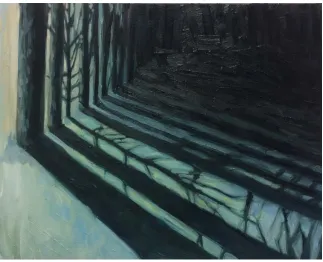
Figure 6: A Dark Path, oil on canvas, 20”x16”, 2016
The foreground of this painting, where light shines through the trees, contains soft brushwork
and as the eye recedes into the background, where more and more darkness fills the image, the
brushwork becomes denser. The dense brushwork in the emptiness creates shapes and movement
in an otherwise blank area. This creates more mystery in those spaces.
For my paintings, I switched from using acrylic to oil paints because it improved my
surface quality. My acrylic surface was very flat and matte and with the use of oil I was able to
address those issues. My paintings have improved with a textured surface and density that oil
paints assist in expressing the ominous theme of my paintings. The edges are thick and are
primarily painted black, which makes the paintings appear heavy and moody. There is a large
range of sizes from 11”x14” to 48”x48”. This allows for an array of pricing and sale options, but
it also changes the way a piece is interpreted. The larger paintings create more of a setting,
whereas the smaller ones are more intimate. Once I have an idea of what I want to depict, I
freeing, so the smaller pieces sometimes allow for me to be more experimental. Ultimately, the
materials I use are chosen in order to enhance the dramatic moods of my paintings, making them
The Wilderness
As the sun disappears, the darkness can have a strange effect on the senses. The sounds I
hear of wildlife moving around in the darkness can lead my imagination to the worst
conclusions. As 17th century explorer, Hermann von Wissmann, describes the forest, “Be it
imagination, be it excitement of the nerves, the slightest sound which at night interrupts the deep
quiet seems to startle you.”6 When I rely on senses other than sight, the fluttering of birds
becomes frightening bats and a rustle in the bushes becomes a predator stalking me. At this time,
I have the knowledge that all other animals have senses far more adept to the environment than
me, which leaves me at a disadvantage. The wilderness makes me feel alive and human because I
am confronted with my own impermanence and that threat is always more prevalent in the
darkness.
This “excitement of the nerves” when in the wilderness is what I try to articulate in my
artworks.7 The dark areas of my paintings lead the viewer into the environment that I create, and
often form a pathway. In The Road Home a dark pathway is illuminated by a mysterious light.
6Hermann von Wissmann quoted by Alexander Porteous, The Forest: In Folklore and Mythology, Dover
Publications, Inc., Mineola, NY, 2002, 16.
Figure 7: The Road Home, oil on canvas, 24”x30”, 2015
Many of my landscape paintings are an invitation on an uncertain journey. The pathways I
describe are often covered in branches and dark, but for some, it may seem alluring. This journey
may lead to a haven or to danger, which one is either escaping or heading towards.
Although many of my artworks may appear foreboding or sinister I have a deep affection,
respect, and appreciation for the wilderness. After losing my home to hurricane Katrina I moved
to the deep country for a year. It was a place where sunsets have never been so vivid and the
land, never so vast. For the first time, I lived in an area where there was nothing but wilderness
across the horizon, from edge to edge. Having grown up in an industrial town, this rural place
was very foreign to me. It soon became a haven. For me, there was no better therapy than taking
a walk amongst the trees, and that is what I did every day. The wilderness got me through one of
the hardest times of my life, in which I was separated from everything I had come to know.
The Romantics
There is nothing like creating an image from an empty canvas. The act of painting is very
meditative and therapeutic, as is walking through the forest. They are both places to think or to
find freedom from thoughts. I chose to primarily concentrate in painting because other painters
inspire me, especially landscape painters. I enjoy paintings in which the setting is the subject.
The reverence that I feel when in nature is something I share with the artists, William
Turner and Caspar David Friedrich. There is a duality in their paintings between the terror and
the beauty of the wilderness. The Romantic landscape paintings of the 18th century are often
described as sublime. Art theorist Edmund Burke defines sublime as, “experiences which supply
a kind of thrill or shudder of perverse pleasure, mixing fear and delight.”8 sublime artworks of
the time usually portrayed a moment of awe over the overwhelming qualities of nature. For
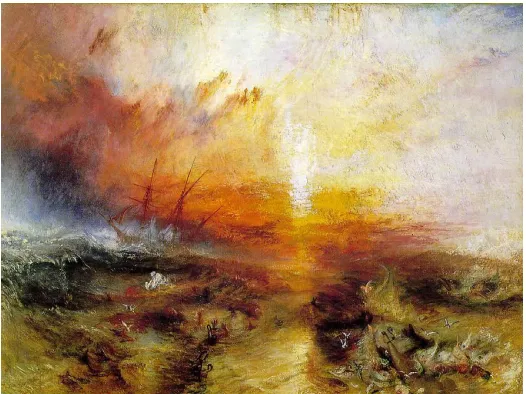
instance, In William Turner’s Slavers Throwing Overboard the Dead and Dying, he uses the
landscape to tell the story.
Figure 8: William Turner, Slavers throwing overboard the Dead and Dying - Typhoon coming on ("The Slave Ship"),oil on canvas, 90.8 x 122.6 cm, Museum of Fine Arts, Boston,1840
8 Edmund Burke quoted by Simon Morley, The Sublime, The MIT Press, Cambridge, Massachusetts,
The overwhelming waves of the water and the bright light of the sun take over the image. The
drama of what is happening on the boat is expressed through the landscape.
I would not describe my artworks as sublime because my artworks are not as epic and
grand as those from the Romantic era. The wilderness in my artworks is not overbearing and can
sometimes be inviting. The connection that I have with this era is that the wilderness is the
subject matter and it has its own energy, often an ominous one. In Caspar David Friedrich’s
Abbey in Oakwood, he painted a bleak forest that contains a haze of light above.
Figure 9: Caspar David Friedrich, Abbey In Oakwood, oil on canvas, 43.3”x67.3”, Alte Nationalgalerie, Berlin,1809
Darkness is either approaching or receding. I would imagine this as a moment that someone
would stop and take in their surroundings. These artists painted not only a faithful rendering of
the landscape, but also something more vehement. They exaggerated the landscape, turning it
Circle of Life
The Romantic era was a time of scientific discovery when Naturalists were finding
parallels among the animal, mineral, and vegetable kingdoms.9 This inquiry can also be found in
my artworks, in the theme that I describe as the circle of life. In Cosmic, I used skeletal imagery
of plants and animals in hopes to relate the connection of all living organisms.
Figure10: Cosmic, Ink and acrylic on paper, 30”x 30”, 2015
In this ink painting, I explored the similarities in structure of the branching in the veins of leaves
to the branching of animal bones. I also took inspiration from photographs of galaxies, because
the connections of life are boundless. As astrophysicist Neil Degrasse Tyson often states, we are
all made of “star-stuff.”10 The same elements of life are found throughout the galaxy.
I take inspiration from the contemporary artist Lee Deigaard, especially in her series of
ink drawings of trees. She compared the veining of trees and leaves to human anatomy, as she
states, “The fractal attenuation of trunks to twigs parallels the circulatory systems of humans and
of rivers.”11 Like Deigaard, I also make connections between animal and botanical anatomies. I
often make comparisons between bone and tree structures. The branches that I paint can be
bone-like in their whiteness and I also create skeletal sculptures out of tree parts. Deigaard’s
comparisons exemplify my interests in the spiritual and scientific connections that all matter
shares.
My interest in the bonds of the natural world stem from my experience as a tour guide at
the animal preservation, Global Wildlife Center. While there, I closely observed the seasonal
changes of its 4,000 animals for several years. The deer especially have distinct seasons such as,
mating in the fall, when all the antlers lose their velvet and the deer fight all day, getting fat and
fluffy for the winter, and then birthing season in the spring. I watched as animals died and new
ones were born, year round. This experience influenced my artworks in which I explore, in part,
the circle of life. This is best exemplified in my sculptures. I use twigs, vines and tree bark,
collected from the forests that I like to spend time in, and I configure them to look like animal
bones. For me, these sculptures represent the symbiotic relationship that animals share with the
Earth. We need Earthly elements to survive and when we die, our remains feed the elements. In
10Neil deGrasse Tyson, Cosmos: A Spacetime Odyssey, “The Lost Worlds of Planet
Earth.” Episode 9, Directed by Brannon Braga and Ann Druyan, Written by Ann Druyan and Steven Soter, National Geographic, March 9, 2014.
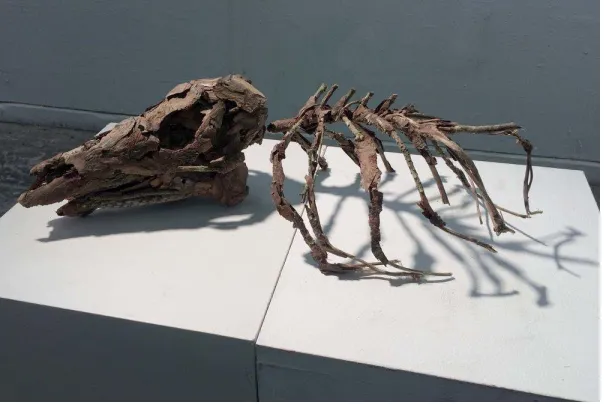
Zero I collected the bark and branches that had fallen to the ground of the woods near my house
and sculpted the remains of an unknown animal.
Figure 11: Zero, bark, twigs, and glue, 2016
The head is too big for the body, which makes it even more curious. It is not grounded and looks
as if it is in movement. The repurposing of fallen twigs and leaves also gives the dead and
discarded another existence beyond life.
My initial inspiration for this body of work was Dominique Mazeaud’s The Great
Cleansing of the Rio Grande River, in which she ritualistically returns every month to pick up
litter from the dying river. She made no object, but the action was documented in journals, and
so, the ritual became the art. I began picking up trash around the woods, but I am attached to the
art object. In Tree of Life Incorporated I used trash found in the woods to create a tree that
contains animal parts such as a deer leg which takes the place of a tree root or birds wings that
Figure 12: Tree of Life Incorporated, litter and acrylic, 30”x30”, 2015
I removed the harmful plastics from the wilderness and created something seemingly organic.
Those plastics represent the interruption of the natural symbiotic relationship of animals and
plants. I had considered continuing to create sculptures like this one, but I felt that it was
disconnected from my paintings because it was too literal, whereas my paintings had become
more ambiguous. The biggest inspiration I took from creating this work was the process of
collecting materials. The inspiration for all of my artworks come from the same places around
Mythology
Working at Global Wildlife Center sparked my interest in life cycles, as well as, animal
mythologies. Global houses 32 different species including giraffes, llamas, camels, antelope,
cattle, and deer. Although I learned facts about these animals from a manual, I often took it upon
myself to research them on my own, to find new and interesting information. I especially liked to
research the myths surrounding different animals. For instance, the sika deer, are known to be a
magical deer in Japan because they blend so well into their environment, they are thought to
magically disappear. Because of this special power, some Japanese people will grind up the
antlers and use it for medicinal purposes, although there is no scientific evidence that it has any
value as such.
In many of my artworks I include a hidden animal, usually a deer. In White Stag I painted
a landscape in which a singular white stag is hidden amongst the brush.
This piece is about an encounter I had with a deer in the woods. There was a moment while
staring at the beauty of the deer, staying as quiet as possible as not to frighten it off, that I
realized there is something very predatorial about the way I was behaving. Once the stag is seen,
it cannot be unseen, as is the experience of seeing an animal in the wild. It is bewitching. There
is something magical about deer that mythology has expressed over and over again in stories and
legends, the white stag represents a quest or an impossible journey. The quest for it is often a
metaphor for the search for God.12 The white stag is seen in storytelling as well, in the legends of
King Arthur, The Hobbit, the Lion the Witch and the Wardrobe, and Harry Potter, all stories
which contain a grand and fantastical journey. It is illusive and is usually seen for a split second,
then it is gone.
Many of my artworks contain trees, which also have a great mythological history. The
forest has long been an inspiration of mystery and enchantment. There is a French proverb which
states that “ the forest which always listens, has the secret of every mystery.”13 I believe that
trees have inspired mythology because they are a source of shelter, have prominent seasonal
changes, and that our primate ancestors lived in trees. The forest also awakens the senses, which
gives one the thrill of life. As Joseph Campbell, scholar of comparative mythology, states,
“People say that what we’re all seeking is a meaning for life. I don’t think that’s what we’re
really seeking. I think that what we’re seeking is an experience of being alive, so that our life
experiences on the purely physical plane will have resonances within our own innermost being
12Jessica Dawn Palmer, Animal Wisdom: The Definitive Guide to the Myth,
Folklore and Medicine Power of Animals, London: Thorsons, 2001, 107.
13Alexander Porteous, The Forest: In Folklore and Mythology, Dover Publications, Inc,
and reality, so that we actually feel the rapture of being alive.”14 Those feelings of rapture are
what is experienced directly in nature and is what is being described in mythologies.
Almost every ancient culture has myths which depicts trees as holy or as sinister.
Ancient Greeks attributed trees to Zeus.15 Ancient Scandinavians believed the forest is where
“Wood-Spirits” dwelled, which are fallen angels, like Lucifer.16 The Burmese often built temples
around trees to remind the people that Buddha attained enlightenment while sitting under a
Bodhi tree.17 The world/cosmic tree is a symbol that spans many cultures including; Norse,
Siberian, Greek, Burmese, and Mesopotamian. It represents the earths connections to both the
heavens (its branches) and to the underworld (its roots).18 All of these cultures no matter how
distanced they were from one another agree on one thing, that trees, and the forest they inhabit,
are a source for spiritual awakening. Reading myths like these make the forest even more
enchanting.
Contemporary artist Kiki Smith has, within recent years, explored myth. She dreams
about birds and has stated, “Birds are stand-ins for souls.”19 She has created sculptures and
drawings of birds, through their life cycles as well as humans, and sometimes human-bird
hybrids.20 She often borrows from Greek and Catholic mythologies as well as folktales like Little
Red Ridding Hood. In her sculpture, Daphne, she depicts the ancient Greek myth, as the nymphs
limbs turn into a tree. While Smiths artwork can take one into the dream-like world of
mythology, the direct representation of mythologies that is sometimes present in her artwork is
14Joseph Campbell, The Power of Myth, Anchor Books: A Division of Random House, Inc., New York,
1991, 1.
15Porteous,149. 16Porteous,148. 17Porteous,153.
18Moyra Caldecott, Myths of the Sacred Tree, Density Books, Vermont, 1993, 5. 19Michael Kimmelman, “The Intuitionist,” The New York Times, Nov. 2006,
not the intention that I have in my artworks. I am interested in the emotions that the natural
environment evoke, that is the inspiration for mythology.
When mythologies describe all of the living beings on earth as enchanted or holy, that
they are more than what meets the eye, it makes the reader give their due respect to them. This is
something that humans have distanced themselves from through the centuries. We are more
enamored with the daily news and gossip than with myth. I look at the pathways I create in my
paintings as the invitation to go on a journey, in the same way that mythology takes the reader on
a spiritual journey. I present the viewer with what I think inspires mythology. It is not to make
the viewer believe in anything other than they already do. It is more of an exercise to remind
myself of how magical the world is, which is easy to forget sometimes. As Joseph Campbell
states,“Nirvana literally means “blown out”; the image is that once one has realized one’s unity
with what is called the Buddha mind – this is the Buddhist conception of Brahman – then one’s
individual ego is extinguished like a candle flame, and one becomes one with the great solar light
. . . But when you get over there, you realize, I was here all the time.”21 Attaining nirvana or
peace does not mean going to some other place, it is here in the mundane, in something as simple
as a tree or its leaves.
Art critic, Suzi Gablik, shares my fascination with myth. She describes the world as
enchanted, “Primitive man’s inclination toward the mythic and the supernatural was not, as
Freud (and others) have claimed, the result of cognitive inferiority, or wish-fulfilling delusions
that we have now outgrown. Rather it was an alternative mode of consciousness that understands
the world in a sacred manner. Because it corresponds to something universal in the collective
unconscious, it remains with us, even though our own cultural response has been to deny and
21Joseph Campbell, Myths of Light: Eastern Metaphors of the Eternal, New World
repress this mode.”22 Her writings relate the spiritual connection of humans to the earth, as she
stresses the importance of myth. To me, mythology is the evidence of human’s ability to dream,
to wonder, and to believe in the improbable.
Natural vs. Artificial
In Gablik’s writings she also stresses the need for humans to regularly connect with
nature. She believes that modern people have lost touch with the wilderness and therefore, have
lost their connection to myth.23 When I first began the graduate program my artwork was
primarily about the loss of connection between people and the natural landscape. I wanted to find
a way to combine the modern world visually with the timelessness of the wilderness. In
Whilrwind I painted from a photograph that I manipulated in Photoshop.
Figure 14: Whirlwind, oil on canvas, 36”x 24”, 2015
I used the obvious swirl effect in Photoshop so that it would be clear that this image had gone
through an unnatural filter. It was not well received. The question was raised as to what was the
point of painting it? Would not presenting the Photoshoped image be more direct? Knowing that
I am a painter, I had to find another way to approach this, with paint. With the help of my
instructors, I decided to focus on my experiences and emotions connected to the landscape and
let go of any symbolic devices I had been using.
Today my paintings, which explore the duality of natural and artificial, are inspired
directly by my experiences. I especially take inspiration from the transitioning light of the
evening time, when the sunlight is dying and artificial lights take its place. In some paintings the
artificial is more subtle, while others portray it directly. The painting Red Light was inspired by a
moment while stopped at a red light in which the trees were illuminated bright red.
Figure 15: Red Light, oil on paper, 12”x12”, 2015
The light source is uncertain in this image. Because the light source is not shown, it could be a
stop light or the sunset, or something more unnatural or mysterious. In Edge of the Forest I
Figure 16: Edge of the Forest, oil on canvas, 24"x30", 2016
There is a wooden streetlight over a gravel road and behind is the forest. I have begun to
incorporate more man made subjects, while still maintaining the wilderness as the subject. I am
exploring the relationship that humans share with nature, and how the wilderness is not often
pristine and untouched by modern inventions.
Contemporary artist, Peter Doig, also investigates the human experience of the modern
landscape. In Concrete Cabin he painted what seems like the fleeting moment of looking at a
building through trees.
The foreground is covered by trees, who’s organic lines greatly contrast with the geometric
building complex, which peaks out between their branches. This contrast between man-made and
organic is seen in my painting, Industrial Park, where trees create a vignette around the image,
surrounding the center, that contains the metal siding of a building. My visual articulation of
man-made inventions revolve around light.
Light
Light is a symbol of the divine. The earliest humans worshipped sun and fire gods. Light
is often associated with enlightenment and revelation, because it reveals the world around us. In
my artwork, I use light as a symbol for a spiritual presence. I use it in small concentrated areas or
I use it overbearingly to where the landscape is obliterated by either light or darkness. In White
Light over half of the image has been taken over by a white light, as tree trunks, surrounded by a
red glow, are aligned in the bottom portion.
Figure 19: White Light, oil on canvas, 24”x24”, 2016
It is as if the viewer steps outdoors for the first time in hours and is blinded by the sunlight. The
obliteration of vision by either light or darkness is a tool I employ in my paintings to convey
My photography also explores light. My initial intentions in using photography, were to
capture moments of the landscape when time and place are lost to me. In You’re Not Alone Out
Here I captured a lovely moment when the sun was setting in the swamp.
Figure 20: You’re Not Alone Out Here, 2014
The sun created an orb-like presence that looks as if it is standing amongst the trees. This
photograph sparked my interest in lens flares because of the mysterious presence that they create.
The spirituality that I feel in the wilderness is visually manifested in the orb of light, which itself
creates a presence.
In the quest to depict spirituality in the environment, I created orbs of light in my
photographs to act as a symbol for a divine or mysterious presence.We are quick to disregard
spirit orbs in photography because there is a long history of trickery associated with them and
simple explanations, such as lens flares and dust, to explain their occurrence. The fact that it is
fascinated that there are people who believe in spirit orbs, as I imagine what that would mean if
they were real.
In the late 19th century the accidental discovery of double exposures opened a new
market for photographers to trick people by inserting images of passed loved ones, as
exemplified in S.W. Fallis’s, “Spirit”.24
Figure 21: S.W. Fallis, Spirit, 1901
It caused great scandal. Photographers were arrested for swindling those in mourning.25
Photography was expected to capture the truth, a record of real events, so people believed the
double exposures were the ghost of their loved ones standing beside them. Even today,
accidental double exposures, or dust and reflected light can alter an image, which can lead some
into believing that there was an invisible presence that only the camera could capture.
24Louis Kaplan. The Strange Case of William Mumler, Spirit Photographer, University of Minnesota
Press, 2008, 10.
Today spirit orbs are one of the many occurrences attributed to capturing the supernatural
on camera. Spirit orbs were introduced to me when a friend of mine showed me pictures of her
trip to a famous haunted plantation. There were pictures of open fields and dusty interior spaces
with orbs of light seemingly floating around, which she believed to be evidence of ghosts. In my
photograph Orb I created a spirit orb by using a spray bottle and the flash of the camera.
Figure 22: Orb, 2015
It is completely staged in the same way spirit photography was. Although, historically
photography has been used to record true events, in this era of Photoshop, images are always in
question of their reality. That is why I have no problem with creating a staged image. It is not
about presenting something false to get the viewer to believe in. It is about expanding ones mind
into contemplating and questioning the existence of paranormal or spiritual presences.
Contemporary artist, Susan Hiller, shares my interest in how irrational phenomenon, like
orbs, have stood the test of time. She also explores topics, such as, levitation, auras, telekinesis,
contact from around the world.26 She does not necessarily require the viewer to believe in alien
contact, rather asks, what might the belief signify and how might it be understood?27 Hiller said
that she is “making work that increasingly puts the viewer where I am, in this situation of
undecidableness”.28 I share that sentiment. I do not ask anybody else to believe in spirits. I just
want to express that feeling of spiritual awakening that I get when in certain environments. It is
exciting to toy around with the idea that maybe there is more to life than what meets the eye.
Moving forward from this body of work, my photography has changed in the same way
that my paintings have, I have let go of using blatant symbolism and focused on more subtle
ways of communicating a spiritual presence within the wilderness. In Dark Forest the sky has
almost turned black and a single tree is singled out amongst the others.
Figure 23: Dark Forest, 2016
26Richard Grayson. "Susan Hiller." Art Monthly. 2011. Biography in Context. EBSCOhost (accessed
November 17, 2016), 24. 27Grayson, 24.
There is a foreboding quality to the image as if one is being swallowed up, of trees and darkness.
It reminds me of the dark forest in the fairytale Snow White, in which the trees are able to reach
and claw at her. There is a threat of darkness in this image. For me, it represents life cycles
because the space is in transition into darkness. In Stunted I also explore cycles.
Figure 24: Stunted, 2016
The foreground consists of a row of trees that have been chopped down, for unseen cables above.
They visually line up with the fully grown trees in the background. Together the foreground and
background create an almost half alive and dead forest.
Lately I have been incorporating more artificial light in my photography. It is a practice
that started when I was creating orbs and curious light flares in my earlier works, but now my
work is more about the modern experience of the landscape. I enjoy the duality between the
natural and artificial lights. Because natural light has always had correlation with the divinity, the
artificial light for me represents the modern deity of technology. I use flashlights, headlights, and
photographed a small crepe and myrtle from a Chuck E Cheese parking lot, which was lit up by
the headlights of my car.
Figure 25: Limbs, 2015
This mundane space was completely transformed by the light, turning a simple tree into
something ghostly and bone-like.
My photography often informs my paintings and visa versa. In Forest Floor I used a
flashlight centered on a pile of branches and vines.
The human footprint is obvious through the light source, yet the image still provokes an ominous
expression, as if there is something more foreboding there than meets the eye. This photograph
was inspired by an earlier painting I made, titled Spotlight , which recounted time I spent in the
woods at dusk.
Conclusion
The time that I have spent at UNO has prepared me for a professional life as an artist.
When starting out in this program I had many doubts in myself and knew vaguely what my
identity as an artist was. With the help of my instructors I feel quite the opposite now. My
artwork has gone from being literal interpretations, relying on symbolic devices to something
more emotional, personal, and poetic. The overall themes of myth, circle of life, light, and the
Bibliography
Amstutz, Nina. "Caspar David Friedrich and the Anatomy of Nature." Art History
37, no. 3 (June 2014): 454-481.
Caldecott, Moyra. Myths of the Sacred Tree. Density Books. Vermont. 1993.
Campbell,Joseph. Myths of Light: Eastern Metaphors of the Eternal. New World
Library. Novato, California. 2003.
Campbell, Joseph with Moyers, Bill. The Power of Myth. Anchor Books: A Division of
Random House, Inc. New York. 1991.
deGrasse Tyson, Neil. Cosmos: A Spacetime Odyssey. “The Lost Worlds of Planet
Earth.” Episode 9. Directed by Braga, Brannon and Druyan, Ann. Written by Druyan,
Ann and Soter, Steven. National Geographic, March 9, 2014.
Deigaard, Lee. “Trees.” http://leedeigaard.com/writing-trees/. (accessed October 10,
2016).
Deris, Rachel Jones. “Artist Statement.” http://racheljonesderis.com/news.html. (accessed
October 10, 2016).
Gablik, Suzi. The Reenchantment of Art. n.p.: [New York, N.Y.] : Thames and
Hudson, 1991.
Grayson, Richard. "Susan Hiller." Art Monthly, 2011., 24, Biography in Context,
EBSCOhost (accessed November 17, 2016).
Kaplan, Louis. The Strange Case of William Mumler, Spirit Photographer. University of
Kimmelman, Michael. “The Intuitionist.” The New York Times. Nov. 2006.
http://www.nytimes.com/2006/11/05/magazine/05kiki.html. (accessed November 25,
2016).
Long, Robert. “Ross Bleckner: Artist Of Light And Form.”
http://easthamptonstar.com/Archive/2/Ross-Bleckner-Artist-Light-And-Form,1998.
(accessed November 3, 2016).
Lovecraft, H.P with an introduction by Jeffrey Andrew Weistock. The Other Gods and
More Unearthly Tales. Barnes and Nobel Inc. New York, N.Y. 2010.
Morley, Simon. The Sublime: Documents of Contemporary Art. MIT Press.
Cambridge, Massachusetts. 2010.
Palmer, Jessica Dawn. Animal Wisdom: The Definitive Guide to the Myth,
Folklore and Medicine Power of Animals. London: Thorsons, 2001.
Porteous, Alexander. The Forest: In Folklore and Mythology. Dover Publications, Inc.
Vita
Dana DeNoux graduated cum laude with a BFA from Southeastern Louisiana University.
She was employed as a gallery assistant at Southeastern Louisiana University Contemporary Art
Gallery and is currently working as a costume designer and fabricator for Artistic Creations.