
The effect of increase in task cognitive complexity on Iranian EFL learners’
accuracy and linguistic complexity: A test of Robinson’s Cognition Hypothesis
Hassan Soleimani
(Assistant Professor, Payame Noor University, Tehran, Iran) Corresponding author’s email: [email protected] Maryam Rezazadeh
(Payame Noor University, Tehran, Iran)
(Received: 19.05.2013, Accepted: 29.08.2013)
Abstract
Designing a task with a reasonable level of cognitive complexity has always been important for syllabus designers, teachers, as well as researchers. This is because task manipulation may lead to different results in oral production. The present study was an attempt to explore the effect of this manipulation - based on Robinson’s resource-directing model (reasoning demands, number of elements, and here and now versus there and then condition) - on picture narration. The study included 30 Iranian EFL learners at the intermediate level between the ages of 21 and 34. They were all native speakers of Persian. Each participant was required to perform the simple version as well as the complex version of the same picture narration task. The participants’ speechwas audio-recorded and the results revealed that an increase in task cognitive complexity leads to greater accuracy and linguistic complexity.
Keywords: complexity, accuracy, task, EFL learners, cognitive complexity
Introduction
For many years, researchers have been eager to find out whether different levels of task structure and cognitive complexity have any noticeable impact on learners’ oral production. This subject has always been controversial since the degree to adjust the task, according to learners’ ability, has always attracted the researchers’ attention. There is general consensus on the claim that planning and other factors such as cognitive complexity of the task might have crucial impact on oral production (Ahmadian, 2012; Ahmadian&Tavakoli, 2011; Ellis, 2000; Skehan & Foster, 1996; Wendel, 1997; Ellis 2003).
production in terms of accuracy and linguistic complexity. Therefore, the use of task-based programs will be open to more research (Skehan, 1998).
According to Revesz (2011), task complexity can affect attentional allocation and the focus on second language (L2) constructions during task performance, and this can influence the quality of learning. However, there were some inconsistencies among the findings of applied linguistics regarding the impact of task type on accuracy and linguistic complexity. To bridge the gap and to understand the importance of selecting appropriate tasks, it is necessary to conduct more studies in the field.
Literature review
Since 1980, second language acquisition (SLA) researchers have been interested to explore the impact of task cognitive complexity on oral production. A clear understanding of the load of cognitive demands on participants can help material producers to design appropriate tasks for learners. Hence, tasks’ management is a crucial basis for communicative language syllabus.
Skehen’s model of task complexity
To Skehan (1998), three factors are associated with task difficulty: code complexity (the syntactic and lexical difficulty of input), cognitive complexity (the processing demands of the tasks), and communicative stress (time pressure and the modality demand). These factors can produce different demands, and therefore can influence the quality of learners’ performance (Taguchi, 2007).
Another factor included in Skehan’s model is planning time. Previous research has explored the effect of planning time on L2 output. Planning time would help learners to
produce more accurate as well as greater level of lexical complexity. However, in case of accuracy, results could be different. Some studies showed that certain task types may lead to more accurate speech while others proved that task condition is an influential factor which determines the degree of accuracy. Skehan (1998), as reiterated in Iwashita, McNamara, and Elder (2001), believes that different numbers of factors have impact on task difficulty. To him, task dimensions such as abstractness and familiarity of task information can influence the difficulty of the task. He maintains that performance conditions (e.g., concrete vs. abstract information) play a crucial role in determining the level of task difficulty.
Iwashita, McNamara, and Elder’s task dimensions
According to Iwashita et al. (2001), Skehan’s framework was encouraging; however, some aspects of the framework were questionable such as: (1) the notion of difficulty, (2) assessing the candidate’s performance, (3) inconsistent results, and (4) the complexity of task performance. Iwashita et al. (2001) consider four dimensions for narrative tasks, with two different performance conditions (+ or -). These task dimensions and performance conditions are defined as follows:
Perspective: When a story is told as if it happened to the participant, more accurate but less complex response is produced. However, telling the story from others’ viewpoint will make a task more difficult and the result would be different.
there-and-then condition are cognitively more complex than those referring to here-and- now condition. Iwashita et al. (2001) associate this complexity with more complex syntax and multi-propositional utterances.
Adequacy: Using a complete set of pictures while narrating (- condition) would make a task less difficult; in this case learners would produce more accurate, but less complex sentences. On the other hand, if some pictures are missing, the result would be opposite.
Planning time:Considering an appropriate planning time in narrative task would make learners’ oral production more accurate. However, narrating without considering the time limitation may lead to some mistakes in learners’ oral production.
Robinson’s task complexity dimension
Robinson’s (2005) cognition hypothesis
could be the most prominent model which was devised to examine the impact of increase in task cognitive complexity on oral production. According to Robinson (2005), the cognition hypothesis reveals that more difficult tasks may produce L2 production with more accuracy and more linguistic complexity. Based on the hypothesis, complex tasks produce interactional processes such as corrective feedback and noticing of input. He believes that researchers need to determine what differences L2 tasks, with different levels of complexity, make to learners’ performance, so that they can sequence and grade the tasks on a proper basis.
When learners perform more than one task at the same time, they actually experience a real world situation; in this case, task complexity is increased along resource-dispersing dimensions. On the other hand, increasing task complexity along resource-directing dimension (e.g., asking for
justification) can motivate learners to use specific L2 constructions. Resource-directing variables of task complexity demand a great deal of attention and working memory, and make learners focus on linguistic forms. Some examples of resource-directing factors are: [± few elements], [±here and now], and [±reasoning]. The low complexity conditions include [+ few elements], [+ here and now], and [- reasoning] and the high complexity conditions are associated with [- few element], [-here and now], and [+reasoning] (Robinson, 2001; 2005). According to Robinson, learners’ attention can be diverted over many L2 elements when the task complexity is increased along recourse-dispersing dimensions. Some examples of resource-dispersing factors include: [± planning], [±single task], and [± prior knowledge]. The low complexity conditions are [+planning], [+single task], and [+prior knowledge] while the high complexity conditions include [-planning], [-single task], and [-prior knowledge] (Robinson, 2005). The cognition hypothesis proves that when we increase the cognitive complexity of the task, learners show more accurate, but less fluent language. Furthermore, in more complex tasks, interactional processes such as noticing and corrective feedback are noticeable (Kim, 2009).
This study was an attempt to explore the extent to which cognitive complexity in tasks could have an effect on Iranian EFL learners’ oral production. To identify the relations, contradictions, and gaps in the literature, the following research questions were formulated to check the aim of the study:
Iranian EFL learners’ oral production?
2. Does increase in task cognitive complexity affect the linguistic complexity of Iranian EFL learners’ oral production?
Methodology
This quasi-experimental research drew preliminary on Robinson’s cognition hypothesis which was a foundation for investigating the impact of cognitive complexity on the aspects of oral performance such as accuracy and linguistic complexity.
Participants
The participants in this study were 30 students at the intermediate level between the ages of 21 to 34. They were all female students studying general English at Kish Institute in Tehran, Iran. The participants were all native speakers of Persian, and on average they had been studying English for three years. Based on non-random sampling, the participants were selected from two intact classes, with 15 participants in each. A version of Test of English as a Foreign Language (TOEFL) was administrated to assure the homogeneity of the participants in the study.
Materials
Testing materials
In order to evaluate learners’ oral production, two tests were used by the researchers: speaking tests from TOEFL IBT book by McGraw (2006) for checking the homogeneity of the participants, and a post-test with the aim of measuring and comparing oral skill of the two groups.
Teaching materials
For teaching materials and treatment, some narrative tasks were selected from English Result by Hancock and McDonald (2012)
with tasks and the exercises designed for intermediate level. The teacher and the researchers agreed that the tasks in this book were appropriate for the aim of the treatment because the content of the book covered both simple as well as complex tasks which could be suitable for assessing learners’ oral skills according to resource-directing elements.
Data collection and procedure
The data in this study drew mostly from the participants’ oral production which was in the form of picture narration tasks. All the necessary data were collected during one of the students’ regular term. The classes lasted two hours, and two experimental groups participated in this study. For the aim of the study, three elements of Robinson’s resource-directing model, +/- few elements, +/- reasoning demand, and +/- here and now condition, were checked along accuracy and linguistic complexity.
To ensure that the tasks’ design manipulation was appropriate for the purpose of the study, two raters, experienced English teachers, cooperated with the researchers in estimating the level of cognitive complexity of the tasks. For each element of this model, the participants were asked to perform two versions of the same task (+ condition and – condition). Hence, six sources of data were analyzed to answer the two research questions.
Checking homogeneity
of their general language proficiency. The mean scores for the two groups were 17.66 and 17.31 respectively which point to homogeneity of the two groups.
Treatment. The treatment plan for the first experimental group included working on more difficult tasks (see Appendix A). These tasks demanded more causal reasoning as well as justification for the replies. The practice plan for these participants included all the aspects which were aimed at the post-test such as +/- reasoning demand, +/- few elements, and here and now vs. there and then condition. For the reasoning demand aspect of the task, two sets of pictures were selected, one with correct order and the other with scrambled pictures. For checking the impact of number of elements on learners’ oral production, the researchers asked the participants to narrate the story once with 9 pictures and the other time with 6 pictures (the three last pictures were omitted).
For the last aspect of Robinson’s (2001) resource-directing model, here and now vs. there and then condition, the participants were first required to tell the story with pictures in front of them. Next, the participants were asked to turn the picture strips over before beginning their narration. For both narrations, the participants were given prompts and instruction. For each dimension, two conditions (+ condition and – condition) were needed to be tested, so all the participants in both experimental groups were supposed to Perform six tasks. Table 2 illustrates a brief description of test tasks based on Robinson’s model. The participants in the second experimental
group were exposed to simpler tasks in the form of picture narration (see Appendix B). For the simpler task, a set of four pictures were selected with a topic familiar to the participants, and the task did not require causal reasoning, justification of beliefs, or any kind of interpretation.
Post Test. The post-test was administered one week after the treatment. The researchers preferred a monologic picture description task to elicit participants’ oral performance (see Appendix C).
As mentioned earlier, each group performed two versions of the same narrative task: a simple and a complex version. The participants had three minutes to read the instructions, take note, and prepare their answers.
Therefore, the three mentioned dimensions in Robinson’s resource-directing model, [± few elements], [±here and now], and [±reasoning], were examined in the study. As Table 1 shows, the low complexity conditions include [+ few elements], [+ here and now], and [- reasoning] while the high complexity conditions are few element], [-here and now], and [+reasoning].
Table 1: Robinson’s resource-directingdimensions
Task Complexity Description in Picture
(Cognitive Factors) Narration Tasks
+/-Few elements More picture(-few elements) vs.
fewer pictures (+few elements)
+/-here-and-now narrate without the pictures (-here and now) vs. narrate with the pictures (+here and now)
+/-reasoning pictures presented in an demands Order (-reasoning) vs.
scrambled pictures (+reasoning)
Table 2: Description of test tasks considering Robinson’s model
Task1 Task2 Task3 Task4 Task5 Task6
Task Picture PicturePicturePicturePicturepicture
type narration narrationnarrationnarrationnarrationnarration
Complexity -reasoning +reasoning –few +few +here& - here &
Factor elements elements now now
Complexity simple complex complex simple simple complex Level
Rating Scale. To measure participants’ oral production in terms of accuracy and linguistic complexity in the post-test, an analytic rating scale proposed by Iwashita et al. (2001) was chosen. In this rating scale, linguistic control as well as managing forms and grammar are among the most prominent factors while assessing accuracy. Based on Iwashita et al. (2001), attempting a variety of verb forms (e.g., passive, modals, and tense), taking grammatical risks in order to express complex meaning, and using coordination and subordination to transfer ideas were the basis for checking linguistic complexity.
Results
The results of MANOVA are presented in two subcategories: The impact of the increase in task cognitive complexity on accuracy and linguistic complexity.
The impact of the increase in task cognitive complexity on accuracy
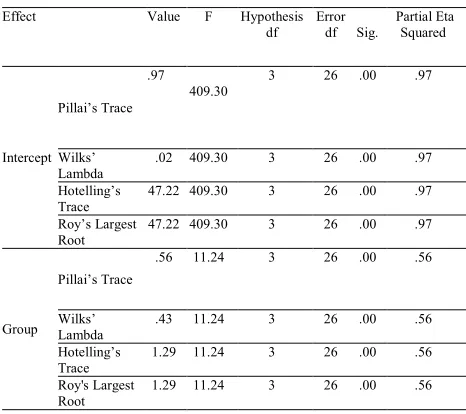
This part depicts the analysis and findings for the first research question: Does increase in task cognitive complexity affect the accuracy of learners’ oral production? Based on the outcome of MANOVA, the two experimental groups’ means were compared on the three accuracy tests (the elements of Robinson’s model). According to Table 3, the following results were obtained:
F (3, 36) = 11.24, p = .00, and Partial η2 = .56.
As the Table reveals, the F-observed value calculated for the effect of the difficulty level on the students’ overall accuracy in oral production was statistically significant.
Table 3: Multivariate tests for total accuracy by groups
Effect Value F Hypothesis
df Error df Sig. Partial Eta Squared
Intercept
Pillai’s Trace
.97
409.30 3 26 .00 .97
Wilks’
Lambda .02 409.30 3 26 .00 .97 Hotelling’s
Trace 47.22 409.30 3 26 .00 .97 Roy’s Largest
Root 47.22 409.30 3 26 .00 .97
Group
Pillai’s Trace
.56 11.24 3 26 .00 .56
Wilks’
Lambda .43 11.24 3 26 .00 .56
Hotelling’s Trace
1.29 11.24 3 26 .00 .56
Roy's Largest
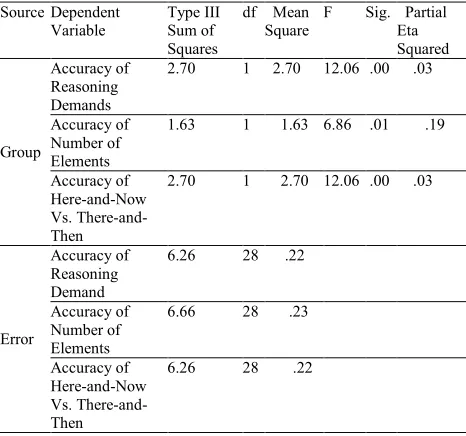
The statistics on the mean score displayed in Table 4 and Table 5 revealed that on average the experimental group 1 (M = 1.93, SD = .65) was more successful than the experimental group 2 (M = 1.33, SD = .57) on the accuracy in tasks checking reasoning demands , F (1, 28) = 12.06, p = .002, and Partial η2 = .30.
Table 4: Descriptive statistics of total accuracy by groups
Table 5: Univariate statistics for accuracy in tasks
Source Dependent Variable
Type III Sum of Squares
df Mean Square
F Sig. Partial Eta Squared Group Accuracy of Reasoning Demands
2.70 1 2.70 12.06 .00 .03
Accuracy of Number of Elements
1.63 1 1.63 6.86 .01 .19
Accuracy of Here-and-Now Vs. There-and-Then
2.70 1 2.70 12.06 .00 .03
Error
Accuracy of Reasoning Demand
6.26 28 .22
Accuracy of Number of Elements
6.66 28 .23
Accuracy of Here-and-Now Vs. There-and-Then
6.26 28 .22
Total
Accuracy of Reasoning Demand
89.00 30
Accuracy of Number of Elements
95.00 30
Accuracy of Here-and-Now Vs. There-and-Then
89.00 30
Since the F-value of 11.24 indicated a significant difference between the experimental group 1 (with difficult tasks) and the experimental group 2 (with easy tasks), the two groups’ performances on the three tasks including reasoning demands, number of elements, and here-and-now vs. there-and-then condition were compared. The results displayed that the experimental group 1 (M=1.93, SD=.50) had higher means than the experimental group 2 (M = 1.46, SD
= .69) on the accuracy tests while checking number of elements. As shown in Table 5, there was a significant difference between the two groups’ means on the accuracy tests as far as the number of elements was concerned, [F (1, 28) = 6.86, p= .00, and Partial η2 = .19].
Accordingly, another MANOVA test was run to check the results of groups’ performance in tasks considering accuracy with two conditions (here-and-now vs. there-and-then). A simple comparison, based on Table 4, demonstrated that the experimental group 1 (M = 1.93, SD = .47) showed greater efficacy than the experimental group 2 (M = 1.33, SD = .55) on the accuracy in tasks checking the mentioned conditions. Furthermore, according to Table 5, there was a large effect size [F (1, 28) = 12.06, p
= .002, and Partial η2 = .30]. In other words, there was a significant difference between the two groups’ performance on the accuracy of here-and-now vs. there-and-then condition.
Dependent Variable
Group Mean Std.
Error 95% Confidence Interval Lower Bound Upper Bound Accuracy of Reasoning Demands Difficult Task
1.93 .12 1.68 2.18
Easy Task
1.33 .12 1.08 1.58
Accuracy of Number of Elements
Difficult Task
1.93 .12 1.67 2.19
Easy Task
1.46 .12 1.20 1.72
Accuracy of Here-and-Now Vs. There-and-Then Difficult Task
1.93 .12 1.68 2.18
Easy Task
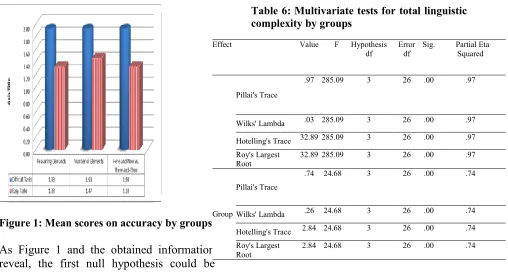
Figure 1: Mean scores on accuracy by groups
As Figure 1 and the obtained information reveal, the first null hypothesis could be rejected.
The impact of the increase in task cognitive complexity on linguistic complexity
In this section, we investigate the findings for the second research question: Does increase in task cognitive complexity affect the linguistic complexity of learners’ oral production?
The results of performing another MANOVA
test indicated that the F-observed value obtained from the students’ performances on overall linguistic complexity was statistically significant [F (3, 36) = 24.68,
p= .00, and partial η2 = .74]. The analysis also specified a large effect size (see Table 6); hence, the second null-hypothesis could be rejected
Table 6: Multivariate tests for total linguistic complexity by groups
Effect Value F Hypothesis df
Error df
Sig. Partial Eta Squared
Pillai's Trace
.97 285.09 3 26 .00 .97
Wilks' Lambda .03 285.09 3 26 .00 .97
Hotelling's Trace 32.89 285.09 3 26 .00 .97
Roy's Largest Root
32.89 285.09 3 26 .00 .97
Group
Pillai's Trace
.74 24.68 3 26 .00 .74
Wilks' Lambda .26 24.68 3 26 .00 .74
Hotelling's Trace 2.84 24.68 3 26 .00 .74
Roy's Largest Root
2.84 24.68 3 26 .00 .74
According to Table 6, the F-value of 24.68 revealed a significant difference between the means on linguistic complexity of oral production; however, the two groups’ performance on the three elements of Robinson’s model was also compared. Based on the descriptive statistics displayed in Table 7 and Table 8, it could be realized that on average the experimental group 1 (M
= 2.06, SD = .60) had better results than the experimental group 2 (M = 1.13, SD = .60) on the linguistic complexity in reasoning demands tasks. Comparing the results in Table 8 proved a large effect size revealing a significant difference between the two groups’ means on linguistic complexity [F (1, 28) = 27.44, P = .00, and Partial η2 = .49].
The data in Table 7 depicted that the experimental group 1 (M = 2.20, SD = .69) outperformed the experimental group 2 (M = 1.06, SD= .68) on linguistic complexity while performing tasks with different number of elements. According to Table 8, there was a large effect size [F (1, 28) = 36.78, p = .00, and Partial η2 = .56]. The
Reaso
ning ElemeFew nts
Here- and-Now Difficult
Tasks 1.93 1.93 1.93 Easy
Tasks 1.33 1.47 1.33
Ax
is
Tit
data proved a significant difference between the two groups’ means on linguistic complexity in tasks with different number of elements.
Table7: Descriptive statistics for linguistic complexity of tasks by groups
Dependent Variable Group Mean Std. Error 95% Confidence Interval Lower Bound Upper Bound Linguistic complexity of Reasoning Demands Difficult task
2.06 .12 1.80 2.32
Easy task
1.13 .12 .87 1.39
Linguistic complexity of Number of Elements Difficult task
2.20 .13 1.92 2.47
Easy task
1.06 .13 .79 1.33
Linguistic complexity of Here-and-Now Vs. There-and -Then Difficult task
2.06 .14 1.77 2.36
Easy
task 1.53 .14 1.23 1.82
Table 8:Univariate statistics for linguistic complexity of tasks by groups
Source Dependent
Variable Type III Sum of Squares
Df Mean
Square F Sig. Partial Eta Squared Group Linguistic complexity of Reasoning Demands
6.53 1 6.53 27.44 .00 .49
Linguistic complexity of Number of Elements
9.63 1 9.63 36.78 .00 .56
Linguistic complexity of Here-and-Now Vs. There-and-Then
2.13 1 2.13 6.89 .01 .19
Error
Linguistic complexity of Reasoning Demands
6.66 28 .23
Linguistic complexity of Number of Elements
7.33 28 .26
Linguistic complexity of Here-and-Now Vs. There-and-Then
8.66 28 .31
Total
Linguistic complexity of Reasoning Demands
90.00 30
Linguistic complexity of Number of Elements
97.00 30
Linguistic complexity of Here-and-Now Vs. There-and-Then
108.000 30
As displayed in Table 7, on average, the experimental group 1 (M = 2.06, SD = .74) got better scores than the experimental group 2 (M = 1.53, SD = .49) on linguistic complexity on here- and-now vs. there-and-then condition. The obtained data from Table 8, [F (1, 28) = 6.89, p = .01], reveals a significant difference between the two groups’ means on linguistic complexity while performing the tasks in two conditions. Figure 2 supports the statistical information.
Figure 2: Mean scores on linguistic complexity by groups
Discussion
In the case of oral production, adjusting the complexity of the task appears to be one of the prominent aims of syllabus designers because based on different studies such as the ones conducted by Revesz (2011),
Reason
ing ElemenFew ts
Here- and-Now Difficult Tasks 2.07 2.20 2.07
Easy Tasks 1.13 1.07 1.53
Ax
is
Tit
Iwashita, et al. (2001), and Robinson (2005), human beings possess a limited processing capacity and are not capable of attending fully to all aspects of a task. When different aspects of oral production are concerned, an appropriate level of cognitive complexity in tasks would help learners to promote their speaking. This study sought to explore the effects of increase in task cognitive complexity on accuracy and linguistic complexity of Iranian EFL learners’ oral production in narrative tasks.
In general, the results of the study indicated that the group that had exposure to more complex tasks presented more accurate speech with more complex structure. This difference in the outcome was noticeable in all the three aspects of Robinson’s resource-directing model.
The effect of increase in task cognitive complexity on accuracy
The findings revealed that scrambled pictures, designed for checking reasoning demands, resulted in more accurate speech. The major explanation for this difference could be that while telling a story with scrambled pictures, participants tried to rely on their logical concepts in order to put the pictures in the correct order on their own way, and for doing that they needed to get help from their knowledge repertoire. The results concerning accuracy are in line with Skehan’s (1998, as cited in Taguchi, 2007) study. The findings also support the claim of Iwashita et al. (2001) about the effect of complex tasks on directing learners’ attentional resources to forms which can lead them to induce risk avoiding behavior. Robinson (2001; 2005, as cited in Revesz, 2011) also emphasizes the beneficial role of complex tasks on making learners focus on linguistic forms. Besides, Tavakoli’s (2009) cognitive approach
towards language learning supports the findings in this study.
In the case of number of elements, the group that performed the narration task with more pictures outperformed the group that did the task with fewer pictures. This might be because using more pictures while narrating produces more sentences, so participants were concerned with the correct connection in order to make their sentences comprehensive. This made the participants process their speech in their minds before revealing it. This reformulation and consistent monitoring resulted in more accurate speech. The outcome bears out the previous studies conducted by Kim (2009), Iwashita et al. (2001), and Robinson (2001, 2005, as cited in Revesz, 2011).
The study also highlights the findings regarding accuracy while checking here-and-now vs. there-and-then condition. In the case of telling a story with pictures in view (here-and-now), the participants produced less accurate sentences than when they had performed the same task without pictures in front of them (there-and-then). The point is that there-and-then condition (telling the story without pictures) put more burdens on participants’ working memory and the participants paid more attention to the forms before producing their speech, therefore their speech were more accurate. This viewpoint is in accordance with Revesz’s (2011) statement.
The effect of increase in task cognitive complexity on linguistic complexity
to pictures in the correct order. Scrambled pictures made participants process the information in their minds while seeking for some new and more complex structures. Besides, participants were more willing to provide reasons to prove why they put the pictures in that order. This led them to use new and more complex structures; this stance is supported by Robinson’s (2001, 2005, as cited in Revesz, 2011) model. The findings demonstrated that narrating the story with more pictures led to more complex language. This could be due to the use of more complex syntax which was associated with the tendency of using more transitions and coordination conjunctions. Other scholars such as Talmy (2000, as cited in Revesz, 2011) pointed to this impact as well.
As far as here-and-now vs. there-and-then is concerned, it could be realized that in second condition participants tended to remember the events and they relied on their memory to connect the sentences in a coherent way and that led the participants to produce not only more accurate speech but also more complex syntax. This attitude supports Iwashita et al.’s (2001) approach in that more attention to forms and planning of production is due to the greater demands on memory and the attempt to make transition between the events.
Conclusion
Generally, Iranian EFL learners have difficulty producing an accurate speech. To solve this problem, we need a comprehensive insight into methodology in general and designing and adjusting the level of tasks in particular. Based on the findings of the present study, the group that performed more cognitively difficult tasks was more successful in terms of accuracy and linguistic complexity; therefore, the first
and second null hypotheses were rejected. The results confirm the beneficial impact of increasing the task cognitive complexity on speaking, especially in accuracy and linguistic complexity. This in turn can be an acceptance for Robinson’s cognition hypothesis with his emphasis on the promotion of learners’ oral skills along with opting for more challenging tasks. This notion and the previous studies as well as the results of the current research indicate that increasing the difficulty of the task to a reasonable level can be highly effective for learners’ improvement in speaking.
However, there were some limitations in the current study. First, gender differences were not considered in this research; the participants were all females, hence the results may not be generalized to coeducational systems. Second, choosing the non-random sampling method and selecting the participants from intact classes as well as small sample size could have influence on external validity.
Acknowledgment
The present study has been supported by Payame Noor University, Iran.
References
Ahmadian, M. J. (2012). The effects of guided careful online planning on complexity, accuracy, and fluency in intermediate EFL learners’ oral production: The case of English articles. Language Teaching Research, 16, 127– 147.doi:10.1177/1362168811425433 Ahmadian, M. J., &Tavakoli, M. (2011).The
35–
39.doi:10.1177/1362168810383329 Ellis, R. (2000). Task-based research and
language pedagogy.Language Teaching Research, 4(3), 193-220. Ellis, R. (2003). Task-based language
learning and teaching. Oxford: Oxford University Press.
Hancock, M., & McDonald, N. (2012).
English result. Oxford: Oxford University Press.
Iwashita, N., McNamara, T., & Elder, C. (2001). Can we predict task difficulty in an oral proficiency test? Exploring the potential of an information- processing approach to task design.Language Learning, 51(3): 401-436.
Jeon, I. & Hahn, J. (2006).Exploring EFL teachers’ perception of task-based language teaching: A case study of Korean secondary school classroom practice.Asian EFL Journal, 8 (1).Retrieved May, 15, 2013 from
http://www.asian-efl-journal.com/March_06_ijj.php
Kim, Y. (2009). The effect of task complexity on learner-learner interaction.System, 37: 254-268. McGraw, H. (2006). The official guide to the
new TOEFL IBT. New York, NY: Author.
Revesz, A. (2011). Task complexity, focus on L2 construction, and individual
differences: A classroom- based study. Modern Language Journal, 95: 162-181.
Robinson, P. (2001). Task complexity, task difficulty, and task production: exploring interactions in a componential framework. Applied Linguistics, 22, 27–57.doi: 10.1093/applin/22.1.27
Robinson, P. (2005). Cognitive complexity and task sequencing: Studies in a componential framework for second language task design. International Review of Applied Linguistics, 43: 1-32.
Skehan, P. (1998). A cognitive approach to language learning.Oxford: Oxford University Press.
Skehan, P. & Foster.P. (1996).The influence of planning on performance in task-based learning.Studies in Second Language Acquisition, 18, 299-324. Taguchi, P. (2007). Task difficulty in oral
speech act production.Applied Linguistics, 28(1), 113-135.
Tavakoli, P. (2009). Task design and second language performance: The effect of narrative type on learner output.
Language Learning, 56(2), 439-473. Wendel, J. N. (1997). Planning and second
language narrative
Appendix A (For full picture see English Result by Hancock & McDonald, 2012)
Appendix C
![Table 8, [F (1, 28) = 6.89, p = .01], reveals a](https://thumb-us.123doks.com/thumbv2/123dok_us/10123570.1999822/9.612.70.292.405.717/table-f-p-reveals.webp)
