."
DST SEMINAR
Application of Computers to Bibliographical Information Processing: Some Developments in
India (Bangalore) (10-13 July 1978)
PROCESSING OF INIS DATA BASE AT B A R C
N M MALWAD, Library and Information Services, Bhabha Atomic Research Centre, Bombay 400 0 8 5 .
The International Nuclear Information System (INIS) is a computer-based information system working on the principle of maximum decentralisation and minimum centralisation. The participating Member States and international organisations prepare the inputs on a decentralised basis and the inputs so received arc centrally processed and made available as INIS
Atomindex - an indexing and abstracting periodical in the field of nuclear science and technology. As a by
product, the magnetic tapes containing the entries in the periodical are made available to the participants. The Library and Information Services of the Bhabha Atomic Research Centre, Bombay, is the national inputting centre for INIS and receives the IN IS output tapes. These are processed using a DEC-10 computer facility of the
National Centre for Software De,relopment and Computing Techniques (NCSDCT). The computer processing) a basic computer program query formulation technique and
Selective Dissemination of Information (SDI) service are explained. The INIS record format and the processing
record format, which is a fixed length record format, are described. The computer p r o g r a m s , are written in COBOL.
Melwad
0 INTRODUCTION
The International Nuclear Information System (INIS) is a computer-based information system providing biblio-graphic description and abstracts of documents published in the field of nuclear science and technology. It was sponsored by the International Atomic Energy Agency (IAEA), Vienna and started functioning in April 1970. Its first INIS Atomindex - an international indexing and abstracting periodical, was published in May 1970. The unique feature of I M S Is its concept of maximum decentralisation and minimum centralisation. The input preparation which in-cludes the intellectual exercise of identification, selec-tion, categorizaselec-tion, indexing, abstracting and the prepa-ration of bibliographic description in a standardized form of all the documents published in the field of nuclear science and technology within the geographical regions is a decentralised activity. The 69 Member States and inter-national organisations prepare the inputs and send, them to
INIS Processing at FARC 1 DATA BASE CREATION
The INIS data base consists of bibliographic informat-ion and abstracts of documents both conventinformat-ional and
non-conventional, in the field of nuclear science and techno-logy which is an inter-disciplinary subject. It is both authoritative and comprehensive, covering some 70,000 documents per year which is almost 85% of world's liter-ature output in the field. The importance of the INIS data is now increased as the well-known Nuclear Science Abstracts (NSA) ceased publicatior. after serving the nuclear scientific community for a long period i.e.s
from 1948 to June 1976.
The decentralised input preparation activity of the INIS is made possible through various standards on 'what to include' and 'how to include' in the information sys-tem. Thus, the standardized form of submitting input to INIS requires, among others:
(a) definition of the set of data elements used to describe the contents and type of document
(b) the structure of recording; and (c) the coding system.
A completed INIS worksheet (Appendix 1) is a reali-zation of the format used for communication within INIS. Each field of the worksheet consists of two sub-fields:
(i) A tag - data field identifier, and (ii) The content of the data field.
Maiwad
The imposition of several INIS standards on the in-putting centres for input preparation enhances uniformity, consistency and reliability of the data base and makes it possible to use it effectively and economically. The INIS standards which are published as INIS reference series, follow, as far as possible, the international standards and codes developed for information handling, by the Inter-national Standards Organisation (ISO) and the UNISIST
reference manuals. It further adds to make the INIS data base as compatible, accessible and inter-connectable to almost any existing or future International network of information systems operating on multi-data bases.
At the INIS head-quarters, Vienna, the input is . received in one of the following modes:
(a) on INIS worksheet (b) on paper tape (c) on magnetic tape
(d) on Optical Character Recognition sheet
After registration, completeness check and verifi-cation, all the different input form, are converted into magnetic- tape file. There are several computer
INIS Processing at BARC
describes the set of computer programs, the format of various data sets (files), the machine configuration, system flow charts, various error messages and a few significant computer printouts. Here, it may be noted that these programs, though they were developed for a specific task, may be of interest to others in that they present a working solution to the problem of developing a computerized information system, particularly when it is based on the concept of decentralised input prepa-ration.
The computer programs for the INIS input proces-sing were first prepared in 1970. Since then many sys-tems changes have been mader including the introduction
of machine-readable abstracts, alterations in the INIS format, etc. At the same time, significant improvements and extensions' have been made to the computer facilities available to the IAEA, from the earlier IBM 1401 through IBM 360 model 30 to the IBM 370 model 145. 'work has now started within the INIS headquarters to review the exis-ting processing system and prepare a new design which meets both the present and future needs, to the extent that the latter can be identified.
2 THE INIS DATA BASE UTILIZATION
The Library and Information Services of the Bhehha Atomic Research Centre, Bombay, being the national in-putting centre for INIS, receives the INIS output on magnetic tapes. The tapes are received by air mail
Maiwad
The INIS output tapes are of £" width and available as 7-track with density 556 cpi or 9-track with densities 800, 1600 or 2400 cpi.
The INIS data base can be used for
-(a) Literature search on a specific subject cribed using the INIS subject categories, ancVor des-criptors from the INIS Thesaurus.
(b) Selective Dissemination of Information (SDI) service on a continuing basis to nuclear scientists whose subject interests are expressed in terms of descriptors from the INIS thesaurus end combined using the Boolean operators AND, OR, NOT or by assigning weightage to des-criptors.
(c) Bibliographies on specific subjects, authors, etc.
The INIS data base includes index terms (descriptors) and abstracts along with the bibliographic descriptions. of documents and as such can be used for testing and eva-luating various information retrieval strategies. In
short, the INIS data base can be utilised, besides for providing various information services, as research tool having a good deal of research potential in the field of information science and technology,
INIS Processing at BARC
to several Member States. The INI3-IRMS is an extended and improved version of the IBM dev3loped software package called Information Retrieval Management System (IRMS), which can be used for providing various information ser-vices.
The INIS-IRMS software package works under operating system OS on IBM 370 model 145 and upward computer models. As the Library and Information Services, BARC, has no
access to an IBM 370 series computer, the INIS-IRMS is not procured; instead, independent computer programs have been developed. The DEC-10 computer facility of the National Centre for Software Development and Computing
Techniques (NCSDCT) located at the Tata Institute of Funda-mental Research (TIFR) is used for processing the B U S data base. The computer programs are written in COBOL. 'The object of processing the INIS data base is to provide
SDI service primarily to the nuclear scientists of BARC and to extend the service under the NISSAT plan to various individuals, government organisations, universities etc. for their information requirements in the field of nuclear science and technology.
3 THE PROCESSING OF INIS DATA BASE AT BARC
Malwad
additional auxiliary storage capacity and a different set of computer programs for file updating and maintenance and hence will take some more time for implementation.
31 Structure of INIS Data
Base-The INIS output tapes received are in the 'carrier format and the records contained in the file are in accordance with the international standard for biblio-graphic information interchange record format (ISO - Re-commendation 2709) which is similar to the MARC format of the US Library of Congress, with a few changes. This
'carrier format' is intended for exchanging information from INIS, Vienna, with the Member States and other
in-formation centres and it is not suitable or convenient for information processing directly. On the DEC-1C, first the INIS tapes are converted into DEC-10 compatible tapes by checking and decoding each ASCII character into the character codes of the DEC-10. Then the 'carrier format1
is changed into the fixed format records as it is conve-nient to handle on DEC-10.
The program- MINREAD written in COBOL is one of the basic programs to understand the identification, selection and extraction of any required date element from; the INIS records contained in the INIS output tape. The. program listing is given in Appendix 2, which may be useful for those who intend to utilise INIS, AGRIS or any other similar data base.
INIS Processing at BARC
is read in record mode in an area which separates the four numeric characters of block length and the 2044
alpha-numeric characters of the record. These 2044 characters may constitute one or more INIS records. The record con-sists of three logical sections:
(i) Leader
(ii) Directory
(iii) Variable fields
fixed length field of 24 characters
consists of a variable number of fixed length fields, each field being of 12 characters
• ..
bibliographic information variable in length
Schematic Representation
LEADER DIRECTORY VARIABLE FIELDS
All data on the interchange tapes are in character format.
311 Leader
MALWAD
Schematic Representation:
Entry flap
L
i
20 23 312 Directory
The directory consists of a series of fixed fields (entries). There must be one entry in the directory for each variable field. The directory is a table containing a variable number of twelve character entries, terminated by a field separator code.
INIS processing at BARC
(b) Length of the field: a four decimal number, equal to the number of characters or bytes occupied by the data field which corresponds to the directory-entry, including indicators and field separators.
(c) Starting Character Position: a five digit decimal number giving the position of the first character of the data field which corresponds to the directory entry. The position is computed relative to the base address of the data part of the record (i.e., the starting character position of the first data field following the directory is zero).
513 Variable Field
Following the leader and directory, the record con-sists of variable fields or data fields. Each variable field consists of alpha-numeric data followed by record separators. I N I S does not use flags or separators within the fields other than normal punctuation. Thus, an INIS field can, in most cases, be printed without modifications. 32 The Program Details
The 2044 characters of the block are referenced in two ways;
(i) The first 24 characters as leader and the
following characters as multiple number of 12 characters each to give directory - maximum of 100 directory entries are considered.
Malwad
(ii) The entire 2044 characters are referenced cha-racter by chacha-racter,
Such reference is required to test the 'Record Status', to calculate 'Delete Records', to find out the specific contents etc. This approach is achieved in COBOL by using REDEFINES and OCCURS clauses. Of course, for a character-oriented computer, the same can be
achieved in much simpler way.
The entire I M S tape contains bibliographic infor-mation in 'characters', and even the numeric digits are in the character code. Hence, such data items like
'block length', 'record length', 'base length', 'base
address', 'length of field', 'starting character position', etc. have to be changed to the numeric arithmetic
com-putational form as there are arithmetic operations to be performed on them. In COBOL, however, it is a simple technique of moving the data elements into the ele-mentary items defined as arithmetic computational.
The block length and record length are compared to find out whether the record is 'long'-spanning into more than one physical block or 'short'-giving a possibility of containing one or more logical records in the same physical block. The 'flags' are set accordingly, for processing them separately.
INIS Processing at BARC
other records are now checked through the record length and the base address which are the data elements in the leader. The number of fixed field entries in the direc-tory is calculated using the formula:
A - (L + 1)
where, ii is the number of fixed field entries in the directory.
A is the base address - one character next to which is the starting character position of
the variable field in the INIS record. L is the length of the Leader ( = 2k chs). F is the length of fixed field entry in the Directory ( = 12 chs}.
Each entry in the directory gives the tag, the star-ting character position for its content and the length of field. The starting character position is relative and
for the first tag entry, it is 00000, which is in INIS record one character next to the end of directory. Star-ting character position of any tag content can be calcu-lated as;
S = B + (P + 1)
Malwad
B is the base address
P is the starting character position as given in the entry in directory.
With this, it is possible to check for any required tag, extract the corresponding variable information, to locate any desired data element which has been included in the bibliographic description of the document as per the INIS descriptive cataloguing rules.
The long records, whose 'record length' is more than the 'block length' span into several physical blocks and the variable field information has to be located accor-dingly.
321 Fixed Record Length File
Using the logic described in the basic program 'MINREAD', the other programs are written, e.g. a pro-gram to create fixed length records, another to print
output result} etc. The record format for fixed
length INIS records is given in Appendix 3, which, in fact, has a general format as;
Line code (2 Chs)
Data description
INIS Processing at BARC
There can be a maximum of 24 such lines having fixed
record length of 2448 characters. In the record entry,
if data description is not available for a particular line
code, it is filled in with spaces. Of course, this amounts
to some wastage in storage capacity but for fixed length '
records this compromise is required. Mow this kind of a
record can be described conveniently in COBOL as:
01 INIS - REC.
02 BIBLE-LINE OCCURS 24 TIMES.
03 LN-CODE PICTURE XX.
03 LN-DATA PICTURE X(100) .
Knowing what lint code is used for what kind of data
description, the accessing of data elements and their
organisation becomes simple. To organise the fixed
re-cords, necessary data elements are identified and
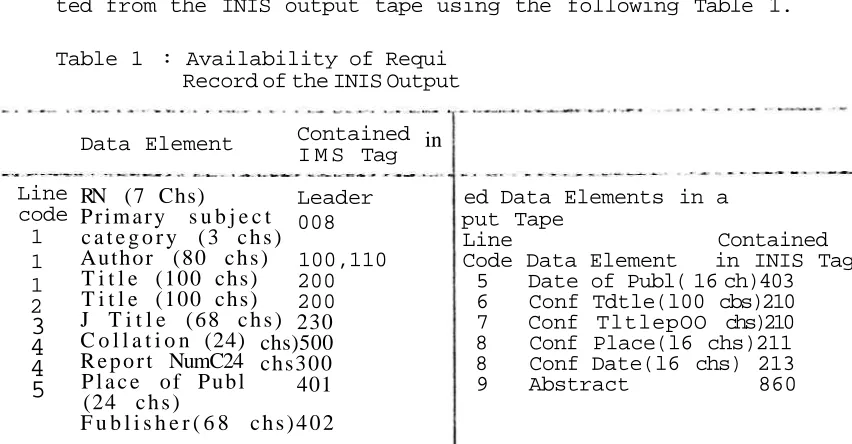
extrac-ted from the INIS output tape using the following Table 1.
Table 1 : Availability of Requi Record of the INIS Output
ed Data Elements in a put Tape
Line Contained Code Data Element in INIS Tag
5 Date of Publ( 16 ch)403 6 Conf Tdtle(l00 cbs)210 7 Conf TltlepOO chs)210 8 Conf Place(l6 chs)211 8 Conf Date(l6 chs) 213
9 Abstract 860 Line code 1 1 1 2 3 4 4 5
Data Element Contained
I M S Tag in
RN (7 Chs)
P r i m a r y s u b j e c t c a t e g o r y ( 3 c h s ) A u t h o r ( 8 0 c h s ) T i t l e (100 c h s ) T i t l e (100 c h s ) J T i t l e ( 6 8 c h s ) C o l l a t i o n (24) R e p o r t NumC24 P l a c e o f P u b l (24 c h s )
F u b l i s h e r ( 6 8 c h s ) 4 0 2
i .alwad
Note: The numbers in parenthesis indicate the field
length in characters. This means only these
many characters appearing first are
consi-dered even if the corresponding data element
has more number of characters.
322 Inverted File
The descriptors are extracted separately from tag
800 and every descriptor is written with the document
number (the INIS R N ) . The file is sorted and inverted
file of descriptors is prepsred. The format of the file
is ,
Descriptor
7 (chs) RK
7 (chs)
RN
7 (chs)
30 RNs in ascending order are grouped in one record.
If there are more than 30 RNs for a descriptor, then
more such records ere created depending on the number of
RNs having assigned the descriptor.
33 Query Cards
The general format of query cards is
Card Columns
Group
No
3 4 Op
Code
9 38 Desciiptor 1
59 68
D e s c r i p t o r 2
74 80
INIS Processing at BARC
The group number codes and their content are as
follows:
Group No Code
OO
01
02 \
X
20 &
91 I
.. J
98 j
Content
user name, designation, address (through columns 9-68)
NOT ^negation) logical operator will follow
AND, OR (conjunction and disjunction) logical operator will follow
Query cards
Final query card
The OF code is the logical operator code which can be
NO for (NOT) negation logical operator
OR for (OR) disjunction logical operator
AD for (AND) conjunction logical operator
Descriptor 1, Descriptor 2:
Two descriptors - checked with I M S thesaurus with
maximum length 30 chs.
Malwad
Identification:
User identification (74-80 card columns, any code .
assigned for the purpose. Query Card
GROUF NO. followed by OP code, followed by 10 earlier group numbers each separated by comma.
Example: a query card such as:
91 OR 02, 05, 06, 19, 20
which means 91 is a group number for query, OR is logical operator for the earlier stated group numbers 02, 05, 05, 19 and 20. Accordingly, if the result of matching the descriptors in one of these groups is positive, the docu-ment will be retrieved. In other words, it is equivalent to an expression such as: (02) OR (05) OR (06) OR (19) OR
(20).
531 Final Query Card
Group number 99 indicates the final query. There can be only one such card in a query. In this card again,
group numbers whose result is found earlier can be used
including the earlier query cards like 91, 95, 98. If 99 card is blank through columns 3 - 6 8 , the result of
Processing at BARC
printed. It may be noted the positive result for NOT
logic is actually negetive answer end will not be printed.
332 A Query Sample
Following is a hypothetical example of a query.
Group No OP 1 00 C1 02 C3 0 4 05 06 0 6 91 92 99 2 3 NO AD OR OR Or; AD Oh OR AD OR Descriptor 1 9 38
DP, VA KAMATH,
MATHEMATICS FRUITS ?ANGOES BANANAS GRAPES RADIATION EFFECTS
0 2 , 0 3 , 0 4 , 0 5 0 3 , 0 4 , 0 5 0 1 , 0 6 92
9 1 , 9 :
D « s c r i p t o r 2
39 68
HEAD, LIB L INF SERV STATISTICS IRRADIATION AIPLES ORANGES GRAPE-FRUITS 0000251 0000251 0000251 0000251 0000251 00C0251 0000251 0000251 0000251 0000251 O0O0251
Q u e r y in n a r r a t i v e form: Dr V A Kamath, Head, Lib & Inf Services, d e s i r e s to have all documents on i r r a d i a t i o n of mangoes or a p p l e s or bananns or oranges or grapes or grape f r u i t s o r f r u i t s , i n g e n e r a l , b u t n e t i f the document a l s o deals with either mathematics or statistcs.
19
Identification
Malwad
4 SDI SERVICE
The user is requested to give his subject interest in narrative form, underlining the subject terms which, he thinks, are important, The concepts are then identi-fied and indexed using the INIS thesaurus. Using the in-dexed terms - descriptors, a query is prepared as illus-trated above. The set of cards punched accordingly is the user profile. This is run against the inverted file of
descriptors using a computer program' to fine the docu-ment numbers which answer the final query positively. The extracted documents are sorted in ascending order and using the fixed record length file, the bibliographic details of the documents in suitable format are printed: The abstracts are included in the bibliographic descrip-tion. The query cards and the number of documents retrie-ved are also printed. The same procedure is repeated for all user profiles. The computer printout is sent to the users requesting for a feedback. On the basis of the feedback received, the user profile is updated.
In the initial stages, the SDI service has beer-limited to the BARC scientists, which will be extended to other government organisations and universities, etc. under the NISSAT plan.
5 SUMMARY
INIS Processing at BARC
Only with experience, it may be possible to find out the missing information.
(2) Only the current file containing some 7000 entries of INIS Atomindex is searched and hence, user by user search may be simple and convenient. But once the retrospective searches are considered, this technique will not be economical.
(5) A critical evaluation of the procedure adopted, the search strategy used etc. is possible after the SDI service is utilised for a year or so by nuclear scientists.
(4) The computer programs written in COBOL for a word-oriented machine have their own advantages and dis-advantages .
6 ACKNOWLEDGEMENT
I am grateful to Dr P K Iyengar, Director, Physics Group, BARC, for his kind permission to present the paper at the Seminar. I am indebted to Dr V A Kamath, Head,
Lib &. Inf Services, BARC, for his valuable guidance in
preparing the paper. 7 REFERENCE
( 1 ) IAEA-INIS-14 (Rev 1) INIS: D e s c r i p t i o n - of c o m p u t e r p r o g r a m s . IAEA, V i e a n n a , 1 9 7 7 .
(2) MALWAD (MN) and KAMATH (VA). P r o b l e m s of c o m p u t e r i s e d information p r o c e s s i n g in I n d i a , J of L i b & I n f Sc
1 ( 1 ) , J u n e 1-76; p p 7 1 - 8 0
Malwad
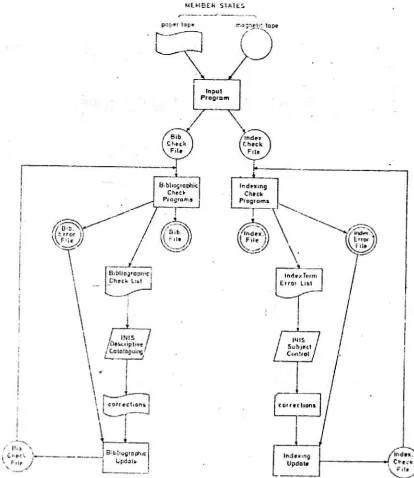
GENERAL ORGANIZATION (PART|)
The high sensitivity and selectivity of radioisotope technique make them a versatile and p o w e r f f u l tool for corrosion
s t u d i e s . Two such techniques have been described. The
Appendix2:Lighting of MINREAD Programme in COBOL
PROGRAM MINREA
LINIS.CBL 06-MAY-78
COBOL 10(370) 6-MAY-78
IDENTIFICATION DIVISION. PROGRAM-ID. MINREAD. REMARKS.
* PROGRAM READS THE INIS OUTPUT TAPE AND + PRINTS THE CONTENT OF EACH TAG.
ENVIRONMENT DIVISION. INPUT-OUTPUT SECTION. FILE-CONTROL.
SELECT INISMP ASSIGN TO DSK. SELECT PRINT-FILE ASSIGN TO DSK. TATA DIVISION.
fILE SECTION.
Fb INSNF VALUE OF ID 'FILE2 A S C LABEL RECORDS ARF STANDARD DATA RECORD IS IN-REC. 01 Itf-REC DISPLAY-7.
02 BL PICTURE 9 ( 4 ) .
0 2 Es-RESl PICTURE X 1 2 0 4 4 ) .
FD P R I M - F I L E VALUE Or IP- " L I S T I N I S F " DATA KECOFiD IS P- RE C.
0 1 P - R L C ,
0 2 F I L L E R PICTURE X ( 1 0 ) .
0 2 P - 7 A C F U T U R E X ( 3 ) . . . . 0 2 F I L L E D PICTURE X ( 4 ) „
0 2 P-DATA PICTURE X ( 1 0 0 ) .
0. FILLER PICTURE X ( 1 6 ) . x
WORKING STORAGE SECTION.
77 LI PICTURE 9(8) COMP-3 VALUE 0.
77 W B L P I C T U R E 9 ( 8 ) C O M P - 3 V A L U E 0 . 77 VT P I C T U R E 9 ( 8 ) C O M P - 3 V A L U E 0.
77 CHAR-COUKT PICTURE 9(5) COMP-3 VALUE 0. 77 NUM-CHAR PICTURE 9 (B) COMP-3 VALUE 0. 77 NP PICTURE S(6) COMP-3 VALUE 0.
77 ACTUAL-CKAR-POS PICTURE 9(8) COMP-3 VALUE 0. 01 W-REC.
0? UDD.
03 WWD occurs 100 T I M E S .
04 WD P I C T U R E X.
0 2 W P D R E D E F I N E S W D D P I C T U R E X ( 1 0 0 ) .
* * * * * * * * * * * * * * * * * * * * * * * * * * * * * * * * * * * * * * * * * * * * * * * * * * * * * * * * * * * * * * *
AREA FOR A 1NIS R E C O R D P I W I N - R E C .
02 WIN-REC-REST. 03 LEADER
04 RLENC- PICTURE 9 C 5) . 04 RSI PICTURE X.
04 R T Y P B I C T U R E X. IV, RBL P I C T U R E X, 04 F I L L E R P I C T U R E X X . C«'i RIC PICTURE X. 04 KDEL PICTURE X. 04 RBAD PICTURE 9(5). 04 FILLER PICTURE X(3). 0 4 E N T M P I C T U R E X ( 4 ) .
03 IN-DIRfcCTORY, 0 4 DIRY O C C U R S 100 T I M E S .
05 D T A G P I C T U R E X(3) . 0 5 f L E N G P I C T U R E 9 ( 4 ) . 0 5 FPOS P I C T U R E 9 ( 5 ) . 0 3 VFLD P I C T U R E X ( 8 2 9 ) .
* TO R E F E R THE A B O V E R E C O R D C H A R A C T E R BY C H A R A C T E R 0 2 C H F L D R E D F F I N E S H I N - R E C - R E S T .
03 CHS O C C U R S 2048 TIME 3 P I C T U R E X.
• i t * * * * * * * * * * * * * * * * * * * * * - * * - * * * * * * * * * * * * * * * * * * * * * * * * * * * * * * * * * * * * * *
P R O C E D U R E D I V I S I O N . O P E N - R T N .
HOVE SPACES TO WPD.
MOVE SPACES TO P-REC-.
WRITE P-REC AFTER ADVANCING 4 LINES.
MOVE *INIS RECORDS' TO P-DATA.
WRIT: P-REC AFTER ADVANCING 1 LINES.
HOVE SPACES TO P-REC.
WRITE P-REC AFTER ADVANCING 2 LINES.
RD-RTN.
READ INI5MF AT END GO TO WINDUP.
MOVE 'READING NEW BLOCK' TO P-DATA.
WRITE P-REC AFTER ADVANCING 1 LINES.
MOVE SPACES TO P-REC.
MOVE ZERO TO WIN-REC.
HOVE 1 TO LOC.
MOVE BL TO WBL.
* TO GET THE BLOCK LENGTH SUBTRACT FOUR CHARACTER OF
* SLOCK LENGTH ITSELF
COMPUTE U'BL = WBL - 4.
MOVE B-REST TO WIN-REC.
serfLAG.
MOVE RLENG TO WRL.
IF WRL GREATER THAN WBL MOVE 1 TO LpNGFLAG
F-LSE MOVE 0 TO LONGPLAG.
MOVE ' TO KT.
* CHECK FOR RECORD STATUS D
IF RST = 'D' GO TO DEL-REC ELSE GO TO COMP-NF.
DEL-REC.
* DELETE THE RECORD S WITH DELETE STATUS BY ADDING T
* RilCOSD LENGTH TO LOCATION SO THAT LOC NOW POINTS T
THE BEGINING OF THE NEXT RECORD.
COMPUTE LOC - LOC + WRL
IF LOC GREATER THAN WBL. GO TO RD-RTN.
F1ELPS SO THAT CHARACTERS ARE CHANGED TO ARTHKATICALLY OF'ERATIOKAl NUMBtRS
MOVE STAG (HI) TO P- TAG. KOVc FLENG (MT) TO W-FLENG.
SUBTRACT ONE CHARACTER POSITION FROM THE FIELD LENGTH A;: THE FIELD LENGTH INCLUDES THE CHARACTER FOR RECORD SEPARATOR
COMPUTE U-FLENG = U-FLENG - 1. MOVE FPOS (HT) TO W-FPOS.
INCREMENT THE STARTING CHARACTER POSITION BY ONE SO THAT IT POINTS TO THE BEGINING OF A VARIABLE FIELD
COMPUTE W-FPOS = U-FPOS + 1. HOVE W-FLENG TO NUM-CHAR.
* * * * * * * * * * * * * * * * * * * * * * * * * * * * * * * * * * * * * * * * * * * * * * * * * * * * * * * * * * * * * * * *
COMPUTE THE ACTUAL STARTING CHARACTER POSITION BY ADDING
T0 STARTING CHARACTER POSITION THE BASE ADDRESS
COMPUTE ACTUAL-CHAR-POS = W-RBAD + W-FPOS. MOVE ACTUAL-CHAR-POS TO VT.
CHAR-MV.
* * * * * * * * * * * * * * * * * * * * * * * * * * * * * * * * * * * * * * * * * * * * * * * * * * * * * * * * * * * * *
HOVE CHARACTER EY CHARACTER THE VARIABLF:: FIELD TO THE WORK ARFA FOR PRINTING
* * * ** * * * * * * * * * ** * * * * * * * * ** * * * * * * * * * ** * * * * * * * * * * * * * * * * * * * * * * * * * *
POVE HS (VT)! TO VD (KT)
ADD 1 TO KT. ADD 1 TO VT.
ADD 1 TO CHAR-COUNT. CH-l.
IF K'T EQUAL TO 100 GO TO P F - Z . .
IF CHAR-COUNT LESS THAN NUW-CHAR GO TO CHAR-HV. OF CHAR-COUNT EQUAL TO NUM-:CHAR GO TO P F - I . CO TO LOOP-OUT.
P f - 2 ,
PEfcfOflH P R T - R T N .
GO TO C H A R - K V .
P R T - R T N .
H V - C H S .
* MOVE F I R S " SEVEN CHARACTERS IN TO THE LEADER AS THE * S I X T H CHARACTER REPRESENTS RECORD STATUS
MOVE f.HS (LT) TO CHS ( K T ) .
ADD 1 TO LT.
ADD 1 TO K T .
IF KT = 7 GO TO D E L - S T . GO TO MV-CHS. D E L - S T .
* CHECK FOR RECORD STATUS D AND DELETE THE RECORD IF RST = ' D ' GO TO DEL-REC
ELSE MOVE RLENG TO WRL GO TO M V - C H S 1 . M V - C H S 1 .
****'******************************** ***************************
* WHEN RECORD STATUS IS NOT EQUAL TO D MOVE THE
* REMAINING CHARACTERS OF THE RECORD TO LEADER DIRECTORY * AND VARIABLE F I E L D S
* * * * * * * * * * * * * * * * * * * * * * * * * * * * * * * * * * * * * * A * * * * x * * * * * * * * * * * * * * *
MOVE CHS (LT) TO CHS ( K T ) .
ADD 1 TO KT. ADC 1 TO LT.
IF KT GREATER THAN WRL GO TO COMP-NF ELSE GO TO MV-CHS1 CO_MP-NF.
MOVE LEADER TO P - D A T A .
WRITE P-REC AFTER ADVANCING 1 L I N E S . MOVE SPACES TO P - R E C .
MOVE RBAD TO W-RBAD.
* COMPUTE NUMBER OF FIXED FIELDS IN THE DIRECTORY
COMPUTE NF = (W-RBAD - 2 5 ) / 1 2 ,
INITIALISE THE COUNTERS SUBSCRIPT VARIABLE?
MOVE 1 TO MT. MOVE 1 TO K T . MOVE 1 TO V T .
MOVE 1 TO CHAR-COUNT.
TAG-MV.
PERFORM PF-RTN THRU LOOF-QUT
WRITE P-REC AFTER A D V A N C I N G 1 L I N E S .
H O V E S P A C E S TO P - R E C .
MOVE 1 TO K T .
MOVE S P A C E S TO W P D , .
Pf-1
P E R F O R M C H A R - M V .
H O V E 1 TO C H A R - C O U N T .
P E R F O R M P R T - R T N .
M O V E 1 TO V T .
M O V E 1 TO K T .
M O V E S P A C E S TO W P D .
L O O P - O U T . E X I T .
B A C K - R T N .
ADD 1 TO U - E N T R Y - C O U N T .
IF W - E N T R Y - C O U N T LESS THAN 20
MOVE S P A C E S TO P-REC
W R I T E P-REC AFTER A D V A N C I N G 2 L I N E S
GO TO F L A G - C H E C K ELSE GO TO W I N D U P .
F L A G - C H E C K .
* * * * * * * * * * * * * * * * * * * * * * * * * * * * * * * * * * * * * * * * * * * * * * * * + * * * * * * * • * * * * * * *
* FOR LONG R E C O R D S THE L O N F F L A G WAS SET TO ONE NOW
* P R O C E S S THE R E M A I N I N G P O R T I O N OF THE RECO-RD C O N S I D E R I N G THE
* B L O C K L E N G T H AND NOT THE R E C O R D L E N G T H FOR N U M B E R OF
* C H A R A C T E R S TO BE M O V E D
* ***************************************************************
IF L O N G F L A G = 1 P E R F O R M R D - R T N MOVE WBL TO NUM-CHAft
HOVE 1 TO KT M O V E 1 TO VT
P E R F O R M C H A R - M V T H R U L O O P - O U T 'MOVE 0 TO L O N G F L A G
P E R F O R M C L E A R - R T N GO TO R D - R T N
ELSE GO TO R E C - C H E C K .
R E C - C H E C K .
+ * * * * * * * * * * * * * * * * * * * * * * * * * * * * * * * * * * * * * * * * * * * * * * * * * * * * * * * * * * * * * * *
* CHECK IF THE B L O C K C O N T A I N S A N O T H E R R E C O R D IF IT DOES
* THEN I N C R E M E N T THE L O C A T I O N BY THE P R E V I O U S RECORD L E N G T H
* TO GET THE S T A R T I N G C H A R A C T E R P O S I T I O N OF THE NEXT R E C O R D
* IF IT DOES NOT THEN READ THE NEXT B L O C K AND CONTINUE
COMPUTE LOC = LOC + WRL.
IF LOC GREATER THAN WBL GO TO RD-RTN ELSE HOVE LOC TO DT
MOVE 1 TO KT GO TO HV-CHS.
CLEA2-R7N.
CLEAR COUNTERS SUBSCRIPT VARIABLES WORK AREA
MOVE 1 TO CHAR-COUNT.
MOVE 1 TO m.
MOVE SPACES TO WPD.
MOVE 1 TO KT.
MOVE 1 TO VT.
MOVE 0 TO Mr.
MOVE 0 TO NUM-CHAR.
WINDUP.
CLOSE INISMF PRINT-FILE.
DISPLAY 'W-ENTRY-COUNT'.
DISPLAY W-ENTRY-COUNT.
DISPLAY 'THANK YOU END JOB*. _ _