A Practical Guide to Rodent Islet Isolation and Assessment
Jeffrey D. Carter, Stacey B. Dula, Kathryn L. Corbin, Runpei Wu,
and Craig S. Nunemaker
Abstract
Pancreatic islets of Langerhans secrete hormones that are vital to the regulation of blood glucose and are, therefore, a key focus of diabetes research. Purifying viable and functional islets from the pancreas for study is an intricate process. This review highlights the key elements involved with mouse and rat islet isolation, including choices of collagenase, the collagenase digestion process, purification of islets using a density gradient, and islet culture conditions. In addition, this paper reviews commonly used techniques for assessing islet viability and function, including visual assessment, fluorescent markers of cell death, glu-cose-stimulated insulin secretion, and intracellular calcium measurements. A detailed protocol is also in-cluded that describes a common method for rodent islet isolation that our laboratory uses to obtain viable and functional mouse islets for in vitro study of islet function, beta-cell physiology, and in vivo rodent islet transplantation. The purpose of this review is to serve as a resource and foundation for successfully pro-curing and purifying high-quality islets for research purposes.
Key words: islets of Langerhans, pancreatic islets, beta-cell, beta cells, cytokines, transplantation, calcium, insulin, apoptosis, necrosis, isolation, islet isolation, collagenase, rodent, mouse, rat, islet.
1. Introduction
Pancreatic islets are thought to play a key role in the pathophys-iology of Type 1 and Type 2 diabetes through the failure of islet beta cells to secrete sufficient quantities of insulin to regulate blood glucose (1). In recent years, increasing interest surrounding islet replacement therapies in humans has provided the drive for advances in the methods used to isolate islets from humans as well as a host of animal research models (2,3). Although there are
Shulin Li (ed.),Biological Procedures Online, Volume 11, Number 1
© to the author(s) 2009
DOI: 10.1007/s12575-009-9021-0 URL:springerprotocols.com; springerlink.com
many published islet isolation protocols specific to mouse and rat, few provide the necessary details for researchers to successfully perform the complex procedures.
The primary goal of isolating pancreatic islets, whether for in vivo transplantation or in vitro studies, is to obtain viable purified islets that respond in a manner consistent with their function in vivo. The key elements of a successful islet isolation procedure are: (1) enzymatically digesting the tissues connecting the islets to the exocrine tissue, (2) separating islets from non-islet tissue, and (3) culturing isolated islets in an environment that maintains cell viability. We review these key elements and provide methods for evaluating islet quality. In addition, we present a common method for the isolation of rodent islets used regularly in our islet isolation facility to consistently procure viable and functional islets for in vitro study of islet function, beta-cell physiology, and in vivo islet transplantation. Our protocol is, by no means, the only suc-cessful method for isolating pancreatic islets; however, the addi-tional details provided in this protocol are intended to provide the rationale for each step in the process in order to assist researchers in their efforts to obtain healthy islets for study.
2. Procedures
of islet isolation
2.1. Basic
methodologies The two most prevalent approaches for isolating islets from rodent pancreatic tissue differ, primarily, in the way digestive enzymes are introduced to the pancreatic tissue surrounding the islets. In the first approach, the pancreas is excised from a euthanized animal and cut into 1–2 mm pieces, thus increasing the surface area and providing conditions for the digestive enzyme collagenase to break down the tissue surrounding the islets (4,5). The pancreatic pieces are enzy-matically digested in a collagenase solution and concurrently me-chanically digested by being stirred or shaken. In the second approach, described by Gotoh et al., collagenase is injected into the common bile duct (CBD) of a euthanized animal. The pancreas is then excised and digested at 37°C without being cut into pieces or mechanically digested (6).
damage to the islet. A comparison of these two methods showed that either method can be used to procure viable and functional rat islets; however, the Gotoh et al. method produced an islet yield approxi-mately 50% higher and was more cost effective (12).
Our laboratory uses a modification of the CBD protocol when isolating rodent islets (seeAppendixAfor a annotated murine pro-tocol andAppendixBfor an abbreviated version). Although can-nulation of the rodent bile duct requires technical skill, we are partial to this approach. Collagenase may interact more closely with the connective tissue surrounding the islets when delivered through intact anatomical structures, which results in a higher islet yield as suggested by others (12). Szot et al. provide a detailed video account of a rodent islet isolation using a method of bile duct cannulation (13). We describe an alternative method of injecting lobes of the pancreas in situ for cases when the bile duct has been compromised or cannot be used (seeAppendixA, 12B). When evaluating any islet isolation protocol, one must consider that the outcome is influenced by differences in the type and concentration of collagenase used, the method of collagenase administration, the temperature and duration of pancreas digestion, the method for purifying islets from pancreatic acinar tissue, and the culture condi-tions following isolation.
2.2. Considerations for choosing collagenase
Collagenase enzymes are routinely used in digesting connective tissue that binds islets to other pancreatic tissue. Variability exists between manufacturers and between each lot of collagenase prod-uct from the same manufacturer. Enzyme activity, purity, and for-mulation, therefore, strongly influence the outcome of the islet isolation. The composition of collagenase and other enzymes in each lot must be ideal to the task of isolating islets specifically. Wolters et al. have described, in detail, the differences in isolation with purified collagenase types 1 and 2 separately, and the combi-nation that yields the most effective rat islet isolation (14,15). De Haan et al. formulated criteria for evaluating each lot of commer-cially available collagenase to ensure proper digestion of rat islets (16). Formulations with increased collagenase activity, a specific range of both neutral proteases and clostripain, and with low lev-els of trypsin activity may produce the most viable islets (14,16). We have found that optimal collagenase formulations for rat islet isolations also provide acceptable criteria for rating collagenase used in our mouse islet isolation procedures.
in isolation of human islets for transplantation (17). The tryptic-like activity in enzyme blends may work in concert with the other enzymes to increase the activity of the digestion, although there is some debate about the damage tryptic-like activity has on the islets (18). Enzyme blends with high purity and precise notation of the components are used in human islet isolation to ensure consistent activity and reproducibility (17, 19). Enzymes with higher purity, and consequently a higher price, are also used in human pancreatic islet isolation to reduce incidence of contamina-tion by endotoxins.
2.3. Endotoxins are another consideration
Endotoxins correlate with increased proinflammatory cytokines in models of transplantation (19). Endotoxins have been iden-tified in both the digestion and gradient separation steps. Colla-genase formulations as well as different types of gradient compounds have been identified as containing endotoxins in varying amounts (19). Endotoxins are of particular concern in human-to-human islet transplantation procedures. Infiltration of transplanted islets by inflammatory cytokines has been attributed to endotoxin contamination (19).
2.4. The process of collagenase digestion
Almost as important as the specific formulation of collagenase is en-suring that a protocol is optimized to the collagenase type and activ-ity and to the animal species and strain in a given protocol. Factors that influence the process include digestion time, digestion temper-ature, collagenase concentration, and the route of administration of collagenase, which vary widely among protocols. Perfusing the pan-creas through the common bile duct allows collagenase to access the islets using biological structures, which may change the duration of digestion when compared to other methods. Differences between collagenase batches and other factors that influence digestion facili-tate the need for testing each protocol for optimal islet viability and islet function, which remains paramount to success and reproducibil-ity of islet isolation.
Our laboratory follows published guidelines for collagenase enzyme formulations (16), which provide consistency for expected outcomes during digestion. We use Collagenase P (Roche, Indianapolis, IN, USA) enzyme at 1.4 mg/mL in a mod-ified Hank’s Balanced Salt Solution (HBSS; Invitrogen, Carlsbad, CA, USA) injected into the pancreas via the CBD. The pancreas is then excised whole and placed in modified HBSS for stationary digestion at 37°C for 8–11 min as described in detail in
AppendicesAandB.
2.5. Gradient separation of islets and pancreatic acinar tissue
digestive enzymes necessitating the separation of islets from pan-creatic acinar tissue (20). Sodium diatrizoate, Histopaque (Sigma-Aldrich, St. Louis, MO, USA), is a hypertonic solution also used in isolating other cell types. Our laboratory has used Ficoll 400 (Sigma-Aldrich, St. Louis, MO, USA) and Histopaque at different densities. In isolations with Ficoll 400 layered in a discontinuous gradient of 1.109, 1.096, 1.070, and 0.570 g/mL islets were iso-lated from the interfaces of both the 1.070/1.096 and 1.096/ 1.109 g/mL layers. However, we found that the preparations were often contaminated with acinar tissue. Our purity results generally improved using aseptically filled and premixed Histopa-que, which is also available in sterile preparations. Combining Histopaque 1.119 g/mL with the 1.077 g/mL preparation to produce a 1.100 g/mL gradient appears to enhance islet purity. It should be noted that these studies comparing Histopaque and Ficoll were not rigorous, and both gradients are widely used and accepted. We provide our anecdotal evidence for consider-ation in choosing a purificconsider-ation method.
The final purity of the product depends on the animal strain and the characteristics of density gradients. In our experience, lean rodents tend to yield a higher purity of the final preparation than those with more fat. There is also a strain-dependent differ-ence in the outcome of the gradient purification, which is consis-tent with findings describing strain-dependent differences in islet isolation (21).
A second purification of islets from acinar tissue is often need-ed to further increase islet purity prior to culture. Our protocol includes using a microscope to identify islets, then handpicking those islets from one suspension culture dish into a second dish containing a buffered solution or culture medium, such as HBSS or RPMI, respectively. Islets can then be transferred to a dish con-taining culture media for overnight incubation. Once islets have been transferred to media, minimizing time outside the sterile in-cubator will limit exposure to contamination and pH changes while handpicking islets for experiments.
yield from an isolation procedure depends a great deal on the age and strain of the rodent.
The expertise of the technician, as well as the method of iso-lation chosen, will also influence the total islet yield. Conse-quently, a definitive expected yield is difficult to quantify. With an experienced technician yields from various mouse strains should range from 200–400 with average yields of 300 islets per mouse (6, 9). Rat yields range from approximately 600– 800 islets per animal (21). Based on estimates of total islet numbers, this suggests that the islet yield ranges from 10% to 30% for the typical rodent pancreas. For comparison, the human pancreas is thought to contain over one million islets, and the typical isolation yields approximately 250,000–450,000 islets as estimated by islet equivalents (27).
3. Islet culture
conditions
After performing islet isolation, proper culture conditions are imperative to ensuring that the islets are able to recover from the insult of collagenase digestion. Examination of media with different glucose concentrations indicated that islets cultured with 11 mM glucose have lower apoptosis rates and increased vi-ability than those in media with both higher and lower glucose concentrations for rodents (28). Media with glucose concentra-tions substantially below 11 mM can reduce islet insulin content and downregulate key genes related to glucose metabolism, whereas extended exposure to high glucose causes toxicity (28, 29). Studies of optimal culture conditions demonstrated that RPMI 1640 with serum maintains or augments glucose-stimu-lated insulin secretion in murine islets (30). Insulin secretion remained lower in islets cultured in five other types of culture media brought to comparable glucose concentrations (30). Thus, properties apart from its higher glucose concentration (11 mmol/L) make RPMI 1640 suited for studies of insulin se-cretion in murine islets (30). In another study CMRL1066, rather than RPMI 1640, was used to culture rat islets in order to preserve the insulin secretory capacity (16).
cul-ture dishes (Corning Inc., # 430591), rather than culcul-ture-treated dishes, to decrease islet attachment. Islets are cultured in 10 mL of RPMI 1640 media in these dishes.
To maintain islets for long-term culture, the optimal islet density is four islets per square centimeter in order to prevent competition for nutrients (16). Overnight incubation of 16–20 h provides islets time to recover from the harsh process of collagenase digestion. Recovery in a sterile incubator at 37°C with 5% CO2infusion and humidified air is necessary for islet function prior to performing via-bility or functional assessment assays (30). Rodent islets can maintain glucose sensitivity for at least 1 week in culture with frequent medium changes (30) and perhaps even longer based on data from human islets (30,31); however, changes in rodent islet function can occur between as little as between 1 and 4 days in culture (32).
4. Assessment
of islet health
and function
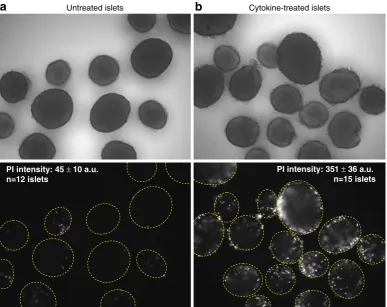
4.1. Morphology Visual inspection of the islets can provide some rudimentary infor-mation regarding health. When viewed with a scanning objective lens under a light microscope, islets appear spherical and golden-brown, approximately 50–250 μm in diameter. These features, particularly the darker color of islets in comparison to the relative-ly transparent exocrine tissue, allow for rapid identification of islets as shown in Fig.1a. Healthy isolated islets following over-night recovery also have few, if any, individual cells protruding from the relatively smooth rounded surface (Fig. 1b). Cells pro-truding from the surface can be a sign of decreased or decreasing health (compare Fig.2a and bdescribed below). Larger islets are also prone to developing hypoxic cells in their center, visibly dis-tinguishable as darker cells compared to the surrounding tissue (Fig.1c). Reducing the amount of media in the dish to allow in-creased oxygenation may reduce this effect (33).
a
b
c
(34). Using these fluorescent dyes in combination, the health of islets can be assessed by the FDA/PI ratio. Unmanipulated isolated islets from healthy control animals generally have 90–95% viability, meaning blue FDA staining in 90–95% of the component cells of an islet and red PI staining is detectable in only 5–10% of the cells in any given islet. Additional techniques commonly used to measure islet viability include AnnexinV, SYTO-13/ethidium bromide, cal-cein AM/ethidium homodimer, fluorescal-cein diacetate, and ethidium bromide which are more expensive but are also more sensitive to islet cell damage than FDA/PI (34–36).
We use a variation of the above approach by quantifying the mean intensity of PI fluorescence within an islet. Imaging soft-ware records the fluorescence intensity within a region of interest (ROI) designated by an encircled islet. Healthy islets typically dis-play smooth round borders (Fig.2a, top panel) and show minimal PI staining (Fig.2a, bottom panel). Unhealthy cells, such as islets
a
Untreated islets Cytokine-treated isletsPI intensity: 45 ±10 a.u. n=12 islets
PI intensity: 351 ±36 a.u. n=15 islets
b
cultured overnight in a mixture of proinflammatory cytokines (Fig. 2b), exhibit cells protruding from the rough islet surface (top panel) and significantly greater PI staining (bottom panel). The mean pixel fluorescence intensity of the ROIs is used to quantify cell death as listed atop the lower panels of Fig.2a, b.
4.3. Glucose-stimulated insulin secretion
A fundamental property of pancreatic islets is their capacity to reg-ulate the release of insulin and other hormones in direct response to changes in extracellular glucose concentration. In large part, this ability defines islet function since insulin is produced and re-leased in the body only from islet beta cells. Insulin is crucial to regulating blood glucose, and reduced insulin secretion is a key feature of both Type 1 and Type 2 diabetes (1). Glucagon, so-matostatin, and other peptides are also produced by islet cells, but these are secreted in smaller amounts and more difficult to de-tect. Glucose-stimulated insulin secretion (GSIS) is thus a well-ac-cepted measure of islet function.
To measure GSIS, islets are cultured in a‘low’glucose concen-tration, typically near 3 mM, to measure the amount of insulin secreted into the media under‘basal’or‘unstimulated’conditions. Stimulated insulin release is measured by exposing islets to a higher glucose concentration such as 11.1 mM (half-maximal) or928 mM (maximal). In response to the glucose stimulation, the time course of the islet response is biphasic, consisting of a rapid spike in insulin release (first phase) followed by a decline to a prolonged second phase plateau of insulin that remains throughout the duration of the stimulus. GSIS can be measured either by static conditions or by perfusing islets to measure the kinetics of insulin release in response to glucose. Each technique has its advantages and disad-vantages, which are reviewed elsewhere (37). The glucose stimula-tion index (SI) is the ratio of stimulated-to-basal insulin secrestimula-tion. Healthy islets have an SI of 2–20 depending on several factors including strain, age, and body weight.
4.4. Glucose-stimulated calcium
As a demonstration of GSCa, we compared islets cultured overnight in RPMI 1640 containing either 5.5 mM glucose or 11 mM glucose. Following overnight culture treatment, islets were loaded with fura-2AM (43), and then [Ca2+]iwas recorded in Krebs-Ringer-bicarbonate containing 3 mM glucose followed by stimulation with 11 mM glucose. The normal GSCa consists of three phases: phase 0 (the initial dip below baseline due calcium uptake by the endoplasmic reticulum), phase 1 (the rapid rise to peak calcium that is concomitant with the release of pre-docked insulin granules), and phase 2 (the elevated plateau; 44). As shown in Fig.3a, the GSCa was more robust for islets cultured in 11 mM glucose RPMI 1640 compared to islets cultured in 5.5 mM glucose RPMI 1640. Specifically, the mean amplitude (calculated as the change in calcium from basal levels) of phase 1 and phase 2 was significantly higher among islets cultured in 11 mM glucose (Fig.3b). These differences are consistent with previous reports of optimal viability and function when islets are cultured in 11 mM glucose culture media (28, 30) and demon-strate the sensitivity of using GSCa as a valuable technique for assessing islet function.
There are several advantages of measuring GSCa over GSIS. Substantial time and costs are involved in GSIS since insulin must be measured by immunoassay following the GSIS experiment, whereas GSCa provides results in real-time without additional ex-pense. Furthermore, GSCa utilizes frequent sampling, which allows for precise temporal analysis of the amplitude, latency, and trajectory of changes in response to glucose stimulation. Also, GSCa can be used to assess individual islets, so fewer than ten islets would be sufficient to characterize the function for the entire batch. In contrast, islets must be grouped together for GSIS to produce detectable quantities of insulin, especially for islet perfu-sion studies (we use 50 islets for each replicate in perfuperfu-sion stud-ies). One limitation, however, is that GSCa cannot be easily normalized to a standard value in the same way that insulin is nor-malized to a standard set of insulin concentrations. Coupled with potential differences in dye loading and changes in light source in-tensity/efficiency over long periods of time, these issues make batch-to-batch comparisons of different islet preparations using GSCa difficult. These issues can be somewhat mitigated by deter-mining the stimulation index, which is commonly used to assess GSIS from donor to donor in human islets for transplantation purposes (45).
4.5. Islet dissociation and cell identification
are beta cells (65–85%) and alpha cells (10–25%), with the remaining 5–10% of cells consisting of delta cells and other cell types (46–48). Isolating these cells requires either mechanically disrupting the bonds between cells or using a digestive enzyme to separate the cells (49). Once islets have been separated into their component cells, use of counterflow elution as described by Pipeleers (50), or light scatter flow cytometry as described by Rabinovitch et al. (51) may be used to identify and purify the cells. We provide a detailed protocol describing the dissocia-tion and culturing of murine islet cells in AppendixC.
0.6 0.7 0.8 0.9 1.0 1.1 1.2 1.3
0 5 10 15
cultured in 5.5G cultured in 11G
Time (minutes)
a
b
Fura-2 ratio (340/380 nm)
3 mM glucose
11 mM glucose
5.5G 11G
Fura-2 ratio (340/380 nm)
*
*
0 0.1 0.2 0.3 0.4
Phase 0 (ER dip)
1st Phase 2nd Phase
Phase 0 Phase 1
Phase 2
5. Conclusions
The ability to consistently procure viable and functional islets is crucial to effectively studying the physiology and pathophysiology of islets and their constituent cells. As stated previously, islet iso-lation is an intricate process. In this review, we have addressed the key factors to consider in the isolation and assessment processes to obtain both viable and functional islets. In the accompanying pro-tocol, we provide a method developed by integrating the reports of many others in the research field with careful experimentation to optimize the islet isolation process for our laboratory. While following this protocol provides a start for islet isolation, any pro-cedure must be optimized to the capabilities of the laboratory and the specific goals of the study.
Acknowledgments
This work was supported by National Institutes of Health Grant DK063609 to the University of Virginia Diabetes Endocrine Re-search Center (DERC) and K01-DK081621 to C.S.N. Mouse islets were acquired through the Cell and Islet Isolation Core Fa-cility at the University of Virginia DERC (DK063609).
Appendix A:
Isolation of islets
from mice
Materials
Two forceps
One Fine Iris scissors for internal use One standard pattern scissors
One to two Bulldog clamp(s) 30 or 27 Ga 1/2″needle 5 mL Luer-lock syringe 10 mL pipette
37°C water bath
Scale (accurately measures in milligrams) Centrifuge
Solutions
For anesthesia: CO2gas
or
Solution (A): Mix 2 mL of ketamine and 1 mL of xylazine Ketamine (60–80 mg/kg) and xylazine (10 mg/kg)
Solution (B): Mix (A) and 7 mL of Normal Saline, injection. Various methods of anesthesia are used to ensure that research protocols follow humane methods. The following are used by our laboratory: CO2 gas for euthanasia, or Ketamine/Xylazine for IP injection, fol-lowed by servical dislocation once animals are in deep anesthesia. With the ketamine/ xylazine, animals are given 0.005 mL per 1 g body weight to induce anesthesia, fol-lowed by cervical dislocation to induce death.
For islet isolation:
G-Solution sterile filtered in 0.22μm filter: HBSS (Invitrogen #14065-056 diluted to 1×) 0.35 g NaHCO3/L
1% bovine serum albumin (BSA)
This solution, as with any cell culture solution, must be sterile filtered. This method is performed using clean techniques, not sterile techni-ques; therefore, it is vital that the solutions are sterile prior to use. Other protocols use protease inhibitors or varying concentrations of BSA to inactivate endogenous proteases, some as high as 10% BSA.
Collagenase solution:
Solution (C): 1.4 mg/mL Collagenase-P (Roche #1129 002 001) in G-Solution (prepare 5 mL/ pancreas)
islet function and viability experiments before using a new enzyme lot experimentally.
Gradient:
Histopaque 1100 Solution (1.100 g/mL):
100 mL Histopaque 1077 (SIGMA # 10771) 120 mL Histopaque 1119 (SIGMA # 11191)
We prepare and store a stock solution at 4°C. Only the amount of Histopaque required is brought to room temperature prior to its use. It is also important to note that the Histopaque solutions should be kept in the dark.
Culture media:
RPMI 1640+L-Glutamine (Gibco #11875-093) 10% FBS (Gibco #16000-044)
Penicillin (100 U/mL)/streptomycin (100 μg/ mL; Gibco # 15140-122)
Protocol
1. Prepare 1 mL of G-solution for each mouse in a 15 mL conical. 2. Place each 15 mL conical from Step 1in ice.
In order to inhibit the collagenase digestion prior to incu-bation, place a 15 mL conical containing 1 mL of HBSS for each mouse on ice. The ice will maintain the collage-nase-filled pancreata at a temperature which inhibits di-gestion. The ice also serves to maintain uniform conditions while isolating islets from multiple pancreata. 3. Euthanize animal with CO2 or inject mouse IP with 0.01 mL/g body weight of solution (B). The mouse is ready for exsanguination after no response to pinching its foot. Note: the investigator MUST refer to institution Animal Care and Use Committee guidelines and policies regarding proper procedures when handling and using animals in research.
Some researchers prefer to use ketamine/xylazine when collecting blood samples.
4. (Optional) Exsanguinate the animal by heart perfusion using a 1 mL syringe with 25 Ga needle.
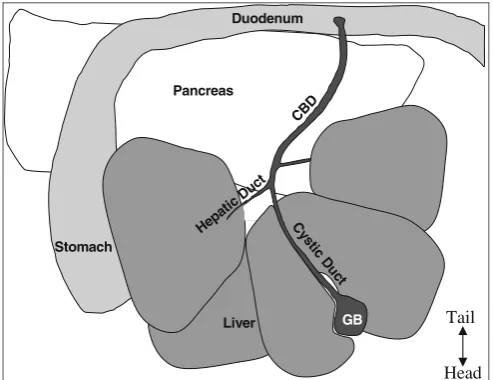
5. Wet abdominal fur with 70% alcohol to reduce the chance of hair contamination in the IP cavity during subsequent steps. 6. Open abdomen with standard pattern scissors in a V-shape starting from the lower abdomen and extending to the lateral portions of the diaphragm in order to expose all organs in the peritoneal cavity (Fig.4).
This position allows for cannulation into the common bile duct from the rostral end closest to the liver at the junction of the cystic and hepatic ducts, leaving space to inject again closer to the duodenum if an error occurs. 8. Secure the liver with 2″×2″gauze.
Lay the liver flat and place an unfolded 2″×2″piece of gauze under the liver closest to the surgeon. Gently flip the liver over onto the gauze exposing the junction of the gall bladder and common bile duct. Fold the remain-ing gauze over the liver to secure it durremain-ing cannulation of the common bile duct.
9. Using a Johns Hopkins Bulldog clamp (Roboz# RS-7441), clamp off the common bile duct near the junction with the small intestine. Alternatively, tightly tied suture string can be used to tie off the CBD at the junction with the small in-testine.
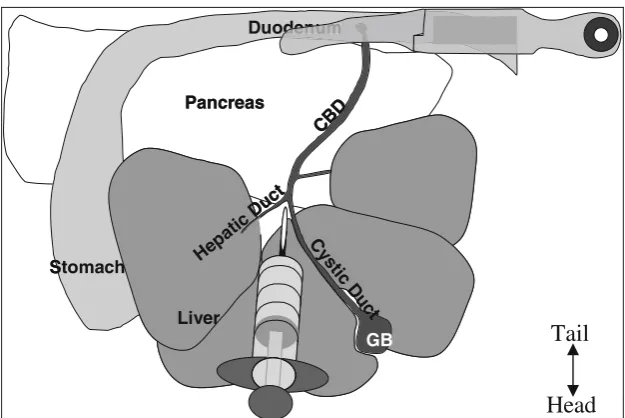
The pancreas contains a system of ducts that allows pan-creatic enzymes to flow into the gut. The panpan-creatic duct merges with the inferior end of the CBD where the pan-creatic enzymes enter the duodenum (see Fig. 4). This pancreatic duct provides the most readily available access to the endocrine pancreas. Clamp the CBD as close to the junction with the small intestine as possible so as not to occlude the pancreatic duct (seeFig.5). Clamping the du-odenum on either side of the junction with the CBD is also an option. Using a clamp allows access to the pancre-atic duct while closing off access to the duodenum. Also
Stomach
GB Pancreas
Liver CB
D
Hepa ticDu
ct
Duodenum
C ys
tic D
u ct
Tail
Head
attached to the CBD are several hepatic ducts. After be-coming proficient with the perfusion technique, the ma-jor hepatic duct that leads to the caudal right lobe of the liver could also be clamped to ensure that minimal collagenase is delivered to the liver.
10. Fill a 5 mL syringe with solution (C).
11. Cannulate the CBD with a 27–30 gauge 0.5 in. needle se-cured to a 5 mL syringe or a 27–30 gauge butterfly needle. Cannulate the CBD at the junction of the cystic duct from the gall bladder and left hepatic duct from the liver (forms a Y-shape,seeFig. 5).
At the most superior portion of the CBD the junction of the cystic duct and hepatic duct forms a Y-shaped refer-ence point in most mice. This location allows the surgeon the opportunity to cannulate the CBD with a 27 gauge butterfly needle or a 27 gauge 0.5 in. needle in 5 mL sy-ringe. Tips for a successful cannulation of the duct: (1) use a new needle for each attempt because the needle may dull very easily; (2) place the needle at the Y-shaped junction and slide the needle into the duct moving in 1 mm increments (small-scale movement is the key to success); (3) if the duct is difficult to visualize, squeeze gently on the gall bladder which may cause the CBD to turn yellow as bile flows through.
12. Inject 4–5 mL of solution (C) into CBD.
A. An injection of 4–5 mL collagenase solution into the CBD should be sufficient to completely inflate the pan-creas such that there is fluid in all regions of the panpan-creas from head to tail. Ensuring that the collagenase inflates
Stomach
GB
Pancreas
Liver
CB D
C ys
tic D u
ct
Hepa tic D
uct Duo
Stomach
GB
Pancreas
Liver
CB D
C ys
tic D u
ct
Hepa tic D
uct Duodenumdenum
Head
Tail
the pancreas in its entirety allows for the maximum yield of islets. The distribution of islets in the pancreas is not uniform; studies show a higher concentration of islets in the pancreatic tail, which makes the full inflation of the pancreas even more important. This step requires skill of the surgeon to obtain consistent results, and success is directly related to islet yield.
B. Failed attempts to infuse the pancreas with collagenase through the hepatic duct eventually destroy the duct. An alternative method involves directly injecting colloge-nase into the numerous lobes of the pancreas. In this method, it is important to inject small amounts (about one to two drops) of collagenase into as many of the lobes of the pancreas as possible. Begin by locating and lifting the spleen ~1 in. above the body cavity with forceps. The pancreas is attached to the spleen and should be visi-ble. Beginning at the top, inject two to three drops of col-lagenase to inflate individual lobes of the pancreas using a 5 mL syringe with 30 gauge needle. As the lobe inflates, move the needle downward into the next lobe and the next, allowing gravity to help get collagenase into the pan-creas, until the needle hilt reaches the tissue (~1 cm). Re-move the needle, and reenter the tissue at another section of tissue to inflate other sections. Adjust forceps as neces-sary to hold new sections of pancreas above the body cav-ity in order to inject downward. Continue to follow the pancreas with the needle and inject the pancreatic lobes along the stomach and intestine. When as many lobes have been injected as possible, remove the pancreas and contin-ue the protocol.
13. Remove pancreas from mouse and place into a 15 mL conical fromStep 1.
A. During the removal of the pancreas, it is important to avoid intestinal rupture in order to reduce the risk of contamination of the cell culture by intestinal bacteria. Removal begins at the point of attachment of the CBD to the duodenum. Using forceps or scissors snip the CBD and gently detach the pancreas from the intes-tines. Then, cut the CBD from the attachment to the liver. Continue to remove the pancreas from the greater curvature of the stomach and finally the spleen. Place the removed pancreas into the 15 mL conical that holds 1 mL of cold HBSS and replace the tube in the ice. B. After injecting the pancreas, place the pancreas that has
14. Repeat the above steps for all mice, then proceed to the next step.
Follow the above procedure for the remaining animals placing one pancreas per tube on ice.
15. Incubate for *8 min at 37°C in 15 mL conical tube. *Incuba-tion time varies among different lots of collagenase (usually 8–11 min).
After collecting the pancreata into their respective tubes on ice, place the same tubes directly into a water bath at 37°C to incubate for 8–11 min. The incubation time varies between lots of collagenase; therefore, it is im-portant to test each lot prior to use in experimental conditions.
16. Shake the 15 mL tube containing digested pancreas hard by hand for approximately 5 s to complete the separation of tis-sue (the result should be the consistency of pea soup and free of large pieces of pancreatic tissue if the pancreas was com-pletely inflated).
This step results in the mechanical digestion of the pan-creas and can be performed for all tubes simultaneously if the tubes are placed into a rack for incubation and cov-ered while shaking. If fat tissue was incubated with the pancreas, it will remain undigested after shaking.
17. Quickly place the 15 mL conical in ice and fill to 15 mL with G-solution to dilute collagenase concentration and slow the digestive process.
18. Centrifuge 2 min at 1,200 rpm (290×g).
19. Discard the supernatant by decanting into a waste container. 20. Wash with of 10 mL G-Solution, 2 min at 1,200 rpm
(290×g).
All wash steps, unless otherwise stated, involve resuspend-ing the tissue pellet with a sterile 10-mL pipette usresuspend-ing room temperature HBSS followed by room temperature centrifugation at 290×gfor 2 min.
21. Discard the supernatant by decanting into a waste container. 22. Add 10 mL of G-solution and resuspend with a 10 mL pipette. 23. Filter each sample through a size 40 (420μm) sieve (Bellco Glass, Inc, Cat# 1985-00040) into separate 50 mL conicals. It is important to put each pancreas into its own conical so that the gradient can sustain the tissue load and prop-erly separate the islets from the exocrine tissue. Overload-ing the gradient will lead to reduced islet yield and purity. 24. Bring volume to 20 mL with G-solution.
26. Decant supernatant, and place the opening of the 50 mL conical onto a paper towel to remove as much liquid as possible.
Removing all of the liquid ensures that the gradient density is not diluted when the pellet is resuspended in the gradient. 27. Resuspend pellet in 10 mL Histopaque 1100 Solution with a
10 mL pipette.
Resuspending the tissue completely in the gradient ensures that islet density is not affected by attached exocrine tissue. Tissue filtered through the sieve should resuspend to a state that appears almost homogenous in the gradient. 28. Centrifuge for 20 min at 1,200 rpm. Note: islets are in the
supernatant.
After centrifugation, islets should be visible in the super-natant of the gradient as floating white specks. If there are fewer islets present than expected, resuspend the pellet produced during the previous step in order to inspect for islets. Also note that if more than one pancreas is added to the gradient, many islets will be found in the pellet. This should not be the case if the gradient contains only one mouse pancreas.
29. Label a new 50 mL conical, and add 25 mL of G-solution. 30. Decant the supernatant into the new 50 mL conical with
G-solution from the previous step.
Note: collect all washes below to be able to look through them later.
31. Centrifuge at 1,500 rpm (453×g) for 4 min and decant the supernatant. Note: islets are in the pellet.
Take care to pour the solution into the waste container in one motion in order to avoid having the solution wash back onto the pellet causing the islets to become dis-lodged and subsequently decanted.
32. Add 10 mL of G-solution to the pellet, and pipette up and down several times with a 10 mL pipette.
The final washes of the pellet are very important to ensur-ing that the islets are clear of the Histopaque solution and that the islets are well separated from one another prior to plating in culture dishes.
33. Centrifuge at 1,200 rpm for 3 min.
34. Decant the supernatant and replace with 10 mL of culture medium.
RPMI1640 with 10%FBS and Pen/Strep
Use a suspension (Petri) culture dish so that the islets do not stick as they would in a tissue culture treated. Incu-bate or pick clean islets under dissecting or light micro-scope using low-retention pipette tips.
Appendix B:
Isolation of islets
from mice
Materials
Two forceps
One Fine Iris scissors for internal use One standard pattern scissors
One to two Bulldog clamp(s) 30 or 27 Ga 1/2″needle 5 mL Luer-lock syringe 10 mL pipette
15 mL conicals 50 mL conicals 2″×2″gauze 37°C water bath
Scale (accurately measures in milligrams) Centrifuge
Solutions
For anesthesia: CO2gas
or
Solution (A): Mix 2 mL of ketamine and 1 mL of xylazine The concentration of xylazine used is 20 mg/mL.
For islet isolation:
G-Solution sterile filtered in 0.22μm filter:
HBSS (Invitrogen Cat#14065-056 diluted to 1×0.35 g NaHCO3/L
1% bovine serum albumin Collagenase solution:
Solution (C): 1.4 mg/mL Collagenase-P (Roche #1129 002 001) in G-Solution (prepare 5 mL/ pancreas)
Gradient:
Histopaque 1100 solution (1.100 g/mL):
100 mL Histopaque 1077 (SIGMA # 10771) 120 mL Histopaque 1119 (SIGMA # 11191) Culture media:
RPMI 1640+L-Glutamine (Gibco #11875-093) 10% FBS (Gibco #16000-044)
Penicillin (100 U/mL)/streptomycin (100 μg/ mL; Gibco #15140-122)
Protocol
1. Prepare 1 mL of G-solution for each mouse in a 15 mL conical. 2. Place each 15 mL conical from Step 1in ice.
3. Euthanize animal with CO2 or inject mouse IP with 0.01 mL/g body weight of solution (B). The mouse is ready for exsanguination after no response to pinching its foot. Note: the investigator must refer to institution Animal Care and Use Committee guidelines and policies regarding proper procedures when handling and using animals in research. 4. (Optional) Exsanguinate the animal by heart perfusion using
a 1 mL syringe with 25 Ga needle.
5. Wet abdominal fur with 70% alcohol to reduce the chance of hair contamination in the IP cavity during subsequent steps. 6. Open abdomen with standard pattern scissors in a V-shape starting from the lower abdomen and extending to the lateral portions of the diaphragm in order to expose all organs in the peritoneal cavity (Fig.6).
7. Turn the animal so that the nose is closest to the surgeon and the tail points away from the surgeon.
8. Secure the liver with 2″×2″gauze.
be used to tie off the CBD at the junction with the small in-testine.
10. Fill a 5 mL syringe with solution (C).
11. Cannulate the CBD with a 27–30 gauge 0.5 in. needle secured to a 5 mL syringe or a 27–30 gauge butterfly needle. Cannulate the CBD at the junction of the cystic duct from the gall bladder and left hepatic duct from the liver (forms a Y-shape,seeFig.7). 12. Inject 4–5 mL of solution (C) into CBD.
13. Remove pancreas from mouse and place into a 15 mL conical fromStep 1.
14. Repeat the above steps for all mice, then proceed to the next step. 15. Incubate for *8 min at 37°C in 15 mL conical tube. *Incu-bation time varies among different lots of collagenase (usual-ly 8–11 min).
16. Shake the 15 mL tube containing digested pancreas hard by hand for approximately 5 s to complete the separation of tissue (the re-sult should be the consistency of pea soup and free of large pieces of pancreatic tissue if the pancreas was completely inflated). 17. Quickly place the 15 mL conical in ice and fill to 15 mL with
G-solution to dilute collagenase concentration and slow the digestive process.
18. Centrifuge 2 min at 1,200 rpm (290×g).
19. Discard the supernatant by decanting into a waste container. 20. Wash with of 10 mL G-Solution, 2 min at 1,200 rpm (290×g). Discard the supernatant by decanting into a waste container.
Stomach
GB Pancreas
Liver CB
D
Hepa ticDu
ct
Duodenum
C ys
tic D
u ct
Tail
Head
21. Add 10 mL of G-solution and resuspend with a 10 mL pipette. 22. Filter each sample through a size 40 (420μm) sieve (Bellco Glass, Inc, Cat# 1985-00040) into separate 50 mL conicals. 23. Bring volume to 20 mL with G-solution.
24. Centrifuge at 1,200 rpm for 2 min to pellet resuspended tissue. 25. Decant supernatant, and place the opening of the 50 mL conical
onto a paper towel to remove as much liquid as possible. 26. Resuspend pellet in 10 mL Histopaque 1100 Solution with a
10 mL pipette.
27. Centrifuge for 20 min at 1,200 rpm. Note: islets are in the supernatant.
28. Label a new 50 mL conical, and add 25 mL of G-solution. 29. Decant the supernatant into the new 50 mL conical with
G-solution from the previous step.
Note: collect all washes below to be able to look through them later.
30. Centrifuge at 1,500 rpm (453×g) for 4 min and decant the supernatant. Note: islets are in the pellet.
31. Add 10 mL of G-solution to the pellet, and pipette up and down several times with a 10 mL pipette.
32. Centrifuge at 1,200 rpm for 3 min.
33. Decant the supernatant and replace with 10 mL of culture medium.
34. Transfer to a sterile Petri dish under culture hood to incubate or pick/clean islets under a dissecting or light microscope (Fig.7).
Stomach
GB
Pancreas
Liver
CB D
C ys
tic D u
ct
Hepa tic D
uct Duo
Stomach
GB
Pancreas
Liver
CB D
C ys
tic D u
ct
Hepa tic D
uct Duodenumdenum
Head
Tail
Appendix C:
dissociation
and culturing of
murine islet cells
Materials
Glass specimen tube Glass 5 3/4″pasture pipets Glass cover slips
0.4% gel to coat cover slips
Six well, non-tissue-culture-treated sterile plate Roboz Micro Dissecting 0.8 mm tip forceps 50 mL centrifuge tube
Solutions
Culture medium:
RPMI 1640+L-Glutamine (Gibco #11875-093) 10% FBS (Gibco #16000-044)
Penicillin (100 U/L)/streptomycin (100μg/mL; Gibco #15140-122)
Dissociation buffer:
Trypsin EDTA solution (Gibco #15400-054)
This should contain 0.5 g/L of trypsin (1:250) and 0.2 g/L of EDTA×4 Na in Hanks’Balanced Salt Solu-tion without CaCl2, MgCl2×6H2O, and MgSO4×7H2O. Silicon solution:
Sigmacote (Sigma #SL-2)
Protocol
1. Autoclave microscope cover slips and the Roboz micro section forceps as well as all glassware to be used for the dis-sociation. Allow sufficient time to dry completely.
A. To autoclave the cover slips, use aluminum foil to make long, rectangular packet that can hold six or seven cover slips that overlap slightly (no more than 1/4 of the width/diameter of the slip). Place the packet into an au-toclave pouch. To minimize the chance of breaking the cover slips, place no more than three packets into the autoclave pouch.
B. Wrap the Roboz micro dissection forceps in foil and place in a small autoclaveable pouch as well.
are received from elsewhere, allow recovery overnight in fresh medium as above.
3. Place one slip into a well of a six-well plate.
4. Coat the cover slips with a 0.4% gelatin coating. Allow to sit in the hood for 15 min, then aspirate the excess gelatin off the cover slides.
5. Place the coated cover slips in incubator overnight to dry. If rushed, 2 hours in an incubator should be sufficient to allow the gel coating to dry.
6. Aliquot RPMI 1640 growth medium into a 50 mL tube and warm. A minimum of 4 mL is needed for every 100 islets. 7. Aliquot 500 μL trypsin per 100 islets into a second 50 mL
centrifuge tube and allow to warm to 37°C.
8. To keep islets and the cells from sticking to the tubes, coat glass specimen tubes and glass pasture pipets with Sigmacote (Sigma #SL-2), following Sigmacote protocol.
9. Place 500μL of trypsin in Sigmacoted specimen tube. If the trypsin is cold, cover with parafilm and place in the incubator to warm.
10. Use 100 islets per specimen tube, the larger the islet, the bet-ter. Place islets with a minimum of medium, into the warm trypsin. Perform this step one tube at a time. Do not allow the islets to sit in the trypsin for prolonged periods of time. 11. Triturate the islets using a Sigmacoted pasture pipet. Triturate rapidly against the sides of the tube while trying to avoid mas-sive amounts of bubbling, or suctioning into the pipettor. 12. Observe the islet/trypsin mix to see if you can still see the
islets. If so, triturate again to try and break the islets apart. 13. Add 1.5 mL RPMI 1640 to each specimen tube to neutralize
the action of the trypsin.
14. If doing more than one tube of islets, place parafilm over the top of the tube and place in the incubator. Proceed to the next tube repeating the steps above until all tubes are done. 15. Place the tubes containing the cell suspension in a centrifuge
and spin at 800 rpm for 3 min.
16. Carefully remove the supernatant by aspirating. Locate the cell pellet at the bottom of the tube, and aspirate without dis-turbing the pellet. (The easiest way to aspirate is to carefully tilt the tube and insert the aspiration line. Tilt the tube in a smooth motion to avoid backwash that could disturb the cell pellet. Aspirate as much of the supernatant as possible.) 17. Resuspend the pellet in 500μL of warm RPMI 1640. Use a
18. Using either a siliconized or low sample retention 1,000μL pipette tip to aliquot the cell suspension onto the gel-coated cover slips.
19. Place 250μL of the suspension onto each gel coated coverslip. Note that the cells will concentrate into the center of the drop. 20. Place the plate into the incubator for 45 min to 1 h to allow the cells to settle. The drops of suspension will spread out to cover the slide while in the incubator.
21. After 45 min to 1 h, add 2 mL of fresh, pre-warmed RPMI 1640 culture medium to each well. Carefully add the medi-um by allowing it to gently flow down the side of the well, in order to minimize disturbances to the cells.
22. Place in the incubator and allow cells to recover overnight. 23. The following day warm 2 mL of RPMI 1640 culture
medi-um per well.
24. Carefully aspirate one well at a time and add 2 mL of fresh medium, again along the side of the well to minimize agitat-ing the cells. Work quickly to minimize exposure to air. 25. Check the cells under a microscope, remembering that the
greatest concentration will be where the center of the drop or drops were placed.
References
1. Donath MY, Halban PA (2004) Decreased beta-cell mass in diabetes: significance, mechanisms and therapeutic implications. Diabetologia 47(3):581–589
2. Hogan A, Pileggi A, Ricordi C (2008) Transplantation: current developments and future directions; the future of clinical islet transplantation as a cure for diabetes. Front Biosci 13:1192–1205
3. Huang X, Moore DJ, Ketchum RJ, Nune-maker CS, Kovatchev B, McCall AL et al (2008) Resolving the conundrum of islet transplantation by linking metabolic dysre-gulation, inflammation, and immune regu-lation. Endocr Rev 29(5):603–630 4. Lacy PE, Kostianovsky M (1967) Method
for the isolation of intact islets of Langer-hans from the rat pancreas. Diabetes 16 (1):35–39
5. O’Dowd JF (2009) The isolation and puri-fication of rodent pancreatic islets of langer-hans. Methods Mol Biol 560:37–42 6. Gotoh M, Maki T, Kiyoizumi T, Satomi S,
Monaco AP (1985) An improved method
for isolation of mouse pancreatic islets. Transplantation 40(4):437–438
7. Ferguson J, Allsopp RH, Taylor RM, John-ston ID (1976) Isolation and preservation of islets from the mouse, rat, guinea-pig and hu-man pancreas. Br J Surg 63(10):767–773 8. Hellerstroem C (1964) A method for the
microdissection of intact pancreatic islets of mammals. Acta Endocrinol (Copenh) 45:122–132
9. Shewade YM, Umrani M, Bhonde RR (1999) Large-scale isolation of islets by tis-sue culture of adult mouse pancreas. Trans-plant Proc 31(3):1721–1723
10. Hara Y, Taniguchi H, Ishihara K, Ejiri K, Tsutou A, Narutaki K et al (1989) Sophis-ticated mesh filtration technique of a large-scale isolation of islets and their function. Diabetes Res Clin Pract 6(2):103–108 11. Pai GM, Slavin BG, Tung P, Volk BW,
12. Shapiro AM, Hao E, Rajotte RV, Knete-man NM (1996) High yield of rodent islets with intraductal collagenase and stationary digestion—a comparison with standard technique. Cell Transplant 5(6):631–638 13. Szot GL, Koudria P, Bluestone JA (2007)
Murine pancreatic islet isolation. J Vis Exp 7:255
14. Wolters GH, Vos-Scheperkeuter GH, van Deijnen JH, van Schilfgaarde R (1992) An analysis of the role of collagenase and protease in the enzymatic dissociation of the rat pancreas for islet isolation. Diabeto-logia 35(8):735–742
15. Wolters GH, Vos-Scheperkeuter GH, Lin HC, van Schilfgaarde R (1995) Different roles of class I and class II Clostridium his-tolyticum collagenase in rat pancreatic islet isolation. Diabetes 44(2):227–233 16. de Haan BJ, Faas MM, Spijker H, van Willigen
JW, de Haan A, de Vos P (2004) Factors influ-encing isolation of functional pancreatic rat islets. Pancreas 29(1):e15–e22
17. Brandhorst H, Friberg A, Andersson HH, Felldin M, Foss A, Salmela K et al (2009) The importance of tryptic-like activity in purified enzyme blends for efficient islet isolation. Transplantation 87(3):370–375 18. Brandhorst H, Raemsch-Guenther N,
Raemsch C, Friedrich O, Huettler S, Kurfuerst M et al (2008) The ratio between collagenase class I and class II influences the efficient islet release from the rat pancreas. Transplantation 85(3):456–461
19. Jahr H, Pfeiffer G, Hering BJ, Federlin K, Bretzel RG (1999) Endotoxin-mediated activation of cytokine production in human PBMCs by collagenase and Ficoll. J Mol Med 77(1):118–120
20. Kessler L, Jesser C, Belcourt A, Pinget M (1997) Influence of acinar tissue contami-nation on encapsulated pancreatic islets: morphological and functional studies. Transplantation 63(10):1537–1540 21. de Groot M, de Haan BJ, Keizer PP,
Schuurs TA, van Schilfgaarde R, Leuvenink HG (2004) Rat islet isolation yield and function are donor strain dependent. Lab Anim 38(2):200–206
22. Bock T, Pakkenberg B, Buschard K (2005) Genetic background determines the size and structure of the endocrine pancreas. Diabetes 54(1):133–137
23. Bock T, Pakkenberg B, Buschard K (2003) Increased islet volume but unchanged islet number in ob/ob mice. Diabetes 52 (7):1716–1722
24. Inuwa IM, El Mardi AS (2005) Correlation between volume fraction and volume-weighted mean volume, and between total number and total mass of islets in post-weaning and young Wistar rats. J Anat 206(2):185–192
25. Lifson N, Lassa CV, Dixit PK (1985) Rela-tion between blood flow and morphology in islet organ of rat pancreas. Am J Physiol 249(1 Pt 1):E43–E48
26. Hellman B (1959) The numerical distribu-tion of the islets of Langerhans at different ages of the rat. Acta Endocrinol (Copenh) 32:63–77
27. Street CN, Lakey JR, Shapiro AM, Imes S, Rajotte RV, Ryan EA et al (2004) Islet graft assessment in the Edmonton protocol: implications for predicting long-term clini-cal outcome. Diabetes 53(12):3107–3114 28. Efanova IB, Zaitsev SV, Zhivotovsky B,
Kohler M, Efendic S, Orrenius S et al (1998) Glucose and tolbutamide induce apoptosis in pancreatic beta-cells. A process dependent on intracellular Ca2+ concen-tration. J Biol Chem 273(50):33501– 33507
29. Robertson RP, Harmon J, Tran PO, Tanaka Y, Takahashi H (2003) Glucose toxicity in beta-cells: type 2 diabetes, good radicals gone bad, and the glutathione con-nection. Diabetes 52(3):581–587
30. Andersson A (1978) Isolated mouse pan-creatic islets in culture: effects of serum and different culture media on the insulin production of the islets. Diabetologia 14 (6):397–404
31. Gaber AO, Fraga D (2004) Advances in long-term islet culture: the Memphis expe-rience. Cell Biochem Biophys 40(3 Suppl): 49–54
32. Gilon P, Jonas JC, Henquin JC (1994) Cul-ture duration and conditions affect the oscil-lations of cytoplasmic calcium concentration induced by glucose in mouse pancreatic islets. Diabetologia 37(10):1007–1014 33. Yasunami Y, Lacy PE, Davie JM, Finke EH
(1983) Prolongation of islet xenograft sur-vival (rat to mouse) by in vitro culture at 37 C. Transplantation 35(4):281–284 34. Barnett MJ, McGhee-Wilson D, Shapiro
AM, Lakey JR (2004) Variation in human islet viability based on different membrane integrity stains. Cell Transplant 13(5): 481–488
of phosphatidylserine expression on early apoptotic cells using fluorescein labelled Annexin V. J Immunol Methods 184(1): 39–51
36. Miyamoto M, Morimoto Y, Nozawa Y, Balamurugan AN, Xu B, Inoue K (2000) Establishment of fluorescein diacetate and ethidium bromide (FDAEB) assay for quality assessment of isolated islets. Cell Transplant 9 (5):681–686
37. Nolan AL, O’Dowd JF (2009) The mea-surement of insulin secretion from isolated rodent islets of langerhans. Methods Mol Biol 560:43–51
38. Levy J (1999) Abnormal cell calcium ho-meostasis in type 2 diabetes mellitus: a new look on old disease. Endocrine 10(1):1–6 39. Hellman B (1975) The significance of calcium
for glucose stimulation of insulin release. Endocrinology 97(2):392–398
40. Satin LS (2000) Localized calcium influx in pancreatic beta-cells: its significance for Ca2+-dependent insulin secretion from the islets of Langerhans. Endocrine 13(3):251– 262
41. Henquin JC (2009) Regulation of insulin secretion: a matter of phase control and amplitude modulation. Diabetologia 52 (5):739–751
42. Henquin JC, Nenquin M, Stiernet P, Ahren B (2006) In vivo and in vitro glu-cose-induced biphasic insulin secretion in the mouse: pattern and role of cytoplasmic Ca2+ and amplification signals in beta-cells. Diabetes 55(2):441–451
43. Jahanshahi P, Wu R, Carter JD, Nunemaker CS (2009) Evidence of diminished glucose stimulation and endoplasmic reticulum
function in nonoscillatory pancreatic islets. Endocrinology 150(2):607–615
44. Roe MW, Mertz RJ, Lancaster ME, Worley JF 3rd, Dukes ID (1994) Thapsigargin inhibits the glucose-induced decrease of in-tracellular Ca2+ in mouse islets of Langer-hans. Am J Physiol 266(6 Pt 1):E852–E862 45. Ryan EA, Lakey JR, Rajotte RV, Korbutt GS, Kin T, Imes S et al (2001) Clinical out-comes and insulin secretion after islet trans-plantation with the Edmonton protocol. Diabetes 50(4):710–719
46. Hohmeier HE, Newgard CB (2004) Cell lines derived from pancreatic islets. Mol Cell Endocrinol 228(1–2):121–128 47. Elayat AA, el-Naggar MM, Tahir M (1995)
An immunocytochemical and morphomet-ric study of the rat pancreatic islets. J Anat 186(Pt 3):629–637
48. Brissova M, Powers AC (2008) Architec-ture of pancreatic islets. In: Seino S, Bell GI (eds) Pancreatic beta cell in health and disease. Springer, Japan, pp 3–11
49. Perez-Armendariz M, Roy C, Spray DC, Bennett MV (1991) Biophysical properties of gap junctions between freshly dispersed pairs of mouse pancreatic beta cells. Bio-phys J 59(1):76–92
50. Pipeleers DG, Pipeleers-Marichal MA (1981) A method for the purification of single A, B and D cells and for the isolation of coupled cells from isolated rat islets. Dia-betologia 20(6):654–663