www.ijper.org
Binary Mixtures of Morphine and Furosemide:
Compatibility and Stability at Different
Concentrations
Espinosa Bosch María1, Sánchez Rojas Fuensanta2*, Bosch Ojeda Catalina2
1UGC Pharmacy, Regional Universitary Hospital of Málaga, 29010, Málaga, Spain. 2Department of Analytical Chemistry, Faculty of Sciences, University of Málaga, Spain.
ABSTRACT
Objectives: In order to avoid separate injections, admixtures of drugs are frequently used in palliative care settings. There are different factors that can influence the compatibility and stability of the mixture: drug type, concentration, solvent, container, temperature and light. There are some mixtures of drugs with proven stability, but there is lack of evidence about the stability and compatibility of the combination of morphine and furosemide. The purpose is to evaluate the compatibility and stability of two admixtures of morphine and furosemide at two different temperatures (25ºC and 37ºC). The concentrations of the admixtures are: 3.0 mg/mL-2.0 mg/mL; 1.0 mg/mL-0.6 mg/mL; in NaCl 0.9% stored in elastomeric infusors protected from light. Methods: The samples were prepared and diluted in NaCl 0.9% in elastomeric infusor in triplicate to obtain four different conditions of concentration and/or temperature of storage (concentration: 3.0 mg/mL-2.0 mg/mL, 1.0 mg/mL–0.6 mg/mL of morphine and furosemide respectively; temperature of storage 25ºC and 37ºC). The concentration of each constituent drug into different mixtures was periodically determined using a HPLC-UV method. The drugs were chromatographed on a C18 reverse phase column; the mobile phase was acetonitrile-water 40:60 (v/v); flow rate 1.5 mL/min. Morphine and furosemide concentrations were determined at 235 nm by interpolation from the calibration curves prepared at (0, 1, 2, 3, 7, 8, 9, 10, 14, 15) days from the standards. Statgraphics centurion XVI program has been used to data treatment. Results: The stability of the admixtures diluted in NaCl 0.9% are as follow: morphine-furosemide (3.0 mg/mL-2.0 mg/mL) is stable (retained > 95% of their initial concentration) eight days at 25ºC and two day at 37ºC; (1.0 mg/mL-0.6 mg/mL) is stable thirty days at 25ºC and two day at 37ºC. Conclusion: The admixture of morphine and furosemide in NaCl 0.9% in elastomeric infusor can be safely used in palliative care for at least two days. Concentrations of the admixture can be prepared in advance and stored at room temperature, but the infusion cannot be longer than two days.
Key words: Furosemide, HPLC, Mixtures, Morphine, Stability. DOI: Correspondence Address10.5530/ijper.49.4s.9 Mr. Fuensanta Sánchez Rojas
Department of Analytical Chemistry, Faculty of Sci-ences, University of Málaga, 29071 Málaga, Spain. E-mail: [email protected]
INTRODUCTION
The definition of the World Health Organi
-zation (WHO)1 about palliative care is fol -low: an approach that improves the quality of life of patients and their families facing the problem associated with life-threatening illness, through the prevention and relief of suffering by means of early identification and impeccable assessment and treatment
Submission Date : 03-06-2015
Revision Date : 29-01-2015
Accepted Date : 18-06-2015
of pain and other problems, physical, psy
-chosocial and spiritual. Palliative care pro
-vides relief from pain and other distressing symptoms affirms life and regards dying as a normal process, intends neither to hasten or postpone death, integrates the psycho
as actively as possible until death, offers a support sys
-tem to help the family cope during the patients illness and in their own bereavement, uses a team approach to address the needs of patients and their families, including bereavement counselling, if indicated, will enhance quality of life, and may also positively influence the course of illness, is applicable early in the course of illness, in conjunction with other therapies that are intended to prolong life, such as chemotherapy or radia
-tion therapy, and includes those investiga-tions needed to better understand and manage distressing clinical complications.
To obtain optimal symptom control in these patients, the simultaneous administration of more than one drug is often required.2
When the oral administration of drugs is no longer pos
-sible at a later stage of the disease because symptoms worsen and the patient’s general condition deteriorates, alternative methods of delivering the drugs may be nec
-essary. The ideal system should deliver the drug reliably in a pain-free manner, use a minimum amount of nurs
-ing time and allow the patient remain mobile. In addi
-tion, it should be simple to use and not too costly.3 To avoid the use of different infusion needles, it may be beneficial to mix different drugs in one single infuser. Drug infusers offer the possibility of continu
-ous subcutane-ous drug administration that, compared to intermittent injections, gives a more constant plasma concentration. The continuous subcutaneous infusion of drugs has become an accepted practice, especially in the palliative care of cancer patients, in the 20 years.4-6 The patients tolerate the treatment well, and infusion-site infection and abscess are rare.
Morphine is an opioid analgesic used for the treat
-ment of moderate to severe pain. It is recommended by the WHO for the relief of moderate cancer-related pain. It is the opioid of choice in palliative and termi
benzoic acid) used in the treatment of congestive heart failure and edema. His medication is also used to treat high blood pressure (hypertension). Furosemide works by blocking the absorption of salt and fluid in the kid
-ney tubules, causing a profound increase in urine output (diuresis). The diuretic effect of furosemide can cause body water and electrolyte depletion. Therefore, careful medical supervision is necessary during treatment. The physical compatibility and/or stability of several drugs in solution destined to subcutaneous infusion has been widely studied,7-11 although in some studies only visual inspection of the samples was performed, pro
-viding information on the physical compatibility but not on the chemical stability of the drugs in the mixture. Moreover, studies have not yet been done regarding the combination of morphine and furosemide in solution in which the quantification of both drugs was performed by HPLC. On the other hand, patients will only benefit from the use of mixtures if those mixtures are of good quality since the administration of incompatible mix
-tures could cause irritation. Besides, chemical incompat
-ibility and instability of the drugs in the mixture will result in an inadequate therapeutic outcome, and the degradation products may cause additional side effects. Therefore, the aim of this study was to determine the compatibility and stability of morphine and furosemide combined in solution at two different concentrations and stored in elastomeric infusors protected from light at 25ºC and 37ºC over a period of 15 days.
MATERIAL AND METHODS
Materials
Commercial morphine ampoules of 20 mg/mL (Mor
-phine, Braun, Spain) and commercial furosemide ampoules of 20 mg/2 mL (Furosemide, Fresenius Kabi, Spain) were used. Sodium chloride 0.9% was obtained from Fresenius Kabi, Spain. HPLC-grade acetonitrile was obtained from Sigma-Aldrich. Other chemical and solvents were of analytical grade and obtained from Sigma-Aldrich, Germany. High purity water (resistiv
-ity 18.2 MΩ cm) obtained by a Milli-Q water purifica
-tion system (Millipore, Bedford, MA, USA) was used throughout this work.
Drug mixtures
The doses of morphine and furosemide assayed in the study were chosen taking into consideration those more frequently used by the units of palliative care in our region. The doses assayed were 3.0 mg/mL-2.0 mg/mL
and 1.0 mg/mL–0.6 mg/mL of morphine and furose
-mide respectively, which were prepared in 0.9% normal saline for injection and stored at two temperatures, 25°C and 37ºC each one, employing a bacteriological and cul
-ture oven with tempera-ture and time regulation and digi
-tal reading, Selecta (INCUDIGIT 19L 2001246). Each of these four alternatives were prepared in triplicate in elas
-tomeric infuser and protected from light and also in glass. From each mixture, five standards of different concentra
-tions between 25 mg/mL and 160 mg/mL of admixture were prepared. The standards were divided into different
Table 1: Statistical evaluation of data for different stability studies Morphine 3000 mg/L-Furosemide 2000 mg/L
Mixture
(mg/L) Mean (mAU) deviation(mAU)Standard co-efficient (%)Variation Minimum (mAU) Maximum (mAU) Confidence level (mAU) Lower Upper
25 401302 10328.2 2.5 384764 418392 388519 414085
50 786610 17395.2 2.2 747382 816979 773827 799393
75 1.16894E6 24395.0 2.1 1.13458E6 1.22736E6 1.15616E6 1.18172E6
100 1.52877E6 45284.0 2.9 1.42979E6 1.57785E6 1.51598E6 1.54155E6
125 1.96128E6 36051.1 1.8 1.87858E6 2.03426E6 1.9485E6 1.97406E6
Morphine 1000 mg/L- Furosemide 600 mg/L Mixture
(mg/L) Mean (mAU) deviation (mAU)Standard co-efficient (%)Variation Minimum (mAU) Maximum (mAU)
Confidence level (mAU) Lower Upper
32 544266 26103.9 4.7 505872 594437 534662 553870
64 972979 30031.7 3.0 920315 1.03607E6 963375 982583
96 1.4587E6 38701.4 2.6 1.33988E6 1.53624E6 1.44909E6 1.4683E6
128 1.92714E6 35780.5 1.8 1.86326E6 2.03565E6 1.91754E6 1.93674E6
aliquot parts, stored in eppendorf tubes and frozen until each analysis day. All the procedures were done under aseptic conditions and using sterile drug solutions.
Physical stability study
The physical stability of the samples was assessed by visual examination during all studied days for colour change and/or precipitation.
Chemical stability study
Mixtures concentrations were determined by a stabil
-ity-indicating HPLC method. HPLC analysis was per
-formed at room temperature (~25ºC) using a Shimadzu LC-6A pump equipped with Rheodine 7125 injection valve 20 μL, a Shimadzu SPD-6A spectrophotometric detector working at 235 nm. The signal from the detec
-tor was recorder and integrated with a chromatography
data system Shimadzu C-R6A chromatopac; a LiChro
-spher® 100 C18 (5 μm) LiChroCART® 250-4 column was employed. The mobile phase consisted of acetoni
-trile: water (40:60, v/v) delivered at flow rate of 1.0 mL/ min. The sample injection volume was 20 μL, and trip
-licate injections were performed for every sample. The initial concentration of mixture was defined as 100%, and subsequent sample concentrations were expressed as a percentage of the initial concentration. Stability of the mixture was defined as retention of at least 95% of the initial mixture concentration.
Forced degradation analysis
Forced degradation is a degradation of new drug sub
-stance and drug product at conditions more severe than accelerated conditions. It is required to demonstrate specificity of stability indicating methods and also pro
-vides an insight into degradation path ways and degra
-dation products of the drug substance.12-13
In this work, six different studies were carried out for this purpose over the mixture solution: acid, base, heat, UV light, hydrogen peroxide and sodium hypochlorite.
Compatibility and stability studies
The compatibility and stability studies were performed at 25 ± 0.5ºC and 37 ± 0.5ºC, and all drug mixtures were Table 2: Concentrations obtained for the admixtures stored into infusors at 25ºC and 37ºC
[Admixture] ± SD* (mg/L) (3000 mg/L-2000 mg/L)
25ºC 37ºC
Day Inf 1 Inf 2 Inf 3 Day Inf 1 Inf 2 Inf 3
0 50 50 50 0 50 50 50
1 51.7 ± 0.5 53.6 ± 0.5 53.3 ± 0.7 1 51.1 ± 0.4 52.0 ± 0.2 50.3 ± 0.7 2 51.9 ± 0.3 52.3 ± 0.3 53.9 ± 0.3 2 47.3 ± 0.4 42.9 ± 0.5 45.2 ± 0.8 3 53.4 ± 0.3 50.7 ± 0.8 51.4 ± 0.4 3 45.9 ± 0.8 44.9 ± 1.2 45.1 ± 0.4 7 52.2 ± 0.3 45.9 ± 0.2 47.8 ± 0.4 7 43.1 ± 1.7 40.8 ± 0.4 42.6 ± 0.9 8 53.4 ± 0.6 47.9 ± 0.1 48.3 ± 0.3 8 - 38.2 ± 1.5 43.6 ± 0.9 10 52.3 ± 0.6 46.4 ± 1.5 46.1 ± 0.2 9 - 40.6 ± 0.6 44.7 ± 0.4
14 53.4 ± 0.6 43.7 ± 0.3 41.4 ± 0.5 - - -
-15 52.1 ± 0.3 - 42.3 ± 0.4 - - -
-*Mean ± standard deviation (n=3)
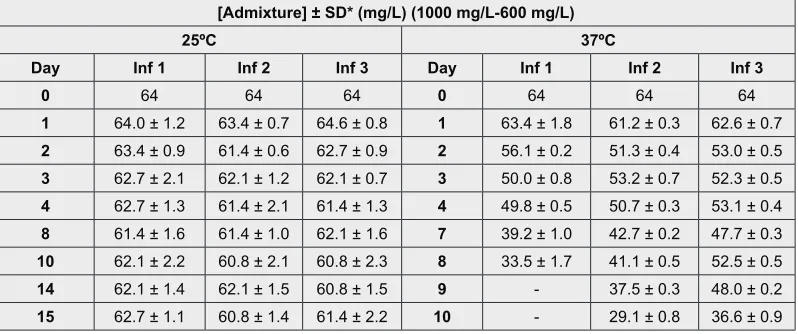
Table 3: Concentrations obtained for the admixtures stored into infusors at 25ºC and 37ºC [Admixture] ± SD* (mg/L) (1000 mg/L-600 mg/L)
25ºC 37ºC
Day Inf 1 Inf 2 Inf 3 Day Inf 1 Inf 2 Inf 3
0 64 64 64 0 64 64 64
1 64.0 ± 1.2 63.4 ± 0.7 64.6 ± 0.8 1 63.4 ± 1.8 61.2 ± 0.3 62.6 ± 0.7 2 63.4 ± 0.9 61.4 ± 0.6 62.7 ± 0.9 2 56.1 ± 0.2 51.3 ± 0.4 53.0 ± 0.5 3 62.7 ± 2.1 62.1 ± 1.2 62.1 ± 0.7 3 50.0 ± 0.8 53.2 ± 0.7 52.3 ± 0.5 4 62.7 ± 1.3 61.4 ± 2.1 61.4 ± 1.3 4 49.8 ± 0.5 50.7 ± 0.3 53.1 ± 0.4 8 61.4 ± 1.6 61.4 ± 1.0 62.1 ± 1.6 7 39.2 ± 1.0 42.7 ± 0.2 47.7 ± 0.3 10 62.1 ± 2.2 60.8 ± 2.1 60.8 ± 2.3 8 33.5 ± 1.7 41.1 ± 0.5 52.5 ± 0.5 14 62.1 ± 1.4 62.1 ± 1.5 60.8 ± 1.5 9 - 37.5 ± 0.3 48.0 ± 0.2 15 62.7 ± 1.1 60.8 ± 1.4 61.4 ± 2.2 10 - 29.1 ± 0.8 36.6 ± 0.9
Figure 1: Percentages of morphine-furosemide mixtures (3000 mg/L-2000 mg/L) remaining at 25ºC and 37ºC
Figure 2: Percentages of morphine-furosemide mixtures (1000 mg/L-600 mg/L) remaining at 25ºC and 37ºC
protected from direct light exposure. All solutions were assayed in triplicate with four replicates in each case. At pre-determined times–that is 0, 1, 2, 3, 7, 8, 9, 10, 14, 15 days-the samples were examined for any development and/or change in colour. Also, the drug mixtures were examined for signs of precipitation or cloudiness (tur
-bidity) and gas production under bright light against a dark background.
RESULTS AND DISCUSSION
Accelerated degradation study
The subsequent studies were made over mixture solu
-tions containing 40 mg/L of morphine and 24 mg/L of furosemide.
pH study
To aliquots of 500 μL of mixture were added different amounts of HCl or NaOH (0.1 M and 1 M) (100, 200, 300, 500 of both concentration).Additions of HCl or NaOH have not influence about the chromatographic signal. The area diminishes by effect dilution when the amount of degradant is higher and also the signal is constant with the time.
Table 4: Stability of admixtures
Morphine-Furosemide (mg/mL-mg/mL)
Days 25ºC 37ºC
3.0 mg/mL-2.0 mg/mL 8 2
Heat study
Three samples of mixture solutions were heated at dif
-ferent temperatures (40ºC, 60ºC, 80ºC) during dif-ferent times (from 5 to 60 minutes). No significant changes were observed in the chromatograms in all cases.
UV light
A mixture solution was subject to UV irradiation during several days. After one day under UV radiation, the sig
-nal of the admixture diminishes and also colour change is observed into glass.
Oxidants
To aliquots of 500 μl of mixture were added different amounts of NaClO 0.2 M and 2 M or H2O2 0.03%, 0.3 and 3% (100, 200, 300, 500 μl of each reagent and con
-centration). No effects were observed when the concen
-tration of reagents were lower. The chromatographic signal increases and also stays constant with the time when 0.3% and 3% ofH2O2 were used.
Physical stability study
All solutions were initially clear and colourless and remained so for the duration of the study. Visible parti
-cles appear into the infusers at the same time decreased the concentration of the admixture stored into they.
Statistical evaluation of data
Calibration curves were linear over the concentration range used with good correlation coefficients. Statisti
-cal evaluations of data for different stability studies are presented in Table 1 for each mixture.
Chemical stability study
All the physically stable solutions were chromatogra
-phied. The experimental data were processed making use of the Statgraphics Centurion XVI program. The linearity of the method was evaluated at 5 concentration levels injected by quadruplicate varying from 25 mg/L to 160 mg/L. The standard calibration curves exhibited good linearity over the range of concentrations tested, with correlation coefficients greater than 0.999 in all cases. The concentrations obtained for each mixture at two studied temperatures (25ºC and 37ºC) are shown in tables 2 and 3. The percentages remaining correspond
-ing to different mixtures are shown in figures 1 and 2.
CONCLUSION
This study was proven to be suitable for determining the stability and compatibility of morphine and furose
-mide mixtures in elastomeric infusors. It may be applied to stablish the stability of different samples prepared in NaCl 0.9 % and stored at two temperatures and can be used in palliative care (Table 4). It can be prepared in advance and stored at room temperature for at least 8 days, but the infusion with a system worn close to a patient that may reach a temperature closer to 37ºC cannot be longer than two days for both concentrations.
ACKNOWLEDGEMENTS
The authors thanks to Consejería de Igualdad Salud y Políticas Sociales(Junta de Andalucía) for supporting this study (PI-0013-2013).
SUMMARY
• Mixture of Morphine-Furosemide (3.0 mg/mL-2.0 mg/mL) is stable eight days at 25ºC and two day at 37ºC • Mixture of Morphine-Furosemide (1.0 mg/mL-0.6 mg/mL) is stable thirty days at 25ºC and two day at 37ºC
Espinosa Bosch Maria was resident in the pharmacy of the UniversitaryHospital Virgen del Rocio in Seville, Spain. During her training, she obtained a Bachelor’s Degree in Health Applied Statistics at UniversityAutónoma of Barcelona. Actually she is working in the UGC Pharmacy in Regional Universitary Hospital of Málaga. Principal investigator of the project obtained in public call from the Junta of Andalucia, Spain for to study the compatibility and stability of different mixtures of drugs and its use in palliative care. About Authors
REFERENCES
1. WHO Definition of Palliative Care. World Health Organization. Retrieved;
2012 March 16.
2. Schrijvers D, Tai-Apin C, De Smet MC, et al. Determination of compatibility
and stability of drugs used in palliative care. J Clin Pharm Ther. 1998;23(4): 311–14.
3. Zachrisson U, Furst CJ. Drug infusers in palliative medicine: a Swedish inquiry. Journal of Pain Symptom Manage 1998; 15(5): 299–304.
4. Bruera E, Brenneis C, Michaud M, et al. Use of the subcutaneous route for
the administration of narcotics in patients with cancer pain. Cancer 1988;
62(2): 407–11.
5. Storey P, Herbert HH, St Louis RH, et al. Subcutaneous infusions for control
of cancer symptoms. Journal of Pain Symptom Manage 1990; 5(1): 33–41.
6. Vigneron J. Stability studies of drugs used in oncology: The role of the hospital pharmacist. Eur J Hosp Pharm Pract. 2006; 12(6): 75−6.
7. Barcia E, Reyes R, Azuara ML, et al. Compatibility of haloperidol and hyoscine-N-butyl bromide in mixtures for subcutaneous infusion to cancer patients in palliative care. Support Care Cancer 2003; 11(2): 107−13.
8. Good PD, Schneider JJ, Ravenscroft PJ. The compatibility and stability of midazolam and dexamethaxone in infusion solutions. Journal of Pain Sympton Management 2004; 27(5): 471−5.
9. Barcia E, Reyes R, Azuara ML, et al. Stability and compatibility of binary mixtures of morphine hydrochloride with hyoscine-N-butyl bromide. Support Care Cancer 2005; 13(4): 239−45.
10. Negro S, Reyes R, Azuara ML, et al. Morphine, haloperidol and hyoscine N-butyl bromide combined in s.c. infusion solutions: Compatibility and stability. Evaluation in terminal oncology patients. Inter J Pharma. 2006; 307(2): 278−84.
11. Negro S, Salama A, Sánchez Y, et al. Compatibility and stability of tramadol and dexametaxone in solution and its use in terminally ill patients. J Clin Pharm Ther. 2007; 32(5): 441−4.
12. Singh S, Junwal M, Modhe G, et al. Forced degradation studies to assess the stability of drugs and products. Trends Anal Chem. 2013; 49(1): 71−88.
13. Blessy M, Patel RD, Prajapati PN, et al. Development of forced degradation and stability indicating studies of drugs-A review. J Pharm Anal. 2014; 4(3):