* Corresponding author.
E-mail: [email protected] (R.Soltani) © 2014 Growing Science Ltd. All rights reserved. doi: 10.5267/j.ijiec.2014.5.001
International Journal of Industrial Engineering Computations 5 (2014) 339–364
Contents lists available at GrowingScience
International Journal of Industrial Engineering Computations
homepage: www.GrowingScience.com/ijiec
Reliability optimization of binary state non-repairable systems: A state of the art survey
Roya Soltani*
School of Industrial Engineering, Iran University of Science and Technology, Tehran, Iran
C H R O N I C L E A B S T R A C T
Article history:
Received September 22 2013 Received in Revised Format April 6 2014
Accepted May 18 2014 Available online May 25 2014
The purpose of this paper is to discuss the state of the art on models and methods for reliability optimization problems (ROPs) including reliability allocation, redundancy allocation and reliability-redundancy allocation. There are literally few surveys for reviewing the literature of the ROPs. Tillman et al. (1980) classified the related papers by system structure, problem type, and solution methods, separately. In another work, Tzafestas (1980) reviewed system reliability optimization models and the optimization techniques. Yearout (1986) reviewed the literature related to standby redundancy. Kuo (2000) studied the system reliability optimization based on system structure and solution methods. Kuo and Prasad (2004) overviewed system reliability optimization methods. Later, Kuo (2007) reviewed recent advances in optimal reliability allocation problems. The present study adds to the previous literature surveys and focuses mainly on papers after year 2000 but with a quick review on the previous works so that the readers become familiar with the existing approaches. This research investigates the literature from system structure, system performance, uncertainty state and solution approach standpoints, simultaneously.
© 2014 Growing Science Ltd. All rights reserved Keywords:
Reliability Allocation Redundancy Allocation Reliability-Redundancy Allocation Stochastic Uncertainty Fuzzy Uncertainty Interval Uncertainty Robust optimization Mathematical programming Exact methods
Heuristic and Meta-heuristic
Acronyms
ROP: Reliability Optimization Problem RAP: Redundancy Allocation Problem
RRAP: Reliability- Redundancy Allocation Problem GA: Generic Algorithm
SA: Simulated Annealing GP: Geometric Programming HBMO: Honey Bee Mating Optimization ABC: Artificial Bee Colony
ACO: Ant Colony Optimization DC: Degrade Ceiling
PSO: Particle Swarm Optimization IA: Immune Algorithm DE: Differential Evolution HS: Harmony Search
VND: Variable Neighborhood Descent VNS: Variable Neighborhood Search EGHS: Effective Global Harmony Search NGHS: Novel Global Harmony Search SOMA: Self-Organizing Migrating Algorithm
BBMOPSO: Bare- Bones Multi-Objective Particle Swarm Optimization
DSAMOPSO: Dynamic Self-Adaptive Multi-Objective Particle Swarm Optimization AUGMECON: Augmented Epsilon Constraint
CTV-MOPSO: Customized Time-Variant Multi- Objective Particle Swarm Optimization UMOSA: Ulungu Multi-Objective Simulated Annealing
LMBB: Lagrange Multiplier and the Branch-and-Bound ICA: Imperialist Competitive Algorithm
FLC: Fuzzy Logic Controller TS: Tabu Search
IIMOM: Intelligent Interactive Multi-Objective Optimization Method GDA: Great Deluge Algorithm
CEA: Cellular Evolutionary Approach
NSGA-II: Non-dominated Sorting Genetic Algorithm EVM : Expected Value Model
CCP : Chance-Constrained Programming (Redundancy CCP) DCP: Dependent Chance Programming
MC: Monte Carlo MCS: Monte Carlo Simulation RSM: Response Surface Methodology BBD: Box-Behnken design
OSSO: Orthogonal Simplified Swarm Optimization SPEA2: Strength Pareto Evolutionary Genetic Algorithm MOHGA: Multi-objective hierarchical genetic algorithm SMOSA: Suppapitnarm Multi-Objective Simulated Annealing PSA: Pareto Simulated Annealing
PDMOSA: Pareto Domination based Multi-Objective Simulated Annealing WMOSA: Weight based Multi-Objective Simulated Annealing LHS: Latin Hypercube Sampling
1. Introduction
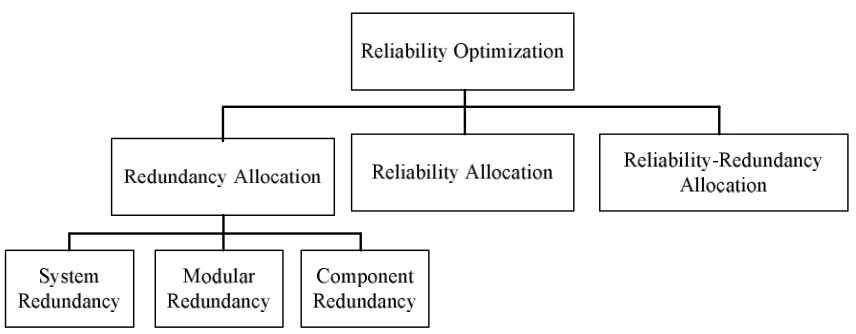
To be more competitive in the market, the reliabilities of systems or products need to be optimized by system designers. This goal is accomplished by applying suitable reliability optimization techniques, which includes three main categories, i.e. the reliability allocation, the redundancy allocation and the reliability-redundancy allocation as presented in Fig. 1. Redundancy can be in system level, subsystem level (Module) and component level.
Fig. 1. Reliability optimization problems
In the reliability allocation problems, the reliability levels of the components is determined such that the consumption of a resource under a reliability constraint is minimized while the redundancy allocation problem generally involves the selection of components and redundancy levels to maximize the system reliability given various system-level’s constraints. The reliability-redundancy allocation, which is the combination of two aforesaid problems, determines the reliability levels and the redundancy levels, simultaneously.
Fig. 2. RAP models
R.Soltani / International Journal of Industrial Engineering Computations 5 (2014)
or vague set, stochastic-fuzzy uncertainty, perturbation in a defined uncertainty set and chaos. Each problem can be modelled with a single objective or multiple objectives each of which with homogenous and heterogeneous components. The redundancy strategy can be either active or standby. The standby redundancy in turn is categorized into cold, hot and warm. The models have been formulated with different system structures and with different performance measures such as reliability, availability, mean time to failure (average life), percentile life, etc. For more information about the application of percentile life and reliability as performance measures readers are referred to the work by Kim and Kuo (2003). Note that fault-tolerance mechanisms, which are the ability of a system to continue performing its intended function in spite of faults, are not investigated in this research.
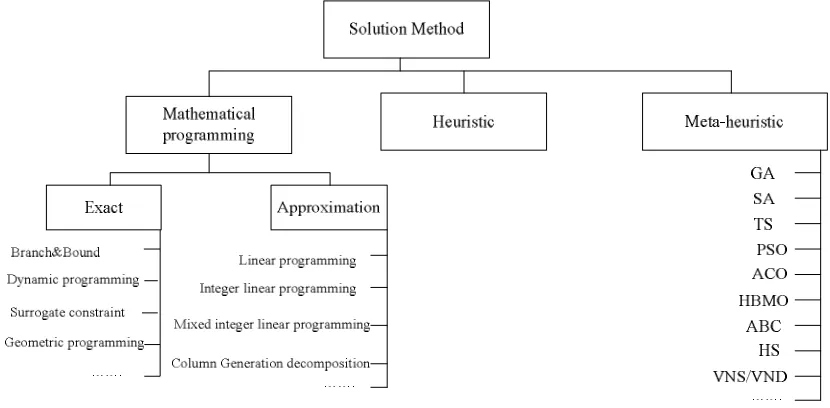
Fig. 3 classifies the solution methods for RAPs. Mathematical programming methods, which include exact and approximation methods are the most suitable for small-sized problems. Chern (1992) proves that RAP in series system is an NP-Hard problem. As the system configuration becomes complex and other simplified assumptions are released the NP-Hardness of the problem increases. Therefore, heuristic and meta-heuristic approaches have been proposed to deal with RAPs.
Fig. 3. RAP solution methods
The rest of the paper is organized as follows. In section 2 the RAP is investigated which include deterministic and non-deterministic models. Section 3 is devoted to reliability allocation. Section 3 surveys the reliability-redundancy allocation problems. Finally, concluding remarks have been provided in section 4.
2. Redundancy allocation
Basic assumptions for RAP are as follows:
1) The availability of the components is unlimited;
2) Failures of individual components are independent;
3) All failed components will not damage the system and are not repaired.
4) No preventive maintenance is considered.
In the followings, other assumptions such as redundancy strategy, being deterministic or non-deterministic, etc. are mentioned. Furthermore, wherever a basic assumption is violated, it is mentioned in a column named other considerations.
2.1 Component redundancy
2.1.1 Deterministic models
Deterministic models assume that all parameters including component reliability, cost, weight, volume, etc. are known, precisely. The RAP is restricted by available system cost, weight, volume, etc. In the field of system-reliability, it has been reported that various exact/mathematical programming and heuristic/meta-heuristic techniques have been used to cope with RAPs. For review on the work before year 2000 readers are referred to the works by Tillman et al. (1980), Kuo (2000), Kuo and Prasad (2004) andKuo (2007). In the area of single objective models with active strategy, Fyffe et al. (1968) were the first who proposed a model for RAP where system’s reliability is maximized subject to constraints on cost and weight. They used a Lagrangian multiplier in the objective function to handle multiple constraints.
Nakagawa and Miyazaki (1981) showed that, sometimes, the use of a Lagrangian multiplier becomes inefficient. Therefore, they proposed the surrogate constraint approach. Other exact and mathematical programming techniques include DP (e.g. Bellman & Dreyfus, 1958; Fyffe et al., 1968; Jianping, 1996; Misra, 1971), Integer programming (e.g. Ghare, 1969; Misra & Sharma, 1991), Partial bound enumeration (e.g. Jianping & Xishen , 1997), Branch and bound (e.g. Bulfin & Liu,1985; Sup & Kwon,1999), GP (e.g. Federowicz & Mazumdar,1968; Govil, 1983; Misra & Sharma, 1973), Lagrange Multiplier (Govil & Agarwala,1983), etc.
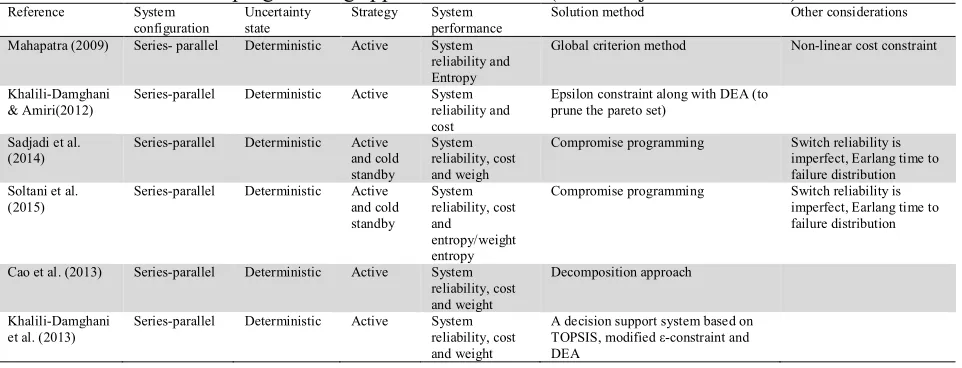
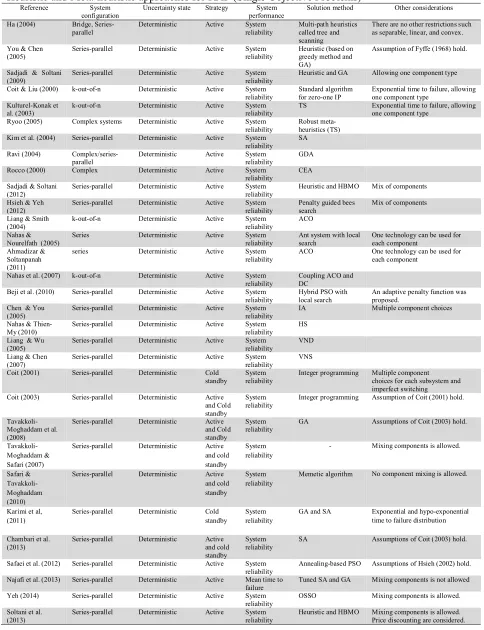
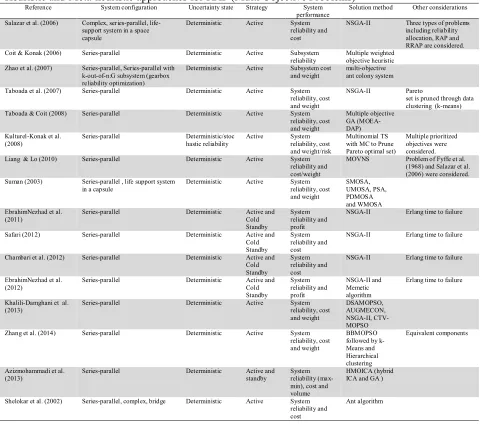
Table 1 lists the related works in the literature after year 2000. Note that the references are not arranged in chronological order but they are arranged based on the solution method. As it is observed, most works have been carried out in active redundancy area except the work by Amari (2010) and Tannous et al. (2011) which consider both active and/or warm standby redundancy strategies and seems like more researches are needed with respect to redundancy strategy.
R.Soltani / International Journal of Industrial Engineering Computations 5 (2014)
Table 1 (a)
Exact and Mathematical programming approaches for RAP (Single Objective Problems)
Reference System
configuration
Uncertainty state
Strategy System performance
Solution method Other considerations
Prasad et al. (2001)
Series- parallel Deterministic Active Percentile life Lexicographic search
An upper bound is used to reduce the search space
Ng & Sancho (2001)
Series- parallel/ overspeed protection system
Deterministic Active System reliability
Hybrid DP/depth first search
Yalaoui et al. (2005)
Series- parallel Deterministic Active System cost DP
Onishi et al. (2007)
Series- parallel Deterministic Active System reliability Improved surrogate constraint Djerdjour and Rekab (2001)
Series- parallel Deterministic Active System cost Branch and bound A heuristic for finding a good lower bound is presented along with some implicit enumeration criteria
Ramirez-Marquez et al. (2004)
Series- parallel Deterministic Active Max-Min reliability
Mixed integer linear programming Lee et al. (2003) Series- parallel Deterministic Active Max-Min
reliability
Comparison of Min-Max approach and NN Hsieh (2003) Series- parallel Deterministic Active System
reliability
Simple linear approximation
Multiple component choices, Constraints
must be linear and separable Hsieh (2002) Series- parallel Deterministic Active System
reliability
Two-Phase Linear Programming
The method provides a good lower bound for branch-and-bound algorithm or artificial methods
Billionnet (2008) Series- parallel Deterministic Active System reliability
Integer linear programming Nourelfath &
Nahas (2003)
Series Deterministic - System
reliability
Quantized hopfield networks
For each component, there are different technologies available
Amari (2010) k-out-of-n deterministic Active/war m standby System reliability linear programming (LP)-based branch-and-bound
Arbitrary general Distributions (such as Weibull or Gamma)
Tannous et al.
(2011)
Series-parallel deterministic Warm standby
System reliability
GA and exact integer programming for reformulated model
SBDD for driving the objective function , exponential failure distribution
Table 1 (b)
Exact and Mathematical programming approaches for RAP (Multi Objective Problems) Reference System
configuration
Uncertainty state
Strategy System performance
Solution method Other considerations
Mahapatra (2009) Series- parallel Deterministic Active System reliability and Entropy
Global criterion method Non-linear cost constraint
Khalili-Damghani & Amiri(2012)
Series-parallel Deterministic Active System reliability and cost
Epsilon constraint along with DEA (to prune the pareto set)
Sadjadi et al. (2014)
Series-parallel Deterministic Active and cold standby
System reliability, cost and weigh
Compromise programming Switch reliability is imperfect, Earlang time to failure distribution Soltani et al.
(2015)
Series-parallel Deterministic Active and cold standby System reliability, cost and entropy/weight entropy
Compromise programming Switch reliability is imperfect, Earlang time to failure distribution
Cao et al. (2013) Series-parallel Deterministic Active System reliability, cost and weight
Decomposition approach
Khalili-Damghani et al. (2013)
Series-parallel Deterministic Active System reliability, cost and weight
A decision support system based on TOPSIS, modified ε-constraint and DEA
Table 2 (a)
Heuristic and Meta-heuristic approaches for RAP (Single Objective Problems) Reference System
configuration
Uncertainty state Strategy System performance
Solution method Other considerations
Ha (2004) Bridge, Series-parallel
Deterministic Active System reliability
Multi-path heuristics called tree and scanning
There are no other restrictions such as separable, linear, and convex.
You & Chen (2005)
Series-parallel Deterministic Active System reliability
Heuristic (based on greedy method and GA)
Assumption of Fyffe (1968) hold.
Sadjadi & Soltani (2009)
Series-parallel Deterministic Active System reliability
Heuristic and GA Allowing one component type
Coit & Liu (2000) k-out-of-n Deterministic Active System reliability
Standard algorithm for zero-one IP
Exponential time to failure, allowing one component type
Kulturel-Konak et al. (2003)
k-out-of-n Deterministic Active System reliability
TS Exponential time to failure, allowing one component type
Ryoo (2005) Complex systems Deterministic Active System reliability
Robust meta-heuristics (TS) Kim et al. (2004) Series-parallel Deterministic Active System
reliability
SA
Ravi (2004) Complex/series-parallel
Deterministic Active System reliability
GDA
Rocco (2000) Complex Deterministic Active System reliability
CEA
Sadjadi & Soltani (2012)
Series-parallel Deterministic Active System reliability
Heuristic and HBMO Mix of components
Hsieh & Yeh (2012)
Series-parallel Deterministic Active System reliability
Penalty guided bees search
Mix of components
Liang & Smith (2004)
k-out-of-n Deterministic Active System reliability
ACO
Nahas & Nourelfath (2005)
Series Deterministic Active System reliability
Ant system with local search
One technology can be used for each component
Ahmadizar & Soltanpanah (2011)
series Deterministic Active System reliability
ACO One technology can be used for each component
Nahas et al. (2007) k-out-of-n Deterministic Active System reliability
Coupling ACO and DC
Beji et al. (2010) Series-parallel Deterministic Active System reliability
Hybrid PSO with local search
An adaptive penalty function was proposed.
Chen & You (2005)
Series-parallel Deterministic Active System reliability
IA Multiple component choices
Nahas & Thien-My (2010)
Series-parallel Deterministic Active System reliability
HS
Liang & Wu (2005)
Series-parallel Deterministic Active System reliability
VND
Liang & Chen (2007)
Series-parallel Deterministic Active System reliability
VNS
Coit (2001) Series-parallel Deterministic Cold standby
System reliability
Integer programming Multiple component choices for each subsystem and imperfect switching Coit (2003) Series-parallel Deterministic Active
and Cold standby
System reliability
Integer programming Assumption of Coit (2001) hold.
Tavakkoli-Moghaddam et al. (2008)
Series-parallel Deterministic Active and Cold standby
System reliability
GA Assumptions of Coit (2003) hold.
Tavakkoli-Moghaddam & Safari (2007)
Series-parallel Deterministic Active and cold standby
System reliability
- Mixing components is allowed.
Safari & Tavakkoli-Moghaddam (2010)
Series-parallel Deterministic Active and cold standby
System reliability
Memetic algorithm No component mixing is allowed.
Karimi et al, (2011)
Series-parallel Deterministic Cold standby
System reliability
GA and SA Exponential and hypo-exponential time to failure distribution
Chambari et al. (2013)
Series-parallel Deterministic Active and cold standby
System reliability
SA Assumptions of Coit (2003) hold.
Safaei et al. (2012) Series-parallel Deterministic Active System reliability
Annealing-based PSO Assumptions of Hsieh (2002) hold.
Najafi et al. (2013) Series-parallel Deterministic Active Mean time to failure
Tuned SA and GA Mixing components is not allowed
Yeh (2014) Series-parallel Deterministic Active System reliability
OSSO Mixing components is allowed.
Soltani et al. (2013)
Series-parallel Deterministic Active System reliability
R.Soltani / International Journal of Industrial Engineering Computations 5 (2014)
Table 2 (b)
Heuristic and Meta-heuristic approaches for RAP (Multi Objective Problems)
Reference System configuration Uncertainty state Strategy System
performance
Solution method Other considerations Salazar et al. (2006) Complex, series-parallel,
life-support system in a space capsule
Deterministic Active System reliability and cost
NSGA-II Three types of problems including reliability allocation, RAP and RRAP are considered.
Coit & Konak (2006) Series-parallel Deterministic Active Subsystem
reliability
Multiple weighted objective heuristic Zhao et al. (2007) Series-parallel, Series-parallel with
k-out-of-n:G subsystem (gearbox reliability optimization)
Deterministic Active Subsystem cost and weight
multi-objective ant colony system
Taboada et al. (2007) Series-parallel Deterministic Active System
reliability, cost and weight
NSGA-II Pareto
set is pruned through data clustering (k-means)
Taboada & Coit (2008) Series-parallel Deterministic Active System
reliability, cost and weight
Multiple objective GA (MOEA-DAP) Kulturel-Konak et al.
(2008)
Series-parallel Deterministic/stoc
hastic reliability
Active System
reliability, cost and weight/risk
Multinomial TS with MC to Prune Pareto optimal set)
Multiple prioritized objectives were considered.
Liang & Lo (2010) Series-parallel Deterministic Active System
reliability and cost/weight
MOVNS Problem of Fyffe et al. (1968) and Salazar et al. (2006) were considered. Suman (2003) Series-parallel , life support system
in a capsule
Deterministic Active System reliability, cost and weight SMOSA, UMOSA, PSA, PDMOSA and WMOSA EbrahimNezhad et al.
(2011)
Series-parallel Deterministic Active and
Cold Standby
System reliability and profit
NSGA-II Erlang time to failure
Safari (2012) Series-parallel Deterministic Active and
Cold Standby
System reliability and cost
NSGA-II Erlang time to failure
Chambari et al. (2012) Series-parallel Deterministic Active and Cold Standby
System reliability and cost
NSGA-II Erlang time to failure
EbrahimNezhad et al. (2012)
Series-parallel Deterministic Active and
Cold Standby System reliability and profit NSGA-II and Memetic algorithm
Erlang time to failure
Khalili-Damghani et al. (2013)
Series-parallel Deterministic Active System
reliability, cost and weight DSAMOPSO, AUGMECON, NSGA-II, CTV-MOPSO
Zhang et al. (2014) Series-parallel Deterministic Active System
reliability, cost and weight
BBMOPSO followed by k-Means and Hierarchical clustering
Equivalent components
Azizmohammadi et al. (2013)
Series-parallel Deterministic Active and
standby
System reliability (max-min), cost and volume
HMOICA (hybrid ICA and GA )
Shelokar et al. (2002) Series-parallel, complex, bridge Deterministic Active System reliability and cost
Ant algorithm
2.1.2 Non-deterministic models
Non-deterministic models assume that at least one of the design parameters is not known, precisely. Regarding the level of access to the historical data the uncertainty can be considered in the following forms.
2.1.2.1 Stochastic Uncertainty
Table 3
Stochastic uncertainty
Reference System
configuration
Uncertainty state Strategy System performance Solution method Other considerations Coit & Smith (2002) Series-parallel Random scale parameter
for weibull distribution
Active Lower percentile of system time to failure
GA The scale parameter doesn’t change with time Coit & Wattanapongsakorn (2004) Series-parallel, bridge, fault tolerant distributed system Stochastic component reliability
Active System reliability and variance
Stochastic optimization
Risk is considered in decision making (risk-averse)
Yeh (2003) Series-parallel, Network
Stochastic component reliability
Active System cost MCS-RSM MCS is used to find the estimated reliability then BBD of RSM is used to find the reliability function Marseguerra et al.
(2005)
Network Stochastic component reliability
Active Expected and variance of system reliability
GA and MC Multiple choices of component types
Tekiner & Coit (2011)
Series-parallel Stochastic component reliability
Active Coefficient of variation
Neighborhood search, and linear integer programming
With and without component mixing
Rubinstein et al. (1997)
Series-parallel Stochastic component reliability
Active Expected values of system reliability
Simulation and GA
Cost is a separable nonlinear function
Reddy et al. (2011) Network Stochastic component reliability
Active System reliability Simulation method
Identical components Zhao & Liu (2003) Series-parallel ,
complex(bridge),co mmunication network, lifetime-support system, series Random lifetime, stochastic cost Active/ standby Mean system-lifetime,α -system lifetime, or system reliability Stochastic programming technique solved by stochastic simulation, NN and GA
There is only one type of elements available, switch reliability is perfect
Yadavalli et al. (2007)
Series-parallel Resource Chance constraint
Active System reliability Branch and bound Uniform, normal, log-normal distributions
Li & Hu (2008) Series-parallel Random lifetimes Active/ standby
Survival function Stochastic comparison Zafiropoulos &
Dialynas (2004)
Power electronic device
Component failure rate uncertainty
- System structure
considering System reliability and cost
SA Triangular and normal
distributions. The failure rates are simulated using LHS method
2.1.2.2 Interval Uncertainty
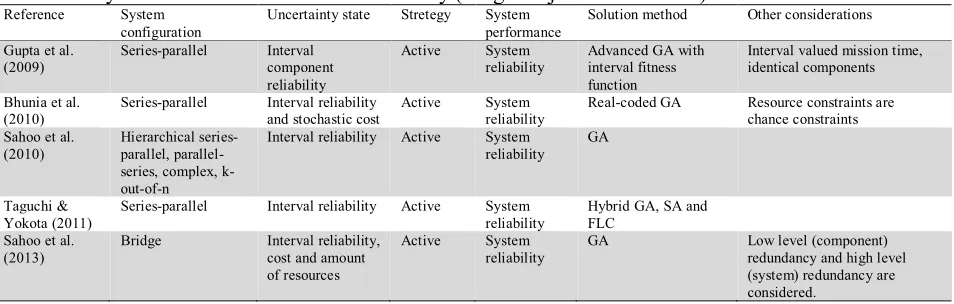
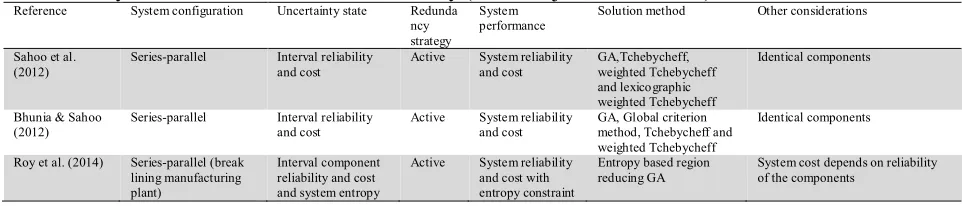
In the interval uncertainty it is assumed that just the information about the lower and upper bounds of the interval is known. Yokota et al. (1995) are the first who formulated the optimal design problem of system reliability as a nonlinear integer programming problem with interval coefficients. They transformed the problem into a bi-criteria 0-1 nonlinear programming problem without interval coefficients, and solve it directly through GA. In general, there are some ways to formulate interval reliability problems, which are maximization of the left bound and/or center of the interval (Yokota et al., 1996; Taguchi et al., 1998), nonlinear goal programming formulation (Taguchi et al., 1997), etc. There are some methods to deal with such problems such as GA (Taguchi & Gen, 1997; Yokota et al., 1996), hybrid GA and SA (Taguchi et al., 1998), Improved GA (Taguchi & Yokota, 1999), etc. Table 4 lists the related works after year 2000.
Table 4(a)
Redundancy allocation under interval uncertainty (Single objective Problems)
Reference System configuration
Uncertainty state Stretegy System performance
Solution method Other considerations
Gupta et al. (2009)
Series-parallel Interval component reliability
Active System reliability
Advanced GA with interval fitness function
Interval valued mission time, identical components
Bhunia et al. (2010)
Series-parallel Interval reliability and stochastic cost
Active System reliability
Real-coded GA Resource constraints are chance constraints Sahoo et al.
(2010)
Hierarchical series-parallel, parallel-series, complex, k-out-of-n
Interval reliability Active System reliability
GA
Taguchi & Yokota (2011)
Series-parallel Interval reliability Active System reliability
Hybrid GA, SA and FLC
Sahoo et al. (2013)
Bridge Interval reliability, cost and amount of resources
Active System reliability
GA Low level (component)
R.Soltani / International Journal of Industrial Engineering Computations 5 (2014)
Table 4(b)
Redundancy allocation under interval uncertainty (Multi-objective Problems)
Reference System configuration Uncertainty state Redunda ncy strategy
System performance
Solution method Other considerations
Sahoo et al. (2012)
Series-parallel Interval reliability and cost
Active System reliability and cost GA,Tchebycheff, weighted Tchebycheff and lexicographic weighted Tchebycheff Identical components
Bhunia & Sahoo (2012)
Series-parallel Interval reliability and cost
Active System reliability and cost
GA, Global criterion method, Tchebycheff and weighted Tchebycheff
Identical components
Roy et al. (2014) Series-parallel (break lining manufacturing plant)
Interval component reliability and cost and system entropy
Active System reliability and cost with entropy constraint
Entropy based region reducing GA
System cost depends on reliability of the components
2.1.2.3 Fuzzy Uncertainty
The concept of fuzzy reliability has been introduced and formulated in the book by Cai (1996). One form of fuzzy uncertainty is having flexible goals and constraints (e.g. Park, 1987). Another form is having imprecise data for components reliabilities/lifetimes, cost, weight, etc. Cheng and Mon (1993) used the α-cut of a triangular fuzzy number to get the interval and find the fuzzy reliability of the series system and the parallel system.
Table 5
Fuzzy uncertainty
Reference System
configuration
Uncertainty state
Strategy System performance Solution method Other considerations
Ravi et al. (2000) Series-parallel Fuzzy goals and constraints
Active System reliability, cost, weight and volume
A global optimization meta-heuristics (Threshold accepting)
Linear membership functions have been assumed for all the goals/objectives.
Zhao & Liu (2005)
Series-parallel Fuzzy lifetimes Standby Expected system lifetime, α-system lifetime, α-system reliability (EVM, CCP, DCP)
Integrated fuzzy simulation, NN and GA
Hou & Wu (2006)
Series-parallel Fuzzy reliability
Active System reliability Fuzzy simulation-based GA
Nonlinear chance constrained programing models and three goal programing models based on possibility and credibility measures
Mahapatra & ROY (2011)
Series-parallel Fuzzy reliability, cost and weight
Active System reliability Fuzzy parametric geometric programming Yao et al. (2008) Series, parallel Triangular
fuzzy numbers
Active System reliability signed distance method to defuzzify Lee et al. (2012) Parallel Level (λ,ρ)
interval-valued fuzzy numbers
Active System reliability signed distance method to defuzzify
Han et al. (2006) Flexible Manufacturing Cells
Triangular fuzzy numbers
- System reliability Fuzzy fault tree
Jameel & Radhi (2014)
Series-parallel Fuzzy reliability and flexible constraints
Active System reliability Penalty function mixed with Nelder and Mend’s algorithm
Multi-Objective
Sasaki & Gen (2003)
Series-parallel Fuzzy objectives Active System reliability and cost
Hybrid GA With Generalized upper bounding (GUB) structure
Chen & Liu(2011)
Series-parallel Type-2 fuzzy lifetime
Standby System lifetime and cost
Fuzzy Goal programming and Approximation approach based PSO
Switching device of the standby system is perfect
fuzzy numbers. Chen (1996) presented a method for fuzzy system reliability analysis based on fuzzy time series and the -cuts operations of fuzzy numbers. Hong et al. (1997) analyzed fuzzy system reliability by the use of t-norm based convolution of fuzzy arithmetic operation, where the reliability of each component is represented by L-R type fuzzy numbers. Table 5 lists other works after year 2000.
2.1.2.4 Intuitionistic fuzzy and vague sets
Kumar et al. (2011) extended the concept of fuzzy set by idea of triangular intuitionistic fuzzy sets (IFS) and proposed a general procedure to construct the membership function and non-membership function of the reliability function using intuitionistic fuzzy failure rate. The major advantage of using intuitionistic fuzzy sets over fuzzy sets is that intuitionistic fuzzy sets separate the positive and the negative evidence for the membership of an element in a set (Mahapatra & Roy, 2009).Table 6 lists the works related to intuitionistic fuzzy and vague sets.
Table 6
Intuitionistic fuzzy and vague sets
Reference System configuration Uncertainty state Redundancy strategy
System performance
Solution method Other considerations Kumar et al.
(2006)
Series, parallel, Marine power plant
Interval valued trapezoidal vague sets
Active System reliability
A method for analyzing the fuzzy
system reliability
An interval is considered for the grade of membership and non- membership of
an element (interval valued vague set) Chen (2003) Series, parallel,
series-parallel
Triangular vague set for components reliabilities
Active System reliability
A method based on the vague set theory
A real number in [0, 1] is considered for the grade of membership and non-
membership of an element Kumar et al.
(2007)
Series, parallel LR type interval valued triangular vague set for component reliability
Active System reliability
Tw (the weakest t norm) based arithmetic operation
The results are exact
Kumar & Yadav (2012)
Series, parallel Intuitionistic fuzzy failure rate
Active System reliability
Non-linear programming
techniques
Different types of intuitionistic fuzzy failure rate are considered. Mahapatra &
Roy (2009)
Series, parallel, electric network model
of dark room
Triangular intuitionistic fuzzy reliability
Active System reliability
(α, β)-cut
Pandey et al. (2011)
Series, parallel, web server
Triangular intuitionistic fuzzy reliability
Active System reliability
A method based on IFS theory Mahapatra &
Roy (2014)
Complex system Intuitionistic fuzzy cost Active System reliability
Intuitionistic fuzzy optimization method
2.1.2.5. Fuzzy-random Uncertainty
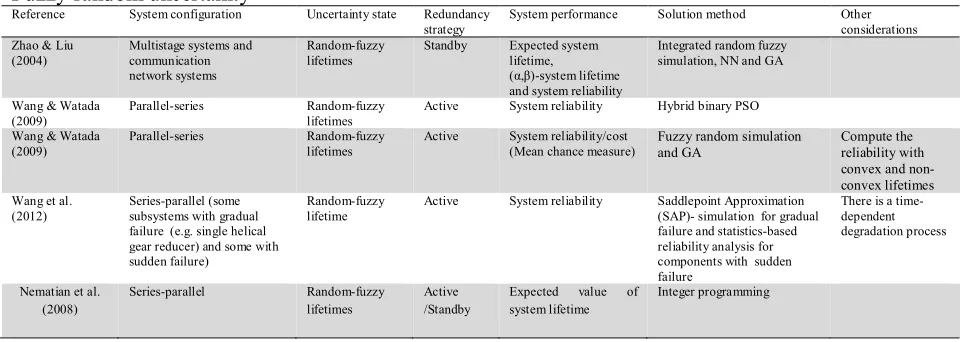
Due to subjective judgment, imprecise human knowledge and perception in capturing statistical data, the real data of lifetimes in many systems are both random and fuzzy in nature. Table 7 lists the related work to fuzzy-random uncertainty.
Table 7
Fuzzy-random uncertainty
Reference System configuration Uncertainty state Redundancy strategy
System performance Solution method Other
considerations Zhao & Liu
(2004)
Multistage systems and communication network systems
Random-fuzzy lifetimes
Standby Expected system lifetime, (α,β)-system lifetime and system reliability
Integrated random fuzzy simulation, NN and GA
Wang & Watada (2009)
Parallel-series Random-fuzzy
lifetimes
Active System reliability Hybrid binary PSO Wang & Watada
(2009)
Parallel-series Random-fuzzy
lifetimes
Active System reliability/cost (Mean chance measure)
Fuzzy random simulation and GA
Compute the reliability with convex and non-convex lifetimes
Wang et al. (2012)
Series-parallel (some subsystems with gradual failure (e.g. single helical gear reducer) and some with sudden failure)
Random-fuzzy lifetime
Active System reliability Saddlepoint Approximation (SAP)- simulation for gradual failure and statistics-based reliability analysis for components with sudden failure
There is a time-dependent degradation process
Nematian et al. (2008)
Series-parallel Random-fuzzy
lifetimes
Active /Standby
Expected value of system lifetime
R.Soltani / International Journal of Industrial Engineering Computations 5 (2014)
2.1.2.6 Robust optimization
Robust approaches are based on the idea that the resulted robust solution would be immune against different realizations of uncertain parameters. There are two main robustness measures: one based on regret (e.g. Feizollahi & Modarres, 2012; Soltani et al., 2013) and the other one based on the realized performance (Feizollahi et al., 2014; Soltani & Sadjadi, 2014). Table 8 lists the existing works in the literature. Amongst the works, just one work, i.e. the work by Soltani et al. (2013) considers cold standby strategy and more researches are needed with respect to redundancy strategy. The author has currently an under review work considering the redundancy strategy choices. Developing other robust optimization techniques is of interest and the author is currently working on this subject matter.
Table 8
Robust RAP
Reference System configuration Uncertainty state Redundancy strategy System performance Solution method Feizollahi & Modarres
(2012)
Series- parallel Interval uncertainty Active Min-Max regret of System reliability
MIP and Benders decomposition Soltani et al. (2013) Series- parallel Interval uncertainty Cold standby Min-Max regret of System
reliability
Benders decomposition, GA and Enumeration method
Soltani & Sadjadi (2014) Series- parallel Fuzzy uncertainty Active Expected value and variance of the system reliability
Branch and cut Feizollahi et al. (2014) Series- parallel Budgeted uncertainty Active System reliability MIP and Benders
decomposition
2.1.2.7 Chaos uncertainty
Chaos means the oscillations, which seem random but in fact they are generated by the deterministic nonlinear model. The idea of chaos theory application in the reliability modeling appears in Zou and Li (2001). The integration of fuzzy reliability model with the phase portraits of variables creates preconditions for the construction of phase portrait reflecting the system reliability dynamics (Rotshtein et al., 2012). To the best of our knowledge, in the area of RAP just one work for chaos uncertainty has been reported as presented in Table 9 and more researches in this area would be interesting.
Table 9
Chaos uncertainty for RAP
Reference System
configuration
Uncertainty state Redundancy strategy System performance Solution method Other considerations
Rotshtein et al. (2012)
Series-parallel Deterministic Active System reliability GA Integration of fuzzy logic and
chaos theory
2.2 Multi-level redundancy (Modular redundancy)
lists the related works to multi-level or modular redundancy. To the best of our knowledge, just one work, i.e. the work by Pourdarvish and Ramezani (2013), considers cold standby redundancy. Therefore, more researches on redundancy strategy are needed. More researches are also required in the area of multi-objective multi-level redundancy. Non-deterministic multi-level redundancy is an interesting area too.
Table 10
Multi-level redundancy
Reference System configuration Uncertainty state Redundancy strategy
System performance
Solution method Other considerations Yun & Kim (2004) Multi-level series Deterministic Active System
reliability
Heuristic and GA Only one unit can be used in a direct line
Yun et al. (2007) Multiple multi-level series (hierarchical structure)
Deterministic Active System
reliability
Simple GA (SGA) If an item is used, all its sibling items should be used or its function should be satisfied by the corresponding child items. Jang & Kim (2011) Multiple multi-level Deterministic Active System
reliability
TS TS of memory-based
mechanisms that balances intensification with diversification via the short-term and long-short-term memory Kumar et al. (2009a) Multilevel series and
series– parallel
Deterministic Active System
reliability
Hierarchical GA
Yeh (2009) Multiple multi-level Deterministic Active System
reliability
Two stage discrete PSO (2DPSO)
Assumptions of Yun et al. (2007) hold.
Wang et al. (2010a) Multilevel redundancy Deterministic Active System reliability
Memetic algorithm with breadth-first crossover and breadth-first mutation Wang et al. (2010b) Multilevel redundancy Deterministic Active System
reliability PSO
He et al (2013) Multilevel redundancy Deterministic Active System
reliability
Hybrid GA based on the two dimensional redundancy encoding mechanism Pourdarvish & Ramezani
(2013)
Multilevel redundancy Deterministic Cold standby System reliability
MA and Hierarchical GA
Multi-objective Problems Kumar et al. (2009 b) Multilevel redundancy Deterministic Active System
reliability and cost
MOHGA including SPEA2 and NSGA-II
2. Reliability Allocation
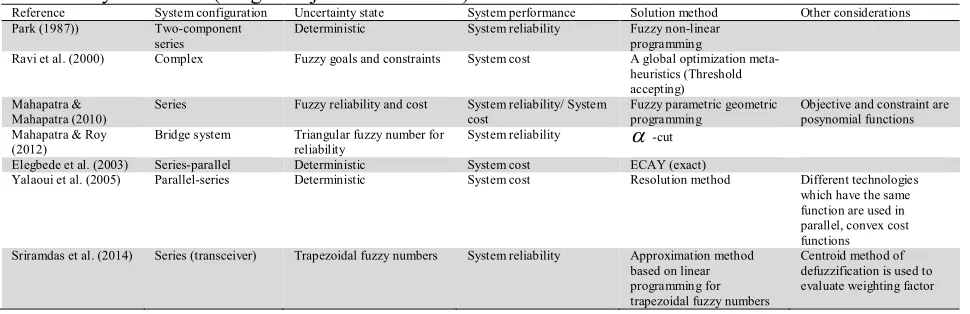
The reliability allocation problems assume fix or known redundancy levels and they aim at determining the reliability levels. There are some methods for determining reliability levels such as Hooke and Jeeves (H-J) pattern search(Tillman et al., 1977), GAG2 (Gopal et al., 1980), to name a few. For more study on these methods, the readers can view the work by Tillman (1985). Table 11 lists the reliability allocation models existed in the literature.
Table 11(a)
Reliability allocation (Single Objective Problems)
Reference System configuration Uncertainty state System performance Solution method Other considerations Park (1987)) Two-component
series
Deterministic System reliability Fuzzy non-linear programming
Ravi et al. (2000) Complex Fuzzy goals and constraints System cost A global optimization meta-heuristics (Threshold accepting) Mahapatra &
Mahapatra (2010)
Series Fuzzy reliability and cost System reliability/ System cost
Fuzzy parametric geometric programming
Objective and constraint are posynomial functions Mahapatra & Roy
(2012)
Bridge system Triangular fuzzy number for reliability
System reliability -cut
Elegbede et al. (2003) Series-parallel Deterministic System cost ECAY (exact)
Yalaoui et al. (2005) Parallel-series Deterministic System cost Resolution method Different technologies which have the same function are used in parallel, convex cost functions Sriramdas et al. (2014) Series (transceiver) Trapezoidal fuzzy numbers System reliability Approximation method
based on linear programming for trapezoidal fuzzy numbers
R.Soltani / International Journal of Industrial Engineering Computations 5 (2014)
Table 11(b)
Reliability allocation (Multi Objective Problems)
Reference System configuration Uncertainty state System performance Solution method Other considerations
Sakawa & Yano (1985)
Series (standby) L-R type fuzzy numbers for DM’s judgment
System reliability, Cost, weight, volume and the product of weight and volume
Fuzzy sequential proxy optimization technique (FSPOT)
Reliability of switch is one, the state of components are independent of each other
Huang et al. (2005) Series-parallel Deterministic System reliability, Cost and weight
IIMOM and ANN Mahapatra & Roy
(2006)
Series, complex Generalized fuzzy set System reliability, Cost Fuzzy multi-objective mathematical programming Mahapatra & Roy
(2006)
Series Crisp/fuzzy cost and
flexible constraints
System reliability/ Cost Fuzzy parametric geometric programming Mahapatra et al.
(2010)
LCD display system Deterministic System reliability and Cost Intuitionistic fuzzy programming
As observed, the problem of reliability allocation has gained less attention amongst researchers in comparison with RAP or RRAP. The uncertainty type considered in the literature for this kind of problem is of fuzzy uncertainty. Considering other forms of uncertainty can be an interesting research area.
3. Reliability- Redundancy Allocation
The reliability-redundancy problem was initially introduced by Misra and Ljubojevic (1973). They treated the number of redundancies as real variables and solved the problem as a reliability allocation problem by using Lagrange multipliers. A trial and error approach was used afterward to obtain the integer solution for the number of redundancies. The problem has been studied on four typical system configurations such as series, series-parallel, complex and over-speed protection system for a gas turbine. The aim is to determine reliability levels and redundancy levels to maximize system reliability subject to constraints on cost, weight and volume usually in nonlinear forms. The techniques for solving RRAP mainly combine the methods for reliability allocation and the methods for redundancy allocation. Tillman et al. (1977) were among the first to solve RRAP using THK method, which is based on a combination of Hooke-Jeeves (H-J) pattern search (Hooke & Jeeves, 1961) for reliability allocation and the Aggrawal-Gupta-Misra (A-G-M) greedy heuristic (Aggrawal et al., 1975) for redundancy allocation in a series-parallel system. Other combinations include H-J&GAG (Gopal et al., 1978), J&S-V (Sharama & Venkateswaran, 1971), J&N-N (Nakagawa & Nakashima, 1977), H-J&K-I (Kohda & Inoue, 1982), GAG2 (Gopal et al., 1980) and GAG, GAG2&S-V, GAG2&NN,
GAG2&K-I, where the first heuristic finds reliability levels and the second heuristic finds redundancy
Table 12(a)
Reliability- Redundancy Allocation (Single Objective Problems)
Reference System configuration Uncertainty state Redundancy
strategy
System performance Solution method
Sun et al. (2001) Bridge, network Deterministic Active System reliability/cost Convexification method (exact) Lee et al. (2002a),
(2002b)
Deterministic Active System reliability Hybrid NN-GA with FLC
Ha & Kuo (2005) Series, bridge Deterministic Active System reliability Scaling method based on multi-path iterative heuristic
Liu (2006) Series-parallel, k-out-of-n:G
Deterministic Active/standby System reliability/cost A combination method including Hooke–Jeeves pattern search and dynamic programming, applying dominating sequences Kim et al. (2006) Series, series-parallel,
complex (bridge)
Deterministic Active System reliability SA
Mori et al. (2007) Series-parallel Deterministic Active System reliability Hybrid SA-GA
Chen (2006) Series, series-parallel, complex and over-speed protection system
Deterministic Active System reliability IA
Hsieh & You (2011) Series, series-parallel, complex and over-speed protection system
Deterministic Active System reliability IA based two-phase
Coelho (2009) Over-speed protection system for a gas turbine
Deterministic Active System reliability DE based on chaotic sequences using Lozi’s map
Coelho et al. (2009) Over-speed protection system for a gas turbine
Deterministic Active System reliability HS with DE
Zou et al. (2010) Complex (bridge), Over-speed protection system for a gas turbine, large scale system
Deterministic Active System reliability NGHS
Zou et al. (2011) Complex (bridge), Over-speed protection system for a gas turbine
Deterministic Active System reliability EGHS (hybrid HS-PSO)
Wang & Li (2012) Series, series-parallel, complex and over-speed protection system
Deterministic Active System reliability DE and HS
Yeh & Hsieh(2011) Series, series-parallel, complex and over-speed protection system
Deterministic Active System reliability ABC
Garg et al. (2013) Series, series-parallel, complex, over-speed protection system, Life support system in a space capsule
Deterministic Active System
reliability/system cost
Two phase algorithm including ABC
Afonso et al. (2013) Series, series-parallel, complex and over-speed protection system
Deterministic Active System reliability Modified ICA
Coelho (2009b) Series, series-parallel and over-speed protection system
Deterministic Active System reliability SOMA with a Gaussian operator
Zia & Coit (2010) Series-parallel Deterministic Active System reliability Column Generation
Coelho (2009) Complex (bridge), over-speed protection system
Deterministic Active System reliability PSO-GC
Wu et al. (2011) Series, series-parallel, complex, over-speed protection system, large scale system
Deterministic Active System reliability Improved PSO (IPSO)
Garg & Sharma (2013) Pharmaceutical Plant Deterministic Active System reliability PSO Tan et al. (2013) series, series-parallel,
complex (bridge), Over-speed protection
Deterministic Active System reliability DE-PSO with chaotic local search
Zhang et al. (2013) series, series-parallel, complex (bridge), Over-speed protection, large scale
Deterministic Active System reliability Hybrid HS/ LXPM –IPSO with
Golden search (GS)
Valian & Valian (2013) series, series-parallel, complex (bridge), Over-speed protection, large scale system
Deterministic Active System reliability Cuckoo search by Lévy flights
Valian et al. (2013) series, series-parallel, complex (bridge), Over-speed protection, large scale system
Deterministic Active System reliability Improved cuckoo search
Kanagaraj et al. (2013) series, series-parallel, complex (bridge), Over-speed protection
Deterministic Active System reliability Hybrid cuckoo search-GA
Ardakan & Hamadani (2014)
series, series-parallel, complex (bridge)
Deterministic Cold standby System reliability Modified GA Mahato et al. (2012) Complex bridge system,
over speed protection system for a gas turbine
R.Soltani / International Journal of Industrial Engineering Computations 5 (2014)
Table 12(b)
Reliability- Redundancy Allocation (Multi Objective Problems)
Reference System configuration Uncertainty state Redundancy
strategy
System performance Solution method Huang (2004) Over-speed protection
system for a gas turbine
Deterministic Active Reliability, cost and
weight
Interactive physical programming Ebrahimipour &
Sheikhalishahi (2012)
Series-bridge Triangular fuzzy reliability
Active System reliability and cost considering price discounting
MOPSO
Sheikhalishahi et al. (2013)
series, series–parallel, and complex (bridge)
Deterministic Active System reliability, cost, weight and volume
hybrid GA-PSO Mutingi & Mapfaira
(2013)
Series Fuzzy goals and
constraints
Active System reliability and cost
Fuzzy multi-objective GA Garg & Sharma (2013) Series–parallel
(pharmaceutical plant)
Intuitionistic fuzzy reliability and flexible constraints
Active System reliability and cost
MOPSO
Garg et al. (2014) Series-parallel, Complex Bridge, Over-speed protection
Triangular fuzzy reliability
Active System reliability and cost
PSO
Garg et al. (2014) Series-parallel, Complex Intuitionistic fuzzy reliability
Active System reliability and cost
Intuitionistic fuzzy programming technique and PSO
4. Concluding remarks
In the present research, three types of reliability optimization methods including redundancy allocation, reliability allocation and reliability-redundancy allocation have been investigated from different perspectives, which have been collected in a table format. Since the area of the reliability optimization problems is vast and so many works have been carried out in this area, the focus of this study has been on binary state non-repairable systems and the problems have been categorized with respect to different criteria. Scholars and researchers who wish to study on each of the mentioned area, need to flashback to the initial works and see the changing trend of the subjects from the scratch so that they can perceive the need for developing new models and methods in reliability. For this purpose, for each area the author has tried to have a quick review on early works and for each classification some of the prominent works in the literature have been introduced so that the interested readers can refer them and find other related papers to study in depth. This study has classified the literature in a novel way and at the end of each classification research guides for further researches have been proposed to help researchers and seems like the same is needed for multistate and/or repairable systems.
References
Abouei Ardakan, M., & Zeinal Hamadani, A. (2014). Reliability–redundancy allocation problem with cold-standby redundancy strategy. Simulation Modelling Practice and Theory, 42, 107-118.
Afonso, L. D., Mariani, V. C., & dos Santos Coelho, L. (2013). Modified imperialist competitive algorithm based on attraction and repulsion concepts for reliability-redundancy optimization. Expert
Systems with Applications, 40(9), 3794-3802.
Aggarwal, K. K., Gupta, J. S., & Misra, K. B. (1975). A new heuristic criterion for solving a redundancy optimization problem. Reliability, IEEE Transactions on, 24(1), 86-87.
Ahmadizar, F., & Soltanpanah, H. (2011). Reliability optimization of a series system with multiple-choice and budget constraints using an efficient ant colony approach. Expert systems with
Applications, 38(4), 3640-3646.
Amari, S. V., & Dill, G. (2010, January). Redundancy optimization problem with warm-standby
redundancy. In Reliability and Maintainability Symposium (RAMS), 2010 Proceedings-Annual (pp.
1-6). IEEE.
Azizmohammadi, R., Amiri, M., Tavakkoli-Moghaddam, R., & Mohammadi, M. (2013). Solving a Redundancy Allocation Problem by a Hybrid Multi-objective Imperialist Competitive Algorithm. International Journal of Engineering (1025-2495), 26(9).
Barlow, R. E., & Proschan, F. (1975). Statistical theory of reliability and life testing: probability
Beji, N., Jarboui, B., Eddaly, M., & Chabchoub, H. (2010). A hybrid particle swarm optimization algorithm for the redundancy allocation problem. Journal of Computational Science, 1(3), 159-167. Bellman, R., & Dreyfus, S. (1958). Dynamic programming and the reliability of multicomponent
devices. Operations Research, 6(2), 200-206.
Bhunia, A. K., Sahoo, L., & Roy, D. (2010). Reliability stochastic optimization for a series system with interval component reliability via genetic algorithm.Applied Mathematics and Computation, 216(3), 929-939.
Bhunia, A. K., & Sahoo, L. (2012). Optimization of Constrained Multi-objective Reliability Problems with Interval Valued Reliability of Components via Genetic Algorithm. Indian Journal of Industrial
and Applied Mathematics, 3(1s), 25-44.
Billionnet, A. (2008). Redundancy allocation for series-parallel systems using integer linear programming. Reliability, IEEE Transactions on, 57(3), 507-516.
Boland, P. J., & El-Neweihi, E. (1995). Component redundancy vs system redundancy in the hazard rate ordering. Reliability, IEEE Transactions on,44(4), 614-619.
Bulfin, R. L., & Liu, C. Y. (1985). Optimal allocation of redundant components for large systems. Reliability, IEEE Transactions on, 34(3), 241-247.
Cai, K. Y. (1996). Introduction to fuzzy reliability. Springer.
Cao, D., Murat, A., & Chinnam, R. B. (2013). Efficient exact optimization of multi-objective redundancy allocation problems in series-parallel systems.Reliability Engineering & System
Safety, 111, 154-163.
Chambari, A., Rahmati, S. H. A., & Najafi, A. A. (2012). A bi-objective model to optimize reliability and cost of system with a choice of redundancy strategies.Computers & Industrial
Engineering, 63(1), 109-119.
Chambari, A., Najafi, A. A., Rahmati, S. H. A., & Karimi, A. (2013). An efficient simulated annealing algorithm for the redundancy allocation problem with a choice of redundancy strategies. Reliability
Engineering & System Safety, 119, 158-164.
Chen, S. M. (1996). New method for fuzzy system reliability analysis.Cybernetics & Systems, 27(4), 385-401.
Chen, S. M. (2003). Analyzing fuzzy system reliability using vague set theory.International Journal of
Applied Science and Engineering, 1(1), 82-88.
Chen, S. M. (1994). Fuzzy system reliability analysis using fuzzy number arithmetic operations. Fuzzy
Sets and Systems, 64(1), 31-38.
Chen, T. C., & You, P. S. (2005). Immune algorithms-based approach for redundant reliability problems with multiple component choices. Computers in Industry, 56(2), 195-205.
Chen, Y., & Liu, Y. (2011). Standby redundancy optimization with type-2 fuzzy lifetimes. In Advances
in Swarm Intelligence (pp. 329-337). Springer Berlin Heidelberg.
Chen, T. C. (2006). IAs based approach for reliability redundancy allocation problems. Applied
Mathematics and Computation, 182(2), 1556-1567.
Cheng, C. H., & Mon, D. L. (1993). Fuzzy system reliability analysis by interval of confidence. Fuzzy
Sets and Systems, 56(1), 29-35.
Chern, M. S. (1992). On the computational complexity of reliability redundancy allocation in a series system. Operations Research Letters, 11(5), 309-315.
Coelho, L. D. S., de Andrade Bernert, D. L., & Mariani, V. C. (2009, October). A harmony search algorithm combined with differential operator applied to reliability-redundancy optimization.
In Systems, Man and Cybernetics, 2009. SMC 2009. IEEE International Conference on (pp.
5215-5219). IEEE.
Coelho, L. D. S. (2009). An efficient particle swarm approach for mixed-integer programming in reliability–redundancy optimization applications. Reliability Engineering & System Safety, 94(4), 830-837.
R.Soltani / International Journal of Industrial Engineering Computations 5 (2014)
Coelho, L. D. S. (2009). Self-organizing migrating strategies applied to reliability-redundancy optimization of systems. Reliability, IEEE Transactions on, 58(3), 501-510.
Coit, D. W., & Smith, A. E. (1996). Reliability optimization of series-parallel systems using a genetic algorithm. Reliability, IEEE Transactions on, 45(2), 254-260.
Coit, D. W., & LIU, J. C. (2000). System reliability optimization with k-out-of-n subsystems. International Journal of Reliability, Quality and Safety Engineering,7(02), 129-142. Coit, D. W., & Smith, A. E. (2002). Genetic algorithm to maximize a lower-bound for system
time-to-failure with uncertain component Weibull parameters.Computers & Industrial Engineering, 41(4), 423-440.
Coit, D. W., & Smith, A. E. (1996). Reliability optimization of series-parallel systems using a genetic algorithm. Reliability, IEEE Transactions on, 45(2), 254-260.
Coit, D. W., & Smith, A. E. (1996). Solving the redundancy allocation problem using a combined neural network/genetic algorithm approach. Computers & Operations Research, 23(6), 515-526.
Coit, D. W., & Konak, A. (2006). Multiple weighted objectives heuristic for the redundancy allocation problem. Reliability, IEEE Transactions on, 55(3), 551-558.
Coit, D. W. (2001). Cold-standby redundancy optimization for nonrepairable systems. IIE
Transactions, 33(6), 471-478.
Coit, D. W. (2003). Maximization of system reliability with a choice of redundancy strategies. IIE
transactions, 35(6), 535-543.
Coit, D. W., & Smith, A. E. (1996). Penalty guided genetic search for reliability design optimization. Computers & industrial engineering, 30(4), 895-904.
Coit, D. W., Jin, T., & Wattanapongsakorn, N. (2004). System optimization with component reliability estimation uncertainty: a multi-criteria approach. Reliability, IEEE Transactions on, 53(3), 369-380. Dhingra, A. K. (1992). Optimal apportionment of reliability and redundancy in series systems under
multiple objectives. Reliability, IEEE Transactions on,41(4), 576-582.
Dinghua, S., (1987). A new heuristic algorithm for constrained redundancy-optimization in complex systems, IEEE Trans on Reliability, 36, 621-623.
Djerdjour, M., & Rekab, K. (2001). A branch and bound algorithm for designing reliable systems at a minimum cost. Applied Mathematics and Computation,118(2), 247-259.
EbrahimNezhad Moghadam Rashti, M., Vishkaei, B. M., & Esmaeilpour, R. (2012). A Memtic genetic algorithm for a redundancy allocation problem.International Journal of Applied Operational
Research-An Open Access Journal,2(2), 49-57.
EbrahimNezhad, M., Vishkaei, B. M., Pasandideh, H. R., & Safari, J. (2011). Increasing the Reliability and the Profit in a Redundancy Allocation Problem. International Journal of Applied Operational
Research, 1(2), 57-64.
Ebrahimipour, V., Haeri, A., Sheikhalishahi, M., Asadzadeh, S. M. (2012) Application of Multi-Objective Particle Swarm Optimization to Solve a Fuzzy Multi-Multi-Objective Reliability Redundancy Allocation Problem. Journal of Safety Engineering, 1(2), 26-38.
Elegbede, A. C., Chu, C., Adjallah, K. H., & Yalaoui, F. (2003). Reliability allocation through cost minimization. Reliability, IEEE Transactions on, 52(1), 106-111.
Federowicz, A. J., & Mazumdar, M. (1968). Use of geometric programming to maximize reliability achieved by redundancy. Operations Research, 16(5), 948-954.
Feizollahi, M. J., & Modarres, M. (2012). The robust deviation redundancy allocation problem with interval component reliabilities. Reliability, IEEE Transactions on, 61(4), 957-965.
Feizollahi, M. J., Ahmed, S., & Modarres, M. (2014)The Robust Redundancy Allocation Problem in Series-Parallel Systems With Budgeted Uncertainty. Reliability, IEEE Transactions on, 8(1), 239-250.
Fyffe, D. E., Hines, W. W., & Lee, N. K. (1968). System reliability allocation and a computational algorithm, IEEE Transactions on Reliability, R-17, 64-69.
Garg, H., Rani, M., & Sharma, S. P. (2013). An efficient two phase approach for solving reliability– redundancy allocation problem using artificial bee colony technique. Computers & Operations
Garg, H. A. R. I. S. H., & Sharma, S. P. (2013). Reliability redundancy allocation problem of pharmaceutical plant. Journal of Engineering Science and Technology, 8(2), 190-198.
Garg, H., & Sharma, S. P. (2013). Multi-objective reliability-redundancy allocation problem using particle swarm optimization. Computers & Industrial Engineering, 64(1), 247-255.
Garg, H., Rani, M., Sharma, S. P., & Vishwakarma, Y. (2014). Bi-objective optimization of the reliability-redundancy allocation problem for series-parallel system. Journal of Manufacturing
Systems, In Press, Available online.
Garg, H., Rani, M., Sharma, S. P., & Vishwakarma, Y. (2014). Intuitionistic fuzzy optimization technique for solving multi-objective reliability optimization problems in interval environment. Expert Systems with Applications, 41(7), 3157-3167.
Ghare, P.M. and Taylor, R.E. (1969) Optimal redundancy for reliability in series system. Operations
Research, 17, 838–847.
Gopal, K., Aggarwal, K. K., & Gupta, J. S. (1978). An improved algorithm for reliability optimization. Reliability, IEEE Transactions on, 27(5), 325-328.
Gopal, K., Aggarwal K. K., & Gupta J. S. (1980). A new method for solving reliability optimization problem, IEEE Transactions on Reliability, R-29, 36-38.
Govil, K. K. (1983). Geometric programming method for optimal reliability allocation for a series system subject to cost constraint. Microelectronics Reliability, 23(5), 783-784.
Govil, K. K., & Agarwala, R. A. (1983). Lagrange multiplier method for optimal reliability allocation in a series system. Reliability Engineering, 6(3), 181-190.
Gupta, R. K., Bhunia, A. K., & Roy, D. (2009). A GA based penalty function technique for solving constrained redundancy allocation problem of series system with interval valued reliability of components. Journal of Computational and Applied Mathematics, 232(2), 275-284.
Ha, C. (2004). Reliability-yield allocation for semiconductor integrated circuits: modeling and
optimization (Doctoral dissertation, Texas A&M University).
Ha, C., & Kuo, W. (2005). Multi-path approach for reliability-redundancy allocation using a scaling method. Journal of Heuristics, 11(3), 201-217.
Han, B. T., Zhang, C. B., Sun, C. S., & Xu, C. J. (2006). Reliability analysis of flexible manufacturing cells based on triangular fuzzy number. Communications in Statistics—Theory and Methods, 35(10), 1897-1907.
He, P., Wu, K., Xu, J., Wen, J., & Jiang, Z. (2013). Multilevel redundancy allocation using two dimensional arrays encoding and hybrid genetic algorithm.Computers & Industrial
Engineering, 64(1), 69-83.
Hikita, M., Nakagawa, Y., Nakashima, K., & Narihisa, H. (1992). Reliability optimization of systems by a surrogate-constraints algorithm. Reliability, IEEE Transactions on, 41(3), 473-480.
Hou, F., & Wu, Q. (2006). Genetic algorithm-based redundancy optimization problems in fuzzy framework. Communications in Statistics—Theory and Methods, 35(10), 1931-1941.
Hong, D. H., & Do, H. Y. (1997). Fuzzy system reliability analysis by the use of Tw (the weakest t-norm) on fuzzy number arithmetic operations. Fuzzy Sets and Systems, 90(3), 307-316.
Hooke, R., & Jeeves, T. A. (1961). ``Direct Search''Solution of Numerical and Statistical Problems. Journal of the ACM (JACM), 8(2), 212-229.
Hsieh, T. J., & Yeh, W. C. (2012). Penalty guided bees search for redundancy allocation problems with a mix of components in series–parallel systems.Computers & Operations Research, 39(11), 2688-2704.
Hsieh, Y. C., Chen, T. C., & Bricker, D. L. (1998). Genetic algorithms for reliability design problems. Microelectronics Reliability, 38(10), 1599-1605.
Hsieh, Y. C. (2003). A linear approximation for redundant reliability problems with multiple component choices. Computers & industrial engineering, 44(1), 91-103.
R.Soltani / International Journal of Industrial Engineering Computations 5 (2014)
Hsieh, Y. C. (2002). A two-phase linear programming approach for redundancy allocation problems. The Yugoslav Journal of Operations Research ISSN: 0354-0243 EISSN: 2334-6043, 12(2).
Huang, H. Z., TIAN, Z. G., & GU, Y. K. (2004). Reliability and redundancy apportionment optimization using interactive physical programming. International Journal of Reliability, Quality
And Safety Engineering, 11(03), 213-222.
Huang, H. Z., Tian, Z., & Zuo, M. J. (2005). Intelligent interactive multiobjective optimization method and its application to reliability optimization. IIE Transactions, 37(11), 983-993.
Jacobson, D. W., & Arora, S. R. (1996, January). Simultaneous allocation of reliability & redundancy using simplex search. In Reliability and Maintainability Symposium, 1996 Proceedings.
International Symposium on Product Quality and Integrity., Annual (pp. 243-250). IEEE.
Jameel, A. F., Radhi, A. Z. (2014). Solution of Fuzzy Redundancy Reliability Optimization Problem by Modified Penalty Function Method. International Journal of Modern Mathematical Sciences, 10(1), 60-74.
Jang, K. W., & Kim, J. H. (2011). A tabu search for multiple multi-level redundancy allocation problem in series-parallel systems. International Journal of Industrial Engineering, 18(3).
Jianping, L. (1996). A bound heuristic algorithm for solving reliability redundancy optimization. Microelectronics Reliability, 36(3), 335-339.
Jianping, L. I., & Xishen, J. (1997). A new partial bound enumeration technique for solving reliability redundancy optimization. Microelectronics Reliability, 37(2), 237-242.
Kanagaraj, G., Ponnambalam, S. G., & Jawahar, N. (2013). A hybrid cuckoo search and genetic algorithm for reliability–redundancy allocation problems. Computers & Industrial
Engineering, 66(4), 1115-1124.
Khalili‐Damghani, K., Abtahi, A. R., & Tavana, M. (2013). A Decision Support System for Solving Multi‐Objective Redundancy Allocation Problems. Quality and Reliability Engineering
International.
Khalili-Damghani, K., & Amiri, M. (2012). Solving binary-state multi-objective reliability redundancy allocation series-parallel problem using efficient epsilon-constraint, multi-start partial bound enumeration algorithm, and DEA. Reliability Engineering & System Safety, 103, 35-44.
Khalili-Damghani, K., Abtahi, A. R., & Tavana, M. (2013). A new multi-objective particle swarm optimization method for solving reliability redundancy allocation problems. Reliability Engineering
& System Safety, 111, 58-75.
Kim, J. H., & Yum, B. J. (1993). A heuristic method for solving redundancy optimization problems in complex systems. Reliability, IEEE Transactions on,42(4), 572-578.
Kim, H. G., Bae, C. O., & Park, D. J. (2006). Reliability-redundancy optimization using simulated annealing algorithms. Journal of Quality in Maintenance Engineering, 12(4), 354-363.
Kim, H., Bae, C., and Park, S., (2004). Simulated Annealing Algorithm for Redundancy Optimization with Multiple Component Choices, In Advanced Reliability Modeling, Proceedings of the Asian
International Workshop, World Scientific, 237–244.
Kim, K. O., & Kuo, W. (2003). Percentile life and reliability as performance measures in optimal
system design. IIE Transactions, 35(12), 1133-1142.
Kohda, T., & Inoue K. (1982). A reliability optimization method for complex system with the criterion local optimality, IEEE Transactions on Reliability, R-31, 109-111.
Kulturel-Konak, S., Coit, D. W., & Baheranwala, F. (2008). Pruned Pareto-optimal sets for the system redundancy allocation problem based on multiple prioritized objectives. Journal of
Heuristics, 14(4), 335-357.
Kulturel-Konak, S., Smith, A. E., & Coit, D. W. (2003). Efficiently solving the redundancy allocation problem using tabu search. IIE transactions, 35(6), 515-526.