R E S E A R C H
Open Access
Newly developed quantitative transactivation
system shows difference in activation by
Vitis
CBF
transcription factors on DRE/CRT elements
Annette Nassuth
*, Mahbuba Siddiqua, Huogen Xiao, Michelle A Moody and Chevonne E Carlow
Abstract
Background:Agroinfiltration-based transactivation systems can determine if a protein functions as a transcription factor, and via which promoter element. However, this activation is not always a yes or no proposition. Normalization for variation in plasmid delivery into plant cells, sample collection and protein extraction is desired to allow for a quantitative comparison between transcription factors or promoter elements.
Results:We developed new effector and reporter plasmids which carry additional reporter genes, as well as a procedure to assay all three reporter enzymes from a single extract. The applicability of these plasmids was demonstrated with the analysis of CBF transcription factors and their target promoter sequence, DRE/CRT. Changes in the core DRE/CRT sequence abolished activation byVitisCBF1 orVitisCBF4, whereas changes in the surrounding sequence lowered activation byVitisCBF1 but much less so forVitisCBF4. The system also detected a reduction in activation due to one amino acid change inVitisCBF1.
Conclusions:The newly developed effector and reporter plasmids improve the ability to quantitatively compare the activation on two different promoter elements by the same transcription factor, or between two different transcription factors on the same promoter element. The quantitative difference in activation by VrCBF1 and VrCBF4 on various DRE/ CRT elements support the hypothesis that these transcription factors have unique roles in the cold acclimation process.
Keywords:CBF, DRE/CRT, Agroinfiltration normalization, Transactivation effector and reporter plasmids
Background
Transient transactivation systems have been developed to evaluate the activation of different promoters by transcription factors. They have been used successfully to analyze relative promoter strengths [1,2], which are reportedly similar to those in transgenic systems [3]. Transient expression systems are preferred for the analysis of the sequence targeted by a transcription factor because genes that are directly activated by the transcription factor will produce transcripts within the time period between infiltration and harvest, whereas genes that are indirectly activated will take a longer time. Synthetic promoters containing (multiple copies of ) defined regulatory elements are often used to avoid complications due to a combinatorial effect
of various elements in a natural promoter, and have allowed the confirmation of cis-regulatory elements important for promoter activation by pathogens [4,5].
DNA from promoter- and transcription factor-plasmids of interest have been introduced into plant cells by a wide variety of means but the most successful methods involve electroporation or PEG treatment for introduction into protoplasts [6-8], and particle bombardment [9,10] or agroinfiltration for introduction into plant tissues [11,12]. Studies on grape genes have employed particle bombardment of grapevine callus to investigate transactiva-tion by transcriptransactiva-tion factors [13] and, with varying success, vacuum infiltration of grapevine leaves fromin vitrogrown plants to investigate gene function in fungal defense [14,15] or agroinfiltration to study subcellular localization [16] or silencing constructs [17].
The CBF pathway in plants ultimately results in the expression of cold regulated (COR) genes which encode proteins that are thought to help the plant survive frost * Correspondence:[email protected]
Department of Molecular and Cellular Biology, University of Guelph, Guelph, Ontario N1G 2 W1, Canada
[18,19]. The name of the pathway derives from CBFs (CRT binding factors), the transcription factors initially discovered in Arabidopsis to be directly responsible for the activation of manyCORgenes at low temperatures by binding to CRT (defined as GCCGAC) elements in their promoters [20,21]. The same proteins were also discovered as DRE-binding transcription factors 1 (DREB1s), reported to bind to drought responsive elements (DRE; defined as TACCGACAT) [22,23]. As a result reference is often made to CBF/DREB1 factors (AtCBF1/DREB1B, AtCBF2/ DREB1A, AtCBF3/DREB1C) that bind to CRT/DRE elements with the sequence A/GCCGAC [18]. CBF/DREB1 proteins have now been reported for a wide variety of plants [19,24] and these appear to also bind and activate via the CRT/DRE sequence. However, not all CBF proteins have the same affinity and specificity for a certain CRT sequence. For example, theBrassica napusBNCBF17 has a lower sequence binding specificity than BNCBF5 [25] whereas the barley HvCBF1 has a binding preference for an element, TTGCCGACAT, containing the GCCGAC (CRT) core sequence over a sequence with the ACCGAC (DRE) core [26]. The results with Chrysanthemum DREB1A- or DREB1B-overexpressing Arabidopsis showed that these CBFs activate different, overlapping regulons, which is in agreement with preferences of these CBF-like proteins for different promoter elements [27]. Also analysis of the promoters from genes that were induced in AtCBF-overexpressing Arabidopsis revealed that variations in the sequence surrounding the CRT element might affect activation by various CBFs [28,29]. Together these results suggest that different CBF paralogs in a plant, and possibly orthologs from different species, have unique preferences for CRT-like sequences but more research is needed to investigate this further. Our lab successfully applied agroinfiltration of tobacco leaves to show that CRT promoter elements are required for regulation of gene expression by grape CBF transcription factors [30,31]. The results also suggested that CBF4 activates better than CBF1 how-ever our analyses did not consider differences in infiltration and extraction that might occur between separate events.
The goal of the present study was to introduce an optimized dual luciferase reporter assay system that allows a better quantitative comparison of gene expression between different combinations of transcription factors (TFs) and promoter elements. The resulting system was used to analyze the activation by grape CBF1 and CBF4 on artificial promoters containing variations of the CRT sequence, and to compare the activation by CBF1 of the wild grape Vitis riparia (VrCBF1) and a VrCBF1 with one amino acid mutated into the amino acid present in the CBF1 of the more freezing sensitive winegrapeV. vinifera.
Results
Development of a quantitative dual luciferase transactivation system
Effector plasmids were prepared starting from pCAMBIA 1305.1 (Figure 1A). For the VrCBF4 effector plasmid (Figure 1B), this involved adding a 35S::VrCBF4-nos terminator cassette into the multiple cloning site (MCS). The VrCBF4 open reading frame (ORF) was replaced by the VrCBF1 ORF for the VrCBF1 effector plasmid. To prepare the reporter plasmid, the VrCBF4 effector plasmid was altered in several aspects. The GUSPlus ORF was replaced by the firefly luciferase (FiLUC) ORF, the VrCBF4 ORF was replaced by the renilla luciferase (RiLUC) ORF, and its 35S promoter was replaced by a 4XCRTmin35S promoter (Figure 1C). As a result, the GUS activity can be taken as an indi-cator of the amount of effector plasmid, and the FiLUC activity as an indicator of the amount of reporter plasmid.
Various assay conditions were tested for compatibility with an analysis of the activities of the beta-glucuronidase, renilla luciferase and firefly luciferase reporter enzymes in a single extract. It was determined that extracts prepared in CCLR and diluted in PLB buffer (both from Promega) could be used for either glucuronidase or luciferase assays. Dilutions between 75 and 100x gave values below the maximum value for the fluorescence reader and were in a linear range. This indicates that all reporter enzyme activity values could be determined from the same extract.
VrCBF1 and VrCBF4 require the conserved DRE/CRT core sequence to transactivate
To determine whether the transactivation by VrCBF1 and VrCBF4 has strict requirements regarding the TACCGACAT sequence present in the RiLUC reporter gene promoter, various mutations were made in this sequence and tested for transactivation. Examination of the results with the regular CRT sequence (GCCGAC = M2) showed that both VrCBF1 and VrCBF4 gave higher RiLUC/FiLUC/GUS values, respectively about 6 and 14 times higher, than the values obtained in the absence of a CBF (Figure 3). Mutations in the CCGAC core DRE/CRT sequence significantly reduced the activation by VrCBF1 and VrCBF4 to values that were not statistically different from those obtained without CBF.
The DRE sequence is ACCGAC, whereas the CRT sequence has a G instead of an A to give GCCGAC [20-23]. The question that was posed is whether the different Vitis CBFs have different affinities for these 2 sequences, and whether another change of the initial nucleotide has an effect. Figure 4 shows that VrCBF1 and VrCBF4 activated reporters with either TACCGACAT (M1) or TGCCGACAT (M2) elements to similar levels,
but when the first nucleotide (A or G) is mutated to C (M10:CCCGAC) or T (M11:TCCGAC) the RiLUC/ FiLUC/GUS values drop to control levels. This result, and also the results from Figures 3 and 5 support our previous suggestion that CBF4 activates better than CBF1 [31]. Five independent replicates of this experiment showed a higher activation by VrCBF1 on CRT (M2) over that on DRE (M1), and this difference was significant in three experiments (see also Figure 5).
Nucleotides flanking DRE sequence also affect activation levels
Nucleotides around the DRE sequence were changed to determine if such changes affect transactivation levels. These sequence variants were made to reflect CRT/DRE elements in Arabidopsis genes that had been reported targets of DREBs. These included elements found in genes as reported by Seki and colleagues [28], namely
RD29A/COR78, (M1: TACCGACAT), RD17/COR47
(M3: GACCGACAT) and RD17/COR47 (M4: TACC
GACTT). Two other chosen variants were based on the frequency logo determined for cold responsive genes, as re-ported by Wang and colleagues [32] (M5: GACCGACAA) or drought responsive genes (M6: GACCGACTC). In the
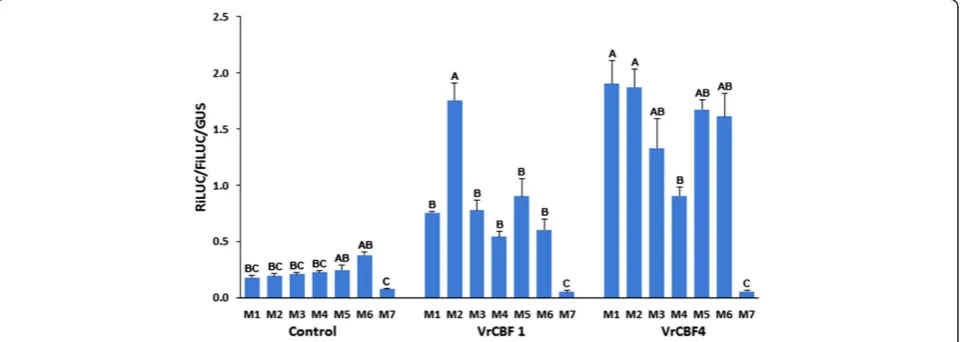
absence of CBF effector, M1 to M6 gave variable activation values which were higher than background activation values with M7, the negative control CRT variant (Figure 5). Even higher activation values were obtained with VrCBF1 or VrCBF4 on all CRT variants except for the nega-tive control M7. Both VrCBF1 and VrCBF4 activation on sequence variant M2 was among the highest whereas activation on sequence variant M4 was the
lowest in all experiments and this was significant in two out of three independent experiments (Figure 5). However, activation by VrCBF1 was more affected by nucleotide changes around the DRE/CRT sequence than activation by VrCBF4 which resulted, generally speaking, in higher induction of transcription by VrCBF4 compared to VrCBF1 irrespective of the DRE/CRT variant present in the reporter plasmid.
Figure 3Activation by VrCBF1 or VrCBF4 on CRT (M2) and mutated core CRT sequence.M2: TGCCGACAT, M7: TGAAGACAT, M8: TGCCGCCAT, M9: TGCCGAAAT. Error bars represent the standard deviation. Infiltrations without CBF effector were included as control. Statistical analysis was performed on the set of no CBF, VrCBF1 and VrCBF4 data separately and significantly different activation values (ANOVA p < 0.05) are indicated by different letters. Similar results were obtained for two other independent experiments.
Figure 2Analysis of reporter gene expression after agroinfiltration of tobacco leaves with VrCBF4 effector in combination with four different 4XCRTmin35S reporter constructs. [A]GUS/protein (blue bars) and FiLUC/protein (black bars),[B]FiLUC/GUS,[C]RiLUC/FiLUC,
Change in CBF amino acid sequence affects activation levels
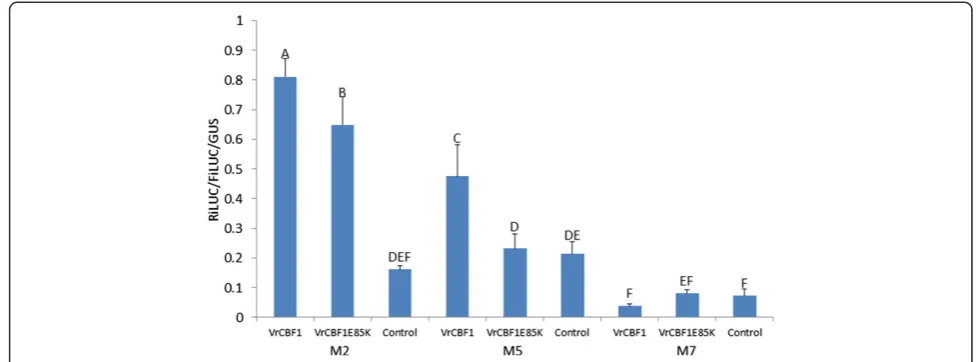
Based on the higher transactivation by CBF1 from V. ripariacompared to activation by CBF1 fromV. vinifera in our previous transactivation system [30], we predicted that a change of the glutamic acid (E) in the AP2 DNA binding domain of VrCBF1 at position 85 to a lysine (K), as is present in VvCBF1, would decrease the transactivation. Therefore, transactivation by VrCBF1 was compared to that by the mutant VrCBF1-E85K in the newly developed dual luciferase transactivation system, on the two DRE/CRT variants that had given the highest values (M2 and M5, see Figure 5). An empty control effector plasmid was included to confirm that the activations observed with either CBF1
or CBF4 are higher than those observed in the presence of endogenous tobacco transcription factor only (control). The results showed that the mutant VrCBF1. E85K indeed had a lower activation of the reporter with either the M2 or M5 variants (4.0x or 1.1x), as compared to the wild type VrCBF1 (5.0x or 2.2x) (Figure 6). This difference in activation was observed in three independent experiments and was statistically significant in two of these.
Discussion
New effector and reporter plasmids were developed for transactivation analyses in plant tissues. The advantages of this new transactivation system are: (1) Two reporter genes, GUSPlus and FiLUC, were included in the vector
Figure 4Activation by VrCBF1 or VrCBF4 on a reporter with various initial nucleotides in the DRE/CRT sequence.M1 = DRE: TACCGACAT, M2 = CRT: TGCCGACAT, M10: TCCCGACAT, M11: TTCCGACAT (core CRT/DE sequence in italics), and the negative control CRT variant M7: TGAAGACAT Statistical analysis was performed on the set of no CBF, VrCBF1 and VrCBF4 data separately and significantly different activation values (ANOVA p < 0.05) are indicated by different letters. Error bars represent the standard deviation. Similar results were obtained in three other independent experiments.
plasmids to be able to normalize for the amount of these proteins and be used as an indicator for the amount of respectively effector and reporter DNA transferred and expressed in the leaf cells. Other researchers examining either plant or animal systems have included a constitutively expressed reporter gene (35S::LUC cassette) on a separate plasmid [33,13,34] to normalize for differences in infiltration between samples. This was under the assumption that both plasmids are delivered in similar quantities into the cells. Our results show that this assumption is not true (Figure 2). (2) The chosen reporter genes have an intron, which cannot be spliced out by bacteria [35], therefore no enzyme is translated from erroneous transcripts that might be produced in the numerous Agrobacteria present in the infiltrated leaf tissue [36]. Commonly used reporter genes for plant tissues areβ-glucuronidase (GUS) [37,38], green fluorescent protein (GFP) [13,39,40], firefly (Photinus pyralis) luciferase (FLUC) [41], and sea pansy (Renilla reniformis) luciferase (RLUC) [42]. The understanding that the inclusion of an intron is important led to the development of intron-containing reporters such as GUSi [34], GUSINT [36], GUSPlus (CAMBIA, Canberra, Australia and [30]), FiLUC [43] and RiLUC [44]. (3) Beta glucuronidase (GUSPlus), renilla luciferase (RiLUC) and firefly luciferase (FiLUC) were chosen as reporters as they all can be measured by a similar procedure. We avoided green fluorescent protein (GFP) as a reporter, since this can diffuse out of the cell [9]. Previously, Renilla luciferase has been used as the normalizer [2], but studies have shown that this luciferase has a 100 fold higher signal when compared to firefly luciferase [45] which gives it a wider range. Therefore, RiLUC was chosen to quantify
differences in activation for our system. (4) The quantifica-tion procedure uses the same extract for the analysis of all reporter activities. This means that the activation value, RiLUC/FiLUC/GUS, is normalized for variation that may occur through infiltration, DNA uptake or protein extraction. The fact that new substrate solution for all enzymes has to be prepared fresh for every experiment means that some variation will exist between experiments and this can affect activation values. We therefore suggest that only effector and reporter combinations that have been analyzed in the same experiment be compared to each other.
The reporter construct was designed to contain 4 DRE/CRT sequence repeats combined with a minimal 35S CaMV promoter. The 46 nt minimal 35S promoter is one of the best characterized plant core regulatory promoter domains [46,47] with a reportedly very low basal transcription level in the absence of additional upstream regulatory elements [48], and has already been used successfully in our previous experiments [30,31]. Although activation by transcription factors of promoters containing only 1 binding domain was shown to be detectable [49], adding additional (4) repeats of a DRE/CRT element was considered appropriate since it would give a stronger activation and therefore higher reporter enzyme activity which would make differences in activation efficiency easier to detect [4]. The low level of activation on mutant DRE/CRT reporter constructs (Figures 3 and 4) showed that there is no significant contribution from any other potential enhancer elements on the reporter vector (for example, in the 35S promoter) to the RiLUC reporter activities caused by theVitisCBFs. The low RiLUC/FiLUC/ GUS values on various DRE/CRT variants suggests that
there is some background activation by tobacco transcrip-tion factors especially when compared to the values on the M7 mutant CRT/DRE sequence, when no grape CBF-producing plasmid was included (see especially M6 and M9, Figures 3 and 5).
An advantage of a transient transactivation system is that one can detect an increase in transcripts from genes that are directly activated by the transcription factor under study, even if this activation is temporary and therefore not detectable in transgenic plants. Another advantage is that transcripts of indirectly activated genes, which can be detected in transgenic plants, are likely absent in the transient system. The transient expression system can therefore assist to interpret results from trans-genic plants. For example, we previously reported that compared to wild type Arabidopsis, VrCBF4- but not VrCBF1-overexpressing plants have increased AtRGL3 expression [50]. One might speculate that this is due to a preference by VrCBF4 and not VrCBF1 for the DRE/CRT-like sequence CCGCC in theAtRGL3promoter. However, the presented transient expression results showed that the M8 reporter construct (containing CCGCC) is not activated much by either VrCBF1 or VrCBF4. Similarly, because VrCBF1- but not VrCBF4-overexpressing plants had an increasedRD29A (COR78) expression, it could be argued that this was due to a preference by VrCBF1 and not VrCBF4 for the CCGAC sequence present twice in the promoter of this gene [50]. However, the transient expression system results shows that all reporter constructs containing CCGAC (M1 to M6) are activated better by VrCBF4 than by VrCBF1 (Figures 4 and 5). This
suggests that the induction of AtRGL3 or RD29A in
the transgenic Arabidopsis is due to an indirect effect, although it is also possible that the CBFs activate these genes via a DRE/CRT element outside of the“promoter” region that was examined for sequence elements, about 1 kb upstream of the ATG start codon [50].
All presented agroinfiltrations were performed in tobacco leaves, by a relatively easy procedure. We were not successful in infiltrating leaves from grapes grown under growth chamber conditions, despite trying various methods including vacuum infiltration. Indeed, also other researchers reported their failure to do so and were only successful if in plants were grown in vitro [14,15]. This has not been pursued further at this time since in vitro culture is labour-intensive and transactivation in grape leaves would only be necessary if one wanted to analyze the transactivation of endogenous grape genes.
Changes in the core DRE/CRT sequence greatly reduced the transactivation values (Figures 3 and 4), confirming that the complete core DRE/CRT sequence is required for binding byVitisCBF1 or 4. This is in line with the report that Arabidopsis DREB1A (AtCBF3) and DREB2A bind weakly or not at all when the core CRT sequence is altered
[51]. Binding by the Arabidopsis DREB proteins was not affected by changes in the surrounding sequence [51] however our transactivation results show that this is different for the Vitis CBFs, especially for Vitis CBF1 (Figure 5). Also of note, is that CRT variant M8 contains the core sequence of the GCC box (GCCGCC) which is known to interact with ERF transcription factors of the ethylene signalling pathway [52] but not with Arabidopsis DREB proteins [51] and, as shown here, also not withVitis CBF1 and CBF4 (Figure 3).
Inclusion of the VrCBF4 effector plasmid generally resulted in higher activation of the DRE/CRT variants than inclusion of the VrCBF1 effector plasmid (Figures 4 and 5). This supports our suggestion that VrCBF4 is a better activator than VrCBF1 on CRT variant M1 based on previous experiments using a different transactivation system [31]. In principle, there are several possible explanations for this phenomenon besides an inherent better activation capability for the VrCBF4 protein. It is possible that different amounts of protein are produced for each because, even though we used the same 5′UTR and 3′UTR sequences for each construct, the coding sequence can also affect translation efficiency [53]. Other possible explanations include a difference in the half-life of the RNA or protein. Translation efficiency and RNA or protein stability likely differ between different tissues and conditions (e.g. ambient vs cold treatment), and the situation found here in tobacco leaves might therefore not reflect the conditions that exist when VrCBF1 and VrCBF4 are expressed in grape tissues. Quantification of CBF protein levels would be possible by Western blot analysis with antibodies specific for each CBF or to a tag added to each CBF. However, the results of the experiment shown in Figure 5 suggest that possible differences in protein quantity are not the main reason for the observed differences in activation by VrCBF1 and VrCBF4. In this experiment the same experimental parameters (bacterial cultures, tobacco plants, length of incubation etc.) were used for all reporters but not all reporters show a lower activation with VrCBF1 than with VrCBF4. A more likely explanation for these results is that VrCBF1 has a preference for the M2 sequence whereas VrCBF4 is more promiscuous. The higher activation by VrCBF1 vs. VrCBF1E85K supports the hypothesis that this amino acid difference contributes to the difference in freezing tolerance betweenV. ripariaandV. vinifera. The ability to detect this difference shows the sensitivity of the transacti-vation system to detect changes in actitransacti-vation due to single amino acid sequence differences.
Conclusions
genes allow for normalization of transactivation values for variation in plasmid entry into the plant cells, sample collection and extract preparation. The ability to distinguish between activation by plasmids with minor sequence variations in DRE/CRT promoter elements or a CBF transcription factor suggests that this system could be valuable in examining a variety of transcription factors and their putative target promoter sequences. The results with VrCBF1 and VrCBF4 activation on DRE/CRT variants suggests that these two transcription factors likely activate different overlapping sets of genes, and therefore have unique roles in cold acclimation.
Materials and methods
Preparation of effector and reporter plasmids
The pCAMBIA 1305.1 binary vector containing a multiple cloning site (MCS) and a 35S::GUSPlus reporter gene (http://www.cambia.org/daisy/cambia/585.html), a gene with a catalase intron, was taken as the starting point for the creation of effector constructs first (Figure 1A). This is a multicopy plasmid, in contrast to the previously used pBI121 [30,31], and thus easier to use. The original pCAMBIA plasmid, which does not encode any CBF, was used as a negative control effector. A HindIII/EcoRI cassette containing a 35S promoter, VrCBF4 coding region with 5′ ribosome binding site (rbs), and Nos termin-ator sequence, obtained from a previously prepared pBI121-based effector [31], was inserted into the MCS of pCAMBIA, yielding the 35S::VrCBF4 pCAMBIA effector (Figure 1B). Preparation of 35S::VrCBF1 pCAMBIA effector plasmid involved simply replacing the BamHI/SacI fragment containing the 5′ ribosome binding site and VrCBF4 coding sequence [31] with a similar fragment containing VrCBF1 coding sequence [30].
The reporter construct was prepared from these pCAMBIA effector constructs in several steps. First the GUSPlus reporter sequence was replaced with a FiLUC (Firefly luciferase coding sequence including the PIV intron from GUSINT) reporter sequence. To this end, NcoI/PmlI digested pCAMBIA effector, i.e. without the GUSPlus sequence, was ligated to an NcoI/PmlI fragment containing the FiLUC sequence which had been amplified from pLUC07 [42] using primers that introduce these restriction
sites (FiLUC-H-2 + NcoI: 5′AGGTAAGCCATGGAAGA
CGCCAA 3′ and FiLUC-C1842 + PmII: 5′TACACGTGT
TACAATTTGGACTTTCCGC 3′). Second, the VrCBF4
coding region was replaced with the RiLUC reporter (Renilla reniformis luciferase coding sequence including a modified intron from the castor bean catalase gene). This was accomplished by ligating a BamHI/SacI RiLUC fragment amplified from RiLUC plasmid [44] using primers that introduce these restriction sites
(RiLUC-H1 + BamHI: 5′ATGGATCCAAGGAGATATAACAAT
GACTTCGAAAGTTTATGATCC 3′ and RiLUC-C936 +
SacI: 5′CGTTGACGAGCTCTTATTGTTCATTTTTGA
GAACTCG 3′) to BamHI and SacI digested, FiLUC
containing pCAMBIA, similar to the CBF fragments earlier. Third, vectors with the RiLUC reporter driven by a 4xCRTmin35S promoter, consisting of 4x TACCGACAT [30] plus 46 nucleotides of the 35S promoter [46,47], were constructed. To this end the HindIII-BamHI 35S promoter-containing fragment was replaced with a HindIII-BamHI fragment containing 4xCRTmin35S promoter (obtained from plasmids described in [30]). Finally, the 2x35S::hygromycin fragment was deleted by digestion with XhoI andBstXI and replaced by a nos
promoter fragment amplified from pBI121 using
primers that introduce these restriction sites (NosproH1+
BstXI: 5′ACCACCATGTTGGGATCATGAGCGGAGAA
TTAAG 3′ and NosproC307 + XhoI: 5′GCAGGCTCGA
GAGATCCGGTGCAGATTATTT 3′), and the completed
reporter plasmid was ready for use (Figure 1C). Effector and reporter plasmids were introduced into A. tumefaciens strain EHA105 according to the freeze-thaw method described by Höfgen and Willmitzer [54].
Reporter plasmids with altered CRT sequences were prepared by a quick change protocol essentially according to the procedure described by Stratagene on a smaller
“35S cloning”plasmid [30] and subsequent subcloning of the new promoter fragment into the reporter plasmid. All primers that were used to prepare the various reporter plasmids are listed in Additional file 1: Table S1.
Agroinfiltration of tobacco leaves
Agroinfiltration was performed based on the protocols developed by Bendahmane and colleagues [55] and Vaucheret [56], essentially as described previously [30,31]. Nicotiana benthamiana plants were grown at 22°C for 16 hours of light and 20°C for 8 hours of dark until they reached a six leaf stage (approximately 4 weeks). Equal volumes ofA. tumefacienswith reporter construct and of A. tumefaciens with effector construct were mixed to produce a final OD600 of 0.5 for each construct and the youngest two fully expanded leaves (leaves 3 and 4) of three different plants were infiltrated from the abaxial (lower) side with this mixture using a syringe. After 40-hour co-cultivation, one disc was taken from each infiltrated leaf, for a total of 6 discs per condition, frozen in liquid nitrogen and stored at −80°C. This was repeated 3–4 times to obtain 3–4 biological repli-cates for each mixture. Each experiment was repeated at least 2 times.
Preparation of extracts
extract. The harvested, frozen leaf discs were ground to powder with liquid N2and then 9μl extraction buffer was
added per mg tissue (300 μl buffer for six ~6 mm leaf discs). As extraction buffer we tried either GUS extraction buffer (25 mM potassium phosphate pH7.8, 1 mM EDTA, 7 mM 2-mercaptoethanol, 1% Triton X-100, and 10% glycerol) or 1X Cell Culture Lysis Reagent (CCLR; Luciferase assay systems, Promega). The glucuroni-dase and luciferase activities determined for the extracts were more consistent and higher when CCLR had been used for the preparation and PLB (Promega) for the dilution of the extracts, and therefore CCLR and PLB were used for all further experiments. Extracts were incubated on ice for 1 hour and cell debris was pelleted by centrifuga-tion for 10 min at 13000 × g (SpeedFuge ® SFR13K, Savant). The supernatant was then diluted 75x with PLB and used for protein, glucuronidase and luciferase assays.
Analysis of protein quantities
Protein quantities were determined using the Bio-Rad dye-binding assay essentially according to the procedure described by the manufacturer (Bio-Rad), based on the method of Bradford [57], with BSA as standard.
Analysis of GUS, RiLUC and FiLUC activities
GUS activity was determined after incubating a mixture of 10 μl of the 75x diluted sample and 90 μl of Assay buffer (50 mM pH 7 Sodium phosphate buffer, 10 mM EDTA, 0.1 Triton X-100, 0.1% N-Lauroylsarcosine Sodium Salt, 10 mM 2-mercaptoethanol, 40 mM 4-MUG) for 30 minutes at 37°C. Each reaction was stopped by adding 900μl of 0.2 M Na2CO3and fluorescence caused
by the conversion of 4-MUG to MUG was measured in a polystyrene flatbottom 96-well plate (Sarstedt) using a POLARStar Omega (BMG Labtech) microplate reader with the excitation filter set at 360 nm and the emission fil-ter at 460–10, and orbital shaking at 300 rpm. Each extract was analyzed in triplicate and the average measurement was taken as the value for one replicate.
The dual luciferase protocol based on the Dual Luciferase reporter assay system from Promega, as reported by Cazzonelli and colleagues [43], was used essentially unchanged to quantify the amount of RiLUC and FiLUC expression. 75x diluted sample (10 μl) was added to Luciferase reagent II (50 μl, LARII) in a polystyrene flatbottom 96-well plate (Sarstedt) and mixed by pipetting. FiLUC fluorescence, indicative ofFiLUCgene expression, was measured immediately in a POLARStar Omega microplate reader with the setting on Luminescence (end point). To measure RiLUC fluorescence, indicative of RiLUC gene expression, 50 μl of Stop and Glo reagent (20 μl substrate into 1 ml S&G buffer and mixed well, freshly prepared according to the instructions from Promega) was added to each sample, mixed by pipetting
and returned to the luminometer for a second measure-ment. Both measurements were set on 0.2 sec delay with 10 flashes per well. Activities for all replicates of each extract were measured consecutively before a second set of replicates was prepared and measured.
Transactivation was expressed as RiLUC/FiLUC/GUS x 100000. The resulting data were analyzed by a one-way ana-lysis of variance (ANOVA). Statistical differences amongst the means for each reporter/effector combination within an experiment were determined by the Tukey–Kramer HSD tests (P < 0.05) using JMP (version 11.1.1; SAS Institute) statistical software.
Additional file
Additional file 1: Table S1.List of primers used to prepare effector and reporter constructs.
Competing interests
The authors declare that they have no competing interests.
Authors’contributions
MAM prepared and tested the original effector and reporter constructs, and participated in the development of the assays, MS participated in the development of the constructs and assays and performed the statistical analyses, HX participated in the preparation of some constructs and subsequent assays, CC participated in the assays and statistical analyses, AN conceived the study, participated in its design and coordination, and wrote the initial manuscript. All authors read and approved the final manuscript.
Acknowledgements
The authors thank Jeff Velten and Luc Mankin for a vector with the RiLUC sequence, and FiLUC sequence respectively. Zamir Jetha provided technical support developing extraction and dilution protocols optimal for reporter enzyme assays. M. Atikur Rahman assisted with the construction of the M10 and M11 reporter constructs. This work was funded by grants from ORF and NSERC to AN. CC was partially supported by an Ontario Graduate Fellowship.
Received: 7 July 2014 Accepted: 30 September 2014 Published: 3 October 2014
References
1. Chiera JM, Bouchard RA, Dorsey SL, Park E, Buenrostro-Nava MT, Ling PP, Finer JJ:Isolation of two highly active soybean (Glycine max (L.) Merr.) promoters and their characterization using a new automated image collection and analysis system.Plant Cell Rep2007,26:1501–1509. 2. Hellens RP, Allan AC, Friel EN, Bolitho K, Grafton K, Templeton M,
Karunairetnam S, Gleave AP, Laing WA:Transient expression vectors for functional genomics, quantification of promoter activity and RNA silencing in plants.Plant Methods2005,1:13.
3. Hernandez-Garcia CM, Martinelli AP, Bouchard RA, Finer JJ:A soybean (Glycine max) polyubiquitin promoter gives strong constitutive expression in transgenic soybean.Plant Cell Rep2009,28:837–849. 4. Rushton PJ, Reinstaedler A, Lipka V, Lippok B, Somssich IE:Synthetic plant
promoters containing defined regulatory elements provide novel insights into pathogen- and wound-induced signalling.Plant Cell2002,14:749–762. 5. Liu W, Mazarei M, Rudis MR, Fethe MH, Stewart CN:Rapidin vivoanalysis
of synthetic promoters for plant pathogen phytosensing.BMC Biotech
2011,11:108.
6. Christensen AH, Sharrock RA, Quail PH:Maize polyubiquitin genes: structure, thermal perturbation of expression and transcript splicing, and promoter activity following transfer to protoplasts by electroporation. Plant Mol Biol1992,18:675–689.
7. Hartmann U, Valentine WJ, Christie JM, Hays J, Jenkins GI, Weisshaar B:
thaliana chalcone synthase promoter using a homologous protoplast transient expression system.Plant Mol Biol1998,36:741–754. 8. Pitzschke A, Persak H:Poinsettia protoplasts - a simple, robust and
efficient system for transient gene expression studies.Plant Methods
2012,8:14.
9. Hernandez-Garcia CM, Bouchard RA, Rushton PJ, Jones ML, Chen X, Timko MP, Finer JJ:High level transgenic expression of soybean (Glycine max) GmERF and Gmubi gene promoters isolated by a novel promoter analysis pipeline. BMC Plant Biol2010,10:237.
10. Rolfe SA, Tobin EM:Deletion analysis of a phytochrome-regulated monocot rbcS promoter in a transient assay system.Proc Natl Acad Sci U S A1991,
88(2):683–2686.
11. Cazzoneli CI, Velten J:In vivo characterization of plant promoter element interaction using synthetic promoters.Transgenic Res2008,17:437–457. 12. Van Moerkercke A, Haring MA, Schuurink RC:The transcription factor
EMISSION OF BENZENOIDS II activates the MYB ODORANT1 promoter at a MYB binding site specific for fragrant petunias.Plant J2011,67:917–928. 13. Bogs J, Jaffe FW, Takos AM, Walker AR, Robinson SP:The grapevine
transcription factor VvMYBPA1 regulates proanthocyanidin synthesis during fruit development.Plant Physiol2007,143:1347–1361. 14. Santos-Rosa M, Poutaraud A, Merdinoglu D, Mestre P:Development of a
transient expression system in grapevine via agro-infiltration.Plant Cell Rep2008,27:1053–1063.
15. Guan X, Zhao H, Xu Y, Wang Y:Transient expression of glyoxal oxidase from the Chinese wild grapeVitis pseudoreticulatacan suppress powdery mildew in a susceptible genotype.Protoplasma2011,248:415–423. 16. Zottini M, Barizza E, Costa A, Formentin E, Ruberti C, Carimi F, Lo Schiavo F:
Agroinfiltration of grapevine leaves for fast transient assays of gene expression and for long-term production of stable transformed cells. Plant Cell Rep2008,27:845–853.
17. Bertazzon N, Raiola A, Castiglioni C, Gardiman M, Angelini E, Borgo M, Ferrari S:Transient silencing of the grapevine gene VvPGIP1 by agroinfiltration with a construct for RNA interference.Plant Cell Rep2012,
31:133–143.
18. Mizoi J, Shinozaki K, Yamaguchi-Shinozaki K:AP2/ERF family transcription factors in plant abiotic stress responses.Biochim Biophys Acta1819,
2012:86–96.
19. Wisniewski M, Nassuth A, Teulieres C, Marque C, Rowland J, Cao P-B, Brown A:
Genomics of cold hardiness in woody plants.Crit Rev Plant Sci2013,
33:92–124.
20. Stockinger EJ, Gilmour SJ, Thomashow MF:Arabidopsis thaliana CBF1 encodes an AP2 domain-containing transcriptional activator that binds to the Crepeat/DRE, a cis-acting DNA regulatory element that stimulates transcription in response to low temperature and water deficit.Proc Natl Acad Sci U S A1997,94:1035–1040.
21. Gilmour SJ, Zarka DG, Stockinger EJ, Salazar MP, Houghton JM, Thomashow MF:
Low temperature regulation of the Arabidopsis CBF family of AP2 transcriptional activators as an early step in cold-induced COR gene expression.Plant J1998,16:433–442.
22. Liu Q, Kasuga M, Sakuma Y, Abe H, Miura S, Yamaguchi-Shinozaki K, Shinozaki K:
Two transcription factors, DREB1 and DREB2, with an EREBP/AP2 DNA binding domain separate two cellular signal transduction pathways in drought- and low temperature- responsive gene expression, respectively, in Arabidopsis.Plant Cell1998,10:1391–1406.
23. Kasuga M, Liu Q, Miura S, Yamaguchi-Shinozaki K, Shinozaki K:Improving plant drought, salt, and freezing tolerance by gene transfer of a single stress-inducible transcription factor.Nature Biotech1999,17:287–291. 24. Miura K, Furumoto T:Cold signaling and cold response in plants.Int J Mol
Sci2013,14:5312–5337.
25. Gao M-J, Allard G, Byass L, Flanagan AM, Singh J:Regulation and characterization of four CBF transcription factors fromBrassica napus. Plant Mol Biol2002,49:459–471.
26. Xue G-P:Characterisation of the DNA-binding profile of barley HvCBF1 using an enzymatic method for rapid, quantitative and high-throughput analysis of the DNA-binding activity.Nucl Acids Res2002,30:e77. 27. Tong Z, Hong B, Yang Y, Li Q, Ma N, Ma C, Gao J:Overexpression of two
chrysanthemum DgDREB1 group genes caused delayed flowering or dwarfism in Arabidopsis.Pl Mol Biol2009,71:115–129.
28. Seki M, Narusaka M, Ishida J, Nanjo T, Fujita M, Oono Y, Kamiya A, Nakajima M, Enju A, Sakurai T, Satou M, Akiyama K, Taji T, Yamaguchi-Shinozaki K, Caminci P, Kawai J, Hayashikazi Y, Shinozaki K:Monitoring the expression profiles of
7000 Arabidopsis genes under drought, cold and high-salinity stresses using a full-length cDNA microarray.Plant J2002,31:279–292.
29. Maruyama K, Sakuma Y, Kasuga M, Ito Y, Seki M, Goda H, Shimada Y, Yoshida S, Shinozaki K, Yamaguchi-Shinozaki K:Identification of cold-inducible downstream genes of Arabidopsis DREB1A/CBF3 transcriptional factor using two microarray systems.Plant J2004,38:982–993.
30. Xiao H, Siddiqua M, Braybrook S, Nassuth A:Three grape CBF/DREB1 genes are regulated by low temperature, drought and abscisic acid.Plant Cell Environ2006,29:1410–1421.
31. Xiao H, Tattersall E, Siddiqua M, Cramer GR, Nassuth A:CBF4 is a unique member of the CBF transcription factor family ofVitis viniferaandVitis riparia.Plant Cell Environ2008,31:1–10.
32. Wang S, Yang S, Yin Y, Guo X, Wang S, Hao D:Anin silicostrategy identified the target gene candidates regulated by dehydration responsive element binding proteins (DREBs) in Arabidopsis genome. Plant Mol Biol2009,69:167–178.
33. Horstmann V, Huether CM, Jost W, Reski R, Decker EL:Quantitative promoter analysis in Physcomitrella patens: a set of plant vectors activating gene expression within three orders of magnitude. BMC Biotech2004,4:13.
34. Narumi O, Mor S, Boku S, Tsuji Y, Hashimoto N, Nishikawa S-I, Yokata Y:
OUT, a novel basic helix–loop–helix transcription factor with an Id-like inhibitory activity.J Biol Chem2000,275:3510–3521.
35. Ohta S, Mita S, Hattori T, Nakamura K:Construction and expression in tobacco of aβ-glucuronidase (GUS) reporter gene containing an intron within the coding sequence.Plant Cell Physiol1990,31:805–814. 36. Vancanneyt G, Schmidt R, O’Connor-Sanchez A, Willmitzer L, Rocha-Sosa M:
Construction of an intron-containing marker gene: splicing of the intron in transgenic plants and its use in monitoring early events in Agrobacterium-mediated plant transformation.Mol Gen Genet1990,
220:245–250.
37. Jefferson R, Kavanagh T, Bevan M:GUS fusions:β-glucuronidase as a sensitive and versatile gene fusion marker in higher plants.EMBO J1987,
6:3901–3907.
38. Samac DA, Tesfaye M, Dornbusch M, Saruul P, Temple SJ:A comparison of constitutive promoters for expression of transgenes in alfalfa (Medicago sativa).Transgenic Res2004,13:349–361.
39. Chalfie MM, Tu Y, Euskirchen G, Ward WW, Prasher DC:Green fluorescent protein as a marker for gene expression.Science1994,263:802–805. 40. Leffel S, Mabon S, Stewart N:Applications of green fluorescent protein in
plants.Biotechniques1997,23:912–918.
41. Ow D, Wood K, DeLuca M, DeWet J, Helsinki D, Howell S:Transient and stable expression of the firefly luciferase gene in plant cells and transgenic plants.Sci1986,234:856–859.
42. Mayerhofer R, Langridge W, Cormier M, Szalay A:Expression of recombinant Renilla luciferase in transgenic plants results in high levels of light emission.Plant J1995,7:1031–1038.
43. Mankin S, Allen G, Thompson W:Introduction of a plant intron into the luciferase gene ofPhotinus pyralis.Plant Mol Biol Rep1997,15:186–196. 44. Cazzoneli CI, Christopher I, Velten J:Construction and testing of an
intron-containing luciferase reporter gene fromRenilla reniformis. Plant Mol Biol Rep2003,21:271–280.
45. Behre G, Smith LT, Tenen DG:Use of a promoterless Renilla luciferase vector as an internal control plasmid for transient co-transfection assays of Ras-mediated transcription activation.Biotechniques1999,26:24–26. 46. Odell JT, Nagy F, Chua NH:Identification of DNA sequences required for
activity of the cauliflower mosaic virus 35S promoter.Nature1985,
313:810–812.
47. Benfey P, Chua N:The cauliflower mosaic virus 35S promoter: combinatorial regulation of transcription in plants.Science1990,250:959–966.
48. Cazzonelli CI, Burke J, Velten J:Functional characterization of the geminiviral conserved late element (CLE) in uninfected tobacco. Plant Mol Biol2005,58:465–481.
49. Eini O, Yang N, Pyvovarenko T, Pillman K, Bazanova N, Tikhomirov N, Eliby S, Shirley N, Sivasankar S, Tingey S, Langridge P, Hrmova M, Lopato S:
Complex regulation by apetela2 domain-containing transcription factors revealed through analysis of the stress responsive TdCor410b promoter from Durum wheat.Plos One2013,8:e58713.
51. Sakuma Y, Liu Q, Dubouzet JG, Abe H, Shinozaki K, Yamaguchi-Shinozaki K:
DNA-binding specificity of the ERF/AP2 domain of Arabidopsis DREBs, transcription factors involved in dehydration- and cold-inducible gene expression.Biochem Biophys Res Comm2002,290:998–1009.
52. Hao D, Ohme-Takagi M, Sarai A:Unique mode of GCC box recognition by the DNA-binding domain of ethylene-responsive element-binding factor (ERF domain) in plant.J Biol Chem1998,273:26857–26861.
53. Tuller T, Waldman YY, Kupiec M, Ruppin E:Translation efficiency is determined by both codon bias and folding energy.Proc Natl Acad Sci U S A2010,107:3645–3650.
54. Höfgen R, Willmitzer L:Storage of competent cells for Agrobacterium transformation.Nucleic Acids Res1988,16:9877.
55. Bendahmane A, Kanyuka K, Baulcombe DC:The Rx gene from potato controls separate virus resistance and cell death responses.Plant Cell
1999,11:781–791.
56. Vaucheret H:Promoter-dependent trans-inactivation in transgenic tobacco plants; kinetic aspects of gene silencing and gene reactivation.C R Acad Sci
1994,317:310–323.
57. Bradford M:A rapid and sensitive method for the quantitation of microgram quantities of protein utilizing the principle of protein-dye binding.Anal Biochem1976,72:248–254.
doi:10.1186/1746-4811-10-32
Cite this article as:Nassuthet al.:Newly developed quantitative transactivation system shows difference in activation byVitisCBF transcription factors on DRE/CRT elements.Plant Methods201410:32.
Submit your next manuscript to BioMed Central and take full advantage of:
• Convenient online submission
• Thorough peer review
• No space constraints or color figure charges
• Immediate publication on acceptance
• Inclusion in PubMed, CAS, Scopus and Google Scholar
• Research which is freely available for redistribution
![Figure 1 Schematic representation of [A] pCAMBIA1305.1, [B] GUS effector and [C] dual luciferase reporter plasmids](https://thumb-us.123doks.com/thumbv2/123dok_us/9167670.1914275/3.595.55.539.90.395/figure-schematic-representation-pcambia-effector-luciferase-reporter-plasmids.webp)