BEER, M. <http://orcid.org/0000-0001-5368-6550>, HUANG, W. and HILL, R.
Available from Sheffield Hallam University Research Archive (SHURA) at:
http://shura.shu.ac.uk/5/
This document is the author deposited version. You are advised to consult the
publisher's version if you wish to cite from it.
Published version
BEER, M., HUANG, W. and HILL, R. (2003). Designing community care systems
with AUML. In: Proceedings of the International Conference on Computer,
Communication and Control Technologies (CCCT '03) and the 9th International
Conference on Information Systems Analysis and Synthesis (ISAS '03), Orlando,
USA, July 31-August 2, 2003. IEEE Computer Society, 247-253.
Copyright and re-use policy
See
http://shura.shu.ac.uk/information.html
Sheffield Hallam University Research Archive
Martin D.Beer1
, Wei Huang2
, and Richard Hill1
1
School of Computing & Management Science, Sheffield Hallam University City Campus, Howard Street, Sheffield, S1 1WB, United Kingdom
E-mail:{m.beer, r.hill}@shu.ac.uk
2
Harrow School of computer Science, University of Westminster Northwick Park, Harrow, Greater London, HA1 3TP, United Kingdom
E-mail: [email protected]
Abstract. This paper describes an approach to developing an appropriate agent environment appropriate for use in community care applications. Key to its success is that software designers collaborate with environment builders to provide the levels of cooperation and support required within an integrated agent–oriented community system. Agent-oriented Unified Modeling Language (AUML) is a practical approach to the analysis, design, implementation and management of such an agent-based system, whilst providing the power and expressiveness necessary to support the specification, design and organization of a health care service. The background of an
agent-based community care application to support the elderly is described. Our
approach to building agent–oriented software development solutions emphasizes the importance of AUML as a fundamental initial step in producing more general agent– based architectures. This approach aims to present an effective methodology for an agent software development process using a service oriented approach, by addressing the agent decomposition, abstraction, and organization characteristics, whilst reducing its complexity by exploiting AUML’s productivity potential.
Introduction
The providers of public and private sector health care services have, in recent years, been faced with some radical changes in the society they serve (Peckham et. al., 1996). This paper considers why agent technology:
1. might be appropriate for the community care domain
2. contribute to the development of community care services
through reorganization of the health and social care services.
Provision is delivered by a wide range of disparate, independent organizations and agencies, each having their own objectives, of which the provision of community care is typically only a part. The objective is to integrate this service with their other
responsibilities in a coherent and efficient manner (Beer & Huang, 2002).
Agent-based community care services are a new approach that automates the process of linking constituents with their core competencies quickly and effectively on the Internet. Important aspects of this development include the need to:
1. use agent–oriented architectures, models and methodologies to create
flexible roles,
2. more closely model the integration of separate services and,
3. dynamically change the relationships among agents.
Huang et. al. (1995) introduced an agent–based distributed medical care system which allowed patients’ own needs to guide their individualized care management. The community care service agents are able to not only support traditional services but also provide a range of utility services such as individual care planning, health service advice, customized information filtering etc., all of which are intended to maintain the client’s integration into the community. In the real world, individual care providers currently use their own heterogeneous databases, workflows and command and control systems with little or no integration between them (Beer et. al.
2003). This causes difficulties, not only in the provision of the most effective
response to emergencies, but also in the management of routine care as the client’s
requirements change, often quite rapidly. Current systems do not provide the
flexibility to allow such changes to be implemented as rapidly as one would desire. This is because an Individual Care Plan is specified by the Social Services Department of the Local Authority. It then contracts various agencies to actually deliver the various components of the care as appropriate. There is therefore no single agency with the overall authority to plan, manage, deliver and monitor the provision of community care. To this must be added the various health care services, and the emergency services, each of which acts independently and have their own independent records and command and control structures but are essential components in the delivery of the total package (Beer et al. 2001). Similarly, there are the large numbers of informal carers (family, friends, neighbours etc.) who are currently almost totally ignored by the system, but who also provide invaluable support.
The objective of the INCA Project is to investigate how community care can be
developed in the internet age through the use of multi-agent technology. The
motivation for this has been a consideration of the agent society's social abilities in:
1. Promoting effective care systems that:
a. provide better services and resources to clients,
b. enhance social interaction between them, and with their carers
c. deliver more effective care
2. Providing the high-abstraction level care management strategies by linking
all relevant agencies into a single framework of accountability.
3. Giving an in-depth understanding of the health information framework that
underpins the delivery of high quality, effective community care, including the formularization of the links between the disparate agencies involved.
4. Establishing a single Agent-Based care monitoring facility that can be used
by all care professionals to assist in effective monitoring and diagnosis.
5. Developing cooperative structures within the community structures to
change service provision and care policies through the use of automated agent involvement in planning, scheduling, organizing (both formal and informal) care and even directing care service programs.
6. Devolving care management and responsibility to those providing the care
by providing shared supervision and teamwork and by separating the organizational from the social requirements, developing a much more responsive and client centred environment that adapts rapidly to changing needs.
Some of these objectives have already been investigated in the medical domain through the use of multi-agent system architectures. For example, the GUARDIAN system (Hayes-Roth, 1996) considered patient monitoring in a Surgical Intensive Care Unit. Support is provided for collaboration among specialists, each an expert in a specific domain but fully committed to sharing information and knowledge among each other and the nurses that continuously monitor the patient in the physicians' care. A system devoted to diabetes care has been presented, where cooperation not only between the medical specialists, but also others, such as administrators is supported within the agent community (Lanzola et al., 1995).
A more general Agent-Based telemedicine framework has been reported (Dela Mea, 2001) that can assist specialists in diagnosing difficult cases through information sharing, cooperation and negotiation. In this case each specialist has their own Tele-medicine-Oriented Medical ASsistant (TOMAS) agent that behaves as a medical assistant and has two generic functions:
1. an agenda for managing appointments, and
2. methods for access to patient records.
flexibility offered by the mobile access to records and services is being demonstrated by the Ward-in-Hand project (Ancona, 2001), but only in the relatively restricted environment of a conventional hospital ward.
The INCA project aims to take these forward from the purely medical domain and integrate them into the general community care environment, where the linkages are less formal and effective cooperation and negotiation is essential if appropriate care is to be delivered. A major difference is that it is rarely possible to share information as freely as within the purely medical domain because of the involvement of different agencies and individuals with widely differing requirements. The agent community therefore has to act as a coordinator and filter to ensure that appropriate and correct information is distributed to all concerned. Also, since help is likely to have to travel some distance it is often better to provide whatever assistance is readily available in a timely manner, rather than the optimal solution that may arrive too late.
The INCA Demonstrator
The demonstrator uses multi-agent technologies to enhance the mechanisms for the systematic and widespread assessment of the health of the elderly out-side of a
conventional clinical care regime. Enhanced assessment provides a valuable and
timely source of information and knowledge that enables the optimization of care provision and management. Non-invasive assessment technology provides a source of health information that is well suited to identifying subtle, yet important, changes in an individual's condition. This can then be combined with appropriate knowledge sources available elsewhere on the agent network to trigger pre-emptive care and treatment.{Haigh & Yanco, 2002} Appropriate care is then be provided in an effective and timely manner.
It aims to improve:
1. Current community care systems by using agent-oriented engineering
solutions to design a new cooperative, coordinated, collaborative health care e-service by the adoption of agent-oriented models, platforms and methodologies.
2. Coordination between social services and medical care services, organizing
and managing these concurrent actions in an effective and inter-operative way.
3. The provision of positive assistance to maintain and enhance the quality of
service and the provision of routine care as specified by the Individual Care Plan.
4. The integration of services by adopting a service oriented approach
effectiveness of agent–oriented community services activities, it would be prudent to have clear methods and models for analyzing, designing, organizing, controlling and managing agents’ cooperation, communication and interaction.
Agent-oriented UML and its Concepts
AUML (Parunak & Odell, 2001) (Bauer et al., 2001) provides the scene of new meaning, the scene of new design purposes and the scene of new way for thinking of
agents and its’ environment. Unified Modeling Language (UML) is a de facto
industry standard established by (Booch, 1999). Object-oriented modeling language presents a form of notation for the object-oriented paradigm analysis and design; it provides system architects working on objects analysis and design with one consistent language for specifying, visualizing, constructing and documenting the artifacts of
software systems, as well as for business modeling (OMG, 1999). UML is a
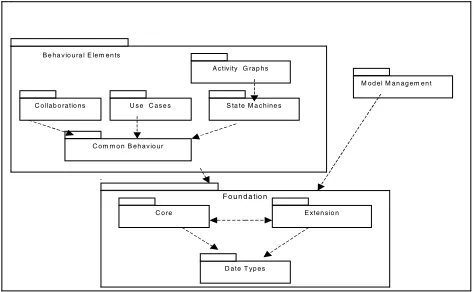
designable meta-model that represents a collection of semantic models including static models, dynamic models, usage models, and architectural models. All the models can be constructed, viewed, developed and even evaluated during the time of systems analysis and design. A semantics package is provided, which allow UML model elements and notations to work independently within different packages for different processing, as shown in Figure 1.
B e h a v io u ra l E le m e n ts
F o u n d a tio n
A c tiv ity G ra p h s
U s e C a s e s
C o llab o ra tio n s S ta te M a c h in e s
M o d e l M a n a g e m e n t
C o re E xte n s io n
[image:6.595.175.412.405.551.2]D a te T yp e s C o m m o n B e h a v io u r
Fig. 1.UML: Package Structure (OMG, 1999)
This aspect of the software development approach (e.g. representational formalism) leads us to focus on using UML notations to represent Agent concepts (e.g AUML), redesigning and reorganizing the existing Community Care & Alarm Services systems.
agents, AUML was selected to assist INCA’s process for agent system design and development.
INCA System Design and Development with AUML
After considering agent concepts at an abstract level, the next step was to develop a practical design and implementation for INCA (Intelligent Community support for the elderly Architecture) systems through the use of agent-oriented Unified Modeling Language (AUML)
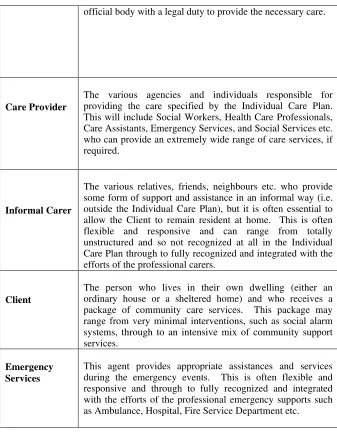
First, it was necessary was to analyze all the needs of an agent–oriented community care environment and analyze the requirements with the agent models. This stage would identify the agent-based roles from all of the available care service resources (including description and identification of the agent tasks, health services and components). In practice, community care agents in INCA system could be as described in Table 1.
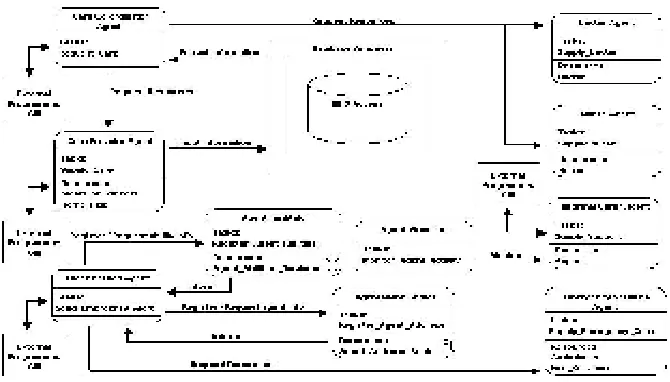
During the INCA System development, agent-based UML semantics and notations are able to adequately address the overall architectural complexity across agent domains by using a set of UML graphical diagrams, such as use-case diagrams, class diagrams, agent behaviour diagrams and implementation diagrams. The sample diagram (Figure 2) is a notation diagram of Agent-based health care Service Supplying, which shows how a series of co-operational agents gathering domain operational information achieve their tasks and domain goals. The model begins with roles/agent initiation and definition, and moves to the roles ‘planning for supplying emergency service’ and organizing agent behaviours, relations and responsibilities, followed by loading some particular class requirements. Finally, this model provides a small autonomous agent domain to generate operations such as an executable service UML package to users.
AUML is much more than a program language and modeling design diagram. It is concerned with agent domain architecture modeling and it provides a range of declarative models. Functionally, UML is a key ingredient in generating agent architecture and approaches to the agent system devolvement processes in detail and it is able to provide the instruction and design platforms by defining all variant and invariant roles of the agents describing their attributes and dynamically organizing pre and post conditions for operations.
NAME DESCRIPTION
Care
Co-ordinator
The agency responsible for providing the range of services necessary to ensure that the Client is properly cared for. The Care co-ordinator is responsible for preparing a Care plan and for monitoring its effectiveness in meeting the needs of the
official body with a legal duty to provide the necessary care.
Care Provider
The various agencies and individuals responsible for providing the care specified by the Individual Care Plan. This will include Social Workers, Health Care Professionals, Care Assistants, Emergency Services, and Social Services etc. who can provide an extremely wide range of care services, if required.
Informal Carer
The various relatives, friends, neighbours etc. who provide some form of support and assistance in an informal way (i.e. outside the Individual Care Plan), but it is often essential to allow the Client to remain resident at home. This is often
flexible and responsive and can range from totally
unstructured and so not recognized at all in the Individual Care Plan through to fully recognized and integrated with the efforts of the professional carers.
Client
The person who lives in their own dwelling (either an ordinary house or a sheltered home) and who receives a
package of community care services. This package may
range from very minimal interventions, such as social alarm systems, through to an intensive mix of community support services.
Emergency Services
This agent provides appropriate assistances and services
during the emergency events. This is often flexible and
[image:8.595.134.471.142.576.2]responsive and through to fully recognized and integrated with the efforts of the professional emergency supports such as Ambulance, Hospital, Fire Service Department etc.
Fig. 2.AUML real-time notation diagram of Community Care Services Supply
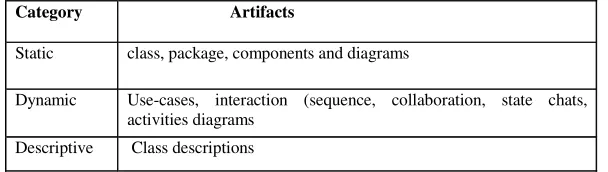
Agent-oriented UML is a modeling platform that describes the formal specification of the function, structure and behaviour of agents and multi-agent system. It has three main categories for describing system artifacts and information; static, dynamic and descriptive (OMG, 1999). Each category solves a type of domain problem. The classification is given in Table 2.
Category Artifacts
Static class, package, components and diagrams
Dynamic Use-cases, interaction (sequence, collaboration, state chats,
activities diagrams
Descriptive Class descriptions
Table 2.UML artefact categories (OMG, 1999)
An agent-oriented UML model represents the static category by describing agent requirements in detail such as classes, packages, diagrams and components. The dynamic artifacts describe the communication among the components inside a shared common agent system. Descriptive artifacts are used with the other diagrams to support the description of information represented in different perspectives. The diagram below is an AUML-Use Case diagram of Community Care Service Scheduling [Figure3], which is a modeling diagram representing the technical roles and routing of community service supply. It allows knowledge-level agents to be linked efficiently and to share and exchange resources in a common communicated agent architecture and to achieve the “Rational Effect” domain goal.
m a k e s
1 . . . * s e n d s
c o n n e c t s c o n t a i n s
i s c o n t e n t o f
i s r e q u e s t e do n H e a lt h C a r e R e c e i v e r s
C a r e S e r v i c e - C o d e C a r e S e r v i c e - l o c a t i o n C a r e S e r v i c e - E v e n t s
C a r e S e r v i c e P r o v i d e r
S e r v i c e - I D
S e r v i c e P a c k a g e - P r o d u c e c o d e C a r e - S e r v i c e - S ta t u s I n s t r u c t i o n - te x t - m e s s a g e E m e r g e n c y a n d C a r e
S e r v i c e D e l i v e r e r s
S e r v i c e s a c t u a l d a t e / t i m e S e r v i c e s s c h e d u l e d a c t i o n / t im e C a r e - S e r v i c e - S ta t u s
C o m m u n i t y C a r e S e r v i c e H e l p L in e
C a r e S e r v i c e - E v e n t- C o d e C a r e S e r v i c e - l o c a t i o n / li n e C a r e S e r v i c e - E v e n t- S t a t u s C o m m u n i t y C a r e C o - o r d i n a t o r
[image:9.595.147.451.436.522.2]Fig. 3.AUML: Use Case diagram of Care Services Scheduling in INCA system
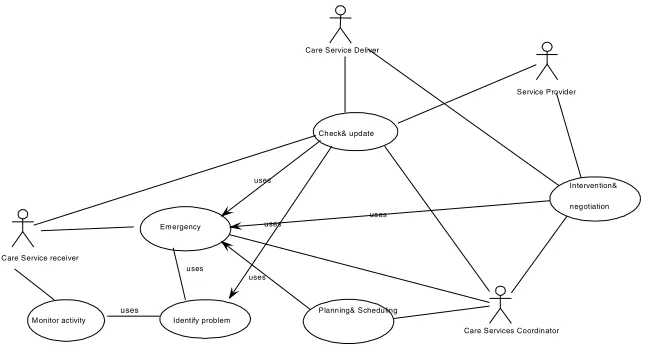
The next stage is modeling, which involves gathering a range of state of the art techniques and models for communication, interaction, coordination and control. It can be divided as the interaction model and acquaintance model (communication, conversation policy, appropriated protocols and negotiation rules among agents). This model represents the technical roles that allow knowledge-level agents to be linked efficiently and to share and exchange resources in common agent architecture. Such interactive community care supply routing can be seen in Figure 4. This is an example of providing care services routing, which illustrates that both official and unofficial care producers/agents (such as Care Provider, Inform Care, Care Co-ordinator) could provide an individual care plan and community care services for Clients through the negotiation agents.
Once the individual care plan has been established, care services required to assist the Client must be managed and controlled by the agent system. Such interaction demands communication messages to be passed and routed as shown in Figure 5.
Care Service receiver
Care Services Coordinator Care Service Deliver
Service Provider
Em ergency
M onitor activity
Intervention& negotiation
Identify problem
Planning& Scheduling Check& update
uses uses
uses
uses uses
Fig. 4.AUML interaction diagram of an individual care plan and communication routing for older person
Furthermore, the main contribution of AUML to INCA work is the attempt at making the design and development of a multi-agent system as simple as possible. It greatly simplifies the configuration and organization of agents, the endowment of communication capability and the cooperation capability of agents. This is achieved by mimicking real-world solutions to the current care service activities [Figure 6].
[image:11.595.135.481.408.603.2]Fig. 6.The Overall Architecture of the INCA Prototype
Conclusions
The development of Agent-oriented community care systems unveil many unexpected challenges and opportunities to create more advanced distributed e-service systems by fully using agent capabilities and responsibilities using a e-service
oriented approach. This allows us to develop new service styles which lead to
reduced costs, improved communications and affect the way we live, work and do business. For example, this paper considers the issues associated with community care of the elderly and infirm. This is only one of a range of care services and we are now using the same methodology to consider the issues associated with child protection. In some cases the same services can be used, while in others new ones need to be developed to meet the different needs. Considerable savings could result from sharing services when appropriate.
Acknowledgements
References
M.Ancona, E.Coscia, G.Dodero, M.Earney, V.Gianuzzi, F.Minuto, S.Virtuoso (2001), "Ward-In-Hand: wireless access to clinical records for mobile healthcare professionals" Proc. TEHRE 2001 m-Health Conference, 1st Annual Conference on Mobile \& Wireless Healthcare Applications, 11 - 14 November 2001, London, UK.
Booch, G. (1999), “Object–Oriented Analysis and Design with Applications,” 2nd Ed., Addison-Wesley 1999 ,pp18-26.
Martin Beer, Richard Hill, David Wei Huang & Andrew Sixsmith (2003), "An Agent-based Architecture for Managing the Provision of Community Care - the INCA (Intelligent Community Alarm) Experience”, AI Communications 16, 179-192.
Beer, M. D, Huang W. & Sixsmith, A. (2002), "Using Agents to Build a Practical Implementation of the INCA (Intelligent Community Alarm) System", in L. C. Jain & Z. Chen, & N. Ichalkaranje, "Intelligent Agents \& their Applications", Springer, pp320-345. Beer, M.D, Hill R, Huang.W (2003), "Using Agents to Promote Effective Co-ordination in a
Community Care Environment" in "Agent Supported Collaborative Work”, Kluwer, Netherlands.
Cancarini, P. & Wooldridge,M.J.,(Eds), (2001), “Agent-oriented Software Engineering”, Springer-Verlag Lecture Notes in AI Volume 1957, January 200, pp2-27
Celler, B. G.,Earnshaw, E. W., Ilsar, E.D, Betbeder-Matibet, L., Harris, M. F., Clark, E. D., Hesketh, T. & Lovell, N. H. (1995), Remote monitoring of health status of the elderly at home: A Multidisciplinary Project on Ageing at the University of NSW, Int. Journal of Biomedical Computing, vol.40, pp147-155.
Della Mea, V., (2001), "Agents acting and moving in healthcare scenario: a paradigm for telemedical collaboration", IEEE Transactions on Information Technology in Bioscience, 5, 10-13.
Department of Health (2001), Building the Information Core: Implementing the NHS Plan, January 2001.
Haigh, K. Z., Phelps, J. & Geib, C. W., (2002), "An Open Agent Architecture for Assisting Elder Independence", in The First International Joint Conference on Autonomous Agents and Multi-Agent Systems (AAMAS), 578-586. July 2002.
Haigh, K. Z. & Yanco, H., (2002), "Automation as Caregiver: A Survey of Issues and Technologies", in AAAI-02 Workshop on Automation as Caregiver: The Role of Intelligent Technology in Elder Care, 39-53. July 2002.
Hays-Roth, B., & Larsson, J. E., (1996), "A domain specific architecture for a class of intelligent agent monitoring systems", Journal of Experimental and Theoretical Artificial Intelligence, 8, 149-171.
Huang.W (2002), “Developing Advanced Agent Systems with UML and Gaia Methodology” paper in conference proceedings of the 6th World Multi-conference on Systemic, Cybernetics, and Informatics (SCI2002), Orlando, Florida, USA, July 14-18, 2002
Lanzola, G., Falsconi, S, and Stefanellii, M., (1995), "Cooperative software agents for patient management",
Lecture Notes in Artificial Intelligence, 934, 173-184.
McDonald, A. (1999), 'Understanding Community Care', MacMillan Press Ltd., London, UK. Nwana, H., Ndumu, D., Lee, L., and Collis, J., (1999) 'ZEUS: A Tool-Kit for Building
Distributed Multi-Agent Systems', Applied Artificial Intelligence Journal, vol. 13, no. 1 pp129-186.
H. Van Dyke Parunak and James Odell (2001), “Representing Social Structures in UML,” Agent-Oriented Software Engineering Workshop II, Michael Wooldridge, Paolo Ciancarini, and Gerhard Weiss, eds., Springer, Berlin, 2002, pp. 1-16. (Lecture Notes on Computer Science -LNCS 2222; from the Second International Workshop, AOSE 2001, Montreal, Canada, May 2001, held at the Agents 2001 conference, Montreal, Canada)
Bernhard Bauer, Jörg P. Müller, James Odell (2001), “Agent UML: A Formalism for Specifying Multiagent Interaction,” Agent-Oriented Software Engineering, Paolo Ciancarini and Michael Wooldridge eds., Springer-Verlag, Berlin, pp. 91-103, 2001. (Held at the 22nd International Conference on Software Engineering (ISCE)).
Object Management Group (1999), “OMG Unified Modeling Language specification version 1.3”, June 1999.
Priestley. M (2002), “Practical Object-Oriented Design with UML” McGraw-Hill Companies, Inc, 2000. pp 5-7.
Wooldridge, M.J, Jennings. & Kinny, D. (2000), “The Gaia Methodology for Agent-Oriented Analysis and Design” In Journal of Autonomous Agents and Multi-Agent Systems, 3 285-312., 2000