The Geography of Inter-State Resource Wars
Francesco Caselli
y, Massimo Morelli
zand Dominic Rohner
xApril 12, 2013
Abstract
We establish a theoretical as well as empirical framework to assess the role of
resource endowments and their geographic location for inter-State con‡ict. The main
predictions of the theory are that con‡ict tends to be more likely when at least one
country has natural resources; when the resources in the resource-endowed country
are closer to the border; and, in the case where both countries have natural resources,
when the resources are located asymmetrically vis-a-vis the border. We test these
predictions on a novel dataset featuring oil…eld distances from bilateral borders. The
empirical analysis shows that the presence and location of oil are signi…cant and
quantitatively important predictors of inter-State con‡icts after WW2.
We wish to thank Johannes Boehm, Patrick Luescher, Cyrus Farsian and Wenjie Wu for excellent
research assistance. Helpful comments from Luis Corchon, Tom Cunningham, Oeindrila Dube, Joan Maria
Esteban, Erik Gartzke, Sebnem Kalemli-Ozcan, Hannes Mueller, Peter Neary, Nathan Nunn, Costantino
Pischedda, Giovanni Prarolo, Jack Snyder, Silvana Tenreyro, Mathias Thoenig, Andrew Wood, Pierre
Yared, Fabrizio Zilibotti, and conference and seminar participants in Barcelona, Bocconi, Copenhagen,
East Anglia, Harvard, Lausanne, Lucerne, Munich, NBER Political Economy Programme, NBER Income
Distribution and Macroeconomics Programme, Oxford, Princeton, SED, St. Gallen, ThReD, York, and
Zurich are gratefully acknowledged.
yLondon School of Economics, BREAD, CEP, CEPR, and NBER. Email: [email protected].
Ac-knowledges …nancial support from the Leverhulme Trust.
zColumbia University. Email: [email protected]. Financial support of the Program for Economic
Research at Columbia University is gratefully acknowledged.
xUniversity of Lausanne. Email: [email protected]. Financial support from the Swiss National
1
Introduction
Natural riches have often been identi…ed as triggers for war in the public debate and in
the historical literature.1 The contemporary consciousness is well aware, of course, of the
alleged role of natural resources in the Iran-Iraq war, Iraq’s invasion of Kuwait, and the
Falklands war. At the moment of writing, militarized tensions involving territorial claims
over areas known, or thought, to be mineral-rich exist in the South China Sea, the East
China Sea, the border between Sudan and South-Sudan, and other locations. But the
his-torical and political science literatures have identi…ed a potential role for natural resources
in dozens of cases of wars and (often militarized) border disputes, such as those between
Bolivia and Peru (Chaco War, oil, though subsequently not found), Nigeria and Cameroon
(Bakassi peninsula, oil), Ecuador and Peru (Cordillera del Condor, oil and other minerals),
Argentina and Uruguay (Rio de la Plata, minerals), Algeria and Morocco (Western
Sa-hara, phosphate and possibly oil), Argentina and Chile (Beagle Channel, …sheries and oil),
China and Vietnam (Paracel Islands, oil), Bolivia, Chile, and Peru (War of the Paci…c,
minerals and sea access).2
However, beyond individual case studies there is only very limited systematic formal
and empirical analysis of the causal role of resources in con‡ict, and of the underlying
mechanisms. This paper aims to begin to …ll this gap.
The key idea of the paper is to relate the likelihood of con‡ict between two countries to
thegeographical location of natural-resource deposits vis-a-vis the two countries’bilateral
1E.g. Bakeless, 1921; Wright, 1942; Westing, 1986; Klare 2002; Kaldor, Karl, and Said, 2007; De Soysa,
Gartzke, and Lie, 2011; and Acemoglu et al., 2012.
2References for these con‡icts include: Price (2005) for Nigeria-Cameroon, Franco (1997) for Ecuador
and Peru, Kocs (1995), for Argentina and Uruguay and Algeria and Morocco, BBC (2011) for
Alge-ria and Morocco, Anderson (1999) for China and Vietnam, Carter Center (2010) for the War of the
Paci…c. Other examples of (militarized) border disputes over areas (thought to be) rich in oil and
other resources include Guyana-Suriname, Nicaragua-Honduras, Guinea-Gabon, Chad-Libya,
Bangladesh-Myanmar, Oman-Saudi Arabia, Algeria-Tunisia, Eritrea-Yemen, Guyana-Venezuela, Congo-Gabon,
Equa-torial Guinea-Gabon, Greece-Turkey, Colombia-Venezuela, Southern and Northern Sudan (cf. Mandel,
border. The reasoning is simple: reaching, seizing, and holding on to areas belonging
to another country is progressively more di¢ cult and costly the further away these areas
are from the border. The further an advancing army has to go, the more opportunities
the defender has to stop the advance, the longer and more stretched the supply lines
become, the greater the likelihood that the local population will be hostile, etc. Therefore,
if countries do indeed engage in military confrontations in order to seize each other’s
mineral reserves, as hypothesized in the case-study literature, they should be relatively
more tempted when these reserves are located near the border. Accordingly, we ask whether
countries are more likely to …nd themselves in con‡ict with countries with mineral deposits
near the border than with countries with minerals far away from the border.
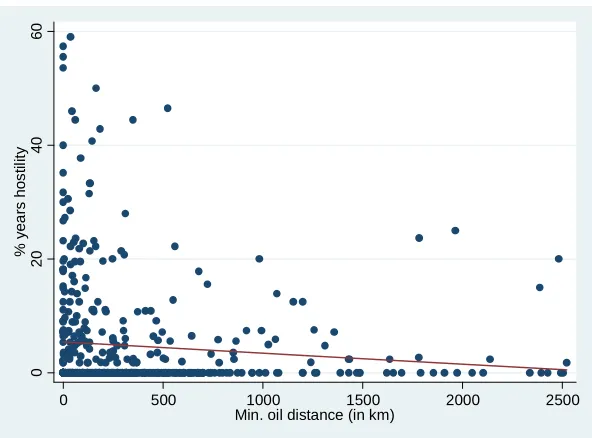
As a preliminary check on the plausibility of this, Figure 1 presents a simple scatterplot
which suggests that the geographic location of oil deposits could be related to cross-country
con‡ict. Each point in the graph is a country pair. On the vertical axis we plot the fraction
of years that the pair has been in con‡ict since World War II, while on the horizontal axis
we measure the (time average of) the distance to the bilateral border of the closest oil
…eld. (Clearly only country pairs where at least one country has oil …elds are included).3
The graph clearly shows that country pairs with oil near the border appear to engage in
con‡ict more often than country pairs with oil far away from the border [the correlation
coe¢ cient is -.11 (p-value: 0.01)].
The crude correlation in Figure 1 could of course be driven by unobserved heterogeneity
and omitted variables. For example, it could be that some countries that have oil near the
border just happen to be more belligerent, so that country-pairs including such countries
spuriously …ght more often. Hence, the rest of the paper engages in a more careful,
model-based empirical investigation that controls for omitted factors, including country …xed
e¤ects, and is sensitive to the issue of border endogeneity.
To see the bene…t of focusing on the geographical location of resource deposits, contrast
our approach with the (simpler) strategy of asking whether countries are more likely to
3Note that for visual convenience we have trimmed both axes, removing the 1% outliers with highest
0
20
40
60
%
yea
rs
hos
til
it
y
0 500 1000 1500 2000 2500
Min. oil distance (in km)
Figure 1: Oil distance from the border and bilateral con‡ict
…nd themselves in con‡ict with neighbors who have natural resources than with neighbors
that are resource-less. There are two shortcomings of this strategy. First, it tells us little
about the mechanism by which resource abundance a¤ects con‡ict. For example, it could
just be that resource-abundant countries can buy more weapons. Second, the potential
for spurious correlation between being resource-rich and other characteristics that may
make a country (or a region) more likely to be involved in con‡ict is non-trivial. For both
reasons, while we do look at the e¤ects of resource abundance per se, we think it is crucial
to complement the analysis with the geographical information.
To the best of our knowledge, there is no theoretical model that places con‡ict inside a
geographical setting. Given the prominence of the concept of territorial war, this omission
may seem surprising. Hence, we begin the paper by developing a simple but novel
two-country model with a well-de…ned geography, where each two-country controls some portion of
this geography, so there is a well-de…ned notion of a border, and where the two countries can
engage in con‡ict to alter the location of the border. This provides a simple formalization
of territorial war.
We use our model of territorial war to generate testable implications on the mapping
from the geographical distribution of natural resources to the likelihood of con‡ict. We
assume that each of the two countries may or may not have a resource deposit (henceforth
bilateral border. If a war leads one of the two countries to capture a portion of territory
that includes an oil …eld, the control over the oil …eld shifts as well.
Compared to the situation where neither country has oil, we show that the appearance
of oil in one country tends to increase the likelihood of con‡ict. In particular, the
height-ened incentive of the resource-less country to seek con‡ict to capture the other’s oil, tends
to dominate the reduced con‡ict incentive of the resource-rich country, which fears losing
the oil. Similarly, ceteris paribus, the likelihood of con‡ict increases with the proximity
of the oil to the border: as the oil moves towards the border the incentive of the oil-less
country to …ght increases more than the incentive for the oil-rich one is reduced. Finally,
when both countries have oil, con‡ict is less likely than when only one does, but more likely
than when there is no oil at all. More importantly, conditional on both countries having
oil, the key geographic determinant of con‡ict is the oil …elds’ asymmetric location: the
more asymmetrically distributed the oil …elds are vis-a-vis the border the more likely it is
that two oil-rich countries will enter into con‡ict. The overall message is thatasymmetries
in endowments and location of natural resources are potentially important determinants
of territorial con‡ict.
While our theory applies to any type of resource endowment, our empirical work
fo-cuses on oil, for which we were able to …nd detailed location information (and which is the
resource most commonly conjectured to trigger con‡ict). We test the model’s predictions
using a novel dataset which, for each country pair with a common border (or whose
coast-lines are relative near each other), records the minimum distance of oil wells in each of the
two countries from the international border (from the other country’s coastline), as well as
episodes of con‡ict between the countries in the pair over the period since World War II.
We …nd that indeed having oil in one or both countries of a country pair increases the
average dispute risk relative to the baseline scenario of no oil. However, this e¤ect depends
massively on the geographical location of the oil. When only one country has oil, and this
oil is very near the border, the probability of con‡ict is between three and four times as
large as when neither country has oil. In contrast, when the oil is very far from the border,
the probability of con‡ict is not signi…cantly higher than in pairs with no oil. Similarly,
when, both countries have oil, the probability of con‡ict increases very markedly with the
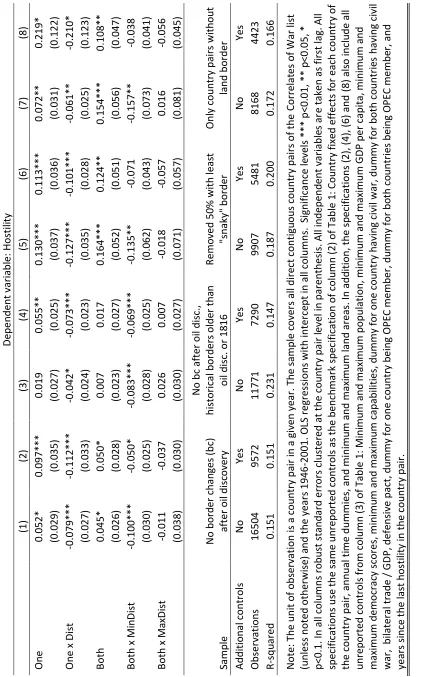
Our results are robust to concerns with endogeneity of the location of the border,
be-cause they hold when focusing on subsamples of country pairs where the oil was discovered
only after the border was set; in subsamples where the border looks “snaky,” and hence
likely to follow physical markers such as mountain ridges and rivers; and in subsamples
where the distance of the oil is measured as distance to a coastline rather than to a land
border. They are also robust to controlling for a large host of country and country-pair
characteristics often thought to a¤ect the likelihood of con‡ict. Since country …xed
ef-fects are included, they are also robust to unobservable factors that may make individual
countries more prone to engage in con‡ict.
Most theoretical work on war onset in political science and economics takes the
belliger-ents’motives as given. The objective is rather either to study the determinants of …ghting
e¤ort (Hirshleifer, 1991, Skaperdas, 1992), or to identify impediments to bargaining to
prevent costly …ghting (Bueno de Mesquita and Lalman, 1992, Fearon, 1995, 1996, 1997,
Powell, 1996, 2006, Jackson and Morelli, 2007, Beviá and Corchón, 2010).4 Our approach
is complementary: we assume that bargaining solutions are not feasible (for any of the
reasons already identi…ed in the literature), and study how the presence and location of
natural resources a¤ect the motives for war.5
The paper is thus closer to other contributions that have focused on factors that enhance
the incentives to engage in con‡ict. On this, the literature so far has emphasized the role of
trade (e.g., Polachek, 1980; Skaperdas and Syropoulos, 2001; Martin, Mayer and Thoenig,
2008; Rohner, Thoenig and Zilibotti, 2013), domestic institutions (e.g., Maoz and Russett,
1993; Conconi, Sahuguet, and Zanardi, 2012), development (e.g., Gartzke, 2007; Gartzke
and Rohner, 2011), and stocks of weapons (Chassang and Padró i Miquel, 2010). Natural
resources have received surprisingly little systematic attention in terms of formal modelling
or systematic empirical investigations. Acemoglu et al. (2012) build a dynamic theory of
4These authors highlight, respectively, imperfect information, commitment problems, and agency
prob-lems as potential sources of bargaining failure. See also Jackson and Morelli (2010) for an updated survey.
5Superimposing our model into one of the existing models of bargaining failure would be feasible, but
unlikely to add much further insight. For similar reasons our model does not feature endogenous …ghting
trade and war between a resource rich and a resource poor country. But their focus is on the
interaction between extraction decisions and con‡ict, and they do not look at geography.
De Soysa et al. (2011) cast doubt on the view that rich countries are targeted by
oil-poor ones, by pointing out that oil-rich countries are often protected by (oil-importing)
superpowers.6
Unlike in the case of cross-country con‡ict, there is a lively theoretical and empirical
literature, nicely summarized in van der Ploeg (2011), on the role of natural resources
in civil con‡ict. The upshot of this literature is that natural-resource deposits are often
implicated in civil and ethnic con‡ict. Our paper complements this work by investigating
whether the same is true for international con‡ict.7
The remainder of the paper is organized as follows. Section 2 presents a simple model
of inter-state con‡ict. Section 3 carries out the empirical analysis, and Section 4 concludes.
Appendix A describes all data in detail, while Appendix B presents additional empirical
results.
6De Soysa et al. also …nd that oil-rich countries are more likely to initiate bilateral con‡ict against
oil-poor ones. Colgan (2010) shows that such results may be driven by spurious correlation between being
oil rich and having a “revolutionary” government. in Appendix B we look at a similar “directed dyads”
approach and …nd that, in our sample, oil-rich countries are relatively less prone to be (classi…ed as)
revisionist, attacker, or initiator of con‡ict, and thattheir propensity to attack is decreasing in their oil
proximity to the border. This di¤erence in results could be due to di¤erences in sample (we only look at contiguous country pairs), or methods (we include a full set of country and time …xed e¤ects and a much
more extensive list of controls).
7The vast majority of the civil-con‡ict literature focuses on total resource endowments at the country
level (see, e.g. Michaels and Lei, 2011, and Cotet and Tsui, 2013, for recent examples and further
refer-ences), but recently a few contributions have begun exploiting within-country distributional information.
For example, Dube and Vargas (2013) …nd that localities producing oil are more prone to civil violence;
Esteban, Morelli and Rohner (2012) …nd that groups whose ethnic homelands have larger endowments of
oil are more prone to being victimized; Morelli and Rohner (2011) …nd that inter-group con‡ict is more
likely when total resources are more concentrated in one of the ethnic groups’ homelands. Harari and
La Ferrara (2012) also …nd that local mineral-resources are associated with more con‡ict, though their
main focus is on climate shocks. None of these studies make use of information on the distance of natural
2
The Model
2.1
Assumptions
The world has a linear geography, with space ordered continuously from 1 to +1: In
this world there are two countries, A and B. Country A initially controls the [ 1;0]
region of the world, while country B controls [0;+1]:In other words the initial border is
normalized to be the origin. Each country has a resource point (say an oil …eld) somewhere
in the region that it controls. Hence, the geographic coordinates of the two resource points
are two points on the real line, one negative and one positive. We call these pointsGA and
GB, respectively. These resource points generate resource ‡ows RA and RB, respectively.
For simplicity the Rs can take only two values, RA; RB 2 f0; Rg, where R >0. Without
further loss of generality we normalize R to be equal to 1.8
The two countries play a game with two possible outcomes: war and peace. If a con‡ict
has occurred, there is a new post-con‡ict boundary,Z. Intuitively, ifZ >0countryA has
won the war and occupied a segment Z of country B. IfZ <0 country B has won. The
implicit assumption here is that in a war the winner will appropriate a contiguous region
that begins at the initial border.
We make the following assumptions on the distribution ofZ.
Assumption 1 Z is a continuous random variable with domain R, density f, cumulative
distribution function F, and mean Z.
In sum, the innovation of the model is to see war as a random draw of a new border
between two countries: this makes the model suitable for the study of territorial wars.
Note that the meanZ can be interpreted as an index of (expected) relative strength of the
two countries. IfZ >0a potential war is expected to result in territorial gains for country
A(the more so the largerZ), so countryAcan be said to be stronger. IfZ <0countryB
8As we discuss in Section 2.3.2 it is easy to generate comparative static predictions with respect to
changes inRA andRB (and hence, implicitly, with respect to changes in oil prices). But data limitations
and identi…cation issues prevent us from testing these predictions. Since we do not pursue empirical
is stronger. Needless to say, sinceZ is de…ned onRit is possible for the (expected) weaker
country to win.9
We assume that each country’s objective function is linearly increasing in the value of
the natural resources located in the territory it controls (at the end of the game). This
means that, ceteris paribus, a country would like to maximize the number of oil …elds it
controls.
Besides the oil, there is an additional cost or bene…t from con‡ict, bi, i =A; B, which
is a catch-all term for all the other considerations that a¤ect a country’s decision to go to
war. We treatbi as a random variable, to re‡ect that con‡ict is often triggered by political
shocks (domestic or international) that change the cost-bene…t analysis of going to war.
In particular, we think of bi as “typically” being negative, re‡ecting the very high costs
that war brings in terms of casualties, destruction, and expense. However, there also is
a positive “tail” to its distribution, re‡ecting the fact that sometimes countries have very
compelling ideological or political reasons to …ght wars. For example, governments facing
a collapse in domestic support have been known to take their countries to war to shore up
their position by riding nationalist sentiments. In other cases they have felt compelled (or
at least justi…ed) to take action to protect the interests of co-ethnic minorities living on
the other side of the border.
We make the following assumption on the distribution of the bis.
Assumption 2 bi, i = A; B is a continuous random variable de…ned on R, with density
h and cumulative distribution function H. Further, h(b)=h( b)< H(b)=H( b) for b >0.
The last statement in the assumption is the important one. It implies that h( ) is
single-peaked, and that it peaks at a negative value of b, since, as discussed, most of the
time the net non-territorial costs of violent con‡icts (deaths and destruction) exceed the
9For simplicity, we treat Z as an exogenous parameter. The important qualitative results remain
unchanged if we endogenizeZ using a standard contest-success-function approach. However, in order to
maintain analytical tractability, strong functional form assumptions are required. The results are available
bene…ts.10 Note that the assumption also impliesh(b)=h( b)> H(b)=H( b) forb < 0.
For simplicity we have implicitly assumed that the distribution H is the same for
both countries, and that the two draws of bi are independent. We discuss relaxing these
assumption below.
This discussion results in the following payo¤ functions. If the outcome is peace, the
payo¤s are simply RA for country A and RB for country B, as by de…nition there is no
border change (and hence also no change in property rights over the oil …elds). Similarly,
we have (implicitly) de…nedb as a net bene…t of con‡ict so thebs do not enter the payo¤s
in case of peace.
If there has been a war, the payo¤s are:
UAC = RAI(Z > GA) +RBI(Z > GB) +bA;
UBC = RAI(Z < GA) +RBI(Z < GB) +bB;
where UC
i is the payo¤ for country i after a con‡ict, and I( ) is the indicator function.
The …rst two terms in each payo¤ function are the oil wells controlled after the war. For
example, country A has hung on its well if the new border is “to the right” of it, and
similarly it has conquered B’s oil if the new border is to the right of it. The last term
represents the non-territorial costs or bene…ts from war. Note that implicitly (and for
simplicity) we assume that countries are risk neutral.11;12
10In principle, not all single-peaked functions that peak at a negative value ofbneed to satisfy the
con-dition in the proposition. However, the concon-dition will be satis…ed in all cases where eitherhis symmetric,
orH is log-concave. The vast majority of commonly-used distributions de…ned onRare either symmetric
or log-concave (or both).
11Our payo¤ functions implicitly assume that the value of the oil …elds is the same in case of war or
without. It would be fairly trivial to allow for some losses in the value of the oil in case of con‡ict. For
example we could assume that conquered oil only delivers R to the conqueror, with 2 (0;1]. The
statements of our propositions would become slightly messier, but the qualitative predictions would be
unchanged.
12In order to use our framework to study other aspects of territorial war, it will typically make sense
thatZ enters directly into the payo¤ functions, re‡ecting that countries may care about their territorial
The timing and actions of the model are as follows. First, each country i draws a
bene…t of con‡ict bi, i=A; B. Then each country decides whether or not to declare war,
and does so to maximize expected payo¤s. If at least one country declares war, war ensues.
In case of war, nature draws the new boundary,Z. Then payo¤s are collected.
2.2
Analysis
It is convenient to focus the analysis on the probability that peace is the outcome. This
requires both countries to prefer peace (conditional on their draw of b), which occurs if
E(UAC) RA and E(UBC) RB, and where the expectation is taken after observing bi.
Given assumption 1 these conditions can be rewritten as
bA+RB[1 F(GB)] RAF(GA); (1)
bB+RAF(GA) RB[1 F(GB)]: (2)
These expressions clearly convey the basic trade-o¤ countries face in deciding whether to
initiate a con‡ict (over and above the trade-o¤s that are already subsumed in thebiterms):
con‡ict is an opportunity to seize the other country’s oil, but also brings the risk of losing
one’s own. Crucially, the probabilities of these two events depend on the location of the
oil …elds. Consider the decision by country A. If its own oil is very far from the border
(GA, and henceF(GA), is small) then countryAis relatively unlikely to lose the oil, which
makes it in turn less likely to choose peace. Similarly, if countryB’s oil is nearer the border
(GB small, so 1 F(GB) large), the prospects of capturing B’s oil improve, and A once
again is less likely to opt for peace.
Remark: The case where RA = 0(RB= 0) is isomorphic to the case whereGA! 1
(GB! 1).
For the purposes of evaluating the likelihood of peace, it makes no di¤erence if one
country does not have oil, or its oil is located in…nitely far from the border. This
observa-tion, which follow directly from inspection of equations (1) and (2), simpli…es slightly the
previous version of this paper we added the term+Z ( Z) to the expression forUC
A (UBC). However this
addition complicates the statements of our results, so we have dropped these terms in the current version
presentation of the results, as it implies that the cases where only one or neither country
have oil are limiting cases of the case where both countries have oil.
Thanks to the latest remark, we can denote the probability of peace asP(GA; GB), i.e.
simply as a function of the location of the oil …elds. In particular, with some slight abuse
of notation, we denote the probability of peace when only countryA has oil (no country
has oil) asP(GA;1)(P( 1;1)). Then equations (1) and (2), together with Assumption
2, imply
P(GA; GB) =H( x)H(x);
where
x RAF(GA) +RB[1 F(GB)]:
We then obtain the following predictions:
Proposition 1
(i) P(GA;1) P( 1;1);
(ii) @P(GA;1)=@GA 0;
(iii) P(GA; GB) P( 1;1);
(iv) P(GA;1) P(GA; GB) if and only if 1 F(GB) 2F(GA);
(v) @P(GA; GB)=@GA 0 if and only if 1 F(GA) F(GB) 0:
Proof: Parts (i), (iii), and (iv) of the proposition use the fact that the function
H( x)H(x) is symmetric around 0, increasing for x < 0 and decreasing for x > 0. We
also have @x=@GA > 0, so @P=@G < 0 if @P=@x < 0, or x > 0. This translates into the
statements in parts (ii) and (v).
The proposition enumerates …ve testable implications about how the presence and
location of oil a¤ects the likelihood of con‡ict among two countries. Parts (i), (iii), and
(iv) compare the likelihood of con‡ict when neither, only one, or both countries have oil.
Parts (ii) and (v) look at how the likelihood varies with the location of the oil. In the rest
of the section we discuss what these predictions say and how they come about within the
logic of the model.
Part (i) of the proposition establishes that con‡ict is more likely when one country
has oil than when neither country does. Recall that a discovery of oil in one country has
oil becomes less likely to wish to get into a con‡ict because it has more to lose, while the
other country has an additional potential prize from going to war. The proposition says
that the latter e¤ect systematically dominates, so the likelihood of con‡ict goes up.
Figure 2: E¤ect of oil presence and location on incentives to …ght
To see why typically the appearance of oil in one country increase the likelihood of
con‡ict, refer then to Figure 2. The bell-shaped curve is the function h(b), assumed to be
symmetric in this particular picture. Imagine an initial situation where neither country
has oil. In this case countryA (B) prefers peace ifbA 0(bB 0), so the area under the
h curve and to the left of 0 represents the probability that either country prefers peace.
Now suppose that oil appears in country A, at location G0
A. Country A prefers peace if
bA F(G0A) and country B prefers peace if bB F(G0A). Hence, relative to the no-oil
case, country A’s desire for peace increases by the shaded area between 0 and F(G0
A),
while countryB’s preference for peace decreases by the shaded area between F(G0A)and
0. It is immediately apparent that the latter e¤ect dominates, giving rise to part (i) of the
proposition.
Intuitively, the appearance of the oil means that country A is now unwilling to …ght
even for some positive values of the non-territorial bene…t bA. But positive values of bA
are relatively rare events: most of the time the non-territorial consequences of con‡ict
are losses (deaths, destruction, expenses). Hence, the presence of the oil eliminates cases
that are relatively infrequent to start with. On the other hand, the presence of the oil
negative realizations of b are more frequent than positive ones, so overall there are more
con…gurations of (bA,bB) that lead to con‡ict.
Part (ii) says that when oil is only in one country the probability of con‡ict increases
when oil moves closer to the border. To see, this, refer again to Figure 2, and just imagine a
further increase inGA toG00A > G0A (not drawn): one can immediately see that the further
change has similarly asymmetric e¤ects on the two countries’incentives for con‡ict. The
intuition is along the same lines as the one o¤ered for part (i).
Part (iii) of the proposition tells us that two countries both having oil are more likely
to experience a con‡ict than two countries both not having oil. Oil always makes one
country more aggressive, and this is enough to trigger more con‡icts. In this sense under
our assumptions the mere presence of oil is always a threat to peace.
Part (iv) compares the situation when both countries have oil to the situation when
only countryAhas oil. It says that the discovery of oil in the second country will typically
defuse tensions. The intuition is that the second country to …nd the oil will typically be
the country initially responsible for most con‡ict between the two. When this country
…nds oil, it becomes less aggressive, as it is concerned with the possibility of losing it.
CountryAdoes become more aggressive, but this is typically insu¢ cient to create a more
belligerent atmosphere, unless the oil in countryAwas initially much further away from the
border than the new oil discovered in countryB –which is the meaning of the conditioning
statement in part (iv). Unconditionally, i.e. without knowledge of the locations of the two
countries’oil …elds, we expect pairs where both countries have oil to engage in less con‡ict
than pairs where only one does.
Finally, part (v) looks at the marginal e¤ect of moving oil towards the border in one
country, while leaving the other country’s oil location unchanged. To better understand
this condition, it is useful to look at the following special case.
Corollary
If Z = 0 (the two countries have equal strength), and f is symmetric, then
@P(GA; GB)=@GA 0 if and only if jGAj GB:
In other words, when both countries have oil, changes in distance that increase the
asymmetry of oil locations tend to increase con‡ict. To see the intuition, we can “recycle”
is symmetric, the incentive to …ght for the other country’s oil exactly cancels out with the
deterrent e¤ect from fear of losing one’s oil (cf. equations (1) and (2)). Hence, the condition
to prefer peace isbi 0,i=A; B, much as in the case where neither country has oil. Now
consider breaking symmetry by increasingGA to, say,G0A. The condition forAchanges to
bA F(G0A) F(GA), which is positive, while forB it changes tobA [F(G0A) F(GA)].
Hence the e¤ects of breaking symmetry can be deduced from Figure 2 by simply replacing
F(G0
A) by [F(G0A) F(GA)]. The conditioning statement in the proposition generalizes
this intuition, asF(GA)will tend to be larger than1 F(GB)whenGAis closer to border
than GB:13
The empirical part of the paper tests predictions (i)-(v).
2.3
Discussion
2.3.1 Con‡ict and border changes
The key modelling choice we have made is to think of international wars as potentially
border-changing events. The long (and very incomplete) list of examples of territorial
wars and militarized border disputes in the Introduction supports this assumption. The
International Relations literature provides further systematic evidence. Kocs (1995) has
found that between 1945 and 1987 86% of all full-blown international wars were between
neighboring states, and that in 72% of wars between contiguous states unresolved disputes
over territory in the border area have been crucial drivers. The unstable nature of borders
is well recognized. According to Anderson (1999) about a quarter of land borders and some
two-thirds of maritime borders are unstable or need to be settled. Tir et al. (1998) identify,
following restrictive criteria, 817 territorial changes between 1816 and 1996, many of which
are the result of international con‡icts. According to Tir et al. (1998) and Tir (2003) 27%
of all territorial changes between 1816 and 1996 involve full-blown military con‡ict, and
47% of territorial transfers involve some level of violence. Weede (1973: 87) concludes that
13However in the case where f is not symmetricjG
Aj GB is not su¢ cient for movements away from
symmetry to generate more con‡ict. The prediction could be overturned if the country whose oil is moving
"the history of war and peace is largely identical with the history of territorial changes as
results of war."
The data described in the next section supports the existing evidence. In our panel of
country pairs 0.4% of all observations feature border changes (corresponding to 90 cases
of border change). Yet, conditional on the two countries being in con‡ict with each other,
the incidence of border changes goes up to 7.4%. In other words the probability of a
border change increases 19-fold in case of war.14 In the appendix we reinforce the message
from these simple calculations by con…rming that con‡ict remains a signi…cant predictor
of border changes after controlling for time and country …xed e¤ects. Indeed we go further
and show that the presence and location of oil …elds has some predictive power for border
changes, despite the very infrequent occurrence of such changes.
Having said that, it is also important to stress that the model emphatically does not
predict that all con‡icts will be associated with border changes. All of our results and
calculations allow for the distribution ofZ to have a mass point at 0. Indeed, a signi…cant
mass point at 0 appears likely in light of the …gures above.
It is also important to point out that, strictly speaking, the distribution function f
need not be the true distribution of post-con‡ict border locationsZ. f is the distribution
used by the decision-makers in the two countries, so the discussion so far essentially
as-sumes that policymakers have correct beliefs about the distribution of outcomes in case
of war. Anecdotal observation suggests that overoptimism is often a factor in war and
peace decisions, so our guess is that the objective numbers cited above are probably lower
bounds on the probabilities assigned by leaders to their chances of moving the border in
case of war. For example, it seems likely that Saddam Hussein overstated his chances of
permanently shifting the borders of Iraq with Iran (…rst) and Kuwait (later).
14Conversely, while only 6% of observed country pairs are in con‡ict, 30% of country pairs experiencing
2.3.2 Allowing for Variation in R
With our assumption that R 2 f0;1g we have normalized all non-zero oil endowments.
It is trivial to relax this assumption to look at the e¤ects of changes in RA and RB. In
particular, as implied by our Remark above, an increase in RA has identical qualitative
e¤ects of a movement of A’s oil towards the border, while an increase in RB is akin to a
move ofB’s oil towards the border. Our propositions can therefore readily be reinterpreted
in terms of changes in quantities. Unfortunately, testing these predictions would require
data on oil …eld-level endowments that we have no access to. Potentially, predictions for
changes in the Rs might be tested using variation in oil prices, as an oil price increase is
an equiproportional increase in both RA and RB. For example, for the case where only
one country has oil, our theory would predict that increases in oil prices tend to lead to
an increase in the likelihood of con‡ict. However, ample anecdotal evidence suggests that
short-term oil prices are very responsive to con‡icts involving oil-producing countries, so it
would be very di¢ cult to sort out a credible causal path from oil prices to con‡ict. Another
issue is that what matters for war should be the long-term oil price: it is not clear that
current oil prices are good forecasts of long-run ones.
2.3.3 Oil as a Source of Military Strength
In our model the discovery of oil in one country tends to make this country less aggressive,
as it fears losing the oil, and the other more aggressive, as it wishes to capture it. We may
call this a “greed”e¤ect. However, the discovery of oil may also provide the discoverer with
…nancial resources that allow it to build stronger military capabilities. If oil rich countries
are militarily stronger, they might also be more aggressive –as the odds of victory go up.
Their neighbors may also be more easily deterred. Hence, there is a potential “strength”
e¤ect that goes in the opposite direction to the “greed”e¤ect.15 To address this potential
15The “strength” e¤ect could easily be added to our model by making Z an increasing function ofR
A
and a decreasing function of RB. However, this would not be enough to fully bring out the ambiguity
discussed in the text. For example, it is easy to see that parts (i)-(iii) of our Proposition would still go
through exactly unchanged. Hence, it would still be the case that, e.g., discovery of oil in one country
ambiguity, we make three observations, in increasing order of importance.
First, the whole premise that oil should make a country militarily stronger may be
somewhat dubious, as a large literature argues that there is a “resource curse” which
lowers incomes in oil-rich countries (see Ross, 2012, for a very comprehensive overview).
Second, while the fact of having oil may have some ambiguous implications through the
opposing “strength” and “greed” e¤ects, the geographical location of the oil should only
matter through greed. Oil will increase resources for …ghting irrespective of its location, but
the risk of losing it will be more severe if the oil is near the border. Hence, our predictions
concerning the e¤ect of oil location on con‡ict –which are the focus for our most distinctive
empirical results – should be una¤ected by the strength argument. As mentioned in the
Introduction, this is one key reason to focus on the geographic distribution of the oil in
the empirical work.
Third, even if we don’t model the “strength” e¤ect explicitly, in our empirical work
we are able to fully control for it. First, in all our speci…cation we include the GDP
of each country in each pair. Since the strength e¤ect operates principally by making
a country richer, controlling for GDP should absorb most of this mechanism. Second,
lest one may worry that oil revenues are more easily turned into weapons than non-oil
revenues, we further control for a measure of “military capabilities.”If having oil allows a
country to build a more powerful army the index of military capabilities should account for
this. Third, just in case oil riches per se make countries more aggressive through channels
not picked up by GDP and military capabilities, we also present a battery of robustness
checks where we include various measures of each country’s aggregate oil endowments.16
bene…t of con‡ict is oil –merely being stronger does not make countryAmore aggressive. In footnote 12
we have alluded to a previous version of the model where countries have territorial aspirations over and
above the control of oil (i.e. Z enters the payo¤ function). In that model the “strength” e¤ect is present
and the empirical predictions are correspondingly a bit more ambiguous.
16Note that while we do not have data on oil-…eld-level oil endowments, we do have data on country-level
oil endowments. The former would be required to test the comparative statics of the model with respect
toRA and RB, i.e. the e¤ect of endowments through the “greed” e¤ect. The latter are su¢ cient to test
for the “strength” e¤ect, which depends only on aggregate endowments matter, and not on their spatial
To anticipate, not only such robustness checks do not a¤ect our headline results, but also
we …nd very little evidence that overall oil endowments play an independent role in causing
con‡ict. This result casts doubt on the importance of the “strength”e¤ect, consistent with
the …rst of our observations above.
2.3.4 Identical distributions for bA and bB
The assumption that thebAandbBare drawn from identical distributions could potentially
be relaxed. For example, a natural extension would be to assume thatbA (bB) is positively
(negatively) related to Z, i.e. that the country that expects the largest territorial gains
also expects the largest non-territorial ones (or to pay a less devastating non-territorial cost
for the con‡ict). A relatively tractable special case of this is to assume that the
country-speci…c distributions hA and hB each satisfy Assumption 2, but di¤er in their means bA
and bB, with 0> bA > bB if Z > 0 and bA< bB < 0otherwise. Under these assumptions
numerical simulations using normal distributions suggest that our results are fairly robust.
For example, in order to reverse part (ii) of our proposition, it needs to be the case that
country A must have a much larger non-territorial bene…t from con‡ict (i.e. bA >> bB).
The closer is the oil to the border, the larger the required di¤erence in bs. The intuition
is that a much larger bA tends to make country A the relatively more aggressive country
(despite being the one having the oil). Hence, as the oil moves towards the border, the
deterrent e¤ect onA is the dominant factor, leading to more peaceful relations. Since our
result is (numerically) robust to all combinations ofbA and bB such that bB > bA, as well
as many combinations such that bA > bB, we conclude that unconditionally, i.e. without
the possibility to condition on measures of bB > bA, we expect the result to hold for the
typical country pair.
3
Empirical Implementation
3.1
Data and Empirical Strategy
3.1.1 Sample
We have constructed a panel dataset, where an observation corresponds to a country pair
list in the "Correlates of War" (2010, CoW) data set. From the universe of country
pairs in CoW, a country pair is included in our data set if it meets a “direct contiguity”
criterion, as de…ned in the "Correlates of War Direct Contiguity Data" (Stinnett et al.,
2002). This criterion is that the two countries must either share a land (or river) border,
or be separated by no more than 400 miles of water. There are 606 pairs of countries
satisfying this criterion.17 The dataset covers the years 1946-2008.
All variables are described in detail in Appendix A, which also contains Table 7 with
summary descriptive statistics. Here we focus on the key dependent variable and the
independent variables of interest.
3.1.2 Dependent Variables
Our main dependent variable is a measure of inter-state dispute, from the "Dyadic
Mil-itarized Interstate Disputes" data set of Maoz (2005), which is an updated and dyadic
(i.e. at the country-pair level) version of the original Militarized Interstate Dispute (MID)
dataset (Jones, Bremer, and Singer, 1996). The MID data is the most widely used data on
interstate hostilities.18 Compared to alternative (and less widely used) data sets –such as
the UCDP/PRIO Armed Con‡ict Dataset (Uppsala Con‡ict Data Program, 2011) – the
MID data has the advantage of not only including the very rare full-blown wars between
states, but also smaller scale con‡icts, and to provide a relatively precise scale of con‡ict
intensity.
In Maoz (2005) interstate disputes are reported on a 0-5 scale. The highest value, 5, is
reserved for “sustained combat, involving organized armed forces, resulting in a minimum
of 1,000 battle-related combatant fatalities within a twelve month period.”This extremely
violent form of confrontation, which we will refer to as “War”, is very rare: only 0.4% of our
observations meet this criterion. The next highest value, 4, is for “Blockade, Occupation
of territory, Seizure, Attack, Clash, Declaration of war, or Use of Chemical, Biological, or
17Approximately 60% of the country pairs in the sample are separated by a land or river border.
18Related papers in economics using this data include for example Martin, Mayer and Thoenig (2008),
Besley and Persson (2009), Glick and Taylor (2010), Baliga, Lucca and Sjöström (2011) and Conconi,
Radioactive weapons.”While still very violent, this type of confrontation, which is labelled
“Use of Force,” is much more frequent, occurring in as many as 5.2% of our observations.
Accordingly, we construct our main dependent variable, which we call “Hostility”by
com-bining all episodes of War and Use of Force.19 We also present robustness checks using
War only,20 or including disputes receiving a value of 3 in Maoz (2005).21
An alternative approach is to investigate data which identi…es the aggressor in a
bilat-eral con‡ict (as in Colgan (2010) and De Soysa et al. (2011)). However, in many cases,
identi…cation of the aggressor requires subjective and possibly unreliable judgments.
Fur-thermore, if a country perceives a potential threat, it may choose to attack …rst, and it
is not clear that data focusing on the direction of attack are always able to account for
such preemptive strikes.22 We submit that our approach based on distance of the oil from
the border o¤ers a more robust strategy. Having said this, in Appendix B we use data
from Maoz (2005) to look at how the presence and the distance of the oil from the border
di¤erentially a¤ect the likelihood that the oil rich or the oil poor country is classi…ed as
"revisionist", "attacker" or "initiator of con‡ict". We …nd robust evidence that oil-rich
countries are less likely to be classi…ed any of the above categories, and that this e¤ect
becomes stronger as the oil gets closer to the border. There is also fairly strong evidence
that countries are more likely to be classi…ed as revisionist towards neighbors that have
oil, the more so the closer the oil is to the border.
Another alternative dependent variable potentially consistent with our theory is border
19It is standard practice in the empirical literature on international con‡ict to aggregate over more
than one of the Maoz (2005) categories. For example, Martin, Mayer and Thoenig (2008) and Conconi,
Sahuguet, and Zanardi (2012) code a country pair to experience con‡ict when hostility levels 3, 4 or 5 are
reached.
20The dataset from Maoz (2005) only runs until 2001. As alternative data on full-blown wars is readily
available, when we check the results using "War" we update this variable using the UCDP/PRIO Armed
Con‡ict Dataset (Uppsala Con‡ict Data Program, 2011).
21Disputes receive a mark of 3 when they meet the criterion of "Display use of force", which is reserved
for "Show of force, Alert, Nuclear alert, Mobilization, Fortify border, Border violation".
22See, e.g., Gaubatz (1991), Gowa (1999), Potter (2007), and Conconi, Sahuguet, and Zanardi (2012),
changes. However, recall from our discussion in Section 2.3 that our theory is consistent
with a mass point at 0 for the distribution of border changes following a con‡ict.
Fur-thermore, the theory is consistent with subjective assessments by key decision makers that
overstate the likelihood of border changes following a con‡ict. For both these reasons we
think that the occurrence of con‡ict, rather than the actual occurrence of a border change,
better captures the forces at work in our model. In addition, because of these
consider-ations border change is an extremely rare event: only 0.4% of our observconsider-ations feature a
border change. Hence, we expect regressions focussing on border change to have very little
power. Having said all this, in Appendix C we do report results using as dependent variable
a dummy variable for border change (constructed from Tir et al., 1998), and still …nd some
support for a role for oil and oil location - though the coe¢ cients are, not surprisingly, less
consistently signi…cant than using Hostility.
3.1.3 Explanatory Variables of Interest
Our main independent variables are one-period lagged measures of the presence and
dis-tance of oil …elds in each country in the pair from the bilateral border or from the other
country’s coastline. To construct these we have combined two sources. The …rst source
is the CShapes dataset of Weidmann, Kuse and Gleditsch (2010), which contains
histor-ically accurate geo-referenced borders for every country and year. The dataset accounts
for border changes over time, both the ones originating from state creation and split-ups,
and those arising from border adjustments. Their border adjustment information is based
on Tir et al. (1998).
The second source is a time varying and geo-referenced dataset on the location of
oil and gas …elds from Lujala, Rod and Thieme (2007, PETRODATA). It includes the
geo-coordinates of hydrocarbon reserves and is speci…cally designed for being used with
geographic information systems (GIS). In total, PETRODATA consists of 884 records for
onshore and 378 records for o¤shore …elds in 114 countries. Note that PETRODATA
includes all oil and gas …elds known to exist, including those not yet under production,
operating and not-yet-operating …elds.23
Using Geographical Information System (GIS) software, we merge these two data sets
so that we can pinpoint each oil …eld position a-vis a country’s borders as well as
vis-a-vis the coastline of neighboring countries. Then, for each country pair and for each oil
…eld belonging to one of the two countries, we measure the oil …eld’s minimum distance to
the other country’s land border, as well as the minimum distance to the coastline of the
other country. The oil …eld’s distance to the other country is then the minimum of these
two.24 The minimum oil distance from the other country is the minimum across all oil
…elds’minimum distances.
On the basis of these data, we have constructed the following …ve explanatory variables.
"One" is a dummy variable taking the value of 1 when only one country in the pair has
oil. Similarly, "Both" takes a value of 1 if both countries of the pair have oil. The omitted
baseline category hence is the case where none of the countries in the pair has oil. "One
x Dist" is the product of the “One” dummy with the distance of the oil from the border.
Similarly, "Both x MinDist" is the product of the “Both”dummy and the minimum of the
distances of the oil from the border in the two countries. Analogously, "Both x MaxDist"
captures the distance from the border in the country whose oil is further from the border.
Note that an increase in "Both x MinDist" (holding "Both x MaxDist" constant) is a
movement towards symmetry, while an increase in "Both x MaxDist" (holding "Both x
23The main data sources of PETRODATA include World Petroleum Assessment by U.S. Geological
Survey (USGS, 2000), Digital database on Giant Fields of the World by Earth Sciences and Resources
Institute at the University of South Carolina (ESRI-USC, 1996), and World Energy Atlas by Petroleum
Economist (Petroleum Economist, 2003).
24Needless to say in many cases there is no land border and in many others there is no coastline, so in
MinDist" constant) is a movement away from symmetry.25
In our main speci…cations, all the distance variables are normalized to lie between 0
and 1, to reduce their range, and constructed so that there are “diminishing marginal
costs” from geographical distance. In particular, the functional form is 1 e d, where d
is the crude geographical distance (in Kms). The idea for the diminishing costs is that
conquering the …rst Km in the enemy’s territory may be a more momentous decision than
conquering the 601st Km when one has already captured the …rst 600. In any case we
present robustness checks for alternative re-scaling or crude unscaled distances.
3.1.4 Control Variables
We include several control variables. Because our distance measures could potentially be
mechanically correlated with country size, and country size could potentially a¤ect con‡ict
independently, in all regressions we control for the maximum and minimum land area in
the pair (i.e. if in a country pair the larger country has a land area of x, and the smaller
one a land area of y, the maximum land area variable for this pair-year takes the value x,
while the minimum area variable takes the value of y). Such minimum-maximum variables
are standard in the literature studying country pairs.
Besides land area, which is always included, most speci…cations also include a set of
“baseline controls”suggested by the con‡ict literature. These are: minimum and maximum
population, minimum and maximum GDP per capita, minimum and maximum …ghting
capabilities, minimum and maximum democracy scores, the number of consecutive years
the two countries have been at peace before the current period, bilateral trade / GDP, a
dummy for membership in the same defensive alliance, two dummies for civil war incidence
in one or both of the countries in the pair, and two dummies for OPEC membership of one
25The attentive reader will have noticed that, in constructing our key dependent variables, we have
taken theminoperator three times: …rst, for each oil…eld in a country, between its distance to the other
country’s border and the other country’s coastline (distance of oil…eld to other country); second, for each
country, among all its oil…elds’ distances to the other country (minimum oil distance to other country);
and, third, between the two countries’minimum oil distances (MinDist). MaxDist is themaxbetween the
or both countries in the pair.26 Finally, in important robustness checks we discuss later,
we further include several variables on the amounts of oil production and reserves in the
two countries. Again, all variables are explained in detail in Appendix A.
3.1.5 Speci…cation and Methods
Our benchmark speci…cation is a linear-probability model that takes the form
HOSTILITYd;t+1 = + Onedt+ (One x Dist)dt
+ Bothdt+ (Both x MinDist)dt+!(Both x MaxDist)dt
+X0dt +ud;t;
where d indexes country pairs, t indexes time, and X is the vector of afore-mentioned
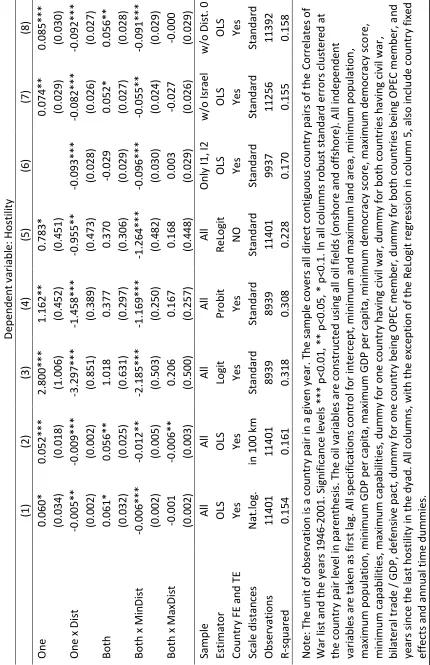
controls. We consider alternative functional forms (including probit and logit) in robustness
checks.
Crucially, our preferred speci…cation for the error termud;t includes a full set of
coun-try dummies as well as a full set of time dummies. This implies that the key source of
identi…cation for, say, the e¤ect of “One” is the relative propensity of a given country to
experience con‡ict with its oil-rich neighbors and with its oil-poor neighbors. We will …nd a
positive estimate of when the same country has more con‡icted relations with its oil-rich
neighbors. The identi…cation of the other coe¢ cients is driven by similar within-country
comparisons, e.g. is a given country more likely to …nd itself in con‡ict with a neighbor
whose oil is near the border than with one whose oil is far away from the border.
In all regressions the standard errors are clustered at the country-pair level. In principle,
26Population and GDP could a¤ect the likelihood of con‡ict in myriad ways, e.g. through the tax base;
…ghting capabilities directly a¤ect the chances of success, so clearly enter the calculation of whether to
engage in con‡ict; democracy scores are included to account for the “democratic peace”phenomenon (Maoz
and Russett, 1993); joint membership in alliances or in OPEC may o¤er countries venues to facilitate the
peaceful resolution of con‡icts; previous history of con‡ict is meant to absorb unobserved persistent factors
leading to con‡ict between the two countries; recent history of domestic civil wars captures one factor that
may weaken one country and tempt the other to take advantage; bilateral trade has been found to matter
we could go further and include a full set of country-pair dummies. Identi…cation of the
oil-related coe¢ cients would then be driven by (i) oil discoveries, which switch the dummies
“One” and “Both” from0 to 1, as well as potentially changing the distance measures (if
the newly-discovered …eld is closer to the border than all the pre-existing …elds); and (ii)
changes in borders. Unfortunately there are too few (relevant) oil discoveries and border
changes in our dataset to provide su¢ cient power for identi…cation. Accordingly, when
we do include a full set of country-pair dummies (and two-way cluster the standard errors
at the country level), most coe¢ cients retain the sign of the benchmark results, but lose
statistical signi…cance.27
3.2
Results
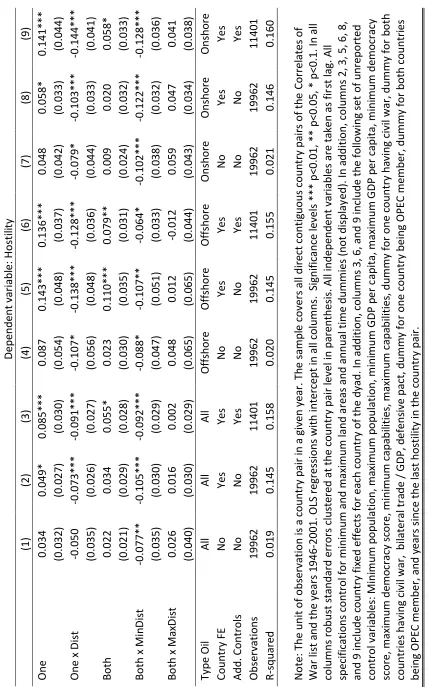
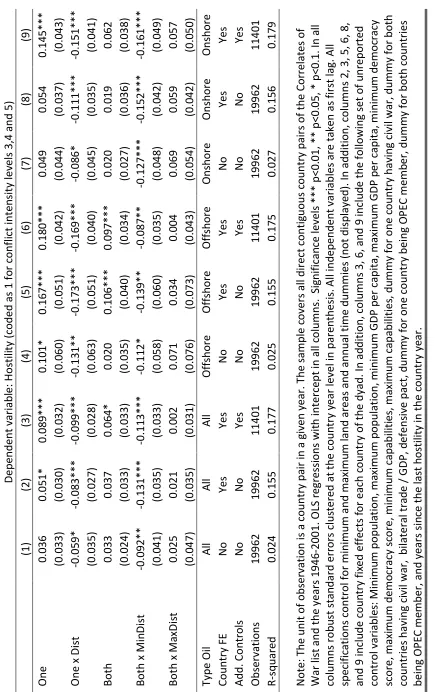
Table 1 displays the baseline regressions for the main dependent variable, Hostility. In the
…rst three columns we use all oil …elds to construct our main variables, while in columns
4-6 we only use o¤shore oil, and in columns 7-9 only onshore oil. In column 1 we show
the coe¢ cients on our variables of interest only after controlling for annual time dummies
and minimum and maximum land area. In column 2 we add country …xed e¤ects, and in
column 3 we further add the full set of baseline controls discussed above. The estimates
are reasonably stable across the three speci…cations, though statistical signi…cance tends
to improve as we add country …xed e¤ects and the further controls.
The speci…cation with the full set of country …xed e¤ects and controls (column 3) is
our preferred speci…cation. In this speci…cation, both the presence and geographic location
of the oil are statistically signi…cant predictors of bilateral con‡ict. As predicted by the
model a country pair with one or both countries having oil is signi…cantly more prone to
inter-state disputes than a pair with no oil whatsoever (which is the omitted category).
More importantly, when only one country has oil, the likelihood of con‡ict signi…cantly
drops when the oil is further away from the border. Similarly, when both countries have
oil, the likelihood of con‡ict is decreasing in the distance from the border of the oil that is
27In particular in our preferred model in Column 3 of Table 1 only the coe¢ cient on “Both” remains
closest to the border - a movement towards symmetry. The only prediction of the model
for which the support is weak concerns the distance of the furthest oil …eld: while the sign
of the coe¢ cient is positive, as predicted, it is not statistically signi…cant.
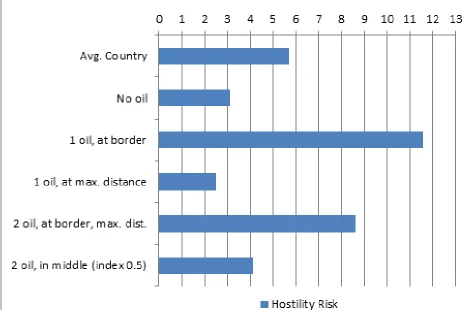
Quantitatively, the e¤ect of geographic location is very sizeable. Figure 3 shows the
probability of con‡ict implied by the regression coe¢ cients in Column 3 as a function of
the oil’s distance from the border (when all the controls are set at their average values). As
already noted, the average risk of con‡ict in our sample is 5.7 percent. This drops to 3.1
percent for country pairs in which neither country has oil. In contrast, when one country
in the pair has oil, and this oil is right at the border (Distance = 0), the probability of
con‡ict is almost 4 times as large: 11.6 percent. But this greater likelihood of con‡ict is
very sensitive to distance. Indeed when the oil is located at the maximum theoretical value
for our distance measure (Distance = 1) the likelihood of con‡ict is similar to the likelihood
when neither country has oil.28 The last two bars in the …gure look at the case where both
countries have oil. In the …rst instance, asymmetry is maximal: one country has oil right at
the border (MinDist=0), the other at the maximum distance (MaxDist=1). The likelihood
of con‡ict is almost three times as large as in the case where neither country has oil, or
8.6 percent. In the second instance, we look at a case of perfect symmetry: both countries
have oil at a distance that is one half of the maximum distance (MinDist=MaxDist=0.5).
The likelihood of con‡ict is a much more modest 4.1 percent.29
28Hence, our model’s formal isomorphism between the cases of no oil and “in…nitely distant” oil seems
to also hold empirically.
29In constructing Figure 3 we have used the coe¢ cient on the interaction term between the “oil in two
countries”dummy and the maximum distance variable even though it is statistically insigni…cant. Because
Dependent variabl e: Hostili ty (1) (2) (3) (4) (5) (6) (7) (8) (9) One 0.034 0.049* 0.085* ** 0.087 0.143* ** 0.136* ** 0.048 0.058* 0.141* ** (0.0 32) (0.0 27) (0.0 30) (0.0 54) (0.0 48) (0.0 37) (0.0 42) (0.0 33) (0.0 44)
One x Dist
-0.050 -0.073* ** -0.091* ** -0.107* -0.138* ** -0.128* ** -0.079* -0.103* ** -0.144* ** (0.0 35) (0.0 26) (0.0 27) (0.0 56) (0.0 48) (0.0 36) (0.0 44) (0.0 33) (0.0 41) Both 0.022 0.034 0.055* 0.023 0.110* ** 0.079* * 0.009 0.020 0.058* (0.0 21) (0.0 29) (0.0 28) (0.0 30) (0.0 35) (0.0 31) (0.0 24) (0.0 32) (0.0 33) Both x Min Dist -0.077* * -0.105* ** -0.092* ** -0.088* -0.107* * -0.064* -0.102* ** -0.122* ** -0.128* ** (0.0 35) (0.0 30) (0.0 29) (0.0 47) (0.0 51) (0.0 33) (0.0 38) (0.0 32) (0.0 36) Bo th x M axD ist 0.026 0.016 0.002 0.048 0.012 -0.012 0.059 0.047 0.041 (0.0 40) (0.0 30) (0.0 29) (0.0 65) (0.0 65) (0.0 44) (0.0 43) (0.0 34) (0.0 38) Type Oil All All All Offshore Offshore Offshore Onshore Onshore Onshore Country FE No Yes Yes No Yes Yes No Yes Yes Add . Controls No No Yes No No Yes No No Yes Observations 1996 2 1996 2 1140 1 1996 2 1996 2 1140 1 1996 2 1996 2 1140 1 R-squared 0.019 0.145 0.158 0.020 0.145 0.155 0.021 0.146 0.160 Note: The unit of obser
vation is a
country p air in a given year. Th e sampl e covers all direct contig uous coun try pair
s of th
e
Correl
ates
of
War list a
nd the
years 1
946
-2001. OLS regressions with intercept in all columns
.
Significance levels *** p<0.01,
**
p<0.05,
* p<0.1. In
all
columns robust standard errors clustered at the country pair level in parenthesis. All independent variables are taken as fir
st lag. All
specifications control for minimum and maximum land areas and annual time dummies (not display
ed). In a dditi on, colu mns 2, 3, 5, 6, 8,
and 9 include c
ountry fix
ed effects f
or each c
ountry of
the dyad. In
addition,
columns
3, 6, and 9
include th e following set of un reported control variab les: Mini mum p opulation, ma ximum p opulation, mini
mum GDP p
er c
apita,
maximum
GDP p
er capita, mini
mum de mocracy score, maxi mum demo cracy sc ore, mini mum capabil ities, maximum capa bilities , du
mmy for one c
ountry ha
ving civil war,
dummy for both countries having ci vil war, bilateral tra de / GDP, d efens
ive pact, d
umm
y fo
r one country being OPEC member, dummy for both countri
es
being OPEC
member, an
d y
ears since the
last hostilit
y in the c
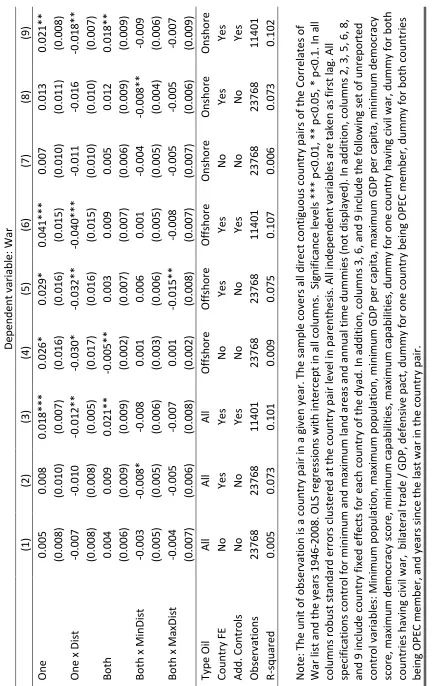
Dependent variabl e: War (1) (2) (3) (4) (5) (6) (7) (8) (9) One 0.00 5 0.00 8 0.01 8*** 0.02 6* 0.02 9* 0.04 1*** 0.00 7 0.01 3 0.02 1** (0.0 08) (0.0 10) (0.0 07) (0.0 16) (0.0 16) (0.0 15) (0.0 10) (0.0 11) (0.0 08)
One x Dist
-0.00 7 -0.01 0 -0.01 2** -0.03 0* -0.03 2** -0.04 0*** -0.01 1 -0.01 6 -0.01 8** (0.0 08) (0.0 08) (0.0 05) (0.0 17) (0.0 16) (0.0 15) (0.0 10) (0.0 10) (0.0 07) Both 0.00 4 0.00 9 0.02 1** -0.00 5** 0.00 3 0.00 9 0.00 5 0.01 2 0.01 8** (0.0 06) (0.0 09) (0.0 09) (0.0 02) (0.0 07) (0.0 07) (0.0 06) (0.0 09) (0.0 09)
Both x MinDist
-0.00 3 -0.00 8* -0.00 8 0.00 1 0.00 6 0.00 1 -0.00 4 -0.00 8** -0.00 9 (0.0 05) (0.0 05) (0.0 06) (0.0 03) (0.0 06) (0.0 05) (0.0 05) (0.0 04) (0.0 06) Both x Ma xDis t -0.00 4 -0.00 5 -0.00 7 0.00 1 -0.01 5** -0.00 8 -0.00 5 -0.00 5 -0.00 7 (0.0 07) (0.0 06) (0.0 08) (0.0 02) (0.0 08) (0.0 07) (0.0 07) (0.0 06) (0.0 09) Type Oil All All All Offshore Offshore Offshore Onsho re Onsho re Onsho re Country FE No Yes Yes No Yes Yes No Yes Yes Add. Cont rols No No Yes No No Yes No No Yes Observ ations 237 68 237 68 114 01 237 68 237 68 114 01 237 68 237 68 114 01 R-squared 0.00 5 0.07 3 0.10 1 0.00 9 0.07 5 0.10 7 0.00 6 0.07 3 0.10 2
Note: The uni
t of obser
vation is a countr
y pair in a gi
ven year.
The sampl
e covers
all direct con
tiguous count
ry pairs of th
e
Correlates
of
War list and the
years 194 6-2008. OLS r egressi ons wi th intercep t in all c olumns. S igni fican ce levels *** p <0.01, ** p<0.
05, * p<
0.1. In a
ll
columns robust standard errors clustered at
the country pair level in parenthesis. All independent variables
are t
aken as
first lag. All
specifications control for minimum and maximum land
areas and annual time dummies (not displayed). In a
ddition, columns 2, 3,
5,
6,
8,
and 9 includ
e countr
y fixed effec
ts for e
ach c
ountry of
the dyad. In
addition,
columns
3, 6, and 9
include the
following set of unrepor
ted
control variables: Mini
mum population, ma
ximum population, mini
mum GDP per capita, ma
ximum GDP p
er capita, minimu
m democracy
score, maximum democracy score, mini
mum capabilities, maximum capabilities,
dummy for one
countr
y having civil war,
dummy for both
countries having civil war, bilateral trade / GDP, defensive pact, dummy f
or one country being OPEC member, dumm
y for both c
ountri
es
being OPEC m
ember, and
years since
the last
war in the c
Dependent
variabl
e: Hostili
ty (coded
as 1 fo
r confli ct inten sity lev els 3,4 and 5) (1) (2) (3) (4) (5) (6) (7) (8) (9) One 0. 036 0.05 1* 0.08 9*** 0.10 1* 0.16 7*** 0.18 0*** 0. 049 0. 054 0.14 5*** (0.0 33) (0.0 30) (0.0 32) (0.0 60) (0.0 51) (0.0 42) (0.0 44) (0.0 37) (0.0 43)
One x Dist
-0.05 9* -0.08 3*** -0.09 9*** -0.13 1** -0.17 3*** -0.16 9*** -0.08 6* -0.11 1*** -0.15 1*** (0.0 35) (0.0 27) (0.0 28) (0.0 63) (0.0 51) (0.0 40) (0.0 45) (0.0 35) (0.0 41) Both 0. 033 0. 037 0.06 4* 0. 020 0.10 6*** 0.09 7*** 0. 020 0. 019 0. 062 (0.0 24) (0.0 33) (0.0 33) (0.0 35) (0.0 40) (0.0 34) (0.0 27) (0.0 36) (0.0 38)
Both x Min
Dist -0.09 2** -0.13 1*** -0.11 3*** -0.11 2* -0.13 9** -0.08 7** -0.12 7*** -0.15 2*** -0.16 1*** (0.0 41) (0.0 35) (0.0 33) (0.0 58) (0.0 60) (0.0 35) (0.0 48) (0.0 42) (0.0 49) Both x Ma xDis t 0. 025 0. 021 0. 002 0. 071 0. 034 0. 004 0. 069 0. 059 0. 057 (0.0 47) (0.0 35) (0.0 31) (0.0 76) (0.0 73) (0.0 43) (0.0 54) (0.0 42) (0.0 50) Type Oil All All All Offshore Offshore Offshore Onshore Onshore Onshore Country FE No Yes Yes No Yes Yes No Yes Yes Add. Co ntrols No No Yes No No Yes No No Yes Observations 199 62 199 62 114 01 199 62 199 62 114 01 199 62 199 62 114 01 R-squared 0. 024 0. 155 0. 177 0. 025 0. 155 0. 175 0. 027 0. 156 0. 179 Note: The unit of obser
vation is a
country pa ir in a given year. The sample c overs all direct contig uous c ountr y pairs of the Correlat es of War list and the years 1 946
-2001. OLS r
egressi
ons wit
h intercept
in all c
olumns.
Sig
nifican
ce levels
*** p<0.
01, ** p<0.
05, * p<
0.1. In a
ll columns robu st stan dard err ors clus tered at the coun try y ear level in paren thesis. All ind ependent variables are ta ken as
first lag. All
specifications control for minimum a
nd maximu
m land areas and annual time dummies (not displayed). In addition, columns 2, 3,
5,
6,
8,
and 9 inclu
de coun
try fix
ed effects f
or each c
ountry of
the dyad. In
ad
dition,
columns
3, 6, and 9
includ
e the
following
set of u
nrepor ted control variables : Minimu m popula tion, ma ximum p opulation, minimum GDP p er capita, maximu
m GDP p
er capita, minimu m democ racy score, maxi mum demo cracy sc ore, mini mum capabiliti es, maximum capabilities , du
mmy for one c
ountry having civil war,
dummy for both
countries
having ci
vil war,
bilateral tra
de / GDP, d
efens
ive pact, d
umm y for one country being O