Sandra Clark
Un i t e d St a t e SAvoiding the Blank Stare:
Teacher Training with the
Gradual Release of
Responsibility in Mind
A
s English as a foreign
lan-guage (EFL) teachers, most of
us can relate to the classroom
moment when we have just taught a
lesson during which we implemented
all our best strategies. We modeled
what we expect our students to do and
used our best language-learning
Eng-lish. We’re on a roll and in the
teach-ing zone. Whether independently or
in collaborative groups, our students
must now get to work on the task at
hand. Ready, set, go! And then, in that
moment of what Routman (2003)
calls “handing over responsibility,” you
see it: the blank stare.
In this moment of releasing
respon-sibility—that is, moving from your
responsibility to prepare students for
the task to their responsibility to carry
it out—the students are confused. For
some reason, they are not clear about
your expectations and unsure about
what to do next. Imagine yourself
arriving at a crossroads and not
know-ing which path to take. Your face goes
blank as you confront the indecision
and quickly contemplate possibilities.
You may even stop, hesitate, and falter.
I know this stare well. I have experienced
it in every instructional venue in my
professional career, whether teaching
young English learners in immersion
classes in the United States,
interna-tional students at the university level,
or EFL teachers from around the world
in professional development courses.
The GRR was introduced in 1983 in the context of early literacy instruction in public schools in the United States (Pearson and Gal-lagher 1983). It has since been applied to the education of K–12 language minority students as well as to adult basic education (Teaching Excellence in Adult Literacy Center 2012). An understanding of this model improves your teaching abilities in any instructional setting by providing you time to observe and assess your students’ understanding of any lesson, thereby deepening your connection to your students and increasing the efficacy of your teaching.
In this article, I will introduce the GRR model in the EFL context, with an emphasis on training teachers in communicative lan-guage teaching (CLT) strategies. I will first define the four steps of the GRR using a stan-dard EFL grammatical topic—the contrast between the gerund and the infinitive—to compare the nature of traditional lessons with those guided by the GRR. I will also provide concrete examples of how I incorporate the GRR in two fundamental EFL teacher-train-ing activities: (1) the information-gap activity and (2) reflections on model lessons. I will use examples from my experiences working with public high school teachers in Pernambuco, Brazil, to show how implementing the GRR model can strengthen student-centered
pro-fessional development programs for local EFL teachers around the world.
The four steps of the GRR
The GRR model reflects the Vygotskian view that meaningful learning takes place over time and with abundant guidance and practice. Deeper levels of mastery are achieved with the mentorship of others. Yet, even though prelimi-nary skills are developed through collaboration, the ultimate goal is learner independence. Each student must take responsibility for and be capable of proficiency in the targeted skill or knowledge. With the GRR, teachers keep their eyes on the prize and “purposefully yet gradu-ally release responsibility for learning from teacher to student” (Fisher and Frey 2008b, 32). Responsibility is handed over in four dis-tinct steps, generally known as (1) Focus Les-son (I do it); (2) Guided Instruction (We do it); (3) Collaborative Learning (You do it together); and (4) Independent Practice (You do it alone) (Fisher and Frey 2008a).
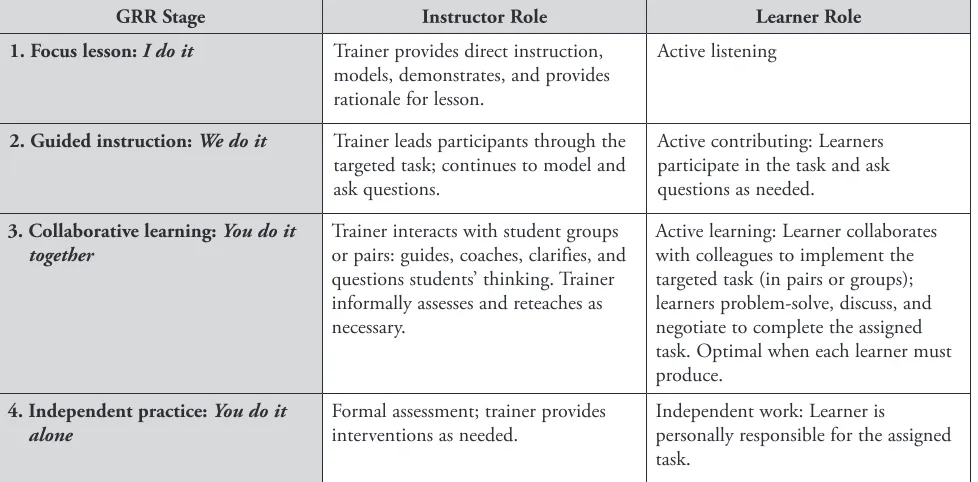
Figure 1 summarizes the roles of both the instructor and the learner—whether they are teacher and learner as in the case of EFL classrooms or teacher-trainer and participant in EFL teacher training—during the four GRR stages.
Describing how the GRR model differs from traditional instruction illustrates how to
GRR Stage Instructor Role Learner Role
1. Focus lesson: I do it Trainer provides direct instruction, models, demonstrates, and provides rationale for lesson.
Active listening
2. Guided instruction: We do it Trainer leads participants through the targeted task; continues to model and ask questions.
Active contributing: Learners participate in the task and ask questions as needed.
3. Collaborative learning: You do it
together Trainer interacts with student groups or pairs: guides, coaches, clarifies, and questions students’ thinking. Trainer informally assesses and reteaches as necessary.
Active learning: Learner collaborates with colleagues to implement the targeted task (in pairs or groups); learners problem-solve, discuss, and negotiate to complete the assigned task. Optimal when each learner must produce.
4. Independent practice: You do it
alone Formal assessment; trainer provides interventions as needed. Independent work: Learner is personally responsible for the assigned task.
implement the GRR in a contemporary EFL classroom. The following three scenarios are based on traditional ways to teach a quirky English grammatical structure—infinitive versus gerund (e.g., “I intend to sleep” versus the ungrammatical “I intend sleeping”).
Traditional scenario #1: Independent learning
Students work by themselves using self-study packets, computer programs, online courses, or other resources to learn when to use gerunds and when to use infinitives.
Traditional scenario #2:
Focus lesson and independent learning
The teacher delivers a stellar focus lesson in which he or she outlines a specific set of high-use verbs and provides ample modeling. Then the teacher asks students to complete fill-in-the-blank exercises in the workbook.
Traditional scenario #3:
Focus lesson, guided instruction, and independent learning
The teacher delivers a stellar focus lesson in which he or she outlines a specific set of high-use verbs and provides ample modeling. Then the teacher monitors the classroom as the students work in pairs to orally complete a list of sentence starters requiring the use of a gerund or an infinitive. The teacher provides individual correction where needed and final-ly asks students to complete fill-in-the-blank exercises in the workbook.
Fisher and Frey (2008a, 13) believe that this third lesson type, though common, is good but not good enough to “result in deep learning, critical or creative thinking, or the ability to mobilize strategies as needed.” Con-sider the following scenario sequence that represents the GRR method and uses
ques-tionnaires from the 21.2.2 Surveys activity in Ur (2009).
GRR scenario: Focus lesson, guided instruction, collaborative learning, and independent learning
Unlike the previous three traditional sce-narios, the GRR scenario utilizes all four stages of the GRR.
1. Focus lesson. The teacher delivers a stellar focus lesson in which he or she outlines a specific set of high-use verbs and provides ample modeling.
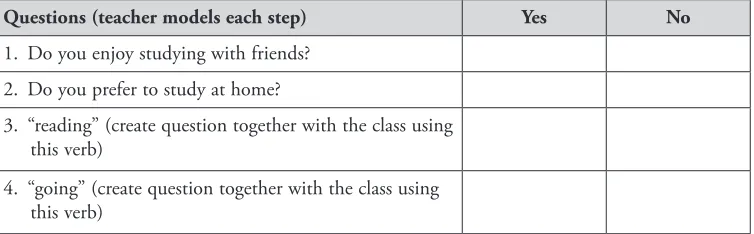
2. Guided instruction. The teacher models a questionnaire containing two gerund/ infinitive questions. Together with the class, the teacher creates two more questions to complete the question-naire (see Figure 2). He or she models how to circulate around the classroom asking the targeted questions and how to collect data by creating sentences that use the gerund or the infinitive. The teacher expects perfect production of the gerund/infinitive as students ask and answer questions to complete the surveys. Students work in groups to create one list of data reports.
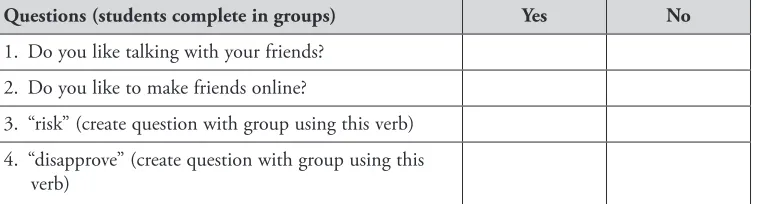
3. Collaborative learning. The teacher pass-es out three other qupass-estionnairpass-es that use the same format but with different questions. (See Figure 3 for an example.) These surveys also have two questions that the teacher has provided and two that the students must create. Students form groups to create the two missing questions. The teacher reviews the ques-tions for accuracy before students collect data. Students follow the same proce-dure using the new questions. Again, the teacher expects perfect production
Questions (teacher models each step) Yes No
1. Do you enjoy studying with friends? 2. Do you prefer to study at home?
3. “reading” (create question together with the class using this verb)
4. “going” (create question together with the class using this verb)
of the gerund/infinitive in sentences as students ask and answer questions to complete the surveys. Students individu-ally write sentences that report their own data. The teacher collects these sentences and uses them to assess the level of the students’ mastery and determine wheth-er to reteach the lesson.
4. Independent learning. The teacher then asks students to complete fill-in-the-blank exercises in the workbook. Each of the scenarios listed above has its time and place. It is neither suitable nor desir-able to implement the GRR with every lesson. GRR lessons should be used when introducing new and important content, or content that directly relates to the stated objectives of the course. Indeed, implementing the GRR implies several underlying beliefs. The teacher believes that the lesson topic is important and merits the use of valuable classroom time. The teacher understands that students are excellent peda-gogical “tools” fully capable of participating in and even enhancing the lesson. The GRR helps teachers realize that teachers as well as students are learning in each lesson. One delightful side effect is that planning and implementing all four stages of the GRR tend to augment the teacher’s own skill set as he or she learns about and responds to students’ specific errors, practices pacing and reteaching strategies, and develops metacognitive awareness of his or her own instructional style. Paradoxically, this deepening of the craft of teaching––this reach-ing fuller capacity as an instructor––creates a natural enthusiasm all of its own: an upward spiral of positive teacher–student interaction.
The GRR and professional development
The GRR model is a natural fit for teacher trainers of student-centered instruction, more specifically CLT. However, EFL teachers in
many parts of the world are often hesitant to implement interactive student activities (Hiep 2005). When we as trainers provide CLT professional development to English teachers who have experienced only grammar-transla-tion approaches both as students of English and as teachers of English, we are asking for a giant leap in awareness and ability. Student-centered instruction requires teachers to make a fundamental shift in how they perceive English can be taught and to often ignore their own experiences and cultural norms and try something new. Often EFL teachers must overcome personal fear about their control over large class sizes and challenging teaching situations as they move from teacher-cen-tered to student-centeacher-cen-tered instruction. These teachers, as much as students, deserve large amounts of collaboration and support.
I learned this the hard way when I began to provide professional development for pub-lic high school English teachers in Brazil. In my first day of training, I introduced a standard information-gap activity with the goal of reviewing the course requirements. I presented the activity, divided my students in groups, and gave each group the text, which I had purposefully highlighted with different colors that matched the groupings. I ignored the blank stare, and slowly my students got to work. They immediately began to dem-onstrate all kinds of unanticipated behaviors. They ignored the highlighting and answered all the questions instead of just their own. Many changed their groupings or even refused to work in groups. I heard quiet in the class-room instead of that satisfying buzz of stu-dents discussing content. I had the presence of mind to know I had taken a sharp turn from my GRR beliefs but not quite enough aware-ness to save this particular lesson.
The information-gap activity is a staple in CLT courses. Information-gap activities,
Questions (students complete in groups) Yes No
1. Do you like talking with your friends? 2. Do you like to make friends online?
3. “risk” (create question with group using this verb) 4. “disapprove” (create question with group using this
verb)
often called jigsaws, are those in which each participant in a group has a bit of information that his or her group mates do not have but need in order to complete the task (Doughty and Pica 1986). Each person in the group must contribute in order for the group to be successful. My teacher-participants needed to understand the strategy, be able to participate in it themselves, and ultimately be able to implement it in their own classrooms. Reflect-ing on the lesson in terms of the GRR helped me to figure out where my teaching had led to confusion and what steps I needed to take to remedy the situation.
Applying the GRR to an information-gap activity in a professional development setting
Classroom confusion almost always can be attributed to omitting one of the two middle steps of the GRR. Most often, the students have not had either enough guided instruction or sufficient collaborative practice (Pearson and Gallagher 1983). We often expect our students to apply learning too soon. Indeed, in introducing the information-gap activity, I had omitted the “We do it” practice stage. I had gone too quickly from teacher modeling to collaborative practice. In subsequent lessons, I returned to the following information-gap activity and used the four stages of the GRR.
First session: I do it
I led the whole class in answering ques-tions about a targeted text in the teacher-training book assigned to the program. The topic was, “How have you learned English?” I modeled how I wanted the questions to be answered—in this case, first-person narrative with personal experiences. Students therefore saw the type of responses that I required in my course.
Second session: We do it
I formed three large “expert” groups that received one segment of the targeted text with a matching question (instead of the whole text and all the questions), and they worked col-laboratively to answer the questions. The task of an expert group is just that: each person in the group becomes an expert on the par-ticular segment of the text that the group has been given. Expert groups generally read and then orally summarize the text. After
discus-sion, they come to agreement about the main points. In this case, they also settled on appro-priate answers to their corresponding ques-tion. The questions were, “How has learning English affected your teaching practice?”; “What are the qualities of a good language learner?”; and “What are the characteristics of a good language teacher?” Then I led a whole-class discussion, having each expert group share its information. I used a PowerPoint to capture the information, although any form of classroom notation would work. The students took notes and used them to write journal reflections on the same topics.
Third session: You do it together
I formed the three large expert groups as above, still giving only one piece of the tar-geted text and its matching question. After each expert group reached agreement about the main points of its text, I reorganized the students into several small “sharing” groups of three (triads), consisting of one expert from each of the three larger groups. In sharing groups, each person instructs the others about his or her text. In this case, each expert taught the main ideas of his or her section to the others in the small group and then discussed the answers to the corresponding question. The students took notes and used them to write journal reflections on the same topics. The topics were “Describe learning styles,” “Describe learning strategies,” and “Describe basic principles of language learning.”
Fourth session: You do it alone
In this session the small groups of three completed a standard jigsaw with a highlight-ed text. Each person had the whole text and all the questions. The students understood that they were responsible for only a sec-tion of the text. They knew that they would become experts of their text section with the help of their small group. They also knew they would be responsible for teaching others who had not read their section. The students took notes and used them to write journal reflec-tions on the topic “Aspects of communicative language teaching.”
The GRR is not necessarily a linear process. Cycling back and reteaching missed steps supports the learning process in a healthy and positive way as you better meet the immediate and future needs of your students.
Sometimes implementing the GRR is a quick and easy modification. For a fill-in-the-blank activity, you simply model the first three items with the whole group. The teacher responds to the first question, asks for input on the second, and gives students a moment to answer the third together before providing the correct response. The students are then ready to complete the worksheet individually. However, in professional development our goals are usually much more complex and far-reaching. Implementing the GRR necessitates the long view as in the information-gap activi-ty shown above or in analyzing model lessons.
Learning to reflect on model lessons
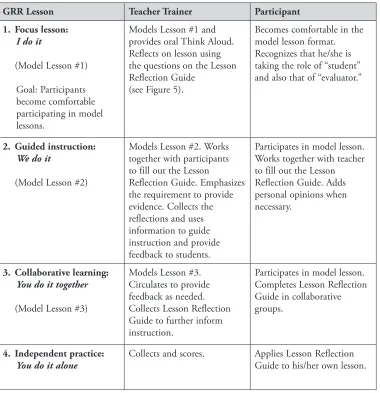
Modeling lessons is a powerful strategy for those of us who are EFL teacher train-ers, but its efficacy depends on the ability of participants to create a meaningful analysis. Initially, the Brazilian teachers I worked with reflected on model lessons with comments such as “It was fun” or “You are a good teacher.” I was happy for the feedback, but I wanted responses with more depth and with concrete examples to support their conclu-sions. A long-term view with the GRR in mind was essential. After a short lesson on the differences between fact and opinion, I used different model lessons to follow the sequence described in Figure 4.
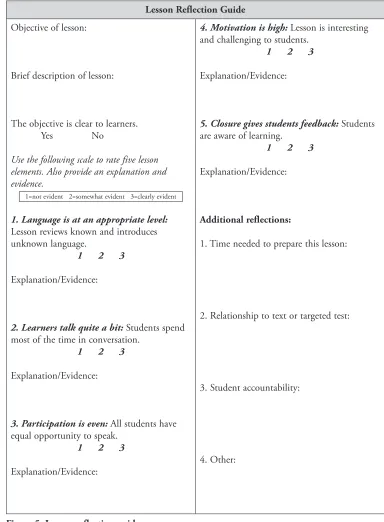
With this sequence, and by using the Les-son Reflection Guide (Figure 5), the teacher-participants learned to reflect on lessons with a
GRR Lesson Teacher Trainer Participant
1. Focus lesson: I do it
(Model Lesson #1)
Goal: Participants become comfortable participating in model lessons.
Models Lesson #1 and provides oral Think Aloud. Reflects on lesson using the questions on the Lesson Reflection Guide
(see Figure 5).
Becomes comfortable in the model lesson format. Recognizes that he/she is taking the role of “student” and also that of “evaluator.”
2. Guided instruction: We do it
(Model Lesson #2)
Models Lesson #2. Works together with participants to fill out the Lesson Reflection Guide. Emphasizes the requirement to provide evidence. Collects the reflections and uses information to guide instruction and provide feedback to students.
Participates in model lesson. Works together with teacher to fill out the Lesson Reflection Guide. Adds personal opinions when necessary.
3. Collaborative learning: You do it together
(Model Lesson #3)
Models Lesson #3. Circulates to provide feedback as needed. Collects Lesson Reflection Guide to further inform instruction.
Participates in model lesson. Completes Lesson Reflection Guide in collaborative groups.
4. Independent practice:
You do it alone Collects and scores. Applies Lesson Reflection Guide to his/her own lesson.
Lesson Reflection Guide Objective of lesson:
Brief description of lesson:
The objective is clear to learners. Yes No
Use the following scale to rate five lesson elements. Also provide an explanation and evidence.
1=not evident 2=somewhat evident 3=clearly evident
1. Language is at an appropriate level: Lesson reviews known and introduces unknown language.
1 2 3
Explanation/Evidence:
2. Learners talk quite a bit: Students spend most of the time in conversation.
1 2 3
Explanation/Evidence:
3. Participation is even: All students have equal opportunity to speak.
1 2 3
Explanation/Evidence:
4. Motivation is high: Lesson is interesting and challenging to students.
1 2 3
Explanation/Evidence:
5. Closure gives students feedback: Students are aware of learning.
1 2 3
Explanation/Evidence:
Additional reflections:
1. Time needed to prepare this lesson:
2. Relationship to text or targeted test:
3. Student accountability:
4. Other:
Figure 5. Lesson reflection guide
greater understanding and to provide support-ing details. They had the ability to make more informed choices about their own instruction and to take those first scary steps in imple-menting CLT strategies in their classrooms. Furthermore, they used this ability to conduct peer observations. The slow but steady release of responsibility provided the security these
initially resistant teachers needed to make those giant leaps into student-centered instruction.
Conclusion
each lesson perfectly, the GRR framework has led me to more powerful teaching. I am able to handle the “blank stare” with more efficacy and grace. I have a greater ability to assess my students’ understanding at any given moment, which has led to more targeted instruction. As a result, I believe I teach with more empa-thy. My relationships with my students have become stronger and more successful. In Brazil, my teacher-participants were able to imple-ment CLT strategies in their classes, which began to have a direct impact on their students. What could be better than that?
References
Doughty, C., and T. Pica. 1986. “Information gap” tasks: Do they facilitate second language acquisi-tion? TESOL Quarterly 20 (2): 305–325. Fisher, D., and N. Frey. 2008a. Better learning
through structured teaching: A framework for the gradual release of responsibility. Alexandria, VA:
ASCD.
——. 2008b. Releasing responsibility. Educational
Leadership 66 (3): 32–37.
Hiep, P. H. 2005. “Imported” communicative lan-guage teaching: Implications for local teachers.
English Teaching Forum 43 (4): 2–9.
Pearson, P. D., and M. C. Gallagher. 1983. The instruction of reading comprehension.
Contem-porary Educational Psychology 8 (3): 317–344.
Routman, R. 2003. Reading essentials: The specifics
you need to teach reading well. Portsmouth, NH:
Heinemann.
Teaching Excellence in Adult Literacy Center. 2012.
Just write! guide. Washington, DC: U.S.
Depart-ment of Education.
Ur, P. 2009. Grammar practice activities: A practical
guide for teachers. 2nd ed. Cambridge:
Cam-bridge University Press.
Sandra Clark, University of Oregon