Stability testing of Ayurvedic
formulations: Exigency of today’s world
Chinky Goyal
1, Sharma Khemchand
2, Gupta Arun Kumar
31Department of Rasa Shastra and Bhaishjya Kalpana, Shri Dhanwantry Ayurvedic College and Dabur
Dhanwantry Hospital, Sector-46 B, Chandigarh, India, 2PG Department of Rasa Shastra & Bhaishjya Kalpana,
Uttarakhand Ayurved University, Rishikul Campus, Haridwar, Uttarakhand, India, 3Department of Panchkarma,
L.N. Ayurveda College and Hospital, Bhopal, Madhya Pradesh, India
Abstract
The concept of stability is one of the most important issues regarding Ayurvedic formulations as till date no specific guidelines are available for the same. Although the Ayurvedic lexicon as well as Gazette notification issued by Government of India on 26th November, 2005 revealed shelf life of Ayurvedic formulations, greater advancements
in packaging and storage technology nowadays has created a need for the revision of their shelf life. Mainly, two guidelines, namely, International Conference on Harmonization (ICH) and the World Health Organization provide details regarding parameters for stability study of pharmaceutical products but ICH guidelines from Q1 to Q11 is generally followed. A well-designed stability protocol containing information such as selection of batches and samples, test attributes, analytical procedures, acceptance criteria, storage conditions and period, testing frequency, sampling plan, container closure systematic, and various types of stability study and stability testing methods should be taken into consideration. Currently, pharmaceutical product is generally assayed using a validated stability indicating analytical method and an expiry date is marked based on the predicated period from date of manufacture when the pharmaceutical product would show more than 10% deterioration in the active molecule. Hence, these guidelines may also be implemented on Ayurvedic formulations where percentage degradation can be assayed when the product is stored at different conditions of temperature and humidity. The general concept of stability for Ayurvedic or modern medicine remains same but the parameters used to assess the stability may vary from product to product.
Key words: Shelf life of Ayurvedic formulations, stability study, stability testing
Address for correspondence: Dr. Chinky Goyal, # 266, Ekta Vihar, Baltana, Tehsil-Dera Bassi, Sahibzada Ajit Singh Nagar - 140 604, Punjab, India.
Phone: +91-9815144152/8192845948/7888641731. E-mail: [email protected]
Received: 12-10-2016 Revised: 08-03-2017 Accepted: 20-07-2017
INTRODUCTION
Concept of Stability in Ayurveda
I
n Ayurvedic lexicon, “Saviryata avadhi” term is mentioned in context of shelf life of recent era which denotes the time period during which the Virya (potency) of any drug remains unaffected and above certain threshold beyond which it may lose its potency to some extent but not completely devoid of it provided that it is stored in the mentioned condition.[1] The word Virya hasgot different meanings as per Sanskrit-English Dictionary, namely, heroism, valor, vigor, strength, virility, energy, firmness, courage, potency, efficacy, splendor, luster, and dignity.[2] Hence, Virya is considered to be the
most active principle of a drug among rasa, guna, vipaka, and prabhava responsible for overall effect of the same.
The concept of shelf life as per various Ayurvedic texts is depicted Table 1:
A Gazette notification issued by Government of India on 12th August, 2016[6] as depicted in Table 2 with slight modification
in the earlier draft notification, issued on 15th October, 2009[7]
described shelf life of Ayurvedic formulations.
The importance of collection of drug considering various factors such as seasonal variation, part of the drug to be
REVIEW
AR
collected, method of collection, qualities of soil from which drug is to be collected, quality of packaging, and storage condition is also emphasized in classics.[8,9]
Concept of Stability in Modern Science
Stability is the capability of a specific formulation in a particular container/closure system to remain within its physical, chemical, microbiological, toxicological, therapeutic specifications, and is always expressed in terms of shelf life.[10]
The shelf life of a product can be defined as the time duration up to which it is expected to retain 90% of its active ingredients (label claim) when stored in recommended condition. The purpose of stability testing is to provide evidence of how the quality of a pharmaceutical product changes with time due to impact of a variety of environmental factors, namely, temperature, humidity, and light and product-related factors, namely, container closure system and packaging materials.[11]
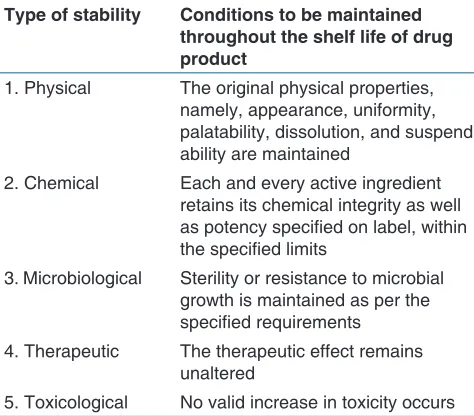
The benefits of stability testing include concern for well-being of the patient and manufacturer by ensuring the product quality, helps in selection of adequate formulations, excipients and container closure systems for a product, to determine shelf life and storage conditions, preparation and substantiation of the claimed shelf life for the registration dossier and to confirm that no variation occurred in the formulation or the manufacturing process that can adversely affect the stability of the product.[11,12] As per USP, different
types of stability study are given in Table 3.
Types of Stability Testing Methods
There are following five types of stability testing methods: 1. Accelerated testing - In accelerated stability testing,
the product is subjected to a several high temperatures, humidity, light intensity, etc., that accelerates degradation and the amount of heat required to degrade the product is determined so as to predict the shelf life.[12] This
concept is based upon Arrhenius equation that describes the relationship between storage temperatures and deterioration rate.
2
1 2 1
1 1
log .15
2.303a
E k
k R T T
= − − ………
Where, k1 and k2 being the rate constants at respective temperatures T1 and T2 (units being K); Ea - activation energy; R - gas constant.
Extrapolated shelf life of any product can also be calculated with 10% degradation rate based on accelerated stability data, as per the following equation:[13]
(
)
Months when 10% degradation occurs 0 month assay value
Intercept { 0 month assay value 10 / 100}
Slope
= −
−
×
Accelerated stability studies are usually used for products with longer shelf life.
2. Real time (long-term) testing - It is normally performed for longer duration to allow significant degradation of the product under specified storage conditions.
3. Intermediate testing - These are mainly conducted when the accelerated studies for general case failed to meet the acceptance criteria and are designed to moderately increase the rate of degradation for a drug intended to be stored long-term at 25°C.
4. Stress testing - It includes the effect of temperature (above that used in accelerated study), humidity (e.g., ≥75% RH), oxidation, photolysis and hydrolysis. 5. Forced degradation testing- It is performed with objective
to provide intrinsic stability assessment of the drug, to elucidate the possible degradation pathways by identifying the likely degradation products and to have an idea of the stability of the analytical process applied for the drug.
Climatic Zones for Stability Testing
For stability testing purpose, the whole world has been divided into four zones as shown in Table 4 depending upon the environmental conditions and are derived on the basis of mean annual temperature and relative humidity data in these Table 1: Saviryata avadhi of different Ayurvedic dosage forms as per classics
Dosage form Saviryata avadhi
Vangasen[3]
(12th century) Sharangdhara Samhita(13th century)[4] Yogaratnakar(17th century)[5]
Kwatha, Kalka, Swarasa ‑ ‑ 03 h
Anjana ‑ ‑ 03 months
Churna ‑ 02 months 03 months
Vati ‑ 12 months ‑
Guda/Avaleha 12 months 12 months 06 months
Ghrita and Taila 6 months 16 months 12 months
regions.[11,14,15]
Protocol for Stability Testing
The protocol is a document describing the basic components of a well-controlled stability study which depends on the type of drug substance, whether the drug is new or is already in the market and in which climatic zone, the product is proposed to be marketed.[16,17] A well-planned stability protocol should
contain the following information:
1. Selection of batches and samples - In general, this selection should constitute a random sample from pilot or production batches that may involve a single batch or 2-3 batches[11]
2. Test attributes - The tests that monitor the quality, potency, purity, and identity that are expected to vary upon storage are chosen as stability tests[17]
3. Analytical procedures - Procedures given in the official compendia should be followed and if alternate methods
are to be used, they need to be duly validated[11,16]
4. Acceptance criteria - This should be fixed beforehand in the form of statistical limits for the results manifested in computable terms and pass or fail for qualitative tests 5. Storage conditions - These are based upon the marketing
climatic zone of the drug as depicted in Table 5.
6. Storage period - It generally extend from minimum of 3 or 6 months in accelerated and stress testing and up to 12, 18, or 60 months in ongoing or follow-up stability testing
7. Testing frequency - It should be sufficient to establish the stability profile of the drug[15] Test schedules for
different types of stability testing are shown in Table 6. 8. Sampling plan - It involves devising for the number of
samples to be placed in the stability chambers and taking out of the charged batch so as to cover the entire study[11]
9. Container closure system - The testing in actual containers as well as closures scheduled for marketing, are to be tested separately with proper orientation of storage of containers[11]
10. Evaluation - The data on quantitative attribute is analyzed to determine the time duration at which 95% one-sided confidence limit for the mean curve intersects the acceptance criterion
11. Statements, labeling - A storage statement, retest period, and re-test date based on the stability evaluation of the drug substance should be established for the labeling.
DISCUSSION
The stability data on any dosage form includes selected parameters that together form the stability profile which forms the basis for assigning the storage conditions and shelf life to pharmaceutical products. The design of the stability program should be based on the knowledge of the behavior and properties of the drug substance and the dosage form.[19,20] In 1984, Rhodes listed some general causes for the
omitted time for which medicines can be kept which includes loss of vehicle (such as evaporation of water or volatile Table 2: Shelf life of Ayurvedic medicine as per D and C Amendment Rules, 1945
Name of the group of Ayurvedic medicine Shelf life
Arka, eye drops 1 year
Churna, Kwath Churna, Dant Manjan powder, Dant Manjan paste, Varti, Shweta Parpati, Ear/Nasal drops,
Dhoopans (inhalers), Ghrita 2 years
Gutika tablet containing Kasthaushadhi, Avleha, Taila, Lepa Churna, Lepa Guti, Lepa Malahar, Ghana Vati,
soft gelatin capsules containing Kashta‑Aushadhi, syrup, Granule/Khand, PravahiKwath 3 years Rasa Gutika, Guggulu, Dravaka, Lavana, Ksara, Naga Bhasma, Vanga Bhasma, Tamra Bhasma*, hard gelatin
capsules 5 years
Mandura‑Lauha 10 years
Rasaushadhies, Asava Arista, Kupipakva, Parpati, Pisti and Bhasma, Swarna, Rajata, Lauha, Mandura,
Abhraka, Godanti, Shankha Bhasma 10 years
*Naga, Vanga, Tamra Bhasma start solidifying after 5 years and they need few “Puta” (one or two) again before using in the dosage form
Table 3: Types of stability study as per USP[12]
Type of stability Conditions to be maintained
throughout the shelf life of drug product
1. Physical The original physical properties, namely, appearance, uniformity, palatability, dissolution, and suspend ability are maintained
2. Chemical Each and every active ingredient retains its chemical integrity as well as potency specified on label, within the specified limits
3. Microbiological Sterility or resistance to microbial growth is maintained as per the specified requirements
4. Therapeutic The therapeutic effect remains unaltered
5. Toxicological No valid increase in toxicity occurs
ingredient), loss of uniformity, change in bioavailability, and appearance. Adoption of recently developed packaging and storage technology by Ayurvedic industries has turned up a need for the reestablishment of the stability period based on some scientific study data. However, work in this direction has already been initiated by many researchers, demand of present era is to thoroughly conduct such type of study on every formulation individually. For instance, Rasayana Churna was found to be suitable at accelerated condition up to 6 months storage whereby its extrapolated shelf life came to be 25.12 months (2.09 years) for climatic Zone I and II and 16.60 months (1.38 years) for climatic Zone III and IV. Real time study of Rasayana Churna showed very good stability up to 1 year when stability study was conducted as per ICH guidelines.[13] Stability studies of Kanakasava at accelerated
temperature after 60, 120, and 180 days revealed that no or very little changes in physicochemical parameters as well as ultraviolet spectrum were noticed during the length of time of
6 months indicating higher stability and a shelf life of more than 2 years may be assigned to Kankasava.[21,22] Another
study on Vasavleha showed it to be stable during the stability study period of 180 days.[23] Likewise, all other formulations
can be tested for the same to predict the efficacy period or possible modifications which need to be done so as to deal with the stability problems. Many newer tools and techniques may be implemented to deal with the instability related to natural medicine as a stable formulation will gain confidence in modern patient compliance.[24]
CONCLUSION
Ayurvedic lexicon as well as Gazette notification regarding shelf life of Ayurvedic formulations specified by Government of India is silent about the guidelines regarding methodology to be followed for estimation of the same. International Table 4: ICH climatic zones and long‑term stability conditions
Climatic
zone Climate Countries MAT/MAPWP* Long‑term testing conditions
I Temperate UK, Northern Europe, US <15°C/<11 hPa 21°C/45% RH
II Subtropical and Mediterranean Japan, Southern Europe >15‑22°C/>11‑18 hPa 25°C/60% RH
III Hot and dry Iraq, India >22°C/<15 hPa 30°C/35% RH
IVa Hot and humid Iran, Egypt >22°C/>15‑27 hPa 30°C/65% RH
IVb Hot and very humid Brazil, Singapore >22°C/>27 hPa 30°C/75% RH
MAT: Mean annual temperature measured in open air, MAPWP: Mean annual partial water vapor pressure, ICH: International Conference on Harmonization
Table 5: Stability testing storage conditions for drugs as per ICH and the WHO[14,17,18] Intended storage
condition Stability test method humidity (period in months) as Test temperature and per ICH
Test temperature and humidity (period in months) as
per the WHO
Room temperature Long term 25±2°C/60±5% RH (12) 25±2°C/60±5% RH or
30±2°C/65±5%RH or 30±2°C/75±5% RH (12)
Intermediate 30±2°C/65±5% RH (6) 30±2°C/65±5% RH (6)
Accelerated 40±2°C/75±5% RH (6) 40±2°C/75±5% RH (6)
Refrigerated Long term 5°C/ambient (12) 5±3°C
Accelerated 25±2°C/60±5% RH (6) 25±2°C/60±5% RH or
30±2°C/65±5% RH
Freezer Long term −20°C/ambient (12) −20°C±5°C
ICH: International Conference on Harmonization, WHO: World Health Organization
Table 6: Test schedule for stability testing of new products[17]
Method and climatic zone Environment Time points for sampling
Long term for climatic Zones I and IV 25°C/60% RH 3, 6, 9, 12, 18, 24, 36 months
Long term for climatic Zones III 30°C/35% RH 3, 6, 9, 12, 18, 24, 36 months
Long term for climatic Zone IVa/intermediate for Zones I and II 30°C/65% RH 3, 6, 9, 12, 18, 24, 36 months Long term for climatic Zone IVb/intermediate for Zones I and II 30°C/75% RH 3, 6, 9, 12, 18, 24, 36 months
Conference on Harmonization guidelines details out the methods of quality assessment parameters as a means of evaluating shelf life which should be applied to ASU drugs also. Assessment of shelf life of Ayurvedic formulations nowadays should be based on various test attributes given in PLIM, Ghaziabad Protocol. It seems nearly impossible to conduct real-time stability study of Ayurvedic formulations having longer shelf life such as rasa preparations, asava arishta, but extrapolated shelf life can be calculated for these based on 10% degradation method using accelerated stability testing, so as to scientifically support ancient Ayurvedic claims regarding shelf life.
REFERENCES
1. Ankit G, Mundeep J, Prajapati PK. Shelf life of Ayurvedic dosage forms - Traditional view, current status and prospective need. Indian J Tradit Knowl 2011;10:672-7. 2. Apte VS. Students Sanskrit English Dictionary.
New Delhi: Government of India; 2007. p. 883.
3. Vaishya SG. Vangasen. 1st ed. Mumbai: Khemraj
Shrikrishnadass Publication; 1983. p. 73.
4. Sastri P. Sharangadhara Samhita with Commentary. 7th ed. Varanasi: Choukhambha Orientalia Publication;
2002. p. 13.
5. Shastri LP. Yogaratnakar. 6th ed. Varanasi: Choukhambha
Sanskrit Sansthan; 2005. p. 203.
6. Anonymous. The Gazette of India, Extraordinary Part-II, Section 3 - Sub-Section (І) No. 605. New Delhi: Gazette; 2016.
7. Anonymous. The Gazette of India, Extraordinary Part-II, Section 3 - Sub-section (І) No. 482. New Delhi: Gazette; 2009.
8. Acharya VY. Charaka Samhita, Chakrapanidatta Commentary. Varanasi: Chaukhambha Sanskrit Sansthan; 2004. p. 894-5.
9. Acharya Sushruta. Sushruta Samhita, Sanskrit Commentary by Dalhana and GayadasAcharya. 8th ed.
Varanasi: Chaukhamba Orientalia; 2005. p. 177-8. 10. Kommanaboyina B, Rhodes CT. Trends in stability
testing, with emphasis on stability during distribution and storage. Drug Dev Ind Pharm 1999;25:857-68.
11. Singh S. Stability Testing During Product Development in Jain NK Pharmaceutical Product Development. India: CBS Publisher and Distributors; 2000. p. 272-93. 12. Carstensen JT. Drug Stability, Principles and Practices.
New York: Marcel Dekker; 2000. p. 245.
13. Patgiri B, Soni H, Bhatt S. Evaluation of stability study of Ayurvedic formulation – Rasayana Churna. J Pharmacogn Phytochem 2014;2:126-30.
14. ICH Q1A (R2). Stability Testing Guidelines: Stability Testing of New Drug Substances and Products. ICH Steering Committee; 2003.
15. Grimm W. Extension of the International Conference on Harmonization Tripartite Guideline for Stability Testing of New Drug Substances and Products to countries of climatic zones III and IV. Drug Dev Ind Pharm 1998;24:313-25. 16. Ali J, Khar RK, Ahuja A. Dosage form and Design.
3rd ed. New Delhi. Birla Publications Pvt. Ltd.; 2008.
p. 100-23.
17. Cha J, Gilmor T, Lane P, Ranweiler JS. Stability Studies in Handbook of Modern Pharmaceutical Analysis. Amsterdam: Separation Science and Technology, Elsevier; 2001. p. 459-505.
18. WHO. Stability Studies in a Global Environment. Geneva Meeting Working Document QAS/05.146 with Comments; 2004.
19. Shah P, Mashru R, Rane Y. Stability testing of pharmaceuticals - A global perspective. J Pharm Res 2007;6:1-9.
20. Shirish SP, Raghunath DP, Mugdha SP. Stability study of a herbal drug. Pharmacologyonline 2008;1:20-3.
21. Chauhan SK, Agarwal S. Stability studies of herbal drugs. East Pharm 1999; XLII (498):35-6.
22. Bharti A. Stability study of Ayurvedic formulation Kankasava. Asian J Pharm Technol 2013;3:1-4.
23. Bharti A. Evaluation of stability study of Ayurvedic formulation Vasavaleha. Asian J Res Pharm Sci 2013;3:1-4.
24. Lovely T, Umang G, Nilesh P, Mahesh D. Novel approaches for stability improvement in natural medicines. Pharmacogn Rev 2011;5:48-54.