University of South Carolina
Scholar Commons
Theses and Dissertations
2017
The Role of Weather in the Social and Economic
Lives of Plantation Owners in Antebellum Beaufort
District, South Carolina
Jennifer A. Simmons
University of South Carolina
Follow this and additional works at:https://scholarcommons.sc.edu/etd
Part of theGeography Commons
This Open Access Thesis is brought to you by Scholar Commons. It has been accepted for inclusion in Theses and Dissertations by an authorized administrator of Scholar Commons. For more information, please [email protected].
Recommended Citation
T
HER
OLE OFW
EATHER IN THES
OCIAL ANDE
CONOMICL
IVES OFP
LANTATIONO
WNERS INA
NTEBELLUMB
EAUFORTD
ISTRICT,
S
OUTHC
AROLINAby
Jennifer A. Simmons
Bachelor of Science Arizona State University, 2013
Submitted in Partial Fulfillment of the Requirements
For the Degree of Master of Science in
Geography
College of Arts and Sciences
University of South Carolina
2017
Accepted by:
Amy Mills, Director of Thesis
Conor Harrison, Reader
April Hiscox, Reader
ii
iii
Acknowledgements
I would like to thank my family for their support and love during this endeavor and my
time in South Carolina.
I would like to thank Dr. Amy Mills for her guidance and support as my advisor at the
University of South Carolina. Thank you for steering me through the thesis writing
process. I have grown immensely as a student and writer.
Thank you Dr. April Hiscox and Dr. Conor Harrison for their feedback during this thesis
process. Thank you Dr. Jean Ellis and A.L.E. for listening and helping me through tough
times.
I would also like to thank my friends for their patience and listening to me talk about
weather and sea island cotton nonstop for the past two and a half years. Also, thank you
iv
Abstract
Weather can determine social, agricultural, and economic impacts on a society.
There has been a lot of contemporary research on adaptation and experiences in severe
weather events. However, there is a lack of historical research. This study uses primary
sources, such as journals, newspapers, and maps, to look into the impact that weather has
on people during a study time. Primary sources, like Thomas Chaplin’s Tombee
Plantation Journal, provide more than a physical description of the event that occurred.
These historical sources present various perspectives, such as personal and emotional, of
people in South Carolina’s Beaufort District and its sea islands in the antebellum period.
Through the assessment of primary and secondary sources during the Great Carolina
Hurricane of 1854, this study shows that these historical sources help explain the social
and economic impact on people during a meteorological event. This thesis helps raise
questions about other meteorological events and offers suggestions for other sources that
might help us find out more about impacts from historical meteorological and
v
Table of Contents
Acknowledgements ... iii
Abstract ... iv
List of Figures ... vii
List of Antebellum Terms ... viii
Chapter 1 Introduction ...1
Chapter 2 Physical Geography...6
Chapter 3 Literature Review ...19
3.1 People and the Natural World ...20
3.2 Scale: Time and Place ...23
3.3 People and the Environment ...26
3.4 Plantation and Society ...34
Chapter 4 Methods ...41
4.1 Personal Journals and Letters ...42
4.2 Maps ...46
4.3 Field Excursion ...47
4.4 Newspapers ...50
4.5 Secondary Sources ...54
Chapter 5 The Great Carolina Hurricane of 1854 ...66
5.1 The Great Carolina Hurricane ...67
vi
5.3 Impacts on Agriculture ...77
5.4 Impacts on the Economy ...82
Chapter 6 Conclusion ...88
vii
List of Figures
Figure 2.1 South Carolina sea islands with distribution of long-staple cotton ...15
Figure 2.2 North Atlantic Hurricane Tracking Chart: 1854 ...16
Figure 2.3 Sea island cotton’s average length of growing season (days) in SC ...17
Figure 2.4 Sample sea island cotton plantation from 1840s ...18
Figure 4.1 Tombee Plantation Journal, May 1853: original handwriting ...56
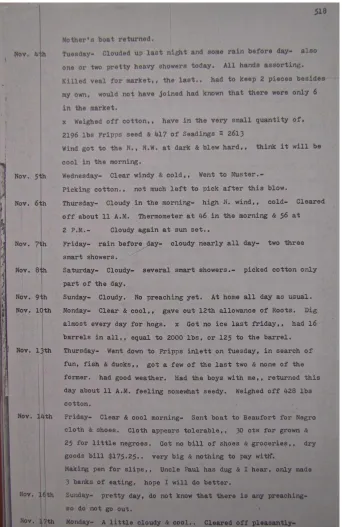
Figure 4.2 Tombee Plantation Journal, November 1856: transcribed version ...57
Figure 4.3 Mills’ Atlas of South Carolina: Beaufort District sea islands, 1825 ...58
Figure 4.4 Atlantic Coast from Hunting Island Lighthouse ...59
Figure 4.5 View of the marina in Downtown Beaufort ...60
Figure 4.6 Coffin Point Plantation House ...61
Figure 4.7 Seaside Road, St. Helena Island ...62
Figure 4.8 Tombee Plantation House...63
Figure 4.9 The Charleston Daily Courier, September 9, 1854, p. 2 ...64
viii
List of Antebellum Terms
The Great Carolina Hurricane of 1854
Ways that damage was described
Dismal
Universal
More or less injured
Irreparably injured
Not a vestige left
Severely injured
Severely suffered
To a considerable extent
Deplorable extent
Most serious
Incalculable
Ruinous
Hurricanes strength
Most protracted
Great violence
ix
Blew a hurricane
Appearance of a gale
To blow a gale
A violent storm
violence and long continuance
Heavy storm
Destructive storm
Hurricane Damage
“The loss everywhere is incalculable”
“The damage to property has been incalculable”
“It would require the whole of one of our pages to give the particulars of the injury to the
roofs, chimneys, and enclosures of private houses”
“It presented the appearance on every side of an angry ocean.”
1
Chapter 1 Introduction
In mid-nineteenth century Beaufort District of South Carolina, the livelihood of
plantation owners was strongly dictated by weather and the success of each season’s
crops, especially sea island cotton. Sea island cotton was one of two crops, the other
being Carolina gold rice, that contributed to the wealth of sea islands and Lowcountry
South Carolina as a whole. Sea island cotton was a global, luxury crop that influenced
many factors of sea islands: social lives, agriculture, economy, and environmental history
(Porcher & Fick, 2005, p. xvii). The Lowcountry coast of South Carolina was vulnerable
to events such as floods, droughts, and strong summer coastal storms. Journals and
newspapers written during this period provide a first-hand account of the events that
occurred, as well as the economic and social impacts that these meteorological events had
on plantation owners and their families. As the climate changes over the course of a few
years or decades, plantation lives did as well. Thomas Chaplin’s journal shows the
connection between time, climate, geographic location, agriculture, and people.
As the inspiration of this thesis, Thomas B. Chaplin was a resident of St. Helena
Island and left behind a very descriptive journal about the daily life on his plantation and
the island. Chaplin, who inherited a productive, family plantation, should have lived in
wealth and well-being; however, due to losing many people he loved, his theme was “loss
and disappointment” (Rosengarten, 1992, p. 25). He wrote nearly every day for 13 years
2
1992, p. 26; Tombee Plantation Journal, 1845-1886). N. P. Gignilliat, a rice planter
living south of Chaplin on a Georgia sea island, left behind his pocket plantation diaries.
These diaries provided me with another source describing many experiences with
weather, crops, and harvesting (Gignilliat Pocket Plantation Diaries, 1854-1859). Often
seen as an agricultural reformer and independent thinker, William Elliott, a planter who
was active in state law, left behind letters written to his wife and children (Jones, 1951, p.
381). Often writing while in Beaufort and Bluffton, he wrote about life, weather, and
their plantation (Scafidel, 1978). In 1832, Elliott ended his time working in politics.
After, he focused on planting, writing, and working in agricultural societies (Jones, 1951,
p. 367). These journals and letters provided this study with not only daily comments
about the weather and status of crops, but also commentary about their family and social
life, the slaves on their plantation, and the plantation's financial status.
The physical geography of the South, especially in South Carolina’s Lowcountry,
had a profound impact on plantation life and strongly influenced the lives in it during the
antebellum period. Weather is interconnected to many themes of the plantations; for
example, it had a large role in the success or failure of agriculture in the Lowcountry. The
special microclimate on the coastal South Carolina sea islands’ dictated the ability to
grow sea island cotton and rice. However, unfortunately, its climatological and
meteorological features also led to the end of the rice industry. This thesis will further the
research showing the major role that weather has played in the economic and social past.
This thesis contributes to the scholarly conversation about historical
personal-environmental connections during the Great Carolina Hurricane in the antebellum period.
3
influenced by the changing economics and agriculture due to severe weather events. This
hurricane presents how closely agriculture and economics are connected to climate and
weather and play a role in people’s social lives (Tuten, 2009; Blanton, Chenoweth, and
Mock, 2009; Fleming, 1990, 2012). Learning about this region’s environmental history
is important because we need to understand past aspects of human relationships with the
environment, such as how people are shaped by and shape the environment. This will
help us better understand why many historical events occurred, especially those related to
our environment. The Great Carolina Hurricane demonstrates the role that weather and
environment had in people’s lives in antebellum Lowcountry plantations and towns.
With plantation owner Thomas Chaplin's journal and many other primary sources,
such as newspapers and personal letters, this study evaluates how the weather impacts the
success of crops and the local economy, and its influence on social lives (Charleston
Mercury; Gignilliat Pocket Plantation Diaries, 1854-1859; The Charleston Daily
Courier; Tombee Plantation Journal, 1845-1886). The journals and other personal
documents provide an insight into how this population was impacted by and interpreted
weather. As Molly McCarthy (2013) talks about in The Accidental Diarist, the reader can
learn so much even from the simplest of things diary keepers said or repeated (p.22).
While analyzing these primary sources and the described weather event, I will examine
not only social, but also agricultural and economic impacts (Kovacik & Mason, 1985;
Kovacik & Winberry, 1989; Porcher & Fick, 2005; Rowland, Moore, & Rogers, 1996). I
will construct a complete analysis of Chaplin’s journal while looking at primary sources
4
community, livelihoods. Weather can impact a person's social and economic life; one
problem can create another in even the smallest ways.
This study proves the strength in using primary and secondary sources to
determine the social, agricultural, and economic impact on a society during a study time,
such as the antebellum period. There are many severe weather events described by
Thomas Chaplin in his journal. In this study, other primary documents were used to
support an event’s evidence and can help look further into others, such as a drought in
1845. Primary documents help determine a weather’s impact on society and the time
period. The descriptions found in first hand historical primary accounts tell more than
what happened in the event. They help describe what happened to the people in social
and economic ways. Through descriptive writing, the primary sources, such as Chaplin’s
journal and newspapers, showed the vulnerability of the sea islands and Beaufort District
to climate and weather events. This study’s research presents new scholarship about
historical weather events’ impacts on South Carolina’s sea islands’ plantation owners in
the antebellum period.
This thesis examines the social, agricultural, and economic impacts of a major
meteorological event that occurred in antebellum Beaufort District, South Carolina. The
analysis is divided into three subsections. First, historical documents, such as journals,
newspapers, and letters, were used to determine how people were impacted by, reacted
to, and interpreted this event. Next, the second subsection will examine the agricultural
impacts the plantation owners experienced as a result of the meteorological event. The
third and final subsection will analyze the economic results of the event both directly in
5
new knowledge about weather's impact on South Carolina's Lowcountry sea island cotton
plantation owners from the mid-nineteenth century. The complete analysis of Chaplin’s
journal, while looking at other historical primary sources, will show the vulnerability to
extreme meteorological events that antebellum plantation owners experienced in South
6
Chapter 2 Physical Geography
The city of Beaufort, South Carolina and adjacent sea islands, such as St. Helena
Island, were home to many plantation owners in the mid-nineteenth century. This region
is located in the southern South Carolina coastal plain—better known as the Lowcountry.
The Lowcountry is a part of South Carolina’s six diverse geographic regions: Blue Ridge
Mountains, Piedmont, Sandhills, Inner Coastal Plain, Outer Coastal Plain, and Coastal
Zone (Kovacik & Winberry, 1989, p. 15). The Coastal Zone includes geographic features
such as beaches, marshes, and sea islands. The sea islands, a chain of the barrier and
erosion-remnant islands parallel to the South Carolina coast, grew the highest quality
long-staple cotton in the antebellum period (Kovacik & Mason, 1985, p. 80; Kovacik &
Winberry, 1989, p. 48; Steinberg, 2012, p. 81). These islands were found in three
districts: Beaufort, Charleston, and Colleton (Porcher & Fick, 2005, p. 102). Beaufort
District included the South’s wealthiest agricultural areas and St. Helena Island, one of
the sea island cotton industry’s most productive locations (Kovacik & Mason, 1985, p.
89; Kovacik & Winberry, 1989, p. 9; Porcher & Fick, 2005, p. 102). Figure 2.1 displays
the three long-staple cotton growing districts in South Carolina. This map shows the
geographical distribution of sea island, along with Santee long and mains, other types of
cotton that was grown in the South Carolina sea islands and mainland adjacent (Porcher
& Fick, 2005, p. 102). St. Helena Island, home of the Tombee Plantation and many other
7
Carolina that grew sea island cotton and found in a region economically important to
South Carolina in the antebellum period (Phillips, 2007, p. 91; Porcher & Fick, 2005, p.
103). This chapter describes the numerous features of the region’s physical geography
that are unique and have important features behind this historical meteorological event.
The natural world, which includes weather, climate, soil, and water, has
significantly defined the American past (Steinberg, 2012, p. ix). Whether this was by
influencing the landscape, disease, society, or economic life, the physical geography of
the South had a profound impact on plantation life during the antebellum period. Climate
played a large role in the success or failure of agriculture in the South. For example,
between 1893 and 1920, frequent events such as droughts, floods, and hurricanes were a
significant factor causing the planters to stop growing rice in the South Carolina
Lowcountry (Tuten, 2009, p. 35). The vulnerability of the 19th and 20th century rice
industry to climatic issues shows the major role that weather and climate plays in
economic and social life in the past, but also today (Tuten, 2009, p. 44). However, the
role of the natural world was not always a negative one. Climate played a positive role in
the creation of the Cotton South. In the 19th century, the South became the world's leading supplier of cotton. By 1860, it grew two-thirds of the world's supply and some of
the world’s finest quality (Steinberg, 2012, p. 82).
Outside of plantation owners, climatic changes were also of interest to physicians
beginning in the early settlement of South Carolina. They believed there was a correlation
between the climate, weather, and patients’ illnesses, especially after witnessing yellow
fever epidemics in the South (Aldredge, 1940, p. 190; Charleston Mercury, September
8
observations. In the 18th century, the first series of instrumental meteorological
observations completed in the United States were done by Dr. John Lining in Charleston.
He made observations for a year while monitoring his own body to better understand
epidemics (Fleming, 1990, p.6). Throughout the 19th and 20th centuries, there was a lot of progress made in the activity of meteorological observation. For example, the
Smithsonian displayed the first weather map, telegraphy, rather than trains, offered a
quicker mode of reporting, and James Pollard Espy became the first meteorologist to be
employed by the United States government (Fleming, 1990, p. 141; Fleming, 2012, p.
74).
As a mid-latitude coastal location with humid subtropical characteristics, South
Carolina has a lot of severe and unique weather events and conditions. Tropical cyclones
are destructive, meteorological threats to the United States South nearly every summer
and fall (Kovacik & Winberry, 1989, p. 38). These storms can bring heavy rain, storm
surge, high winds, and tornadoes. Depending on strength, the tropical cyclone can vary in
intensity when considering the wind speed: tropical depression (38 mph or less), tropical
storm (39 - 73 mph), or hurricane (74 mph and greater) (“Saffir-Simpson Wind Scale”,
n.d.). However, in historical context, these storms with strong winds were often referred
to as a “gale”. In Fernandez-Partagas and Diaz's (1997) study, "A Reconstruction of
Historical Tropical Cyclone Frequency in the Atlantic from Documentary and Other
Historical Sources 1851-1880: Part 1", there were four documented and land impacting
storms which directly affected South Carolina during the antebellum period. These
storms occurred on the following dates: August 16-27, 1851; October 6-10, 1852;
9
tropical cyclones which were officially documented, in the National Hurricane Center’s
HURDAT Re-Analysis Project (Hurricane Research Division, n.d.) The September 1854
storm came to be known as “The Great Carolina Hurricane”. “The North Atlantic
Hurricane Tracking Chart: 1854” plots the track of this hurricane, along with all storms
of the summer of 1854 (Hurricane Research Division, n.d.). The track shows the storm
making landfall in Georgia as a hurricane on September 8, 1854 and moving into South
Carolina on the 9th. It crosses into South Carolina as a very weak hurricane and weakens
into a tropical storm throughout most of its time in the state (Figure 2.2). There were
likely many other storms that affected South Carolina prior to 1851, but they have not yet
been studied and documented.
Despite severe storms, the climate of Beaufort, South Carolina, rather than some
locations further inland, others desirable living conditions. The sea breeze brings cooler
air to the quickly heating land during the day (Kovacik & Winberry, 1989, p. 37).
Kovacik and Winberry (1989) explain thatthe significance of the Bermuda High, when
this high pressure system stalls off the coast, provides relief from cold fronts and summer
thunderstorms. However, it creates hot, dry, and sunny days, and can often lead to
drought conditions (Kovacik & Winberry, 1989, p. 36). These conditions can intensify
quickly and impact the local agriculture and its economy.
Cotton and rice were the principal crops in the Beaufort District during the
mid-19th century and are reflective of the physical geography in the region (Rowland et al., 1996, p. 368). Contributing to the wealthy, agricultural Beaufort District, rice plantations
flourished along areas like the Savannah and other rivers. However, the physical
10
19th century. Weather events, such as hurricanes, hydrometeorological events, and the declining soil fertility, accelerated the failure of the rice industry (Tuten, 2009, p. 35). In
the cotton industry, the wealthy plantation owners, along a limited area in the coastal
counties of South Carolina, Georgia, and eastern Florida, grew acres worth of the
long-staple cotton known as sea island cotton (Phillips, 2007, p. 91; Porcher & Fick, 2005, p.
7; Tombee Plantation Journal, 1845-1886). The significance of St. Helena Island’s
location and climate is very important to the value and growth of its plantation’s sea
island cotton. As Porcher and Fick (2005) explains,
climatic differences between the sea islands and the mainland are identified…as
one of the factors that produced sea island cotton, and that made the difference
between the quality of sea island cotton and the other two market classes of
long-staple cotton, mains and Santee long. (p. 36)
The warm, humid atmosphere of the sea islands contributed to the high quality of sea
island cotton (Porcher & Fick, 2005, p. 106; Turnbull, 1917, p. 41). The sea islands are
the only locations that have a climate that supports the sea island cotton’s growing
season. Due to four reasons, the sea islands in South Carolina grew the highest quality of
cotton: the sea islands’ supreme environment, cultivation methods, isolation from upland
cotton, and seed selection method (Porcher & Fick, 2005, p. 107). The control of water in
the soil and preventing the saturation of roots, on these islands, created an environment to
grow a good cotton crop (Porcher & Fick, 2005, p. 106). Therefore, flooding, from a
tropical cyclone’s substantial precipitation and storm surge, could cause severe damage to
a year’s crop. These unique characteristics of sea island cotton are due to the soil and
11
2005, p. xvii). The differences, in silkiness, yield, and staple length, found in further
inland varieties are why Santee-long and mains long-staple cotton were never of equal
quality (Kovacik & Mason, 1985, p. 79).
The state of South Carolina is classified as having a humid subtropical climate.
Several factors control its climate: the proximity to the Appalachian Mountains and
Atlantic Ocean, elevation, and its location in the northern mid-latitudes (“South Carolina
climate,” n.d., para. 1). The average temperature varies by region in South Carolina. The
mountain regions have an average temperature in the mid-50 degree Fahrenheit and the
coastal areas average annually in the low-60 degree Fahrenheit (“South Carolina
climate,” n.d., para. 4). The oceans have a moderating effect on the coastal temperatures
(Kovacik & Mason, 1985, p. 80; Porcher & Fick, 2005, p. 106). Without a large
fluctuation in temperature, the coastal zone is able to provide sea island cotton with ideal
conditions for growth and a longer growing season over all. Sea island cotton is nearly a
year-round crop. Figure 2.3, from Porcher and Fick (2005), illustrates the variation in
average growing season throughout South Carolina (p. 32). Depending on the distance
from the coast, the growing season ranges from 290 days closest to the coast, to 260 days
when moving 20 miles inland (Kovacik & Mason, 1985, p. 80). This warmer climate,
with enough rainfall and the right precipitation pattern, was essential for the growth of
the long-staple cotton in the South Carolina sea islands (Steinberg, 2012, p. 82). While
Beaufort and near sea islands can occasionally be threatened by tropical cyclones,
summer coastal storms are more common and the proximity to rivers and other bodies of
water make flooding a threat when affected by heavy precipitation. Beaufort County’s
12
occurring in August (“Beaufort County,” n.d.). There is no monthly average precipitation
less than two inches, with no wet or dry season. As a whole, South Carolina has only
heavy or light precipitation periods (“South Carolina Climate,” n.d.). Events such as
droughts and tropical cyclones can have a drastic impact on the tropical precipitation and
weather.
In order to keep track of the daily weather and the agricultural and financial status
of their plantation, many plantation owners kept plantation journals or diaries, one of
those being the well-known journal of Thomas B. Chaplin. Due to the specific climate
needed to produce sea island cotton, as well as many other crops, the journal keeping
planters paid close attention to the many weather and climate variables, such as cold,
heat, and moisture, occurring on their plantations (Stewart, 1997, p. 242). Chaplin, as
well as many of his friends and family on the island, grew sea island cotton. Like many
plantation owners, his livelihood relied on each season’s crops’ success. In addition to
sea island cotton, on Chaplin’s 376-acre plantation, one could also find a variety of other
crops and livestock, such as corn, potatoes, and cattle (Tombee Plantation Journal,
1845-1886). Chaplin spends May 6, 1845 describing the day as:
Tuesday- looks cloudy- & I am hopes we will have some rain through the day. A
few drops as a beginning about 10 Oclk—unfortunately it clears off without any
rain. (Tombee Plantation Journal, 1845-1886)
The days prior to May 6, 1845, Chaplin had continuously mentioned the heat and lack of
rain since late March. This journal entry illustrates the multitude of effects weather had in
the thesis study area of Beaufort and its surrounding sea islands, as well as the insight
13
240). In addition to this insight, the plantation journal keepers and personal documents
also left details about the region’s extreme diversity of climates (Scafidel, 1978; Stewart,
1997, p. 243; Tombee Plantation Journal, 1845-1886).
Sea island physical geography also played a significant role in the building of
plantations. For example, climate was taken into consideration when building Chaplin’s
Tombee Plantation. Due to the warm summers, planters built each room with windows on
three sides to allow for ventilation (Porcher & Fick, 2005, p. 396). Homes were also built
when considering the location of the sun, or the main roads. The south-facing home
helped warm the heater-lacking house in the cool winter (Porcher & Fick, 2005, p. 360).
However, the house’s location in relation to the main road sometimes determined its
location rather than the warmth (Porcher & Fick, 2005, p. 361). Figure 2.4 presents a
hypothetical sea island cotton plantation from the 1840s in South Carolina’s Lowcountry.
Due to its location, planter’s grew sea island cotton on various types of land, such as
reclaimed marsh and low-laying land. The plantation’s buildings and acres worth of crops
would have been surrounded by an environment, such as a salt marsh, creeks, and
woodlands, as this picture shows. Surrounding woodlands on a planter’s land was often
set aside for firewood and occasionally used as animal habitats or lumber (Porcher &
Fick, 2005, p. 370). Like in Figure 2.4, plantations were adjacent to a waterway, such as a
tidal creek, to assist in transportation of crops (Kovacik & Mason, 1985, p. 83; Porcher &
Fick, 2005, p. 359). This plantation’s house is tiny compared to the acres and acres worth
of its “money crop”, sea island cotton (Gallman, 1970, p. 5). In figure 2.4, the illustration
14
Beginning with Tombee Plantation and the accompanying journal, I can see that
the physical geography played a significant role in the life of Thomas Chaplin and
antebellum planters. With plantation journals and other personal documents, plantation
owners left behind many previously unknown details about the weather and climate in the
past, especially contributing to this thesis. The physical geography, as a whole,
contributed to the production of the sea island cotton crop. This includes the numerous
features of the sea islands’ location along the coast, such as the climate, North Atlantic
hurricanes, and surrounding environment. The humid subtropical climate and the coastal
location impacted meteorological characteristics of the islands, such as precipitation and
the growing seasons. Additionally, the sea islands were frequently in the path of
hurricanes which left its impact. Specific features of the environment, such as the
landforms and their influence on plantation crops, also played a large role in the
production. Therefore, when moving further into this research, it is important to
understand the relationship between the environment and the social, agricultural, and
economic portions of people’s lives in the past. In the following chapter, I will examine
the environmental history in the Lowcountry and, more specifically, the sea islands and
15
16
Figure 2.2 North Atlantic Hurricane Tracking Chart: 1854. Track 3 shows the Great Carolina Hurricane making landfall in Georgia as a hurricane on the 8th and moves into South Carolina on the 9th. It weakens and moves throughout SC as a tropical
17
18
19
Chapter 3 Literature Review
This literature review supports the thesis by discussing scholarship to examine the
role that weather and climate played in plantations and the surrounding environment
during the antebellum period in the Lowcountry South Carolina. Many scholars have
stressed that the natural world, and climate specifically, has changed over time, and that
these changes play a large role in shaping social and economic life (Steinberg, 2002, p.
803; Stewart, 1997, p. 240-242; Worster, 1988, p. 292). This history is important because
society needs to understand past aspects of human relationships with the environment
(Worster, 1988, p. 302-303). The key strategy of this thesis is relying on historical
journals and personal documents (Gignilliat Pocket Plantation Diaries, 1854-1859;
Scafidel, 1978; Tombee Plantation Journal, 1845-1886). Thomas Chaplin’s journal thus
provides a rare glimpse into how local residents made sense of, and acted in response to,
the daily effects of weather and climate change (Tombee Plantation Journal, 1845-1886).
William Elliott’s discussion between his wife and daughter also provide a personal view
of weather events and his daily life (Scafidel, 1978, p. 478). Chaplin’s journal determined
the scale, or the extent by time and size of place, for my thesis. This location, during the
antebellum period, will demonstrate how citizens, many of which were poorly educated
in meteorology, were impacted by weather and climate socially, agriculturally, and
economically in the past. The following literature reviews these aspects of environmental
20
background of antebellum plantation life and the numerous ways that weather and
climate were involved in the environmental history. The sequence of events in this
chapter proceeds as follows: people and the natural world, scale: time and place, people
and environment, and plantation and society.
3.1 People and the Natural World
Generally speaking, scholarship in environmental history examines the historic
interactions of people with the natural world, including the climate and all nonhuman
living things. In Ted Steinberg's (2002) forum essay, Down to Earth: Nature, Agency,
and Power in History, he defines the natural world as plants, animals, climate and
weather, soil, and water (p. 799; Steinberg, 2012, p. ix). Steinberg (2002) stresses the
importance of seeing nature as an active, shaping force. By better understanding nature's
role to humans in the past, we may better understand its relevance to the lives of people
today (p. 803). Mart A. Stewart (1998) and Donald Worster (1988) both state in their
respective works that environmental history is about the role and place that nature has in
human life. Stewart (1998) elaborates, and includes in his definition, that environmental
history is "the history of all the interactions that societies have had with the nonhuman
past, in their environments" (p. 352). Stewart understands environmental history as the
history about the relationship between all humans and nonhumans in the world. In
“Environmental History, Ecology, and Meaning”, White (1990) states that Worster
“places environmental history at the point where the natural and the cultural intersect and
interact with each other" (p. 1111). Worster’s understanding of environmental history as
21
of how the natural world, through meteorological and climatological events, interacted
with, and impacted, Lowcountry South Carolina and surrounding sea island plantation
communities.
J.R. McNeill (2003) developed research in environmental history by naming three
main strands of environmental history scholarship: material, cultural/intellectual, and
political in focus (p. 6). The material in focus strand of environmental history involves
the study of changes in physical and biological environments, and how these changes
impact human society. This area of scholarship stresses the technological and economic
dimensions of human affairs. Research on cultural/intellectual environmental history
examines the images and representations of nature in arts and letters, to understand how
they have changed, and what they reveal about the people and society that produced
them. Lastly, work in the political environmental history considers how law and state
policies influence the surrounding natural environment (McNeill, 2003, p. 6). The
approach in this thesis is most directly inspired by scholarship in cultural/intellectual
history; although, the research is also material in focus because of my consideration of
the study site’s physical geography.
Environmental history is a diverse and in-depth field (Atkinson, 1992, p. 8). After
selecting the strands in scholarship that inspired this thesis, I determined the theme of
environmental history by considering Stewart’s six major themes in environmental
history (1998, p. 356-361). Yet, there’s more to determining the theme to environmental
history. Pyne (2005) describes that environmental history is a topic that can be described
in its own way and that the themes should change and modify with time (p. 72).
22
history fall into the following themes: 1) what is nature, 2) what is "wilderness" and the
"wild", 3) environmental history, social meaning, and justice, 4) green history and green
politics, 5) regionalism/bioregionalism, and 6) global history and global discussions.
Stewart’s first theme looks further into the meaning of nature. Nature is complex is
meaning; it is said to be nearly as complex as culture and looked further into these two
terms interactions with each other (1998, p. 356). The second theme defines and
examines the many meanings of the terms “wilderness” and “wild”. For example, it can
be defined as the last undamaged preserves of nature (Stewart, 1998, p. 358). Stewart also
examines the relationship between environmental history, social meaning, and social
justice. He states that there has been little attention to race, gender, class, ethnicity, and
environmental history and that this needs to be greatened (1998, p. 359). The fourth
theme, green history and green politics, evaluates at the many ways history is “green”; for
example, is green good? Or, how green is it? Stewart’s fifth theme looks at regionalism.
It is often used to organize studies about the interaction between nature and culture;
however, in the past few decades, there has been more of a focus on national forces
(Stewart, 1998, p. 361). Bioregionalism is the study of the relationships between humans
and nature that is defined by bioregions, which are characterized by nature rather than the
manmade environment. Lastly, Stewart’s sixth theme, global history and discussions,
states that it is important to take on studies that are global and have a cross-cultural focus
(1998, p. 361).
This thesis will be looking within Stewart's fifth theme of environmental history:
regionalism and bioregionalism. Bioregions are the physical and environmental features
23
Helena Island and surrounding plantation communities in Beaufort District, is a specific
location that had a unique relationship between its physical geography and economy in
the antebellum period due to its climate. As described in Chapter 2, South Carolina
Lowcountry’s sea islands were part of the only region that had a climate suitable for sea
island cotton production. I will use this community to better understand the relationship
between nature and humans on a local level; this, in turn, can illuminate larger or
different regional trends (Stewart, 1998, p. 361). I drew upon Stewart’s work because it
was important to focus on using a specific region in this study. Moving out of the
Lowcountry, and more specifically the Beaufort District, affects the results I got
drastically when looking climate and weather events. This relationship between climate
and sea island cotton, and its impact in the economy, illustrates the role that bioregions
play in nature and culture. This thesis thus contributed to research on bioregionalism with
its unique case study.
3.2 Scale: Time and Place
Research in environmental history can be performed while using many different
scales. Scale is plays a large role in this thesis because it is one of geography’s core
concepts and determines relative size. It is one of the core concepts because it allows us,
when performing a study, to understand an event in relation to surrounding geographic
context (Herod, 2010, p. 5). Two ways that information can be analyzed is by using
spatial and temporal scales. Some literature about environmental history is location
specific such as Stewarts’s coastal Georgia from 1680 to 1920 in What Nature Suffers to
24
such as those that are regional, national, or global in focus (Cronon, 2003; Crosby, 2004;
Fleming, 1990). This thesis employs body, urban, and regional scales in its historical and
environmental evaluation; although, the primary scale of focus is that of the body. Body
is the building block, or foundation, of larger units or scales (Herod, 2010, p. 59). For
example, in this study, a body is a plantation or sea island. It is necessary to be location
specific in order to see how these plantation owners of the South Carolina sea islands
react and adapt to this very specific climate. The intensity of meteorological events can
vary significantly over a small area, even when looking at two locations less than a mile
from each other. Drastic differences are often seen when comparing rainfall totals and
thunderstorm impacts of two locations affected by the same weather event. Therefore, it
is import to remember that intensity can vary by area when looking at the small spatial
focus. Although I focus primarily on a small scale, I situate my site within a regional
context. The coastal counties of South Carolina, Georgia, and eastern Florida, that grew
acres worth of the sea island cotton, were the regional focus (Phillips, 2007, p. 91;
Porcher & Fick, 2005, p. 7). Meanwhile, Tombee Plantation and surrounding plantations
on St. Helena Island were the smaller, specific focus within the study’s region (Porcher &
Fick, 2005, p. 103). A changing climate or meteorological event impacted many of these
plantations similarly despite varying locations along the coast.
Literature in environmental history also considers temporal scale. After looking at
spatial scale in this thesis, temporal, or time, scale must be evaluated. Temporal scales
can be developed by using various lengths: an event, a life, or time period (Wakild, 2014,
p. 20). For example, all three played a role when determining my thesis temporal scale:
25
period). Chaplin was alive outside of the antebellum period, but I wanted to see the
impact that severe weather had on him and his involvement in the sea island cotton
industry. Also, his journal only documented days on his plantation from 1845-1861.
Different temporal scales can determine the type of climatological event and its impact
on the people and agriculture in the area. Long time scale, climatological events such as
droughts, can be alleviated by meteorological events with short time scales such as a
tropical cyclone or a flood. There are many examples of this occurring throughout the
past two centuries, such as the remnants of Tropical Storm Marco and Hurricane Klaus,
which ended the ongoing drought in South Carolina in 1990 ("South Carolina climate,"
n.d., para. 31). Descriptions of possible drought conditions and its effects on the Southern
agriculture were a common theme in Thomas Chaplin's journal. Chaplin wrote,
September 8, 1845 Had the corn measured that came from the main - 531/2
bushels. Weather warm & dry, would like to have a little rain. The slips are all
drying. Do not think I shall make see for next year. (Tombee Plantation Journal,
1845-1886)
Chaplin’s description of the current weather and his desire for more rain was interwoven
within his journal entry about the plantation’s current condition. This entry shows how
closely the weather affected his crops even into the successive year.
Floods, tropical cyclones, and extreme cold or frosts are examples of physical
geographic processes with short time scales that can impact a population (Fraser Jr.,
2007; Mock, 2010; Rohland, 2015). Mock (2010) and Rohland (2015) present historical
tropical cyclones that hit Louisiana, in the 18th and 19th centuries, and their numerous
26
severe weather and can have long lasting impacts (Blanton et al., 2009, p. 3). Thomas
Chaplin's family was frequently impacted by short time scale weather events, such as
frosts and floods. For example, Chaplin describes a frost by saying,
February 4, 1850 Monday. Bitter cold, black frost. Wind very high. Don't think
the boat can possibly get to the main. Every green thing in the garden looks
completely stewed up with cold - green peas, that are in blood, particularly so.
(Tombee Plantation Journal, 1845-1886)
Thomas Chaplin’s journal entry provides imagery that would not be possible if using a
picture alternatively. His excerpt provides a way that the reader can “feel” the event
better than a picture would. Many of Chaplin’s descriptive words and phrases, such as
“bitter cold” and “stewed up with cold”, give the cold, frosty event a harsh and frigid
feeling. This cold and frost had an intense impact on the plantation, especially the corn
crops. Chaplin is afraid because his finances, and on a larger scale, Southern economic
progress, owed a lot to the climate, topography, and natural resources of the land
(Tombee Plantation Journal, 1845-1886). A variety of scholarship proves these journal
entries, and life experiences, true (Edelson, 2007, p. 386; Kovacik & Mason, 1985, p.
80-81; Morris, 2009, p. 586; Stephens, 1976, p. 391-392). Much of land’s physical
geography contributes to the economic aspects of people’s lives in the past, and present.
3.3 People and the Environment
Scholarship has determined that weather events and changing climates have a
significant impact on a society’s economy and surrounding culture. Historically, there
27
such as tropical cyclones, droughts, and severe precipitation can leave many results such
as flooding, destroyed homes, and endless damaged crops. Ruined crops can interrupt an
industry and economy for a season, or more. That is why plantation owners kept
plantation journals to keep track of the weather. Literature by many scholars, such as
Kovacik and Mason (1985), Stewart (1997), and Tuten (2009), looks at how historical
climate events impacted people in many economic and social ways. For example, Tuten
(2009) looked at the role the climate had on the rice industry and its collapse in the
Lowcountry. His scholarship included not just the effects on the rice economy, but
people’s entire social livelihoods on plantations. My thesis will look further into how
severe weather events and climates can impact the sea island cotton economy and culture
in the Lowcountry.
Weather's role in the failure or success of a crop can impact not only plantation
farmers and their economy and society, but also the corresponding industry. As Ulrich B.
Phillips (2007) said at the beginning of Life and Labor in the Old South,
Let us begin by discussing the weather, for that has been the chief agency in
making the South distinctive. It fostered the cultivation of the staple crops, which
promoted the plantation system, which brought the importation of Negroes, which
not only gave rise to chattel slavery but created a lasting race problem. (p. 3)
This quote explains that weather had a role in not only the growth of crops, but led to
much more. In the history of the South, a lot of the culture and society began with the
weather. Due to its unique geology and necessary growing climate, sea island cotton is
one example of an exclusively Southern coastal crop (Porcher & Fick, 2005, p. 3). The
28
this labor force was filled by African slaves that worked in the task system and were
believed to have the ability to work better in the heat and humidity (Kovacik & Winberry,
1989, p. 73; Porcher & Fick, 2005, p. 136; Stewart, 1997, p. 241; Tuten, 2010, p. 13).
Climate thus played a role in slavery as an institution and in South Carolina, as a
producer of cotton for the national and global textile industry. Climate events played a
role in the collapse of the rice industry in South Carolina in the late 19th and early 20th
centuries (Fraser, 2007, p. 201-202, 210; Tuten, 2009, p. 35). As Tuten (2009) explained,
a period of intense and numerous tropical cyclones, droughts, and floods contributed to
the toll taken on the Lowcountry (p. 35). The rice planter was intimately connected to the
larger industry; individual plantation collapses impacted both individual livelihoods and
other people within the industry (Tuten, 2009, p. 43). These events had regional impacts,
because an industry often relied heavily on one crop, such as the sea islands for
long-staple cotton or the South Carolina Lowcountry for rice.
There has been a longstanding question of the relationship between climate and
culture, especially in the South (Stewart, 1997, p. 240). Like Phillips states (2007), in the
past and present, many geographers, historians, and journals believe that we should begin
the discussion with the weather (p. 3; Stewart, 1997, p. 240). Traditionally, Americans
tend to derive cultural meaning from their regional climates with this phenomenon
exceptionally shown in the South (Stewart, 1997, p. 241, 250). However, cultural change
is a rare outcome of a disaster. While already facing economic and political strains,
Virginia’s Great Flood of 1771 had two significant impacts on Virginia: "prices of land,
much of which was devalued by the flood's effects, and in losses of stockpiled tobacco in
29
current years' crops. Tuten (2009) described that a storm can impact two years' crops
when the previous years is stockpiled in a storeroom and affected by flooding, etc. (p.
40). For example, after the Storm of 1910, planters in Edisto gave up rice cultivation after
reaching a point that was too much to bear. Duncan C. Heyward, the largest rice grower
in South Carolina at the time, lost 75% of his rice crop in the storm (Fraser, 2006, p.
210). In New Orleans, after a hurricane in 1794, the indigo, rice, and tobacco crops
suffered so badly that neither subsistence nor cash crops could be marketed (Rohland,
2015, p. 153). Although cultural change is rarely an outcome of disaster, most habits of
life are affected by climate. Phillips (2007) explains that things like work, manners, and
speech are all impacted by the tiresome heat during hot weather (p. 5). For example, seen
in both past and present, there is the risk of food scarcity and threat of migration after a
hurricane and areas such as southeastern United States (Rohland, 2015, p. 145).
Considering how severely societies and their economies are impacted by meteorological
and climatological events, this shows how significant the physical geography’s role can
be in their decline. This thesis contributes to research about the historical meteorological
events that have occurred and their role.
Scholarship on environmental history also examines people’s long part of and
increasing influence on the environment, as demonstrated by work done by early
American planters as environmental agents who were both creative and destructive to the
ecology (Edelson, 2007, p. 383; McNeill, 2003, p. 6; Tuten, 2009, p. 41). Changing
practices within a culture often influences the evolution of agriculture and people’s land
use. Land use change is one example of an antebellum planter’s influence on the
30
agricultural economy for centuries, land use change occurred throughout time due to
changing socio-economic conditions and agriculture practices (Kovacik & Mason, 1985,
p. 100). Over time, planters have found ways to turn negative or destructive
environmental situations on or near their plantations into something positive. For
example, due to a similar land use type, as the indigo industry collapsed, planters
replaced the crop with another, the sea island cotton (Sharrer, 1971, p. 102). The
following scholarship review presents people’s influence, both positive and negative, on
the environment. The early American planters produced many large and successful
plantation economies on the South Carolina coast. In Georgia and South Carolina, the
colonial economic foundations were built on rice and indigo plantations (Chaplin, 1991,
p. 175). During the colonial and antebellum period, rice and indigo acted as foundation in
the South Carolina sea islands economy (Kovacik & Mason, 1985, p. 77). Throughout
time, the role of natural resources in the plantation economy changed depending on need
in the local and worldwide economies. During the Revolutionary War, and when the
European rice and indigo markets were not accessible, cotton production provided
Lowcountry planters with textiles and new uses for land (Chaplin, 1991, p. 181). Many
antebellum plantation owners saw a transition between crops. The Lowcountry economy
had an impact on the amounts of crops planted and needed throughout time, such as the
transition from indigo to sea island cotton industry during the late 18th and early 19th century (Kovacik & Winberry, 1987, p. 87). Indigo thrived in light, sandy soils which
covered the sea islands (Kovacik & Mason, 1985, p. 81). Beaufort District consisted of
31
area grew some of the best quality sea island cotton (Kovacik & Mason, 1985, p. 89;
Sharrer, 1971, p. 100).
As resources became commodities, people left behind a trail of destruction. For
example, as rice cultivation occurred, there was a high ecological cost (Stewart, 2002, p.
108). In the 18th century, planters and slaves cleared thousands of acres of swamplands and forests in South Carolina Lowcountry to create rice fields (Edelson, 2007, p. 382).
With the destruction, early Lowcountry planters found many ways to revitalize the land
and use surrounding environment. Through the introduction to new innovations, such as
improved soil and more wisely selected seed, antebellum planters prevented an early and
quick decline of the sea island cotton (Kovacik & Mason, 1985, p. 84). In addition, with
the improvements, planters discovered the use of salt marsh grass and salt marsh mud as
manures. These new manures contributed many new positive usages on the plantations,
such as soil restoration due to over cropping and production stimulated in poor areas
(Kovacik & Mason, 1985, p. 84-85).
Human changes to the landscape can lead to problems in other areas or aspects of
the landscape and environment. The dredging of the Savannah River, during the
Post-Reconstruction Era, altered the flow of the river which hurt rice planters in the area
(Tuten, 2009, p. 41). During the Revolutionary War, soldiers had a negative influence on
the surrounding environment. They burned plantations, killed livestock, and destroyed
property (Sharrer, 1971, p. 98). Today, humans’ negative influence on the environment is
apparent and can be exemplified by our role in pollution. Ted Steinberg (2002) draws
attention to historic and destructive human-environmental relationships. He describes
32
fish, between the rise of cleaner cities and the decline of the working-class's roaming
pigs, between conservation for white, middle-class vacationers and its consequences for
rural whites and Native Americans" (Steinberg, 2002, p. 820). Steinberg used these
historical examples to demonstrate human-environmental relationships that can and did
occur. For example, as cities became cleaner, the food available to eat for roaming pigs
lessen and therefore, their population decreased. As shown, humans and the environment,
often not on purpose, have negative relationships towards each other. This includes
situations such as the effects of development on the surrounding trees and crops or
building in areas that are susceptible to flooding from hurricanes. In an area like a coastal
plain, where many antebellum plantation owners made a living growing cotton and rice,
the imposition of the crops on the land made it more prone to destructive flooding
(Edelson, 2006, p.108; Tuten, 2009, p. 35). The creation of cultural landscapes, such as
the destruction of mangroves in Southern Florida and creation of urbanized land, have
created high risk environments (Eudell, 2015, p. 161; Steinberg, 2000, p. 49). The
developers transformed the land into something it is not, which makes it more hazardous
when experiencing extreme weather events (Eudell, 2015, p. 161; Steinberg, 2000, p. 48).
This can be seen today in flooding that occurs in residential areas that were built on flood
plains and urban regions that used to be wetlands. Urban development and stress on
populations can easily negatively impact the environment when people are adjusting to
the results of a severe weather event.
While there are many destructive relationships between natural resources and
humans, there are many positive relationships and natural resources that can create the
33
colonial plantation economy in Lowcountry South Carolina relied on rice and indigo
production (Kovacik & Mason, 1985, p. 77). After the Revolutionary War, rice
production became more widespread and grew to be the most important crop. It was a
valuable crop with the reputation for being of high quality in the South and produced the
first generation of wealth in the Lowcountry (Edelson, 2005, p. 354; Tuten, 2010, p. 11).
Meanwhile, indigo lost its economic practicality and was replaced with sea island cotton
grown on the sea islands (Kovacik & Mason, 1985, p. 77; Kovacik & Winberry, 1989, p.
87). The value of natural resources, such as sea island cotton, depends on cultural values
and the available technology in society (Stewart, 2002, p. 3). The export and value of sea
island cotton is at its peak during most of Chaplin's journal (Porcher & Fick, 2005, p.
322; Tombee Plantation Journal, 1845-1886). Throughout Chaplin’s writing, the
significance of cotton’s success in his family’s life is shown. His daily entries often
included details about cotton, and other crops, growth and income from bales (in pounds)
sold.
Many Lowcountry plantation owners wrote in their diaries, in great detail, about
the weather and its impact on their crops and animals (Stewart, 1997, p. 243). St. Helena
Island’s plantation owners, such as Chaplin, relied on the success of the season's crops,
especially for sea island cotton (Porcher & Fick, 2005, p. 36; Tuten, 2009, p. 40). This
type of cotton is nearly a year-round crop. However, the success of cotton varies
depending on the time of year when it is planted; for example, it must escape frosts or
droughts (Porcher & Fick, 2005, p. 165). Thomas Chaplin spends July 27, 1845
34
Rode down home & over all the crop. Cotton looks very well, but backward.
March corn tolerable --- young, good & very bad in spots. Potatoes very bad. Peas
miserable. 3 ¾ acres of slips planted, no rain to plant more. Had only a few drops last eve, thought we had a fine rain at the village. Ground almost as dry as it was
before. Cattle suffering for water. (Tombee Plantation Journal, 1845-1886)
Chaplin uses many descriptive words in this entry to help show the impact, and to what
extent, the weather is having on his plantation. The terms, “miserable” and “suffering”,
are used to show the pain and poor condition his cows and peas are in. “Tolerable” is
used to explain the decent conditions of his corn. Chaplin’s phrase about the lack of rain
he received compared to the village is an example of how even a small difference in
location can impact what weather events, and how severe, a place can receive. In the days
prior to July 27, 1845, Chaplin had continuously mentioned the heat and temperature
outside. This journal entry illustrates the multitude of effects climate had on agriculture in
Beaufort and St. Helena Island, as well as the insight plantation journals can provide into
historical weather patterns (Stewart, 1997, p. 240; Tombee Plantation Journal,
1845-1886).
3.4 Plantation and Society
The key themes in Southern plantation scholarship are social integrity and social
roles. An antebellum society plays a significant role in a functioning plantation and the
surrounding human environment. While researching Southern climate and plantation
scholarship, I discovered the distinct social roles in the antebellum period and on
35
women. Because of the intimate link between climate and economy, research in
environmental history has explored how climate played a role in slavery due to slavery’s
position in plantation agriculture. The role of slavery is an important theme in the history
of the antebellum plantation South. Scholarship has identified various types of
management and labor that were used on plantations (Chaplin, 1991, p. 177; Stewart,
1997, p. 249). In the late 1700s, the hand system began. This system represented the
slave's labor ability. A healthy male equaled one hand. A slave in poor health would be
equal to less than one hand, such as one-half, and children working in the fields equal to
one-quarter (Joseph, 1993, p. 66). Therefore, if three hands were required to complete a
job, three healthy males, or more than three unhealthy males, were needed. As plantation
sizes grew, it provided the opportunity for specialization of work within the slave
communities. These skilled slaves, rather than field workers, were of a greater value to
plantation owners. Skilled positions of value included bakers, cooks, washer women,
coopers, seamstresses, drivers, boatmen, blacksmiths, bricklayers, and shoemakers
(Collins, 2001, p. 9; Joseph, 1993, p. 66). There were also slaves selected to assist the
wife with the children and duties around the house. The plantation owner had overseers
and specifically selected slaves acting as drivers to oversee and guide the laborers. When
the owner was away from the plantation, these slaves were especially important in
ensuring that work on the plantation continued smoothly and efficiently in their absence
(Taylor, 1954, p. 147). According to Collins (2001), P.C. Weston, a resident of South
Carolina, viewed job specialization and hierarchy as a way to create system and
accountability (p. 9). In the September 1, 1841 issue of Southern Planter, when
36
and control others' and to provide 'system, order, and management.' " (Collins, 2001, p.
8-9). Therefore, in order for the expansive plantations covering acres to remain in order,
there must be structure and command to ensure organization and production.
Studies of weather and climate were interconnected to another large theme in
antebellum plantations – women’s vital role in the plantation home. Their primary
responsibility was to ensure the smooth operation of the domestic portion of plantation
life (Weiner, 1997, p. 23). Meteorological and climatological events had a significant
impact on the success of a plantation which can carry over into the domestic life. Many
historians have defined women as the main caretaker of the infants and the younger
children of the family (McMillen, 1994, p. 515). While there were different experiences
depending on class, the general structure of production and reproduction under the
dominance of men did not change regardless of wealth (Fox-Genovese, 1988, p. 39).
Especially in this time period, many men did not view treatment of women as well as
Chaplin does. After Thomas Chaplin watched his wife in labor and reflected on all she
does throughout life, he wrote in his journal about how no man can treat his wife ill after
seeing what she goes through for him.
Sept. 26th, 1845 How much women suffer for men and how badly some & many
of them are treated. I do not think that any male being after seeing how much his
wife suffers for him, & can treat her ill after, can have any soul or heart, except so
much as will keep life in them. (Tombee Plantation Journal, 1845-1886)
This journal excerpt shows that he wrote about much more. While talking mostly about
his plantation, weather, and outings, Chaplin also wrote about his family and reflected
37
26th, Chaplin had a relaxing day out and spent it having fun shooting pistols. However, in this entry, he wrote about how women suffer for men and many are treated poorly. After
seeing what his wife goes through during labor, he makes it clear that no man should treat
a woman badly. When not reproducing and taking care of their husband and children,
women were expected to take care of the house and all domestic responsibilities. But
despite being busy at home on the plantation, women were found to be active participants
in the community as well. Due to the wealth found in Beaufort, the area was unusually
social. Much of the social activity was purposeful (Rowland et al., 1996, p. 281). For
example, women were often involved in church and missionary societies that raised
money for domestic and foreign missions (Johnson, 1969, p. 122; Fox-Genovese, 1988,
p. 80).
Another theme in environmental studies is research in women’s education. In the
antebellum period, many people still saw school education not fitting for girls
(Fox-Genovese, 1988, p. 46). Hagler (1980) describes that it was considered a "miseducation"
because it was not teaching young girls the skills, or labors, seen as necessary for a
woman to know (p. 407). As the 19th century progressed, Fox-Genovese's (1988) book,
Within the Plantation Household: Black and White Women of the Old South, shows many
occasions where there was still not equal access to education as there was for men, but
more and more schools were opening for girls (p. 46). Plantation owners were some of
the few people who could afford to send their girls to school. Thomas Chaplin's daughter,
Virginia, had the privilege of attending school in the village, as described in the journal in
summer of 1855 (Tombee Plantation Journal, 1845-1886). However, when experiencing
38
for females. In addition to the few years that they may have had the opportunity to attend
to school, girls had years’ worth of training from their mother to help prepare for adult
life. This included activities such as cooking, learning how to sew, reading, writing, how
to behave, and how to garden (Fox-Genovese, 1988, p. 110). With this knowledge,
Weiner (1997) found that girls were then seen as having the necessary primary adult
duties and prepared to attract a suitable husband (p. 28-29).
One major theme in the studies of plantation culture is the role of women,
servants, and slaves who are described as playing the active roles in the household
(Johnson, 1960; Fox-Genovese, 1988). However, McMillen (1994) found that many
Southern fathers’ writings from that time revealed that the men had active participation in
the lives of their children and wives and often voiced deep concern for their well-being
(p. 514). Many fathers’ personal accounts, such as the Tombee Plantation Journal and
William Elliott’s letters, show that the fathers frequently cared for ill family members and
were determined to see their children succeed (Scafidel, 1978, p. 475; McMillen, 1994, p.
520; Tombee Plantation Journal, 1845-1886). Elliott wrote his wife immediately after the
Great Carolina Hurricane insuring he was okay and describing the conditions surrounding
(Scafidel, 1978, p. 778). Chaplin’s journal and Elliott’s letters support that idea that
despite some accounts of poor treatment of wives and the man’s traditional and superior
role within the household, there were many fathers who expressed concern for their wife
and children. Throughout many journal entries, the readers can see the true commitment
that Chaplin had to his family and the love he had for them.
Understanding the environmental history of the Lowcountry and South, in