Volume 5, Issue 3, 2018, pp. 131-147 Available online at www.jallr.com ISSN: 2376-760X
* Correspondence: Mohanad Qasim Mohammed, Email: mohanned1311 gmail.com © 2018 Journal of Applied Linguistics and Language Research
Difficulties of Iraqi EFL Learners with Substance Errors in
Writing
Mohanad Qasim Mohammed *
Lecturer, Ministry of education, Iraq
Abstract
The present research adopts an empirical method by studying substance errors in the argumentative composition writing of Iraqi EFL learners. The participants in this study are 70 Iraqi EFL learners (31 males and 39 females) majoring in English from 4 classes and 3 grades (grade 2, 3, and 4) in the University of AL-Mustansirih in Iraq. The writing errors are identified and classified into categories and sub-categories according to a revised version of James (2001) error classification. The analysis of the writing task shows that Iraqi EFL learners have problems in substance areas. The common types of substance errors are spelling, capitalization, and punctuation. As for the frequency findings of substance errors, we found that the totality of substance errors are 855 times, which divide into three categories. The highest frequency of substance errors is spelling errors, which account for 49% of the totality of errors. Moreover, a new phenomenon is that learners overuse the space between parts of compound words and split the word into two words as in “every thing” or “out side”. A further new phenomenon we identified is learners’ failure to separate the constituent words by fusing two separate words as in “feednews” or “infront”. This error changes two things. Firstly, it changes the form of the word. Secondly, it changes the meaning of the word in some cases. As to the possible causes of errors, it is noticed that in some writings in the findings these errors attributed to Arabic language transfer “first language”.
Keywords: Substance errors, Iraqi EFL learners, L1 transfer
INTRODUCTION
strategy based errors (James 2001). Indeed, most of the linguists’ views about the error causes attributed errors for both the first language interference and second language system influence.
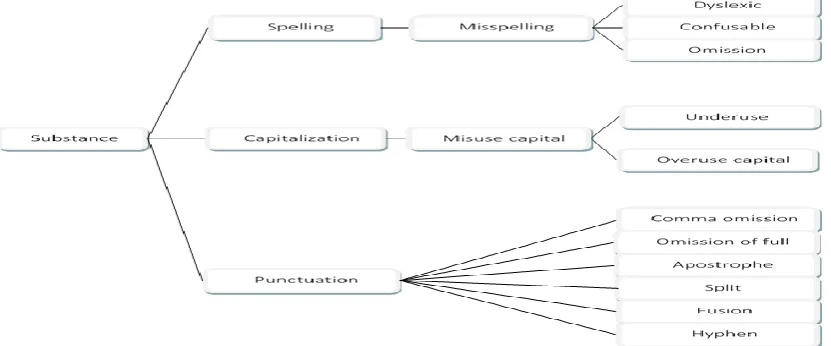
According to James (2001), misspelling errors are dyslexic errors, confusable errors and omission errors (typographic). The dyslexic error refers to the misselection from two letters have the same sound, for example, learners’ misselection the sound /k/ in the word “parc” instead of “park”.
Figure 1.The conceptualization of substance categories of errors
Whereas confusable error indicates that learners knows two words, but cannot differentiate between them in spelling, for example, learners failed to differentiate between the words “quite” and “quiet”. Another case, learners omitted one letter in the word because they depended on their pronunciation when they writing, for example, “mor” instead of “more”.
REVIEW OF LITERATURE
Substance errors
They are those errors committed in writing, which include misspelling, mispronunciation, miscues and misperception. The substance errors include punctuation errors, capitalization errors and misspelling errors.
Misspelling errors
It refers to the incorrect form of words when learners don’t know how to write it correctly. Besides, classify misspelling errors into three subcategories as a revised version of James (2001) “dyslexic”, “confusable” and “omission”.
Capitalization errors
should not capitalize, for example, the word “but” after the comma. James (2001) stated that the most frequent errors of capitalizations are “underuse” or “overuse” of capitals. Punctuation errors
Punctuation errors are comma, full stop, apostrophe, split, fusion and hyphenated errors. According to James (2001), the most common errors of punctuations are underuse of apostrophes’, overuse or underuse of the space between compound words and overuse hyphen. Actually, English and Arabic have very differently punctuation in most cases. The most frequent errors in punctuation are: 1) omitted comma; 2) omitted period; 3) omitted apostrophe such as “cant”; 4) splitting some words that should not split such as “any thing”; 5) combining two separate words such as “inaddition”;6) hyphenated words such as “cash-point”.
L1 transfer errors
Errors that attributed to L1 influences by which learners commit errors because of a lack of second language knowledge. They were thinking in their first language (Arabic) and borrowed some patterns of the second language (English). The L1 played a negative role when the two languages have differences because L1 patterns were not the same as second language. It’s obvious that these learners generalize the L1 to the second language. In other words, the learners carry over the knowledge of their L1 to the second language. When an L1 pattern which is not found in the second language is applied in second language utterance by EFL learners, L1 error appears. L1 errors represent the negative influences of L1 and the differences between L1 and second language. This happens in different levels like grammar, substance, syntax or other levels when the structures of the two languages are different or when the learners carry the knowledge of first language over to second language and generalize the items like rules or patterns of first language to second language.
Difficulties in EFL learners writing
could adopt in teaching English. He concluded that error was the most important part in SLA (Li Lei 2013).
Junaid, Ampa, and Basri (2013) investigated syntactic errors by native Indonesian- speaking students of English. They identified the types and manners of errors about the phrases in the descriptive paragraphs. These categories included verb phrase, noun phrase, adverb phrase, adjective phrase, and prepositional phrase, whereas secondly, the functions included, predicate, subject, object, adjunct, and complement. Their research findings indicated that learners made 16 types of errors including word form, identifier, “be” auxiliary, passive form, “do” auxiliary and word class. Besides, the results also referred that students made 18 manners of syntactic errors, such as: omission of identifier, misuse of verb form, an omission of “be”, misuse of singular nouns, misuse of word order, misuse of the prepositional phrase as a subject, and misuse of an identifier. They concluded that in learning English the phrases were the major problems because there were different MT collections of words from their Indonesian language.
resulted from partial learning and imperfect mastery of the second language (intralingual source) whereas errors resulting from first language transfer (L1 source) accounts a small proportion (Asghar 2015). The Iraqi researchers’ studied writing errors from different perspectives. In some studies, researchers focused on causes of errors.
Ali (2007) investigated some linguistic problems of EFL learners at University of Mousal. The study focused on the cause of the error (L1) or first language transfer (Arabic). He found that errors were inevitable in language learning. Al-Qaraghooly and Sultan researched the scientific writings of Iraqi EFL postgraduates at the University of Technology. They found that syntactico-morphological errors were the most frequently committed in scientific writing by Iraqi EFL postgraduates, followed by stylistic and lexico-semantic errors. It was found that errors in the use of tenses were the most frequent ones. Other errors were found in the use of verb groups, the use of articles and lack of concord. Besides, intralingual errors seemed to outweigh MT interference and transfer errors(Al-Qaraghooly & Sultan 2008). Khalid investigated the use of the appropriate lexical relations of Iraqi EFL learners. The study focused on the levels of mastery and production of Iraqi EFL learners. The findings of the study indicated that Iraqi EFL learners made both combinatorial and substitutional errors and the most frequent errors was substitutional. Besides, most of these lexical errors were due to intralingual causes (Khalid 2011).
Ridha (2012) investigated EFL learners in terms of the effect of first language on their writings. The researcher investigated the EFL learners’ major difficulties in writing. The investigator categorized errors into word order, lexical, grammatical, and semantic and substance errors. The results revealed that most students’ errors are related to their first language. The researcher concluded that the most serious and frequent errors in EFL learners writing were the substance errors and the grammatical errors.
Ali (2012) studied paragraph writing of Iraqi EFL learners in University of Baghdad at three levels advanced, intermediate and simple. The study concentrated at identifying the most common errors committed by Iraqi EFL learners in paragraph writing. He found that most of Iraqi EFL learners had difficulty in writing paragraph, particularly in the use of certain grammatical structures and coherent sentences. Jasim researched Iraqi EFL learners writing in English in Misan province. The purpose of the study was to determine why Iraqi EFL learners were poor writers. The findings of the study showed that Iraqi EFL teachers misunderstood the nature of writing process whereas learners did not practice enough English writing (Jasim 2012). Humeid studied the use of compound prepositions by 100 Iraqi EFL university students. He concluded that most of Iraqi EFL students failed to recognize and produce prepositions. Besides, students did not realize the preposition's functions. In addition, the main causes of error were that students did not discern their meanings, and grammar book did not list their meanings (Humeid 2013).
that Iraqi EFL learners have no mastery over the use of tenses even at advanced level of learning. Another study on types of errors by Faisal (2013) investigated on students from the department of educational and psychological sciences in terms of syntactic errors. Errors were classified according to their process wrong ordering, addition, permutation, substitution and omission. The research results indicated the interference of the mother tongue, and the production of these errors showed that the students thought in their first language when they were writing in English. As a matter of fact, this kind of classification cannot apply for all the categories of errors (e.g. split, fusion and subject- verb agreement
...etc.).
From the foregoing studies it can be seen that few researchers have focused on the high level of errors as substance field in Iraq. Moreover, most of these research studies writing errors are from different perspectives and aims. What is more, this empirical research goes deeper in analyzing learner’s errors into subcategories. Accordingly, the present study focuses on substance field of errors as well as adopted a revised version of James (2001) the linguistic and the surface structure classification to classify errors into categories and sub-categories made by Iraqi EFL learners. Our study addresses the following questions:
1. What are the common types of substance errors Iraqi EFL learners commit in their English writings?
2. What are the frequency types of substance errors? 3. What are the possible causes of substance errors? METHODOLOGY
Participants
The participants in this study are 70 learners’ (31 males and 39 females) EFL majors, English from the University of AL-Mustansirih in Iraq. They are all randomly selected from 4 classes and different grades (2, 3, and 4); each class has more than 30 students. These learners asked to take part in this study. Participants spoke the Arabic language (Iraqi) as their first language. They are undergraduate learners who have studied English as a foreign language. They have learned English as EFL under formal instruction about twelve years (two years in primary school, six years in middle and high school and four years in the university). All the participants have different levels of proficiency in English; therefore, they are able to produce data study for analysis.
Instruments
Data collection
The 70 English major students from the University of AL-Mustansirih in Iraq were to take part in this study. The samples were all randomly selected in class under their teachers’ instruction and supervision. One writing task was used to collect these Iraqi EFL learners’ writings. This task of writing was designed based on an IELTS writing model test. The reasons for using an IELTS writing assignment were given as follows: (1) it was designed from the perspectives of real English speakers and it can test the one’s authentic English language proficiency; (2) for each IELTS writing assignment, there was elaborate explanation on grading standards. Besides, the model writing can also be downloaded and accessed through the Internet easily. These learners were provided with the topic entitled “Besides a lot of advantages, some people believe that the Internet creates many problems”. In fact, to ensure the validity of this study, the researcher chose this topic because it is very clear, simply stated and would reflect the learners’ real writing abilities. Besides, most of learners like this kind of topic, they are more motivated to write and express their ideas. The participants were asked to write a composition of at least about 250 words during about 45 minutes. In this way, the writings can truly reflect the participants’ language proficiency. Moreover, to ascertain the reliability of the study, none of the subjects are informed about this writing task. After they finished writing, the writings were collected. The instructions for the writing assignment was as follows:
Please write about the following topic:
Besides a lot of advantages, some people believe that the Internet creates many problems.
To what extent do you agree or disagree with this statement?
Some people think that the internet brings us a lot of benefits. It is obvious that the internet brings us great convenience and efficiency. The Internet can be used to make friends. It overcomes the geographical barriers and makes the world smaller. We can have easy and quick access to the latest information worldwide. Others think that its defects should not be ignored. It gives rise to people’s mental problems. It results in various computer crimes. It is harmful to the growth of the youth.
Note: please write at least 250 words.
All these writings will be investigated in term of substance errors and then show their sources. After 45 minutes, the writings were collected. All 70 students had finished the composition and 70 Iraqi EFL writings were collected.
Data analysis
this study, the author provided these teachers with a model of errors and explanations. Furthermore, in identifying errors the teachers committee had a general agreement on the standard sample, the author using abbreviations for each category as follows: * = Erroneous form, verb= V, articles=Art, prepositions=Pre, plurals=Pl, pronouns=Pro, auxiliaries=Aux, subject-verb agreement=SVA, spelling=S, capitalization=Cap and punctuation=Pun. Besides, these teachers performed this error detection by examining the rules based on their experience and the model explanation. Lastly, the author reviewed and evaluated the final results. The writing was analyzed in terms of substance errors. The frequency of substance errors will be counted by Ms-Excel 2010 software. Then the frequencies reveal the results of substance errors. Moreover, the author analyzes the causes of these errors in order to show the reasons. The following table shows each step of research procedures in the present study:
Table 1. Common types of substance errors in the learners’ writing
NO. Substance Errors
1. spelling
2. capitalization
3. punctuation
RESULT AND DISCUSSION
The common types of substance errors
Spelling
Spelling errors are the most problematic area in the subjects writing. The majority of these errors are dyslexic errors, which relate to the first language interference. Indeed, the main problem of the spelling errors is that learners in most cases follow the pronunciation rather than the original form of English words. In this case these learners overgeneralize first language into second language, since Arabic language is a phonetic language. Another occasion, the subjects omit one letter in the word, the most common omission found in this study is the omission of the vowel sound “e”. Another case,
learners confuse two similar words that they know and cannot differentiate between them in spelling.
Dyslexic
In example 1, the student spells the word according to its pronunciation as “Finely”, “interenet” and “modren”, it appears that he or she depends on the pronunciation. In example 2, another student, also relies on his or her pronunciation when he or she spells the words “persionl” and “expirince”. Whereas, in example 3, we see the same occasion the student spells the word according to its pronunciation as “speciallist”, “medcin” and
“phsycology”. From all the examples above, it appears that the majority of these errors are due the interference of first language.
Eg.1:
Eg. 2:
*One my persionl expirince …. Eg. 3:
*When he is a speciallist in any trend such as in technology, medcin, engineering, phsycology .
Confusable words
In example 1, the student confuses two similar words as “effect” and “affect” that he or she knows and has difficulty in distinguishing the correct form of the word. In example 2, another student errors in choosing the correct form of the words “think” and thing. Whereas, in example 3, the student confuses the two words “think” and “thing”.
Eg. 1:
*Every one has his own Life his style of living even The tea Time didn’t effect them.
Eg. 2:
*To get informations about every think…. Eg. 3:
*I dont thing that the internet is useful.
Omission
As we can see in example 1, the student omits one letter in the words as “thoug”, “mor” and *acadmic. In example 2, the student omits the vowel sound |e| in the word “atmospher”, whereas, in example 3, the student omits the vowel sound |a| in the word “nowdays” as well as the vowel |e| in the word “exampl”. Indeed, the most common spelling omission errors in this study are that the subjects omit the silent sounds or the vowel sounds especially the vowel |e|. It appears that these students also are relying on their pronunciation since these sounds have no importance when the word is pronounced.
Example 1:
*A whole new person Thoug mor advanced acadmic paper are a category all their own.
Eg. 2:
*There are many things which may be bad idea to bring it in the atmospher of the family.
Eg. 3:
*For exampl some people who are called nowdays Hackers.
Capitalization
in common with many other European languages, has this feature. Since this feature is absent in Arabic we see that the majority of the subjects in this study have difficulty in distinguishing the correct use of this feature. Overuse of capitalsis most common in this research; they capitalized some letters, which is unnecessary. On other occasions, some students capitalize some letters in the middle or final position of the word. Moreover, we see in some of the students’ writing that they capitalize certain letters in the entire paragraph. It appears that some students lack knowledge of the relevant conventions and therefore it is not only L1 interference that is the dominant factor in this area.
Misuse (underuse) capitals
In example 1, the student misuses the capital when he or she does not capitalize the first word in the sentence. Another case, in example 2, the student does not capitalize the name of the country that supposed to be capitalized. Another occasion, in example 3, the student does not capitalize the pronoun “I” that is always written with a capital letter. These kinds of errors do appear to be due to L1 interference.
Eg. 1:
*by this way I can do anther kinds of studies in my country. Eg. 2:
*sudan and the other in Yambuku, Democratic Republic of congo.
Eg. 3:
*The advantages i saw the internet brought my family and friends closer to me.
Misuse (Overuse) capitals
As shown in examples 1, 2 and 3, some students misuse capitalization when they capitalize certain letters in all positions of the word when there is no need to do so. English language has no such pattern so this type of error is non- standard English.
Eg. 1:
*People May Benefit from it or May be it hurts The families. Eg. 2:
*Well, I think That The inTernet brings us a lot of benefits. Eg. 3:
*My persnoL experience with these issues revolves around mischief making.
Punctuation
Comma omission
In example 1, the student omits the comma after the introductory word “finally”. Whereas, in example 2, the student omits the comma after and before the word “for” “example” when he or she gives some extra details. In example 3, the student omits the comma before the contrary word “but”.
Eg. 1:
*Finally I would like to say that internet is useful for us. Eg. 2:
*When I use it in good way For Example when I search for some thing related to my study.
Eg. 3:
*There are loads of other pros to the Internet but these are what came first to my mind.
Full stop/ Period
In example 1, the student omits the full stop at the end of the sentence. In example 2, the student has the same error by omitting the full stop at the end of the sentence. Whereas, in example 3, the student omits the full stop when he or she use the expression etc he or she ignores to add full stop. Indeed, this type of error is typo error or ignorance error because most of learners know these basic things.
Eg. 1:
*Civilazation and the live in so many fields-Eg. 2: *I didn’t find any problem about using of Internet Eg. 3:
*You cand send text messages, photos, videos ,documents , etc
Apostrophe
As we see in three example 1, 2 and 3, the students omit the apostrophe in the words “dont”, “thats” and “theres” when they using the contraction form. As a matter of fact, some of the subjects ignore to insert apostrophe, it appears since this technique is absent they pay less attention to it.
Eg. 1:
*I dont thing that the internet is useful. Eg. 2:
*Push our contnries in this vortix thats one of harmful to exclusion him from his principles.
Eg. 3:
Split
In example 1, the student splits the words “any thing” and “every thing” but the meaning is still clear. Whereas, in example 2, the student splits the words “every one”, “have n’t” and “out side”, which results in the meaning becoming unclear. In example 3, the student splits the word “friend ships”, which potentially changes its meaning. Actually, this new phenomenon is serious in two aspects, firstly, it can change the meaning of the words in some cases and secondly, it does not reflect the form of Standard English.
Eg. 1:
* To know any thing about every thing or to connect with others in any place in earth.
Eg. 2:
* In connecting with every one in or out side the country who you have n’t see or call them for a long time.
Eg. 3:
* My cousins who Live out of my country, I could make New friend ships with other people.
Fusion
In example 1, the student fuses the word “feednews” instead of separating it as in the original form. In example 2, the student fuses the word “infront”. Whereas, in example 3, the student fuses the words “goon” instead of separates them into two words. This case is a new phenomenon in the punctuation when some of the subjects fuse two separated words and make them as a one word.
Eg. 1:
*In facebook to see the feednews of my friends. Eg. 2:
*Sad things that could bring the world infront of us. Eg. 3:
*Youth who goon for long time to use the websites May fail in their studies.
Hyphen
As we can see in three examples 1, 2 and 3, the students misuse hyphen when they insert hyphen mark in some unnecessary positions in the sentence.
Eg. 1:
*We should keep in mind that the Internet is just a way to help not a main life-style.
Eg. 2:
Eg. 3:
*Especially to those who live out of Iraq- and recieved from them. The frequencies and possible causes of substance errors
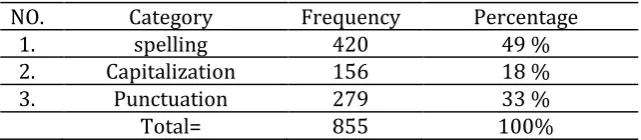
Table 2 summarizes the statistical results of frequency and percentage of major substance categories of errors. The totality substance errors were 855, which can be classified into three major categories as spelling, capitalization and punctuation.
Table 2. Frequencies of major substance categories of errors
NO. Category Frequency Percentage
1. spelling 420 49 %
2. Capitalization 156 18 %
3. Punctuation 279 33 %
Total= 855 100%
The most frequently substance errors were spelling, which occupied 420 (49%) of the totality of errors. The second high frequency of errors were punctuation errors, which took up 279 (33%) of the totality errors. Finally, misuse of capitalization errors were covered 156 (18%) of the totality errors, as in the following table.
Furthermore, Table 3 shows the frequency and percentage of each sub-category of substance errors.
Table 3. Frequencies of sub-categories of substance errors
NO. Major-category Total Sub-category Frequency Percentage
1. Spelling 420
dyslexic 266 63 %
100%
confusable 37 9%
omission 117 28 %
2. capitalization 156 misuse(underuse) capitals misuse(overuse) capitals 59 97 38 % 62 % 100%
3. Punctuation 279
comma omission 69 25 %
100%
full stop 8 3 %
apostrophe use 45 16 %
split 93 33 %
fusion 57 20 %
hyphen 7 3 %
common errors of this type in this study result from that some learners using a rote learning method. When they are unfamiliar with the form of the word, they follow their pronunciation and write the word according to its phonetic features. This kind of error is due to first language interference Arabic in other words dyslexia errors.
There are clearest examples of first language interference in spelling errors. An example of first language interference is in “now days”, “there for” when learners spell the words according to their first language and omitted “a”. This kind of error occurs because learners using direct Arabic translation technique when they spell the words in English not according to their forms. The clearest examples found in the learners writing that they spell the words according to its pronunciation when they do not know how to write the words correctly as in “thanx”, “mistacies”, “peaple”, “bliive”.Another evidence on first language interference in spelling that learners omit the silent sounds or the vowel sounds especially the vowel |e| when they spell the words in English as in the following deviant forms “funy”, “wich”, “aful”, “thoug”, “stak”, “needles” because these sounds have no importance when the word is pronounced. This type of error happens because those learners transferred the writing techniques of first language writing system into second language and commit errors. In Salim Abu-Rabia and Rana Sammour’s (2013) study, it was found that spelling errors of dyslexic bilingual Arabic-English students “phonetic errors” were more prevalent in Arabic than English. It is noticed that some learners confuse between two similar words as in “us” and “as” or between “life” and “live” or “then” and “than” the cause of this error could be intralingual errors because they fail to distinguish between two similar words.
Error in misusing capitals is divided into two sub-categories as: misuse “underuse” capitals, which counts 38% and misuse “overuse” capitals, which counts 62%. Unlike English, Arabic language has no capitalization in the written language. In spite of that we noticed that learners overuse capitals and capitalized some letters in the middle or final position of the word in the entire paragraph, which is deviant form because they lack knowledge of the relevant conventions. For example, in “people May Benefit from it or Maybe it hurts The families” learners overused of capital for certain letters on the basis of other patterns in the second language. Another example, in “But in spite of all These reasons I find Life is nothing without This Invention” learners here overused capital when they capitalized the words “May”, “Benefit” and “The” that supposed to be as small letters. Besides, we have noticed that some learners underuse capital when they forget to capitalize the first word of the sentence as in “the culture of the many countries and also we can use the face book to communicate with our friends”. Another occasion, learners ignore to capitalize the word “facebook” as in “I created my own page on facebook”. In capitalization error, the possible cause is first language interference because learners have difficulty in choosing the correct usage of capitals and also Arabic lacks this form.
tongue. A good example of interference in the comma as in “it very useful for researchers and scholars “،” ie “،” when learners separated the sentence by “،” that is used in Arabic punctuation instead of the comma in English, which is “,”. This clearly shows this type of error attributed to first language interference. Another occasion is seen in the comma omission as in “finally I would like to say that internet is useful for us” when learners omitted the comma after the introductory word “finally”. Another example in “in my opinion, the internet is more useful, because it makes us able to see the world” here the learners insert the comma before the introductory words “in my opinion” and insert comma before “because”, which is unnecessary. From these examples we understand that the possible cause is the influence of L1“Arabic”. In relation to period we noticed that learners transferred pattern from Arabic into English. They used sequence of period that is used in Arabic. In Arabic, this pattern used at the end of the sentence when someone indicates that there is word the speaker wants to be implied instead of period as in “sometimes it lacks the credibility and reliability ….”.
Learners make this error because they influence by their first language and transferred pattern from their native language. Arabic has no apostrophe in written form. In learners writing we noticed that some learners confuse between the contraction form and the possession form and in some cases they omit it as in “its more like a necessary in everyday life now”. Another occasion that learners omitted the apostrophe in the contraction form as in “the internet didn’t tell us to make an account by this way it may be a bad thing”. The possible reason why learners make this error is first language influence. We have noticed a new phenomenon that learners split the entire word into two words instead of combining it, which changes meaning in some cases as in “now adays” “face book”, “in formation”, “him self” and “tele communication”. In Arabic, there is no compound word. A further new phenomenon we discovered in the learners writing that learners fuse two separated words and make them into one word as in “comedown”,” anyplace”, “feednews” and “faraway”. English has different nature than Arabic and it is possible the cause of those errors attributed to first language. As for hyphen error we noticed that learners confuse in using the hyphen as in “we should keep in mind that the Internet is just a way to help not a main life-style” the cause of this error could be intralingual error.
In summary, we found that Iraqi EFL learners have negative first language influence in relation to substance errors causes include spelling “dyslexic error” and “omission error”, misuse “underuse” capitals and misuse “overuse” capitals, comma omission, period, apostrophe, split and fusion. As for the cause of errors that attributed to intralingual errors we found that confusion in using hyphen related to second language error.
CONCLUSION
two similar words that they know but cannot differentiate between them in spelling. In relation to misuse of capitalization errors, it was found that learners have difficulty in distinguishing the necessary use of this feature. Overuse of capitals is most common in this research; learners capitalized some letters in the middle or final position of the word, which is incorrect. We found in some of the students’ writing that they capitalize a certain individual letter throughout the entire paragraph. As to punctuation errors, we found that learners committed a high level of errors in this area including comma omission, incorrect use of the full stop, apostrophe use, split, fusion, and hyphen. In some cases learners omit the comma after the introductory word or when he or she gives some extra details without separating the sentence.
Besides, learner’s omission of the full stop at the end of the sentence in some cases may simply be a typographical or orthographical error. On the other hand, learners ignore inserting an apostrophe when they using the contraction form. A new phenomenon we found is that learners split the entire word into two words instead of combining it, which changes meaning in some cases. A further new phenomenon we discovered is when learners fuse two separated words and make them into one word. Actually, these new phenomena are significant from two aspects: first, the meaning of the words in some cases is changed, second, it does not reflect the form of Standard English. As for the frequency findings of substance errors, we found that the totality of substance errors is 855, which are divided into three categories. The highest frequency of substance errors is spelling errors, which occupies 49% of the totality errors. Furthermore, the second highest frequency error is punctuation errors. Besides, we found that capitalization errors are the least committed substance errors.
To sum up, we found that Iraqi EFL learners have writing problems in substance field. Moreover, through the analysis of the data and examination of the examples we found that the possible causes of substance errors are L1 transfer, we found that Iraqi EFL learners have negative first language influence include spelling “dyslexic error” and “omission error”, misuse “underuse” capitals and misuse “overuse” capitals, comma omission, period, apostrophe, split and fusion.
REFERENCES
AbiSamra, N. (2003). An analysis of errors in Arabic speakers’ English writing.
Unpublished doctoral dissertation, American University of Beirut.
Ali, N. (2007). “Some Linguistic Problems Facing Arab Learners of English”. University of Mosul, (48).
Ali, S. (2012). An Analysis of Iraqi EFL learners’ Errors in Paragraph writing. University of Baghdad, (200).
Al-Qaraghooly, D., & Sultan, K. (2008). An Error Analysis of the Scientific Writing of Iraqi
EFL Postgraduates at the University of Technology. Al-Mustansiriyah University.
Asghar, R. (2015). A quantitative analysis of Iranian EFL Learners’ Sources of written errors. International Journal of Research Studies in Language Learning, (1) : 31–42. DIAB, N. (1997). The Transfer of Arabic in the English Writings Lebanese Students.
Doolan, S., & Miller, D. ( 2012). Generation 1.5 Written Error Patterns: A Comparative Study. Journal of Second Language Writing, (21): 1-22.
Faisal, W. (2013). Syntactic Errors made by Students and Psychological Sciences.
University of Babylon Journal, 21: (2).
Fang, M. (2012). Error Analysis of English Composition in Junior Middle School: with Class
one and Two in Grade Nine of No.21 Junior Middle School in Lushan as Samples. He
Nan University.
Guo, N. (2009). An Experimental Study of Error Analysis in College English Writing
Teaching. Shenyang Normal University.
Humeid, A. (2013). Compound Prepositions used by Iraqi EFL University students.
International Journal of English Linguistics, 3: (2), 1923-869.
James, C. (2001). Errors in Language Learning and use: Exploring Error Analysis, China: Pearson Education Limited.
Jasim, M. (2012). Poor Writing in English: A Case of the Iraqi EFL learners in Misan
Province. University of Misan Journal, (24).
Junaid, Ampa, A., & Basri, M. (2013). Syntactic Errors in Descriptive Paragraphs by Native Indonesian-Speaking Students of English. International Journal of Linguistics, 5(5):
1948-5425.
Khalid, W. (2011). Investigating Iraqi EFL learners mastery and use of the appropriate
lexical Relations. Al-Anbar University Journal, (99).
Li, L. (2013). The Relationship between Error Analysis and English Teaching. Yancheng University.
Liu, M., & Xu, Y. (2013). An Investigation of Syntactic Errors in Chinese Undergraduate EFL Learners’ Compositions: A Cohort Study. International Journal of Applied Linguistics and English Literature, 2(4).
Reishaan, A. (2013). The use of Tenses in the Iraqi Advanced EFL learners’ Writings: An
Error analysis. University of Brasov, (1): 99-116.
Ridha, N. (2012). The effect of EFL learner’ Mother Tongue on their writings in English: An Error Analysis Study. Journal of the College of Arts. University of Basrah, (60). Sattayatham, A., & Ratanapinyowoug, p. (2008). Analysis of Errors in Paragraph Writing in English By First Year Medical Students from the Four Medical Schools at Mahidol University. Silpakorn University International Journal, 8.
Wanlan, W. (2006). The Invistigation and Analysis of Errors in English Written Production
from Senior One Students’ in Shangiang Senior High School. Zhejiang Normal
University.