00.200.02
Kat.-Nr. 199 90
Fundamentals of
Preface
Oerlikon Leybold Vacuum, a member of the globally active industrial Oerlikon Group of companies has developed into the world market leader in the area of vacuum technology. In this leading position, we recognize that our customers around the world count on Oerlikon Leybold Vacuum to deliver technical superiority and maximum value for all our products and services. Today, Oerlikon Leybold Vacuum is strengthening that well-deserved reputation by offering a wide array of vacuum pumps and aftermarket services to meet your needs.
This brochure is meant to provide an easy to read overview covering the entire range of vacuum technology and is inde-pendent of the current Oerlikon Leybold Vacuum product portfolio. The presented product diagrams and data are pro-vided to help promote a more comprehensive understanding of vacuum technology and are not offered as an implied war-ranty. Content has been enhanced through the addition of new topic areas with an emphasis on physical principles affecting vacuum technology.
To us, partnership-like customer relationships are a funda-mental component of our corporate culture as well as the continued investments we are making in research and development for our next generation of innovative vacuum technology products. In the course of our over 150 year-long corporate history, Oerlikon Leybold Vacuum developed a comprehensive understanding of process and application know-how in the field of vacuum technology. Jointly with our partner customers, we plan to continue our efforts to open up further markets, implement new ideas and develop pioneer-ing products.
Preface
Fundamentals
of Vacuum
Technology
revised and compiled by
Dr. Walter Umrath
with contributions from
Table of Contents
2.2 Choice of pumping process . . . .60
2.2.1 Survey of the most usual pumping processes . . . .60
2.2.2 Pumping of gases (dry processes) . . . .62
2.2.3 Pumping of gases and vapors (wet processes) . . . .62
2.2.4 Drying processes . . . .64
2.2.5 Production of an oil-free (hydrocarbon-free) vacuum . . . .65
2.2.6 Ultrahigh vacuum working Techniques . . . .65
2.3 Evacuation of a vacuum chamber and determination of pump sizes . . . .66
2.3.1 Evacuation of a vacuum chamber (without additional sources of gas or vapor) . . . .66
2.3.1.1 Evacuation of a chamber in the rough vacuum region . . . .67
2.3.1.2 Evacuation of a chamber in the high vacuum region . . . .68
2.3.1.3 Evacuation of a chamber in the medium vacuum region . . . . .68
2.3.2 Determination of a suitable backing pump . . . .69
2.3.3 Determination of pump-down time from nomograms . . . .70
2.3.4 Evacuation of a chamber where gases and vapors are evolved . . . .71
2.3.5 Selection of pumps for drying processes . . . .71
2.3.6 Flanges and their seals . . . .73
2.3.7 Choice of suitable valves . . . .73
2.3.8 Gas locks and seal-off fittings . . . .75
3. Vacuum measurement, monitoring, control and regulation . . . .76
3.1 Fundamentals of low-pressure measurement . . . .76
3.2 Vacuum gauges with pressure reading that is independent of the type of gas . . . .77
3.2.1 Bourdon vacuum gauges . . . .77
3.2.2 Diaphragm vacuum gauges . . . .77
3.2.2.1 Capsule vacuum gauges . . . .77
3.2.2.2 DIAVAC diaphragm vacuum gauge . . . .78
3.2.2.3 Precision diaphragm vacuum gauges . . . .78
3.2.2.4 Capacitance diaphragm gauges . . . .78
3.2.3 Liquid-filled (mercury) vacuum gauges . . . .79
3.2.3.1 U-tube vacuum gauges . . . .79
3.2.3.2 Compression vacuum gauges (according to McLeod) . . . .79
3.3 Vacuum gauges with gas-dependent pressure reading . . . .81
3.3.1 Spinning rotor gauge (SRG) (VISCOVAC) . . . .81
3.3.2 Thermal conductivity vacuum gauges . . . .82
3.3.3 Ionization vacuum gauges . . . .83
3.3.3.1 Cold-cathode ionization vacuum gauges (Penning vacuum gauges) . . . .83
3.3.3.2 Hot-cathode ionization vacuum gauges . . . .84
3.4 Adjustment and calibration; DKD, PTB national standards . . . .86
3.4.1 Examples of fundamental pressure measurement methods (as standard methods for calibrating vacuum gauges . . . .87
3.5 Pressure monitoring,control and regulation in vacuum systems . . . .88
3.5.1 Fundamentals of pressure monitoring and control . . . .88
3.5.2 Automatic protection, monitoring and control of vacuum systems . . . .89
3.5.3 Pressure regulation and control in rough and medium vacuum systems . . . .90
3.5.4 Pressure regulation in high and ultrahigh vacuum systems . . .92
3.5.5 Examples of applications with diaphragm controllers . . . .93
1. Vacuum physics Quantities, their symbols, units of measure and definitions . . . .9
1.1 Basic terms and concepts in vacuum technology . . . .9
1.2 Atmospheric air . . . .13
1.3 Gas laws and models . . . .13
1.3.1 Continuum theory . . . .13
1.3.2 Kinetic gas theory . . . .13
1.4 The pressure ranges in vacuum technology and their characterization . . . 14
1.5 Types of flow and conductance . . . .15
1.5.1 Types of flow . . . .15
1.5.2 Calculating conductance values . . . .16
1.5.3 Conductance for piping and openings . . . .16
1.5.4 Conductance values for other elements . . . .18
2. Vacuum Generation . . . .19
2.1 Vacuum pumps: A survey . . . .19
2.1.1 Oscillation displacement vacuum pumps . . . .20
2.1.1.1 Diaphragm pumps . . . .20
2.1.2 Liquid sealed rotary displacement pumps . . . .20
2.1.2.1 Liquid ring pumps . . . .20
2.1.2.2 Oil sealed rotary displacement pumps . . . .21
2.1.2.2.1 Rotary vane pumps (TRIVAC A, TRIVAC B, TRIVAC E, SOGEVAC) . . . .21
2.1.2.2.2 Rotary plunger pumps (E Pumps) . . . .23
2.1.2.2.3 Trochoid pumps . . . .24
2.1.2.2.4 The gas ballast . . . .24
2.1.3 Dry compressing rotary displacement pumps . . . .27
2.1.3.1 Roots pumps . . . .27
2.1.3.2 Claw pumps . . . .31
2.1.3.2.1 Claw pumps with internal compression for the semiconductor industry (“DRYVAC Series”) . . . .33
2.1.3.2.2 Claw pump without internal compression for chemistry applications (“ALL·ex”) . . . .35
2.1.4 Accessories for oil-sealed rotary displacement pumps . . . .38
2.1.5 Condensers . . . .38
2.1.6 Fluid-entrainment pumps . . . .40
2.1.6.1 (Oil) Diffusion pumps . . . .41
2.1.6.2 Oil vapor ejector pumps . . . .43
2.1.6.3 Pump fluids . . . .44
2.1.6.4 Pump fluid backstreaming and its suppression (Vapor barriers, baffles) . . . .44
2.1.6.5 Water jet pumps and steam ejectors . . . .45
2.1.7 Turbomolecular pumps . . . .46
2.1.8 Sorption pumps . . . .50
2.1.8.1 Adsorption pumps . . . .50
2.1.8.2 Sublimation pumps . . . .51
2.1.8.3 Sputter-ion pumps . . . .51
2.1.8.4 Non evaporable getter pumps (NEG pumps) . . . .53
2.1.9 Cryopumps . . . .54
2.1.9.1 Types of cryopump . . . .54
2.1.9.2 The cold head and its operating principle . . . .55
2.1.9.3 The refrigerator cryopump . . . .56
2.1.9.4 Bonding of gases to cold surfaces . . . .56
2.1.9.5 Pumping speed and position of the cryopanels . . . .57
Table of Contents
4. Analysis of gas at low pressures using
mass spectrometry . . . .95
4.1 General . . . .95
4.2 A historical review . . . .95
4.3 The quadrupole mass spectrometer (TRANSPECTOR) . . . .96
4.3.1 Design of the sensor . . . .96
4.3.1.1 The normal (open) ion source . . . .96
4.3.1.2 The quadrupole separation system . . . .97
4.3.1.3 The measurement system (detector) . . . .98
4.4 Gas admission and pressure adaptation . . . .99
4.4.1 Metering valve . . . .99
4.4.2 Pressure converter . . . .99
4.4.3 Closed ion source (CIS) . . . .99
4.4.4 Aggressive gas monitor (AGM) . . . .99
4.5 Descriptive values in mass spectrometry (specifications) . . . .101
4.5.1 Line width (resolution) . . . .101
4.5.2 Mass range . . . .101
4.5.3 Sensitivity . . . .101
4.5.4 Smallest detectable partial pressure . . . .101
4.5.5 Smallest detectable partial pressure ratio (concentration) . . . .101
4.5.6 Linearity range . . . .102
4.5.7 Information on surfaces and amenability to bake-out . . . .102
4.6 Evaluating spectra . . . .102
4.6.1 Ionization and fundamental problems in gas analysis . . . .102
4.6.2 Partial pressure measurement . . . .106
4.6.3 Qualitative gas analysis . . . .106
4.6.4 Quantitative gas analysis . . . .107
4.7 Software . . . .108
4.7.1 Standard SQX software (DOS) for stand-alone operation (1 MS plus, 1 PC, RS 232) . . . .108
4.7.2 Multiplex/DOS software MQX (1 to 8 MS plus 1 PC, RS 485) . . . .108
4.7.3 Process-oriented software – Transpector-Ware for Windows . . . .108
4.7.4 Development software TranspectorView . . . .109
4.8 Partial pressure regulation . . . .109
4.9 Maintenance . . . .109
5 Leaks and their detection . . . .110
5.1 Types of leaks . . . .110
5.2 Leak rate, leak size, mass flow . . . .110
5.2.1 The standard helium leak rate . . . .112
5.2.2 Conversion equations . . . .112
5.3 Terms and definitions . . . .112
5.4 Leak detection methods without a leak detector unit . . . .113
5.4.1 Pressure rise test . . . .113
5.4.2 Pressure drop test . . . .114
5.4.3 Leak test using vacuum gauges which are sensitive to the type of gas . . . .114
5.4.4 Bubble immersion test . . . .115
5.4.5 Foam-spray test . . . .115
5.4.6 Vacuum box check bubble . . . .115
5.4.7 Krypton 85 test . . . .115
5.4.8 High-frequency vacuum test . . . .115
5.4.9 Testing with chemical reactions and dye penetration . . . .115
5.5 Leak detectors and how they work . . . .116
5.5.1 Halogen leak detectors (HLD 4000, D-Tek) . . . .116
5.5.2 Leak detectors with mass spectrometers (MS) . . . .116
5.5.2.1 The operating principle for a MSLD . . . .117
5.5.2.2 Detection limit, background, gas storage in oil (gas ballast), floating zero-point suppression . . . .117
5.5.2.3 Calibrating leak detectors; test leaks . . . .118
5.5.2.4 Leak detectors with quadrupole mass spectrometer (ECOTEC II) . . . .119
5.5.2.5 Helium leak detectors with 180° sector mass spectrometer (UL 200, UL 500) . . . .119
5.5.2.6 Direct-flow and counter-flow leak detectors . . . .120
5.5.2.7 Partial flow operation . . . .120
5.5.2.8 Connection to vacuum systems . . . .121
5.5.2.9 Time constants . . . .121
5.6 Limit values / Specifications for the leak detector . . . .122
5.7 Leak detection techniques using helium leak detectors . . . . .122
5.7.1 Spray technique (local leak test) . . . .122
5.7.2 Sniffer technology (local leak testing using the positive pressure method) . . . .123
5.7.3 Vacuum envelope test (integral leak test) . . . .123
5.7.3.1 Envelope test – test specimen pressurized with helium . . . . .123
a) Envelope test with concentration measurement and subsequent leak rate calculation . . . .123
b) Direct measurement of the leak rate with the leak detector (rigid envelope) . . . .123
5.7.3.2 Envelope test with test specimen evacuated . . . .123
a) Envelope = “plastic tent” . . . .123
b) Rigid envelope . . . .123
5.7.4 “Bombing” test, “Storage under pressure” . . . .123
5.8 Industrial leak testing . . . .124
6 Thin film controllers and control units with quartz oscillators . . . .125
6.1 Introduction . . . .125
6.2 Basic principles of coating thickness measurement with quartz oscillators . . . .125
6.3 The shape of quartz oscillator crystals . . . .126
6.4 Period measurement . . . .127
6.5 The Z match technique . . . .127
6.6 The active oscillator . . . .127
6.7 The mode-lock oscillator . . . .128
6.8 Auto Z match technique . . . .129
6.9 Coating thickness regulation . . . .130
6.10 INFICON instrument variants . . . .131
7 Application of vacuum technology for coating techniques . . . .133
7.1 Vacuum coating technique . . . .133
7.2 Coating sources . . . .133
7.2.1 Thermal evaporators (boats, wires etc.) . . . .133
7.2.2 Electron beam evaporators (electron guns) . . . .134
7.2.3 Cathode sputtering . . . .134
7.2.4 Chemical vapor deposition . . . .134
7.3 Vacuum coating technology/coating systems . . . .135
7.3.1 Coating of parts . . . .135
Table of Contents
7.3.3 Optical coatings . . . .136
7.3.4 Glass coating . . . .137
7.3.5 Systems for producing data storage disks . . . .137
8 Instructions for vacuum equipment operation . . . .139
8.1 Causes of faults where the desired ultimate pressure is not achieved or is achieved too slowly . . . .139
8.2 Contamination of vacuum vessels and eliminating contamination . . . .139
8.3 General operating information for vacuum pumps . . . .139
8.3.1 Oil-sealed rotary vacuum pumps (Rotary vane pumps and rotary piston pumps) . . . .140
8.3.1.1 Oil consumption, oil contamination, oil change . . . .140
8.3.1.2 Selection of the pump oil when handling aggressive vapors . .140 8.3.1.3 Measures when pumping various chemical substances . . . . .141
8.3.1.4 Operating defects while pumping with gas ballast – Potential sources of error where the required ultimate pressure is not achieved . . . .142
8.3.2 Roots pumps . . . .142
8.3.2.1 General operating instructions, installation and commissioning . . . .142
8.3.2.2 Oil change, maintenance work . . . .142
8.3.2.3 Actions in case of operational disturbances . . . .143
8.3.3 Turbomolecular pumps . . . .143
8.3.3.1 General operating instructions . . . .143
8.3.3.2 Maintenance . . . .143
8.3.4 Diffusion and vapor-jet vacuum pumps . . . .144
8.3.4.1 Changing the pump fluid and cleaning the pump . . . .144
8.3.4.2 Operating errors with diffusion and vapor-jet pumps . . . .144
8.3.5 Adsorption pumps . . . .144
8.3.5.1 Reduction of adsorption capacity . . . .144
8.3.5.2 Changing the molecular sieve . . . .144
8.3.6 Titanium sublimation pumps . . . .145
8.3.7 Sputter-ion pumps . . . .145
8.4 Information on working with vacuum gauges . . . .145
8.4.1 Information on installing vacuum sensors . . . .145
8.4.2 Contamination at the measurement system and its removal . .146 8.4.3 The influence of magnetic and electrical fields . . . .146
8.4.4 Connectors, power pack, measurement systems . . . .146
9. Tables, formulas, nomograms, diagrams and symbols . . .147
Tab I Permissible pressure units including the torr and its conversion . . . .147
Tab II Conversion of pressure units . . . .147
Tab III Mean free path . . . .147
Tab IV Compilation of important formulas pertaining to the kinetic theory of gases . . . .148
Tab V Important values . . . .148
Tab VI Conversion of pumping speed (volume flow rate) units . . . .149
Tab VII Conversion of throughput (a,b) QpV units; leak rate units . . . .149
Tab VIII Composition of atmospheric air . . . .150
Tab IX Pressure ranges used in vacuum technology and their characteristics . . . .150
Tab X Outgassing rate of materials . . . .150
Tab XI Nominal internal diameters (DN) and internal diameters of tubes, pipes and apertures with circular cross-section (according to PNEUROP). . . . .151
Tab XII Important data for common solvents . . . .151
Tab XIII Saturation pressure and density of water . . . .152
Tab XIV Hazard classificationof fluids . . . .153
Tab XV Chemical resistance of commonly used elastomer gaskets and sealing materials . . . .155
Tab XVI Symbols used invacuum technology . . . .157
Tab XVII Temperature comparison and conversion table . . . .160
Fig. 9.1 Variation of mean free path λ(cm) with pressure for various gases . . . .160
Fig. 9.2 Diagram of kinetics of gases for air at 20°C . . . .160
Fig. 9.3 Decrease in air pressure and change in temperature as a function of altitude . . . .161
Fig. 9.4 Change in gas composition of the atmosphere as a function of altitude . . . .161
Fig. 9.5 Conductance values for piping of commonly used nominal internal diameters with circular cross-section for molecular flow . . . .161
Fig. 9.6 Conductance values for piping of commonly used nominal internal diameters with circular cross-section for molecular flow . . . .161
Fig. 9.7 Nomogram for determination of pump-down time tp of a vessel in the rough vacuum pressure range . . . .162
Fig. 9.8 Nomogram for determination of the conductance of tubes with a circular cross-section for air at 20°C in the region of molecular flow . . . .163
Fig. 9.9 Nomogram for determination of conductance of tubes in the entire pressure range . . . .164
Fig. 9.10 Determination of pump-down time in the medium vacuum range taking into account the evolution of gas from the walls . . . .165
Fig.9.11 Saturation vapor pressure of various substances . . . .166
Fig. 9.12 Saturation vapor pressure of pump fluids for oil and mercury fluid entrainment pumps . . . .166
Fig. 9.13 Saturation vapor pressure of major metals used in vacuum technology . . . .166
Fig. 9.14 Vapor pressure of nonmetallic sealing materials (the vapor pressure curve for fluoro rubber lies between the curves for silicone rubber and Teflon). . . .167
Fig. 9.15 Saturation vapor pressure ps of various substances relevant for cryogenic technology in a temperaturerange of T = 2 – 80 K. . . . .167
Fig. 9.16 Common working ranges of vacuum pumps . . . .167
Fig. 9.16a Measurement ranges of common vacuum gauges . . . .168
Fig. 9.17 Specific volume of saturated water vapor . . . .169
Fig. 9.18 Breakdown voltage between electrodes for air (Paschen curve) . . . .169
Fig 9.19 Phase diagram of water . . . .170
10. The statutory units used in vacuum technology . . . .171
10.1 Introduction . . . .171
10.2 Alphabetical list of variables, symbols and units frequently used in vacuum technology and its applications . . . .171
Table of Contents
10.4 Tables . . . .176 10.4.1 Basic SI units . . . .176 10.4.2 Derived coherent SI units with special names andsymbols . .177 10.4.3 Atomic units . . . .177 10.4.4 Derived noncoherent SI units with special names
and symbols . . . .177
11. National and international standards and recommendations particularly relevant
to vacuum technology . . . .178
11.1 National and international standards and recommendations of special relevance to
vacuum technology . . . .178
12. References . . . .182
Vacuum physics
1.
Quantities, their symbols, units of measure
and definitions
(cf. DIN 28 400, Part 1, 1990, DIN 1314 and DIN 28 402)
1.1
Basic terms and concepts in vacuum
tech-nology
Pressure p (mbar)
of fluids (gases and liquids). (Quantity: pressure; symbol: p; unit of mea-sure: millibar; abbreviation: mbar.) Pressure is defined in DIN Standard 1314 as the quotient of standardized force applied to a surface and the extent of this surface (force referenced to the surface area). Even though the Torr is no longer used as a unit for measuring pressure (see Section 10), it is nonetheless useful in the interest of “transparency” to mention this pressure unit: 1 Torr is that gas pressure which is able to raise a column of mercury by 1 mm at 0 °C. (Standard atmospheric pressure is 760 Torr or 760 mm Hg.) Pressure p can be more closely defined by way of subscripts:
Absolute pressure pabs
Absolute pressure is always specified in vacuum technology so that the “abs” index can normally be omitted.
Total pressure pt
The total pressure in a vessel is the sum of the partial pressures for all the gases and vapors within the vessel.
Partial pressure pi
The partial pressure of a certain gas or vapor is the pressure which that gas or vapor would exert if it alone were present in the vessel.
Important note:Particularly in rough vacuum technology, partial pressure in a mix of gas and vapor is often understood to be the sum of the partial pressures for all the non-condensable components present in the mix – in case of the “partial ultimate pressure” at a rotary vane pump, for example.
Saturation vapor pressure ps
The pressure of the saturated vapor is referred to as saturation vapor pres-sure ps. pswill be a function of temperature for any given substance.
Vapor pressure pd
Partial pressure of those vapors which can be liquefied at the temperature of liquid nitrogen (LN2).
Standard pressure pn
Standard pressure pnis defined in DIN 1343 as a pressure of pn= 1013.25 mbar.
Ultimate pressure pend
The lowest pressure which can be achieved in a vacuum vessel. The socalled ultimate pressure penddepends not only on the pump’s suction speed but also upon the vapor pressure pdfor the lubricants, sealants and propellants used in the pump. If a container is evacuated simply with an oil-sealed rotary (positive displacement) vacuum pump, then the ultimate pressure which can be attained will be determined primarily by the vapor pressure of the pump oil being used and, depending on the cleanliness of the vessel, also on the vapors released from the vessel walls and, of course, on the leak tightness of the vacuum vessel itself.
Ambient pressure pamb
or(absolute) atmospheric pressure
Overpressure peor gauge pressure
(Index symbol from “excess”) pe= pabs– pamb
Here positive values for pewill indicate overpressure or gauge pressure; negative values will characterize a vacuum.
Working pressure pW
During evacuation the gases and/or vapors are removed from a vessel. Gases are understood to be matter in a gaseous state which will not, how-ever, condense at working or operating temperature. Vapor is also matter in a gaseous state but it may be liquefied at prevailing temperatures by increasing pressure. Finally, saturated vapor is matter which at the prevail-ing temperature is gas in equilibrium with the liquid phase of the same sub-stance. A strict differentiation between gases and vapors will be made in the comments which follow only where necessary for complete understanding.
Particle number density n (cm-3)
According to the kinetic gas theory the number n of the gas molecules, ref-erenced to the volume, is dependent on pressure p and thermodynamic temperature T as expressed in the following:
p = n · k · T (1.1)
n = particle number density k = Boltzmann’s constant
At a certain temperature, therefore, the pressure exerted by a gas depends only on the particle number density and not on the nature of the gas. The nature of a gaseous particle is characterized, among other factors, by its mass mT.
Gas density ρ(kg · m-3, g · cm-3)
The product of the particle number density n and the particle mass mTis the gas density ρ:
ρ= n · mT (1.2)
The ideal gas law
The relationship between the mass mTof a gas molecule and the molar mass M of this gas is as follows:
Vacuum physics
Avogadro’s number (or constant) NAindicates how many gas particles will be contained in a mole of gas. In addition to this, it is the proportionality factor between the gas constant R and Boltzmann’s constant k:
R = NA· k (1.4)
Derivable directly from the above equations (1.1) to (1.4) is the correlation between the pressure p and the gas density
ρ
of an ideal gas.R · T
p
=
ρ
⋅ (1.5)M
In practice we will often consider a certain enclosed volume V in which the gas is present at a certain pressure p. If m is the mass of the gas present within that volume, then
m
ρ= −−− (1.6)
V
The ideal gas law then follows directly from equation (1.5): m
p⋅ V= −−− ⋅ R⋅ T = ν ⋅ R⋅ T (1.7) M
Here the quotient m / M is the number of moles υpresent in volume V. The simpler form applies for m / M = 1, i.e. for 1 mole:
p · V = R · T (1.7a)
The following numerical example is intended to illustrate the correlation between the mass of the gas and pressure for gases with differing molar masses, drawing here on the numerical values in Table IV (Chapter 9). Contained in a 10-liter volume, at 20 °C, will be
a) 1g of helium b) 1g of nitrogen
When using the equation (1.7) there results then at V = 10 l , m = 1 g,
R = 83.14 mbar · l· mol–1· K–1, T = 293 K (20 °C)
In case a) where M = 4 g · mole-1(monatomic gas): In case b), with M = 28 ≠g mole-1(diatomic gas):
The result, though appearing to be paradoxical, is that a certain mass of a light gas exerts a greater pressure than the same mass of a heavier gas. If one takes into account, however, that at the same gas density (see Equation 1.2) more particles of a lighter gas (large n, small m) will be pre-sent than for the heavier gas (small n, large m), the results become more understandable since only the particle number density n is determinant for the pressure level, assuming equal temperature (see Equation 1.1).
The main task of vacuum technology is to reduce the particle number den-sity n inside a given volume V. At constant temperature this is always equivalent to reducing the gas pressure p. Explicit attention must at this point be drawn to the fact that a reduction in pressure (maintaining the volume) can be achieved not only by reducing the particle number density n but also (in accordance with Equation 1.5) by reducing temperature T at constant gas density. This important phenomenon will always have to be taken into account where the temperature is not uniform throughout volume V.
The following important terms and concepts are often used in vacuum technology:
Volume V (l, m3, cm3)
The term volume is used to designate
a) the purely geometric, usually predetermined, volumetric content of a vacuum chamber or a complete vacuum system including all the piping and connecting spaces (this volume can be calculated);
b) the pressure-dependent volume of a gas or vapor which, for example, is moved by a pump or absorbed by an adsorption agent.
Volumetric flow (flow volume) qv
(l/s, m3/h, cm3/s )
The term “flow volume” designates the volume of the gas which flows through a piping element within a unit of time, at the pressure and tempera-ture prevailing at the particular moment. Here one must realize that, although volumetric flow may be identical, the number of molecules moved may differ, depending on the pressure and temperature.
Pumping speed S (l/s, m3/h, cm3/s )
The pumping speed is the volumetric flow through the pump’s intake port. dV
S = −−− (1.8a)
dt
If S remains constant during the pumping process, then one can use the difference quotient instead of the differential quotient:
ΔV
S = −−− (1.8b)
Δt
(A conversion table for the various units of measure used in conjunction with pumping speed is provided in Section 9, Table VI).
Quantity of gas (pV value), (mbar
⋅
l)The quantity of a gas can be indicated by way of its mass or its weight in the units of measure normally used for mass or weight. In practice, howev-er, the product of p · V is often more interesting in vacuum technology than the mass or weight of a quantity of gas. The value embraces an energy dimension and is specified in millibar · liters (mbar · l) (Equation 1.7). Where the nature of the gas and its temperature are known, it is possible to use Equation 1.7b to calculate the mass m for the quantity of gas on the basis of the product of p · V:
(1.7)
p V m M R T
· = · ·
mbar
=
=
609
p g mbar mol K K
K g mol
= · · · · ·
·
· · ·
– –
–
1 83 14 293
10 4 1 1 1 . · · · · mbar = = 87
p g mbar mol K K
K g mol
= · · · · ·
·
· · ·
– –
–
1 83 14 293
Vacuum physics
(1.7b)
Although it is not absolutely correct, reference is often made in practice to the “quantity of gas” p · V for a certain gas. This specification is incomplete; the temperature of the gas T, usually room temperature (293 K), is normally implicitly assumed to be known.
Example:The mass of 100 mbar · l of nitrogen (N2) at room temperature (approx. 300 K) is:
Analogous to this, at T = 300 K: 1 mbar · l O2= 1.28 · 10-3g O
2 70 mbar · l Ar = 1.31 · 10-1g Ar
The quantity of gas flowing through a piping element during a unit of time – in accordance with the two concepts for gas quantity described above – can be indicated in either of two ways, these being:
Mass flow qm(kg/h, g/s),
this is the quantity of a gas which flows through a piping element, referenced to time
m
qm= −−− or as
t
pV flow qpV(mbar · l · s–1).
pV flow is the product of the pressure and volume of a quantity of gas flow-ing through a pipflow-ing element, divided by time, i.e.:
p · V d (p · V)
qpV= ⎯⎯⎯ = ⎯⎯⎯⎯
t dt
pV flow is a measure of the mass flow of the gas; the temperature to be indicated here.
Pump throughput qpV
The pumping capacity (throughput) for a pump is equal either to the mass flow through the pump intake port:
m
qm= ⎯⎯ (1.9)
t
or to the pV flow through the pump’s intake port: p · V
qpV= ⎯⎯⎯ t
It is normally specified in mbar · l · s–1. Here p is the pressure on the intake side of the pump. If p and V are constant at the intake side of the pump, the throughput of this pump can be expressed with the simple equation
m
mbar
g mol
mbar
mol
K
K
=
·
·
·
· ·
·
·
−
− −
100
28
83
300
1
1 1
g
g
=
·
=
=
2800
300 83
0 113
.
m p V MR T = · ·
· qpV= p · S (1.10a)
where S is the pumping speed of the pump at intake pressure of p. (The throughput of a pump is often indicated with Q, as well.)
The concept of pump throughput is of major significance in practice and should not be confused with the pumping speed! The pump throughput is the quantity of gas moved by the pump over a unit of time, expressed in mbar≠l/s; the pumping speed is the “transportation capacity” which the pump makes available within a specific unit of time, measured in m3/h or l/s.
The throughput value is important in determining the size of the backing pump in relationship to the size of a high vacuum pump with which it is con-nected in series in order to ensure that the backing pump will be able to “take off” the gas moved by the high vacuum pump (see Section 2.32).
Conductance C (l · s–1)
The pV flow through any desired piping element, i.e. pipe or hose, valves, nozzles, openings in a wall between two vessels, etc., is indicated with
qpV= C(p1– p2) = Δp · C (1.11)
Here Δp = (p1– p2) is the differential between the pressures at the inlet and outlet ends of the piping element. The proportionality factor C is designated as the conductance value or simply “conductance”. It is affected by the geometry of the piping element and can even be calculated for some sim-pler configurations (see Section 1.5).
In the high and ultrahigh vacuum ranges, C is a constant which is indepen-dent of pressure; in the rough and medium-high regimes it is, by contrast, dependent on pressure. As a consequence, the calculation of C for the pip-ing elements must be carried out separately for the individual pressure ranges (see Section 1.5 for more detailed information).
From the definition of the volumetric flow it is also possible to state that: The conductance value C is the flow volume through a piping element. The equation (1.11) could be thought of as “Ohm’s law for vacuum technology”, in which qpVcorresponds to current, Δp the voltage and C the electrical conductance value. Analogous to Ohm’s law in the science of electricity, the resistance to flow
1 R= −−−
C
has been introduced as the reciprocal value to the conductance value. The equation (1.11) can then be re-written as:
1
qpV= —— · Δp (1.12)
R
The following applies directly for connection in series:
R∑= R1 + R2 + R3 . . . (1.13)
When connected in parallel, the following applies:
1 1 1 1
--- = −−− + −−− + −−− + ⋅ ⋅ ⋅ ⋅ (1.13a)
Vacuum physics
Leak rate qL(mbar · l · s–1)
According to the definition formulated above it is easy to understand that the size of a gas leak, i.e. movement through undesired passages or “pipe” elements, will also be given in mbar · l · s–1. A leak rate is often measured or indicated with atmospheric pressure prevailing on the one side of the barrier and a vacuum at the other side (p < 1 mbar). If helium (which may be used as a tracer gas, for example) is passed through the leak under exactly these conditions, then one refers to “standard helium conditions”.
Outgassing(mbar · l)
The term outgassing refers to the liberation of gases and vapors from the walls of a vacuum chamber or other components on the inside of a vacuum system. This quantity of gas is also characterized by the product of p · V, where V is the volume of the vessel into which the gases are liberated, and by p, or better Δp, the increase in pressure resulting from the introduction of gases into this volume.
Outgassing rate (mbar · l · s–1)
This is the outgassing through a period of time, expressed in mbar · l · s–1.
Outgassing rate (mbar · l · s–1· cm–2)
(referenced to surface area)
In order to estimate the amount of gas which will have to be extracted, knowledge of the size of the interior surface area, its material and the sur-face characteristics, their outgassing rate referenced to the sursur-face area and their progress through time are important.
Mean free path of the moleculesλ(cm)and collision rate z (s-1) The concept that a gas comprises a large number of distinct particles between which – aside from the collisions – there are no effective forces, has led to a number of theoretical considerations which we summarize today under the designation “kinetic theory of gases”.
One of the first and at the same time most beneficial results of this theory was the calculation of gas pressure p as a function of gas density and the mean square of velocity c2for the individual gas molecules in the mass of molecules mT:
1 __ 1 __
p = --- ρ ⋅ c2= ---- ⋅ n ⋅ m
T⋅ c2 (1.14)
3 3
where
__ k ·T
c2= 3 ⋅ --- (1.15)
mT
The gas molecules fly about and among each other, at every possible velocity, and bombard both the vessel walls and collide (elastically) with each other. This motion of the gas molecules is described numerically with the assistance of the kinetic theory of gases. A molecule’s average number of collisions over a given period of time, the so-called collision index z, and the mean path distance which each gas molecule covers between two colli-sions with other molecules, the so-called mean free path length λ, are described as shown below as a function of the mean molecule velocity
c-the molecule diameter 2r and c-the particle number density molecules n – as a very good approximation:
---C
Z = --- (1.16)
λ
where (1.17)
and (1.18)
Thus the mean free path length λfor the particle number density n is, in accordance with equation (1.1), inversely proportional to pressure p. Thus the following relationship holds, at constant temperature T, for every gas
λ ⋅p = const (1.19)
Used to calculate the mean free path length λ for any arbitrary pressures and various gases are Table III and Fig. 9.1 in Chapter 9. The equations in gas kinetics which are most important for vacuum technology are also summa-rized (Table IV) in chapter 9.
Impingement rate zA(cm–2⋅s–1) and
monolayer formation time
τ
(s)A technique frequently used to characterize the pressure state in the high vacuum regime is the calculation of the time required to form a monomole-cular or monoatomic layer on a gas-free surface, on the assumption that every molecule will stick to the surface. This monolayer formation time is closely related with the so-called impingement rate zA. With a gas at rest the impingement rate will indicate the number of molecules which collide with the surface inside the vacuum vessel per unit of time and surface area:
(1.20)
If a is the number of spaces, per unit of surface area, which can accept a specific gas, then the monolayer formation time is
(1.21)
Collision frequency zv(cm–3· s–1)
This is the product of the collision rate z and the halfof the particle number density n, since the collision of twomolecules is to be counted as only one
collision:
(1.21a)
zV=n·z 2
τ
=
=
·
·
a
z
a
n c
A
4
zA= n c·4
( )
λ
π
=
·
· ·
1
2
n
2
r
2c
k T
m
R T
M
T
=
· ·
·
=
· ·
·
8
8
Vacuum physics
1.2
Atmospheric air
Prior to evacuation, every vacuum system on earth contains air and it will always be surrounded by air during operation. This makes it necessary to be familiar with the physical and chemical properties of atmospheric air. The atmosphere is made up of a number of gases and, near the earth’s surface, water vapor as well. The pressure exerted by atmospheric air is referenced to sea level. Average atmospheric pressure is 1013 mbar (equivalent to the “atmosphere”, a unit of measure used earlier). Table VIII in Chapter 9 shows the composition of the standard atmosphere at relative humidity of 50 % and temperature of 20 °C. In terms of vacuum technology the following points should be noted in regard to the composition of the air: a) The water vapor contained in the air, varying according to the humidity
level, plays an important part when evacuating a vacuum plant (see Section 2.2.3).
b) The considerable amount of the inert gas argon should be taken into account in evacuation procedures using sorption pumps (see Section 2.1.8).
c) In spite of the very low content of helium in the atmosphere, only about 5 ppm (parts per million), this inert gas makes itself particularly obvious in ultrahigh vacuum systems which are sealed with Viton or which incor-porate glass or quartz components. Helium is able to permeate these substances to a measurable extent.
The pressure of atmospheric air falls with rising altitude above the earth’s surface (see Fig. 9.3 in Chapter 9). High vacuum prevails at an altitude of about 100 km and ultrahigh vacuum above 400 km. The composition of the air also changes with the distance to the surface of the earth (see Fig. 9.4 in Chapter 9).
1.3
Gas laws and models
1.3.1 Continuum theory
Model concept: Gas is “pourable” (fluid) and flows in a way similar to a liq-uid. The continuum theory and the summarization of the gas laws which fol-lows are based on experience and can explain all the processes in gases near atmospheric pressure. Only after it became possible using ever better vacuum pumps to dilute the air to the extent that the mean free path rose far beyond the dimensions of the vessel were more far-reaching assump-tions necessary; these culminated in the kinetic gas theory. The kinetic gas theory applies throughout the entire pressure range; the continuum theory represents the (historically older) special case in the gas laws where atmos-pheric conditions prevail.
Summary of the most important gas laws (continuum theory)
Boyle-Mariotte Law
p ⋅V = const.
for T = constant (isotherm)
Gay-Lussac’s Law (Charles’ Law)
for p = constant (isobar)
Amonton’s Law
for V = constant (isochor)
Dalton’s Law
Poisson’s Law
p ⋅Vκ= const (adiabatic)
Avogadro’s Law
Ideal gas Law
Also: Equation of state for ideal gases(from the continuum theory)
van der Waals’ Equation
a, b = constants (internal pressure, covolumes) Vm = Molar volume
also: Equation of state for real gases Clausius-Clapeyron Equation
L = Enthalpy of evaporation, T = Evaporation temperature,
Vm,v,Vm,l= Molar volumes of vapor or liquid
1.3.2 Kinetic gas theory
With the acceptance of the atomic view of the world – accompanied by the necessity to explain reactions in extremely dilute gases (where the continu-um theory fails) – the ”kinetic gas theory” was developed. Using this it is possible not only to derive the ideal gas law in another manner but also to calculate many other quantities involved with the kinetics of gases – such as collision rates, mean free path lengths, monolayer formation time, diffu-sion constants and many other quantities.
L
T
dp
dT
V
m vV
m l=
·
·
(
−
)
, ,
(
p
a
) (
)
V
mV
mb
R T
+
·
−
=
·
2
p V
m
M
R T
R T
·
=
· ·
=
ν
· ·
m V
m
V M M
1
1 2
2 1 2
: = :
pi ptotal
i =
∑
Vacuum physics
Model concepts and basic assumptions:
1. Atoms/molecules are points.
2. Forces are transmitted from one to another only by collision. 3. The collisions are elastic.
4. Molecular disorder (randomness) prevails.
A very much simplified model was developed by Krönig. Located in a cube are N particles, one-sixth of which are moving toward any given surface of the cube. If the edge of the cube is 1 cm long, then it will contain n particles (particle number density); within a unit of time n ·c ·Δt/6 molecules will reach each wall where the change of pulse per molecule, due to the change of direction through 180 °, will be equal to 2 ·mT·c. The sum of the pulse changes for all the molecules impinging on the wall will result in a force effective on this wall or the pressure acting on the wall, per unit of surface area.
where
Derived from this is
Ideal gas law (derived from the kinetic gas theory)
If one replaces c2withc–2then a comparison of these two “general” gas equations will show:
or
The expression in brackets on the left-hand side is the Boltzmann constant k; that on the right-hand side a measure of the molecules’ mean kinetic energy:
Boltzmann constant
Mean kinetic energy of the molecules
thus
In this form the gas equation provides a gas-kinetic indication of the tem-perature!
p V· =N k T· · =2 · ·N Ekin 3
Ekin
mT c
= ·
2
2
k
m
TR
M
J
K
=
·
=
1 38 10
.
−23·
p V N mT R
M T N
m
T c
· = ·( · )· = 2 · ·( · )
3 2
2
p V m
M R T N mT c
· = · · = 1· · ·
3
2
p V· = 1·N m· T·c 3 2 n N V = n
c mT c n c mT p
6 2
1 3
2
· · · · = · · · =
The mass of the molecules is
where NAis Avogadro’s number (previously: Loschmidt number).
Avogadro constant NA= 6.022 ⋅1023mol–1
For 1 mole, and
V = Vm = 22.414 l (molar volume);
Thus from the ideal gas law at standard conditions (Tn= 273.15 K and pn= 1013.25 mbar):
For the general gas constant:
1.4
The pressure ranges in vacuum technology
and their characterization
(See also Table IX in Chapter 9.) It is common in vacuum technology to subdivide its wide overall pressure range – which spans more than 16 pow-ers of ten – into smaller individual regimes. These are generally defined as follows:
Rough vacuum (RV) 1000 – 1 mbar
Medium vacuum (MV) 1 – 10–3 mbar
High vacuum (HV) 10–3– 10–7 mbar
Ultrahigh vacuum (UHV) 10–7– (10–14) mbar
This division is, naturally, somewhat arbitrary. Chemists in particular may refer to the spectrum of greatest interest to them, lying between 100 and 1 mbar, as “intermediate vacuum”. Some engineers may not refer to vacu-um at all but instead speak of “low pressure” or even “negative pressure”. The pressure regimes listed above can, however, be delineated quite satis-factorily from an observation of the gas-kinetic situation and the nature of gas flow. The operating technologies in the various ranges will differ, as well.
R
mbar
mol
K
mbar
mol K
=
·
·
=
=
·
·
−1013 25
22 4
273 15
83 14
1.
.
.
.
p V m
M R T
· = · ·
mT M = 1
1.5
Types of flow and conductance
Three types of flow are mainly encountered in vacuum technology: viscous or continuous flow, molecular flow and – at the transition between these two – the so-called Knudsen flow.
1.5.1 Types of flow
Viscous or continuum flow
This will be found almost exclusively in the rough vacuum range. The char-acter of this type of flow is determined by the interaction of the molecules. Consequently internal friction, the viscosity of the flowing substance, is a major factor. If vortex motion appears in the streaming process, one speaks of turbulent flow. If various layers of the flowing medium slide one over the other, then the term laminar flow or layer flux may be applied.
Laminar flow in circular tubes with parabolic velocity distribution is known as Poiseuille flow. This special case is found frequently in vacuum tech-nology. Viscous flow will generally be found where the molecules’ mean free path is considerably shorter than the diameter of the pipe:
λ
« d.A characteristic quantity describing the viscous flow state is the dimension-less Reynolds number Re.
Re is the product of the pipe diameter, flow velocity, density and reciprocal value of the viscosity (internal friction) of the gas which is flowing. Flow is turbulent where Re > 2200, laminar where Re < 2200.
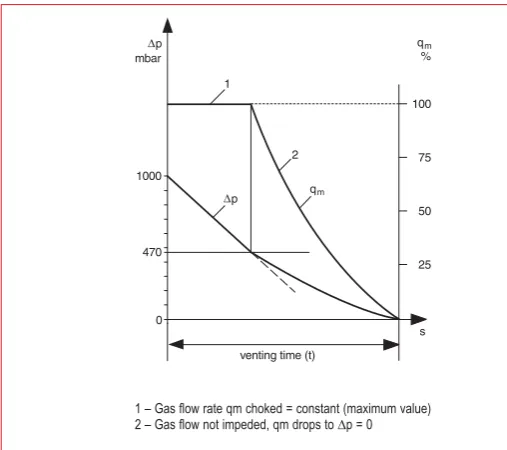
The phenomenon of choked flowmay also be observed in the viscous flow situation. It plays a part when venting and evacuating a vacuum vessel and where there are leaks.
Gas will always flow where there is a difference in pressure
Δp = (p1– p2) > 0. The intensity of the gas flow, i.e. the quantity of gas flowing over a period of time, rises with the pressure differential. In the case of viscous flow, however, this will be the case only until the flow velocity, which also rises, reaches the speed of sound. This is always the case at a certain pressure differential and this value may be characterized as “criti-cal”:
(1.22)
A further rise in Δp > Δpcritwould not result in any further rise in gas flow; any increase is inhibited. For air at 20,°C the gas dynamics theory reveals a critical value of
(1.23)
The chart in Fig. 1.1 represents schematically the venting (or airing) of an evacuated container through an opening in the envelope (venting valve), allowing ambient air at p = 1000 mbar to enter. In accordance with the infor-mation given above, the resultant critical pressure is
Δpcrit= 1000 ⋅(1– 0.528) mbar ≈ 470 mbar; i.e. where Δp > 470 mbar the flow rate will be choked; where Δp < 470 mbar the gas flow will decline.
p
p
crit2
1
0528
⎛ ⎝
⎜ ⎞⎠⎟
= .
Δ
p
p
p
p
crit
crit
=
−⎛ ⎝⎜ ⎞⎠⎟
⎡ ⎣
⎢ ⎤
⎦ ⎥
1 2
1
1
Molecular flow
Molecular flow prevails in the high and ultrahigh vacuum ranges. In these regimes the molecules can move freely, without any mutual interference. Molecular flow is present where the mean free path length for a particle is very much larger than the diameter of the pipe:
λ
>> d.Knudsen flow
The transitional range between viscous flow and molecular flow is known as Knudsen flow. It is prevalent in the medium vacuum range:
λ
≈ d.The product of pressure p and pipe diameter d for a particular gas at a cer-tain temperature can serve as a characterizing quantity for the various types of flow. Using the numerical values provided in Table III, Chapter 9, the following equivalent relationships exist for air at 20 °C:
Rough vacuum – Viscous flow
⇔
p ⋅d > 6.0 ⋅10–1mbar ⋅cmMedium vacuum – Knudsen flow
⇔
⇔
6 ⋅10–1> p ⋅d > 1.3 ⋅10–2mbar ⋅cmHigh and ultrahigh vacuum – Molecular flow
⇔
p ⋅d < 1.3 ⋅10–2mbar ≠cmIn the viscous flow range the preferred speed direction for all the gas mole-cules will be identical to the macroscopic direction of flow for the gas. This alignment is compelled by the fact that the gas particles are densely packed and will collide with one another far more often than with the boundary walls of the apparatus. The macroscopic speed of the gas is a
λ >
d
2
d
d
100
< <
λ
2
λ <
100
d
Vacuum physics
Δp mbar
qm
%
1
2
1000
qm Δp
470
0
25 50 75 100
s
venting time (t)
Fig. 1.1 Schematic representation of venting an evacuated vessel
“group velocity” and is not identical with the “thermal velocity” of the gas molecules.
In the molecular flow range, on the other hand, impact of the particles with the walls predominates. As a result of reflection (but also of desorption fol-lowing a certain residence period on the container walls) a gas particle can move in any arbitrary direction in a high vacuum; it is no longer possible to speak of ”flow” in the macroscopic sense.
It would make little sense to attempt to determine the vacuum pressure ranges as a function of the geometric operating situation in each case. The limits for the individual pressure regimes (see Table IX in Chapter 9) were selected in such a way that when working with normal-sized laboratory equipment the collisions of the gas particles among each other will predom-inate in the rough vacuum range whereas in the high and ultrahigh vacuum ranges impact of the gas particles on the container walls will predominate. In the high and ultrahigh vacuum ranges the properties of the vacuum con-tainer wall will be of decisive importance since below 10–3mbar there will be more gas molecules on the surfaces than in the chamber itself. If one assumes a monomolecular adsorbed layer on the inside wall of an evacuat-ed sphere with 1 l volume, then the ratio of the number of
adsorbed particles to the number of free molecules in the space will be as follows:
at 1 mbar 10–2
at 10–6 mbar 10+4 at 10–11 mbar 10+9
For this reason the monolayer formation time τ(see Section 1.1) is used to characterize ultrahigh vacuum and to distinguish this regime from the high vacuum range. The monolayer formation time τis only a fraction of a sec-ond in the high vacuum range while in the ultrahigh vacuum range it extends over a period of minutes or hours. Surfaces free of gases can therefore be achieved (and maintained over longer periods of time) only under ultrahigh vacuum conditions.
Further physical properties change as pressure changes. For example, the thermal conductivity and the internal friction of gases in the medium vacu-um range are highly sensitive to pressure. In the rough and high vacuvacu-um regimes, in contrast, these two properties are virtually independent of pres-sure.
Thus, not only will the pumps needed to achieve these pressures in the various vacuum ranges differ, but also different vacuum gauges will be required. A clear arrangement of pumps and measurement instruments for the individual pressure ranges is shown in Figures 9.16 and 9.16a in Chapter 9.
1.5.2 Calculating conductance values
The effective pumping speed required to evacuate a vessel or to carry out a process inside a vacuum system will correspond to the inlet speed of a particular pump (or the pump system) only if the pump is joined directly to the vessel or system. Practically speaking, this is possible only in rare situ-ations. It is almost always necessary to include an intermediate piping sys-tem comprising valves, separators, cold traps and the like. All this
Vacuum physics
represents an resistance to flow, the consequence of which is that the effective pumping speed Seffis always less than the pumping speed S of the pump or the pumping system alone. Thus to ensure a certain effective pumping speed at the vacuum vessel it is necessary to select a pump with greater pumping speed. The correlation between S and Seffis indicated by the following basic equation:
(1.24)
Here C is the total conductance value for the pipe system, made up of the individual values for the various components which are connected in series (valves, baffles, separators, etc.):
(1.25)
Equation (1.24) tells us that only in the situation where C = ∞(meaning that the flow resistance is equal to 0) will S = Seff. A number of helpful equations is available to the vacuum technologist for calculating the con-ductance value C for piping sections. The concon-ductance values for valves, cold traps, separators and vapor barriers will, as a rule, have to be determined empirically.
It should be noted that in general that the conductance in a vacuum com-ponent is not a constant value which is independent of prevailing vacuum levels, but rather depends strongly on the nature of the flow (continuum or molecular flow; see below) and thus on pressure. When using conductance indices in vacuum technology calculations, therefore, it is always necessary to pay attention to the fact that only the conductance values applicable to a certain pressure regime may be applied in that regime.
1.5.3 Conductance for piping and orifices
Conductance values will depend not only on the pressure and the nature of the gas which is flowing, but also on the sectional shape of the conducting element (e.g. circular or elliptical cross section). Other factors are the length and whether the element is straight or curved. The result is that vari-ous equations are required to take into account practical situations. Each of these equations is valid only for a particular pressure range. This is always to be considered in calculations.
a) Conductance for a straight pipe, which is not too short, of length l, with a circular cross section of diameter d for the laminar, Knudsen and mol-ecular flow ranges, valid for air at 20 °C (Knudsen equation):
(1.26) where
d = Pipe inside diameter in cm l = Pipe length in cm (l ≥ 10 d)
p1 = Pressure at start of pipe (along the direction of flow) in mbar p2 = Pressure at end of pipe (along the direction of flow) in mbar
p
=
p
1+
p
22
C
d
l
p
=
135
+
4
d
l
d p
d p
s
·
+
· ·
+
· ·
12 1
1 192
1 237
3
.
/
1 1 1 1 1
1 2 3
C C C C Cn
= + + + . . .
1
1
1
Vacuum physics
If one rewrites the second term in (1.26) in the following form
(1.26a)
with
(1.27)
it is possible to derive the two important limits from the course of the func-tion f (d ·
p
–):Limit for laminar flow
(d ·–
p
> 6 ·10–1mbar ·cm):(1.28a)
Limit for molecular flow
(d ·p–< 10–2mbar ·cm) :
(1.28b)
In the molecular flow region the conductance value is independent of pressure!
The complete Knudsen equation (1.26) will have to be used in the transi-tional area 10–2< d ·p–< 6 ·10–1mbar ·cm. Conductance values for straight pipes of standard nominal diameters are shown in Figure 9.5 (lami-nar flow) and Figure 9.6 (molecular flow) in Chapter 9. Additional nomo-grams for conductance determination will also be found in Chapter 9 (Figures 9.8 and 9.9).
b) Conductance value C for an orifice A
(A in cm2): For continuum flow (viscous flow) the following equations (after Prandtl) apply to air at 20 °C where p2/p1= δ:
C
d
l
s
=
12 1
·
3
.
/
C
d
l
p
s
=
135
·
·
4
/
( )f d p d p d p
d p
· = + · · + · · ·
+ · ·
1 203 2 10
1 237
3 2 2
.78
(
)
C
d
l
f d p
=
12 1
·
·
·
3
.
for δ≥ 0.528 (1.29)
for δ≤ 0.528 (1.29a)
and for δ≤ 0,03 (1.29b)
δ= 0.528 is the critical pressure situation for air
Flow is choked at δ< 0.528; gas flow is thus constant. In the case of mole-cular flow (high vacuum) the following will apply for air:
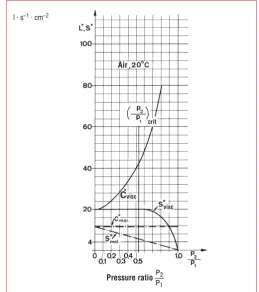
Cmol = 11,6 ·A·l ·s-1 (A in cm2) (1.30) Given in addition in Figure 1.3 are the pumping speeds S*viscand S*mol refer-enced to the area A of the opening and as a function of δ = p2/p1. The equations given apply to air at 20 °C. The molar masses for the flowing gas are taken into consideration in the general equations, not shown here.
p p
crit 2
1
⎛ ⎝
⎜ ⎞
⎠ ⎟
C
A
s
visc
=
20
·
C
A
s
visc
=
20
·
1
−
δ
C A
s
visc=76 6. ·δ0.712· 1−δ0.288·1−δ
Fig. 1.2 Flow of a gas through an opening (A) at high pressures (viscous flow) Fig. 1.3 Conductance values relative to the area, C*visc, C*mol, and pumping speed S*viscand S*molfor an orifice A, depending on the pressure relationship p2/p1for air at 20 °C.
Vacuum physics
When working with other gases it will be necessary to multiply the conduc-tance values specified for air by the factors shown in Table 1.1.
Nomographic determination of conductance values
The conductance values for piping and openings through which air and other gases pass can be determined with nomographic methods. It is pos-sible not only to determine the conductance value for piping at specified values for diameter, length and pressure, but also the size of the pipe diam-eter required when a pumping set is to achieve a certain effective pumping speed at a given pressure and given length of the line. It is also possible to establish the maximum permissible pipe length where the other parameters are known. The values obtained naturally do not apply to turbulent flows. In doubtful situations, the Reynolds number Re (see Section 1.5.) should be estimated using the relationship which is approximated below
(1.31)
Here qpV= S ·p is the flow output in mbar l/s, d the diameter of the pipe in cm.
A compilation of nomograms which have proved to be useful in practice will be found in Chapter 9.
1.5.4 Conductance values for other elements
Where the line contains elbows or other curves (such as in right-angle valves), these can be taken into account by assuming a greater effective length leffof the line. This can be estimated as follows:
(1.32)
Where
laxial : axial length of the line (in cm) leff : Effective length of the line (in cm) d : Inside diameter of the line (in cm) θ : Angle of the elbow (degrees of angle)
leff=laxial+ · d
°· 133
180
. θ
Re =
15
·
q
d
pV
The technical data in the Leybold catalog states the conductance values for vapor barriers, cold traps, adsorption traps and valves for the molecular flow range. At higher pressures, e.g. in the Knudsen and laminar flow ranges, valves will have about the same conductance values as pipes of corresponding nominal diameters and axial lengths. In regard to right-angle valves the conductance calculation for an elbow must be applied. In the case of dust filters which are used to protect gas ballast pumps and roots pumps, the percentage restriction value for the various pressure lev-els are listed in the catalog. Other components, namely the condensate separators and condensers, are designed so that they will not reduce pumping speed to any appreciable extent.
The following may be used as a rule of thumb for dimensioning vacuum lines: The lines should be as short and as wide as possible.They must exhibit at least the same cross-section as the intake port at the pump. If particular circumstances prevent shortening the suction line, then it is advisable, whenever this is justifiable from the engineering and economic points of view, to include a roots pump in the suction line. This then acts as a gas entrainment pump which reduces line impedance.
Table 1.1 Conversion factors (see text)
Gas (20 °C) Molecular flow Laminar flow
Air 1.00 1.00
Oxygen 0.947 0.91
Neon 1.013 1.05
Helium 2.64 0.92
Hydrogen 3.77 2.07
Carbon dioxide 0.808 1.26
Water vapor 1.263 1.73
2.
Vacuum generation
2.1.
Vacuum pumps: A survey
Vacuum pumps are used to reduce the gas pressure in a certain volume and thus the gas density (see equation 1.5). Consequently consider the gas particles need to be removed from the volume. Basically differentiation is made between two classes of vacuum pumps:
a) Vacuum pumps where – via one or several compression stages – the gas particles are removed from the volume which is to be pumped and ejected into the atmosphere (compression pumps). The gas particles are pumped by means of displacement or pulse transfer.
b) Vacuum pumps where the gas particles which are to be removed condense on or are bonded by other means (e.g. chemically) to a solid surface, which often is part of the boundary forming volume itself. A classification which is more in line with the state-of-the-art and practical applications makes a difference between the following types of pumps, of
which the first three classes belong to the compression pumps and where the two remaining classes belong to the condensation and getter pumps: 1. Pumps which operate with periodically increasing and decreasing pump
cham-ber volumes (rotary vane and rotary plunger pumps; also trochoid pumps)
2. Pumps which transport quantities of gas from the low pressure side to the high pressure side without changing the volume of the pumping chamber (Roots pumps, turbomolecular pumps)
3. Pumps where the pumping effect is based mainly on the diffusion of gases into a gas-free high speed vapor jet (vapor pumps)
4. Pumps which pump vapors by means of condensation (condensers) and pumps which pump permanent gases by way of condensation at very low temperatures (cryopumps)
5. Pumps which bond or incorporate gases by adsorption or absorption to surfaces which are substantially free of gases (sorption pumps). A survey on these classes of vacuum pumps is given in the diagram of Table 2.1.
Vacuum generation
Adsorption pump Fluid entrainment
vacuum pump
Ejector vacuum pump
Liquid jet vacuum pump
Gas jet vacuum pump
Vapor jet vacuum pump
Diffusion pump
Self-purifying diffusion pump
Fractionating diffusion pump
Diffusion ejector pump Drag
vacuum pump
Gaseous ring vacuum pump
Turbine vacuum pump
Axial flow vacuum pump
Radial flow vacuum pump
Molecular drag vacuum pump
Turbomolecular pump Rotary
vacuum pump
Liquid sealed vacuum pump
Liquid ring vacuum pump
Rotary vane vacuum pump
Multiple vane vacuum pump
Rotary piston vacuum pump
Rotary plunger vacuum pump
Dry compressing vacuum pump
Roots vacuum pump
Claw vacuum pump
Scroll pump Reciprocating
positive displacement vacuum pump
Diaphragm vacuum pump
Piston vacuum pump
Ion transfer vacuum pump
Getter pump
Bulk getter pump
Sublimation pump
Getter ion pump
Evaporation ion pump
Sputter-ion pump
Cryopump
Condenser
Vacuum pump (Operating principle)
Kinetic vacuum pump Gas transfer
vacuum pump Positive displacement
vacuum pump
Entrapment vacuum pump
Vacuum generation
2.1.1 Oscillation displacement vacuum pumps
2.1.1.1 Diaphragm pumps
Recently, diaphragm pumps have becoming ever more important, mainly for environmental reasons. They are alternatives to water jet vacuum pumps, since diaphragm pumps do not produce any waste water. Overall, a diaphragm vacuum pump can save up to 90 % of the operating costs compared to a water jet pump. Compared to rotary vane pumps, the pumping chamber of diaphragm pumps are entirely free of oil. By design, no oil immersed shaft seals are required. Diaphragm vacuum pumps are single or multi-stage dry compressing vacuum pumps (diaphragm pumps having up to four stages are being manufactured). Here the circumference of a diaphragm is tensioned between a pump head and the casing wall (Fig. 2.1). It is moved in an oscillating way by means of a connecting rod and an eccentric. The pumping or compression chamber, the volume of which increases and decreases periodically, effects the pumping action. The valves are arranged in such a way that during the phase where the volume of the pumping chamber increases it is open to the intake line. During compression, the pumping chamber is linked to the exhaust line. The diaphragm provides a hermetic seal between the gear chamber and the pumping chamber so that it remains free of oil and lubricants (dry compressing vacuum pump). Diaphragm and valves are the only components in contact with the medium which is to be pumped. When coating the diaphragm with PTFE (Teflon) and when manufacturing the inlet and exhaust valves of a highly fluorinated elastomer as in the case of the DIVAC from LEYBOLD, it is then possible to pump aggressive vapors and gases. It is thus well suited for vacuum applications in the chemistry lab. Due to the limited elastic deformability of the diaphragm only a
comparatively low pumping speed is obtained. In the case of this pumping principle a volume remains at the upper dead center – the so called “dead space” – from where the gases can not be moved to the exhaust line. The quantity of gas which remains at the exhaust pressure expands into the
expanding pumping chamber during the subsequent suction stroke thereby filling it, so that as the intake pressure reduces the quantity of inflowing new gas reduces more and more. Thus volumetric efficiency worsens
continuously for this reason. Diaphragm vacuum pumps are not capable of attaining a higher compression ratio than the ratio between “dead space” and maximum volume of the pumping chamber. In the case of single-stage diaphragm vacuum pumps the attainable ultimate pressure amounts to approximately 80 mbar. Two-stage pumps such as the DIVAC from LEYBOLD can attain about 10 mbar (see Fig. 2.2), three-stage pumps can attain about 2 mbar and four-stage diaphragm pumps can reach about 5·10-1mbar.
Diaphragm pumps offering such a low ultimate pressure are suited as backing pumps for turbomolecular pumps with fully integrated Scroll stages (compound or wide range turbomolecular pumps, such as the
TURBOVAC 55 from LEYBOLD). In this way a pump system is obtained which is absolutely free of oil, this being of great importance to
measurement arrangements involving mass spectrometer systems and leak detectors. In contrast to rotary vane pumps this combination of pumps for leak detectors offers the advantage that naturally no helium is dissolved in the diaphragm pump thereby entirely avoiding a possible build up of a helium background.
2.1.2 Liquid sealed rotary displacement pumps
2.1.2.1 Liquid ring pumps
Due to the pumping principle and the simple design, liquid ring vacuum pumps are particularly suited to pumping gases and vapors which may also contain small amounts of liquid. Air, saturated with water vapors or other gases containing condensable constituents, may be pumped without problems. By design, liquid ring pumps are insensitive to any contamination
(1) Casing lid (2) Valves (3) Lid (4) Diaphragm disk
(5) Diaphragm (6) Diaphragm support disk (7) Connecting rod (8) Eccentric disk
Fig. 2.1 Schematic on the design of a diaphragm pump stage (Vacuubrand) Fig. 2.2 Principle of operation for a two-stage diaphragm pump (Vacuubrand) Opening and closing of the valves, path and pumping mechanism during four subsequent phases of a turn of the connecting rod (a-d)
a )
b)
c )
d)
1st stage 2nd stage
which may be present in the gas flow. The attainable intake pressures are in the region between atmospheric pressure and the vapor pressure of the operating liquid used. For water at 15 °C it is possible to attain an operating pressure of 33 mbar. A typical application of water ring vacuum pumps is venting of steam turbines in power plants. Liquid ring vacuum pumps (Fig. 2.3) are rotary displacement pumps which require an operating liquid which rotates during operation to pump the gas. The blade wheel is arranged eccentrically in a cylindrical casing. When not in operation, approximately half of the pump is filled with the operating fluid. In the axial direction the cells formed by the blade wheel are limited and sealed off by “control discs�