Journal of Applied Linguistics and Language Research Volume 3, Issue 3, 2016, pp. 278-289
Available online at www.jallr.com ISSN: 2376-760X
* Correspondence: Shahriar Sarvari, Email: [email protected] © 2016 Journal of Applied Linguistics and Language Research
Teaching Collocations:
Further Developments in L2 Speaking Fluency
Shahriar Sarvari *
Science and Research University, Guilan branch, Iran Alieh Hematzadeh Gukani Science and Research University, Guilan branch, Iran
Hananeh Yousefi Khomami Payam-e-Noor University, Rasht, Iran
Abstract
The current study aimed at investigating teaching collocations and its effect on further developments in speaking fluency. To achieve this, a total number of 60 EFL learners who were learning English at a language institute in Talesh served as sampling. A Michigan Test of English Language Proficiency (1997) was used to ensure the homogeneity of the participants. That is, those language learners who met the selection criterion, i.e., performed one standard deviation above and below the mean on the proficiency test were divided into two classes (N=38). Then, they were randomly divided into two groups: one experimental group (N=19) and one control group (N=19). Participants in experimental group were provided with teaching collocations; however, the control group underwent traditional instruction of lexical items. It was assumed that teaching collocations is an efficient way to improve the learner’s language speaking fluency. After 12 weeks of treatment, an IELTS speaking task was given to the both groups and an independent t test was used to compare means of test scores between groups. Results indicated that the experimental group outperformed the control group, i.e., collocation instruction was an effective approach for further improvement of EFL learners’ speaking fluency.
Keywords: collocation, speaking fluency, instruction
INTRODUCTION
emphasis because they were considered the first point in the learning process. However, over the past few decades, more emphasis was placed on vocabulary teaching and learning which in turn led to development of Lexical Approach in 1994 by Lewis. As a result of the growing interest in vocabulary teaching by researchers, various techniques and strategies were suggested for learning and teaching the forms of a target language. Researchers started testing and evaluating these techniques in order to reach the best results in the process of language learning and as a result a growing body of literature now addresses lexical acquisition. Nowadays, it is observed that "vocabulary is an essential element of every second/ foreign language teaching and learning program" (Csomay & Petrović, 2012, p.305). Moreover, it has been observed by components of the lexical approach that “the building blocks of language learning and communication are not grammar, functions, notions, or some other unit of planning and teaching but lexis, that is, word and word combinations” (Richards & Rodgers, p.132). They also argue that “the meaning of a word is determined by the co-occurring words. Consequently, lexis is considered to be independent and separable from grammar. Thus, a part of the meaning of a word is the fact that it collocates with another word” (Martyńska, 2004, p.1).
Collocation in linguistic theory was highlighted first by Firth. Other researchers (e.g. Sinclair and Halliday) expanded the Firth’s concepts. Since then the pedagogical value of collocation was recognized and it was incorporated into EFL dictionaries. This, in turn, has fed back into language pedagogy, and is influencing teaching and translation (Krishnamurthy, 2006). Collocations are “linguistic phenomena that occur when two or more words appear together more often than by chance and whose meaning often cannot be inferred from the meanings of its parts” (Petrović, Šnajder & Bašić, 2010 p.383) which are “arbitrary by nature and problematic to L2 learners” (Fan, 2009, p.383). For example, which prepositions are used with particular verbs, or which verbs and nouns are typically used together. An example of this is the collocation tall man. While the same meaning could be conveyed through the approximately equivalent *high man, the fact is that a man is thought of being tall rather than high. A similar observation holds for high wall, which is preferred over *tall wall.
It should be noticed that collocations are examples of lexical units. They should not be confused with idioms although both are similar in that there is a degree of meaning present in the collocation or idiom that is not entirely compositional. In effect, collocations are mostly compositional while with idioms the meaning is completely non-compositional. A collocation consists of two parts: (1) a pivot word which is the central one in the collocation, (2) collocate(s) of that word, i.e., the word or words accompanying the pivot word (Shin & Nation, 2008).
The BBI Combinatory Dictionary of English: A Guide to Word Combinations (Benson, Benson, and Ilson, 1986) classifies lexical collocations by structural types:
(3) noun + verb
(4) noun1 + of + noun2 (5) adverb + adjective (6) verb + adverb
Many errors by L2 learners may stem from a difference between collocational patterns in the L1 and the language that they are struggling to learn; and the extent to which learners commit errors depends on the extent that there are such differences between L1 and L2 (Sadeghi, 2009). Therefore, in contexts like this, learners either avoid lexical collocations and use only the limited number of them (Paribakht, 2005; Wu, 1996) or “under the influence of their first language “create” unnatural and farfetched collocations” (Wu, 1996, p.469).
There are many reasons that indicate teaching and learning collocations is absolutely crucial to language learners: (1) collocations play a significant role in communicative competence (Sadeghi, 2009), (2) collocations “cannot be spontaneously acquired” (Wu, 1996, p.469), (3) teaching collocations help “reduce negative transfer” (Kuo, 2009, p.152), (4) in collocations “words are learned and used in context” (Sadeghi, 2009, p.104), (5) competency in using collocations leads to a decrease in language learners’ anxiety (Kuo, 2009), and (6) collocation can be used to solve lexical ambiguities (Leffa, 1998), (7) knowing how words combine into chunks (collocation) is necessary since if words are not learned in chunks, learners will not be able to achieve the native-like level of proficiency (Martyńska, 2004), (8) if learners are not familiar with collocations, they can only generate awkward sentences with traces of native-language interference (Wu, 1996),(9) since most EFL learners only learn the definitions of English words, their passive vocabulary cannot be easily reconstructed into acceptable chunks or natural and meaningful sentences. Lexical collocation is “one way to make passive vocabulary active” (Wu, 1996, p.468), (10) collocations are a major issue for advanced students in the production of correct English (Bahns & Eldaw, 1993).
approach could reduce much of lexical collocations' teaching and learning load. The teaching of lexical collocations in EFL should concentrate on items for which there is no direct translational equivalence in English and in the learners’ respective mother tongues. In fact, contrastive analysis of lexical collocations simplifies the teaching of collocations. Materials writers should bear in mind that “it will not be advisable to have the same selection of collocations for all learners of English as a Foreign Language. The collocations chosen for inclusion in such material will have to be different in each case, depending on the L1 of the learners” (Bahns, 1993, p.61).
Bahns (1993) also believes that “one of the main obstacles to teaching lexical collocations systematically, however, is their number, which amounts to tens of thousands” (p. 56). Although the reliable learners’ dictionaries are the popular tools for many learners, most learners’ dictionaries are unsatisfactory regarding finding lexical collocations (Bahns, 1993; Wu, 1996). Even though “the collocations are listed in the dictionaries, they are often ‘hidden’ under improper entries so that users can’t track them down easily” (Wu, 1996, p. 470). Another key issue on English learners’ part is that there are no rules regarding collocation that can be learned. The native English speaker intuitively makes the correct collocation. However, intuition is not effective enough to make learners aware of collocations of lexical items. It should be also kept in mind that “the overgeneralization of collocational range is quite risky” (Wu, 1996, p. 469). In fact, issues regarding collocations decrease when learners learn English consciously or unconsciously (Sadeghi, 2009).
Frequency in the language is another important criterion for selecting what to focus on in collocations studies. Collocations are stored in the mental lexicon and accessed holistically. The mechanism which determines the constituency is the frequency with which items occur together in natural, connected speech, that is, the collocational frequency (Sosa & MacFarlane, 2002). To Sadeghi (2009) “the immediate implication is a need for beginning learners consciously to learn high-frequency collocations and for intermediate and advanced EFL learners to learn less frequent ones (in addition to highly frequent ones)” (p.116). However, “it is only one of several important criteria that learners need” (Shin & Nation, 2008, p. 346). Other factors include “range of use, difficulty, teachability, and suitability for the age and background of the learners” (ibid). The study of collocations can reveal the different senses of a word and show how it may be associated with a particular semantic prosody. By studying the collocations associated with a group of so-called synonyms it is often possible to identify slight but significant differences in the meaning of the words in the group (Walker, 2011). This was investigated in a study by Mansoory and Jafarpour (2014), where prosodic variations among near synonyms were studied and their influence on word choice appropriateness was put into test.
beginning, learners’ attention should be invited to collocations and learners should be constantly familiar with a growing number of collocations (Martyńska, 2004).
Many teachers and learners now are interested in collocations since “collocations help learners’ language use, both with the development of fluency and native-like selection” (Shin & Nation, 2008, p.340). Errors due to inappropriate use “of lexical collocations make both oral and written communication difficult” (Wu, 1996, p.468), and learning collocations results in higher precision, accuracy, coherence/fluency and authenticity of speech. Therefore, collocation instruction tends to be “a perfect way to fluency and proficiency in the language as well as to greater language competence” (Martyńska, 2004, p.11). Several studies have investigated the relations between collocations and different aspects of language: many studies have focused on the relations between collocations and English for specific purposes (ESP) (e.g. Gledhill, 2011), and collocations and English for academic purposes (EAP) (e.g. Charles, 2012), collocations and cross-disciplinary context (Durrant, 2009), the study of collocations of high frequency words in medical abstracts and articles and their relation with prototypical phraseology of the genre (Gledhill, 2000), collocation and speaking (e.g. Tim Hsu & Chiu, 2008), and collocation and writing ability (e.g. Hsu, 2007). Moreover, Hsu (2007) found a strong relationship between the frequency of lexical collocations and online writing fluency. In addition, the damaging effect of the lack of collocational competence is more evident in L2 learners’ production (Wu, 1996). However, the relation between collocation and speaking fluency has been largely overlooked. Therefore, the current study attempts to fill the gap and supplement the existing studies.
Fluency, which is defined as “the production of language in real time without undue pausing or hesitation”, can be measured. It requires an investigation of temporal factors such as rate of production, the number and length of pauses (Ellis & Barkhuizen, 2005).To make a reliable and valid assessment of fluency, rubrics are necessary. A rubric can be defined as a scoring scale used to evaluate student performance, which is composed of at least two criteria by which student work is to be judged on a specific task and at least two levels of performance for each criterion (Mueller, 2006).
Therefore, the purpose of this study is to investigate the impact of teaching collocations in fostering learners' speaking fluency in an EFL context. Therefore, the research hypothesis is as follows:
Teaching collocation has a significant effect on the improvement of EFL learners' speaking fluency.
METHOD
Participants
group. Their ages were 16 to 26. All participants were male students and gender is not considered as a moderator variable in this study.
The students’ native language was Persian, and they were learning English as a foreign language. They had already studied English for 7 to 9 years, with a mean of 8 years. Classes were held three times per week and each session took 75 minutes. English is the medium of instruction in these classes.
Materials
At the beginning of the study, a Michigan Test of English Language Proficiency (1997) was administrated to assess the participants' level of language proficiency. The validity and reliability of the test were already presupposed. The reliability of the proficiency test was reported to be 0.89, which was estimated through Kuder and Richardson 21 formula (KR-21).
For treatment, passages 2 (Richards, 2008), the book that they were taught as their course book, and Oxford Collocations Dictionary as a complementary book were selected.
Speaking Scoring rubric
The modified version of IELTS Speaking band descriptors (public version) University of Cambridge as a fluency scoring rubric was used in this study, which consisted of 4 subscales: fluency and coherence, lexical resource [twice], and pronunciation, each with 10 levels or bands, of which fluency was the subject to the study (See appendix A). Since both groups were required to take IELTS-like speaking test, validity of the test was established. To establish test reliability, two collogues were asked to rate the learners speaking fluency. Each rater gave a score to each student' fluency; the mean score of these 2raterswas considered the student' final score. It is worth mentioning that rating process was done after recording the learners’ speech according to the revised scoring rubric.
Treatment
these two groups was that in treatment group the focus was on teaching collocations while other parts of the book were taught, too.
The classes were held three times a week for 12 weeks (2 semesters) and each session took 75 minutes. In both groups the teacher (also researcher) was the same.
Procedure
Before the study, students in both groups read a consent form that explained the purpose of the study and they agreed to participate. Following the proficiency tests, students filled out a questionnaire on which they record their age and gender, etc. Students take the IELTS fluency test after 12 weeks of treatment.
At the outset of the study, a Michigan Test of English Language Proficiency (1997) was administrated to assess the participants' level of language proficiency and in order to choose homogenous students. Out of 60 participants who took the test, those who performed about one standard deviation above and below the mean on the test (N:38) were chosen as homogeneous students. In the next step, and after a time period of 3 months, the speaking fluency test was administered to the target groups.
The technique used to elicit speaking was the speaking tests of IELTS. To achieve this, the IELTS-like speaking tests were adopted from The Speaking Test of IELTS (Ramezanee & Hakimi, 2004). The IELTS speaking test is 11-14 minutes long and is in three parts. Learners have a discussion with a certified examiner. It is a one-to-one interaction and close to a real-life situation. In part one, learners answered general questions about themselves and their family. It normally took 4-5 minutes. The second part began with a verbal prompt. The verbal prompt or written input was in the form of a general instruction on a cue card. Learners had only one minute to prepare themselves. They were allowed to make notes and jot down some key points to help themselves relate the main ideas while they were speaking. After a one-minute preparation time, they delivered a speech about the topic. This part took 3-4 minutes. In part 3, learners had a longer discussion of more abstract issues and concepts that were thematically linked to the topic introduced in part 2. It required interactions between the tester and the learners. This part usually took between 4-5 minutes. The whole testing session was recorded for further analysis.
The recordings of their speech were checked based on a rubric by two raters who were familiar with the scoring rubrics. Each rater gave a separate score to the learners’ fluency using the rubric. The scores ranged from 0 to 10, corresponding to IELTS score bands. Moreover, the inter-rater reliability was checked. The correlation between the two raters was examined through running a Pearson correlation to the scores of fluency test.
Data Analyses
group, t test was used. All of the assumptions for this statistic were met. In this calculation, the null hypothesis of no difference within group means was chosen. The alpha level was set to .05
RESULTS
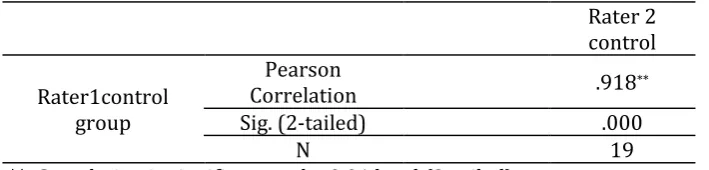
The measure of inter-rater reliability for the two raters is reported in Tables1 and 2. The Pearson correlation provides the overall agreement of the two raters. The inter rater reliability measured by the Pearson correlation for the experimental and control groups’ fluency scores were 0.921 and 0.918 respectively which were considered to be acceptable.
Table 1. Inter rater Correlation for the fluency test scores of the experimental group
Rater 2 experimental
Rater1 experimental group
Pearson
Correlation .921**
Sig. (2-tailed) .000
N 19
**. Correlation is significant at the 0.01 level (2-tailed).
Table 2. Inter rater Correlation for the fluency test scores of the control group
Rater 2 control
Rater1control group
Pearson
Correlation .918**
Sig. (2-tailed) .000
N 19
**. Correlation is significant at the 0.01 level (2-tailed).
As the tables of inter rater-correlation show, there was a strong correlation between the two raters’ scores for the speaking fluency test of the two groups (p ≤.05). Given the similarity of ratings by the two raters, the average of the two raters’ scores was used as the respondent's final speaking fluency score.
Descriptive statistics for fluency test score, for both groups, are presented in Table 3. The means on fluency test scores for control and experimental groups are 6.026 and 6.658, respectively. Similar differences in sum scores were also found. There was a small difference in the standard deviation (SD) (0.8575 and 0.6466). The two distributions had neither significant skewness nor kurtosis problems.
Table 3. Descriptive statistics of fluency test scores (experimental & control groups)
N Range Sum Mean SD Skewness Kurtosis
Statistic Statistic Statistic Statistic Error Std. Statistic Statistic Error Std. Statistic Error Std.
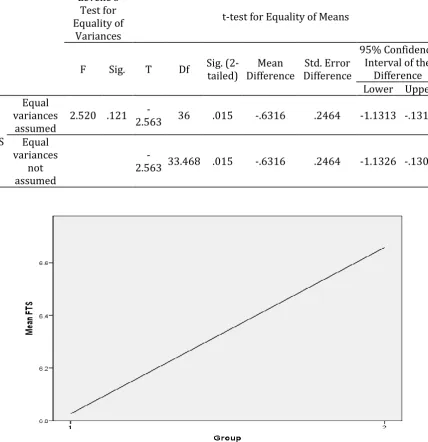
Table 4 shows the result of an independent t test of fluency test scores between control and experimental groups (M = -.6316, at a 95% confidence). It shows that the difference is statistically significant, t (36) = -2.563, at p < .05, 2-tailed. Therefore, the hypothesis of the study is confirmed. That is, the average difference of -.6316 between fluency test scores of control and experimental groups was statistically significant. This suggests that the students in experimental group outperformed control group in speaking fluency to a statistically significant degree in the 12-week period, during which they engaged in further learning collocations.
Table 4. Independent samples test between experimental and control groups’ fluency test scores
Levene's Test for Equality of
Variances
t-test for Equality of Means
F Sig. T Df Sig. (2-tailed) Difference Mean Difference Std. Error
95% Confidence Interval of the
Difference Lower Upper
FTS
Equal variances
assumed
2.520 .121
-2.563 36 .015 -.6316 .2464 -1.1313 -.1319
Equal variances
not assumed
-2.563 33.468 .015 -.6316 .2464 -1.1326 -.1305
DISCUSSION AND CONCLUSION
The results of the study indicated that experimental group significantly outperformed control group in terms of speaking fluency. That is, collocation instruction had a significant effect on the learners’ speaking fluency. Therefore, the results of the present study supported the research hypothesis that the learners’ speaking fluency would improve better through collocation instruction. However, to appropriately address the results of the present study, they should be interpreted with caution.
The difference in the learners' knowledge of lexical depth between the groups is meaningful because the difference is large. Possible explanations for the differences between the groups’ performance may be found by considering the following two non-pedagogical factors: (a) participant expectancy, and (b) measurement issue. First, the learners in group B may have expected some improvement in their speaking fluency after the treatment because the purpose of the study was already explained to them. In addition, the consent form they read at the beginning of the study revealed the purpose of the study.
Second, the results could be different depending on the way they were measured. In this study, the modified version of IELTS Speaking band descriptors was used as a fluency scoring rubric and the learners’ average score assigned by two raters to their recorded speech was considered as a method for measuring speaking fluency. Since two raters, using scoring rubrics, scored the recordings; and since the correlation between two sets of scores was acceptable, attributing the experimental group’s improvement to the measuring method seems irrelevant.
IMPLICATIONS
The very first implication is that collocation instruction leads to further improvement in language speaking fluency and this improvement is meaningful. Therefore, teaching collocations should be incorporated into instructional curriculum.
The higher achievement of learners in experimental group could have several reasons. First, since collocated words are learned as prefabricated chunks, the learners produce them with shorter hesitation and less effort to find words or grammar. Secondly, since collocated pairs are well-paired, learners using collocations tend to be more coherent which itself helps to the fluency. Thirdly, since collocated words are longer than single words, using collocations helps speak at length which in turn leads to fluency.
Furthermore, since the study took around 3 months, it can be concluded that collocation instruction is effective in improving speaking fluency, in a long-term period. However, it does not reject the effect of the teaching collocation on speaking fluency in short term periods.
vocabulary should be taught with a heavy emphasis on collocations so that the speaking fluency of the learners is promoted.
Although the main interest of the study was in learners’ speaking fluency, after carful investigation of the recordings, both raters mentioned some other differences between groups: (1) pronunciation; the experimental group had more native-like pronunciation in comparison with control group. That might be due to the special combinations of two or more words as in collocations in English which apply specific pronunciation like hot tea compared with *worm tea, (2) intonation; the experimental group outperformed the control group in observing intonation patterns. This might be because of the fewer number of pauses in experimental group’s speech that in turn lead to less distinct foreign intonation patterns, (3) interference; the learners inthe experimental group displayed fewer traces of negative transfer since the collocations were learned as fixed expressions and learners did not have to rely on their L1 for finding appropriate collocates, which usually results in negative transfer, (4) synonym errors; since incorrectly collocated words are ones that are synonyms of the correct ones, the experimental group’s speech showed fewer synonym errors compared with the control group. Some other areas that were mentioned by only one of the rotors were accuracy and clear meaning. That is, the experimental group was clearer in getting the meaning across and was also more accurate.
REFERENCES
Bahns, J. (1993). Lexical collocations: a contrastive view. ELT Journal, 47 (1), 56–63. Bahns, J. & Eldaw, M. (1993).Should we teach EFL students collocations? System, 24 (1),
101-114.
Benson, M., Benson, E. & Ilson, R. (1986). The BBI Combinatory Dictionary of English: A Guide to Word Combinations. Amsterdam and Philadelphia: John Benjamins.
Charles, M. (2012). ‘Proper vocabulary and juicy collocations’: EAP students evaluate do-it-yourself corpus-building. English for Specific Purposes, 31(2), 93–102.
Csomay, E. & Petrović, M. (2012). "Yes, your honor!: A corpus-based study of technical vocabulary in discipline-related movies and TV shows. System, 40 (2), 305-315. Durrant, P. (2009). Investigating the viability of a collocation list for students of English
for academic purposes. English for Specific Purpose, 28 (3), 157-169.
Ellis, R., & Barkhuizen, G. (2005). Analyzing learner language. Oxford: Oxford University Press.
Fan, M. (2009). An exploratory study of collocational use by ESL students – A task based approach. System, 37, (1), 110-123.
Gledhill, Ch. (2000). The discourse function of collocation in research article introductions. English for Specific Purposes, 19 (2), 115-135.
Gledhill, Ch. (2011). The 'lexicogrammar' approach to analysing phraseology and collocation in ESP texts. La Revue du GERAS, 59, 5-23.
Krishnamurthy, R. (2006). Collocations. Encyclopedia of Language & Linguistics, 596-600.
Kuo, Ch. L. (2009). An analysis of the use of collocation by intermediate EFL college students in Taiwan. ARECLS, 6, 141-155.
Lea, D. (Ed.) (2002). Oxford Collocations Dictionary for Students of English. Oxford: Oxford University Press.
Leffa, J. V. (1998). Textual constraints in L2 lexical disambiguation. System, 26 (2), 183-194.
Mansoory, N. &Jafarpour, M. (2014).Teaching semantic prosody of English verbs through the DDL approach and its effect on learners’ vocabulary choice appropriateness in a Persian EFL context. Advances in Language and Literary Studies, 5 (2), 149-161.
Martyńska, M. (2004). Do English language learners know collocations? Investigationes Linguisticae, 11,1-12.
Mueller, J. (2006). Authentic assessment toolbox. Retrieved March 13, 2006, from http://jonathan.mueller.faculty.noctrl.edu/toolbox/index.htm
Paribakht, T. S. (2005). The Influence of first language lexicalization on second language Lexical inferencing: A study of Farsi-speaking learners of English as a foreign language. Language Learning, 55 (4), 701-748.
Petrović, S., Šnajder, J. & Bojana, B. D. (2010). Extending lexical association measures for collocation extraction. Computer Speech & Language, 24 (2), 383-394.
Ramezanee, A. & Hakimi, Kh. (2004).The Speaking Test of IELTS. Tehran: Rahnama Press.
Richards, J. C., Rodgers, T. C. (2001). Approaches and methods in language teaching (2ndEd). Cambridge: Cambridge University Press.
Richards, J. C.& Sandy, C. (2008). Passages (2nded.).Cambridge: Cambridge University Press.
Sadeghi, K.(2009). Collocational differences between L1and L2: Implications for EFL learners and teachers. TESL Canada Journal, 26 (2), 100-124.
Shin, D. & Nation, P. (2008). Beyond single words: the most frequent collocations in spoken English. ELT Journal, 62 (4), 339-348.
Sosa, A. V. & MacFarlane, J. (2002).Evidence for frequency-based constituents in the mental lexicon: collocations involving the word of. Brain and Language, 83 (2), 227-236.
Tim Hsu, J., & Chiu, C. (2008). Lexical collocations and their relation to speaking proficiency of college EFL learners in Taiwan. Asian EFL Journal, 10(1), 78-94. Walker, C. (2011). How a corpus-based study of the factors which influence collocation
can help in the teaching of business English. English for Specific Purposes, 30, 101-112.