Quality improvement initiative using
transcutaneous bilirubin nomogram to
decrease serum bilirubin sampling in
low-risk babies
Muhammad Hussain Shah,1 Shabina Ariff,1 Syed Rehan Ali,2
Rayaan Asad Chaudhry,1 Maryam Pyar Ali Lakhdir,3 Fatima Qaiser,4 Simon Demas,1 Ali Shabbir Hussain 1
To cite: Shah MH, Ariff S, Ali SR, et al. Quality improvement initiative using transcutaneous bilirubin nomogram to decrease serum bilirubin sampling in low-risk babies. BMJ Paediatrics Open 2019;3:e000403. doi:10.1136/ bmjpo-2018-000403
Received 2 November 2018 Revised 4 January 2019 Accepted 7 January 2019
1Department of Paediatrics and
Child Health, The Aga Khan University, Karachi, Pakistan 2The Indus Hospital, Karachi,
Pakistan
3Department of Community
Health Sciences, The Aga Khan University, Karachi, Pakistan 4Department of Pediatrics, Dow
University of Health Sciences, Karachi, Pakistan
Correspondence to
Dr Ali Shabbir Hussain, The Aga Khan University; ali. hussain@ aku. edu
© Author(s) (or their employer(s)) 2019. Re-use permitted under CC BY-NC. No commercial re-use. See rights and permissions. Published by BMJ.
AbstrACt
background Screening for neonatal hyperbilirubinaemia
in the postnatal ward has traditionally been performed using serum bilirubin sampling, but this has significant drawbacks such as risk of infection and slower reporting time.
Objective We aimed to assess the impact of introducing
transcutaneous bilirubin (TcBR) testing using TcBR nomogram on the number of serum bilirubin samples sent.
Methods A before-and-after study was performed
following the introduction of a protocol integrating the use of the Dragger JM-105 transcutaneous bilirubinometer in the postnatal ward. Only babies born at ≥37 weeks of gestation, weighing ≥2500 g who presented with jaundice after the first 24 hours and within the first 7 days of life were included in the study. The number of total serum bilirubin samples (TSBRs) sent were compared for the 6-month periods before and after (a total of 12 months) implementation of the new protocol.
results In the pre-implementation phase, a total of 882
(49%) out of 1815 babies had at least one serum bilirubin sample taken as opposed to a total of 236 (17%) out of 1394 babies in the post-implementation phase. The odds of performing TSBRs at least one time among babies in post-implementation phase were 79% lower than in pre-implementation phase (OR 0.21, 95% CI 0.18 to 0.25). We also estimated a significant cost saving of approximately US$1800 over a period of 6 months
Conclusion TcBR testing used in conjunction with our
proposed nomogram significantly reduces the need for serum bilirubin sampling.
IntrOduCtIOn
Jaundice in the neonatal period is a very common cause of concern for both parents and healthcare providers. Clinically, it is subjectively determined by an observer as a yellow discolouration of the skin or sclera. It usually presents after the first 24 hours of life and spontaneously resolves over the next few days. If jaundice remains unrecognised for a prolonged period of time, there is a high risk
of bilirubin-induced neurological dysfunc-tion and irreversible neurological damage.1
Traditionally, babies are screened using the Kramer’s Scale which divides the body into five different quadrants for rapid visual assessment of jaundice.2 Total serum
bili-rubin (TSBR) levels are done to confirm the diagnosis and commence treatment.3 This
not only leads to excessive blood sampling but also predisposes to infections and causes significant pain to the child. Obtaining blood samples also requires trained personnel and clinical expertise.4 Laboratory testing is also
expensive and time-consuming, which may cause delays in initiation of treatment.5
What is already known on this topic?
► Jaundice is a common newborn problem. Early rec-ognition and treatment play a key role in preventing bilirubin-induced neurological dysfunction.
► Transcutaneous bilirubin (TcBR) measurement provides a reliable screening tool for detection of neonatal jaundice; however, its widespread use in low- and lower middle-income countries is still limited.
► Significant differences in TcBR nomogram exist across populations based on ethnicity, race and bil-irubin kinetics.
What this study hopes to add?
► A TcBR measurement protocol that significantly re-duces serum sampling in healthy, full-term and low-risk babies.
► A TcBR nomogram which is easy to use and reliable.
► This TcBR nomogram and screening protocol can be used at a larger scale in similar settings for im-provement in quality and reduction in cost of care for babies with neonatal jaundice in low- and lower middle-income countries.
on September 12, 2020 by guest. Protected by copyright.
The transcutaneous bilirubin (TcBR) meter pres-ents us with a viable solution to these problems. It uses multi-wavelength spectral reflectance from the skin to estimate TSBR and hence avoid blood sampling. TcBR is an inexpensive ‘point of care’ test that can be performed by any health caregiver in the hospital or community setting.6 It is used as a quick, non-invasive, screening tool
for neonatal hyperbilirubinaemia.7 Over time, various
studies have demonstrated its reliability and validity.8 9
One randomised controlled trial done in the Netherlands showed significant reduction in blood bilirubin samples
in TcBR group compared with non-TcBR group.9
Imple-mentation of TcBR in hospital or community-screening programme is associated with a reduction in the inci-dence of severe neonatal jaundice, readmission for phototherapy and lower duration and rate of photo-therapy.10 Despite its utility, very few hospital wards in
low- and lower middle-income countries are using TcBR as a screening tool. Hence TSBR remains the gold stan-dard for commencement of phototherapy.11
Although several TcBR nomograms have been eval-uated, significant differences exist across populations based on ethnicity, race and bilirubin kinetics.12 Studies
from Pakistan have also shown encouraging results,13 but
the widespread use of the transcutaneous bilrubinometer has still not been adopted. In addition, there has never been any study that looked to establish a TcBR nomo-gram for Pakistani population. This study would allow us to develop a protocol for initiation of phototherapy that could be used in various neonatal healthcare settings and might reduce the complications and delay of blood sampling.
Our aim was to implement a quality improvement initiative to reduce the number of blood sampling for jaundice in low-risk well babies using a TcBR nomogram.
MethOdOlOgy setting
Our methods followed the framework that was described in our protocol.14
The study was carried out in the postnatal well-baby wards of The Aga Khan University Hospital (AKUH), Karachi. AKUH is a JCI-accredited, 600-bedded large private sector tertiary care hospital that contributes to healthcare needs of the largest city of Pakistan and adja-cent areas within the province of Sindh. It has two well-baby wards with a total capacity of around 60 patients at any given time. There are on average around 6000 babies born at the hospital every year. Cost of care is born by the patient. Mostly women belonging to upper middle socio-economic class deliver here, although we offer welfare to those who are in need. Well babies are kept for approx-imately 48–72 hours and followed up based on the risk assessment usually within a week from discharge.
duration
The study was divided into two distinct 6-month phases, a retrospective pre-implementation phase and a prospec-tive post-implementation phase, with a 1- month imple-mentation phase in between. The overall duration of the study was 12 months from 1st September 2016 to 30th September 2017.
study population
All babies that were admitted in the postnatal ward during this period with a gestational age greater than 37 weeks and birth weight greater than 2500 g were enrolled. However, any patients that presented with clinical jaundice within
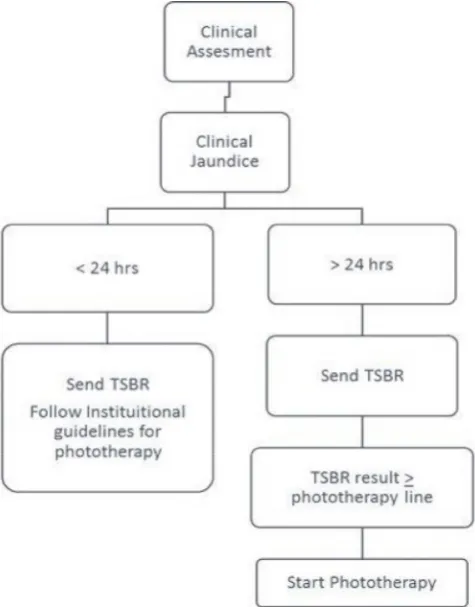
Figure 1 Pre-implementation phase flowchart. TSBR, total serum bilirubin .
Figure 2 TcBR nomogram. (TcBR transcutaneous bilirubin.)
on September 12, 2020 by guest. Protected by copyright.
the first 24 hours of life or after 7 days were excluded. Those at high risk for neonatal jaundice such as babies born at less than 37 weeks of gestation, with birth weight less than 2500 g, with a positive direct Coombs test or whose mothers had a positive anti-red blood cell antibody screening test were also not eligible for the study. Any baby with a history of a sibling with glucose-6-phosphate dehydrogenase deficiency, kernicterus or requiring exchange transfusion for neonatal hyperbilirubinaemia were also excluded from the cohort.
Patient involvement
Patients were not directly involved in the design of this study.
Pre-implementation phase
Data of all eligible babies during this phase were extracted from the electronic medical records. Flow chart for pre-implementation phase is shown in figure 1.
Intervention and post-implementation phase TCBR nomogram
We used the American Academy of Paediatrics (AAP) phototherapy guidelines to make a modified TcBR nomo-gram (figure 2). The high-risk and intermediate-risk lines from the AAP nomogram were removed and the low-risk line was renamed and colour coded as the phototherapy (red) line. A new TcBR (blue) line was drawn 2 mg/dL (34.2 μmol/L) below the phototherapy (red) line. This was done because various published articles and the device manufacturer reported a variation of ±1 mg/dL (17.1 μmol/L) in the values of TcBR and TSBR.15
Equipment and training
Two Dragger JM-105 TcBR metres were used, one for each well-baby nursery. Both devices were routinely
checked, calibrated and serviced by the staff from the biomedical department. TcBR measurements were taken over the mediastinum as studies suggest that it is better than forehead measurements.16 Three consecutive
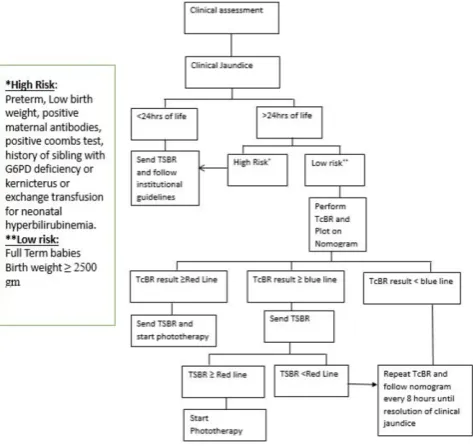
read-ings were taken and the average result was recorded. As per our study protocol (figure 3), if TcBR level fell on or over the phototherapy (red) line, serum TSBR was sent and phototherapy was also started. If TcBR level fell on or over the TcBR (blue) line, then serum TSBR was sent; however, phototherapy was started only if TSBR levels fell on or over the phototherapy (red) line. All babies that tested below the TcBR line were followed with serial TcBR testing every 8 hours until resolution of clinical jaundice.
Prior to the implementation phase, a hands-on training and competency certification of all neonatal healthcare providers were done. During this phase, all components of the study protocol were explained and the protocol flow chart (figure 3) and TcBR nomogram (figure 2) were handed over to them. The same were also pasted across all postnatal ward areas for reference. Monthly refreshers were also conducted.
data collection
Data from the two distinct phases were collected from the electronic medical records for all neonates during both phases of the study. Demographics, including gesta-tional age, chronological age, gender and birth weight, were obtained. TcBR levels were obtained for patients suspected of having hyperbilirubinaemia as determined by trained physicians or nurses. All data were recorded in the predesigned study proforma.
Analysis and ethics
Analysis was done using Stata V.12. Demographic factors were measured to ensure that children in both phases had similar attributes. Comparisons between the percent-ages of babies that required TSBR in the two phases were made using a χ2 test with a p value less than 0.05 indicating
significance. Mean peak TcBR and mean peak TSBR in post-implementation phase were compared to look for differences. Crude sampling cost was calculated to look for any meaningful savings between the two phases.
Figure 3 Post-implementation phase
flowchart. (G6PD, glucose-6-phosphate dehydrogenase; TcBR, transcutaneous bilirubin; TSBR, total serum bilirubin.)
Table 1 Demographic data for the live inborn non-high-risk babies >37 weeks of gestation in both phases of the study Demographic data of term well babies eligible for study
Phase 1 Phase 2
Number of term well
babies 1815 1394
Mean gestational
age±SD (weeks) 38.0 (±1.0) 38.0 (±1.0) Mean birth weight±SD
(g) 3092.0 (±371.9) 3133.0 (±374.91)
Male n (%) 875 (48%) 696 (50%)
Female n (%) 940 (52%) 698 (50%)
on September 12, 2020 by guest. Protected by copyright.
The study was presented to and approved by the Hospi-tal's Ethics Review Committee (Ref # 4742-PED-ERC-17).
results
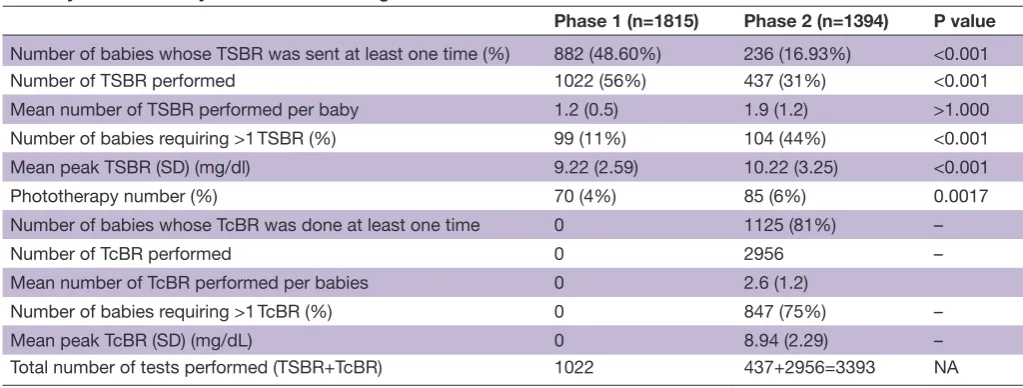
There were a total of 2286 and 1705 babies born in the hospital during the two phases. Of these, 1815 and 1394 babies were recruited, respectively, in each phase based on the exclusion criteria. There was no significant differ-ence in the demographics of the babies for the two time phases (table 1).
The results showed that a total of 1022 TSBR samples were sent in phase 1, whereas 437 in phase 2. There were around 49% (n=822) of the 1815 term well babies in phase 1 whose TSBR was performed at least one time, whereas in phase 2, around 17% (n=236) of the 1394 term well babies whose TSBR was performed at least one time (z=18.6; p value <0.001). This represents an OR of 0.21 (95% CI 0.18 to 0.25) for babies in phase 2 whose TSBR was performed at least one time compared with babies in phase 1. The odds of performing TSBRs at least one time among babies in phase 2 were 79% lower as compared with phase 1. The mean peak TSBR (9.2±2.6 mg/dL) among babies in phase 1 was significantly lower as compared with mean peak TSBR (10.22±3.3 md/dL) among babies in phase 2 (t=−5.0; p value <0.001) (table 2).
There was significant difference between rates of phototherapy in both phases. Around 4% (n=70) of babies in phase 1 were given phototherapy on the basis of TSBR, whereas around 6% (n=85) of babies in phase 2 were given phototherapy (z=2.93; p value =0.0017). Out of 85, around 60% (n=51) were given phototherapy on the basis of TcBR. This represents an OR of 1.61 (95% CI 1.17 to 2.24) for babies given phototherapy in phase 2 compared with babies given phototherapy in phase 1.
The odds of a baby receiving phototherapy in phase 2 were 61% higher as compared with phase 1 based on tests.
dIsCussIOn
To the best of our knowledge, this is the first Pakistani study to incorporate the effectiveness of TcBR nomo-gram in managing neonatal jaundice. We report a significant reduction in the percentage of babies who required TSBR in the post-implementation phase. Our finding of a 79% reduction is comparatively higher than other similar studies.17–20 den Boer found a reduction of
46.9% and Maisels showed a 40% decrease in serum bili-rubin sampling. We estimate that this large decrease in our study was due to excessive sampling that was being previously performed at our centre. This was likely done keeping in mind the high (15%) incidence of severe neonatal jaundice in the South Asian population.21
Although in comparison with phase 1, where serum samples of about half of the babies were sent, the serum samples in phase 2 were significantly less (17%). Mean number of TSBR performed per baby (whose TSBR was sent at least one time) in phase 2 was higher (1.9) as compared with phase 1 (1.2). This is probably because a significantly lesser number of babies had blood samples in phase 2, but all those who had blood samples were either at or near the phototherapy threshold and probably required more frequent TSBR sampling as compared with those babies who had blood samples for TSBR in phase 1. TcBR, on the other hand, in phase 2 was performed in about 80% of the eligible babies. This may be because TcBR was relatively easy to perform, available at bed side, free of cost at that time and made the assessment of the bilirubin extremely rapid. It was also observed that the threshold for performing a TcBR,
Table 2 Outcome data for two distinct implementation phases Primary and secondary outcome data of eligible cases
Phase 1 (n=1815) Phase 2 (n=1394) P value
Number of babies whose TSBR was sent at least one time (%) 882 (48.60%) 236 (16.93%) <0.001
Number of TSBR performed 1022 (56%) 437 (31%) <0.001
Mean number of TSBR performed per baby 1.2 (0.5) 1.9 (1.2) >1.000
Number of babies requiring >1 TSBR (%) 99 (11%) 104 (44%) <0.001
Mean peak TSBR (SD) (mg/dl) 9.22 (2.59) 10.22 (3.25) <0.001
Phototherapy number (%) 70 (4%) 85 (6%) 0.0017
Number of babies whose TcBR was done at least one time 0 1125 (81%) –
Number of TcBR performed 0 2956 –
Mean number of TcBR performed per babies 0 2.6 (1.2)
Number of babies requiring >1 TcBR (%) 0 847 (75%) –
Mean peak TcBR (SD) (mg/dL) 0 8.94 (2.29) –
Total number of tests performed (TSBR+TcBR) 1022 437+2956=3393 NA
In the post-implementation phase, 2956 TcBRs were performed. The mean peak TcBR among babies in phase 2 was 9.0±2.3 mg/dL. TcBR, transcutaneous bilirubin; TSBR, total serum bilirubin.
on September 12, 2020 by guest. Protected by copyright.
based on clinical judgement, was lower and that more tests in total were done in phase 2 compared with phase 1. This was also due, in part, to the fact that our initial protocol demanded that TcBR be repeated every 8 hours until resolution of symptoms.
The study was not designed to assess the accuracy of TcBR readings as this has already been well estab-lished internationally and22 23 in Pakistan also.8 22Nahar
et al calculated a mean difference of 0.97±1.01 mg/dL
between the TSBR and TcBR readings. This was in line with the difference of 1.28 mg/dL illustrated in our data between the mean peak TSBR and TcBR readings, with the latter being lower which is consistent with interna-tional data. Foreseeing this underestimation, we estab-lished a serum sampling cut-off that was 2 mg/dL below the phototherapy line (red line) in our nomogram. This allowed us to account for the variation in readings that may have arisen between TcBR and TSBR and main-tain a margin of safety during the study to ensure that no infants were missed.24It is also in accordance with the
nomogram established by Wainer et al who used a similar lower threshold to begin serum sampling.
Mean peak TSBR in phase 1 was significantly lower in comparison to phase 2. This was because in phase 1 serum TSBR was sent on many babies based purely on clinical judgement, whereas in phase 2 TSBR was only performed on babies who met the criteria for serum sampling based on the TcBR nomogram.
In the pre-implementation phase, 49% of babies underwent blood sampling in order to give phototherapy to only 4% babies, whereas in phase TSBR samples of 17% babies were sent to administer phototherapy to 6% babies. A higher percentage of babies’ receiving photo-therapy in phase 2 (6%) than in phase 1 (4%) were prob-ably due to early detection of babies at risk for developing jaundice by TcBR who may have been missed in phase 1.
Crude cost savings were estimated using the assumption from phase 1 that around 50% of the babies would have been pricked in the absence of this protocol. This means that from the total eligible babies in phase 2 (1394), half of them (697) would require at least one serum sampling for TSBR. Because we actually performed TSBR on 437 babies, we saved around 260 samples from being sent. One TSBR sample costs around $7 at our institute and based on the number of samples saved we estimate a total crude cost savings of around $1800 in just 6 months. This figure does not include extra saving incurred such as the cost of antiseptic measure (gloves, swabs), storage containers, syringes, time, requirement of skilled indi-viduals and risk of hospital-acquired infections etc. Based on the above-mentioned figure, the cost of device can be recovered in 2 years, whereas the service life of the device as quoted by the manufacturer is 150 000 measurements, enough for a 25-year service at The Aga Khan University Hospital.25This supports the substantial
savings demonstrated by Mcclean et al who also observed the difference in smaller community settings. In a low- to lower middle-income country such as Pakistan, this
is especially significant and can benefit a large popu-lation. The nomogram also proved easy to understand and implement by all involved healthcare professionals, making the transition faster and more efficient.
Along the course of our study, we came across some shortcomings which we would like to report. First, our study is a small, single-centre study, with a study duration of only 12 months. We feel that during the post-imple-mentation phase, TcBR may have been used more than that reported because of convenience, rapid results and easy availability. In addition, we did not do TcBR and TSBR simultaneously. Doing this would have allowed us to eliminate any further discrepancy in between the two readings. We did not include babies at high risk for devel-oping jaundice for which further studies can be planned. Although there were no cases of exchange transfusion during the study period, we did not specifically record duration of phototherapy and hospitalisation in our data. We would also like to look at frequency of babies in both phases who were readmitted for phototherapy.
COnClusIOn
We conclude that TcBR screening in conjunction with our nomogram provides a rapid and useful tool for screening low-risk babies for neonatal jaundice. It is a safe, easy to use, cost-effective method and also prevents unnecessary painful pricks. Furthermore, large popula-tion-based trials are required to look at the efficacy, safety and cost-effectiveness of the nomogram so that it can be instituted at a larger scale throughout Pakistan.
Acknowledgements We would like to acknowledge the staff of well-baby nursery, all physicians involved in well-baby care. n Rukhsana, Naureen Lalani, Khalil Ahmad and Sohail salat.
Contributors SRA, ASH and MSA planned, conducted the study and reviewed the manuscript. RA, MA, ASH helped in analysis and wrote the initial draft. FQ and MHS helped in conducting, analysis and manuscript writing. SD helped in conducting the study. All authors contributed equally in finalising the manuscript.
Funding The authors have not declared a specific grant for this research from any funding agency in the public, commercial or not-for-profit sectors.
Competing interests None declared. Patient consent for publication Not required.
ethics approval This study was approved by the AKU ethical review committee ERC number :4742-ped-ERC-17.
Provenance and peer review Not commissioned; externally peer reviewed. Open access This is an open access article distributed in accordance with the Creative Commons Attribution Non Commercial (CC BY-NC 4.0) license, which permits others to distribute, remix, adapt, build upon this work non-commercially, and license their derivative works on different terms, provided the original work is properly cited, appropriate credit is given, any changes made indicated, and the use is non-commercial. See: http:// creativecommons. org/ licenses/ by- nc/ 4. 0/.
reFerenCes
1. Wusthoff CJ, Loe IM. Impact of bilirubin-induced neurologic dysfunction on neurodevelopmental outcomes. Semin Fetal Neonatal Med 2015;20:52–7.
2. Kramer LI. Advancement of dermal icterus in the jaundiced newborn. Am J Dis Child 1969;118:454–8.
3. Begum NA, Alam K, Shaha A, et al. Transcutaneous billirubinometry: a useful screening tool for neonatal jaundice in term and near term
on September 12, 2020 by guest. Protected by copyright.
babies - a hospital based study. Bangladesh Journal of Child Health 2017;39:116–22.
4. Moyer VA, Ahn C, Sneed S. Accuracy of clinical judgment in neonatal jaundice. Arch Pediatr Adolesc Med 2000;154:391–4. 5. De Luca D, Zecca E, Zuppa AA, et al. The joint use of human and
electronic eye: visual assessment of jaundice and transcutaneous bilirubinometry. Turk J Pediatr 2008;50:456–61.
6. Carceller-Blanchard A, Cousineau J, Delvin EE. Point of care testing: transcutaneous bilirubinometry in neonates. Clin Biochem 2009;42:143–9.
7. Gupta BK, Chaudhary N, Bhatia BD, et al. Non invasive trans-cutaneous bilirubin as a screening test to identify the need for serum bilirubin assessment in healthy term neonates. Journal of Universal College of Medical Sciences 2014;1:17–21.
8. Saeed T. Validity of Transcutaneous Bilirubinometer in Neonates as compared to Laboratory serum Bilirubin Estimation. Journal of Rawalpindi Medical College 2013;17:81–3.
9. van den Esker-Jonker B, den Boer L, Pepping RM, et al.
Transcutaneous bilirubinometry in jaundiced neonates: a randomized controlled trial. Pediatrics 2016;138:e20162414.
10. Raimondi F, Lama S, Landolfo F, et al. Measuring transcutaneous bilirubin: a comparative analysis of three devices on a multiracial population. BMC Pediatr 2012;12:70.
11. Madubuike C, Ugochukwu E, Ezeanosike O, et al. Evaluation of MBJ20® Transcutaneous Bilirubinometer in the Assessement of Severity of Neonatal Jaundice. Int J Neonatal Screen 2016;2:8. 12. De Luca D, Jackson GL, Tridente A, et al. Transcutaneous bilirubin
nomograms: a systematic review of population differences and analysis of bilirubin kinetics. Arch Pediatr Adolesc Med 2009;163:1054–9.
13. Waqar T, Ahmad Z, Ali A. Comparison of serum bilirubin estimation with transcutaneous bilirubinometry in neonates. Pakistan Armed Forces Medical Journal 2010;60:382–6.
14. Hussain AS, Shah MH, Lakhdir M, et al. Effectiveness of transcutaneous bilirubin measurement in managing neonatal
jaundice in postnatal ward of a tertiary care hospital in Pakistan. BMJ Paediatr Open 2017;1:e000065.
15. Wainer S, Parmar SM, Allegro D, et al. Impact of a transcutaneous bilirubinometry program on resource utilization and severe hyperbilirubinemia. Pediatrics 2012;129:77–86.
16. Moey PKS. Transcutaneous bilirubin measurement to estimate serum bilirubin in neonates in a multi-ethnic cohort: a literature review. Proceedings of Singapore Healthcare 2017;26:42–57. 17. Rodríguez-Capote K, Kim K, Paes B, et al. Clinical implication
of the difference between transcutaneous bilirubinometry and total serum bilirubin for the classification of newborns at risk of hyperbilirubinemia. Clin Biochem 2009;42:176–9.
18. den Boer L. Implementation of a transcutaneous bilirubinometer in a newborn nursery.
19. Qualter YM, Allen NM, Corcoran JD, et al. Transcutaneous bilirubin--comparing the accuracy of BiliChek® and JM 103® in a regional postnatal unit. J Matern Fetal Neonatal Med 2011;24:267–70. 20. Maisels MJ. Transcutaneous bilirubin measurement: does it work in
the real world? Pediatrics 2015;135:364–6.
21. Greco C, Arnolda G, Boo NY, et al. Neonatal Jaundice in Low- and Middle-Income Countries: Lessons and Future Directions from the 2015 Don Ostrow Trieste Yellow Retreat. Neonatology 2016;110:172–80.
22. Nahar N, Mannan MA, Dey AC, et al. Comparison of Serum Bilirubin with Transcutaneous Bilirubinometry in Late Preterm and Term Newborn. Mymensingh Med J 2017;26:621–7.
23. Sanpavat S, Nuchprayoon I. Noninvasive transcutaneous bilirubin as a screening test to identify the need for serum bilirubin assessment. J Med Assoc Thai 2004;87:1193–8.
24. Wainer S, Parmar SM, Allegro D, et al. Impact of a transcutaneous bilirubinometry program on resource utilization and severe hyperbilirubinemia. Pediatrics 2012;129.
25. McClean S, Baerg K, Smith-Fehr J, et al. Cost savings with transcutaneous screening versus total serum bilirubin measurement for newborn jaundice in hospital and community settings: a cost-minimization analysis. CMAJ Open 2018;6:E285–91.
on September 12, 2020 by guest. Protected by copyright.