R E S E A R C H
Open Access
Polypharmacy in patients with multiple
sclerosis: a gender-specific analysis
Niklas Frahm
*, Michael Hecker
†and Uwe Klaus Zettl
†Abstract
Background:Multiple sclerosis (MS) affects about three times more women than men. Due to variable MS courses,
multiple therapies are necessary in clinical practice.
Objective:We aimed at conducting sex-specific analyses of MS patients regarding polypharmacy (≥5 drugs) and
at identifying differences in the medication spectrum.
Methods:Clinico-demographic data were gathered from 306 patients using clinical examinations, structured
patient interviews, and patient records. Statistical data analyses were performed to evaluate whether the same or different factors are associated with polypharmacy in both genders.
Results:Women (N= 218) and men (N= 88) showed similar polypharmacy rates (56.0% vs. 58.0%;p= 0.799). For both genders, higher age, severe disability degrees, comorbidities, and inpatient treatment were significantly associated with a higher polypharmacy risk. Low educational levels were predictors of polypharmacy only in women. Fampridine (p< 0.021) and antispasmodics (p< 0.010) were used more often by men, while women took more frequently thyroid medications (p< 0.001) and contraceptives (p< 0.001). The age-related increase in medication use was much stronger in women (p< 0.001).
Conclusion:Male and female MS patients with older age, comorbidities, higher disability degree, and inpatient treatment are at greater risk of polypharmacy. Future studies should examine the occurrence of clinically relevant drug interactions in MS patients stratified by sex.
Keywords:Multiple sclerosis, Polypharmacy, Patient care, Comorbidity, Concomitant drugs, Medication management, Gender
Introduction
Gender differences can influence the onset and progres-sion of complex diseases including neurodegenerative and neuropsychiatric diseases like Huntington’s disease, Tourette’s syndrome, and Parkinson’s disease. Women’s risk of suffering from multiple sclerosis (MS), the most widespread immune-mediated neurological disease, is more than twice as high as the risk for men [1]. Environ-mental and genetic factors contribute to the risk of de-veloping MS [1, 2]. Through processes of inflammation, demyelination, axonal damage, and loss of synapses in the central nervous system, diverse persisting symptoms can emerge in the course of the disease. These include
paresis and spasticity, pain, sensory disturbances, fatigue, cognitive, and emotional disturbances as well as coord-ination disturbances [2].
Since the introduction of interferon-beta-1b [3] prepa-rations in the early 1990s, important progress has been achieved, both in the development of further disease-modifying drugs (DMDs) and in the conception of indi-vidual symptomatic treatments. Independently of these, MS patients may also receive treatment for comorbidi-ties and some use complementary medications [4].
With such a complex treatment scenario, the risk of polypharmacy cannot be neglected. According to current estimates, 10% of US Americans and 30% of the older US population take more than four medications simultan-eously [5]. Similar statistics have been reported internation-ally [6]. Generinternation-ally speaking, polypharmacy is defined as the intake of five or more medications [7]. A failure to
© The Author(s). 2019Open AccessThis article is distributed under the terms of the Creative Commons Attribution 4.0 International License (http://creativecommons.org/licenses/by/4.0/), which permits unrestricted use, distribution, and reproduction in any medium, provided you give appropriate credit to the original author(s) and the source, provide a link to the Creative Commons license, and indicate if changes were made. The Creative Commons Public Domain Dedication waiver (http://creativecommons.org/publicdomain/zero/1.0/) applies to the data made available in this article, unless otherwise stated.
* Correspondence:[email protected]
†Michael Hecker and Uwe Klaus Zettl contributed equally to this work.
recognize the importance of polypharmacy in the medica-tion management process can lead to serious medicamedica-tion interactions, rising costs, side effects, insufficient patient adherence owing to medication complexity, and rehospita-lizations [6]. There is evidence that women take quantita-tively more medications than men. Manteuffel et al., for instance, reported that over a period of 12 months, women have a higher likelihood than men of taking at least one medication (68% vs. 59%;p< 0.001), while women take an average of 5.0 drugs and men take an average of 3.7 [8].
In light of the aforementioned findings, we conducted a sex-specific investigation of factors determining polyphar-macy in a single-center MS patient cohort. Additionally, to identify the most frequently used medications in men and women with MS and to uncover sex-related medica-tion differences, we analyzed the full range of medicamedica-tions taken by these patients.
Methods
The presented clinical cross-sectional study was con-ducted between March 2017 and April 2018 at the Department of Neurology and the Neuroimmunology Ward of Rostock’s University Hospital. Patient assess-ment was divided into different procedures: First, after the patient’s agreement to participate in our study, we inspected the patient’s history and the respective medical records. Second, patients were clinically examined before undergoing a structured patient interview. The inclusion criterion for this study was the diagnosis of MS or a clinically isolated syndrome (CIS) according to the re-vised McDonald criteria from 2010 [9]. With informed consent, 309 MS patients attended the examination, three of whom declined to participate due to personal reasons. Thus, the study ultimately included 306 patients. The study was approved by the Ethics Committee of the University of Rostock (approval number A 2014-0089) and conducted in accordance with the Declaration of Helsinki.
Data acquisition
All data were gathered by one pharmacist (NF) accord-ing to three different categories: sociodemographic, clinical-neurological, and pharmacological. The data col-lection was performed in the same manner for each pa-tient: By conducting a thorough review of the patient’s medical records, followed by a structured patient inter-view, we ensured the completeness and correctness of the collected data. Only those medications that were ac-tually taken as stated by the patients were considered for the analysis. By this means, we could capture the current medication spectrum of the included MS patients.
Sociodemographic data included age, number of school years (without time spent in training or higher education), educational level (no training, skilled worker, technical col-lege, university), employment status (in training, employed,
unemployed, retiree, others), relationship status (partner-ship or not), place of residence (< 5000 residents: rural community, 5000–19,999: provincial town, 20,000–99,999: medium-sized town, ≥100,000: city), number of children, and number of siblings.
Clinical-neurological data included Kurtzke’s Expanded Disability Status Scale (EDSS), which scores MS patients’ degree of disability [10]. In addition, MS subtypes were distinguished into relapsing-remitting MS (RRMS), CIS, primary progressive MS (PPMS), and secondary pro-gressive MS (SPMS) [2]. Finally, we collected data on the presence of comorbidities (Pw/oSI—patients without secondary illnesses, PwSI—patients with secondary ill-nesses), disease duration (measured since the time of the initial diagnosis), and patient care (outpatient, inpatient).
Pharmacological data included the trade names of the drug preparations, indications, active ingredients, dos-ages, and routes of administration. The data analysis encompassed all of the medications that were actually taken as stated by the respective patient.
Inpatient and outpatient ward
Before the data acquisition, inpatients and outpatients were asked to participate in our study. Outpatients usually presented a stable disease situation and had a routine checkup at the outpatient ward of the Department of Neurology of Rostock’s University Hospital. Inpatients, on the other hand, had more severe disease courses or had an acute increase of disease activity.
Drug analysis
Drug regimens
The medications were divided into long-term and as-needed (pro re nata (PRN)) medications. Long-term medi-cations are taken daily or at regular intervals, for instance once a week or once a month and are used to treat long-term illnesses or complaints. PRN medications are used whenever necessary, at irregular intervals, to treat acute or sporadic complaints.
Prescription status
In the analyses, we distinguished between prescription-only and over-the-counter (OTC) medications.
Therapeutic objective
Polypharmacy and secondary illnesses
The threshold to define polypharmacy was five medica-tions. Therefore, patients with five or more medications were categorized as patients with polypharmacy (PwP), while those with fewer than five medications were cate-gorized as patients without polypharmacy (Pw/oP). This definition of polypharmacy is commonly used and fre-quently reported in the literature [7].
At least one comorbidity was present in PwSI. Fol-lowing the studies by Laroni et al. [12] and Marrie et al. [13] (“International Workshop on Comorbidities in MS”), comorbidities were assessed based on the patient records, the patient interviews, and the physi-cians’expert opinion.
Statistics
The data were analyzed using PASW Statistics 18 (IBM). Patients’data were anonymized prior to entry into the data-base. For the comparative analysis of men and women, we used two-sample two-tailed Student’sttests, Fisher’s exact tests, chi-square tests, and Mann-WhitneyUtests. Associa-tions between polypharmacy (response variable) and seven sociodemographic (age, school years, highest educational attainment, partnership status, place of residence, chil-dren, siblings) as well as four clinical-neurological vari-ables (EDSS, disease duration, comorbidities, patient care) (explanatory variables) were examined separately for men and for women using univariate logistic regres-sion. For the further analysis of sex-specific relationships between clinico-demographic factors and the number of medications taken, we used Ftests for linear models and Pearson correlation tests. The significance level was set at α= 0.05. The p values were corrected according to the false discovery rate (FDR) to take into account alpha error inflation in the case of multiple testing [14].
Results
Sociodemographic data
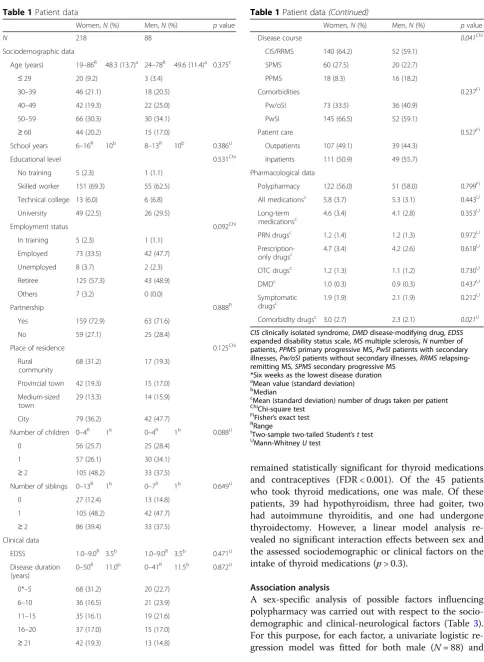
Women made up 71.2% of the overall study population. Men and women were very similar with respect to age, with women being slightly younger (women 48.3 years vs. men 49.6 years). Men were more frequently employed than women (men 47.7% vs. women 33.5%). Conversely, the proportion of female retirees was higher than the rate of male retirees (women 57.3% vs. men 48.9%). Both genders were very much alike in terms of family, with similar percentages found for partnership status, number of children, and number of siblings. There were no sig-nificant differences between male and female patients regarding the sociodemographic factors (Table1).
Clinical data
The statistical analyses of the clinical-neurological data re-vealed both similarities and differences between women
and men (Table1). With respect to physical disability, pa-tient care as well as comorbidities, men and women showed comparable values. The proportion of patients that have been diagnosed within the last 5 years was higher for women (31.2%) compared to men (22.7%), but the gender differences in disease duration did not reach statistical significance overall. However, a significant dif-ference was found considering the MS subtypes (chi-square test:p= 0.041): Although RRMS was the most fre-quent subtype in both sexes, followed by SPMS and PPMS, male patients showed a similar proportion of SPMS and PPMS (22.7% vs. 18.2%, respectively). By con-trast, the female population comprised more than three times as many SPMS patients than PPMS patients (27.5% vs. 8.3%, respectively).
Polypharmacy and medications
The analysis of the entire patient cohort yielded a poly-pharmacy rate of 56.5%. Overall, the average number of medications taken by the patients amounted to 5.7 (SD 3.6), with a minimum of one medication and a maximum of 19. Men and women showed very similar polypharmacy rates (women vs. men, 56.0% vs. 58.0%; Fisher’s exact test:p= 0.799). Women took an average of 5.8 medications and men an average of 5.3 (Mann-Whit-neyUtest: p= 0.443). There were no significant sex dif-ferences concerning polypharmacy and the number of overall medications, long-term medications, PRN drugs, prescription-only drugs, OTC medications, DMDs, and symptomatic drugs received (Mann-WhitneyUtest:p> 0.05). The only significant difference emerged for medi-cations to treat secondary illnesses (Mann-Whitney U test:p= 0.021) (Table1). On average, women took more of these medications than men (women vs. men, 3.0 vs. 2.3).
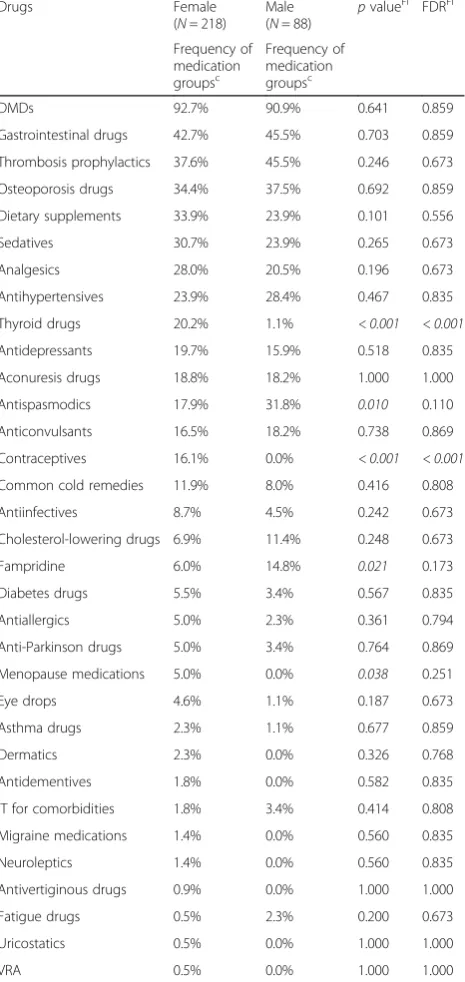
DMDs were taken by over 90% of the men and of the women and they were thus the most frequently recorded medication group for both sexes (Table2). For male MS patients, this was followed by gastrointestinal drugs (45.5%), thrombosis prophylactics (45.5%), osteoporosis medications (37.5%), and antispasmodics (31.8%). Differ-ences between men and women in terms of rank order were observable. For instance, for men, antispasmodics occupied the fifth place in the order of frequency, while for women they were in twelfth place. At the fifth place for women were dietary supplements (33.9 %).
remained statistically significant for thyroid medications and contraceptives (FDR < 0.001). Of the 45 patients who took thyroid medications, one was male. Of these patients, 39 had hypothyroidism, three had goiter, two had autoimmune thyroiditis, and one had undergone thyroidectomy. However, a linear model analysis re-vealed no significant interaction effects between sex and the assessed sociodemographic or clinical factors on the intake of thyroid medications (p> 0.3).
Association analysis
A sex-specific analysis of possible factors influencing polypharmacy was carried out with respect to the socio-demographic and clinical-neurological factors (Table 3). For this purpose, for each factor, a univariate logistic re-gression model was fitted for both male (N= 88) and Table 1Patient data
Women,N(%) Men,N(%) pvalue
N 218 88
Sociodemographic data
Age (years) 19–86R 48.3 (13.7)a 24–78R 49.6 (11.4)a 0.375t
≤29 20 (9.2) 3 (3.4)
30–39 46 (21.1) 18 (20.5)
40–49 42 (19.3) 22 (25.0)
50–59 66 (30.3) 30 (34.1)
≥60 44 (20.2) 15 (17.0)
School years 6–16R 10b 8–13R 10b 0.386U
Educational level 0.531Chi
No training 5 (2.3) 1 (1.1)
Skilled worker 151 (69.3) 55 (62.5)
Technical college 13 (6.0) 6 (6.8)
University 49 (22.5) 26 (29.5)
Employment status 0.092Chi
In training 5 (2.3) 1 (1.1)
Employed 73 (33.5) 42 (47.7)
Unemployed 8 (3.7) 2 (2.3)
Retiree 125 (57.3) 43 (48.9)
Others 7 (3.2) 0 (0.0)
Partnership 0.888Fi
Yes 159 (72.9) 63 (71.6)
No 59 (27.1) 25 (28.4)
Place of residence 0.125Chi
Rural community
68 (31.2) 17 (19.3)
Provincial town 42 (19.3) 15 (17.0)
Medium-sized town
29 (13.3) 14 (15.9)
City 79 (36.2) 42 (47.7)
Number of children 0–4R 1b 0–4R 1b 0.088U
0 56 (25.7) 25 (28.4)
1 57 (26.1) 30 (34.1)
≥2 105 (48.2) 33 (37.5)
Number of siblings 0–13R 1b 0–7R 1b 0.649U
0 27 (12.4) 13 (14.8)
1 105 (48.2) 42 (47.7)
≥2 86 (39.4) 33 (37.5)
Clinical data
EDSS 1.0–9.0R 3.5b 1.0–9.0R 3.5b 0.471U
Disease duration (years)
0–50R 11.0b 0–41R 11.5b 0.872U
0*–5 68 (31.2) 20 (22.7)
6–10 36 (16.5) 21 (23.9)
11–15 35 (16.1) 19 (21.6)
16–20 37 (17.0) 15 (17.0)
≥21 42 (19.3) 13 (14.8)
Table 1Patient data(Continued)
Women,N(%) Men,N(%) pvalue
Disease course 0.041Chi
CIS/RRMS 140 (64.2) 52 (59.1)
SPMS 60 (27.5) 20 (22.7)
PPMS 18 (8.3) 16 (18.2)
Comorbidities 0.237Fi
Pw/oSI 73 (33.5) 36 (40.9)
PwSI 145 (66.5) 52 (59.1)
Patient care 0.527Fi
Outpatients 107 (49.1) 39 (44.3)
Inpatients 111 (50.9) 49 (55.7)
Pharmacological data
Polypharmacy 122 (56.0) 51 (58.0) 0.799Fi
All medicationsc 5.8 (3.7) 5.3 (3.1) 0.443U
Long-term medicationsc
4.6 (3.4) 4.1 (2.8) 0.353U
PRN drugsc 1.2 (1.4) 1.2 (1.3) 0.972U
Prescription-only drugsc
4.7 (3.4) 4.2 (2.6) 0.618U
OTC drugsc 1.2 (1.3) 1.1 (1.2) 0.730U
DMDc 1.0 (0.3) 0.9 (0.3) 0.437U
Symptomatic
drugsc 1.9 (1.9) 2.1 (1.9) 0.212
U
Comorbidity drugsc 3.0 (2.7) 2.3 (2.1) 0.021U
CISclinically isolated syndrome,DMDdisease-modifying drug,EDSS expanded disability status scale,MSmultiple sclerosis,Nnumber of patients,PPMSprimary progressive MS,PwSIpatients with secondary illnesses,Pw/oSIpatients without secondary illnesses,RRMS relapsing-remitting MS,SPMSsecondary progressive MS
*Six weeks as the lowest disease duration
a
Mean value (standard deviation)
b
Median
cMean (standard deviation) number of drugs taken per patient ChiChi-square test
Fi
Fisher’s exact test
R
Range
female MS patients (N= 218). Comorbidities and patient care were the only factors showing an association with the occurrence of polypharmacy for both men and women with p value < 0.001. Remarkably, educational level (p= 0.025; OR = 0.699) was associated with poly-pharmacy only for women. The proportions of male and female PwP with respect to comorbidities, patient care,
school years, and disease duration are presented in Fig.1. However, there were no significant interactions between each variable in Table 3 and sex with respect to the total number of medications taken by the MS patients, with the exception of the educational level (linear model analysis:p= 0.012).
When comparing the total numbers of medications taken by men and women in different age groups, no significant differences emerged (Table 4). However, the mean number of medications received clearly increased with age. Women aged over 60 years took around three times as many medications as women under 30 years (difference in mean values = 5.9). Men in the highest age group (≥60 years), by contrast, took just under twice as many medications as men≤29 years (difference in mean values = 3.3). Thus, women and men differed signifi-cantly regarding the increase in the number of medica-tions taken with increasing age (Pearson: p< 0.001, correlation coefficient = 0.995), with a particularly high number of medications taken by older women (Fig. 2). Further correlation analyses of the gender differences in the total number of medications taken by the patients with differentiation according to the number of years of schooling (p= 0.105), educational level (p= 0.515), or disease duration (p= 0.105) did not reveal any significant differences.
Discussion
Our clinical cross-sectional study aimed to analyze poly-pharmacy as well as clinico-demographic factors dependent on sex. Previous polypharmacy studies with MS patients examined the quality of life and relapse rates [15], fa-tigue and cognitive abilities [16], and the use of anti-epileptic drugs or antidepressants [17]. The focus of the present study was on the consideration of differ-ences regarding medication choices and polypharmacy between women and men.
Male and female MS patients differed only slightly with respect to their polypharmacy rates (women vs. men, 56.0% vs. 58.0%), and this difference was not statis-tically significant (Fisher’s exact test: p= 0.799). How-ever, our sample size was limited. A sensitivity power analysis revealed that for our cohort, a > 17% difference in the polypharmacy rates between men and women would be actually needed to be considered as significant with a statistical power of > 0.80. Nonetheless, our re-sults are in line with previous studies examining poly-pharmacy, which were not restricted on MS patients and similarly failed to detect a sex-related difference in poly-pharmacy rates [18,19]. When analyzing the pharmaco-logical data of our cohort, the only significant difference emerged with respect to medications to treat comorbidi-ties: On average, women took significantly more of such medications than men (3.0 vs. 2.3), partly reflecting that Table 2Frequency of drug use in MS patients
Drugs Female
(N= 218)
Male
(N= 88) p
valueFi FDRFi
Frequency of medication groupsc
Frequency of medication groupsc
DMDs 92.7% 90.9% 0.641 0.859
Gastrointestinal drugs 42.7% 45.5% 0.703 0.859
Thrombosis prophylactics 37.6% 45.5% 0.246 0.673
Osteoporosis drugs 34.4% 37.5% 0.692 0.859
Dietary supplements 33.9% 23.9% 0.101 0.556
Sedatives 30.7% 23.9% 0.265 0.673
Analgesics 28.0% 20.5% 0.196 0.673
Antihypertensives 23.9% 28.4% 0.467 0.835
Thyroid drugs 20.2% 1.1% < 0.001 < 0.001
Antidepressants 19.7% 15.9% 0.518 0.835
Aconuresis drugs 18.8% 18.2% 1.000 1.000
Antispasmodics 17.9% 31.8% 0.010 0.110
Anticonvulsants 16.5% 18.2% 0.738 0.869
Contraceptives 16.1% 0.0% < 0.001 < 0.001
Common cold remedies 11.9% 8.0% 0.416 0.808
Antiinfectives 8.7% 4.5% 0.242 0.673
Cholesterol-lowering drugs 6.9% 11.4% 0.248 0.673
Fampridine 6.0% 14.8% 0.021 0.173
Diabetes drugs 5.5% 3.4% 0.567 0.835
Antiallergics 5.0% 2.3% 0.361 0.794
Anti-Parkinson drugs 5.0% 3.4% 0.764 0.869
Menopause medications 5.0% 0.0% 0.038 0.251
Eye drops 4.6% 1.1% 0.187 0.673
Asthma drugs 2.3% 1.1% 0.677 0.859
Dermatics 2.3% 0.0% 0.326 0.768
Antidementives 1.8% 0.0% 0.582 0.835
IT for comorbidities 1.8% 3.4% 0.414 0.808
Migraine medications 1.4% 0.0% 0.560 0.835
Neuroleptics 1.4% 0.0% 0.560 0.835
Antivertiginous drugs 0.9% 0.0% 1.000 1.000
Fatigue drugs 0.5% 2.3% 0.200 0.673
Uricostatics 0.5% 0.0% 1.000 1.000
VRA 0.5% 0.0% 1.000 1.000
DMDsdisease-modifying drugs,FDRadjustedpvalue according to false discovery rate,ITimmunotherapy,Nnumber of patients,VRAvasopressin receptor antagonists
c
Proportion of patients in %
Fi
Table 3Gender examination of clinico-demographic factors for association with polypharmacy
Female (N= 218) Male (N= 88)
pc OR (95% CI) pc OR (95% CI)
Age (years) < 0.001 1.075 (1.048–1.101) 0.013 1.053 (1.011–1.097)
School years* 0.288 0.879 (0.692–1.116) 0.803 0.954 (0.658–1.382)
Educational level* 0.012 0.635 (0.446–0.904) 0.402 0.809 (0.492–1.329)
Partnership* 0.082 1.852 (0.925–3.710) 0.524 1.399 (0.498–3.928)
Place of residence* 0.068 1.254 (0.983–1.599) 0.104 0.725 (0.493–1.068)
Number of children* 0.068 0.742 (0.539–1.022) 0.448 1.251 (0.702–2.229)
Number of siblings* 0.618 0.960 (0.819–1.126) 0.321 0.848 (0.612–1.175)
EDSS* < 0.001 1.653 (1.336–2.045) 0.005 1.454 (1.117–1.893)
Disease duration (years)* 0.993 1.000 (0.965–1.036) 0.179 0.959 (0.902–1.019)
Comorbidities* < 0.001 3.632 (1.885–6.996) < 0.001 6.213 (2.266–17.037)
Patient care* < 0.001 5.598 (2.857–10.970) < 0.001 11.820 (4.099–34.083)
CIconfidence interval,EDSSexpanded disability status scale,Nnumber of patients,ORodds ratio,p pvalue *Adjusted for age
c
Univariable logistic regression
they suffered more frequently from secondary illnesses. Previous studies revealed that women generally use more dietary supplements than men [20,21], and conse-quently, the number of medications taken by women was shown to be higher, independent of the presence of comorbidities.
We could show for the first time that some sociodemo-graphic and clinical variables correlate with polypharmacy to differing degrees depending on sex. A higher age, the presence of comorbidities, a higher degree of disability, and inpatient treatment are all factors that were associated with polypharmacy in both sexes. However, high age and higher
EDSS scores were somewhat more strongly associated with polypharmacy in women than in men, as reflected in the higher ORs (age, 1.075 vs. 1.053; EDSS, 1.653 vs. 1.454). The risk of polypharmacy rises with age, often as a conse-quence of comorbidities which require additional drug therapies [22]. Comorbidities and inpatient treatment more strongly predicted polypharmacy for men than for women. More specifically, for male PwSI, the risk of polypharmacy was over six times higher than for male Pw/oSI, while fe-male PwSI had roughly a four times higher risk of poly-pharmacy than female Pw/oSI. Other MS polypoly-pharmacy studies have already reported differences in the age and the degree of disability between PwP and Pw/oP, albeit not stratified for women and men [15,16]. In contrast to men, polypharmacy of women was also associated with educa-tion: The lower the level of education, the higher the risk of polypharmacy among female patients. The correlation of education and polypharmacy has already been re-ported in studies examining elderly patients [23–25] but not among MS patients or especially female pa-tients. Moreover, there was a significant age-related difference between men and women regarding the number of medications taken: With increasing age, the slope in the number of medications taken was steeper for women than for men (p< 0.001).
When comparing the medication groups between men and women, significant differences emerged for fampri-dine, antispasmodics, thyroid medications, menopause medications, and contraceptives. The study by Feys et al. gave implications of increased walking impairment in patients with PPMS as compared to those with SPMS [26]. This may be an explanation for the more frequent use of fampridine in men compared to women, as the proportion of PPMS patients in our study cohort was twice as high in men than in women. With regard to the use of antispasmodics, previous studies support our re-sult of a significantly higher use of those drugs among Table 4Number of drugs taken by male and female MS patients in different age groups
Age (years) ≤29 30–39 40–49 50–59 ≥60
N 23 64 64 96 59
Number of PwP (%) Female 4 (20.0) 16 (34.8) 23 (54.8) 40 (60.6) 39 (88.6)
Male 1 (33.3) 8 (44.4) 10 (45.5) 20 (66.7) 12 (80.0)
pvalueFi 0.539 0.569 0.600 0.653 0.407
Number of drugsa Female 3.1 (1.4) 4.1 (2.1) 5.1 (3.1) 6.3 (3.7) 9.0 (4.1)
Male 4.0 (2.0) 4.6 (2.7) 4.7 (3.3) 5.3 (2.8) 7.3 (3.5)
pvaluet 0.316 0.501 0.638 0.178 0.152
Mean difference in the number of drugs* −0.9 −0.5 0.4 1.0 1.7
Nnumber of patients,PwPpatients with polypharmacy
*Differences in the average number of medications taken by female and male MS patients: The differences correlated with the age grouping (Pearson coefficient = 0.995 andp< 0.001). Women thus showed a significantly stronger age-related increase in the number of drugs used compared to men
a
Mean value (standard deviation)
Fi
Fisher’s exact test
t
Two-sample two-tailed Student’sttest
men compared to women: In the study of Oreja-Guevara et al., the proportion of male MS patients with spasticity was significantly higher than the rate of male MS patients without spasticity (p< 0.001) [27] and Windt et al. de-scribed that the use of muscle relaxants was significantly higher in men than in women (p= 0.024) [28]. So far, find-ings on the effects of hormonal contraceptives on the course of MS have been inconsistent, with negative, neu-tral, and protective effects being reported [29].
Thyroid medications (including levothyroxine) were taken significantly more frequently by women than by men in our study (20.2% vs. 1.1%). Other studies re-ported a more frequent occurrence of hypothyroidism in women than in men (women vs. men, 5.1% vs. 0.92%) [30], and the use of levothyroxine has therefore been as-sociated with female sex (OR = 6.28, 95% CI = 3.19– 12.36) [31]. Among the 45 patients receiving medical thyroid treatment in our study, hypothyroidism was the most frequent thyroid condition with 84.4%, followed by struma (6.7%), Hashimoto’s thyroiditis (4.4%), and post-thyroidectomy status (4.4%). The only man with a thyroid disease belonged to the thyroidectomy patient group. In general, autoimmune thyroid diseases are the most preva-lent autoimmune comorbidities in MS patients [32]. How-ever, we could identify only two patients with definite autoimmune-based thyroid disease. For the remaining 43 patients, the specific cause of the thyroid disease, for instance iodine deficiency, autoimmune thyroiditis or radioiodine therapy [33], was not documented.
As of today, most MS patients receive immunotherapy with DMDs early after disease onset. In our study, DMDs were taken by over 90% of the included MS pa-tients, with similar rates for women and men. However, in perspective, there is a growing spectrum of drugs that might be chosen for symptomatic treatment, for instance fampridine and antispasmodics [2], which were often used by male MS patients in our study. Apart from that, concomitant medications play an increasing role in pa-tients with MS. Self-medication is especially performed with dietary and herbal supplements as these are low-cost and easily available without prescriptions. Supple-ments have become more and more popular in the general population as well as in the MS population, in particular in women [34,35]. All of these aspects contribute to poly-pharmacy. In both genders, unmonitored polypharmacy can lead to increased health care costs, adverse drug-drug interactions, more frequent rehospitalizations, and side ef-fects [36–38]. Thus, a gender-specific distinction regard-ing the need and choice of medications should be an integral part of an optimal and individualized treatment of MS. This would permit gender-specific adjustments re-garding treatment strategies. For instance, well-thought-out medication plans have to be prepared for pregnant women with MS to protect the fetus and to treat the
mother adequately [39]. Another important issue that gains attention is finding the optimal dose, which usually depends on the patient’s weight, height, or certain hor-mones and thus gender.
With such a large amount of diverse medications, it is difficult to predict the clinical consequences of particular medication interactions on an individual basis. A possi-bility to improve medication management is the regular analysis of the necessity or usefulness of all medications by the physician with the aim of optimizing the medica-tion plan. To supplement or support treatment, several evidence-based non-medical approaches are available, such as cognitive-behavioral therapy [40] and physio-therapy [41–43]. The differentiated consideration of women and men in future MS studies would enable further sex-specific analyses, which might stimulate the development of individualized MS therapies.
Limitations of the study include the cross-sectional study design. Each MS patient was screened and inter-viewed once during the study period without repeating the data collection, yielding snapshot medication pro-files. Thus, changes in medication plans have not been recorded because the primary objective of our study was to systematically examine associations between gender and polypharmacy as well as medications in MS patients. Another limitation was the lack of patient adherence data. Poor adherence is a common issue, especially in the context of chronic diseases that require life-long treatments such as MS [44]. A reliable assessment of the patients’ actual drug intake is difficult, but mobile healthcare solutions and specialized patient support pro-grams have been developed to monitor and foster adher-ence [45, 46]. Further studies on polypharmacy in MS are thus warranted that include self-documentation of medication use in a longitudinal scenario.
In summary, our study showed that comorbidities, higher age, inpatient treatment, and a higher degree of disability are associated with an increased risk of poly-pharmacy both in men and in women with MS. Further-more, low education was a predictor of polypharmacy for women but not for men. With higher age, women showed a more marked increase in the overall number of medica-tions taken than men. Moreover, men more frequently took fampridine and antispasmodics, while women more frequently took comorbidity drugs, in particular thyroid medications. Future studies on the occurrence of medica-tion interacmedica-tions and side effects stratified by the sex of the patients remain to be conducted.
Abbreviations
CIS:Clinically isolated syndrome; DMDs: Disease-modifying drugs;
RRMS: Relapsing-remitting MS; SD: Standard deviation; SPMS: Secondary progressive MS
Acknowledgements
The authors would like to express their special thanks to Antje Bombor, Ina Schröder, Angela Steffan, Sylvia Röhring, and Nele Retzlaff of the Department of Neurology at the University of Rostock for providing help in the data acquisition and to Sarah L. Mannion for professional translation service.
Authors’contributions
UKZ inspired and directed the study. NF gathered, analyzed, and interpreted the data, drafted the manuscript, and prepared all tables and figures. MH helped with the data analysis. UKZ and MH contributed to the interpretation of the results and corrected and improved the paper. All authors read and approved the final manuscript.
Funding
This research did not receive any specific grant from funding agencies in the public, commercial, or not-for-profit sectors.
Availability of data and materials
The datasets generated and analyzed in the current study are available from the corresponding author on reasonable request.
Ethics approval and consent to participate
The study was approved by the Ethics Committee of the University of Rostock (approval number A 2014-0089) and conducted in accordance with the Declaration of Helsinki.
Consent for publication
With informed consent, MS patients attended the examination.
Competing interests
MH received speaking fees and travel funds from Bayer HealthCare, Biogen, Novartis, and Teva. UKZ received research support as well as speaking fees and travel funds from Almirall, Bayer HealthCare, Biogen, Merck Serono, Novartis, Sanofi, and Teva. NF received travel funds from Novartis.
Received: 25 March 2019 Accepted: 17 May 2019
References
1. Reich DS, Lucchinetti CF, Calabresi PA. Multiple sclerosis. N Engl J Med. 2018;378:169–80.
2. Filippi M, Bar-Or A, Piehl F, et al. Multiple sclerosis. Nat Rev Dis Primers. 2018;4:43.
3. Zettl UK, Hecker M, Aktas O, et al. Interferonβ-1a andβ-1b for patients with multiple sclerosis: updates to current knowledge. Expert Rev Clin Immunol. 2018;14:137–53.
4. Kochs L, Wegener S, Sühnel A, et al. The use of complementary and alternative medicine in patients with multiple sclerosis: a longitudinal study. Complement Ther Med. 2014;22:166–72.
5. Quinn KJ, Shah NH. A dataset quantifying polypharmacy in the United States. Sci Data. 2017;4:170167.
6. Wastesson JW, Morin L, Tan ECK, et al. An update on the clinical consequences of polypharmacy in older adults: a narrative review. Expert Opin Drug Saf. 2018;17:1185–96.
7. Masnoon N, Shakib S, Kalisch-Ellett L, et al. What is polypharmacy? A systematic review of definitions. BMC Geriatr. 2017;17:230.
8. Manteuffel M, Williams S, Chen W, et al. Influence of patient sex and gender on medication use, adherence, and prescribing alignment with guidelines. J Women's Health (Larchmt). 2014;23:112–9.
9. Polman CH, Reingold SC, Banwell B, et al. Diagnostic criteria for multiple sclerosis: 2010 revisions to the McDonald criteria. Ann Neurol. 2011;69:292–302.
10. Kurtzke JF. Rating neurologic impairment in multiple sclerosis: an expanded disability status scale (EDSS). Neurology. 1983;33:1444–52.
11. Vargas DL, Tyor WR. Update on disease-modifying therapies for multiple sclerosis. J Investig Med. 2017;65:883–91.
12. Laroni A, Signori A, Maniscalco GT, et al. Assessing association of comorbidities with treatment choice and persistence in MS: a real-life multicenter study. Neurology. 2017;89:2222–9.
13. Marrie RA, Miller A, Sormani MP, et al. Recommendations for observational studies of comorbidity in multiple sclerosis. Neurology. 2016;86:1446–53. 14. Benjamini Y, Hochberg Y. Controlling the false discovery rate: a practical
and powerful approach to multiple testing. J R Stat Soc Series B Stat Methodol. 1995;57:289–300.
15. Jelinek GA, Weiland TJ, Hadgkiss EJ, et al. Medication use in a large international sample of people with multiple sclerosis: associations with quality of life, relapse rate and disability. Neurol Res. 2015;37:662–73. 16. Thelen JM, Lynch SG, Bruce AS, et al. Polypharmacy in multiple sclerosis:
relationship with fatigue, perceived cognition, and objective cognitive performance. J Psychosom Res. 2014;76:400–4.
17. Beiske GAG, Holmøy T, Beiske AG, et al. Antiepileptic and antidepressive polypharmacy in patients with multiple sclerosis. Mult Scler Int. 2015;2015:317859. 18. Beloosesky Y, Nenaydenko O, Gross Nevo RF, et al. Rates, variability, and
associated factors of polypharmacy in nursing home patients. Clin Interv Aging. 2013;8:1585–90.
19. Al-Hashar A, Al Sinawi H, Al Mahrizi A, et al. Prevalence and covariates of polypharmacy in elderly patients on discharge from a tertiary care hospital in Oman. Oman Med J. 2016;31:421–5.
20. Dickinson A, MacKay D. Health habits and other characteristics of dietary supplement users: a review. Nutr J. 2014;13:14.
21. Kantor ED, Rehm CD, Du M, et al. Trends in dietary supplement use among US adults from 1999-2012. JAMA. 2016;316:1464–74.
22. Davies EA, O'Mahony MS. Adverse drug reactions in special populations -the elderly. Br J Clin Pharmacol. 2015;80:796–807.
23. Wauters M, Elseviers M, Vaes B, et al. Polypharmacy in a Belgian cohort of community-dwelling oldest old (80+). Acta Clin Belg. 2016;71:158–66. 24. Walckiers D, van der Heyden J, Tafforeau J. Factors associated with
excessive polypharmacy in older people. Arch Public Health. 2015;73:50. 25. Haider SI, Johnell K, Weitoft GR, et al. The influence of educational level on
polypharmacy and inappropriate drug use: a register-based study of more than 600,000 older people. J Am Geriatr Soc. 2009;57:62–9.
26. Feys P, Bibby BM, Baert I, et al. Walking capacity and ability are more impaired in progressive compared to relapsing type of multiple sclerosis. Eur J Phys Rehabil Med. 2015;51:207–10.
27. Oreja-Guevara C, González-Segura D, Vila C. Spasticity in multiple sclerosis: results of a patient survey. Int J Neurosci. 2013;123:400–8.
28. Windt R, Glaeske G, Hoffmann F. Treatment of multiple sclerosis in Germany: an analysis based on claims data of more than 30,000 patients. Int J Clin Pharm. 2013;35:1229–35.
29. Rankin K, Bove R. Caring for women with multiple sclerosis across the lifespan. Curr Neurol Neurosci Rep. 2018;18:36.
30. Garmendia Madariaga A, Santos Palacios S, Guillén-Grima F, et al. The incidence and prevalence of thyroid dysfunction in Europe: a meta-analysis. J Clin Endocrinol Metab. 2014;99:923–31.
31. Olmos RD, Figueiredo RC, Aquino EM, et al. Gender, race and
socioeconomic influence on diagnosis and treatment of thyroid disorders in the Brazilian Longitudinal Study of Adult Health (ELSA-Brasil). Braz J Med Biol Res. 2015;48:751–8.
32. Marrie RA, Reider N, Cohen J, et al. A systematic review of the incidence and prevalence of autoimmune disease in multiple sclerosis. Mult Scler. 2015;21:282–93.
33. Gessl A, Lemmens-Gruber R, Kautzky-Willer A. Thyroid disorders. Handb Exp Pharmacol. 2012;214:361–86.
34. Evans E, Piccio L, Cross AH. Use of vitamins and dietary supplements by patients with multiple sclerosis: a review. JAMA Neurol. 2018;75:1013–21. 35. Lentjes MAH. The balance between food and dietary supplements in the
general population. Proc Nutr Soc. 2019;78:97–109.
36. Guthrie B, Makubate B, Hernandez-Santiago V, et al. The rising tide of polypharmacy and drug-drug interactions: population database analysis 1995-2010. BMC Med. 2015;13:74.
37. Maher RL, Hanlon J, Hajjar ER. Clinical consequences of polypharmacy in elderly. Expert Opin Drug Saf. 2014;13:57–65.
38. Sganga F, Landi F, Ruggiero C, et al. Polypharmacy and health outcomes among older adults discharged from hospital: results from the CRIME study. Geriatr Gerontol Int. 2015;15:141–6.
40. Dennison L, Moss-Morris R. Cognitive-behavioral therapy: what benefits can it offer people with multiple sclerosis? Expert Rev Neurother. 2010;10:1383–90. 41. Cattaneo D, Jonsdottir J, Zocchi M, et al. Effects of balance exercises on
people with multiple sclerosis: a pilot study. Clin Rehabil. 2007;21:771–81. 42. Broekmans T, Roelants M, Feys P, et al. Effects of long-term resistance
training and simultaneous electro-stimulation on muscle strength and functional mobility in multiple sclerosis. Mult Scler. 2011;17:468–77. 43. Cakt BD, Nacir B, Genç H, et al. Cycling progressive resistance training for
people with multiple sclerosis: a randomized controlled study. Am J Phys Med Rehabil. 2010;89:446–57.
44. Lugaresi A, Rottoli MR, Patti F. Fostering adherence to injectable disease-modifying therapies in multiple sclerosis. Expert Rev Neurother. 2014;14:1029–42.
45. Zettl UK, Bauer-Steinhusen U, Glaser T, et al. Adherence to long-term interferon beta-1b injection therapy in patients with multiple sclerosis using an electronic diary. Adv Ther. 2016;33:834–47.
46. Klasnja P, Pratt W. Healthcare in the pocket: mapping the space of mobile-phone health interventions. J Biomed Inform. 2012;45:184–98.
Publisher’s Note