R
R
O
O
B
B
U
U
S
S
T
T
T
T
H
H
R
R
E
E
E
E
-
-
S
S
T
T
E
E
P
P
B
B
R
R
O
O
Y
Y
D
D
E
E
N
N
–
–
L
L
I
I
K
K
E
E
A
A
L
L
G
G
O
O
R
R
I
I
T
T
H
H
M
M
S
S
F
F
O
O
R
R
F
F
U
U
N
N
C
C
T
T
I
I
O
O
N
N
S
S
O
O
F
F
S
S
E
E
V
V
E
E
R
R
A
A
L
L
V
V
A
A
R
R
I
I
A
A
B
B
L
L
E
E
S
S
S
S
.
.
O
O
.
.
Y
Y
u
u
s
s
u
u
f
f
f
f
11,
,
I
I
.
.
A
A
.
.
O
O
s
s
i
i
n
n
u
u
g
g
a
a
11,
,
O
O
.
.
J
J
.
.
A
A
d
d
e
e
n
n
i
i
r
r
a
a
n
n
11,
,
S
S
.
.
A
A
.
.
O
O
n
n
a
a
s
s
h
h
o
o
g
g
a
a
221
Department of Mathematics, Federal University of Agriculture, P. M. B. 2240, Abeokuta, Ogun State, Nigeria
2
Department of Computer Science, Federal University of Agriculture, P. M. B. 2240, Abeokuta, Ogun State, Nigeria
Corresponding Author: I. A. Osinuga [email protected]
ABSTRACT: In this work, we suggest some variants of Broyden-like algorithm to solve systems of nonlinear equations using various combination of quadrature rules . The proposed methods are three-step in nature whereby the first step is the initial iterate of the Newton’s method and the remaining two steps are the predictor-corrector of Broyden method and quadrature rules. Numerical tests show that these methods give encouraging results with respect to some existing Broyden-like methods in view of Dolan and More performance profile and Bogle and Perkins comparison index.
KEYWORDS: Broyden-like method, quadrature formulas, predictor-corrector model, systems of nonlinear equations, numerical examples.
1. INTRODUCTION
Consider the system of nonlinear equations
0 ) (x
F (1)
where F:Dn n is a continuously differentiable function. In practice, algorithms for solving (1) are iterative in nature as solutions to such equations are rather not in existence or difficult to find using analytical methods. Classical Newton’s method is the prominent method used in applications due to its convergence property. Different Newton’s like schemes have been proposed in the literature in order to avert challenges associated with classical Newton’s method with regard to solution quality and computational effort [MW15, MMW12]. Among them is the fixed Newton method which avoids the computation of the Jacobian but challenged with slower convergence rate [WLM12]. Dembo et al. [DES12] proposed an inexact Newton method which computes an approximate solution to the Newton equation. Other numerical methods similar to Newton-like schemes proposed in literature adopted some techniques such as matrix-free secant method, quadrature rules, high order Newton’s method and composition scheme; see for example, [FS03, SDK10, DS11, WF00, WLM12, CT06, CT07, SAN08, FS04 and CTV12]. In the recently
proposed Newton-like model of Saheya et al. [S+16], a new rational approximation technique is introduced for system of nonlinear equations. The novel method revises the Jacobian matrix by a rank one matrix each iteration and obtains quadratic convergence property.
Another efficient approach that approximates the Jacobian or its inverse with less computational matrix is the quasi- Newton method. But despite the emergence of Broyden’s method as one of the famous and simplest quasi-Newton; the scheme still requires more number of iterations to converge to a solution.
In an attempt to reduce the number of iterations required by the classical Broyden to converge to a solution, various Broyden-like methods have been introduced. These attempts are mainly because of the influences and applications of nonlinear equations of the form (1) in science, engineering and chemical problems.
equations. The scheme was shown to be encouraging and convergence property established under mild conditions.
In this paper, we are interested in a robust and competitive scheme for the solution of (1). Motivated by the idea in Muhammed at al. [MMW13], we propose a three point predictor-corrector model. Unlike Osinuga and Yusuff [OY17, OY18], [MMW14] and [MW15], our study employ predictor-corrector approach (after true Jacobian for initial iterations) where the classical Broyden is the predictor in the second step and proposed variants based on quadrature formulas is the corrector in the third step. This method reduces the number of iterations required to converge to a solution as well as function evaluation. The rest of the paper is organized as follows. We develop in the next section variants of Newton-like schemes. Some numerical experiment results are reported in section 3 while section 4 is for brief conclusion.
2. DESCRIPTION OF THREE-STEP
VARIANTS OF BROYDEN-LIKE METHOD
In this section we present the proposed schemes, the idea are to start by evaluating the Jacobian at and finding the first iterate by Newton’s method. We proceed by using the predictor-corrector approach to find the next iterates where the classical Broyden as predictor method and then use the proposed schemes as corrector method based on weight combination of quadrature formulas.
It is has been shown [SAN08] that the quadrature formulas play an important and significant role in the evaluation of the integrals from the fundamental theorem of calculus (See [SAN08, MMW14, etc.]). The quadrature formulas have been utilized to develop some iterative schemes for solving nonlinear equations in the literature (see [MMW14, MW15, SAN08, OY17, OY18, CT07, FS04] and references therein). In the same vein, we develop and analyze further some iterative methods using weight combination of trapezoidal, midpoint and Simpson quadrature formulas. Thus, we present the algorithms for variants of three-step Broyden-like methods:
Three-step midpoint-Simpson (3MS) Algorithm:
Given initial guess and letting , compute the approximation solution by the
iterative schemes
for
Three-step midpoint-trapezoidal (3MT)
Algorithm: Given initial guess
x
0and letting),
(
0 0J
x
B
compute the approximation solution1
k
x
by the iterative schemes
for
Three-step trapezoidal-Simpson (3TS)
Algorithm: Given initial guess
x
0and letting),
(
0 0J
x
B
compute the approximation solution1
k
x
by the iterative schemes
for
Three-step trapezoidal-Simpson-midpoint
(3TSM) Algorithm: Given initial guess
x
0and lettingB
0
J
(
x
0),
compute the approximation solutionx
k1by the iterative schemes
for
3. NUMERICAL RESULTS
the following, we give details of the used test functions:
Problem 1 [R+90]:
Problem 2 [R+90]:
Problem 3 [R+90]:
Problem 4 [R+90]:
Problem 5 [R+90]:
In order to evaluate the performance of the suggested schemes, the comparison was carried out
based on the number of iterations and Robustness index using performance profile of [DM02] and the comparison index proposed by [BP90] respectively. The computational experiments were carried out on MATLAB 2017a with a double precision arithmetic. In all our examples, the maximum number of iteration is n=500 and we used a stopping criterion
for the computer programs if no x
satisfies. A failure is reported (denoted by ‘-‘) in the tabulated result.
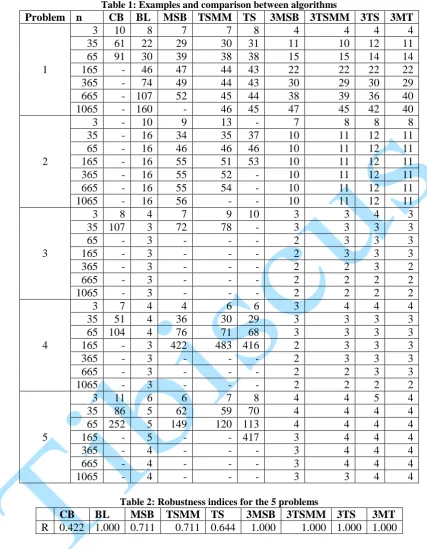
Table 1 bellow give numerical result of the five test functions used in the experiments. It can be clearly seen that the proposed schemes showed a significant improvement in the number of iterations performed as compared to CB, BL, TS, MSB and TSMM. The proposed schemes solved all the tested problems along with the BL but still showed its superiority as the dimension of variables increases by converging with lesser number of iterations.
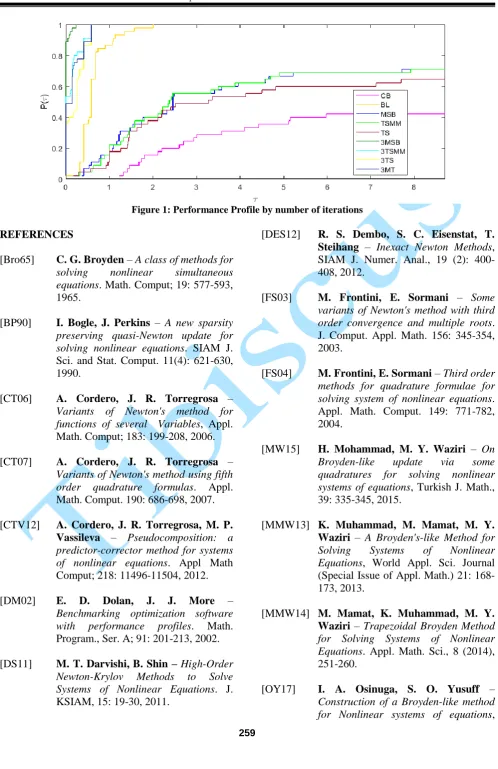
On the set of benchmark problems in Table 2, this profile uses Robustness index. The Table shows that in terms of Robustness, the proposed schemes are superior only to CB, MSB, TS and TSMM methods. In Figure 1, 3MSB, 3TSMM, 3MT, 3TS and BL climb off the graph and this indicates that they solved all the tested problems successfully. Besides, we can say that the 3MSB is the fastest solver follow by 3TSMM, 3MT, 3TS and BL based on the number of iterations pertaining to Figure 1.
4. CONCLUSION
Table 1: Examples and comparison between algorithms
Problem n CB BL MSB TSMM TS 3MSB 3TSMM 3TS 3MT
1
3 10 8 7 7 8 4 4 4 4
35 61 22 29 30 31 11 10 12 11
65 91 30 39 38 38 15 15 14 14
165 - 46 47 44 43 22 22 22 22
365 - 74 49 44 43 30 29 30 29
665 - 107 52 45 44 38 39 36 40
1065 - 160 - 46 45 47 45 42 40
2
3 - 10 9 13 - 7 8 8 8
35 - 16 34 35 37 10 11 12 11
65 - 16 46 46 46 10 11 12 11
165 - 16 55 51 53 10 11 12 11
365 - 16 55 52 - 10 11 12 11
665 - 16 55 54 - 10 11 12 11
1065 - 16 56 - - 10 11 12 11
3
3 8 4 7 9 10 3 3 4 3
35 107 3 72 78 - 3 3 3 3
65 - 3 - - - 2 3 3 3
165 - 3 - - - 2 3 3 3
365 - 3 - - - 2 2 3 2
665 - 3 - - - 2 2 2 2
1065 - 3 - - - 2 2 2 2
4
3 7 4 4 6 6 3 4 4 4
35 51 4 36 30 29 3 3 3 3
65 104 4 76 71 68 3 3 3 3
165 - 3 422 483 416 2 3 3 3
365 - 3 - - - 2 3 3 3
665 - 3 - - - 2 2 3 3
1065 - 3 - - - 2 2 2 2
5
3 11 6 6 7 8 4 4 5 4
35 86 5 62 59 70 4 4 4 4
65 252 5 149 120 113 4 4 4 4
165 - 5 - - 417 3 4 4 4
365 - 4 - - - 3 4 4 4
665 - 4 - - - 3 4 4 4
1065 - 4 - - - 3 3 4 4
Table 2: Robustness indices for the 5 problems
CB BL MSB TSMM TS 3MSB 3TSMM 3TS 3MT
Figure 1: Performance Profile by number of iterations
REFERENCES
[Bro65] C. G. Broyden – A class of methods for
solving nonlinear simultaneous
equations. Math. Comput; 19: 577-593,
1965.
[BP90] I. Bogle, J. Perkins – A new sparsity preserving quasi-Newton update for
solving nonlinear equations. SIAM J.
Sci. and Stat. Comput. 11(4): 621-630, 1990.
[CT06] A. Cordero, J. R. Torregrosa –
Variants of Newton's method for
functions of several Variables, Appl.
Math. Comput; 183: 199-208, 2006.
[CT07] A. Cordero, J. R. Torregrosa –
Variants of Newton's method using fifth
order quadrature formulas. Appl.
Math. Comput. 190: 686-698, 2007.
[CTV12] A. Cordero, J. R. Torregrosa, M. P. Vassileva – Pseudocomposition: a predictor-corrector method for systems
of nonlinear equations. Appl Math
Comput; 218: 11496-11504, 2012.
[DM02] E. D. Dolan, J. J. More – Benchmarking optimization software
with performance profiles. Math.
Program., Ser. A; 91: 201-213, 2002.
[DS11] M. T. Darvishi, B. Shin –High-Order
Newton-Krylov Methods to Solve
Systems of Nonlinear Equations. J.
KSIAM, 15: 19-30, 2011.
[DES12] R. S. Dembo, S. C. Eisenstat, T. Steihang – Inexact Newton Methods, SIAM J. Numer. Anal., 19 (2): 400-408, 2012.
[FS03] M. Frontini, E. Sormani – Some variants of Newton's method with third
order convergence and multiple roots.
J. Comput. Appl. Math. 156: 345-354, 2003.
[FS04] M. Frontini, E. Sormani – Third order methods for quadrature formulae for
solving system of nonlinear equations.
Appl. Math. Comput. 149: 771-782, 2004.
[MW15] H. Mohammad, M. Y. Waziri – On
Broyden-like update via some
quadratures for solving nonlinear
systems of equations, Turkish J. Math.,
39: 335-345, 2015.
[MMW13] K. Muhammad, M. Mamat, M. Y. Waziri – A Broyden's-like Method for
Solving Systems of Nonlinear
Equations, World Appl. Sci. Journal
(Special Issue of Appl. Math.) 21: 168-173, 2013.
[MMW14] M. Mamat, K. Muhammad, M. Y. Waziri – Trapezoidal Broyden Method for Solving Systems of Nonlinear
Equations. Appl. Math. Sci., 8 (2014),
251-260.
[OY17] I. A. Osinuga, S. O. Yusuff – Construction of a Broyden-like method
Annals. Computer Science Series, 15 (2): 128 -135, 2017.
[OY18] I. A. Osinuga, S. O. Yusuff –
Quadrature-based Broyden-like method
for system of nonlinear equations, Stat.
Optim. Inf. Comput., 6 (1): 130 –138, 2018.
[R+90] A. Rouse, V. Kulla, M. Lomp, T. Meresso – Test examples of systems of
nonlinear equations, Estonian Software
and Computer Service Company, Tallin, (1990).
[SAN08] A. R. Soheili, S. A. Ahmadian, J. Naghipoor – A Family of Predictor-Corrector Methods Based on Weight
Combination of Quadratures for
Solving Nonlinear Equations,
International J. Nonlinear Sci., 6: 29-33, 2008.
[SDK10] B. C. Shin, M. T. Darvishi, C. H. Kim
– A comparison of the Newton-Krylov
Method with high order Newton-like
methods to solve nonlinear systems.
Appl. Math. Comput., 217 (7): 3190-3198, 2010.
[S+16] B. Saheya, C. Guo-qing, S. Yun-kang, W. Cai-ying – A new Newton-like
method for solving nonlinear equations,
SpringerPlus, 5: 1269, 2016.
[WF00] S. Weerakoon, T. G. I. Fernando – A variant of Newton's method with
accelerated third order convergence.
Appl. Math. Lett. 13: 87-93, 2000.
[WLM 12] M. Y. Waziri, W. J. Leong, M. Mamat – A Two-Step Matrix-Free Secant Method for Solving Large-Scale
Systems of Nonlinear Equations, J.