A
A
D
D
A
A
T
T
A
A
E
E
N
N
C
C
R
R
Y
Y
P
P
T
T
I
I
O
O
N
N
S
S
T
T
A
A
N
N
D
D
A
A
R
R
D
D
(
(
D
D
E
E
S
S
)
)
B
B
A
A
S
S
E
E
D
D
W
W
E
E
B
B
S
S
E
E
R
R
V
V
I
I
C
C
E
E
S
S
S
S
E
E
C
C
U
U
R
R
I
I
T
T
Y
Y
A
A
R
R
C
C
H
H
I
I
T
T
E
E
C
C
T
T
U
U
R
R
E
E
M
Mo
os
sa
ad
do
ol
lu
uw
wa
a
N
N.
.
D
Da
ao
od
du
u,
,
A
Ar
ro
om
me
e
J
Ju
un
ni
io
or
r
G
Ga
ab
br
ri
ie
el
l,
,
B
Bo
on
ni
if
fa
ac
ce
e
K
Ka
ay
yo
od
de
e
A
Al
le
es
se
e,
,
A
Ad
de
eb
ba
ay
yo
o
A
Ad
de
et
tu
un
nm
mb
bi
i
Department of Computer Science, The Federal University of Technology, Akure Ondo State, Nigeria
Corresponding author: Arome Junior Arome, [email protected]
ABSTRACT: Web Service Security (WSS) provides message level protection between two ends of clients and
web services. This work proposes a WSS architecture
whose security will be based on Data Encryption Standard
(DES). It models a web service security based on DES, and
evaluates the performance of the WSS using some standard
metrics. To enable evaluation of the system, experiments
were conducted in a Windows Vista Operating System
environment using relevant tools. The evaluation result revealed that, deploying security alongside web services
comes with additional overheads like Extra Central
Processing Unit (XCPU) Time Cost for the message that is encrypted and to be transmitted, the server CPU Time to Process Request with Encryption (SCTPWE) increases along with the Request/Respond Time with Encryption (TRRWE), the Server CPU Time to Process Request with Encryption (SCTPWE) is greater than the Server CPU Time to Process Request without Encryption (SCTPWOE).
KEYWORDS: Web Services, Web Services Security, Web
Commerce, Information Security, Cryptography, Encryption.
1. INTRODUCTION
Web services are essentially changing the policies governing Web commerce. Today, we are witnessing better and more productive business transactions. This majorly is as a result of Web services connecting together programs at different remote locations across the globe, as well as ensuring cheaper and more efficient transportation of large amounts of data across enterprise networks.
Exchange of data between applications and/or nodes across networks are greatly facilitated by Web services. In fact [Eri00] opined that Web services enable program-to-program communication, integrating and interconnecting applications at diverse Internet locations as if they were part of a single, large Information Technology (IT) system. A Web service is a software system designed to support interoperable machine-to-machine interaction over a network. It is based on some common protocols like: (a). Extensible Markup Language (XML), which include the Simple Object Access protocol (SOAP), (b). Web Services Description Language (WSDL), which is an interface described in a machine-processable format, and
(c). Universal Description, Discovery and Integration (UDDI).
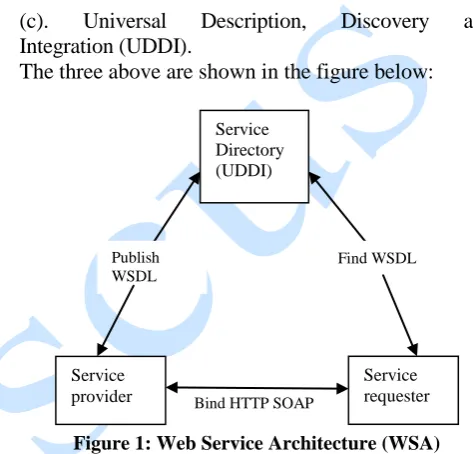
The three above are shown in the figure below:
Figure 1: Web Service Architecture (WSA)
These protocols are not dependent on the machine architecture, the underlying operating system or even the programming language. Other systems interact with the Web service in a manner prescribed by its description using SOAP messages, usually conveyed by means of HTTP, an XML serialization and other Web-related standards. A Web service provides a software interface that describes a collection of operations that can be accessed over the network through standardized XML messaging. It uses protocols based on the XML language to describe an operation to execute or data to exchange with another Web service.
Existing researches shows that IT has been used to provide different electronic solutions in education, health ([Gar11]), governance ([RK11]), shopping ([AAH06]), medicine ([Gar11]) and even in democratic decision making ([O+13]).
Although it is a good idea to apply Web services to these systems, the security (privacy, confidentiality and integrity) of information (data) while in storage and even in transit, must be given serious consideration, especially if the data in question are sensitive. There is a serious need to include a security module into the Web Service Architecture. This would go a long way in preventing attacks such as spoofing, eavesdropping, falsification and/or repudiation.
Service Directory (UDDI)
Service provider
Service requester Publish
WSDL
Find WSDL
The Transport Layer Security (TLS) is a simple and generally acceptable means of ensuring secure transactions for the Web security. However, TLS is originally intended for authenticating the server hosting the Web service; there is no means to authenticate a single service or sets of services running on the same machine. Consequently TLS can not sufficiently meet the security requirements of the Web Services system which are more intricate than Web applications.
Web services offer a standard approach to interoperating different software applications, running on diverse platforms and/or frameworks. Figure 1 shows a Web Services Architecture (WSA). This architecture provides an abstract model and a background for understanding Web services as well as the relationships between the components of this model. The WSA describes both the minimal characteristics that are common to all Web services, and a number of characteristics that are needed by many, but not all, Web services. WSA is an interoperability architecture that identifies those global elements of the global Web services network that are required for guaranteeing interoperability between Web services ([BHM04]).
A Web Service can be defined as any service that is available over the Internet, using a standardized Extensible Markup Language (XML) messaging system, it is not tied to any operating system or programming language and it is self-describing via a common XML grammar [Hon10].
Web services enable application integration and data sharing on a neutral platform, language independent environment for both business and science. This increases the degree of exposure of critical resources which poses new challenges to securing data and service. The Web services use XML (Extensible Markup Language) to pack data into XML messages defined by SOAP message, called WSDL (Web Services Description Language). With web services, applications owned by different organizations can be easily integrated; even if they are developed in different programming languages and deployed on different platforms (Middleware/OS). As a result, web services have been widely adopted in the industry as a standard platform independent middleware technology [C+07].
In this work, Web Service Security requirements were studied from different literatures and a security mechanism, Data Encryption Standard (DES) based security architecture was proposed for the Web Services.
2. GENERAL INFORMATION
Motivation
Many research papers on Web Service Security have been published by researchers all over the world. However, the security issue of the Web Service has
often been considered as a crucial barrier to its application in many fields that conducts sensitive information, such as e-commerce [Hon10].
Booth et al., ([BHM04]) discovered that Web Service itself does not provide secure transmission protocol for messages; it brings high risks to both sides of the message exchanger. Although, traditional security technologies such as Secure Socket Layer (SSL) and Hypertext Transfer Protocol (HTTPS) can partially resolve this problem by encrypting messages transferred between two points, these point-to-point transport layer security technologies cannot insure end-to-end security along the entire path from client to a web service in a complicated multi-tiers distributed system. Furthermore, these point-to-point security technologies are all based on a specific transport protocol/layer, such as Transport Control Protocol/Internet Protocol (TCP/IP) for Secure Socket Layer (SSL) and Hypertext Transfer Protocol (HTTP) for HTTPS.
[Oas04] developed Web Services Security in other to provide message level protection between two ends (client and web service) through message integrity, message confidentiality and message authentications. Web Services Security (WSS) makes use of SOAP’s composable and extendable architecture by embedding security related information (such as, security token and signature) in the SOAP header without affecting the data stored in the SOAP’s body but may be encrypted or signed.
WSS enhances the security of web services but it has its own performance overheads. The overheads are: (a). extra CPU times to process WSS related elements (b). longer networking times to transport larger SOAP messages due to additional WSS contents. [Hon10] introduced the Security Token Service into an existing WS-Security and present a Security Token Service based Security architecture, named STS-based Secure Web Services (STS-WS) for Web Services for higher security and higher performance services. Chen et al., [C+07] carried out the performance evaluation on Web Service Security using XML Security technologies in other to evaluate the performance cost of applying Web Service Security and also developed a simple performance model for Ws-security.
So far, WSS enhances the security of Web services but it has its own performance overheads which is the extra CPU times to process WSS related elements. Hence, in this course of work, a Web Service Security performance will be modeled and the performance evaluation of WSS will be carried out using DES technology to check the cost effectiveness of security on web service taking WSS overhead into account. This work is specifically;
(b) modeled a DES based Web Services Security Performance; and
(c) evaluated the performance of Web Services Security (WSS) using some standard metrics.
3. SYSTEM ANALYSIS AND DESIGN
Performance Evaluation of Web Service Security
WSS improves the security of web services. However, WSS incurs additional performance overheads to standard web services owing to additional CPU processing and larger messages transferred.
This WSS overhead was evaluated in [C+07]. The authors designed a web service that was benchmarked with and without WSS Security policies and their results were compared. A simple request/reply style messaging was used as benchmark. This consists of a client and a web service. The client sends the web service a request for a list of customer records. For flexible testing configuration, the request contains information required for a specific test such as message sizes and security setting was designed. The web service receives the request and replies by sending back a specific amount of customer records with/without applying WSS policies according to the information in the request.
The prototyping was done in C# and deployed on Microsoft NET Framework 2.0 with WSE 2.0. In addition, XML security technology was used to carry out the performance evaluation on web service security [C+07].
3.1. The Proposed Model
In order to reach the goal of implementing this work, the work was carried out using a symmetric key cryptographic scheme (DES). This scheme provides for confidentiality and Integrity of messages, by encrypting such messages. DES also makes use of a secret key to preventing unauthorized access to data/information that has been encrypted. DES scheme is important for the protection of government, commercial, school and private information whether in store or on transit.
3.2 Data Encryption Standard (DES)
DES is a Symmetric cryptographic algorithm that enables the transformation of information from a clear plaintext form to an unintelligible coded form called cipher-text ([G+13]).
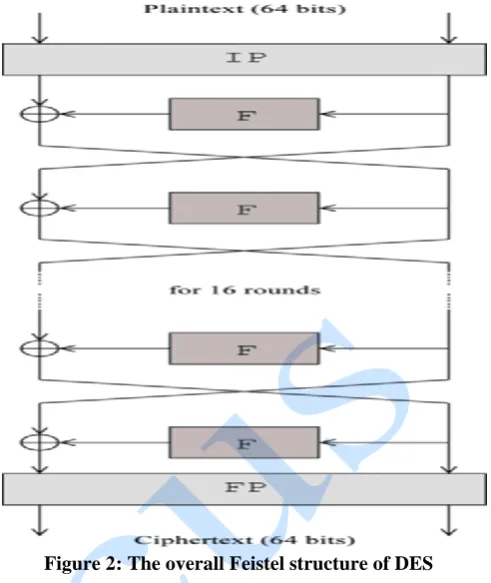
DES is a block cipher, so it operates on a single chunk of data at a time encrypting 64 bits (8bytes) of plain text which can produce 64bits of cipher-texts. The key length is 56 bits which is equivalent to 8 characters with extra bit used as parity check.
Figure 2: The overall Feistel structure of DES
The algorithm has 19 stages. The first stage record 64 bit input block by applying a fixed permutation while the last stage is the exact inverse of the permutation. During each iteration, the algorithm takes in two 32-bit inputs and produces two 32-bit outputs. The left output is simply a copy of the right input. The right output is the exclusive OR (XOR) of the left input [DMH01].
3.2.1 Mathematical Theory of Data Encryption Standard (DES)
DES exhibits the complementation property as follow:
(1)
where;
denotes encryption with key K & denotes plaintext blocks.
3.2.2 DES-WS Architecture Overview
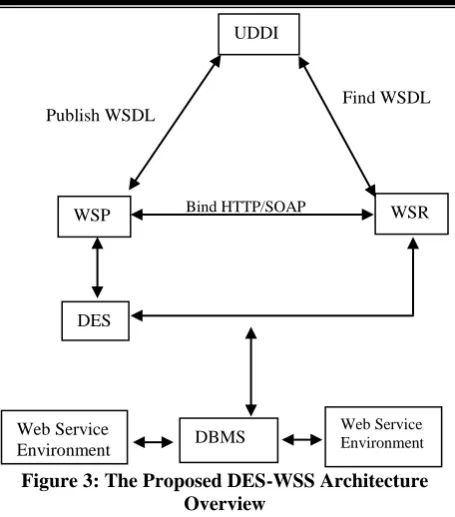
The DES-WS architecture in Figure 3 is made up of four (4) components; the UDDI, Web Service Requester (WSR), Web Service Provider with DES (WSP-DES), and a Database Management System of student record to be encrypted (DBMS).
Figure 3: The Proposed DES-WSS Architecture Overview
3.3 Performance of Web Services Security
In determining the performance of web services security, the additional time cost on message transmission as well as the additional time cost on processing the security content of the message is considered.
The performance of web services security can be captured as follows;
(2)
where:
Pwss = Performance of web services security
Pws = Performance of web services without security Tsmt = Additional time cost on SOAP message Transmission
Tscp = Additional time cost on processing the secured content of messages
3.4 Web Service Request and Response Interface
This is the Interface which shows the result of the requested information and the respond to the information with or without encryption. It also shows the extra CPU time cost for processing the encryption. The following data are shown on the Interface:
REQINFO: Number of requested information LRCWOE: Length of requested content without
encryption
TRRWOE: Request/Respond time without encryption
SCTPWOE: Server CPU time to process request without encryption (milsec)
Figure 4: Web Service Request and response Interface
XCPU: the extra CPU time cost for processing the encryption=SCTPWE-SCTPWOE
LRCWE: Length of requested content with encryption
TRRWE: Request/Respond time with encryption SCTPWE: Server CPU time to process request
with encryption (milsec).
3.5 Performance Evaluation
Table 4.1 shows the performance evaluation of the Web Service Request and Respond Output of seven (7) records of students obtained with or without encryption.
Table 4.1 Web Service Request and Response Output table. We further evaluated with the aid of graph. The graphs showing the performance evaluation are printed out from the PDF file which is on the Web Service Request/Response Interface.
3.5.1 Graph of Extra Server CPU Time Cost for Processing Encryption (XCPU)
Figure 5. Graph of Extra Server CPU time cost for processing encryption (milsec)
This graph shows the XCPU for the seven (7) records that are requested for.
Find WSDL Publish WSDL
Bind HTTP/SOAP
DES
UDDI
WSP WSR
DBMS Web Service
Environment
3.5.2 Graph of SCTPWE and TRRWE
Figure 6: Graph of SCTPWE and TRRWE
This graph shows the Server CPU Time to Process Request with Encryption (SCTPWE) in conjunction with the Request/Respond Time with Encryption (TRRWE). The dotted line represents SCTPWE while the thick line represents TRRWE. While SCTPWE is increasing, the TRRWE is also increasing.
3.5.3 Graph of SCTPWOE and TRRWOE
Figure 7: Graph of SCTPWE and SCTPWOE
This shows the graph of Server CPU Time to Process Request without Encryption (SCTPWOE) and Request/Respond Time without Encryption (TRRWOE). The time it took the Server CPU to
process the request without encryption is smaller than the Request/Respond time.
3.5.4 Graph of SCTPWE and SCTPWOE
Figure 8: Graph of SCTPWOE and TRRWOE
This graph compares the Server CPU Time to Process Request with Encryption (SCTPWE) and Server CPU Time to Process Request without Encryption (SCTPWOE). From the graph, it is clear that the SCTPWE execution time is greater than the SCTPWOE execution time and this difference gives what is known as the XCPU time which is major challenge in the Web Service Security (WSS). Though the advantage of WSS is greater when compare to its disadvantage.
3.5.5 Graph of TRRWE and TRRWOE
This graph shows the time of request/respond for information with encryption and the information without encryption. The execution time of the request/respond of information with encryption is greater than the execution time of the request/respond of information without encryption.
Table 1. Performance evaluation of Web Services on the R
REQ INFO LRCWOE TRRWOE SCTPWOE LRCWE TRRWE SCTPWE XCPU
1 1332 31 15 1708 1544 1528 1513
2 3783 125 94 4853 515 468 374
3 5121 63 47 6571 422 390 343
4 6822 78 63 8760 577 562 499
5 7957 78 62 10231 609 593 531
6 8708 110 94 11207 655 655 561
7 9090 125 109 11698 718 702 593
4. CONCLUSIONS
Lack of security can bring about threats to the message/information requested for, and the entire network infrastructure. Keeping messages secure by encryption will to a great extent, ensure their Integrity, Privacy and Confidentiality is not compromised.
REFERENCES
[AAH06] C. P. Adelina, K. Ali, Hishamnddin –
E-Commerce: A study on online shopping in Malaysia. Journal of Social Science. 3(3), 231-242.
[BHM04] D. Booth, H. Haas, F. McCabe – Web Services Architecture, W3C Working Group Note. http://www.w3c.org/TR/ws-arch/ 2004.
[C+07] S. Chen, B. Yan, J. Zic, R. Liu, A. Ng, Evaluation and Modelling of Web Services Performance, In Proceedings in the IEEE International Conference on Web Services (ICWS'07). 2007.
[Dou04] E. Douglas - Computer Networks and Internets with Internet Application P. p542-596, 2004.
[DMH01] O. Donal, P. Michael, T. Hitesh -
Electronic Payment Systems for E-commerce. Second Edition. Pp22. 2001.
[Enc12] C. Encyclopedia - The Colombia Electronic Encyclopedia, sixth edition. Colombia University Press. 2012.
[Eri00] N. Eric - Understanding Web Services. Addison Wesley Professional. p.7, 2000.
[Gar11] A. Gartner - E-health for a Healthier Europe. Retrieved online at
www.calliope-etwork.eu/Linkclick.aspx, 2011
[G+13] J. A. Gabriel., B. K. Alese, A. O.
Adetunmbi, O. S. Adewale – Post-Quantum Crystography: A Combination of Post-Quantum Cryptography and Steganograph. International Conference for Internet Technology and Secured Transactions, United Kingdom. December 2013.
[Hon10] K. Hongzhao - A Study on the Security Mechanism for Web Services. In Proceedings of the World Congress on Engineering and Computer Science 2010 Vol. I WCECS 2010, October 20- 22, 2010, San Francisco, USA
[OASIS04] OASIS Web Services Security - Web Services Security: SOAP Message Security 1.0 (WSSecurity 2004), 01
March 2004. http://docs.oasis- open.org/wss/2004/01/oasis-200401-wsssoap-message-security-1.0.pdf.
[OMA11] O. M. Olaniyan, T. Mapayi, S. A. Adejumo – A Proposed Multiple Scan Biometric-Based System for Electronic Voting, African Journal of Computing and ICT (Journal of IEEE Nigeria Computer Section), 4(2), 9 – 16. 2011.
[O+11] O. M. Olaniyi, O. T. Arulogun, E. O. Omidiora, O. Adeoye - Design of Secure Electronic Voting System Using Multifactor Authentication and Cryptographic Hash Functions, International Journal of Computer and Information Technology (IJCIT),2 (6),pp 1122-1130. 2013.