The Effect of Exchange-Correlation Holes on the Temperature Dependent
Dynamic Dielectric Function of Single-Layer Quantum Wells and Coupled
Nanolayers
S. A. Hashemizadeh*, Vahdat Rafee
Physics Department, faculty of science, Payame Noor University, Po box 19395-3697 Tehran, Iran
Abstract
In this paper, for the first time we have studied theoretically the
effect of exchange-correlation holes around electrons in GaAlAs/GaAs/GaAlAs nanostructure on the
temperature-dependent dynamic dielectric function of two-dimensional electron
gas by employing random phase, STLS and Hubbard approximations. Also, we have investigated another interesting
system which is coupled quantum wells structure. To make a good
comparison and show the effect of local field, the numerical results have been compared with those obtained within RPA which
considers long-range interactions and ignores exchange-correlation
effects completely. We found that taking into account the exchange-correlation effects changes considerably the values of
dynamic dielectric function at low electron densities at finite temperatures.
2014 JNS All rights reserved
Article history:
Received 11/10/2013 Accepted 20/12/2013 Published online 1/3/2014
Keywords:
Temperature-dependent Dielectric Function, Double Nanolayer
Exchange-Correlation Hubbard Approximation
*Corresponding author:
E-mail address:
[email protected] Phone: 98 9134518188 Fax: +98 21 22485929
1. Introduction
Since more than two last decades nanotechnology
has been received great deal of attention from
researchers working in different fields of science. Nanostructures, in which incresed surface effects are
responsible for outstanding properties, have been
studied theoretically by quantum many-particle theory. In the heart of this theory there is dynamic
dielectric function that includes necessary
information about electron-electron interaction and
lots of more in a many body system. The famous
random phase approximation (RPA) dielectric
function which considers the long-range Coulomb
interaction has been used to calculate a lot of different quantities in the highly interesting quantum
layers (2DEGS) so far. Although, the RPA dielectric function provides a satisfactory description of the
electron gas systems, its validity is limited to high
electron densities [1] though. At low electron
the RPA calculations is not positive for small
inter-particle separations. This non-physical prediction is
due to ignoring the short-range interactions. By
introducing the so-called local field corrections which take into account the exchange and correlation hole
around each electron, the RPA results is modified [2]. The first improvement of the RPA is the Hubbard
approximation in which the short-range exchange
interaction is accounted by an analytical expression
for the static local field factor [3]. Also, a self-consistent local field correction containing both the
exchange and correlation effects was proposed by Singwi, Tosi, Land and Sjölander (STLS) [4] who
derived a relation between the static local field
factor,G q( ), and static structure factor,S q( ). The
static structure factor that includes the contributions
from the plasmons and electron-hole excitations is
related to the dielectric function through the fluctuation-dissipation theorem. Gold and Calmels [5]
gave a sum-rule version of the STLS in
two-dimension which was in good agreement with the full STLS and the Monte Carlo results.
In this work, we investigate the effect of short-range
Coulomb interactions on the dielectric function of a GaAs-based single-layer and double-layer
two-dimensional electron gas system at low densities.
2. Theory
As it is already mentioned, the STLS approximation
for the dielectric function has been introduced to
include the short-range exchange and correlation effects which are associated with the charge
fluctuations in terms of a local field correction. The
short-range interactions can be considered by calculating the dynamic dielectric function of the
system,( , )q , a functional of the Fourier transform
of the pair-distribution function. This can provide a self-consistent scheme for calculating the dynamic
dielectric function of a 2DEG with a sheet electron
density n through these three coupled equations:
2 2
. ( )
1 ( )
2
1
( ) d v S
q v G n
q q q q q q qq (1)
01
( ) Im
( , ) S d n v
q q q (2)
00 1 ( )
1 ( ) ( , )
( , )
1 ( ) ( ) ( , )
G v v G
q q q
q
q q q
(3)
Hereq is a 2D wave vector and 0( , )q is the
non-interacting two-dimensional electronic density-density
response function [2]. Also, v( )q is the Fourier
transform of bare Coulomb interaction between two electrons in the lowest subband:
2 2
( ) ( )
s
e
v q F qL
q
(4)
( )
F qL is the form factor of the quantum well that
contained all information about geometry of system and has been calculated for an infinite rectangular
quantum well as [5]:
2 4
2 2 2 2 2 2
3 8 32 [1 ( )]
( )
4 ( 4 )
x x exp x
F x
x x x
(5)
where x qL and L and s are the quantum layer
thickness (quantum well width) and background
dielectric constant, respectively. In the STLS formalism, the integral expression for G q( ) involves
the static structure factor obtained from the assumption that the two-particle distribution function
may be decoupled as a product of two one-particle
distribution functions multiplied by the
pair-correlation function. In addition to, the static structure factor is related to the dielectric function by the
fluctuation-dissipation theorem and the dielectric function in turn, depends on the local field
corrections. It is well-known that dielectric function
function, Fourier transform of Coulomb potential and
local field correction factor as:
0
0
( ) ( , , ) ( , , ) 1
1 ( ) ( , , ) ( )
v q q T
q T
v q q T G q
(6)
where
G q
( )
is the local field correction factor which contains exchange–correlation effects and
0( , )
q
is the non-interacting electronic density-density
response function. Of course, dynamic dielectric function for double-layer case, is a determinant.
At finite temperature, the imaginary part of
0 for a2DEG system is given by [6,7]
(7)
Here N0 m*
2 and F1 2( )x is the Fermifunction of order1 2:
(8)
2
(
2
2)
A
Q
Q
and
E
F are thedimensionless temperature, wave vector, energy
and chemical potential, respectively. In a 2DEG,
the dimensionless chemical potential which
depends on the temperature as well as the electron density is obtained as:
1
( t 1)
tln e
(9)
For the real part of 0
we have:
(10)
( ) 2
a QQ and the function Mt( )x is defined
as :
2 0
( )
4 ( ) 2
x t
x
M x d
tcosh t
(11)For coupled quantum layers, we need to construct
dielectric matrix of the system and then we can use
the determinant as the dielectric function [8] as:
1 2
11 1 1
22 2 2
det ( , , , )qT T 1 V ( ) ( , , ) 1q qT V ( ) ( , , )q qT
12( ) 1( , , 1) 21( ) 2( , , 2)
V T V T
q q q q
(12)
3. Results and discussion
We have calculated the dynamic dielectric
function of single and double nanolayers within
RPA, Hubbard and STLS approximations by employing above-mentioned theory. In all
calculations the temperature is fixed and equal to
Fermi temperature. Also, the density parameter is approximately 4 that makes sense to consider our
system as a low density one. For this value of
electron density, we know that RPA results are not reliable at all and we can focus of results from
Hubbard and STLS approximations. The width of
quantum wells are 20 nm and the distance between centers of quantum wells in case of double
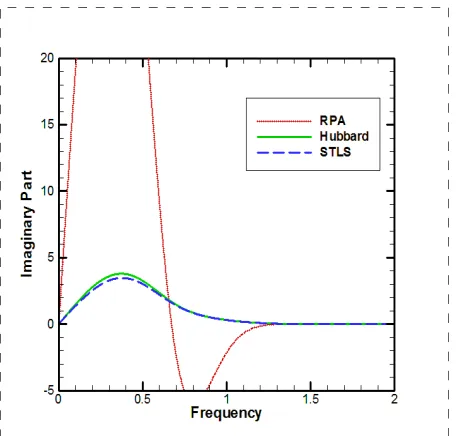
quantum wells is 50 nm. Figure 1 and 5 depict the
imaginary parts of dynamic dielectric functions calculated within all approximations for single
layer and double-layer cases respectively. In Figure
2 and 6 we have depicted results for the real parts of dielectric functions, again for single layer and
double-layer cases, respectively. Finally, in figure
3 and 7 the norm of dielectric functions have been
given within RPA, Hubbard and STLS approximations. To have an idea about the values
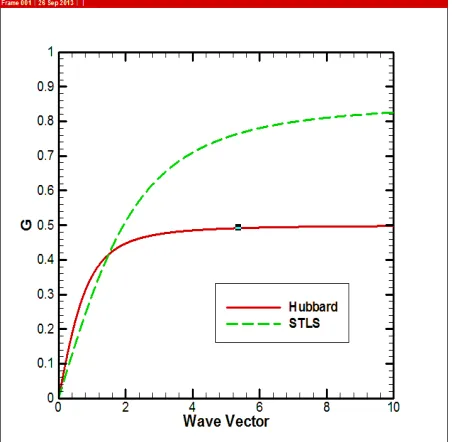
of local filed factors in Hubbard and STLS approximations, we have provided Fig. 4 in which
the local filed factors as a function of wave vector
are depicted. As we see, the exchange and correlation affect seriously on the values of
dynamic dielectric function of a quantum layer. 0
0 1 2 1 2
Im ( , )
2 2 2
t A A
q N F F
Q 1 2
1 2 0 ( )
1
( )
1
y x
y
F
x
dy
e
0 2 2
0
( ) ( )
1
Re ( , ) ( ) ( )
( ) 1 t t
Sgn a Sgn a
q N M a M a
exp t Q Q
Fig. 1. Imaginary Part of dynamic dielectric function of single nanolayer within all approximations.
Fig. 2. Real Part of dynamic dielectric function of single nanolayer within all approximations.
4. Conclusion
In the work presented here, for the first time we have concentrated our study on the effect of
exchange-correlation holes around electrons in two
different interacting many-body structures, namely, single nanolayer and coupled nanolayers.
Fig. 3. Norm of dynamic dielectric function of single nanolayer within all approximations.
Fig. 4. Local field correction factors in Hubbard and STLS approximations.
nanolayers within all approximations.
To take into account the effect of
exchange-correlation holes on the dynamic dielectrc functions of the systems, we have utilized the
Hubbard and STLS approximations. Numerical
effect is really significant in low electron density
regime.
Fig. 5. Imaginary Part of dynamic dielectric function of coupled nanolayers within all approximations.
Fig.6. Real Part of dynamic dielectric function of coupled oupled
Fig. 7. Norm of dynamic dielectric function of coupled nanolayer within all approximations.
Acknowledgment
The financial support of this work by Research
Council of Payame Noor University is gratefully acknowledged.
References
[1] A. L. Fetter and J. D. Walecka, Quantum Theory of Many-Particle Systems, McGraw-Hill, New York,
(1971).
[2] G. D. Mahan, Many-Particle Physics, Plenum,
New York, (1990).
[3] J. Hubbard, Proc. R. Soc. London A 243 (1958)
336-352.
[4] K. S. Singwi, M. P. Tosi, R. H. Land, and A.
Sjölander, Phys. Rev. 176 (1968) 589-+.
[5] A. Gold and L. Calmels, Phys. Rev. B 48 (1993)
11622-11637.
[6] K. Flensberg and B. Yu-Kuang Hu, Phys. Rev. B
52(1995) 14796-14808.
[7] T. Vazifehshenas and T. Salavati-fard, Phys. Scr.
81 (2010) 02571-02575.
[8] T. Vazifehshenas, B. Bahrami and T. Salavati-fard,