Iranian Journal of Language Teaching Research 6(2), (July, 2018) 1-21 1
* Corresponding author: Department of Teaching and Learning, College of Education, University of South Florida, Tampa, US
Email address: [email protected]
Urmia University
This article takes a critical second look at understanding idiomaticity in CALL (Computer Assisted Language Learning). The conditions markedly affecting second language teaching and learning are highlighted amidst pedagogical constructs supporting the reconstructive nature of idiomatic understanding and production in English. The ensuing discussion underscores the promise digital technologies hold for further research work on idiomaticity including, but not limited to, idiom, metaphor, simile, metonymy, hyperbole, proverb, slang, cliché, lexical bundle, phrasal expression, multiword construction, collocation, colloquialism, and tropes of figurative language. It is argued that for the purposes of diagnosis and achievement idiomaticity must be thoughtfully anchored in pedagogical paradigms requiring further examination and care. These exemplars, as the need arises across contexts and audiences, are seen as particularly useful to the development and refinement of idiomatic knowledge, especially when such knowledge reflects the judicious and purposeful use of CALL technologies, electronic tools, and digital resources. Pedagogical implications addressing idiom-learning activities and task-based digital projects are also discussed.
Keywords: idiomaticity; pragmatics; second language teaching; digital learning; learner empowerment; natural language use
© Urmia University Press
Received: 2 Oct. 2017 Revised version received: 23 Nov. 2017
Accepted: 1 Dec. 2017 Available online: 1 Jan. 2018
Refocusing the Digital Lens of Idiomaticity: A Second
Look at Understanding Idiomaticity in CALL
1John I. Liontas
a, *a
University of South Florida, US
A B S T R A C T
A R T I C L E H I S T O R Y
Content list available at http://ijltr.urmia.ac.ir
Iranian Journal
of
2 John I. Liontas/Refocusing the digital lens of …
Introduction
One of the principled goals of learning another language is the ability to use the language competently and appropriately to communicate thoughts, ideas, and interests, as the need arises across contexts and audiences. Doing so effectively and efficiently is many a time a life-long quest often pursued but rarely fulfilled. As elusive as this may sound to the ears of the untrained, professedly, there are certain conditions of learning which, if addressed with due attention, are likely to bring us one step closer to achieving greater facility with the language studied. Computer Assisted Language Learning (CALL) technologies, applications, and tools, many of which have already been reviewed elsewhere (Liontas, 2018a), can hasten and support this noble endeavor if care is taken to investigate closely the digital footprint by which understanding idiomaticity in CALL including, but not limited to, idiom, metaphor, simile, metonymy, hyperbole, proverb, slang, cliché, lexical bundle, phrasal expression, multiword construction, collocation, colloquialism, and tropes of figurative language can ultimately be achieved.
Due to space constraints, this second look at understanding idiomaticity in CALL will not investigate the effectiveness of a/synchronous m-learning (mobile learning), e-learning (electronic learning), or Web 2.0 technologies (internet-based applications and social networking services) across multifaceted idiomatic learning pursuits for doing so would only underscore arguments already published. Nor will this article explore further the CALL training practices known to affect the attainment of idiomaticity—the study of idioms and idiomatic language—in English as a second or foreign language within digital environments reflecting authentic language use. Instead, this article will focus exclusively on the five conditions believed to be instrumental to second language teaching and learning. Particular attention will be paid to how such conditions can be best utilized by language learners to foster a new kind of CALL knowledge concerning the reconstructive nature of idiomatic understanding and production in English as such (re)focus, so it will be argued throughout, is deemed particularly useful for the purposes of diagnosis and achievement. Where needed, representative research studies will be referenced to underscore the promise digital technologies hold for further research work on idiomaticity. Pedagogical implications will also be discussed.
Through the Looking Glass: A First Look
The Spanish-born American philosopher, essayist, poet, and novelist of the late nineteenth and early twentieth centuries, Jorge Agustín Nicolás Ruiz de Santayana y Borrás (1863-1952), observed that “Those who cannot remember the past are condemned to repeat it.” Whether history “repeats” itself or just “rhymes,” as Mark Twain is often reputed to have uttered the nifty humorous aphorism, “History doesn’t repeat itself but it often rhymes,” regardless, it behooves
Iranian Journal of Language Teaching Research 6(2), (July, 2018) 1-21 3
Look Back, Look Forward and Learn
For more than two decades now, we live in a brave new world, a world filled with interconnected computers and miniature notebooks, iPhones and mobile devices from A to Z. We search the internet, buy cars and houses on Ebay, order books and groceries on Amazon.com, have access to hundreds of thousands of databases all over the world, pursue careers and loved ones online, pay our bills with the click of a mouse, the touch of a button, the waving of our smartphone, and download and stream the latest music hits and movies on iTunes, Netflix, Hulu, and Amazon. In this new world, the world of digital information and superhighways paved with lightning-fast fiber optics, chatbots, artificial intelligence, and machine learning algorithms, we live, learn, work, play, shop, and entertain ourselves like never before in the annals of human communication. 24 x 7 x 365 days a year, this world tests our sensibilities, forcing us to question laws of ethics, taste, and legal issues of what is allowed and what is not. “Fake News” and hacking headlines now overshadow the daily news cycle both in mainstream broadcast news media and online social media. What used to be clear cut, a black-and-white issue, is no more. Now all that remains is a gray landscape. The line of separation is no longer visible to the naked eye. Everything goes, everything is allowed. Nowadays, 15-minutes of fame is all that we can stomach for someone making waves in the mass media. Examples need no further mention here.
No matter our convictions, this is the world we live in, this is the world we have created, these are the times that define us. There is no escaping this digital world, there is no denying it. System crashes, Trojan viruses, ID theft, lost personal data in Cyberspace have become the order of the day. Kilobytes and Megabytes, Gigabytes and Terabytes, Petabytes, Exabytes, and Zettabytes the bytes we consume to compute information. Windows, Mac, and Linux; Moodle, WebCT, Canvas, Angel, Blackboard, and Smartboard; Sakai Hot Potatoes, Photoshop, Dreamveaver, Java, and Inspiration; CSS, HTML, and XML; CD-ROM, DVD-RAM, Blue Ray, and HD our trusted course management systems and software. .txt, .doc, and .pdf; .xls, GIF, JPEG, SVGA, and XGA our newest extensions. LAN and WAN; DSL, cable modem, and broadband; Cat 5e, Cat 6, and ISP our trusted Ethernet networks; Internet Explorer, Yahoo, Firefox, and Google the browsers we employ; Wi-Fi, Bluetooth Flash, and USB the thumb and pen drives we use; and Apple Pay, Samsung Pay, and Google Pay the digital wallet payment choices we now embrace. YouTube, Facebook, Twitter, Snapchat, Instagram, Pinterest,WeChat, and WhatsApp our home away from home. We download and upload, we blog and chat, we FTP and Gopher, we Telnet and HyperTalk, we SMS and Skype, we hold Wikis, podcast, vodcast, and moodle, we write, twit, edit, and send files, sounds, pictures, selfies, ringtones, compressed videos, and texts on the fly, on a moment’s notice. iPhones, iPods, iPads, MP3s, PDAs, and GPS; USBs, Clickers, Firewire, Bluetooth, and Wi-Fi the devices we carry around, on us, in our pockets, in our purses, always within an arm’s reach, always fearful to leave home without them.
From A to Z and everything in between, virtual worlds of AR and VR included, this is the new alphabet soup being served in the 21st century and beyond. Instant communication has become
4 John I. Liontas/Refocusing the digital lens of …
manage our cryptographically protected and secured modern-day financial digital transactions and interactions without central recordkeeping—the mobile and digital crypto wallet of choice, one click, one block, one fingerprint at a time. As the saying goes, you are either “in the know” or you “go home.” You snooze, you lose. It is as simple as that.
And so it is that our brave new world has become but a stage and we merely players. We each have our entrances, we each have our exits, much like in Shakespeare’s time. On this stage, four centuries later, Google, already lauded as the largest and most comprehensive digital library in the history of the world, a multimedia explosion of mankind’s accumulated knowledge and innovation is taking place, forever changing the ways we look at our ever-shrinking global village. New technologies and apps—over 2.1 million iOS apps alone, not counting iPad apps, Apple Watch apps, Apple TV apps since the initial 800 apps offering in July 2008 (see How Many Apps Are in the App Store at https://www.lifewire.com/how-many-apps-in-app-store-2000252) or the 3.8 million Android apps in the market to date—enhance our ability to create new ideas, make discoveries, prove our theories, test our knowledge, and realize our dreams like never before. Apple’s “There’s an app for that” slogan now officially trademarked remains perhaps the most pilfered and endlessly parroted tagline since Apple’s iPhone 3GS ad campaign in 2009 first coined the phrase. There is even a tongue-in-cheek website, www.appft.com, for that witty “App For That” ubiquitous catchphrase, but I digress.
For better or for worse, this is the digital world we have created, this is the world of binary digits and algorithms sifting through masses of data our children will inherit. Many our children will inherit more, some a lot less, and few nothing but the great promise of a digital world too daring to enter, too brave to tame, too seditious to police. The Great Digital Divide—the haves and have-nots—but a distant memory first expressed in a footnote in a book on the subject now comfortably resting on a lonely dusty office shelf.
As for our students, it is no great mystery that today’s digital generation has access to music, video, images, information, and other people on demand. They create Facebook, Twitter, Snapchat, Instagram, Pinterest, WeChat, and WhatsApp accounts, YouTube videoclips, personal blogs, and podcasts/vodcasts. They communicate with smartphones and instant messaging daily. They hang out online, often on social networking websites, communicating emotional nuance and tone via universally understood and internationally standardized emoticons, emojis, symbols, and animations, forcing linguists and language professionals alike to have a field day while also pondering whether emoticons and emojis would soon become the first truly global language or what we, as a society, will lose in translation (see, for example, The Emoji Is the Birth of a New Type of Language (No Joke) at https://www.wired.com/2016/04/the-science-of-emoji/).
Iranian Journal of Language Teaching Research 6(2), (July, 2018) 1-21 5
Good, bad, and indifferent, might history offer us lessons worth revisiting or is that just the fallacy of wishful thinking? Might a trip down memory lane reveal lessons we never knew existed until now? And yet, might the pages of history littered with spurious tech episodes we rather soon forget force us to re-think the past as we attempt to build a progressive digital future? The answer, I would argue, is a resounding “Yes.”
Affirmatively so stated, studying the past can teach us lessons about not repeating the mistakes of the past. The past is our opportunity to learn today the lessons we failed to learn yesterday. It forces us to recognize our mistakes, acknowledge our failures, celebrate our successes. Simply put, lessons not learned are our past repeated. The truth of past experiences can easily be deployed as an instrument for future action. Wishing alone does not make it so. In the end, history always matters to those who seek to abandon the incorrect assumptions of choices made in the past. It matters to us all because we are the past. We are the products of our past. Diving into history puts modern problems into perspective. Embracing history breaks preconceived notions of the past. Examining history spearheads the process of knowledge creation that idle curiosity alone has forever failed to advance the present. To understand the present we must know the past to shape the future. Acknowledging the past informs the present. The past subsists in the present and is edified by it. Understanding the present invents the future. And by controlling the past we control the future—a future yet to come, a future yet to shape, a future yet to guide.
Looking at technology in the past can still teach us many a lesson today. From the mundane to the profound, lessons learned anew today from critically examining past failures can modify behavior and practices that no doubt will facilitate the continuous improvement of processes for language learning in general and idiomaticity in particular. Most assuredly, a trip down memory lane will invite new solutions to important lessons learned through trial and error. Moreover, using time-tested notions of theory-to-practice as a model for organizing research and pedagogy supports for understanding idiomaticity in CALL may well prevent us from taking the wrong turn even with our eyes held wide open. Along the way, we shall come to know what we have as yet failed to achieve and, thereby, the path of discovery, replete with zigs and zags too numerous to mention, shall become clear as day, no U-turns at intersections allowed.
Software applications once capable of running solely on mainframe computers are now present in nearly every electronic and computing device imaginable. The advent of the personal desktop computer in the late 1970s brought about technological advancements that were hard to conceive not even a few years earlier (Higgins & Johns, 1984; Last, 1989; Marty, 1981). Some of the most popular themes during the 1980s included Computer-Assisted Instruction (CAI), CALL (in particular Student Input and the Integration of Materials Into the Curriculum), Computer Assisted ESL Research (on Student Errors), Interactive Videotapes and Videodisk Approaches to Teaching, Interactive Television, Microcomputers (specifically Developing Materials for Microcomputers), Computers for Testing (Computer Assisted Testing and Computer Use for Making Tests), Using Computers for Translation, Courseware Authoring Systems, Parsing, Artificial Intelligence and Computer Assisted Instruction, and Hypertext.
6 John I. Liontas/Refocusing the digital lens of …
The arrival of the new millennium witnessed a substantial expansion of themes and foci from the previous two decades combined as well as the emergence of new digital technologies and research practices including, but not limited to, Using Literature Electronically, Multiliteracies and Digital Technologies, DVDs for Interactive Video, Tutoring through Computers and the Internet, Testing Oral Skills through the Computer, the Internet and Language Learning, Student Computer Literacy, Synchronous vs. Asynchronous Communication, Distance Language Learning and Teaching, Email, Online Courses, Attitudes and Motivation, Error Detection, Recognition, Diagnosis and Correction Using CALL, Computerized Dictionaries, Corpus Analyses, Instant Messaging/Online Chats, PowerPoint/Prezi Presentations, Website Development for ESL Learners, Web 2.0, Artificial Intelligence, Virtual Games, and Virtual/Augmented Reality.
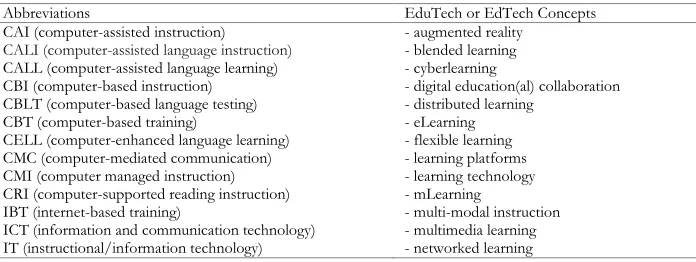
Throughout these decades, CALL widened its scope to include a variety of language learning approaches and technologies. From Traditional CALL and Explorative CALL to Multimedia CALL and Web-based CALL, many CALL practitioners set out to evaluate the integration of technology in second language learning (Alatis, 1983; Adair-Hauck, Willingham-McLain, & Youngs, 2000) or preservice foreign language teacher education programs (Wildner, 2000), others sought to investigate the expanding role of technology in foreign language teacher education programs (Hubbard, 2008; Luke & Britten, 2007), and still others put forth the argument that instructional technology really works, especially in multimedia environments (Burston, 2003; Kornum, 1993). Relatedly, some reflected critically on the processes and products involved in connecting CALL theory and practice in preservice teacher education and beyond (Arnold & Ducate, 2011; Rilling, Dahlman, Dodson, Boyles, & Pazvant, 2005), others took issue with CALL implementation and its implications on teacher training, the current uses of computers in ESOL instruction, or the role computers play in the language classroom (Daud, 1992; de Quincey, 1986; Johnson, 1987), and still others contemplated a return to interactivity, the integration of new technologies into the modern languages curriculum, and the most recent developments in technology and language learning (Liontas, 2001a, 2002a; Magrath, 2001; Stoks, 1993; Zhao, 2003). Table 1 presents a comprehensive summary of the most common typology employed in scores of articles, monographs, books, and conferences addressing education in general and second/foreign language teaching and learning in particular. Each one of those abbreviated terms (and their conceptual extensions) evokes, connotes, and denotes important paradigm shifts in the underlying pedagogies witnessed along the way—Structural CALL (1970s to 1980s), Communicative CALL (1980s to 1990s), and Integrative CALL (2000 onwards). Collectively, they embody the pedagogical bedrocks upon which many a CALL applications and components were epistemologically based
(see Warschauer & Healey, 1998; see also Blake, 2013; Chapelle, 2005; Chapelle & Jamieson, 2008; Egbert, 2005; Smith, 2016).
Table 1
Technology Terms and Concepts Use in Language/General Education
Abbreviations EduTech or EdTech Concepts
CAI (computer-assisted instruction) CALI (computer-assisted language instruction) CALL (computer-assisted language learning) CBI (computer-based instruction) CBLT (computer-based language testing) CBT (computer-based training)
CELL (computer-enhanced language learning) CMC (computer-mediated communication) CMI (computer managed instruction) CRI (computer-supported reading instruction) IBT (internet-based training)
ICT (information and communication technology) IT (instructional/information technology)
- augmented reality - blended learning - cyberlearning
- digital education(al) collaboration - distributed learning
- eLearning - flexible learning - learning platforms - learning technology - mLearning
Iranian Journal of Language Teaching Research 6(2), (July, 2018) 1-21 7
MALL (mobile-assisted language learning) TEL (technology-enhanced learning) TELL (technology-enhanced language learning) VLE (virtual learning environments)
WBT (web-based training)
- online education
- personal learning environments - ubiquitous learning
- virtual education - virtual reality
In the interim, the field of idiomaticity continued to expand its own epistemological knowledge base. Much of that research focused on investigating the theoretical and pedagogical constructs of idiom identification, recall, and use (Liontas, 2002b, 2002c, 2002d, 2003; Vasiljevic, 2015); the comprehension and production of idioms with and without contextual support (Cieślicka, 2006; Liontas, 2007); the viability of corpora to researching and teaching idiomatic expressions and phrases, idioms, collocations, lexical chunks, and multiword expressions (Gardner & Davies, 2007; Hatami, 2015; Hinkel, 2017; Liu, 2003; Macis, & Schmitt, 2016; Walker, 2011); the integration of conceptual metaphors and metonymies (Chen & Lai, 2014; Hussey & Katz, 2009) and etymological elaboration as a strategy for learning figurative idioms (Boers, Demecheleer, & Eyckmans, 2004b; Boers, Eyckmans, & Stengers, 2007); the avoidance of literal/figurative phrasal verbs and idioms (Liao & Fukuya, 2004; Martinez, & Schmitt, 2012; Yasuda, 2010); the effect of L1-L2 degree of idiom similarity (Laufer, 2000; Liontas, 2001b); the role of interlexical and intralexical factors in learning collocations (Peters, 2016); the lexical access during the production of idiomatic phrases (Sprenger, Levelt, & Kempen, 2006); the teaching of formulaic language sequences and idiomatic language in context through all four language skills in the second language classroom (Alali & Schmitt, 2012; Liontas, 2018b; Meunier, 2012; Wray, 2013); and the pedagogic value of multiword expressions (Omidian, Shahriari, & Ghonsooly, 2017) and proverbs and idioms in raising cultural awareness (Liontas 2018c) and cultural variation in comprehending and remembering figurative idioms (Boers, Demecheleer, & Eyckmans, 2004a).
Respecting matters of idiomaticity via technological constructs, a number of studies explored the application of CALL on learning idiomatic expressions (Tabatabaei, 2012) and Chinese idioms (Lewis, Luk, & Ng, 1998); the learning of Chinese idioms through iPads (Yang & Xie, 2013) and mobile devices in creating authentic content to enhance students’ personal and social meaning-making processes (Wong, Chin, Tan, & Liu, 2010; Wong & Looi, 2010); the impact mobile devices have on learning idioms and collocations in a contextualized mode (Amer, 2014) or individualized formats encouraging the taking of pictures to create artifacts depicting English idioms learnt (Foomani & Hedayati, 2016); the use of short message service (Hayati, Jalilifar, & Mashhadi, 2013) and humorous idiom video and movie clips (Abolfazli Khonbi & Sadeghi, 2017; Neissari, Ashraf, & Ghorbani, 2017) to teach and learn English idioms to EFL students; the integration of a tangible user interface device with a game-based learning strategy to facilitate idiom study (Ku, Huang, & Hus, 2015); and the anatomy and application of artificial intelligence knowledge systems for idiom learning (Liontas, 2006) and Web 2.0 internet-based applications to create and promote user-generated idiom content (Liontas, 2018a).
Through the Looking Glass: A Second Look
8 John I. Liontas/Refocusing the digital lens of …
applications, multimedia, cloud computing, interoperable systems, online games, social media, and mobile devices, to name but a few, could be methodologically based to ensure optimal digital learning in both face-to-face and blended/virtual learning environments. Because of space constraints, they are presented in Table 2 as thirty-sixterse statements only.
Table 2
Principles and Practices of Understanding Idiomaticity Language input is critical…
Authentic samples typifying idiomatic language use are a prime source of meaningful input with built-in relevance and credibility.
Accessing copious digital samples of interactive input taken from authentic conversations with native speakers of various ages, proficiency levels, and regional dialects is key to developing knowledge of idiomaticity.
Audio and video texts of various lengths and genres, from distinct facets of human interaction exhibiting (multi)cultural communicative exchanges, need to be made available for analysis and evaluation.
Reading and writing samples should be interesting and meaningful for the learner and should include informational, non-fictional, and fictional texts displaying ascending levels of difficulty in readability and cognitive complexity.
Samples chosen need to cover diverse topics and interests with an ever-increasing level of sophistication in language style, syntactic structure, semantic variation, and discourse features that typify distinct graphophonological, morphological, and grammatical qualities worth noticing in the input.
Selected samples of text, speech, and audio must equally exemplify a range of vocabulary and language functions from which to discover and extract the linguistic and metalinguistic knowledge and patterns needed for effective communication in different contexts.
Language practice is paramount…
Learning how to listen, speak, read, and write in another language, while adhering to the cultural norms and practices of the people who use the language for distinct communicative events, requires large amounts of language practice and reciprocal interaction.
Language practice involves both receptive and productive practice with a range of authentic samples displaying natural idiomatic language use.
Developing knowledge of idiomaticity requires learners to practice idiomatic language with a purpose and for a purpose within awareness raising and attention direction activities and tasks that help them create with the language even when linguistic or pragmatic success is not always assured.
Purposeful practice involving idiomatic language is best expressed in learner-centered activities, tasks, and projects in which learners are given the freedom to exercise full control over the rate, length, and quality of such practice.
Language practice needs to be couched in simple, easy-to-understand curricular and language program expectations that address learners’ figurative language needs and wants.
Receptive and productive language practice supports affective, cognitive, and behavioral processes that learners can employ profitably during communicative events requiring them to derive figurative/metaphoric meaning from literal expressions with maximum accuracy.
Language awareness is fundamental…
Language awareness dictates a move away from past habits or preferences in learning style entrenched in conventional comfort and familiarity and a renewed openness to taking risks and experimenting with the target language in (a)synchronous communicative settings employing idiomatic language use.
Awareness raising and attention direction activities designed to achieve competence in content, form (morphology, syntax, phonology), and use (pragmatics) accelerate learner attempts at restructuring and reformulating idiomatic output for maximum rhetorical effect.
Idiomatic efficiency is possible via a balanced activities approach that combines language awareness with structured idiomatic input and structured idiomatic input with purposeful communicative output while also allowing for natural error correction and increased accuracy of idiomatic appropriateness.
Communicative and explorative tasks involving idiomatic-driven discussions, role plays, and information gap exercises embolden learners to stretch themselves idiomatically beyond accepted norms of modified output for the sake of the output.
Iranian Journal of Language Teaching Research 6(2), (July, 2018) 1-21 9
exploration with naturally occurring idiomatic output.
Production of accurate and culturally appropriate idiomatic language use is best achieved when learners are afforded carefully planned opportunities to rehearse language with native speakers (writers, readers, listeners) in real-life situations.
Learner-centered work helps learners understand the hows and whys of language learning.
Leaners need to be “pushed” to go beyond simple-minded tasks and exercises that fail to offer an appropriate level of linguistic difficulty or intellectual challenge.
Learners need to experience multiple forms of input, interaction, and output and a variety of (un)structured opportunities to express themselves in the new language and culture regardless of language modality or multisensory outlet targeted.
Language play is key…
There is no substitute for actual language use with speakers of the target language and culture: interacting in the target language with a real audience is the truest form of effective teaching and learning in general and idiomaticity in particular.
Effective and efficient communicative output resembling, to the extent possible, native-like idiomatic production necessitates using the target language competently and appropriately.
Willingness to venture out of one’s comfort zone to experience language play in earnest, in real life, with real texts, and with native speakers eager to engage in discoursal exchanges and negotiations of meaning is a sure sign that one is equally open to failure under unrehearsed conditions of language usage in actual use.
Language play is at play at each and every communicative turn demanding appropriate linguistic and metalinguistic behavior from its participants.
Learners must be afforded carefully planned opportunities to play authentic roles that support active learning and meaningful language use.
Multisensory, multimodal interactions with native speakers involving natural language use are a powerful way to experience language play up close.
Authentic “language plays” make no apologies for interactive opportunities missed, for errors made, for mistakes corrected, for misunderstandings in communication resolved.
Language play experiences, from an interactional perspective, transform learners from mere passive consumers of input to active producers of output.
Language empowerment is a must…
Learners must be empowered to exercise control over their own learning just as teachers must provide for different language levels, interests, and learning styles.
Learners must be afforded carefully planned opportunities to define and refine their own learning goals both inside and outside the class where the focus of interaction is active language use rather than passive language study.
Giving learners the power to make their own decisions about idiomatic learning fundamentally changes their perception of literal and figurative language usage as such independent inquiry makes for more conscious, insightful choices about how language evolves ideas and beliefs into concrete reality passed on from one generation to the next.
Learner involvement designed to create safe environments for idiomatic learning helps learners develop a strong sense of community and even motivates them to test their language-acquiring efforts outside the safe confines of the classroom.
Carefully planned social events provide the scaffold needed for learners to perform idiomatic tasks and functions they are likely to use outside of class. They serve as powerful springboards to constructing and
deconstructingidiomatic languagewith and for a purpose.
Deconstructing idiomatic language helps learners construct idiomatic language from the ground up in that they become aware of the singular functions idioms serve in natural communication.
Idiom Deconstruction in Action, or IDA in short, serves to expedite understandings of idiomatic knowledge
and, more importantly, highlights notions of idiom appropriateness in the very communicative settings learners are expected to participate.
10 John I. Liontas/Refocusing the digital lens of …
supports befitting natural language use. Using language competently and appropriately, as the need arises across contexts and audiences, to communicate thoughts, ideas, and interests necessitates clear-cut opportunities for emulating natural communicative behavior. Some of those opportunities may need to take advantage of certain CALL technologies, hardware, and peripherals, while others may need to be organized more systematically across social and academic settings and according to students’ interests, needs, and abilities. Multifarious inputs displaying
manifold encounters with target idiomatic expressions, combined with authentic feedback, will no
doubt greatly influence the conditions of second language teaching and learning and, ultimately, the level of success achieved as each condition is certain to interact with the next, thereby creating a cascade effect with many enduring benefits. Some of these benefits, already realized in the research literature to date, are examined next.
Pedagogical Constructs Worth a Second Look
Just as one does not learn how to play the piano by looking at the piano keys or to swim by looking at the water, similarly, one does not learn to speak, read, write, and listen in another language by declaring one’s accumulated knowledge about the language and culture studied. Expressed laconically, to speak the English language, one must connect the 26 letters of the alphabet to the individual sounds (phonemes) they make and blend them to produce the 44 phonetic sounds these letters and combinations make. Said another way, one must start making categorical sounds of vowels, consonants, and blends (digraphs, trigraphs, and other letter combinations forming distinct spelling sounds) in ways that others would easily identify as phonetically distinct units of speech resembling English sounds (20 vowel phonemes derived from 5 vowel letters, 24 consonant phonemes derived from 21 consonant letters), and, furthermore, combine those sounds with other sounds to produce single units of human speech (syllables) bigger than individual speech sounds, forming either the whole word or one of the parts into which a word can be separated. These larger units of spoken language organization for a speech sound or series of speech sounds communicating distinct and meaningful elements of speech (or writing) are then used alone or with other abstract units of the lexicon (vocabulary) to form a phrase or sentence with a more or less readily identifiable meaning or lexical/grammatical function within a given discipline, field, or discourse community. What freestanding words denote and connote either individually, in combination, or cross-linguistically, how they are linked to concrete things or abstract concepts, the asymmetrical and symmetrical relations words seemingly
have between them such as polysemy (coexistence of many possible meanings for a word or
phrase), homonymy (words with identical spelling or pronunciation but different meanings and
origins), synonymy (words or phrases with nearly the same or similar meaning), antonymy (words or
phrases with opposite meanings), hyponymy (the semantic relationship between classes of words of
being subordinate), meronymy (part-to-whole relationship of constituent lexical items), and holonymy
(whole-to-part relationship of constituent lexical items), to name but the most important word
relationships, and, finally, the associative or “specialized” meanings they attain and communicate
through individual or conventionalized usage over time and space both in context-dependent and context-independent settings by different social groups, classes, ethnicities, or age groups, are all part and parcel of the dynamic medium of human communication most native speakers competently control during speech processing and production.
Iranian Journal of Language Teaching Research 6(2), (July, 2018) 1-21 11
to, the real McCoy, mind your Ps and Qs, night owl, once in a blue moon, over a barrel, pass the buck, pour oil on troubled waters, press into service, saved by the bell, sitting pretty, smoke and mirrors, the early bird catches the worm, the last straw, the pleasure is all mine, the sky’s the limit, till the cows come home, turn a blind eye, up in arms, walk the plank, wet behind the ears, what’s up, willy-nilly, worth one’s salt, zero tolerance, and the like. Individually and collectively, these figures of speech, semi-fixed and fixed expressions, set phrases, phrasal verbs, turns of phrase, idioms, and sayings of many different types, functions, origins, and frequencies, their nomenclature as manifold as the individuals creating these terms (see Liontas, 2019), are commonly used by native speakers to communicate cultural nuances and shades of meaning not always inherently present in the lexemes comprising the expressions— expressions which holistically do not mean what the individual components literally state despite the contextually-relevant encounters in which they are so frequently and purposefully uttered. Emulating the sociocultural fluency so effortlessly controlled by all competent speakers of a language is a communicative goal worth pursuing in our classrooms and beyond. To this end, conditions of learning must be created to optimize students’ receptive and productive knowledge of idiomaticity from Day One.
Allowing for some sound variation dependent on accent, dialect, and articulation, replication of speed, rate, prosody, and fluency will need to accompany such productive efforts in linguicultural learning in general and idiomatic learning in particular. During idiomatic listening, for instance, it is expected that the learner would be able to hear the segments of sound to parse them into appropriate units of meaning before replying to the communicative demands placed within the output produced. Idiomatic responses, numbering thousands upon thousands, are the result of communicative need expressed in sociocultural events, not the cause of it. If the resulting behavior in listening, followed by reciprocal production in speech (or writing), were appropriate to the situation at hand, listening as a skill couched in meaningful idiomatic speech would be termed successful. A similar linguicultural behavior is expected in the application of idiomatic language during reading and writing. Depending on quantity and quality of idiomatic samples available for review and time spent studying or controlling those samples to decipher and extract the building blocks of language learning, attempts at producing “idiomatic” language will be short lived unless one also has the opportunity to practice language with native speakers (writers, readers, listeners) in real-life situations. In so doing, one must be encouraged and be willing to take risks with the target language in both synchronous and asynchronous communicative events.
12 John I. Liontas/Refocusing the digital lens of …
plays are the “real McCoy.” There is no escaping them. There is no denying them. In such situations, one’s true mettle will surely be tested. And there will be no warning shot across the bow either. Once one steps inside the metaphoric sandbox of language play, the shoes are likely to be met with sand, the hands likely to get dirty. Even so, learners must be afforded opportunities to play authentic roles that support active idiomatic learning and meaningful language use. Where possible, opportunities must involve multimodal/multisensory interactions with native speakers in contexts befitting natural language use. Both CALL and MALL technologies, in all their “digital” manifestations to date and those yet to come, can provide unparalleled authentic language practice that is second to none.
For learners to develop idiomatic competence in pragmatic communication, that is, “the ability to understand and use idioms appropriately and accurately in a variety of sociocultural contexts, in a manner similar to that of native speakers, and with the least amount of mental effort” (Liontas, 2003, p. 299), they must be afforded opportunities to engage in age-appropriate activities that can easily be adapted to suit their specific needs, contexts, and comfort levels. In turn, activities must promote active language use couched in carefully-planned multimodal tasks requiring (un)structured input that is both rich and meaningful. Some tasks could be specifically designed for individuals, others for partners and small groups, and still others for whole-class interactions and dynamic discovery learning (more than a dozen such activities can be found in Liontas, 2015). Irrespective of activity or task type, all learners without exception should be made aware of the instructional rationale driving the how and why. Learners should not be left to their own devices to figure out what the goals of a particular idiom-learning activity might be or which language objective is to be mastered under what modality or condition. It is therefore pedagogically prudent that teachers inform students prior to commencing an activity or task what the goals and objectives are and how their performance is to be assessed. Ensuring that learners have the linguistic and pragmatic skills necessary to perform the activity or task successfully is yet another important consideration here. At all times, performance expectations should be commensurate with learners’ overall language proficiency and should be neither too high to reach nor too low to ignore. For best results, expectations should be placed at just the right level of linguistic challenge that is both realistic and manageable for students to achieve, especially if pragmatic enactment behaviors are to drive idiomatic performance, that is, the actual use of linguistic and pragmatic knowledge in understanding and producing appropriate and accurate idiomatic conduct in diverse social contexts. As I have affirmed elsewhere, “Requiring learners to produce idioms in ways that native speakers use them enhances learners’ mastery of them, facilitating the binding and mapping processes of idiom internalization” (Liontas, 2017, p. 14), a necessary first step toward acquiring idiomatic competence.
Iranian Journal of Language Teaching Research 6(2), (July, 2018) 1-21 13
application of a wide spectrum of instructional practices should be reserved exclusively for pedagogical treatment, in-class language practice, or active language output.
For maximum results, idiom-learning activities and task-based digital projects embodying distinct cultural concepts, free of unwarranted stress or anxiety of task completion, will need to be purposefully structured and varied to reflect technology-based conditions best met within online or hybrid (blended) environments that are conducive to language development in general and idiomatic learning in particular. To this end, learners must be provided with opportunities to interact socially and negotiate meaning as needed. They must also be given the freedom to self-select the technology, hardware, software, network, or delivery mode likely to produce for them the most powerful idiom-based product reflecting varied and creative language use. Where required, support should be offered to those learners experiencing light technical difficulties with a particular communication technology choice as “technical glitches,” many as they often are, are unavoidable and a by-product of today’s transitional, fast-paced technical landscape.
While language empowerment is a must, at times it may become pedagogically necessary to “walk the walk,” not just the talk, with learners in need of a helping hand so that they may attend more thoughtfully to the idiomatic learning process at hand. Leading by example by serving students’ communication needs is a pedagogical maxim with transformational implications worth following. It goes without saying that all learners—from the youngest attending elementary school to the oldest attending university classes—will need to have their autonomy supported and valued with enough time build into the lesson plan or unit for constructive feedback, practice, and peer review. Furthermore, idiom activities and task-based projects requiring use and manipulation of different digital media will need to be suitable to learners’ age and intellectual capacity befitting their (meta)cognitive maturity. Above all, as sure as eggs is eggs, their judicious application, both formal and informal, will need to complement and support what learners are actually trying to learn: language and culture through the digital lens of idiomaticity. Refocusing the digital lens is the first step taken on a journey of a thousand miles—a journey filled with transformative learning experiences, customized adventure lessons, and linguicultural wit not soon forgotten.
Regardless of the nature of each idiom-learning activity or task-based project, it is essential that different activities and projects also target different language skills and purposes so as to provide for a rich but measured variety of strategies students will need to employ in class or at home. Desired language skills can be taught either in isolation or in combination and should provide generous contextual supports to reinforce and promote that which is being targeted in the lesson, activity, or task such as listening/reading comprehension, vocabulary development, fluency practice, summarizing, generalizing, predicting, supporting point of view, reading/writing content organization, drawing conclusions, understanding the main point, using sight words and lexical strategies to understand unknown vocabulary, conventions of spelling, grammar and syntactic structure, word choice and figurative language use, voice, and argument evaluation to name but the most important language study skills and skill-learning strategies. In turn, these skills and strategies need to be typified in a variety of easily accessible audiovisual texts and text types representing diverse written genres at a range of readability levels. Collectively, custom-tailored skills, texts, and text types embody the dynamic idiom-learning platform upon which CALL can begin to engage learners critically in individual, pair, or group experiences that exemplify the purposes for which language is truly used in real life such as problem solving, producing, and communicating needs and interests across time and space.
14 John I. Liontas/Refocusing the digital lens of …
audiences, as evidenced in the many artifacts and media in which idiomatic language is so often used by so many of us. Across contexts, exposure and production are both critical components of learner success in language teaching and idiomatic learning respectively. Not only must learners be exposed to diverse materials and media tools, equally, they must be afforded varied opportunities to practice and produce language output that approximates native-like use and function, extralinguistic pragmatic behavior notwithstanding. Given the sheer number of web sites and materials targeting idioms (and other tropes of figurative language) online, the selection of sites, materials, and tools needs to proceed not on the basis of quantity attained, but on the basis of the quality present in these forms. Expressed differently, it is best to have access to a few good sites with representative examples of idiomatic language deemed authentic and purposeful than to have compiled a mile-long list of bookmarked web sites and resources not to be visited any time soon by either teacher or students.
Similarly, it is best to amass one’s own list of idioms (metaphors, metonymies, proverbs, clichés, similes, hyperboles, slang, multiwords, formulaic sequences, etc.) over time than to rely on sites touting thousands of idioms in their pages. The sheer quantity of “idiom lists” available on Google alone (19,600,000 results in 0.28 seconds as of May 19, 2018) or the thousands of thousands of “idioms in English” videos on YouTube (683,000 results) is enough to make anyone’s head spin with no end in sight. Type in only the word “idioms” and you are likely to have access to some 10,900,000 results in 0.31 seconds. And while any one of those sites can provide teachers with viable idiom samples, astute language teachers and CALL practitioners alike may want to select sparingly and only occasionally. Learning about figurative language in general and idioms in particular is not a mindboggling 9.58 seconds 100m world-record sprint, but an ongoing, voluntary, and self-motivating marathon run in pursuit of knowledge that far exceeds the official distance of 42.195 kilometers (26.219 miles, or 26 miles 385 yards), metaphorically speaking of course. Synchronic and diachronic analyses are two different and complimentary viewpoints that best exemplify authentic language usage at a particular moment in time, a point in the past, or over a period of time. Both account for present language state and observed changes in language development and evolution through time, and both constitute erudite understandings of idiomaticity manifested readily in form and meaning, including origins and derivations of words and idioms.
Etymological investigations of events and the surrounding circumstances that gave institutional voice to a particular idiomatic or proverbial expression is both enlightening and empowering as such investigations can transform the perspective learners hold toward the need to learn about, acquire, and employ idiomatic or figurative language in their own expression of thoughts, words, and actions via natural language. In practical terms, each new expression learned brings greater cultural appreciation for the very people who created the expression within the pragmatic constraints of their own time and space. By becoming aware of the impact and power of language, about how native speakers express themselves naturally, and how they interpret and transact meaning in distinct community transactions sans cultural violations, learners can learn a most pivotal lesson: how to express complex thoughts and ideas to describe one’s own perception of reality. In short, the command of the language itself becomes the vehicle through which idiomatic and figurative language laconically transforms reality, even if only in metaphoric, nonliteral terms.
Iranian Journal of Language Teaching Research 6(2), (July, 2018) 1-21 15
Supporting learner autonomy no doubt will have an indelible effect on understanding idiomaticity in CALL. Because empowerment is both a process and an outcome, learners can and should use language actively and creatively with the very people they seek to understand. And regardless of their familiarity or facility with the language, they must be encouraged to perform idiom-based tasks in communicative settings exemplifying natural language use. At all times, students should be encouraged to learn how to apply idiomaticity in CALL purposefully across a/synchronous digital contexts both inside and outside of the classroom. Indeed, they must be trained in the responsible and reasonable uses of multimedia communications on any device while also learning how best to employ peripherals and electronic resources in pursuit of higher achievements in language development and mastery of academic content and concepts. Doing so in socially and culturally appropriate, legal, and ethical ways helps them learn how to gather information from a variety of media sources, how to collaborate with peers and others across digital divides, and how to promote maximum conditions for language learning in general and idiomaticity in particular. By designing, developing, and publishing products of their own choosing, learners epitomize their evolving understanding of idiomaticity in CALL. Beyond that, they engage in communicative behaviors that no doubt optimize the appropriate and responsible use of a new multi-platform approach to digital learning. Taking ownership of digital learning and the means by which such interactive learning is to be demonstrated is, I would submit, the ultimate goal of applying idiomaticity in CALL with a purpose and for a purpose.
[
Conclusion
Understanding idiomaticity in CALL is a topic of immense research interest to those of us interested in pushing the digital envelope in ways yet to be fully conceived. From inception through conception to development, CALL—in all its digital communication channels and platforms (internet, social networks, cloud computing, cross-platform software/hardware, tablets, smartphones, and other portable devices) to date and those still to come in the days ahead— remains the one frontier that, in eyes of this idiomatologist at least, can easily bring about an explosion of opportunities to learn another language in digital multimodal settings that are as natural as traveling the world in person. At a minimum, our learners would be afforded heretofore unprecedented opportunities to willfully exploit universal interactions among systems, people, and places worldwide.
Beginning with a retrospective account of significant CALL events and developments affecting second language learning and practice, including common nomenclature and concepts associated with CALL technologies, this article first appraised time-tested notions of theory-to-practice within pedagogy supports befitting natural language use. The conditions affecting markedly second language teaching and learning—Input, Practice, Awareness, Play, Empowerment—were then highlighted amidst pedagogical constructs supporting the reconstructive nature of idiomatic understanding and production in English. This was followed by a series of practical implications that take full advantage of the digital and communications technologies to date. Based on students’ interests, needs, and abilities, the systematic organization and execution of idiom-learning activities and task-based digital projects across diverse social and academic settings, if addressed with attention and care, was lauded as a viable methodological framework certain to impact the success or failure of understanding idiomaticity in CALL.
16 John I. Liontas/Refocusing the digital lens of …
development of idiomatic competence in second language learners. The development and refinement of idioms and idiomatic knowledge is possible especially when such knowledge reflects the judicious use of streamlined application building and enablement platforms and analytics. At a minimum, refocusing the digital lens of idiomaticity promises greater access to computing and information resources. Taking full advantage of modern information and communications technology will no doubt exemplify a great many opportunities for language learning derived from access alone. The ability to effectively and purposefully use such technology, the many input/output software and hardware devices, peripherals, and memory storage included, can only lead to greater knowledge creation and linguicultural insights drawn from personal experience and experimentation. Notwithstanding the challenges learners are certain to encounter along the way, as many as they may be, more importantly, learners will transform themselves from passive observers of language to active producers of language, not just consumers of digital tools and software. In the process, they shall reap the benefits of idiomatology study filled with limitless potential for authentic learning and countless rewards for future language growth and achievement—a trajectory of success seemingly limited only by technology’s knotty twists and turns and the thrill and joy of unrealized risk-reward ratios exceeding expectations well beyond the basics until now. To be crystal clear, idiomatic competence is the result of language acquisition at work, not a by-product of transient technology use. Despite the promise digital technologies hold for further research work on idiomaticity, much remains to be investigated still and even more to be discovered in the days ahead. Time alone will tell if understanding idiomaticity in CALL through the looking glass was all “it’s cracked up to be.” And while the jury may still be out on CALL and idiomaticity, the path forward is clear as day: digital learning, in all its electronic manifestations, will force many of us to rethink the ways we teach and the ways our students learn across all learning areas and domains both locally and globally. It is our choice how we choose to understand idiomaticity in CALL now or in the future yet to come. The choice is ours. Ours and ours alone!
References
Abolfazli Khonbi, Z., & Sadeghi, K. (2017). Improving English language learners’ idiomatic competence: Does mode of teaching play a role? Iranian Journal of Language Teaching Research, Special issue on Idiomaticity and language teaching research, 5(3), 61-79. Adair-Hauck, B., Willingham-McLain, L., & Youngs, B. E. (2000). Evaluating the integration of
technology and second language learning. CALICO Journal, 17(2), 269-306.
Alali, F. A., & Schmitt, N. (2012). Teaching formulaic sequences: The same as or different from teaching single words? TESOL Journal, 3, 153–180.
Alatis, J. E. (1983).The application of instructional technology to language learning. CALICO Journal, 1(1),9-14.
Amer, M. (2014). Language learners usage of a mobile learning application for learning idioms and collocations. CALICO Journal, 31(3), 285–302.
Arnold, N., & Ducate, L. (Eds.) (2011). Present and future promises of CALL: From theory and research to new directions in language teaching. San Marcos, TX: CALICO Publications.
Blake, R. (2013). Brave new digital classroom: Technology and foreign language learning (2nd ed.).
Iranian Journal of Language Teaching Research 6(2), (July, 2018) 1-21 17
Boers, F., Demecheleer, M., & Eyckmans, J. (2004a). Cultural variation as a variable in comprehending and remembering figurative idioms. European Journal of English Studies, 8, 375-388.
Boers, F., Demecheleer, M., & Eyckmans, J. (2004b). Etymological elaboration as a strategy for learning figurative idioms. In P. Bogaards & B. Laufer (Eds.), Vocabulary in a second language: Selection, acquisition and testing (pp. 53-78). Amsterdam, Netherlands: John Benjamins.
Boers, F., Eyckmans, J., & Stengers, H. (2007). Presenting figurative idioms with a touch of etymology: More than mere mnemonics? Language Teaching Research, 11, 43-62.
Burston, J. (2003).Proving IT works. CALICO Journal, 20(2), 219-226.
Chapelle, C. A. (2005). Computer applications in second language acquisition: Foundations for teaching, testing, and research (4th ed). Cambridge, England: Cambridge University Press.
Chapelle, C. A., & Jamieson, J. (2008). Tips for teaching with CALL: Practical approaches to computer-assisted language learning. White Plains, NY: Pearson Education.
Chen, Y.-c., & Lai, H.-l. (2014). The influence of cultural universality and specificity on EFL learners’ comprehension of metaphor and metonymy. International Journal of Applied Linguistics, 24, 312–336.
Cieślicka, A. B. (2006). Literal salience in on-line processing of idiomatic expressions by second language learners. Second Language Research, 22(2), 115-144.
Daud, N. M. (1992). Issues in CALL implementation and its implications on teacher training. CALICO Journal, 10(1), 69-78.
de Quincey, P. (1986). Stimulating activity: The role of computers in the language classroom. CALICO Journal, 4(1), 55-66.
Egbert, J. (2005). CALL essentials: Principles and practice in CALL classrooms. Alexandria, VA: TESOL.
Foomani, E. M., & Hedayati, M. (2016). A seamless learning design for mobile assisted language learning: An Iranian context. English Language Teaching, 9(5), 206–213.
Gardner, D., & Davies, M. (2007). Pointing out frequent phrasal verbs: A corpus-based analysis. TESOL Quarterly, 41, 339–359.
Hatami, S. (2015). Teaching formulaic sequences in the ESL classroom. TESOL Journal, 6(1), 112–129.
18 John I. Liontas/Refocusing the digital lens of …
Hinkel, E. (2017). Teaching idiomatic expressions and phrases: Insights and techniques. Iranian Journal of Language Teaching Research, 5(3), 45-59.
Hubbard, P. (2008). CALL and the future of language teacher education. CALICO Journal, 25(2), 175-188.
Hussey, K., & Katz, A. (2009). Perception of the use of metaphor by an interlocutor in discourse. Metaphor and Symbol, 24, 203–236.
Johnson, N. (1987). Current uses of computers in ESOL instruction in the U.S. CALICO Journal, 5(2), 71-77.
Kornum, L. (1993). Foreign language teaching and learning in a multimedia environment. CALICO Journal, 10(3), 65-76.
Ku, D. T., Huang, Y.-H., & Hus, S.-C. (2015). The effects of GBL and learning styles on Chinese idiom by using TUI device. Journal of Computer Assisted Learning, 31(6), 505–515. Last, R. W. (1989). Artificial intelligence techniques in language learning. Chichester, England: Ellis
Horwood.
Laufer, B. (2000). Avoidance of idioms in a second language: The effect of L1-L2 degree of similarity. Studia Linguistica, 54, 186–196.
Lewis, R., Luk, R. W. P., & Ng, A. B. Y. (1998). Computer-assisted learning of Chinese idioms. Journal of Computer Assisted Learning, 14, 2–18.
Liao, Y., Fukuya, Y. J. (2004). Avoidance of phrasal verbs: The case of Chinese learners of English. Language Learning, 54, 193–226.
Liontas, J. I. (2001a). Reading and multimedia annotations: Going beyond bells and whistles, hot links and pop-up windows.The IALL Journal of Language Learning Technologies, 33(1), 53-78.
Liontas, J. I. (2001b). That’s all Greek to me! The comprehension and interpretation of modern Greek phrasal idioms. TheReading Matrix: An International Online Journal, 1(1), 1-32. Liontas, J. I. (2002a). CALL media digital technology: Whither in the new millennium? CALICO
Journal,19(2), 315-330.
Liontas, J. I. (2002b). Context and idiom understanding in second languages. In S. H. Foster-Cohen, T. Ruthenberg, & M-L. Poschen (Eds.), EUROSLA yearbook: Annual conference of the European second language association: Vol. 2 (pp. 155-185). Amsterdam/ Philadelphia: John Benjamin Publishing Company.
Iranian Journal of Language Teaching Research 6(2), (July, 2018) 1-21 19
Liontas, J. I. (2002d). Transactional idiom analysis: Theory and practice. Journal of Language and Linguistics, 1(1), 17-53.
Liontas, J. I. (2003). Killing two birds with one stone: Understanding Spanish VP idioms in and out of context. Hispania, 86(2), 289-301.
Liontas, J. I. (2006). Artificial intelligence and idiomaticity. The APAMALL Higher Education Journal: Language Learning & Technology, 1(1), 1–33.
Liontas, J. I. (2007).The eye never sees what the brain understands: Making sense of idioms in second languages.Lingua et Linguistica, 1(2), 25-44.
Liontas, J. I. (2015). Developing idiomatic competence in the ESOL classroom: A pragmatic account. TESOL Journal, 6(4), 621–658.
Liontas, J. I. (2017). Why teach idioms? A challenge to the profession. Iranian Journal of Language Teaching Research, Special issue on Idiomaticity and language teaching research, 5(3), 5-25.
Liontas, J. I. (2018a). Understanding idiomaticity in CALL. In J. Perren, K. Kelch, J-s Byun, S. Cervantes, & S. Safavi (Eds.), Applications of CALL theory in ESL and EFL environments
(pp. 36-58). Hershey, PA: IGI Global Publishing.
Liontas, J. I. (2018b). Teaching idiomatic language in context. In J. I. Liontas (Ed.), The TESOL encyclopedia of English language teaching, First edition. K. T. Reynolds (Ed., Teaching vocabulary, Vol. V) (pp. 3247-3256). Hoboken, NJ: John Wiley & Sons, Inc.
Liontas, J. I. (2018c). Proverbs and idioms in raising cultural awareness. In J. I. Liontas (Ed.), The TESOL encyclopedia of English language teaching, First edition. S. Nero (Ed., Sociocultural aspects of English language teaching, Vol. V)(pp. 3641-3650). Hoboken, NJ: John Wiley & Sons, Inc.
Liontas, J. (2019, forthcoming). Teaching idioms and idiomatic expressions across the second language curriculum. In E. Hinkel (Ed.), Teaching essential units of language: Beyond single-word vocabulary. New York, NY: Routledge.
Liu, D. (2003). The most frequently used spoken American English idioms: A corpus analysis and its implications. TESOL Quarterly, 37, 671–700.
Luke, C. L., & Britten, J. S. (2007). The expanding role of technology in foreign language teacher education programs. CALICO Journal, 24(2), 253-267.
Macis, M., & Schmitt, N. (2016).Not just ‘small potatoes’: Knowledge of the idiomatic meanings of collocations. Language Teaching Research, 1-20.
20 John I. Liontas/Refocusing the digital lens of …
Martinez, R., & Schmitt, N. (2012). A phrasal expressions list. Applied Linguistics, 33, 299–320. Marty, F. (1981). Reflections on the use of computers in second language acquisition. System, 9(2),
85-98.
Meunier, F. (2012). Formulaic language and language teaching. Annual Review of Applied Linguistics, 32, 111-129.
Neissari, M., Ashraf, H., & Ghorbani, M. R. (2017). Humorous videos and idiom achievement: Some pedagogical considerations for EFL learners. Iranian Journal of Language Teaching Research, Special issue on Idiomaticity and language teaching research, 5(3), 109-127. Omidian, T., Shahriari, H., & Ghonsooly, B. (2017). Evaluating the pedagogic value of
multi-word expressions based on EFL teachers’ and advanced learners’ value judgments. TESOL Journal, 8(2), 489-511.
Peters, E. (2016). The learning burden of collocations: The role of interlexical and intralexical factors. Language Teaching Research, 20(1), 113-138.
Rilling, S., Dahlman, A., Dodson, S., Boyles, C., & Pazvant, O. (2005). Connecting CALL theory and practice in preservice teacher education and beyond: Processes and products. CALICO Journal, 22(2),213-235.
Smith, B. (2016). Technology in language learning: An overview. New York, NY: Routledge.
Sprenger, S. A., Levelt, W. J. M., & Kempen, G. (2006). Lexical access during the production of idiomatic phrases. Journal of Memory and Language, 54, 161-184.
Stoks, G. (1993). Integrating new technologies into the modern languages curriculum. CALICO Journal, 11(1), 76-93.
Tabatabaei, O. (2012). The effect of computer-assisted language learning (CALL) on learning idiomatic expressions: A case of Iranian EFL students. Language, Culture, and Translation, 1(1), 119–137.
Vasiljevic, Z. (2015). Teaching and learning idioms in L2: From theory to practice. MEXTESOL Journal, 39(4), 1-24.
Walker, C. P. (2011). A corpus-based study of the linguistic features and processes which influence the way collocations are formed: Some implications for the learning of collocations. TESOL Quarterly, 45, 291–312.
Warschauer, M., & Healey, D. (1998). Computers and language learning: An overview. Language Teaching, 31(2), 57-71.
Wildner, S. (2000). Technology integration into preservice foreign language teacher education programs. CALICO Journal, 17(2), 223-250.
Iranian Journal of Language Teaching Research 6(2), (July, 2018) 1-21 21
Wong, L.-H., & Looi, C.-K. (2010). Vocabulary learning by mobile-assisted authentic content creation and social meaning-making: Two case studies. Journal of Computer Assisted Learning, 26(5), 421–433.
Wray, A. (2013). Formulaic language. Language Teaching, 46(3), 316-334.
Yang, C., & Xie, Y. (2013). Learning Chinese idioms through iPads. Language Learning & Technology, 17(2), 12–23.
Yasuda, S. (2010). Learning phrasal verbs through conceptual metaphors: A case of Japanese EFL learners. TESOL Quarterly, 44, 250–273.
Zhao, Y. (2003). Recent developments in technology and language learning: A literature review and meta-analysis. CALICO Journal, 21(1), 7-27.
John I. Liontas, PhD, holds a doctorate in second language acquisition and teaching and is a
tenured associate professor of FL/ESOL and director and doctoral faculty of Technology in Education and Second Language Acquisition (TESLA) at the University of South Florida. He is a distinguished thought leader, author, and practitioner in the fields of applied linguistics, second language acquisition, and English as a second/foreign language and the recipient of over three dozen local, state, regional, national, and international teaching awards and honors. An active member of several (inter)national learned societies, he has participated as PI and Co-PI on several multimillion dollar funded projects. He is also the Editor-in-Chief of
the 2018 TESOL Encyclopedia of English Language Teaching (John Wiley & Sons, Inc.) and
Guest Editor of the 2017 Special Issue on Idiomaticity and Language Teaching Research
(Iranian Journal of Language Teaching Research, Volume 5, Issue 3).
1Portions of this article were first published in 2017 in The Messenger of Alfred Nobel University (Series
Pedagogy and Psychology. Pedagogical Sciences, 2(14), 229-237) and are reprinted here with the expressed permission