58
BIBECHANA
ISSN 2091-0762 (Print), 2382-5340 (Online)Journal homepage: http://nepjol.info/index.php/BIBECHANA
Publisher: Department of Physics, Mahendra Morang A.M. Campus, TU, Biratnagar, Nepal
Composite of lampblack and printer toner powder as a
low-cost counter electrode material for dye-sensitized solar cells
Prakash
Joshi
1*, Umesh Lawaju
1, Binod B.K.
11
Physics Department, Bhaktapur Multiple Campus (BMC), Tribhuvan University (T.U.),
Bhaktapur, Nepal
*
Email:
[email protected]
Article Information:
Received: September 15, 2019 Accepted: November 117, 2019
Keywords:
Carbon
Counter electrode Dye-sensitized solar cell Lampblack, Printer toner
ABSTRACT
Lampblack prepared by using a traditional mustard oil lamp was mixed with printer toner in the ratio of 1:1 by weight and the composite was used as a low-cost catalyst for the reduction of tri-iodide ions in dye-sensitized solar cells (DSCs). The X-ray diffraction (XRD) of the lampblack showed that the lampblack contains a carbonaceous material of graphitic form. The scanning electron microscope (SEM) images of the lampblack and printer toner revealed that the lampblack consists of a few tens of nanometer to 100 nanometer sized particles (or nanosheet) whereas the toner powder consists of micron sized particles. The adhesion test of the composite film on the counter electrode (CE) of the DSC showed that the composite film is firmly attached on the CE. The DSCs based on the composite yielded the overall light to electricity conversion efficiency of 3.20 % (Jsc = 7.90 mA/cm2, Voc = 0.667 V and FF = 0.607)
compared with 4.18 % efficiency (Jsc = 8.56 mA/cm2, Voc = 0.748 V and FF =
0.654) of the DSC based on platinum when the solar cells were tested in the simulated light of 100 mW/cm2.
1.Introduction
Dye-sensitized solar cells (DSCs), developed by O’Regan and Gratzel, have been attracting researchers as these photovoltaic devices can generate low-cost solar electricity compared with crystalline silicon solar cells [1-3]. A DSC is an electrochemical solar cell with a liquid electrolyte enclosed between two electrodes named photoanode and counter electrode [1]. Generally, the electrolyte is a solution of chemicals in organic solvents comprising iodide and tri-iodide ions
[4-6]. Similarly, the photoanode is a few microns thick film of interconnected titanium-dioxide (TiO2)
nano-particles coated onto a transparent conducting oxide (TCO)-glass substrate like Fluorine-doped tin-oxide (FTO)-glass substrate. Furthermore, a mono-layer of light sensitive dye molecules is chemically attached onto the surface of the nano-particles of the TiO2 film [2,5,7]. The counter
electrode (CE) is a TCO (like FTO-glass substrate) coated with a thin film of catalyst like platinum [4,8-10]. When the photoanode is irradiated with
This work is licensed under the Creative Commons CC BY-NC License.https://creativecommons.org/licenses/by-nc/4.0/
Prakash Joshi et al. / BIBECHANA 17 (2020) 58-66
59 sunlight, the dye-molecules on the photoanode emit electrons and they enter in the conduction band of the TiO2. The photoelectrons diffuse in the TiO2
film and they flow up to the CE through an external circuit. The oxidized dye-molecules obtain electrons from the iodide ions in the electrolyte and the dye molecules are regenerated [5,11,12]. On the other hand, the iodide ions are converted into iodide ions after losing the electrons and the tri-iodide ions diffuse towards the CE. The tri-tri-iodide ions capture the photoelectrons arrived at the CE and the tri-iodide ions are converted into iodide ions [1,5]. The thin film of platinum coated onto the CE serves a catalyst to accelerate the flow of the electrons from the CE to the electrolyte [6,10]. Because of excellent catalytic property for the reduction of tri-iodide ions, platinum is widely used in the fabrication of CEs of DSCs [1,13]. However, platinum is an expensive metal [6]. Thus, the use of platinum as a CE material can increase the fabrication cost of DSCs. Besides, the instability of platinum in the corrosive electrolyte used in DSCs is another concern among researchers [11,14,15]. Thus, researchers have used various types of carbon such as graphite, carbon black, carbon nanotubes, carbon nanofibers and activated carbon instead of platinum while fabricating the CEs [1,10,11,13,15-19]. Similarly, Wu et al. reported discarded toner of a printer as a catalyst for the reduction of tri-iodide ions of DSCs [20]. In this research, the composite of mustard oil based lampblack and printer toner was adopted as a novel low-cost CE material for DSCs; the printer toner (in the composite) was used as a binder (rather than a catalyst) to adhere the lampblack powder of the composite on the CEs of DSCs. The DSCs with CEs based on the composite of the lampblack and printer toner yielded comparable light to electricity conversion efficiency as the DSCs with CEs based on platinum.
2.Experimental Method
Preparation of lampblack and its characterization
Mustard oil was purchased from a local market (in Nepal). The lampblack of the mustard oil was prepared as described below. The flame of a traditional mustard oil lamp with cotton wicks was covered with a porcelain mortar (bowl) so that the lamp soot is deposited onto the inner surface of the bowl and the lampblack was collected from the porcelain mortar. The structural composition of the lampblack was analyzed by using X-ray powder diffractometer (D2 PHASER, Bruker) at Nepal Academy of Science and Technology (NAST), Nepal. Similarly, the XRD (X-ray diffraction) of the printer toner powder (available in the local market for refilling of Brother printer toner) was also obtained.
In order to explore size and shape of the mustard oil-based lampblack and printer toner, their scanning electron microscope (SEM) images were obtained. Similarly, the carbon film was prepared by doctorblading the paste of mustard lampblack and printer toner (the ratio of the two materials was 1:1 by weight in ethanol) onto a glass substrate and the SEM images of the film were also obtained after sintering the film. Similarly, thin film of printer toner was obtained by doctorblading the paste of the printer toner (in ethanol) on a glass substrate and the SEM image of the sintered film of the toner was obtained. The SEM images of all the samples were taken using LEO 435VP SEM at the Indian Institute of Technology (IIT), Roorkee, India.
Adhesion test of lampblack film without and with printer toner
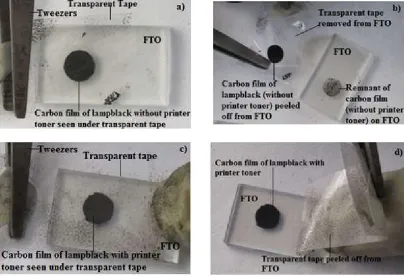
60 two types of pastes were doctobladed onto two separate FTO-glass substrates. The FTO-glass substrates with doctorbladed paste were sintered at ~100ºC. The FTOs having the sintered films of the lampblack (without and with printer toner) were covered with pieces of a transparent tape. Then the pieces of the transparent tape were removed from the FTOs to check adhesion of the carbon films on the FTOs.
Fabrication of DSCs and their characterization
In order to fabricate DSCs, counter electrodes (CEs) and photoanodes were prepared. The CEs of the DSCs were prepared as described below. First of all, FTO-glass substrates were cleaned with soap water, acetone, ethanol and distilled water successively. Then the paste of the composite of mustard oil lampblack and printer toner was doctorbladed onto the FTO. The FTO-glass substrates with the doctorbladed film of the composite were heated on a hot plate first at ~50˚C and then at ~100°C for several hours.
Similarly, the photoanodes of the DSCs were prepared following similar procedures described by Joshi [21]. Brief description of the method is given below. The paste of nano-crystalline TiO2
(Ti-Nanoxide T/SP, Solaronix, Switzerland) was doctorbladed onto the clean FTO-glass substrates. The FTO-glass substrate with the doctorbladed TiO2 film was sintered at temperature of ~100°C
for ~30 minutes and then at ~450°C for ~45 minutes. The FTO-glass substrates with sintered TiO2 film were allowed to cool down to room
temperature in air. In order to sensitize the sintered TiO2, the FTO-glass substrates with the sintered
TiO2 film were heated at ~80 °C for few minutes in
air and then they were immersed into ~0.25 mM Ruthenizer 535-bisTBA (Solaronix, Switzerland) dye solution in anhydrous ethanol at least for 12 hours.
Just before assembling the photoanodes and the CEs, the photoanodes (FTO-glass substrates with dye-sensitized TiO2 film) were removed from the
dye solution and they were washed with anhydrous
ethanol to remove unanchored dye on the TiO2
film. Then they were dried with a hot air drier to evaporate ethanol from the TiO2 film. Similarly, the
CEs with the composite film were dried to remove the adsorbed water vapour on the carbon film. The two electrodes were assembled with a piece of parafilm sheet; the parafilm served both as a sealant and a spacer (to separate the electrodes). The space between the two electrodes was filed with a liquid electrolyte containing iodide/tri-iodide ions (Solaronix) and the DSC was further sealed with hot-glue [21].
In addition to the fabrication of DSCs with the CEs based on the composite film, the DSCs with the CEs based on platinum, printer toner and only FTO (without any catalyst) were also fabricated to use them as reference cells. The photoanodes and electrolyte of these reference cells were similar with those of the DSCs with CEs based on the composite, however, the catalyst used in the reference cells were different from the previous ones (composite based DSCs). The CEs of the platinum based solar cells were prepared by coating the conducting part of FTO-glass substrates with Platisol T solution (precursor of platinum purchased from Solaronix) and sintering the FTO-glass substrates at ~450°C for 30 minutes. Similarly, the CEs of the toner based DSCs were prepared by simply doctorblading the paste of the toner powder (in ethanol) onto the FTO-glass substrates, then sintering the paste at temperature ~80°C to ~100°C. In case of the DSCs without catalyst, simply the FTO-glass substrates (without any catalyst) were used as CEs. The photovoltaic performances of the solar cells were tested in the simulated light of ~100 mW/cm2 (Abet SunLite
Solar Stimulator 11002 available at Kathmandu University, Nepal).
3.Results and Discussion
Prakash Joshi et al. / BIBECHANA 17 (2020) 58-66
61 have demonstrated that electrospun carbon nanofibers having graphitic structure of carbon possess good catalytic property for the reduction of tri-iodide ions in DSCs [1]. Thus, the lampblack with graphitic form of carbon can also be employed as the catalyst in DCSs.
Fig. 2 shows the SEM images of the lampblack powder, the printer toner powder, the film of printer toner powder and the film of lampblack/printer toner composite. Fig. 2a is the SEM image of the lampblack powder, the image shows that the lampblack consists of particles (or sheets) of a few tens of nanometer to ~100 nm. Similarly, Fig. 2b is the SEM image of the printer toner powder and the SEM image shows that the particles of the toner are irregular in shape and they are several microns in size. Fig. 2c is the SEM image of the film of the printer toner and the image reveals that the micron sized particles of the toner powder were glued together after sintering the film.
Similarly, Fig. 2d is the SEM image of the film of the lampblack and printer toner composite. The size of the particles seen in this SEM image is comparable (several microns) with the size of the particles seen in the SEM image of the printer toner powder (Fig. 2c). However, the surface of the micron-sized particles seen in the SEM image of the composite (Fig. 2d) is different from the surface of toner powder seen in the SEM image of film of the toner power only (Fig 2c). The surface of the particles seen in Fig. 2d is rougher compared with that seen in Fig. 2c. The rough surface of the particles (seen in Fig. 2d compared with those seen in Fig. 2c) can be due to the adherence of the lampblack onto the toner particles. This indicates that when the composite of the lampblack and the printer toner is used in the fabrication of CEs, the printer toner powder acts as a binder to hold the particles of the lampblack on the CEs.
Fig. 3 is the photographs of the adhesion test of the lampblack without and with printer toner powder. Fig. 3a is the photograph of the carbon film of the lampblack only (without printer toner) coated onto
an FTO-glass substrate; the carbon film was covered with a transparent tape. Fig. 3b is the photograph of the carbon film (without printer toner) after removal of the transparent tape. Similarly, Fig. 3c is the photograph of the carbon film of lampblack with the printer toner coated onto an FTO-glass substrate; the carbon film (with printer toner) was covered with a transparent tape. Fig. 3d is the photograph of the film of the lampblack and the printer toner after removal of the transparent tape. Fig. 3 shows that the carbon film of the lampblack without the printer toner detached from the FTO (Fig. 3b) whereas the carbon film of the lampblack with the printer toner remained on the FTO (Fig. 3d) after removal of the tapes. This experiment indicates that the carbon film of the composite of the lampblack and the printer toner strongly adhered on the FTO compared with the carbon film of the lampblack without the printer toner. Moreover, it implies that the printer toner in the composite is required to enhance adhesion of the particles of the lampblack on the FTO of CEs.
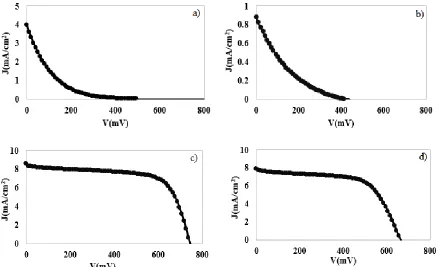
Fig. 4 shows current density- voltage (J-V) curves of DSCs. Fig. 4a, Fig. 4b and Fig. 4c are J-V curves of DSCs with CEs based on FTO (without catalyst), toner powder and platinum, respectively. Similarly, Fig. 4d is the J-V curve of the DSC with CE containing the composite of the lampblack of mustard oil lamp and the toner powder as a catalyst. The photovoltaic parameters of the DSCs calculated from the J-V curves are enlisted in Table 1.
62
0
1000
2000
3000
4000
15
35
55
75
In
ten
si
ty
(a
.u
.)
2
θ
reduction of tri-iodide ions in DSCs. However, the
𝜂(0.05%) of the DSC with CE based on the printer toner was much smaller than the η (3.20%) of the DSC with CE prepared from the lampblack and printer toner composite. Similarly, the values of the other photovoltaic parameters: short circuit current density (Jsc), open circuit voltage (Voc) and fillfactor (FF) of the toner based DSC were much smaller than those of the DSC based on the composite. This indicates that the printer toner in the composite does not play significant role of the catalyst for the reduction of the tri-iodide ions, rather it (the printer toner) plays the role of a binder to adhere the lampblack powder onto the FTO-glass substrate of the CEs, and better performance of the composite based DSCs was attributed to the catalytic ability of the lampblack.
On the other hand, the comparable photovoltaic parameters of the DSC based on the composite with those of the DSC based on the platinum indicate that the catalytic ability of the composite is comparable with that of the platinum, and the composite can be employed as a low-cost catalyst for the reduction of tri-iodide ions instead of expensive platinum metal in DSCs. However, the composite based solar cell yielded slightly lower value of the η (3.20%) compared with the η (4.18%) of the platinum based solar cell.
One of the causes of lower efficiency of the composite based solar cell can be its lower FF compared with that of the platinum based solar cell.
In a previous paper, Joshi et al. [1] have revealed that higher value of series resistance (Rs) of a DSC can cause lower value of FF and η of the device. The researchers have reported that the DSC with CE based on electrospun carbon nanofibers (ECN) yielded η of 5.5 % compared with 6.97 % efficiency from the DSC with CE based on sputtered platinum. The FF of the ECN based DSC was 0.57 and that of the platinum based DSC was 0.71. Similarly, the Rs of the ECN based device was 15.5 Ω cm2 and that of the platinum based
device was 4.8 Ω cm2; they concluded that the
lower value η of the ECN based solar cell was mainly due to the larger value of the Rs of the ECN based device compared with that of the platinum based device [1]. In this research, the values of the Rs of the DSCs based on composite and thermally deposited platinum were found to be equal to 49.410 Ω and 38.430 Ω, respectively. Thus, slightly lower value of the efficiency of the composite based DSC compared with that of the thermally deposited platinum based DSC can be due to the higher value of Rs of the composite based solar cell. Hence, the Rs of the composite based DSCs should be minimized to improve FF and η of the device. Optimization of the ratio of the lampblack and printer toner powder in the composite film may improve the FF and η of the composite based DSCs.
Prakash Joshi et al. / BIBECHANA 17 (2020) 58-66
63
Fig. 2: SEM images of a) mustard oil based lampblack powder, b) printer toner powder, c) film of sintered printer toner and d) film of mustard oil based lampblack and printer toner composite.
64
Fig. 4: Current density-Voltage (J-V) curves of DSCs with CEs based on a) FTO only (without catalyst), b) printer toner, c) platinum and d) the composite of lampblack of mustard oil lamp and printer toner.
Table 1: Photovoltaic parameters of the DSC with the composite of mustard oil based lampblack and printer toner and reference DSCs.
DSCs with CE based on
Jsc
(mA/cm2) Voc (V) FF η (%)
FTO only 3.98 0.505 0.078 0.16
Printer toner 0.89 0.414 0.132 0.05
Platinum 8.56 0.748 0.654 4.18
Composite 7.90 0.667 0.607 3.20
4.Conclusions
The composite of lampblack of mustard oil lamp and printer toner was used as a novel counter electrode material of DSCs. The printer toner used in the composite served as a binder to hold the lampblack (of the composite) on the counter electrode and the composite film showed good adhesion on FTO-glass substrates. The film of lampblack and printer toner composite exhibited rough and porous surface morphology.
Though the series resistance of the DSCs with CEs based on the composite of the lampblack of
Prakash Joshi et al. / BIBECHANA 17 (2020) 58-66
65
Acknowledgements
This research was carried out with the research grant awarded by University Grants Commission (UGC)-Nepal (Award No. SRDI-73/74-S&T-01). Thus, authors are thankful to UGC-Nepal.
The solar cells prepared under this project were tested using the standard solar cell testing system available at the Kathmandu University (K.U.) and the authors would like to acknowledge K.U. and Dr. Bhim Kafle (K.U.) for providing the facility of testing the solar cells.
Similarly, the authors are thankful to Bhaktapur Multiple Campus (BMC), T.U., Associate Prof. Dr. Krishna Prasad Pokharel (Campus Chief, BMC), Associate Prof. Sudarshana Shakya ( Assistant Campus Chief, Science, BMC), Dr. Suresh Kumar Dhungel (Nepal Academy of Science and Technology), Indian Institute of Technology (IIT)-Roorkee, Prof. Dr. Tika Katuwal (Physics Department, Tri-Chandra Multiple Campus, T.U.) and Associate Prof. Dr. Mimlal Nakarmi (Chairperson, Physics Department, the Graduate Centre, Brooklyn College, the City University of New York, USA) for their support.
References
[1] P. Joshi, L. Zhang, Q. Chen, D. Galipeau, H. Fong, Q. Qiao, Electrospun Carbon Nanofibers as Low-Cost Counter Electrode for Dye-Sensitized Solar Cells, Acs Applied Materials & Interfaces 2 (2010) 3572-3577. https://doi.org/10.1021/am100742s.
[2] H. Koo, J. Park, B. Yoo, K. Yoo, K. Kim, M. Park, Size-dependent Scattering Efficiency in Dye-sensitized Solar Cell, Inorganica Chimica Acta, 361 (2007) 677–683. 10.1016/j.ica.2007.05.017.
[3] B. O'Regan, M. Gratzel, A Low-Cost, High-Efficiency Solar-Cell Based on Dye-Sensitized Colloidal TiO2 Films, Nature 353 (1991) 737-740.
https://doi.org/10.1038/353737a0.
[4] M. Gratzel, Perspectives for Dye-sensitized Nanocrystalline Solar Cells, Prog. Photovolt. Res. Appl. 8 (2000) 171-185. https://doi.org/10.1002/(SICI)1099-
159X(200001/02)8:1<171::AID-PIP300>3.0.CO;2-U. [5] M. Gratzel, Dye-sensitized Solar Cells, Journal of
Photochemistry and Photobiology C: Photochemistry Reviews 4 (2003) 145–153. doi:
https://doi.org/10.1016/S1389-5567(03)00026-1.
[6] P. Joshi, Y. Xie, M. Ropp, D. Galipeau, S. Bailey, Q. Qiao, Dye-sensitized Solar Cells Based on Low
Cost Nanoscale Carbon/TiO2 Composite Counter
Electrode, Energy Environ. Sci. 2 (2009) 426-429.
https://doi.org/10.1039/B815947P.
[7] S. Ito, P. Liska, P. Comte, R. Charvet, P. Péchy, U. Bach, L. Schmidt-Mende, S.M. Zakeeruddin, A. Kay, M. K. Nazeeruddina, M. Gratzel, Control of Dark Current in Photoelectrochemical (TiO2/I−–
I3−) and Dye-Sensitized Solar Cells, Chemical Co mmunicatio ns 34 ( 2005) 4351 -4353.
https://pubs.rsc.org/en/content/articlelanding/2005/c
c/b505718c.
[8] C. Longo, M. D. Paoli, Dye-sensitized Solar Cells: A Successful Combination of Materials, J. Braz. Chem. Soc. 14 (2003) 889-901. http://dx.doi.org/10.1590/S0103-50532003000600005.
[9] T. Matsubara, R. Sakaguchi, H. Nagai, K. Aramaki, A. Katagiri, Measurement and Analysis of the Ser ies Resistance in a Dye Sensitized Solar Cells, Electrochemistry 73 (2004) 60-66.
https://doi.org/10.5796/electrochemistry.73.60.
[10] T. N. Murakami, A. Kay, S. Ito, Q. Wang, M. K. Nazeeruddin, T. Bessho, P. Liska, R. H. Baker, P. Comte, P. Péchy, M. Gratzel, Highly Efficient Dye-sensitized Solar cells Based on Carbon Black Counter Electrodes, J. of Electrochemical Society 153 (2006) A2255-A2261.
https://doi.org/10.1149/1.2358087.
[11] P. Joshi, Z. Zhou, P. Poudel, A. Thapa, X.F. We, Q. Qiao, Nickel Incorporated Carbon Nanotube/nanofiber Composites as Counter Electrodes for Dye-sensitized Solar Cells, Nanoscale 4 (2012) 5659-64. :
https://www.ncbi.nlm.nih.gov/pubmed/22868278.
[12] E. Ramasamy, W. J. Lee, D. Y. Lee, J. S. Song, Nanocarbon Counter Electrode for Dye Sensitized Solar Cells, Appl. Phys. Lett. 90 (2007) 173103-1-173103-3. https://doi.org/10.1063/1.2731495. [13] A. Kay, M. Gratzel, Low Cost Photovoltaic
Modules Based on Dye Sensitized Nanocrystalline Titanium Doixide and Carbon Powder, Solar Energy Materials and Solar Cells 44 (1996) 99-117. https://doi.org/10.1016/0927-0248(96)00063-3.
[14] E. Olsen, G. Hagen, S. E. Lindquist, Dissolution of Platinum in Methoxy Propionitrile Containing LiI/I2, Solar Energy Materials & Solar Cells 63
(2000) 267-273.
https://doi.org/10.1016/S0927-0248(00)00033-7.
[15] T. N. Murakami, M. Gratzel, Counter Electrodes for DSC: Application of Functional Materials as Catalysts, Inorganica Chimica Acta 361 (2008) 572–580.
https://doi.org/10.1016/j.ica.2007.09.025.
66
Cells, Solar Energy Materials & Solar Cells 79 (2003) 459–469.
https://doi.org/10.1016/S0927-0248(03)00021-7.
[17] W. J. Lee, E. Ramasamy, D.Y. Lee, J.S. Song, Efficient Dye-Sensitized Cells with Catalytic Multiwall Carbon Nanotube Counter Electrodes, Acs Applied Materials & Interfaces 1 (2009) 1145-1149.
https://doi.org/10.1021/am800249k.
[18] K. C. Sun, A. A. Memon, A. A. Arbab, I. A. Sahito, M. S. Kim, S. Y. Yeo, Y. O. Choi, Y. S. Kim, S. H. Jeong, Electrocatalytic Porous Nanocomposite of Graphite Nanoplatelets Anchored with Exfoliated Activated Carbon Filler as Counter Electrode for Dye Sensitized Solar Cells, Solar Energy 167 (2018) 95-101.
https://doi.org/10.1016/j.solener.2018.04.002.
[19] R. Kumar, S. S. Nemala, S. Mallick, P. Bhargava, Synthesis and Characterization of Carbon Based Counter Electrode for Dye Sensitized Solar Cells (DSSCs) Using Sugar Free as a Carbo n Material, Solar Energy 144 (2017) 215-220.
https://doi.org/10.1016/j.solener.2017.01.030.
[20] M. X. Wu, X. Lin, T. H. Wang, J. S. Qiu, T. L. Ma, Low-cost Dye-sensitized Solar Cell Based on Nine Kind s o f Carbo n Co unter Electrodes, Ener gy Environ. Sci. 4 (2011) 2308–2315.
https://pubs.rsc.org/en/content/articlelanding/2011/ ee/c1ee01059j.