https://doi.org/10.5194/gmd-12-4729-2019 © Author(s) 2019. This work is distributed under the Creative Commons Attribution 4.0 License.
OpenArray v1.0: a simple operator library for the decoupling
of ocean modeling and parallel computing
Xiaomeng Huang1,2,3, Xing Huang1,3, Dong Wang1,3, Qi Wu1, Yi Li3, Shixun Zhang3, Yuwen Chen1,
Mingqing Wang1,3, Yuan Gao1, Qiang Tang1, Yue Chen1, Zheng Fang1, Zhenya Song2,4, and Guangwen Yang1,3 1Ministry of Education Key Laboratory for Earth System Modeling, Department of Earth System Science,
Tsinghua University, Beijing 100084, China
2Laboratory for Regional Oceanography and Numerical Modeling, Qingdao National Laboratory for Marine Science and Technology, Qingdao, 266237, China
3National Supercomputing Center in Wuxi, Wuxi, 214011, China
4First Institute of Oceanography, Ministry of Natural Resources, Qingdao, 266061, China Correspondence:Xiaomeng Huang ([email protected])
Received: 1 February 2019 – Discussion started: 25 February 2019
Revised: 19 August 2019 – Accepted: 26 September 2019 – Published: 11 November 2019
Abstract. Rapidly evolving computational techniques are making a large gap between scientific aspiration and code implementation in climate modeling. In this work, we sign a simple computing library to bridge the gap and de-couple the work of ocean modeling from parallel computing. This library provides 12 basic operators that feature user-friendly interfaces, effective programming, and implicit par-allelism. Several state-of-the-art computing techniques, in-cluding computing graph and just-in-time compiling, are em-ployed to parallelize the seemingly serial code and speed up the ocean models. These operator interfaces are designed using native Fortran programming language to smooth the learning curve. We further implement a highly readable and efficient ocean model that contains only 1860 lines of code but achieves a 91 % parallel efficiency in strong scaling and 99 % parallel efficiency in weak scaling with 4096 Intel CPU cores. This ocean model also exhibits excellent scalability on the heterogeneous Sunway TaihuLight supercomputer. This work presents a promising alternative tool for the develop-ment of ocean models.
1 Introduction
Many earth system models have been developed in the past several decades to improve the predictive understanding of the earth system (Bonan and Doney, 2018; Collins et al.,
2018; Taylor et al., 2012). These models are becoming in-creasingly complicated, and the amount of code has ex-panded from a few thousand lines to tens of thousands or even millions of lines. In terms of software engineering, an increase in code causes the models to be more difficult to develop and maintain.
The complexity of these models mainly originates from three aspects. First, more model components and physical processes have been embedded into the earth system mod-els, leading to a 10-fold increase in the amount of code (e.g., Alexander and Easterbrook, 2015). Second, some heteroge-neous and advanced computing platforms (e.g., Lawrence et al., 2018) have been widely used by the climate modeling community, resulting in a 5-fold increase in the amount of code (e.g., Xu et al., 2015). Last, most of the model pro-grams need to be rewritten due to the continual development of novel numerical methods and meshes. The promotion of novel numerical methods and technologies produced in the fields of computational mathematics and computer science have been limited in climate science because of the extremely heavy burden caused by program rewriting and migration.
transiting the current earth system models to the next gen-eration of computing environments will be highly challeng-ing and disruptive. Overall, complex codes in earth system models combined with rapidly evolving computational tech-niques create a very large gap between scientific aspiration and code implementation in the climate modeling commu-nity.
To reduce the complexity of earth system models and bridge this gap, a universal and productive computing library is a promising solution. Through establishing an implicit par-allel and platform-independent computing library, the com-plex models can be simplified and will no longer need ex-plicit parallelism and transiting, thus effectively decoupling the development of ocean models from complicated parallel computing techniques and diverse heterogeneous computing platforms.
Many efforts have been made to address the complex-ity of parallel programming for numerical simulations, such as operator overloading, source-to-source translator, and domain-specific language (DSL). Operator overloading sup-ports the customized data type and provides simple opera-tors and function interfaces to implement the model algo-rithm. This technique is widely used because the implemen-tation is straightforward and easy to understand (Corliss and Griewank, 1994; Walther et al., 2003). However, it is prone to work inefficiently because overloading execution induces nu-merous unnecessary intermediate variables, consuming valu-able memory bandwidth resources. Using a source-to-source translator offers another solution. As indicated by the name, this method converts one language, which is usually strictly constrained by self-defined rules, to another (Bae et al., 2013; Lidman et al., 2012). It requires tremendous work to de-velop and maintain a robust source-to-source compiler. Fur-thermore, DSLs can provide high-level abstraction interfaces that use mathematical notations similar to those used by do-main scientists so that they can write much more concise and more straightforward code. Some outstanding DSLs, such as ATMOL (van Engelen, 2001), ICON DSL (Torres et al., 2013), STELLA (Gysi et al., 2015), and ATLAS (Deconinck et al., 2017), are used by the numerical model community. Although they seem to be source-to-source techniques, DSLs are newly defined languages and produce executable pro-grams instead of target languages. Therefore, the new syntax makes it difficult for the modelers to master the DSLs. In ad-dition, most DSLs are not yet supported by robust compilers due to their relatively short history. Most of the source-to-source translators and DSLs still do not support the rapidly evolving heterogeneous computing platforms, such as the Chinese Sunway TaihuLight supercomputer which is based on the homegrown Sunway heterogeneous many-core pro-cessors and located at the National Supercomputing Center in Wuxi.
Other methods such as COARRAY Fortran and CPP tem-plates provide alternative ways. Using COARRAY Fortran, a modeler has to control the reading and writing operation of
each image (Mellor-Crummey et al., 2009). In a sense, one has to manipulate the images in parallel instead of writing se-rial code. In term of CPP templates, it is usually suitable for small amounts of code and difficult for debugging (Porkoláb et al., 2007).
Inspired by the philosophy of operator overloading, source-to-source translating and DSLs, we integrated the ad-vantages of these three methods into a simple computing li-brary which is called OpenArray. The main contributions of OpenArray are as follows:
– Easy to use.The modelers can write simple operator ex-pressions in Fortran to solve partial differential equa-tions (PDEs). The entire program appears to be serial and the modelers do not need to know any parallel com-puting techniques. We summarized 12 basic generalized operators to support whole calculations in a particular class of ocean models which use the finite difference method and staggered grid.
– High efficiency.We adopt some advanced techniques, including intermediate computation graphing, asyn-chronous communication, kernel fusion, loop optimiza-tion, and vectorizaoptimiza-tion, to decrease the consumption of memory bandwidth and improve efficiency. Perfor-mance of the programs implemented by OpenArray is similar to the original but manually optimized parallel program.
– Portability. Currently OpenArray supports both CPU and Sunway platforms. More platforms including GPU will be supported in the future. The complexity of cross-platform migration is moved from the models to Ope-nArray. The applications based on OpenArray can then be migrated seamlessly to the supported platforms. Furthermore, we developed a numerical ocean model based on the Princeton Ocean Model (POM; Blumberg and Mel-lor, 1987) to test the capability and efficiency of OpenArray. The new model is called the Generalized Operator Model of the Ocean (GOMO). Because the parallel computing details are completely hidden, GOMO consists of only 1860 lines of Fortran code and is more easily understood and maintained than the original POM. Moreover, GOMO exhibits excel-lent scalability and portability on both central processing unit (CPU) and Sunway platforms.
2 Concepts of thearray,operator, andabstract staggered grid
In this section, we introduce three important concepts in Ope-nArray:array,operator, andabstract staggered gridto illus-trate the design of OpenArray.
2.1 Array
To achieve this simplicity, we designed a derived data type,
Array, which inspired our project name, OpenArray. The new
Arraydata type comprises a series of information, including a 3-dimensional (3-D) array to store data, a pointer to the computational grid, a Message Passing Interface (MPI) com-municator, the size of the halo region, and other information about the data distribution. All the information is used to ma-nipulate theArrayas an object to simplify the parallel com-puting. In traditional ocean models, calculations for each grid point and thei,j, andkloops in the horizontal and vertical directions are unavoidable. The advantage of taking the Ar-rayas an object is the significant reduction in the number of loop operations in the models, making the code more intu-itive and readable. When using the OpenArray library in a program, one can usetype(Array)to declare new variables.
2.2 Operator
To illustrate the concept of an operator, we first take a 2-dimensional (2-D) continuous equation solving sea surface elevation as an example:
∂η ∂t +
∂DU ∂x +
∂DV
∂y =0, (1)
whereηis the surface elevation,UandV are the zonal and meridional velocities, and D is the depth of the fluid col-umn. We choose the finite difference method and staggered Arakawa C grid scheme, which are adopted by most regional ocean models. In Arakawa C grid,Dis calculated at the cen-ters,U component is calculated at the left and right side of the variableD, andV component is calculated at the lower and upper side of the variableD(Fig. 1). Variables (D, U, V) located at different positions own different sets of gird incre-ments. Taking the term ∂DU∂x as an example, we firstly apply linear interpolation to obtain theD0s value atUpoint repre-sented by tmpD. Through a backward difference to the prod-uct of tmpD and U, the discrete expression of ∂DU∂x can be obtained.
tmpD(i+1, j )=0.5·(D(i+1, j )+D(i, j ))
·U (i+1, j ), (2)
and
∂DU ∂x =
tmpD(i+1, j )−tmpD(i, j )
dx(i, j )∗
= 1
2·dx(i, j )∗·((D(i+1, j )+D(i, j ))·U (i+1, j ) −(D(i, j )+D(i−1, j ))·U (i, j )) ,
(3) where dx(i, j )∗=0.5·(dx(i, j )+dx(i−1, j )).
In this way, the above continuous equation can be dis-cretized into the following form.
ηt+1(i, j )−ηt−1(i, j ) 2·dt
+ 1
2·dx(i, j )∗·((D (i+1, j )+D (i, j ))·U (i+1, j ) −(D (i, j )+D (i−1, j ))·U (i, j ))
+ 1
2·dy(i, j )∗((D (i, j+1)+D (i, j ))·V (i, j+1) −(D (i, j )+D (i, j−1))·V (i, j ))=0, (4) where dx(i, j )∗=0.5·(dx(i, j )+dx(i−1, j )),dy(i, j )∗= 0.5·(dy(i, j )+dy(i, j−1)), and subscriptsηt+1andηt−1 de-note the surface elevations at the (t+1) time step and (t−1) time step. To simplify the discrete form, we introduce some notation for the differentiation (δfx,δby) and interpolation (()xf,
()yb). Theδand overbar symbols define the differential oper-ator and average operoper-ator, respectively. The subscriptxory
denotes that the operation acts in thexorydirection, and the superscript f or b denotes that the approximation operation is forward or backward.
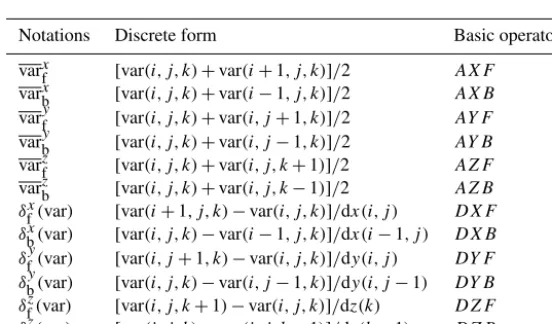
Table 1 lists the detailed definitions of the 12 basic opera-tors. The term var denotes a 3-D model variable. All 12 op-erators for the finite difference calculations are named using three letters in the form [A|D][X|Y|Z][F|B]. The first letter contains two options,AorD, indicating an average or a dif-ferential operator. The second letter contains three options,
X,Y, orZ, representing the direction of the operation. The last letter contains two options,F orB, representing forward or backward operation. The dx, dy, and dzare the distances between two adjacent grid points along thex,y, andz direc-tions.
Using the basic operators, Eq. (4) is expressed as
ηt+1−ηt−1 2·dt +δ
x f
Dxb·U+δfyDyb·V=0. (5) Thus,
ηt+1=ηt−1−2·dt·
Figure 1.Arrangement of variables in the staggered Arakawa C grid.
Table 1.Definitions of the 12 basic operators.
Notations Discrete form Basic operator
varxf [var(i, j, k)+var(i+1, j, k)]/2 AXF
varxb [var(i, j, k)+var(i−1, j, k)]/2 AXB
varyf [var(i, j, k)+var(i, j+1, k)]/2 AY F
varyb [var(i, j, k)+var(i, j−1, k)]/2 AY B
varzf [var(i, j, k)+var(i, j, k+1)]/2 AZF
varzb [var(i, j, k)+var(i, j, k−1)]/2 AZB δxf(var) [var(i+1, j, k)−var(i, j, k)]/dx(i, j ) DXF δxb(var) [var(i, j, k)−var(i−1, j, k)]/dx(i−1, j ) DXB δyf(var) [var(i, j+1, k)−var(i, j, k)]/dy(i, j ) DY F δyb(var) [var(i, j, k)−var(i, j−1, k)]/dy(i, j−1) DY B δzf(var) [var(i, j, k+1)−var(i, j, k)]/dz(k) DZF δzb(var) [var(i, j, k)−var(i, j, k−1)]/dz(k−1) DZB
pseudo-codes (the right part), the corresponding implemen-tation by operators is more straightforward and more consis-tent with the equations.
Next, we will use the operators in shallow water equations, which are more complicated than those in the previous case. Assuming that the flow is in hydrostatic balance and that the density and viscosity coefficients are constant, and neglect-ing the molecular friction, the shallow water equations are
∂η ∂t +
∂DU ∂x +
∂DV
∂y =0, (7)
∂DU ∂t +
∂DU U
∂x +
∂DV U
∂y −f V D= −gD ∂η ∂x
+µD
∂2U
∂x2 +
∂2U ∂y2
, (8)
∂DV ∂t +
∂DU V
∂x +
∂DV V
∂y +f U D= −gD ∂η ∂y
+µD
∂2V
∂x2 +
∂2V ∂y2
, (9)
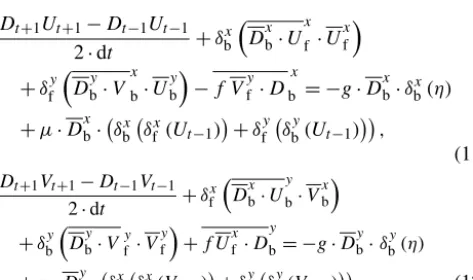
wheref is the Coriolis parameter,gis the gravitational ac-celeration, andµis the coefficient of kinematic viscosity. Us-ing the Arakawa C grid and leapfrog time difference scheme, the discrete forms represented by operators are shown in Eqs. (10)–(12).
ηt+1−ηt−1 2·dt +δ
x f
Figure 2.Implementation of Eq. (6) by basic operators. The elf and elb variables are the surface elevations at times (t+1) and (t−1), respectively.
Dt+1Ut+1−Dt−1Ut−1
2·dt +δ
x b
Dxb·Uxf ·Uxf
+δfyDyb·V
x b·U
y b
−f Vyf·D
x
b = −g·D x b·δbx(η)
+µ·Dxb· δbx δfx(Ut−1)
+δyf δyb(Ut−1)
,
(11)
Dt+1Vt+1−Dt−1Vt−1 2·dt +δ
x
f
Dxb·U y
b·V
x
b
+δby
Dyb·Vyf·Vyf
+f Uxf·D y
b= −g·D
y
b·δ
y
b(η)
+µ·Dyb· δxf δbx(Vt−1)
+δyb δyf(Vt−1)
. (12)
As the shallow water equations are solved, spatial average and differential operations are called repeatedly. Implement-ing these operations is troublesome and thus it is favorable to abstract these common operations from PDEs and encapsu-late them into user-friendly, platform-independent, and im-plicit parallel operators. As shown in Fig. 3, we require only three lines of code to solve the shallow water equations. This more realistic case suggests that even more complex PDEs can be constructed and solved by following this elegant ap-proach.
2.3 Abstract staggered grid
Most ocean models are implemented based on the stag-gered Arakawa grids (Arakawa and Lamb, 1981; Griffies et al., 2000). The variables in ocean models are allocated at different grid points. The calculations that use these vari-ables are performed after several reasonable interpolations or differences. When we call the differential operations on a staggered grid, the difference value between adjacent points should be divided by the grid increment to obtain the fi-nal result. Setting the correct grid increment for modelers is troublesome work that is extremely prone to error, especially when the grid is nonuniform. Therefore, we propose an ab-stract staggered grid to support flexible switching of operator calculations among different staggered grids. When the grid information is provided at the initialization phase of OpenAr-ray, a set of grid increments, including horizontal increments (dx(i, j ), dy(i, j )), and vertical increment (dz(k)), will be combined with each corresponding physical variable through grid binding. Thus, the operators can implicitly set the
cor-rect grid increments for differentArrayvariables, even if the grid is nonuniform.
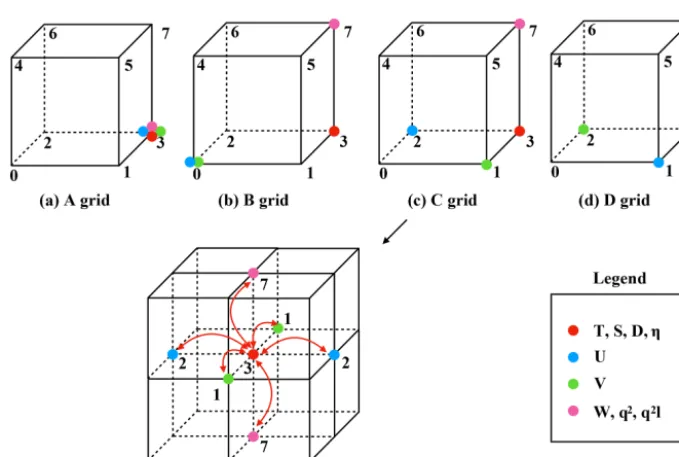
As shown in Fig. 4, the cubes in the (a), (b), (c), and (d) panels are the minimum abstract grid accounting for 1/8 of the volume of the cube in panel (e). The eight points of each cube are numbered sequentially from 0 to 7, and each point has a set of grid increments, i.e., dx,dy, and dz. For example, all the variables of an abstract Arakawa A grid are located at point 3. For the Arakawa B grid, the horizontal velocity
Array(U,V) is located at point 0, the temperature (T), the salinity (S), and the depth (D) are located at point 3, and the vertical velocityArray(W) is located at point 7. For the Arakawa C grid,ArrayUis located at point 2 andArrayV is located at point 1. In contrast, for the Arakawa D grid,Array Uis located at point 1 andArrayV is located at point 2.
When we call the average and differential operators men-tioned in Table 1, e.g., on the abstract Arakawa C grid, the position ofArrayDis point 3, and the averageAXB opera-tor acting onArrayDwill change the position from point 3 to point 1. SinceArrayUis also allocated at point 1, the op-erationAXB(D)·U is allowed. In addition, the subsequent differential operator onArrayAXB(D)·U will change the position ofArrayDXF (AXB(D)·U )from point 1 to point 3.
The jumping rules of different operators are given in Ta-ble 2. Due to the design of the abstract staggered grids, the jumping rules for the Arakawa A, B, C, and D grids are fixed. A change in the position of an array is determined only by the direction of a certain operator acting on that array.
Figure 3.Implementation of the shallow water equations by basic operators. elf, el, and elb denote sea surface elevations at times (t+1),
t, and (t−1), respectively. Uf,Uand Ub denote the zonal velocity at times (t+1),t, and (t−1), respectively. Vf,V, and Vb denote the meridional velocity at times (t+1),t, and (t−1), respectively. Variable aam denotes the viscosity coefficient.
Figure 4.The schematic diagram of the relative positions of the variables on the abstract staggered grid and the jumping procedures among the grid points.
the transformation of grid types can be easily implemented.
ηt+1(i, j )−ηt−1(i, j ) 2·dt
+ 1
4·dx(i, j )∗((D(i+1, j )+D(i, j ))·(U (i+1, j ) +U (i+1, j+1))−(D(i, j )+D(i−1, j )) ·(U (i, j )+U (i, j+1)))
+ 1
4·dy(i, j )∗((D(i, j+1)+D(i, j )) ·(V (i, j+1)+V (i+1, j+1)) −(D(i, j )+D(i, j−1))
·(V (i, j )+V (i+1, j )))=0, (13)
ηt+1=ηt−1−2·dt·
δfxDxb·Uyf+δfyDyb·Vxf. (14)
The position information and jumping rules are used to implicitly check whether the discrete form of an equation is correct. The grid increments are hidden by all the differen-tial operators, thus it makes the code simple and clean. In addition, since the rules are suitable for multiple staggered Arakawa grids, the modelers can flexibly switch the ocean model between different Arakawa grids. Notably, the users of OpenArray should input the correct positions of each ar-ray in the initialization phase. The value of the position is an input parameter when declaring anArray. An error will be reported if an operation is performed between misplaced points.
Table 2.The jumping rules of an operator acting on anArray.
The initial position The position of The position of The position of of var [A|D]X[F|B](var) [A|D]Y[F|B](var) [A|D]Z[F|B](var)
0 1 2 4
1 0 3 5
2 3 0 6
3 2 1 7
4 5 6 0
5 4 7 1
6 7 4 2
7 6 5 3
2003; Korn, 2017), and even the spectral element method (e.g., Levin et al., 2000). In our current work, we design the basic operators only for finite difference and finite volume methods with structured grids. More customized operators for the other numerical methods and meshes will be imple-mented in our future work.
3 Design of OpenArray
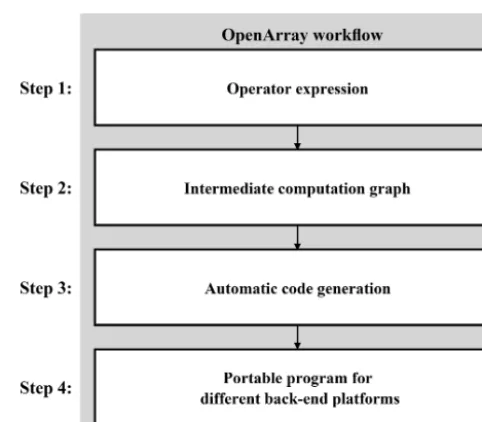
Through the above operator notations in Table 1, ocean mod-elers can quickly convert the discrete PDEs into the corre-sponding operator expression forms. The main purpose of OpenArray is to make complex parallel programming trans-parent to the modelers. As illustrated in Fig. 5, we use a computation graph as an intermediate representation, mean-ing that the operator expression forms written in Fortran will be translated into a computation graph with a particular data structure. In addition, OpenArray will use the interme-diate computation graph to analyze the dependency of the distributed data and produce the underlying parallel code. Finally, we use stable and mature compilers, such as the GNU Compiler Collection (GCC), Intel compiler (ICC), and Sunway compiler (SWACC), to generate the executable pro-grams according to different back-end platforms. These four steps and some related techniques are described in detail in this section.
3.1 Operator expression
Although the basic generalized operators listed in Table 1 are only suitable to execute 1st-order difference, other high-order difference or even more complicated operations can be com-bined by these basic operators. For example, a 2nd-order dif-ference operation can be expressed asδxf(δbx(var)). Suppos-ing the grid distance is uniform, the correspondSuppos-ing discrete form is[var(i+1, j, k)+var(i−1, j, k)−2·var(i, j, k)]/dx2. In addition, the central difference operation can be expressed as (δfx(var)+δbx(var))/2 since the corresponding discrete form is[var(i+1, j, k)−var(i−1, j, k)]/2dx.
Using these operators to express the discrete PDE, the code and formula are very similar. We call this effect “the
Figure 5.The workflow of OpenArray.
self-documenting code is the formula”. Figure 6 shows the one-to-one correspondence of each item in the code and the items in the sea surface elevation equation. The code is very easy to program and understand. Clearly, the basic operators and the combined operators greatly simplify the development and maintenance of ocean models. The complicated parallel and optimization techniques are hidden behind these opera-tors. Modelers no longer need to care about details and can escape from the “parallelism swamp”, and can therefore con-centrate on the scientific issues.
3.2 Intermediate computation graph
Figure 6.The effect of “the self-documenting code is the formula” illustrated by the sea surface elevation equation.
the result in a new array, tmp3. Numerous temporary arrays consume a considerable amount of memory, making the effi-ciency of operator overloading poor.
To solve this problem, we convert an operator expression form into a directed and acyclic graph, which consists of ba-sic data and function nodes, to implement a so-called lazy ex-pression evaluation (Bloss et al., 1988; Reynolds, 1999). Un-like the traditional operator overloading method, we overload all arithmetic functions to generate an intermediate compu-tation graph rather than to obtain the result of each function. This method is widely used in deep-learning frameworks, e.g., TensorFlow (Abadi et al., 2016) and Theano (Bastien et al., 2012), to improve computing efficiency. Figure 7 shows the procedure of parsing the operator expression form of the sea level elevation equation into a computation graph. The input variables in the square boxes include the sea surface elevation (elb), the zonal velocity (u), the meridional veloc-ity (v), and the depth (D). Variable dt2 is a constant equal to 2·dt. The final output is the sea surface elevation at the next time step (elf). The operators in the circles have been overloaded in OpenArray. In summary, all the operators pro-vided by OpenArray are functions for theArraycalculation, in which the “=” notation is the assignment function, the “– ” notation is the subtraction function, the “*” notation is the multiplication function, the “+” notation is the addition func-tion, DXF and DYF are the differential functions, and AXF and AYF are the average functions.
3.3 Code generation
Given a computation graph, we design a lightweight engine to generate the corresponding source code (Fig. 8). Each op-erator node in the computation graph is called a kernel. The sequence of all kernels in a graph is usually fused into a large kernel function. Therefore, the underlying engine schedules and executes the fused kernel once and obtains the final result directly without any auxiliary or temporary variables. Simul-taneously, the scheduling overhead of the computation graph and the startup overhead of the basic kernels can be reduced. Most of the scientific computational applications are lim-ited by the memory bandwidth and cannot fully exploit the computing power of a processor. Fortunately, kernel fusion is an effective optimization method to improve memory local-ity. When two kernels need to process some data, their fusion holds shared data in the memory. Prior to the kernel fusion, the computation graph is analyzed to find the operator nodes
that can be fused, and the analysis results are stored in sev-eral subgraphs. Users can access any individual subgraph by assigning the subgraph to an intermediate variable for diag-nostic purposes. After being given a series of subgraphs, the underlying engine dynamically generates the corresponding kernel function in C++using just-in-time (JIT) compilation techniques (Suganuma and Yasue, 2005). The JIT compiler used in OpenArray can fuse numbers of operators into a large compiled kernel. The benefit of fusing operators is to allevi-ate memory bandwidth limitations and improve performance compared with executing operators one by one. In order to generate a kernel function based on a subgraph, we first add the function header and variable definitions according to the name and type in theArraystructure. And then we add the loop head through the dimension information. Finally, we perform a depth-first walk on the expression tree to convert data, operators, and assignment nodes into a complete ex-pression including load variables, arithmetic operation, and equal symbol with C++language.
Notably, the time to compile a single kernel function is short but practical applications usually need to be run for thousands of time steps and the overhead of generating and compiling the kernel functions for the computation graph is extremely high. Therefore, we generate a fusion kernel func-tion only once for each subgraph, and put it into a funcfunc-tion pool. Later, when facing the same computation subgraph, we fetch the corresponding fusion kernel function directly from the pool.
Since the arrays in OpenArray are distributed among dif-ferent processing units, and the operator needs to use the data in the neighboring points, to ensure the correctness it is necessary to check the data consistency before fusion. The use of different data-splitting methods for distributed arrays can greatly affect computing performance. The current data-splitting method in OpenArray is the widely used block-based strategy. Solving PDEs on structured grids often di-vides the simulated domain into blocks that are distributed to different processing units. However, the differential and average operators always require their neighboring points to perform array computations. Clearly, ocean modelers have to frequently call corresponding functions to carefully control the communication of the local boundary region.
manage-Figure 7.Parsing the operator expression form into the computation graph.
Figure 8.The schematic diagram of kernel fusion.
ment module uses asynchronous communication to update and maintain the data of the boundary region, which is useful for simultaneous computing and communication. These pro-cedures of asynchronous communication are implicitly in-voked when calling the basic kernel or the fused kernel to ensure that the parallel details are completely transparent to the modelers. For the global boundary conditions of the lim-ited physical domains, the values at the physical border are always set to zero within the operators and operator expres-sions. In realistic cases, the global boundary conditions are set by a series of functions (e.g., radiation, wall) provided by OpenArray.
3.4 Portable program for different back-end platforms With the help of dynamic code generation and JIT compi-lation technology, OpenArray can be migrated to different
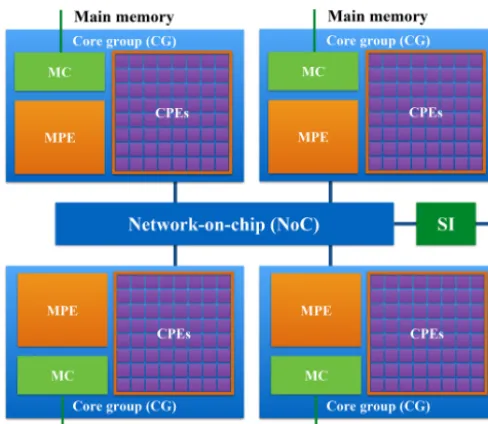
plat-Figure 9.The MPE–CPE hybrid architecture of the Sunway pro-cessor. Every Sunway processor includes 4 core groups (CGs) con-nected by the network-on-chip (NoC). Each CG consists of a man-agement processing element (MPE), 64 computing processing ele-ments (CPEs) and a memory controller (MC). The Sunway proces-sor uses the system interface (SI) to connect with outside devices.
form. Currently, we have designed the corresponding source code generation module for Intel CPU and Sunway proces-sors in OpenArray.
According to the TOP500 list released in November 2018, the Sunway TaihuLight is ranked third in the world, with a LINPACK benchmark rating of 93 petaflops provided by Sunway many-core processors (or Sunway CPUs). As shown in Fig. 9, every Sunway CPU includes 260 processing ele-ments (or cores) that are divided into four core groups. Each core group consists of 64 computing processing elements (CPEs) and a management processing element (MPE) (Qiao et al., 2017). CPEs handle large-scale computing tasks and the MPE is responsible for the task scheduling and commu-nication. The relationship between MPE and CPE is like that between CPU and many-core accelerator, except that they are fused into a single Sunway processor sharing a unified memory space. To make the most of the computing resources of the Sunway TaihuLight, we generate kernel functions for the MPE, which is responsible for the thread control, and CPE, which performs the computations. The kernel func-tions are fully optimized with several code optimization tech-niques (Pugh, 1991) such as loop tiling, loop aligning, single-instruction multiple-date (SIMD) vectorization, and function inline. In addition, due to the high memory access latency of CPEs, we accelerate data access by providing instructions for direct memory access in the kernel to transfer data between the main memory and local memory (Fu et al., 2017).
Table 3.Comparing GOMO with several variations in the POM.
Model Lines of Method Computing
code platforms
POM2k 3521 Serial CPU
sbPOM 4801 MPI CPU
mpiPOM 9685 MPI CPU
POMgpu 30 443 MPI+CUDA GPU
GOMO 1860 OpenArray CPU, Sunway
4 Implementation of GOMO
In this section, we introduce how to implement a numerical ocean model using OpenArray. The most important step is to derive the primitive discrete governing equations in operator expression form, and then the following work is completed by OpenArray.
The fundamental equations of GOMO are derived from POM. GOMO features a bottom-following free-surface stag-gered Arakawa C grid. To effectively evolve the rapid sur-face fluctuations, GOMO uses the mode-splitting algorithm inherited from POM to address the fast-propagating sur-face gravity waves and slow-propagating internal waves in barotropic (external) and baroclinic (internal) modes, respec-tively. The details of the continuous governing equations, the corresponding operator expression form, and the descriptions of all the variables used in GOMO are listed in the appen-dices A–C, respectively.
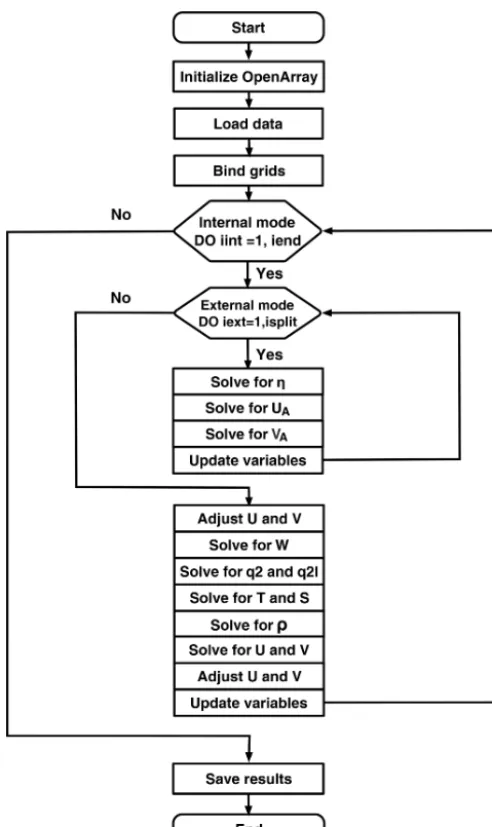
Figure 10 shows the basic flow diagram of GOMO. At the beginning, we initialize OpenArray to make all opera-tors suitable for GOMO. After loading the initial values and the model parameters, the distance information is input into the differential operators through grid binding. In the exter-nal mode, the main consumption is computing the 2-D sea surface elevationηand column-averaged velocity (UA,VA). In the internal mode, 3-D array computations predominate in order to calculate baroclinic motions (U, V , W), tracers (T , S, ρ), and the turbulence closure scheme (q2, q2l) (Mel-lor and Yamada, 1982), whereU, V ,andWare the velocity fields in thex,y, andσdirections andT , S,andρare the po-tential temperature, the salinity, and the density, respectively.
q2/2,andq2l/2 are the turbulence kinetic energy and pro-duction of turbulence kinetic energy with turbulence length scale, respectively.
im-Figure 10.Flow diagram of GOMO.
plicitly converted to parallel C++code by OpenArray, and the parallelization is hidden from the modelers.
Because the complicated parallel optimization and tuning processes are decoupled from the ocean modeling, we com-pletely implemented GOMO based on OpenArray in only 4 weeks, whereas implementation may take several months or even longer when using the MPI or CUDA library.
In comparison with the existing POM and its multiple variations, including (to name a few) Stony Brook Paral-lel Ocean Model (sbPOM), mpiPOM, and POMgpu, GOMO has less code but is more powerful in terms of compatibility. As shown in Table 3, the serial version of POM (POM2k) contains 3521 lines of code. Models sbPOM and mpiPOM are parallelized using MPI, while POMgpu is based on MPI and CUDA-C. The codes of sbPOM, mpiPOM, and POMgpu are extended to 4801, 9680, and 30 443 lines, respectively. In contrast, the code of GOMO is decreased to 1860 lines.
Table 4.Comparison of the amount of code for different functions.
Functions Lines of code
POM2k sbPOM GOMO
Solve forη 16 72 1
Solve forUA 75 183 11
Solve forVA 75 183 11
Solve forW 36 90 3
Solve forq2andq2l 318 854 162
Solve forT orS 178 234 71
Solve forU 118 230 50
Solve forV 118 230 50
Moreover, GOMO completes the same function as the other approaches while using the least amount of code (Table 4), since the complexity has been transferred to OpenArray, which includes about 11 800 lines of codes.
In addition, poor portability considerably restricts the use of advanced hardware in oceanography. With the advantages of OpenArray, GOMO is adaptable to different hardware ar-chitectures, such as the Sunway processor. The modelers do not need to modify any code when changing platforms, elim-inating the heavy burden of transmitting code. As computing platforms become increasingly diverse and complex, GOMO becomes more powerful and attractive than the machine-dependent models.
5 Results
In this section, we first evaluate the basic performance of OpenArray using benchmark tests on a single CPU platform. After checking the correctness of GOMO through an ideal seamount test case, we use GOMO to further test the scala-bility and efficiency of OpenArray.
5.1 Benchmark testing
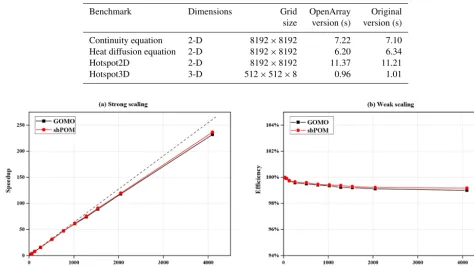
CPU. The experimental results show that the performance of OpenArray versions is comparable to the original versions. 5.2 Validation tests of GOMO
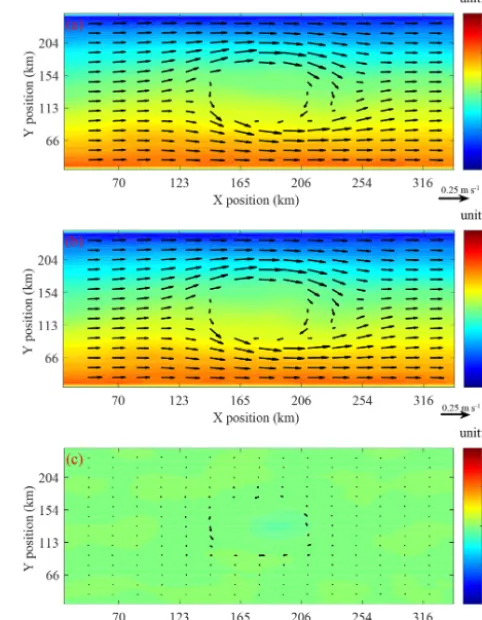
The seamount problem proposed by Beckmann and Haidvo-gel is a widely used ideal test case for regional ocean mod-els (Beckmann and Haidvogel, 1993). It is a stratified Tay-lor column problem which simulates the flow over an iso-lated seamount with a constant salinity and a reference verti-cal temperature stratification. An eastward horizontal current of 0.1 m s−1 is added at model initialization. The southern and northern boundaries are closed. If the Rossby number is small, an obvious anticyclonic circulation is trapped by the mount in the deep water.
Using the seamount test case, we compare GOMO and sbPOM results. The configurations of both models are ex-actly the same. Figure 11 shows that GOMO and sbPOM both capture the anticyclonic circulation at 3500 m depth. The shaded plot shows the surface elevation, and the array plot shows the current at 3500 m. Panels 11a, b, and c show the results of GOMO, sbPOM, and the difference (GOMO-sbPOM), respectively. The differences in the surface eleva-tion and deep currents between the two models are negligible (Fig. 11c).
5.3 The weak and strong scalability of GOMO
The seamount test case is used to compare the performance of sbPOM and GOMO in a parallel environment. We use the X86 cluster at the National Supercomputing Center in Wuxi, China, which provides 5000 Intel Xeon E5-2650 v2 CPUs for our account at most. Figure 12a shows the re-sult of a strong scaling evaluation, in which the model size is fixed at 2048×2048×50. The dashed line indicates the ideal speedup. For the largest parallelism with 4096 pro-cesses, GOMO and sbPOM achieve 91 % and 92 % paral-lel efficiency, respectively. Figure 12b shows the weak scal-ability of sbPOM and GOMO. In the weak scaling test, the model size for each process is fixed at 128×128×50, and the number of processes is gradually increased from 16 to 4096. Taking the performance of 16 processes as a baseline, we de-termine that the parallel efficiencies of GOMO and sbPOM using 4096 processes are 99.0 % and 99.2 %, respectively. 5.4 Testing on the Sunway platform
We also test the scalability of GOMO on the Sunway plat-form. Supposing that the baseline is the runtime of GOMO at 10 000 Sunway cores with a grid size of 4096×4096×50, the parallel efficiency of GOMO can still reach 85 % at 150 000 cores, as shown in Fig. 13. However, we notice that the scal-ability declines sharply when the number of cores exceeds 150 000. There are two reasons leading to this decline. First, the block size assigned to each core decreases as the num-ber of cores increases, causing more communication during
Figure 11.Comparison of the surface elevation (shaded) and cur-rents at 3500 m depth (vector) between GOMO and sbPOM on the 4th model day.(a)GOMO,(b)sbPOM, and(c)GOMO-sbPOM.
boundary region updating. Second, some processes cannot be accelerated even though more computing resources are avail-able; for example, the time spent on creating the computa-tion graph, generating the fusion kernels, and compiling the JIT cannot be reduced. Even though the fusion-kernel codes are generated and compiled only once at the beginning of a job, it consumes about 2 min. In a sense, OpenArray per-forms better when processing large-scale data, and GOMO is more suitable for high-resolution scenarios. In the future, we will further optimize the communication and graph-creating modules to improve the efficiency for large-scale cores.
6 Discussion
Table 5.Four benchmark tests.
Benchmark Dimensions Grid OpenArray Original
size version (s) version (s)
Continuity equation 2-D 8192×8192 7.22 7.10
Heat diffusion equation 2-D 8192×8192 6.20 6.34
Hotspot2D 2-D 8192×8192 11.37 11.21
Hotspot3D 3-D 512×512×8 0.96 1.01
Figure 12.Performance comparison between sbPOM and GOMO on the X86 cluster. Panels(a)shows the strong scaling result; vertical axis denotes the speedup relative to 16 processes in a single node. Panel(b)shows the weak scaling result.
Figure 13.Parallel efficiency of GOMO on the Sunway platform.
DSL, STELLA, and COARRAY) require users to manually control the boundary communication and task scheduling to some extent. In contrast, OpenArray implements completely implicit parallelism with user-friendly interfaces and pro-gramming languages.
However, there are still several problems to be solved in the development of OpenArray. The first issue is
computa-tional efficiency. Once a variable is in one of the processor registers or in the highest speed cache, it should be used as much as possible before being replaced. In fact, we should never move variables more than once each time step. The memory consumption brought by overloading techniques is usually high due to the unnecessary variable moving and un-avoidable cache missing. The current efficiency and scalabil-ity of GOMO are close to sbPOM since we have adopted a series of optimization methods, such as memory pool, graph computing, JIT compilation, and vectorization, to al-leviate the requirement of memory bandwidth. However, we have to admit that we cannot fully solve the memory band-width limit problem at present. We think that time skew-ing is a cache-oblivious algorithm for stencil computations (Frigo and Strumpen, 2005) since it can exploit temporal locality optimally throughout the entire memory hierarchy. In addition, the polyhedral model may be another potential approach, which uses an abstract mathematical representa-tion based on integer polyhedral to analyze and optimize the memory access pattern of a program.
defined in a template file, where the calculation form of each customized operator is described by a regular expression. If users want to add a customized operator, they only need to append a regular expression into the template file.
OpenArray and GOMO will continue to be developed, and the following three key improvements are planned for the fol-lowing years.
First, we are developing the GPU version of OpenArray. During the development, the principle is to keep hot data in GPU memory or directly swapping between GPUs and avoid returning data to the main CPU memory. NVLink provides high bandwidth and outstanding scalability for GPU-to-CPU or GPU-to-GPU communication and addresses the intercon-nect issue for multi-GPU and multi-GPU/CPU systems.
Second, the data input/output is becoming a bottleneck of earth system models as the resolution increases rapidly. At present we encapsulate the PnetCDF library to provide sim-ple I/O interfaces, such as load operation and store opera-tion. A climate fast input/output (CFIO) library (Huang et al., 2014) will be implemented into OpenArray in the next few years. The performance of CFIO is approximately 220 % faster than PnetCDF because of the overlapping of I/O and computing. CFIO will be merged into the future version of OpenArray and the performance is expected to be further im-proved.
Finally, as for most of the ocean models, GOMO also faces the load imbalance issue. We are adding the more effective load balance schemes, including space-filling curve (Dennis, 2007) and curvilinear orthogonal grids, into OpenArray in order to reduce the computational cost on land points.
OpenArray is a product of the collaboration between oceanographers and computer scientists. It plays an im-portant role in simplify the porting work on the Sunway TaihuLight supercomputer. We believe that OpenArray and GOMO will continue to be maintained and upgraded. We aim to promote it to the model community as a development tool for future numerical models.
7 Conclusions
In this paper, we design a simple computing library (Ope-nArray) to decouple ocean modeling and parallel computing. OpenArray provides 12 basic operators that are abstracted from PDEs and extended to ocean model governing equa-tions. These operators feature user-friendly interfaces and an implicit parallelization ability. Furthermore, some state-of-the-art optimization mechanisms, including computation graphing, kernel fusion, dynamic source code generation, and JIT compiling, are applied to boost the performance. The experimental results prove that the performance of a program using OpenArray is comparable to that of well-designed pro-grams using Fortran. Based on OpenArray, we implement a numerical ocean model (GOMO) with high productivity, enhanced readability, and excellent scalable performance.
Moreover, GOMO shows high scalability on both CPU sys-tems and the Sunway platform. Although more realistic tests are needed, OpenArray may signal the beginning of a new frontier in future ocean modeling through ingesting basic op-erators and cutting-edge computing techniques.
Appendix A: Continuous governing equations
The equations governing the baroclinic (internal) mode in GOMO are the 3-dimensional hydrostatic primitive equa-tions. ∂η ∂t + ∂U D ∂x + ∂V D ∂y + ∂W
∂σ =0, (A1)
∂U D
∂t + ∂U2D
∂x +
∂U V D
∂y +
∂U W
∂σ
−f V D+gD∂η ∂x = ∂ ∂σ K M D ∂U ∂σ +gD 2 ρ0 ∂ ∂x 0 Z σ
ρdσ0−gD ρ0 ∂D ∂x 0 Z σ
σ0 ∂ρ ∂σ0dσ
0+
Fu, (A2)
∂V D ∂t +
∂U V D
∂x +
∂V2D
∂y +
∂V W
∂σ +f U D
+gD∂η ∂y = ∂ ∂σ K M D ∂V ∂σ +gD 2 ρ0 ∂ ∂y 0 Z σ
ρdσ0
−gD ρ0 ∂D ∂y 0 Z σ
σ0 ∂ρ ∂σ0dσ
0+
Fv, (A3)
∂T D
∂t + ∂T U D
∂x +
∂T V D
∂y + ∂T W ∂σ = ∂ ∂σ KH ∂T ∂σ
+FT +
∂R
∂σ, (A4)
∂SD ∂t + ∂SU D ∂x + ∂SV D ∂y + ∂SW ∂σ = ∂ ∂σ KH ∂S ∂σ
+FS, (A5)
ρ=ρ(T Sp), (A6)
∂q2D ∂t +
∂U q2D
∂x +
∂V q2D
∂y +
∂W q2
∂σ = ∂ ∂σ K q D ∂q2 ∂σ +2KM
D " ∂U ∂σ 2 + ∂V ∂σ 2#
+2g ρ0
KH
∂ρ ∂σ −
2Dq3 B1l
+Fq2, (A7)
∂q2lD ∂t +
∂U q2lD
∂x +
∂V q2lD
∂y +
∂W q2l
∂σ = ∂ ∂σ Kq D
∂q2l ∂σ
+E1l
( KM D " ∂U ∂σ 2 + ∂V ∂σ 2#
+gE3 ρ0 KH
∂ρ ∂σ
e
W−Dq 3
B1 +Fq2l, (A9)
whereFu,Fv,Fq2, andFq2lare horizontal kinematic
viscos-ity terms of u,v,q2, andq2l, respectively. FT andFS are
horizontal diffusion terms ofT andS, respectively.Weis the wall proximity function.
Fu=
∂
∂x(2AMD ∂U
∂x)+ ∂ ∂y
AMD(
∂U ∂y + ∂V ∂x) , (A10)
Fv=
∂
∂y(2AMD ∂V
∂y)+ ∂ ∂x
AMD(
∂U ∂y + ∂V ∂x) , (A11)
FT =
∂ ∂x(AHH
∂T ∂x)+
∂ ∂y(AHH
∂T
∂y), (A12)
FS=
∂ ∂x(AHH
∂S ∂x)+
∂ ∂y(AHH
∂S
∂y), (A13)
Fq2=
∂ ∂x(AMH
∂q2 ∂x)+
∂ ∂y(AMH
∂q2
∂y ), (A14)
Fq2l=
∂ ∂x(AMH
∂q2l ∂x )+
∂ ∂y(AMH
∂q2l
∂y ), (A15)
e
W=1+E2l κ
1
η−z+
1
H−z
. (A16)
The equations governing the barotropic (external) mode in GOMO are obtained by vertically integrating the baroclinic equations.
∂η ∂t +
∂UAD
∂x +
∂VAD
∂y =0, (A17)
∂UAD
∂t +
∂(UA)2D
∂x +
∂UAVAD
∂y −f VAD
+gD∂η
∂x=Feua−wu(0)+wu(−1)
−gD ρ0 0 Z −1 0 Z σ D∂ρ ∂x− ∂D ∂xσ 0∂ρ ∂σ
dσ0dσ+Gua, (A18)
∂VAD
∂t +
∂UAVAD
∂y +
∂(VA)2D
∂y +f UAD
+gD∂η
∂y =Feva−wv(0)+wv(−1)
−gD ρ0 0 Z −1 0 Z σ D∂ρ ∂y − ∂D ∂yσ 0∂ρ ∂σ
dσ0dσ+Gva, (A19)
where Feua and Feva are the horizontal kinematic viscosity
terms ofUAandVA, respectively.Gua andGva are the
dis-persion terms ofUAandVA, respectively. The subscript “A” denotes vertical integration.
e
Fua =
∂ ∂x
2H (AAM)
∂UA ∂x + ∂ ∂y
H (AAM) ∂U A ∂y + ∂VA ∂x , (A20) e
Fva =
∂ ∂y
2H (AAM)
∂VA ∂y + ∂ ∂x
Gua =
∂2(UA)2D
∂x2 +
∂2UAVAD
∂x∂y −Feua
−∂ 2(U2)
AD
∂x2 −
∂2(U V )AD
∂y2 +(Fu)A, (A22)
Gva=
∂2UAVAD
∂x∂y +
∂2(VA)2D
∂y2 −Feva
−∂ 2(U V )
AD
∂x2 −
∂2(V2)AD
∂y2 +(Fv)A, (A23)
UA= 0 Z
−1
U dσ, (A24)
VA= 0 Z
−1
V dσ, (A25)
(U2)A= 0 Z
−1
U2dσ, (A26)
(U V )A= 0 Z
−1
U V dσ, (A27)
(V2)A= 0 Z
−1
V2dσ, (A28)
(Fu)A= 0 Z
−1
Fudσ, (A29)
(Fv)A= 0 Z
−1
Fvdσ, (A30)
AAM = 0 Z
−1
Appendix B: Discrete governing equations
The discrete governing equations of baroclinic (internal) mode expressed by operators are shown as below:
ηt+1−ηt−1
2dt i +δ
x f(D
x bU )+δ
y f(D
y bV )+δ
z
f(W )=0, (B1)
(DxbU )t+1−(DxbU )t−1
2dt i +δ
x
b h
(DxbU ) x
fU
x
f i
+δfyh(DybV ) x
bU
y
b i
+δfz(WxbUzb)−(f Ve
y
fD)
x
b
−(f VyfD) x
b+gD
x
bδ
x
b(η)=δ
z
b "
KxM
b
(Dxb)t+1δ
z
f(U
t+1) #
+g(D x
b)2
ρ0 0 Z
σ
"
δbx(ρzb)−σ δ x
b(D)
Dxb δ z
b(ρ
x
b) #
dσ0+Fu, (B2)
(DybV )t+1−(Dy bV )t−1
2dt i +δ
x
f h
(DxbU ) y
bV
x
b i
+δbyh(DybV ) y
fV
y
f i
+δzf(WybVzb)+(f Ue
x
fD)
y
b
+(f UxfD) y
b+gD
y
bδ
y
b(η)=δ
z
b "
KyM
b
(Dyb)t+1δ
z
f(V
t+1) #
+g(D y
b)2
ρ0 0 Z
σ
"
δby(ρzb)−σ δ y
b(D)
Dyb δ z
b(ρ
y
b) #
dσ0+Fv, (B3)
(T D)t+1−(T D)t−1
2dt i +δ
x f(T
x bU D
x b)+δ
y f(T
y bV D
y b)
+δfz(TzbW )=δzb
K H
Dt+1δ z f(T
t+1)
+FT +δfzR, (B4)
(SD)t+1−(SD)t−1
2dt i +δ
x f(S
x bU D
x b)
+δfy(SybV Dyb)+δzf(SzbW )=
δzb
K H
Dt+1δ z f(S
t+1)
+FS, (B5)
ρ=ρ(T Sp), (B6)
(q2D)t+1−(q2D)t−1
2dt i +δ
x f(U
z b(q2)b
x
Db x
)
+δfy(Vb z
(q2) b
y
Db y
)+δzf(W q2)z b=
δzb
"
(Kq)f z
Dt+1 δ z f(q
2)t+1 #
+ 2KM D
h
δbz(Uxf)i2
+ h
δzb(Vyf)
i2 +2g
ρ0
KHδzb(ρ)− 2Dq3
B1l
+Fq2, (B7)
(q2lD)t+1−(q2lD)t−1
2dt i +δ
x f(U
z b(q2l)
x bD
x b)
+δfy(Vzbq2ly bD
y b)+δ
z f(W q2l)
z b=
δzb
"
(Kq)f z
Dt+1 δ z f(q
2l)t+1 #
+lE1
KM
D
h
δbz(Uxf)i2
+hδzb(Vyf)i2
e
W+lE1E3g ρ0
KHδbz(ρ)We−
Dq3 B1
+Fq2l, (B8)
whereFu,Fv,Fq2, andFq2lare horizontal kinematic
viscos-ity terms ofu,v,q2, andq2l, respectively.FT andFS are horizontal diffusion terms ofT andS, respectively.
Fu=δxb h
2AMDδfx(U t−1)i
+δfy
((AM) x b) y b(D x b) y b h
δbx(Vt−1)+δyb(Ut−1)
i
, (B9)
Fv=δby h
2AMDδyf(V t−1)i
+δfx
((AM) x b) y b(D x b) y b h
δbx(Vt−1)+δyb(Ut−1)i
, (B10)
FT =δxf h
(AH) x bH
x bδbx(T
t−1)i
+δfyh(AH) y bH y bδ y b(T
t−1)i, (B11)
FS=δfx h
((AH) x bH
x bδbx(S
t−1)i
+δfyh(AH) y bH y bδ y b(S
t−1)i, (B12)
Fq2 =δfx
((AM) x b)b
z
Hxbδbx(q2)t−1
+δfy
((AM) y b)b
z
Hybδyb(q2)t−1
, (B13)
Fq2l=δxf
((AM)b x
)b z
Hxbδbx(q2l)t−1
+δfy
((AM)b y
)b z
Hybδby(q2l)t−1
. (B14)
The discrete governing equations of barotropic (external) mode expressed by operators are shown as below:
ηt+1−ηt−1
2dt e +δ
x f(D
x
bUA)+δfy(D y
(DxbUA)t+1−(DxbUA)t−1
2dt e +δ
x
b h
(DxbUA) x
f(UA)
x
f i
+δfy
h
(DybVA) x
b(UA)
y
b i
− [fA(VA)e
y
fD]
x
b
− [f (VA)yfD] x
b+gD
x
bδ
x
b(η)=
δbx
n
2(AAM)Dδxf
h
(UA)t−1
io
+δfy
h
(AAM)xb
iy b(D x b) y b
δbx(VA)+δby(UA)t−1
+φx, (B16)
(DybVA)t+1−(D y bVA)t−1
2dt e +δ
x f
h
(DxbUA) y b(VA)
x b i
+δbyh(DybVA) y f(VA)
y f i
+ [feA(UA) x fD]
y b
+ [f (UA) x fD]
y b+gD
y bδ
y b(η)=
δybn2(AAM)Dδfy h
(VA)t−1 io
+
δxf
[(AAM)
x b] y b(D x b) y b
δbx(VA)+δyb(UA) t−1
+φy, (B17)
where
φx= −W U (0)+W U (−1)
−g(D x b)2
ρ0 0 Z −1 0 Z σ
δxb(ρ)zbdσ0
dσ
+gD x bδbxD
ρ0 0 Z −1 0 Z σ
σzbδbz(ρxb)
dσ
+Gx, (B18)
φy= −W V (0)+W V (−1)
−g(D y b)2
ρ0 0 Z −1 0 Z σ
δyb(ρ)zbdσ0
dσ
+gD y bδ y bD ρ0 0 Z −1 0 Z σ
σzbδbz(ρyb)
dσ
Appendix C: Descriptions of symbols
The description of each symbol in the governing equations is listed below.
Table C1.Descriptions of symbols.
Symbol Description
η Free surface elevation
H Bottom topography
UA,VA Vertical average velocity inxandydirections, respectively
U,V,W Velocity inx,y, andσdirections, respectively
D Fluid column depth
f The Coriolis parameter
g The gravitational acceleration
ρ0 Constant density
ρ In situ density
T Potential temperature
S Salinity
R Surface solar radiation incident
q2/2 Turbulence kinetic energy
l Turbulence length scale
q2l/2 Production of turbulence kinetic energy and turbulence length scale dt i Time step of baroclinic mode
dt e Time step of barotropic mode dx Grid increment inxdirection dy Grid increment inydirection
AM Horizontal kinematic viscosity
AH Horizontal heat diffusivity
KM Vertical kinematic viscosity
KH Vertical mixing coefficient of heat and salinity
Author contributions. XiaH led the project of OpenArray and the writing of this paper. DW, QW, SZ, and XinH designed OpenArray. XinH, DW, QW, SZ, MW, YG, and QT implemented and tested GOMO. All coauthors contributed to the writing of this paper.
Competing interests. The authors declare that they have no conflict of interest.
Acknowledgements. Xiaomeng Huang is supported by a grant from the National Key R&D Program of China (2016YFB0201100), the National Natural Science Foundation of China (41776010), and the Center for High Performance Computing and System Simulation of the Pilot National Laboratory for Marine Science and Technology (Qingdao). Xing Huang is supported by a grant from the National Key R&D Program of China (2018YFB0505000). Shixun Zhang is supported by a grant from the National Key R&D Program of China (2017YFC1502200) and Qingdao National Laboratory for Marine Science and Technology (QNLM2016ORP0108). Zhenya Song is supported by National Natural Science Foundation of China (U1806205) and AoShan Talents Cultivation Excellent Scholar Pro-gram supported by Qingdao National Laboratory for Marine Sci-ence and Technology (2017ASTCP-ES04).
Financial support. This research has been supported by the Na-tional Key R&D Program of China (grant nos. 2016YFB0201100, 2018YFB0505000, and 2017YFC1502200), the National Natural Science Foundation of China (grant nos. 41776010 and U1806205), and the Qingdao National Laboratory for Marine Science and Tech-nology (grant nos. QNLM2016ORP0108 and 2017ASTCP-ES04).
Review statement. This paper was edited by Steven Phipps and re-viewed by David Webb and two anonymous referees.
References
Abadi, M., Barham, P., Chen, J., Chen, Z., Davis, A., Dean, J., Devin, M., Ghemawat, S., Irving, G., Isard, M., Kud-lur, M., Levenberg, J., Monga, R., Moore, S., Murray, D. G., Steiner, B., Tucker, P., Vasudevan, V., Warden, P., Wicke, M., Yu, Y., and Zheng, X.: TensorFlow: A Sys-tem for Large-Scale Machine Learning, in 12th USENIX Symposium on Operating Systems Design and Implementa-tion (OSDI 16) USENIX AssociaImplementa-tion, Savannah, GA, 265– 283, available at: https://www.usenix.org/conference/osdi16/ technical-sessions/presentation/abadi (last access: 28 Octo-ber 2019), 2016.
Alexander, K. and Easterbrook, S. M.: The software architec-ture of climate models: a graphical comparison of CMIP5 and EMICAR5 configurations, Geosci. Model Dev., 8, 1221–1232, https://doi.org/10.5194/gmd-8-1221-2015, 2015.
Arakawa, A. and Lamb, V. R.: A Potential Enstrophy and En-ergy Conserving Scheme for the Shallow Water Equations,
Mon. Weather Rev., 109, 18–36, https://doi.org/10.1175/1520-0493(1981)109<0018:APEAEC>2.0.CO;2, 1981.
Bae, H., Mustafa, D., Lee, J. W., Aurangzeb, Lin, H., Dave, C., Eigenmann, R., and Midkiff, S. P.: The Cetus source-to-source compiler infrastructure: Overview and evaluation, Int. J. Parallel Prog., 41, 753–767, 2013.
Bastien, F., Lamblin, P., Pascanu, R., Bergstra, J., Goodfellow, I. J., Bergeron, A., Bouchard, N., Warde-Farley, D., and Ben-gio, Y.: Theano: new features and speed improvements, CoRR, abs/1211.5, available at: http://arxiv.org/abs/1211.5590 (last ac-cess: 28 October 2019), 2012.
Beckmann, A. and Haidvogel, D. B.: Numerical simu-lation of flow around a tall isolated seamount, Part I: problem formulation and model accuracy, J. Phys. Oceanogr., 23, 1736–1753, https://doi.org/10.1175/1520-0485(1993)023<1736:NSOFAA>2.0.CO;2, 1993.
Bloss, A., Hudak, P., and Young, J.: Code optimizations for lazy evaluation, Lisp Symb. Comput., 1, 147–164, https://doi.org/10.1007/BF01806169, 1988.
Blumberg, A. F. and Mellor, G. L.: A description of a three dimen-sional coastal ocean circulation model, Coast. Est. Sci., 4, 1–16, 1987.
Bonan, G. B. and Doney, S. C.: Climate, ecosystems, and planetary futures: The challenge to predict life in Earth system models, Sci-ence, 80, 6357, https://doi.org/10.1126/science.aam8328, 2018. Che, S., Boyer, M., Meng, J., Tarjan, D., Sheaffer, J. W., Lee, S. H.,
and Skadron, K.: Rodinia: A benchmark suite for heterogeneous computing, in: Proceedings of the 2009 IEEE International Sym-posium on Workload Characterization, IISWC 2009, 2009. Chen, C., Liu, H., and Beardsley, R. C.: An unstructured grid,
finite-volume, three-dimensional, primitive equations ocean model: Application to coastal ocean and estuaries, J. At-mos. Ocean. Tech., 20, 159–186, https://doi.org/10.1175/1520-0426(2003)020<0159:AUGFVT>2.0.CO;2, 2003.
Collins, M., Minobe, S., Barreiro, M., Bordoni, S., Kaspi, Y., Kuwano-Yoshida, A., Keenlyside, N., Manzini, E., O’Reilly, C. H., Sutton, R., Xie, S. P., and Zolina, O.: Challenges and opportu-nities for improved understanding of regional climate dynamics, Nat. Clim. Change, 8, 101–108, https://doi.org/10.1038/s41558-017-0059-8, 2018.
Corliss, G. and Griewank, A.: Operator Overloading as an Enabling Technology for Automatic Differentiation, preprint MCS-P358–0493, Argonne National Labora-tory, available at: https://pdfs.semanticscholar.org/77f8/ 2be571558246e564505cc654367bf38977e1.pdf (last access: 28 October 2019), 1993.
Deconinck, W., Bauer, P., Diamantakis, M., Hamrud, M., Kühn-lein, C., Maciel, P., Mengaldo, G., Quintino, T., Raoult, B., Smo-larkiewicz, P. K., and Wedi, N. P.: Atlas?: A library for numerical weather prediction and climate modelling, Comput. Phys. Com-mun., 220, 188–204, https://doi.org/10.1016/j.cpc.2017.07.006, 2017.
Dennis, J. M.: Inverse space-filling curve partitioning of a global ocean model, Proc. – 21st Int. Parallel Dis-trib. Process. Symp. IPDPS 2007, Abstr. CD-ROM, 1–10, https://doi.org/10.1109/IPDPS.2007.370215, 2007.
an-nual international conference on Supercomputing, 361–366, https://doi.org/10.1145/1088149.1088197, 2005.
Fu, H., He, C., Chen, B., Yin, Z., Zhang, Z., Zhang, W., Zhang, T., Xue, W., Liu, W., Yin, W., Yang, G., and Chen, X.: 18.9-Pflops nonlinear earthquake simulation on Sunway TaihuLight: enabling depiction of 18-Hz and 8-meter scenarios, in: Proceed-ings of the International Conference for High Performance Com-puting, Networking, Storage and Analysis, 2017.
Griffies, S. M., Böning, C., Bryan, F. O., Chassignet, E. P., Gerdes, R., Hasumi, H., Hirst, A., Treguier, A.-M., and Webb, D.: Devel-opments in ocean climate modelling, Ocean Model., 2, 123–192, https://doi.org/10.1016/S1463-5003(00)00014-7, 2000. Gysi, T., Osuna, C., Fuhrer, O., Bianco, M., and Schulthess, T. C.:
STELLA: A Domain-specific Tool for Structured Grid Meth-ods in Weather and Climate Models, Proc. Int. Conf. High Perform. Comput. Networking, Storage Anal. – SC ’15, 1–12, https://doi.org/10.1145/2807591.2807627, 2015.
Huang, W., Ghosh, S., Velusamy, S., Sankaranarayanan, K., Skadron, K. and Stan, M. R.: HotSpot: A com-pact thermal modeling methodology for early-stage
VLSI design, IEEE T. VLSI Syst., 14, 501–513,
https://doi.org/10.1109/TVLSI.2006.876103, 2006.
Huang, X. M., Wang, W. C., Fu, H. H., Yang, G. W., Wang, B., and Zhang, C.: A fast input/output library for high-resolution climate models, Geosci. Model Dev., 7, 93–103, https://doi.org/10.5194/gmd-7-93-2014, 2014.
Huang, X., Wu, Q., Wang, D., Huang, X., and Zhang, S.: OpenAr-ray, available at: https://github.com/hxmhuang/OpenArOpenAr-ray, last access: 28 October 2019a.
Huang, X., Huang, X., Wang, D., Wu, Q., Zhang, S. and Li, Y.: A simple user manual for OpenArray version 1.0, avail-able at: https://github.com/hxmhuang/OpenArray/tree/master/ doc, last access: 28 October 2019b.
Huang, X., Huang, X., Wang, M., Wang, D., Wu, Q., and Zhang, S.: GOMO, available at: https://github.com/hxmhuang/GOMO, last access: 28 October 2019c.
Korn, P.: Formulation of an unstructured grid model for global ocean dynamics, J. Comput. Phys., 339, 525–552, https://doi.org/10.1016/j.jcp.2017.03.009, 2017.
Lawrence, B. N., Rezny, M., Budich, R., Bauer, P., Behrens, J., Carter, M., Deconinck, W., Ford, R., Maynard, C., Mullerworth, S., Osuna, C., Porter, A., Serradell, K., Valcke, S., Wedi, N., and Wilson, S.: Crossing the chasm: how to develop weather and climate models for next generation computers?, Geosci. Model Dev., 11, 1799–1821, https://doi.org/10.5194/gmd-11-1799-2018, 2018.
Levin, J. G., Iskandarani, M., and Haidvogel, D. B.: A nonconforming spectral element ocean model, Int. J. Nu-mer. Meth. Fl., 34, 495–525, https://doi.org/10.1002/1097-0363(20001130)34:6<495::AID-FLD68>3.0.CO;2-K, 2000. Lidman, J., Quinlan, D. J., Liao, C., and McKee, S.
A.: ROSE::FTTransform β-A source-to-source trans-lation framework for exascale fault-tolerance re-search, Proc. Int. Conf. Dependable Syst. Networks, https://doi.org/10.1109/DSNW.2012.6264672, 25–28 June 2012.
Mellor, G. L. and Yamada, T.: Development of a turbulence closure model for geophysical fluid problems, Rev. Geophys., 20, 851– 875, https://doi.org/10.1029/RG020i004p00851, 1982.
Mellor-Crummey, J., Adhianto, L., Scherer III, W. N., and Jin, G.: A New Vision for Coarray Fortran, in Proceedings of the Third Conference on Partitioned Global Address Space Programing Models, ACM, New York, NY, USA, 5:1–5:9, 2009.
National Research Council: A National Strategy for Advancing Cli-mate Modeling, National Academies Press, Washington, D.C., https://doi.org/10.17226/13430, 2012.
Porkoláb, Z., Mihalicza, J., and Sipos, Á.: Debugging C++
template metaprograms, in: Proceeding GPCE ’06 Pro-ceedings of the 5th international conference on Gener-ative programming and component engineering, 255–264, https://doi.org/10.1145/1173706.1173746, 2007.
Pugh, W.: Uniform Techniques for Loop Optimization, in Proceed-ings of the 5th International Conference on Supercomputing, ACM, New York, NY, USA, 341–352, 1991.
Qiao, F., Zhao, W., Yin, X., Huang, X., Liu, X., Shu, Q., Wang, G., Song, Z., Li, X., Liu, H., Yang, G., and Yuan, Y.: A Highly Effec-tive Global Surface Wave Numerical Simulation with Ultra-High Resolution, in: International Conference for High Performance Computing, Networking, Storage and Analysis, SC, 2017. Reynolds, J. C.: Theories of Programming Languages, Cambridge
University Press, New York, NY, USA, 1999.
Shan, A.: Heterogeneous Processing: A Strategy for Augment-ing Moore’s Law, Linux J., 142, available at: http://dl.acm. org/citation.cfm?id=1119128.1119135 (last access: 28 Octo-ber 2019), 2006.
Shchepetkin, A. F. and McWilliams, J. C.: The regional oceanic modeling system (ROMS): A split-explicit, free-surface, topography-following-coordinate oceanic model, Ocean Model., 9, 347–404, https://doi.org/10.1016/j.ocemod.2004.08.002, 2005.
Suganuma, T. and Yasue, T.: Design and evaluation of dynamic opti-mizations for a Java just-in-time compiler, ACM Trans., 27, 732– 785, https://doi.org/10.1145/1075382.1075386, 2005.
Taylor, K. E., Stouffer, R. J., and Meehl, G. A.: An overview of CMIP5 and the experiment design, B. Am. Meteorol. Soc., 93, 485–498, https://doi.org/10.1175/BAMS-D-11-00094.1, 2012. Torres, R., Linardakis, L., Kunkel, J., and Ludwig, T.: ICON
DSL: A Domain-Specific Language for climate model-ing, In: International Conference for High Performance Computing, Networking, Storage and Analysis, avail-able at: http://sc13.supercomputing.org/sites/default/files/ WorkshopsArchive/pdfs/wp127s1.pdf (last access: 28 Octo-ber 2019), 2013.
van Engelen, R. A.: ATMOL: A Domain-Specific Language for Atmospheric Modeling, J. Comput. Inf. Technol., 9, 289–303, https://doi.org/10.2498/cit.2001.04.02, 2001.
Walther, A., Griewank, A., and Vogel, O.: ADOL-C: Automatic Differentiation Using Operator Overloading in C++, PAMM, https://doi.org/10.1002/pamm.200310011, 2003.