Http://www.ijetmr.com©International Journal of Engineering Technologies and Management Research [78]
FRAMEWORK TO ENHANCE THE IMPLEMENTATION OF QUALITY
MANAGEMENT SYSTEM IN CONSTRUCTION
Idris Othman*1, Hisham Mohamad2, Madzlan Napiah3, Siti Norfarahhanim Mohd Ghani4,
Salah Zoorob5
*1,2, 3, 4 Civil Engineering Department, Universiti Teknologi PETRONAS, Malaysia 5 Kuwait Institute of Scientific Research
Abstract:
In Malaysia, construction industry plays an important role in benefitting towards the development of country’s economy as well as providing the necessary infrastructure and enhanced facilities for social comfort. Despite these contributions, this thriving industry is responsible for generating an excessive amount of construction waste and numerous cases on delaying which then tarnish the reputation of the company. Therefore, this study evaluates the factors affecting the implementation of quality management system practices in construction project through the application of structured questionnaire and case study of high rise construction project to come out with a structured framework that can enhance the quality management system in construction project. The statistical techniques used to evaluate the data obtained are relative importance index (RII) and Average Index (AVI), while cronbach’s alpha is used to measure the significant between three different groups of respondents, the reliability and validity of the study.
Keywords: Framework; Quality Management System; Delay; Enhance; High Rise Construction Project.
Cite This Article: Idris Othman, Hisham Mohamad, Madzlan Napiah, Siti Norfarahhanim Mohd Ghani, and Salah Zoorob. (2018). “FRAMEWORK TO ENHANCE THE IMPLEMENTATION OF QUALITY MANAGEMENT SYSTEM IN CONSTRUCTION.” International Journal of
Engineering Technologies and Management Research, 5(12), 78-91.
DOI: https://doi.org/10.29121/ijetmr.v5.i12.2018.330.
1. Introduction
Quality Management System (QMS) is a one of the commitment made by the development industry in Malaysia to demonstrate their enthusiasm in the project quality delivery. Implementation by CIDB Malaysia towards Grade 7 contractor to obligatorily be certified with ISO certification had made rapid changes in the construction industry. The construction industry is a project based and quality is one of the customer's prime worries towards their investment in the construction industry.
Http://www.ijetmr.com©International Journal of Engineering Technologies and Management Research [79] adopting such as lack in the knowledge regarding the QMS. Thus, this paper will research about the advantages and the factor that will contribute to the successfulness of QMS in the construction project.
1.1.Problem Statement
According to the Department of Statistics Malaysia, the estimation of construction work done in the second quarter 2017 recorded twofold digit growth of 11.2 per cent year-on-year to record RM33.8 billion (Q1 2017: RM35.1 billion). The development in estimation of construction work done was driven by positive growth in all sub-sectors such as Civil engineering (19.3%), special trade activities (11.6%), Non-residential buildings (9.7%) and Residential buildings (3.8%) respectively. The statistics shows that civil engineering sub-sector contributes the most for the performance in today’s Malaysia construction industry. Moreover, the construction industry in Malaysia is expected to growth up to 8% which driven by the mega infrastructure project (CIDB, 2017). Raza stated that, for making Malaysia a developed country in a monetary sense as well as far as social equity, political stability, system of government, quality of life, social and spiritual esteems, national pride and confidence which have been said by many people nowadays was Malaysia vision of 2020. With an aim to become a developed nation by 2020, the government comes up with the housing program to focus on the people that will afford to buy their own house called as the “Perumahan Rakyat 1 Malaysia (PR1MA)” with an investment of RM 1.6 billion. Therefore, in regard the construction industry in Malaysia plays a significant role in promoting economic growth in facing the fast-forward pace of today’s world.
By looking into spectrum of construction perspective, what are the crucial challenges that QMS facing in the organization and how to handle the challenges? By considering all the factors in the development projects that can be completed with distinctive quality will enable to satisfy their customer’s needs. Henceforth the craved for quality has and will reliably be the main concern among the project stakeholders in the construction industry (CIDB, 2009). Quality is a fundamental component in development from its beginning until the completion (Alcock, 1994). Construction projects that can be completed with a distinctive quality will definitely increase their customer’s interest to invest in such project developed. Quality can be changed into durability in term of structural strength, effectiveness in convenience and less viability on the construction output. Therefore, to what extent does the quality management system really affects the construction industries that will eventually portrait the image of a world-class company? However, the issue of quality in the construction industry really a serious concern by the project stakeholder as they know that this benchmarking will determine the interest of their client needs. According to Tan, the significance of the construction industry sector in Malaysia with respect to economic growth of the rapid development of the construction project and the concern about the quality of the project attract the attention of the public needs.
Http://www.ijetmr.com©International Journal of Engineering Technologies and Management Research [80] 1.2.Objectives
The objectives of this study are as below:
1) To identify and rank its top ten (10) factors influencing the implementation of quality management system during the construction phases which affect the performance of completion in the construction project.
2) To validate the factors and construction practitioners’ practices influencing the implementation of quality management system during the construction phases.
3) To propose a structured quality management system framework consisting top five (5) factors suitable for industrial practitioners to enhance the implementation of quality management system in construction project.
1.3.Scope of Study
This research is to identify, rank and analyse factors influencing the successful implementation of quality management system based on the actual case studies of a high-rise building construction project. The application of gap system in this research tends to improve the validity of it through identifying the relative factors that may have not been explored yet by past researches. The study focuses on these contractors’ practitioners including; (i) engineer, (ii) manager, (iii) supervisor. The ranked factors are then further discussed and investigated through personal interview in order to obtain more information regarding their quality management system practices on real site condition.
1.4.Relevancy and Feasibility of the Project
Construction industry is one of the cannonading industries of today, which reflect a great impact towards the development of a country. According to Construction Industry Development Board (2009), the construction sector is expected to grow by eight per cent to RM170 billion this year (2017), supported by the numerous mega infrastructure projects in the country. The Malaysian construction industry is generally separated into two areas. One zone is general construction, which contains residential construction, non-residential construction and civil engineering construction. The second territory is special trade works, which comprises activities of metal works, electrical works, plumbing, sewerage and sanitary works, refrigeration and air-conditioning works, painting works, carpentry, tiling and flooring works and glass works. The construction industry makes up an important part of the Malaysian economy because of the amount of industry connected to it, for example, those for basic metal items and electrical machinery. Subsequently, the construction industry could be described as a significant economic driver for Malaysia.
Http://www.ijetmr.com©International Journal of Engineering Technologies and Management Research [81] To conclude, it is necessary for the industry to enhance the implementation of quality management system practices in construction. The identification of the factors and construction practitioners’ practices that influence the implementation of quality management system and its analysis outcome could be relevant and useful towards the successful in completion of construction.
2. Literature Review
2.1.Introduction to Quality Management System
Quality management system (QMS) is characterized as the managing structure, responsibilities, methodology, processes, and management resources to execute the standards and activity lines expected to accomplish the quality objectives of an organization. QMS is routinely being related with the manufacturing industry as it is utilized to direct and control an organization with regard to the end-product through different QMS manufacturing models, specifically Malcolm Baldrige National Quality Award, the ISO 9000 quality standards, Total Quality Management (TQM), Six Sigma and Lean. Quality management system (QMS) is a formalized framework that documents procedures, methodology, and obligations regarding accomplishing quality policies and objectives. A QMS helps facilitate and guide an organization’s activities to meet client and regulatory prerequisites and enhance its effectiveness and productivity consistently. Quality management is vital to the accomplishment of an organization. It empowers to deliver products and services that meet the both client’s requirements and regulations, securing its reputation while lessening expenses and driving improvement. It also enables an organization to ensure it is working in the most sustainable way.
Quality planning guarantees that quality requirements are tended to addressed all the product and service lifecycle. Quality control concentrates on the process outputs to guarantee that standards are really met. Quality assurance gives certainty that benchmarks and requirements are being met. Quality improvement is the procedure that informed by all the activities and the requirements of the business.
2.2.History of Quality Management System
The history of quality management can be traced the way back to The Middle Ages. Work finished by understudies and disciples were assessed and reviewed by the specialist to guarantee that quality standards were met in all parts of the completed product to ensure fulfilment of the purchaser. And keeping in mind that the history of quality management has experienced various changes since that time but the end goal is the same.
ISO 9001 is the world's most popular and most generally utilized standard for quality management systems. A standard is not a law, however an agreement or best practice that an organisation can adapt voluntarily. A standard reflects a decent level of professionalism. A quality management system is an instrument which an organisation can decide how it can meet the necessities of its clients and the other invested parties that are engaged with its activities.
There is a lot of benefit that ISO 9001 QMS will gives to the company when they adapt to their organisation such as:
Http://www.ijetmr.com©International Journal of Engineering Technologies and Management Research [82] 2) shows that the products and services that meet the client's necessities, follow the law and
enactment, and meet the organization’s own prerequisites;
3) Enable to streamline the business forms and persistently enhance them. 4) ISO 9001 can increase customer needs;
5) ISO 9001 can reflect that organization is conforming to internationally recognized quality standards.
The ISO 9001 have recently updated their framework every seven (7) years. For instance, for QMS there are ISO 9001:2008 & ISO 9001:2015 which both frameworks serves the same purpose to have a standard in implementing the QMS in organization. Below is the difference between both frameworks that have been highlighted in the clause:
Table 1: Difference between ISO 9001:2008 & ISO 9001:2015
ISO 9001:2008 ISO 9001:2015
Introduction Introduction
Scope Scope
Normative reference Normative reference
Terms and definitions Terms and definitions
Quality management system Context of the organisation
Management responsibility Leadership
Planning
Resource management Support
Product realisation Operation
Measurement, analysis and improvement Performance evaluation
Improvement
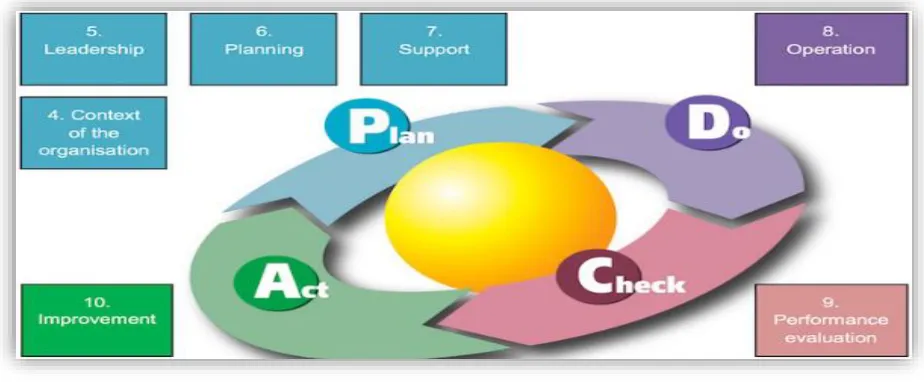
The first three clauses in ISO 9001:2015 are the same as those in ISO 9001:2008, yet there are significant contrasts between ISO 9001:2008 and ISO 9001:2015 from the fourth statement onwards. The last seven clauses are currently arranged according by the PDCA cycle (Plan, Do, Check, Act).
Http://www.ijetmr.com©International Journal of Engineering Technologies and Management Research [83] 2.3.The Advantages of Implementing the Quality Management System in Construction
Project
According to year 2014 survey, the total number of Malaysian organizations certified for ISO 9001 Quality Management System was 11,487, a four (4) percent (%) decrease from 2013. However, up until this point QMS has brought positive changes in the Malaysian Construction Industry.
According to Said et al. (2009), there are four (4) main advantages when implementing the quality management system which is organization image and reputation enhancement, performance and customers’ satisfaction improvement, documentation procedures & instructions establishment and constant quality service. QMS is a flexible management tool that a company can use to enhance their objectives, proficiency and productivity. The use of QMS can influence the company to enhance their performance and increase clients' satisfaction. Besides that, a company is also able to set up clear documented procedures and instruction that incorporates the documented statements of policy quality and goals quality, manual quality, documented procedures, effective standard requirement planning, operation, record and control of the procedures are also required. Other than that, the implementation of QMS can serve as a guideline to ensure the quality services can meet the standard.
Samsudin (2012) stated that quality management system gives much more value than the drawback. This has been agreed by many scholar QMS implementation give benefits by increasing the communication level as the business were framed from combination of different educational backgrounds and different parties (design team, contractor, developer & etc.) that works towards a same goals. Thus, an organization should not takes things for granted as QMS will gives positive impacts toward internal and external factor of the company.
The factors affecting the successful implementation of sustainable waste control practices in construction project
The factors were identified based on an intensive literature review and discussion with several construction practitioners’. The factors are then categorized into three different groups of factors: management commitment, documentation & resource management, and customer satisfaction.
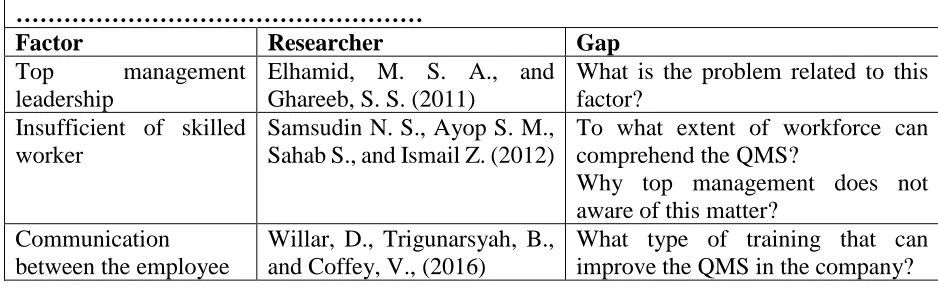
Table 2: The previous studies on management commitment related factors
………
Factor Researcher Gap
Top management
leadership
Elhamid, M. S. A., and Ghareeb, S. S. (2011)
What is the problem related to this factor?
Insufficient of skilled worker
Samsudin N. S., Ayop S. M., Sahab S., and Ismail Z. (2012)
To what extent of workforce can comprehend the QMS?
Why top management does not aware of this matter?
Communication between the employee
Willar, D., Trigunarsyah, B., and Coffey, V., (2016)
Http://www.ijetmr.com©International Journal of Engineering Technologies and Management Research [84] Lack supervision on the
QMS
Ahmed, M. A., Coffey, V., and Xia, B. (2017)
How to ensure that management know what is happening on the construction site?
Table 3: The previous studies on documentation & resource management related factors
Documentation & resource management related factors
Factor Researcher Gap
Loss of the time for the material to arrive on the site
Elhamid, M. S. A., and Ghareeb, S. S. (2011)
How to ensure the goods arrive on time?
Difficulty to monitor the productivity changes by the amount of materials, tools, & equipment expended during construction
Elhamid, M. S. A., and Ghareeb, S. S. (2011)
How to incorporate with the changes regarding material, tools & equipment?
Percentages of waste in raw material due to bad storage
Elhamid, M. S. A., and Ghareeb, S. S. (2011)
What is the best storage for the material whether in digital format or hardcopy? Difficulty in understanding ISO and
QMS terminology used in the Construction project
N. S. Samsudin, S. M. Ayop, S. Sahab, and Z. Ismail (2012)
What can be done to for QMS to be understood by the employee?
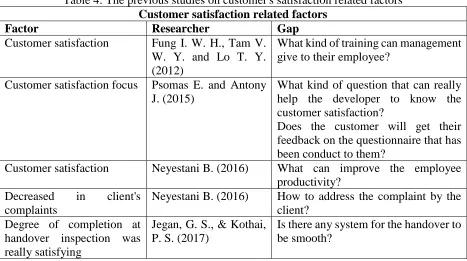
Table 4: The previous studies on customer's satisfaction related factors
Customer satisfaction related factors
Factor Researcher Gap
Customer satisfaction Fung I. W. H., Tam V. W. Y. and Lo T. Y. (2012)
What kind of training can management give to their employee?
Customer satisfaction focus Psomas E. and Antony J. (2015)
What kind of question that can really help the developer to know the customer satisfaction?
Does the customer will get their feedback on the questionnaire that has been conduct to them?
Customer satisfaction Neyestani B. (2016) What can improve the employee productivity?
Decreased in client's complaints
Neyestani B. (2016) How to address the complaint by the client?
Degree of completion at handover inspection was really satisfying
Jegan, G. S., & Kothai, P. S. (2017)
Is there any system for the handover to be smooth?
3. Methodology
Http://www.ijetmr.com©International Journal of Engineering Technologies and Management Research [85] the highest impact factors influence the implementation of quality management system practices in high rise construction project. The identified factors were grouped under the following categories: (a) management commitment; (b) documentation & resources; and (c) customer’s satisfaction. The questionnaire was distributed among three different groups: Engineer, Manager, and Supervisor.
The data obtained are then ranked according to its RII value, the higher the RII, the higher the rank. The ranking is necessary to determine which factors have the highest impact towards the successful implementation of quality management system practices in construction project. AVI is used to classify these ranked factors into its five different classes of impacts from very low to very high. The RII and AVI value is calculated based on the formula as shown in Table 6.
Table 5: The formula used to calculate RII and AVI Relative Importance Index (RII)
𝑹𝑰𝑰 = ∑ 𝑾 𝑨 ∗ 𝑵
W: Weighting given to each factor A: Highest weightage
N: Total number of respondents Average Index (AVI)
𝑨𝑽𝑰 = ∑(𝜷 ∗ 𝒏) 𝑵
: Weighting given to each factor n: Frequency of respondents N: Total number of respondents
The correlation, reliability and validity of the data gathered are then analyzed through the application of Statistical Package for the Social Sciences (SPSS) software. The Cronbach’s coefficient Alpha is used to measure the reliability and validity of the study where the nearest the value to +1 reflects the higher reliability.
4. Results and Discussion
A total of 30 questionnaires were distributed among the contractors practitioners to give the feedbacks. These 30 feedbacks include 8 of engineers, 8 of manager, and the rest of site supervisors. The respondents were senior project manager, planning engineer, resident engineer, site engineers, safety and health officers, and site supervisors with an average experience of less than 15 years in the construction industry.
4.1.High Impact Factors Affecting the Successful Implementation of Waste Control Practices
Http://www.ijetmr.com©International Journal of Engineering Technologies and Management Research [86] Figure 1: Top Ten High Impact Factors
Table 6: Factor Description
Limited knowledge on the QAQC procedure (RII = 0.840, AVI = 4.200)
Http://www.ijetmr.com©International Journal of Engineering Technologies and Management Research [87] exposure from the top level until the bottom level of management. The training conductor need to be someone that has been experience in implementing the QMS in the organization and knows well about the implementation about it.
Lack supervision on the QMS (RII = 0.813, AVI = 4.067)
The significance of supervision affects the overall performance and efficiency of the construction project. Inadequate supervision is is believe to be one of the significant reason of rework. Therefore, an experienced and well trained supervisor plays a vital part in limiting the amount of rework because of construction defects. When the quality of the management system is improve, the action of rework will not be occurred in the construction project. Moreover, this factor can be avoided by having a frequent audit of quality management system such as a weekly meeting of the progress construction with top management until the bottom of the management to aware what have been completed until that meeting. Thus, everyone will keep track of the individual performance on how they really did their task efficiently.
Bad worker’s attitude towards the job & environment at the job (RII = 0.813, AVI = 4.067)
It is not uncommon for a working environment to have bad worker’s attitude towards their occupations. Unfortunately, this bad attitude can have a negative effect upon the whole workforce and even the achievement upon the completion of the construction project. In a long term, this sort of attitude could cause irreparable damage which can promote other employers to leave the organization and in addition clients taking their business somewhere else. Thus, it is a smart thought to address any worries over a worker with a bad attitude to reduce the impact to the organization. Thus, top management need to promote and show the good attitude as a good leader will produce a great soldier. A leader must display a good role model and create a friendly environment to the employers.
High percentages of waste in raw material due to bad storage (RII = 4.067, AVI = 0.813)
The improper technique used to store materials has dependably been the most contributing variables toward waste generation. Inappropriate storage tends to build the likelihood of the materials to get harmed, deteriorated and loss of profit to the contractor. They may need to put in a request for new one which requires an extra cost and induce more time to the construction progress. Reduction in the material waste means more resource efficiency, less pollution and more benefits to the organization. Each of the dollars saved money on raw materials costs goes straight to the primary concern. Thus, a good storage for the documented procedure need to be developed as this is a private and confidential to the organization. All organization matters need to be kept in documented and no loss of track upon the important documents. This documented procedure can be documented in a softcopy platform such as the adaptation of using tab that have a software about the things that need to be inspect according to the standard of procedure module.
QAQC personnel responsible for large workload (RII = 0.800, AVI = 4.000)
Http://www.ijetmr.com©International Journal of Engineering Technologies and Management Research [88] certain task in a certain amount of timeframe. Thus, the task need to be distribute equally among the workers as this will promote equality among the staff and their salary given. If the task is kept on increasing, the organization need to recruit more workers which is reliable and able to do the work until completed.
4.2.Framework to Enhance the Implementation of Quality Management System Practices in Construction Project
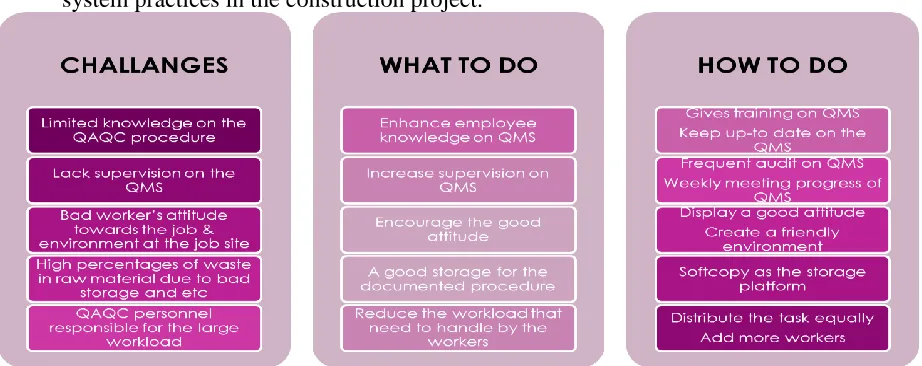
Based on the forty (24) barriers obtained through intensive literature review and discussion with several contractors’ practitioners, top five high impact factors affecting the successfulness implementation of quality management system practices in construction project (Limited knowledge on the QAQC procedure, Lack supervision on the QMS, Bad worker’s attitude towards the job & environment at the job, High percentages of waste in raw material due to bad storage. QAQC personnel responsible for large workload) was analyzed on why they have been chosen as the highest rank compared to others and several ways on how to address these problems were proposed accordingly.
The framework proposed as shown in Figure 2 is developed to guide contractors’ practitioners;
1) Acknowledge major challenges that could inhibit the implementation of quality management system practices in construction project,
2) Identify what could be done to overcome these challenges (What to do), 3) Identify how, methods to overcome these challenges (How to do it),
4) The possible goal of the framework, to enhance the implementation of quality management system practices in the construction project.
Figure 2: Proposed framework for response towards enhancement in completion of the construction project
5. Conclusions and Recommendations
Http://www.ijetmr.com©International Journal of Engineering Technologies and Management Research [89] The employment of this system itself has been relatively time and effort effective as this system proved to excel further in these aspects. In reference to the quality, the author has noted that the quality is the most profound among purchaser that have no clue of what material or workmanship during the construction project. Therefore, this system can enables the purchaser to have an overview to what extend does the quality of the workmanship in the construction site.
The top five highest impact factors affecting the effectiveness in implementation of quality management system practices are:
1) Limited knowledge on the QAQC procedure 2) Lack supervision on the QMS
3) Bad worker’s attitude towards the job & environment at the job site 4) Percentages of waste in raw material due to bad storage
5) QAQC personnel responsible for the large workload
The framework is developed to guide industrial practitioners to further understand the major challenges that could hinder the successful in implementation of quality management system practices and several ways are suggested to address these problems.
As the world keep on furthering transcend into innovation with evolving design and engineering, the higher will be in the interest for quality in building and structures. Furthermore, the world is now are moving towards the 4.0 industrial revolution that has been promoting by the Malaysian government to be gradually adopted in the country. This shows that the crave in the delivering of remarkable quality in construction industry is a vital aspect that need to be improve from time to time. What's more, a great review with the information of quality management system must be embraced to guarantee that everything runs with an exceptional nature of workmanship.
To make this study to be more significant in the future, there are several recommendation needs to be considered as below:
• Increase the number of respondents
• More case studies
• Presentation of the survey question.
• Careful and thoughtful work attitudes.
• The implementation of QMS as a whole.
Acknowledgements
The research was conducted as collaboration between Universiti Teknologi PETRONAS and Ministry of Education Malaysia as a funder for this research.
References
[1] Abd, E., Manal, S., & Ghareeb, S. (2011). Measuring Performance in Egyptian Construction Firms Applying Quality Management Systems. Journal of Construction Engineering and Project Management, 1(2), 18-27.
Http://www.ijetmr.com©International Journal of Engineering Technologies and Management Research [90]
[3] Abidin, N., Z. and Pasquire, C., L. (2005). "Delivering sustainability through value management: Concept and performance overview", Engineering, Construction and Architectural Management, 12(2), pp.168 – 180.
[4] Ahmed, M. A., Coffey, V., & Xia, B. (2017). The requirements of developing a framework for successful adoption of quality management systems in the construction industry. International Journal of Social, Behavioral, Educational, Economic, Business and Industrial Engineering, 11(1), 183-191.
[5] Ahzahar, N., Karim, N. A., Hassan, S. H., & Eman, J. (2011). A study of contribution factors to building failures and defects in construction industry. Procedia Engineering, 20, 249-255.
[6] Arditi, D., & Gunaydin, H. M. (1997). Total quality management in the construction process. International Journal of Project Management, 15(4), 235-243.
[7] Baker, T., L. (1994). Doing Social Research (2nd Edn.). New York: McGraw-Hill Inc. Du Plessis, C. (2007). "A strategic framework for sustianable construction developing countries." Construction Management and Economics, 25, 67-76.
[8] Fung, I. W., Tam, V. W., & Lo, T. Y. (2012). Does ISO quality management system improve project performance in a construction project?. NICMAR Journal of Construction Management, 27(2&3), 53-60. Hawkins, J. A. (1995). Construction Management Excellence Using ISO 9000 to Improve Quality Systems (No. LMI-CE501MR1). LOGISTICS MANAGEMENT INST MCLEAN VA.
[9] Hillman Willis, T., & Willis, W. D. (1996). A quality performance management system for industrial construction engineering projects. International Journal of Quality & Reliability Management, 13(9), 38-48.
[10] Hussin, J., M., Rahman, I., A. and Memon, A., H. (2013). The Way Forward in Sustainable Construction: Issues and Challenges. International Journal of Advances in Applied Sciences (IJAAS), 2(1), pp. 15-24.
[11] Jegan, G. S., & Kothai, P. S. (2017). A Study on Quality Management System and Customer Satisfaction IN Construction Companies with a Special Reference to Coimbatore.
[12] Karim, K., Marosszeky, M., & Kumaraswamy, M. (2005). Organizational effectiveness model for quality management systems in the Australian construction industry. Total Quality Management & Business Excellence, 16(6), 793-806.
[13] Khan, R. A., Liew, M. S., & Ghazali, Z. B. (2014). Malaysian construction sector and Malaysia vision 2020: Developed nation status. Procedia-social and behavioral sciences, 109, 507-513. [14] Kiew, P. N., Ismail, S., & Yusof, A. M. (2016). Integration of Quality Management System in the
Malaysian Construction Industry.
[15] Lam, H. F., & Chang, T. Y. P. (2002). Web‐Based Information Management System for Construction Projects. Computer‐Aided Civil and Infrastructure Engineering, 17(4), 280-293. [16] Leong, T. K., Zakuan, N., Mat Saman, M. Z., Ariff, M. S. M., & Tan, C. S. (2014). Using project
performance to measure effectiveness of quality management system maintenance and practices in construction industry. The Scientific World Journal, 2014.
[17] Neyestani, B. (2016). Impact of ISO 9001 Certification on the Projects' Success of Large-Scale (AAA) Construction Firms in the Philippines. International Research Journal of Management, IT & Social Sciences (IRJMIS), 11(3), 35-45.
[18] Neyestani, B. (2016). Effectiveness of Quality Management System (QMS) on Construction Projects.
[19] Neyestani, B., & Juanzon, J. B. P. (2017). Impact of ISO 9001 Standard on the Quality Cost of Construction Projects in the Philippines.
[20] Ofori, G., Gang, G., & Briffett, C. (2002). Implementing environmental management systems in construction: lessons from quality systems. Building and environment, 37(12), 1397-1407. [21] Ogwueleka, A. C. (2013). A review of safety and quality issues in the construction industry. Journal
Http://www.ijetmr.com©International Journal of Engineering Technologies and Management Research [91]
[22] Othman, I., Idrus, A., & Napiah, M. (2011, September). Effectiveness of Human Resource Management in Construction project. In National Postgraduate Conference (NPC), 2011 (pp. 1-6). IEEE.
[23] Öztaş, A., Güzelsoy, S. S., & Tekinkuş, M. (2007). Development of quality matrix to measure the effectiveness of quality management systems in Turkish construction industry. Building and Environment, 42(3), 1219-1228.
[24] Palaneeswaran, E., Ng, T., & Kumaraswamy, M. (2006). Client satisfaction and quality management systems in contractor organizations. Building and Environment, 41(11), 1557-1570. [25] Pheng Low, S., & Faizathy Omar, H. (1997). The effective maintenance of quality management
systems in the construction industry. International Journal of Quality & Reliability Management, 14(8), 768-790.
[26] Pheng, L. S., & Omar, H. F. (1997). Integration, segmentalism and the maintenance of quality management systems in the construction industry. Building Research & Information, 25(1), 36-49. [27] Priede, J. (2012). Implementation of quality management system ISO 9001 in the world and its
strategic necessity. Procedia-Social and Behavioral Sciences, 58, 1466-1475.
[28] Psomas, E., & Antony, J. (2015). The effectiveness of the ISO 9001 quality management system and its influential critical factors in Greek manufacturing companies. International Journal of Production Research, 53(7), 2089-2099.
[29] Said, I., Ayub, A. R., Abd Razaki, A., & Tee, K. K. (2009). Factors affecting construction organization quality management system in the Malaysian construction industry.
[30] Sakthivel, M., Devadasan, S. R., Vinodh, S., Ramesh, A., & Shyamsundar, S. (2006). ISO 9001: 2000 based quality information management responsibility system. International Journal of Business Information Systems, 2(2), 217-237.
[31] Samsudin, N. S., Ayop, S. M., Sahab, S., & Ismail, Z. (2012, September). Problems and issues on the implementation of Quality Management System in construction projects. In Business, Engineering and Industrial Applications (ISBEIA), 2012 IEEE Symposium on (pp. 684-689). IEEE.
[32] Samsudin, N. S., Ayop, S. M., Sahab, S. S., & Ismail, Z. (2012, December). The advantages of quality management system in construction project. In Humanities, Science and Engineering (CHUSER), 2012 IEEE Colloquium on (pp. 38-41). IEEE.
[33] Shao, H., & Fu, H. (2015, December). Construction engineering project quality evaluation method based on fuzzy analytic hierarchy process. In Intelligent Transportation, Big Data and Smart City (ICITBS), 2015 International Conference on (pp. 228-231). IEEE.
[34] Takim R. (2005), A Framework for successful construction project performance, PhD Thesis, Glasgow Caledonian University.
[35] Willar, D., Trigunarsyah, B., & Coffey, V. (2016). Organisational culture and quality management system implementation in Indonesian construction companies. Engineering, Construction and Architectural Management, 23(2), 114-133.
*Corresponding author.