© Strojniški vestnik (43) št. 3-4, str. 117-128, 1997 Tiskano v Sloveniji. Vse pravice pridržane.
UDK 681.5.015:621.941
© Journal o f Mechanical Engineering (43) No. 3-4, pp. 117-128, 1997 Printed in Slovenia. All rights reserved.
SV: 0039-2480(97)2-R2 UDC 681.5.015:621.941
Sprotna identifikacija rezalnega procesa na makro nivoju
On-line Cutting Process Identification at the Macro Level
SLAVKO DOLINŠEK
V članku so prikazani rezultati sprotne identifikacije rezalnega procesa na makro nivoju, praktično izvedenega p ri vzdolžnem ortogonalnem struženju. Identifikacija temelji na kibernetski zasnovi obdelovalnega sistema, ki popisuje proces z oceno prenosne funkcije, definirane na vstopno/ izstopnih energijskih povezavah. Oblika prenosne funkcije j e karakteristika rezalnega procesa v
povezavi s strukturno dinamiko obdelovalnega sistema v sklenjeni zanki. S spreminjanjem obdelovalnih razmer se značilno spreminjajo ocenjene vrednosti parametrov prenosne funkcije (vrednosti ojačanja in dušenja). Tovrstne identifikacijske karakteristike lahko zato uporabimo kot učinkovite informacije v prilagodljivem krmiljenju rezalnega procesa.
Ključne besede: procesi rezanja, identifikacija procesov, modeli energijski, funkcije prenosne
In the paper, the results o f the on-line identification o f the cutting process at the macro level o f straight orthogonal turning are presented. A cybernetic concept o f the machining system, proposed as a basis o f identification, describes the process by estimation o f the transfer function defined by the input/output energy relations. The shape o f the transfer function is a characteristic o f the cutting process in connection with the structure dynamics o f the machining system in closed loop. In relation to the changes in cutting conditions, a significant change occurs in the transfer function parameter estimates (gain and the damping values). Such identification characteristics provide effective infor mation fo r reliable adaptive control o f the cutting process.
Keywords: cutting process, identification,energy model, transfer function
0 UVOD
O bdelovalni proces m ora biti izpeljan v optimalnih razmerah, kar pomeni odstraniti čimvečjo prostornino obdelovanega materiala v določenem času ob stabilnem procesu skozi celoten obdelovalni cikel. Ti dve zahtevi sta si v nasprotju, zato je naloga raziskovalcev razviti ustrezne nadzorne in krmilne sisteme, ki bodo zagotavljali nemoten obdelovalni proces tudi pri težkih in zahtevnih režimih dela. V zadnjih letih je bilo vloženih veliko naporov v raziskave in vpeljavo različnih uporabnih tehnik za nadzor orodja [1], vendar so praktične izvedbe še vedno predrage in nezanesljive.
M odeli, ki p o p isu je jo rezaln i proces na determ inističen način, slonijo na predpostavkah napovedljivosti statičnih in dinam ičnih lastnosti procesa. Zaradi zapletenosti obdelovalnega procesa in uporabljenih omejitvenih približkov so ti modeli v glavnem nenatančni, vendar so tovrstni prijemi veliko prispevali k razumevanju osnovnih načel odrezovalnih procesov. Cilji raziskav morajo zato biti usmerjeni v razvoj zanesljivih m etod sprotne identifikacije, povezanih z optimizacijo in v končni fazi prilagodljivim krmiljenjem procesa. Možnosti za uresničenje takšnih zahtev pa so v tesni povezavi z zmožnostjo ocene prenosnih karakteristik rezalnega procesa [2].
0 INTRODUCTION
The machining process has to be realised in optimum conditions, which means the maximum re moval volume o f the workpiece in desired tim e at stable process through the entire m achining cycle. Since these two demands are in opposition, the re search tasks are to develop the appropriate supervi sion and control systems which should assure an un disturbed machining process, also in heavy and ex acting cutting conditions. Great efforts have been made during the last decade in researching and intro ducing different applications o f tool monitoring tech niques [1], how ever the p rac tic a l ap p licatio n s are still too expensive and unreliable.
Predlagana sprotna identifikacija ozirom a določitev vstopno/izstopnih karakteristik rezalnega procesa in njihovih ocen tem elji na dolgoletnem tovrstnem raziskovalnem delu prof. Peklenika, začetega leta 1964 z zamislijo, ki popisuje obdelovalni proces kot črno šk atlo [3]. Z obrav n av an jem celotnega obdelovalnega procesa v zaprti zanki in p rikazom n a k lju č n e g a k a ra k te rja p aram etro v rezalnega procesa so bili postavljeni tem elji za identifikacijo rezalnega procesa glede na vstopno/ izstopne energijske povezave [4], Prenosno funkcijo tako določamo iz meritev časovno odvisnih sprememb določenih vstopno/izstopnih parametrov procesa.
Nadaljevanje raziskav v tej smeri je bilo mogoče v zadnjih letih zaradi hitrega razvoja tehnologij zaznavanja in obdelave signalov. Leta 1985 je bila predstavljena zamisel o medpovršinskih vmesnikih in energijskih kvantih [5] in kasneje rezultati raziskav na mikro nivoju [6]. Zadnje potrditve na makro nivoju rezalnega procesa, narejene pri različnih rezalnih p a ra m e trih in o b ra b a h o ro d ja , pa p o trju je jo sprejemljivost predlaganega modela kot eno od metod za sprotno oceno k arakteristik rezalnega procesa
[7] in [8],
1 ENERGIJSKI MODEL ZA IDENTIFIKACIJO REZALNEGA PROCESA
Največ uporabljani energijski model pravo kotnega odrezovanja, ki gaje predlagal Merchant [9], definira vstopno energijo rezalnega procesa kot vsoto transformacijske in izstopne energije. Vstopna energija se porabi za preoblikovanje obdelovanega materiala v odrezek, za prem agovanje trenja na orodju in o d rezku, pa tu d i za p o sp e še v a n je o d rez k a in oblikovanje novonastale površine. Zadnji dve, kinetično in površinsko energijo, običajno zanem arjam o, upoštevati pa ju moramo pri velikih hitrostih obdelave. Glavni del, ki sestavlja izstopno energijo, je torna energija, potrebna za nastajanje tornih medpovršinskih vmesnikov. Glede na ugotovljeni naključni značaj energij je bil predlagan razširjen model, ki upošteva njihove časovne spremembe [3]:
Za pravokotni model odrezovanja, prikazanega na sliki 1, izrazimo vstopno in izstopno energijo v obliki merjenih časovno odvisnih sprememb parametrov energijskih enačb [4]:
The proposed on-line identification or deter mination of the input/output characteristics of the cut ting process and their estimation are based on many years o f research work by Prof. Peklenik, starting in 1964 with the idea o f describing the machining proc ess as a black box [3], By considering the entire machining process in a close loop with a machine tool and presenting the stochastic character o f the parameters o f the cutting process, his model proposed as the basis for identification o f the cutting process on input/output energy relations [4]. In such a way the transfer function is determined on the basis of time series measurements o f the selected input/out put parameters.
The continuation o f this research was encour aged in recent years by rapid developments in the area of sensing technology and signal processing. In 1985, the idea o f surface interfaces and energy quanta was presented [5], and later the results of the research at the micro level [6], The latest verifica tions at the macro level o f the cutting process, made at different cutting parameters and tool wears con firmed that the proposed model is one o f the accept able methods for on-line estimation of the cutting proc ess [7] and [8].
1 ENERGY MODEL FOR THE IDENTIFICA TION OF CUTTING PROCESS
The usual energy model for orthogonal cutting, proposed by Merchant [9], expresses the input en ergy o f the process as a sum o f transformation and output energies. The input energy is used for the trans formation o f workpiece material to a chip, for over coming the chip and tool friction, and also for chip acceleration and new surface formation. Regarding the latter, the kinetic and surface energies are nor mally neglected, but they should be considered in high speed cutting. The main part constituting the output energies is the friction energy necessary for the fric tional surface interface realisation. According to the presentation o f the stochastic character o f energies, the extended energy model was proposed in the form o f a time series [3]:
0
)-For the orthogonal cutting model, presented in Figure 1, the input and output energies are expressed in the form o f their measured time series parameters [4]:
(2),
v,W = r;W[v,W±iW]
Rezalni proces je tako m ogoče popisati s sprotnim ocenjevanjem vrednosti vstopno/izstopnih energij in njihovih spektralnih ocen. Prenosna funkcija je definirana kot razmerje med oceno križne spektralne moči med vstopno in izstopno energijo in oceno spektralne moči vstopajoče energije [6]:
The cutting process can be described in this way by on-line estimation o f the input/output energy values and their spectral estimations. The transfer function is defined as the ratio between the cross power estimate o f the input and output energies and the auto power spectrum estimate o f the input en ergy [6]:
(4).
r
PROCES
PROCESS U o(t) w --- ^
u , ( t )
U, - vstopna energija / input energy
Uc- izstopna energija / output energy
U, - transform, energija / transform, energy
y ( t ) t
hitrosti premikov v oseh z in y vibrational speeds in z and y-axis
' m
Sl. 1. Energijski model rezalnega procesa in parametri vstopno/izstopnih energij [4j, [6]
Fig. 1. Energy model o f the cutting process and the parameters fo r the input/output energies [4], [6]
2 OPIS EKSPERIMENTALNEGA SISTEMA 2 DESCRIPTION OF THE EXPERIMENTAL SET-UP
Za eksperimentalno potrditev predstavljenega modela potrebujemo na vstopu rezalnega procesa obdelovanec in orodje, obnovljeni eksperimentalni obdelovalni stroj pa je zagotavljal ustrezna relativna kinem atična gibanja za odstranjevanje materiala. Dodatno potrebna oprema so zaznavala za spremljanje parametrov energijskih enačb in inštrument za hkratno obdelavo podatkov vseh zaznaval v realnem času. Praktična izvedba preizkusa na prim eru pravo kotnega vzdolžnega struženja ter uporabljena za- znavalna in meri Ina oprema je prikazana na sliki 2 [ 10].
Zaznavalni sistem vsebuje zaznavalo sile, zaznavalo za m erjenje pospeška rezalnega robu (hitrosti relativnih premikov) in zaznavalo rezalne hitrosti. S svojimi lastnostmi zaznavala ne vplivajo na pričak o v an e fre k v e n č n e z n a čiln o sti rezaln eg a procesa. Največji problem je pri merjenju hitrosti odtekanja odrezka. Ideja o sprotnem spremljanju zdaj še ni bila uresničena, tako da je treba te hitrosti računati iz medsebojnih povezav debelin odrezka in rezalnih hitrosti. V preglednici 1 je podan popis karakteristik obdelovanega m ateriala in orodja, območje uporabljenih rezalnih razmer in nastavitve inštrumenta za zbiranje in obdelavo podatkov.
For experimental verification o f the above model, we needed - at the input o f the cutting proc ess - the workpiece and cutting tool, while for pro viding the relative kinematic movements for material removal, a renovated experimental machine tool was used. Additional equipm ent to access all parameters in energy equations includes sensors and an acquisi tion system to record all m easured parameters si multaneously in real time. In Fig. 2 the practical im plementation of the experiment in orthogonal straight turning, and the sensory and measuring equipment is presented [10].
Spektralni analizator HP356 A HP Merilni program Spectrum Analyzer HP3567A HP Measurem. Software
Fz - vstopna sila / input force Fy - izstopna sila / output force
vc - vstopna hitrost / input speed
v0 - izstopna hitrost / output speed
ž - pospešek v vstopni smeri / acceleration at input y - pospešek v izstopni smeri / acceleration at output
Sl. 2. Praktična izvedba eksperimentalne overitve in sistem za zbiranje in obdelavo podatkov
Fig. 2. Practical implementation o f the experimental verification and system fo r signal acquisition
Preglednica 1: Popis eksperimentalnih razmer in karakteristik inštrumenta
Table 1: Description o f the experimental conditions and instrumentation characteristics
O BD E LO V A N E C / W O R K P IE C E O R O D JE / TO O L
material / material toplotna obdel. / heat treat. Izmen, ploščice / inserts sestava / grade
jeklo / steel C45E4 - ISO normalizirano / normalized TNMA 220408 415 P15
REZALNI PARAMETRI / CU TTIN G C O N D ITIO N S
rezalna hitrost / cut. speed podajanje / feed globina / depht hlajenje / lubrication
50... 250 m/min 0,106 ... 0,303 mm/vrt 1 ... 3 mm suho / dry
NASTAVITVE M ER ILN E G A IN ŠTR U M EN TA / IN STR U M EN TATIO N CH A R A C T E R IS T IC S
dolžina zapisa / sample length frekven. območje /freq. range ločljivost / resolution St. povpr. / aver. No.
5 s 6,4 kHz 1600 linij /lines 40
Obdelovalni sistem ( obdelovalni stroj, držalo orodja, zaznavala) m ora zag otavljati znane in nespremenljive značilnosti prek celotnega območja uporabljenih rezalnih parametrov. Ustreznih statičnih in dinam ičnih značilnosti posameznih delov ob delovalnega stroja ni treba določati, saj je za potrditev predlaganega modela dovolj, da opazujemo rezalni proces samo v rezalni točki in definiramo vse potrebne značilnosti ustrezno tej točki. Z uporabo metod m o d aln e a n a liz e [11] o z iro m a z m erjen je m frekvenčnih odgovorov na konici sestavljenega rezalnega sklopa (orodje/dinam om eter/stroj) smo določili izrazite resonančne vrhove rezalne konice v smeri vstopa (3,68 kHz) in izstopa (2,25 kHz) procesa. K oje dinamometer sestavni del rezalnega sklopa, se njegova resonančna frekvenca zniža (5,0 kHz v rezalni in 4,28 kHz v podajalni smeri), a je še vedno nad frekvenčnim območjem rezalnega procesa.
3 OCENE SPEKTRA MOČI PARAMETROV ENERGIJSKIH ENAČB IN POVEZAVA NJEGOVE PORAZDELITVE S STRUKTURNO
DINAM IKO REZALNE KONICE
3 POWER SPECTRUM ESTIM ATE OF THE PARAMETERS IN ENERGY EQUATIONS,
AND RELATIONS TO THE STRUCTURE DYNAMICS OF THE CUTTING TIP
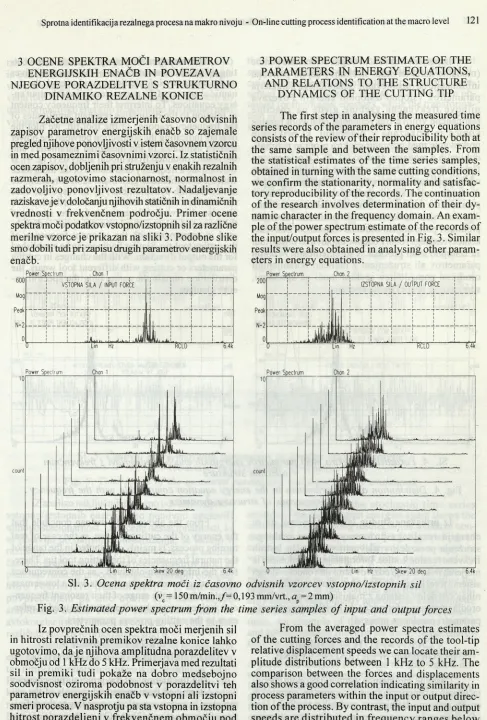
Začetne analize izmerjenih časovno odvisnih zapisov parametrov energijskih enačb so zajemale pregled njihove ponovljivosti v istem časovnem vzorcu in med posameznimi časovnimi vzorci. Iz statističnih ocen zapisov, dobljenih pri struženju v enakih rezalnih razmerah, ugotovimo stacionarnost, normalnost in zadovoljivo ponovljivost rezultatov. Nadaljevanje raziskave je v določanju njihovih statičnih in dinamičnih vrednosti v frekvenčnem področju. Prim er ocene spektra moči podatkov vstopno/izstopnih sil za različne merilne vzorce je prikazan na sliki 3. Podobne slike smo dobili tudi pri zapisu drugih parametrov energijskih enačb.
600 Mag Peak N -2
0
Power Spectrum _ _ _ _ _ Chon 1 VSTOPNA SILA / INPUT FORCE
j
1
i 1
1ilk iO lL —»■ jA,_.
The first step in analysing the measured time series records o f the param eters in energy equations consists o f the review o f their reproducibility both at the same sample and between the samples. From the statistical estimates o f the tim e series samples, obtained in turning with the same cutting conditions, we confirm the stationarity, normality and satisfac tory reproducibility o f the records. The continuation o f the research involves determination o f their dy namic character in the frequency domain. An exam ple o f the power spectrum estimate o f the records o f the input/output forces is presented in Fig. 3. Similar results were also obtained in analysing other param eters in energy equations.
Power Spectrum _ _ _ _ _ Chon 2_ _ _ _ _ _ _ _ _ _ _ _ _ _ _ _ _ _ _ _ Ì IZSTOPNA SILA / OUTPUT FORCE
Power Spectrum Chon 2
couni
Lin Hz Skew 20 deg
SI. 3. Ocena spektra moči iz časovno odvisnih vzorcev vstopno/izstopnih sil
(vc= 150 m/min.,/= 0,193 mm/vrt., ap = 2 mm)
Fig. 3. Estimated power spectrum from the time series samples o f input and output forces
Iz povprečnih ocen spektra moči merjenih sil in hitrosti relativnih premikov rezalne konice lahko ugotovimo, d a je njihova amplitudna porazdelitev v območju od 1 kHz do 5 kHz. Primerjava med rezultati sil in premiki tudi pokaže na dobro medsebojno soodvisnost oziroma podobnost v porazdelitvi teh parametrov energijskih enačb v vstopni ali izstopni smeri procesa. V nasprotju pa sta vstopna in izstopna hitrost porazdeljeni v frekvenčnem obm očju pod 1 kH z in ne v p liv a ta z n a č iln o na fre k v en čn o porazdelitev vstopno/izstopnih energij.
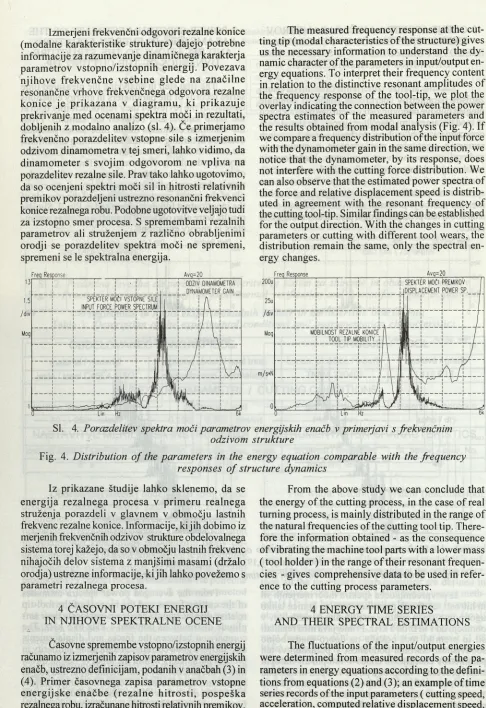
Izmerjeni frekvenčni odgovori rezalne konice (modalne karakteristike strukture) dajejo potrebne informacije za razumevanje dinamičnega karakterja param etrov vstopno/izstopnih energij. Povezava njihove frekvenčne vsebine glede na značilne resonančne vrhove frekvenčnega odgovora rezalne konice je p rik a z an a v diagram u, ki prik azu je prekrivanje med ocenami spektra moči in rezultati, dobljenih z modalno analizo (sl. 4). Če primerjamo frekvenčno porazdelitev vstopne sile s izmerjenim odzivom dinamometra v tej smeri, lahko vidimo, da dinam om eter s svojim odgovorom ne vpliva na porazdelitev rezalne sile. Prav tako lahko ugotovimo, da so ocenjeni spektri moči sil in hitrosti relativnih premikov porazdeljeni ustrezno resonančni frekvenci konice rezalnega robu. Podobne ugotovitve veljajo tudi za izstopno smer procesa. S spremembami rezalnih parametrov ali struženjem z različno obrabljenimi orodji se porazdelitev spektra moči ne spremeni, spremeni se le spektralna energija.
The measured frequency response at the cut ting tip (modal characteristics o f the structure) gives us the necessary information to understand the dy namic character o f the parameters in input/output en ergy equations. To interpret their frequency content in relation to the distinctive resonant amplitudes of the frequency response o f the tool-tip, we plot the overlay indicating the connection between the power spectra estimates o f the measured parameters and the results obtained from modal analysis (Fig. 4). If we compare a frequency distribution o f the input force with the dynamometer gain in the same direction, we notice that the dynamometer, by its response, does not interfere with the cutting force distribution. We can also observe that the estimated power spectra of the force and relative displacement speed is distrib uted in agreement with the resonant frequency of the cutting tool-tip. Similar findings can be established for the output direction. With the changes in cutting parameters or cutting with different tool wears, the distribution remain the same, only the spectral en ergy changes.
SI. 4. Porazdelitev spektra moči parametrov energijskih enačb v primerjavi s frekvenčnim
odzivom strukture
Fig. 4. Distribution o f the parameters in the energy equation comparable with the frequency
responses o f structure dynamics
Iz prikazane študije lahko sklenemo, da se energija rezalnega procesa v prim eru realnega struženja porazdeli v glavnem v območju lastnih frekvenc rezalne konice. Informacije, kijih dobimo iz merjenih frekvenčnih odzivov strukture obdelovalnega sistema torej kažejo, da so v območju lastnih frekvenc nihajočih delov sistema z manjšimi masami (držalo orodja) ustrezne informacije, kijih lahko povežemo s parametri rezalnega procesa.
From the above study we can conclude that the energy o f the cutting process, in the case o f real turning process, is mainly distributed in the range of the natural frequencies o f the cutting tool tip. There fore the information obtained - as the consequence o f vibrating the machine tool parts with a lower mass ( tool holder ) in the range o f their resonant frequen cies -gives comprehensive datato be used in refer ence to the cutting process parameters.
4 ČASOVNI POTEKI ENERGIJ
IN NJIHOVE SPEKTRALNE OCENE
4 ENERGY TIME SERIES
AND THEIR SPECTRAL ESTIMATIONS
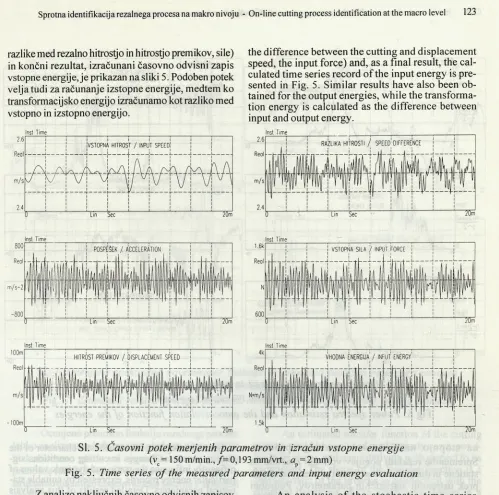
Časovne spremembe vstopno/izstopnih energij računamo iz izmerjenih zapisov parametrov energijskih enačb, ustrezno definicijam, podanih v anačbah (3) in (4). Primer časovnega zapisa parametrov vstopne en e rg ijsk e en ačbe (re z a ln e h itro sti, posp ešk a rezalnega robu, izračunane hitrosti relativnih premikov,
razlike med rezalno hitrostjo in hitrostjo premikov, sile) in končni rezultat, izračunani časovno odvisni zapis vstopne energije, je prikazan na sliki 5. Podoben potek velja tudi za računanje izstopne energije, medtem ko transformacijsko energijo izračunamo kot razliko med vstopno in izstopno energijo.
Inst Time
the difference between the cutting and displacement speed, the input force) and, as a final result, the cal culated time series record o f the input energy is pre sented in Fig. 5. Similar results have also been ob tained for the output energies, while the transform a tion energy is calculated as the difference between input and output energy.
Inst Time Inst Time
SI. 5. Časovni potek merjenih parametrov in izračun vstopne energije
(v. = 150 m/min., / = 0,193 mm/vrt., ap = 2 mm)
Fig. 5. Time series o f the measured parameters and input energy evaluation
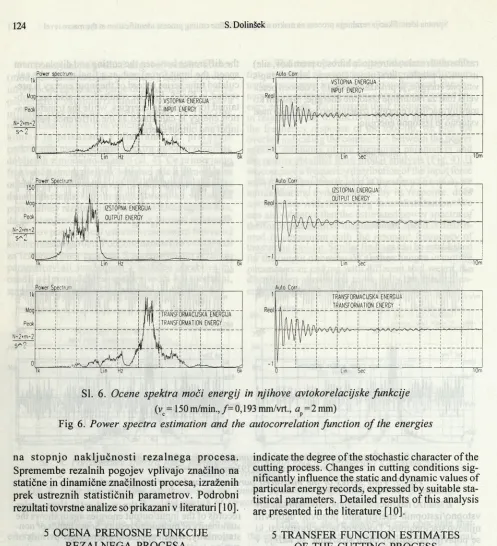
Z analizo naključnih časovno odvisnih zapisov vstopno/izstopnih energij smo ponovno ugotovili njihovo stacionarnost. Določene nestacionamosti, ki se pojavijo po daljših časih struženja, se kažejo v različnih vrednostih povprečij in varianc. Z analizo časovno krajših zapisov je za oceno spektrov moči in prenosne funkcije procesa mogoče uporabiti običajno hitro F o u rierjev o tra n sfo rm ac ijo . Z ustreznim povprečenjem pa sm o dobili tudi za d o v o ljiv e am plitudne ocene. Prim er ocen spektra m oči in avtokorelacijskih funkcij za časovno odvisne zapise različnih energij je prikazan na sliki 6.
Analiza ocenjenega spektra moči posameznih energij kaže, daje spekter porazdeljen ustrezno silam ter hitrostim relativnih prem ikov rezalnega robu. Posamezen zapis pa zopet kaže izrazit amplitudni vrh, ki se ujema z lastno frekvenco rezalne konice glede na opazovano vstopno ali izstopno smer procesa. Določena periodičnost v energijah, povezana s temi resonančnim i vrhovi, se izraža tudi v njihovih avtokorelacijskih funkcijah, velikost dušenja pa kaže
An analysis o f the sto ch astic tim e series records o f the input/output energies again shows the stationarity of measuring results. Some trends o f non- stationarity, which appeared after longer periods of cutting, are reflected as differences in average or variance values. Using short tim e partitions o f the records, the classical Fast Fourier Transforme ap proach proved suitable as a basis for estimating the power spectra o f the energies and defining the en ergy transfer function. By appropriate averaging we also obtained satisfactory amplitude spectral estima tions. An example o f the estim ated power spectra and autocorrelation function for the different energy time series is presented in Figure 6.
Auto Corr
1 1 1 1
•
1
1 1
1 1
VSTOPNA E INPUT ENER
sJERGIJA j GY ! i i
—
T
^1
1
<
j
<t
_
1 .
-—
ö ' ' '"Lin Seč ' ' 1 1 TCH Auto Corr
Auto Corr
Sl. 6. Ocene spektra moči energij in njihove avtokorelacijske funkcije
(vc = 150m/mm.,/=0,193mm/vrt., ap = 2mm)
Fig 6. Power spectra estimation and the autocorrelation function o f the energies
na s to p n jo n a k lju č n o s ti re z a ln e g a p ro c e sa . Spremembe rezalnih pogojev vplivajo značilno na statične in dinamične značilnosti procesa, izraženih prek ustreznih statističnih param etrov. Podrobni rezultati tovrstne analize so prikazani v literaturi [10].
5 OCENA PRENOSNE FUNKCIJE REZALNEGA PROCESA
Ocene povprečnih spektrov moči vstopno/ izstopnih energij in njihovih avtokorelacijskih funkcij dajejo osnovne informacije o značilnostih rezalnega procesa. Za celovito identifikacijski postopek pa moramo poznati tudi ocene spektralnih povezovalnih funkcij, določenih glede na znane definicije [12]. Kakor je prikazano na sliki 7, kaže ocenjena križna spektralna moč skupni signal v frekvenčnem območju 2 do 2,5 kHz, tu obstajajo tudi dobre koherenčne povezave (med 0,75 in 0,85) in zadovoljiva razmerja signal-šum (med 0,75 in 0,85). N a sliki je prikazan tudi končni rezultat identifikacije, ocenjena prenosna funkcija rezalnega procesa, določena glede na definicijo v enačbi (4) in njeno impulzno prenosno funkcijo.
indicate the degree o f the stochastic character o f the cutting process. Changes in cutting conditions sig nificantly influence the static and dynamic values of particular energy records, expressed by suitable sta tistical parameters. Detailed results o f this analysis are presented in the literature [10].
5 TRANSFER FUNCTION ESTIMATES OF THE CUTTING PROCESS
Cross Power Transfer Fune
SI. 7. Ocenjene spektralne povezovalne funkcije in prenosna funkcija rezalnega procesa
(v. = 150 m/min., / = 0,193 mm/vrt., ap = 2 mm)
Fig. 7. Estimated related spectral functions and transfer function o f the cutting process
Ocenjeno prenosno funkcijo rezalnega procesa lahko analiziramo kakovostno glede na njeno obliko in kolikostno glede na njene param etre. O blika prenosne funkcije je značilnost procesa v povezavi s strukturno dinamiko obdelovalnega sistema v sklenjeni zanki. V am plitudnih povezavah lahko lociramo določeno izrazito ojačanje v frekvenčnem območju med 2 do 2,3 kHz, k ije posledica rezalnega procesa. Neznačilni amplitudni vrhovi, kijih lahko opazimo tudi v višjih frek v en čn ih o b m o čjih , so povezani z večmodalnim i odzivi strukture rezalne konice in dinamometra. Vrednosti dušenja prenosne funkcije dobimo iz njene obratne Fourierjeve transformacije kot faktor dušenja sinusnega valovanja.
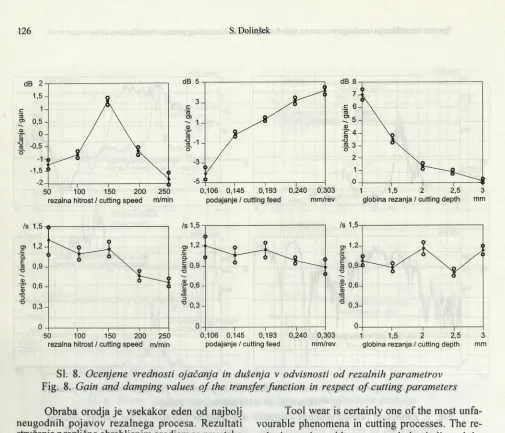
Pomembni sklepi, ki izhajajo iz analize tako določene prenosne funkcije so, da se spremembe rezalnih razm er kažejo le v razbranih vrednostih ojačanja in dušenja. S slike 8, na kateri so ocenjene vrednosti ojačanja in dušenja prikazane v odvisnosti od sprememb rezalne hitrosti, podajanja in globine reza, lahko ugotovimo določene statistično značilne razlike. Z ato so lahko ti p aram etri osnova za identifikacijo procesa in kriterij za sprotno prilagajanje rezalnih razmer glede na njihove optimalne vrednosti.
An estimated transfer function o f the cutting process could be analysed qualitatively correspond ing to its shape, and quantitatively with respect to its parameters. The shape o f the transfer function is a characteristic o f the process in connection with the structure dynamics o f the m achining system in a closed loop. In amplitude relationships we can locate some distinctive gain in the frequency region between 2 and 2.3 kHz as a consequence o f the cutting proc ess. Insignificant amplitude peaks observed at higher frequencies are those connected with the multimodal responses o f the tool-tip and dynam om eter. The damping values o f the transfer function were obtained from inverse Fourrier transform o f the transfer func tion as the damping factor o f one-sided sine wave.
Sl. 8. Ocenjene vrednosti ojačanja in dušenja v odvisnosti od rezalnih parametrov
Fig. 8. Gain and damping values o f the transfer function in respect o f cutting parameters
Obraba orodja je vsekakor eden od najbolj neugodnih pojavov rezalnega procesa. Rezultati struženja z različno obrabljenim orodjem so prav tako pokazali, da se ocenjeni parametri prenosne funkcije z obrabo značilno spreminjajo, medtem ko se njena oblika ne spremeni. Slika 9 prikazuje odvisnost ocenjenih vrednosti ojačanja in dušenja prenosne funkcije glede na različno stopnjo obrabe orodja. Zmanjševanje ojačanja in povečevanje dušenja so torej identifikacijske karakteristike, ki so v povezavi z neugodnimi rezalnimi razmerami. To dejstvo potrjuje ustreznost tovrstnega identifikacijskega postopka, rezultati, dobljeni v realnih rezalnih razmerah, pa mu dajejo tudi praktično vrednost.
Tool wear is certainly one o f the most unfa vourable phenomena in cutting processes. The re sults in turning with a worn tool also indicated the significant changes in the estimated parameters of the transfer function, while its shape remains un changeable. Fig. 9 shows the relation of the estimated parameters o f the transfer function to the different tool wears. A decrease in gains and an increase in damping values are the identification characteristics connected with the unfavourable cutting conditions. This fact confirms the relevance o f such as identifi cation procedure; the results obtained in real cutting circumstances also reflect its practical values.
obraba proste ploskve flank wear
SI. 9. Ocenjene vrednosti ojačanj in dušenja v odvisnosti od obrabe orodja
6 SKLEP
V članku so prikazane nekatere zadnje overitve energijskega modela rezalnega procesa, narejene v realnih odrezovalnih razmerah. Proces je popisan z oceno njegove prenosne funkcije, definirane z vstopno/ izstopnimi energijskimi povezavami. Oblika ocenjene prenosne funkcije je karakteristika rezalnega procesa v povezavi s strukturno dinam iko obdelovalnega sistema v zaprti zanki. V odvisnosti od sprememb rezalnih parametrov in obrabe orodja se spreminjajo ocenjeni parametri prenosne funkcije. Zmanjšanje v re d n o s ti o ja č a n ja in p o v e č a n je d u š e n ja so identifikacijske karakteristike, ki kažejo na neugodne rezalne razm ere in značilno povezavo s stanjem rezalnega procesa.
S prikazano overitvijo smo na ta način potrdili m o ž n o st u p o ra b e p r e d la g a n e g a m o d e la za identifikacijo rezalnega procesa, seveda pa je za njegovo praktično uporabnost potrebno nadaljevati eksperimentalne potrditve v različnih obdelovalnih razm erah . Prav ta k o je o d p rto tudi v p raša n je analitičnega modela, eksperimentalne overitve pri poševnem odrezovanju, za zanesljivo spremljanje parametrov energijskih enačb pa vgradnja mikro zaznaval.
6 CONCLUSIONS
Some o f the latest verifications o f the energy model, realised at macro level o f the cutting process in realistic cutting circumstances, are presented. The process is described by its transfer function estimates, defined on the basis o f the input/output energy rela tions. The shape o f the estimated transfer function is a characteristic o f the process in relation with the structure dynamics o f the m achining system in close loop. Corresponding to changes in cutting parameters and tool wear, the estimated parameters o f the transfer function changed. A decrease in gains and an increase in damping values are identification characteristics which reveal the unfavourable cutting conditions and which have a significant connection with the cutting process behaviour.
The proposed analysis has therefore con firmed the possibility o f applying the proposed model; however, more experimental verifications in differ ent cutting conditions should be made in order to pro vide a possibility for practical use. Also there still re main open questions of: the analytical model, the ex perimental verification at the oblique cutting and, for reliable assessment o f the parameters in energy equa tions, the implementation o f micro sensors.
ZAHVALA
Prispevek je povzetek iz raziskav v okviru d o ktorskega štu d ija in n eka terih ka snejših potrditev. Rad bi se zahvalil mentorju, prof. J. Pekleniku, za dano priložnost raziskovati tako zanim ivo področje ter za njegovo vsesplošno podporo. Prav tako se želim zahvaliti sodelavcem iz laboratorija za odrezavanje za tehnično pomoč, Ministrstvu za znanost in tehnologijo Slovenije za fin a n č n o p o d p o ro in to va rn i S a n d vik Coromant za podarjena orodja.
ACKNOWLEDGEMENTS
This paper originates from research made fo r my doctoral thesis, with some later verifica tions. I would like to thank my mentor, Prof. J. Peklenik, who gave me the opportunity to work on such an interesting domain and who offered me all support. I am also most grateful to col leagues from the Laboratory fo r cutting, fo r help ing me in the technical work; to the M ST Slovenia fo r financial support; and the Sandvik Coromant fo r the supply o f tools.
7 LITERATURA 7 REFERENCES
[1] Byrne, G., D. Domfeld, I. Inasaki, G.Ketteler, R. Teti: Tool condition monitoring, the status of research and industrial application. Annals of the CIRP, Voi. 44,1995/ 2,24-41.
[4] Peklenik, J.: Complexity in manufacturing systems. Manufacturing Systems. Proceedings of the CIRP Seminars, Voi. 24,1995/1,17-25.
[3] Peklenik, J . , T. Mosedale: A statistical analysis of the cutting system based on an energy principle. Proceedings of the 8th International MTDR Conference, Manchester, 1967,209-231.
[4] Mosedale, T. W., J. Peklenik: An analysis of the transient cutting energies and the behaviour o f the metal-cutting
[5] Peklenik, J., I. Žun: Surface interface in cutting process. Proceedings of the International Conference o f Metals,
New Orleans 1985,20-47.
[6] Peklenik ,J., A. Jerele: Some basic relationship for identification of the machining process. Annals of the CIRP, Voi.
41,1992/1,129-136.
[7] Dolinšek, S., J. Peklenik: An on-line estimation of the transfer function for the cutting process. Technical paper of NAMRI/SME, Voi. 27,1996/ 1,34-40.
[8] Dolinšek, S. : Transfer function o f the cutting process based on energy relations - some recent verifications. Advanced Manufacturing Systems and Technology, Edited E. Kuljanić, Springer Verlag, Wien 1996,129-136.
[9] Merchant, M.E.: Mechanics o fth e metal cutting process. Journal of Applied Physics, Voi. 16, 1945/ 3,
267-275.
[ 10] Dolinšek, S.: Sprema identifikacija rezalnega procesa na makro nivoju. Doktorska disertacija, Univerza v Ljubljani, FS
1995.
[11] Ewins, D. J.: Modal testing - theory and practice. John Willey & Sons, London, 1984.
[12] Bendat, J., A. A. Piersol: Engineering applications of correlation and spectral analysis. John Willey and Sons Ltd, New York, 1980.
Avtorjev naslov: dr. Slavko Dolinšek, dipl. inž. Author's Address: Dr. Slavko Dolinšek, Dipl. Ing. Univerza v Ljubljani
Fakulteta za strojništvo Aškerčeva 6
1000 Ljubljana
University of Ljubljana
Faculty o f Mechanical Engineering Aškerčeva 6
1000 Ljubljana, Slovenia
Prejeto:
Received: 17.2.1997
Sprejeto: