33
This work is licensed under Creative Commons Attribution 4.0 International License.
Development of WC-Feal Composite by Stir Casting Method
Rahul Verma1 and Rohit Srivastava2
1M.Tech Student, Department of Production Engineering, S R Institute of Technology and Management Lucknow, INDIA 2Assistant Professor, Department of Mechanical Engineering, S R Institute of Technology and Management Lucknow, INDIA
1
Corresponding Author: [email protected]
ABSTRACT
In this paper author make an effort to develop a new material for fulfill the need of present requirement. This material is developed by the using of stir casting method. A AMMC’s composite are developed to fulfill the need of present requirements. This composite material is prepared by the use of 3 metals. These metals are iron (Fe), aluminum (Al) and tungsten carbide (WC).Thus this composite come under metal matrix composite. This composite is WC – FeAl composite. This is prepared by the use of stir casting method. The base metals are iron and aluminum. These are having equal quantity by weight. In this the sample is prepared by the change the of percentage reinforcement. This is varying from 0 to 3%. A test is conduct to check their tensile strength as well as compressive strength. By these test it is confirm that with the increase the percentage of reinforcement in the composite their tensile strength is decrease but their compressive strength is increase.
Keywords-- Iron, Aluminum, Tungsten Carbide, Stir
Casting method, Mechanical Property
I.
INTRODUCTION
A composite material is made up of two or more materials which are combining in same or different percentage by weight or by mass. These materials have different mechanical as well as chemical property. The composite material fulfills the need of present requirements.
Composite material has high strength to weight ratio. By selecting a suitable combination of matrix and reinforcement material, a new material can be made that actually meets the requirements of a particular application. Composite designs also provide flexibility because many of them can be molded into complex shapes. Negative side is often cost. Although the resulting product is more efficient, raw materials are often expensive.(1)
The individual components remain separate and distinct within the finished structure. The new material may be preferred for many reasons: common examples include materials which are stronger, lighter, or less expensive when compared to traditional materials.
For example, reinforced concrete (made of concrete and steel) has resistance to pressure and to bending forces. Bullet-proof glass (made of glass and plastic) is more resistant to impact Concrete itself is a composite material, one of the oldest man-made composites, used more than any other man-made material in the world. Wood is a natural composite of
cellulose
fibers
in a matrix of lignin. The earliest man-made composite materials were straw andmud combined
form bricks for building construction.
polymerase
in wide use today, as is glass-reinforced plastic. The ordinary word 'composite' gives a slight indication of the vast range of personal combinations involved in this class of material.34
This work is licensed under Creative Commons Attribution 4.0 International License.
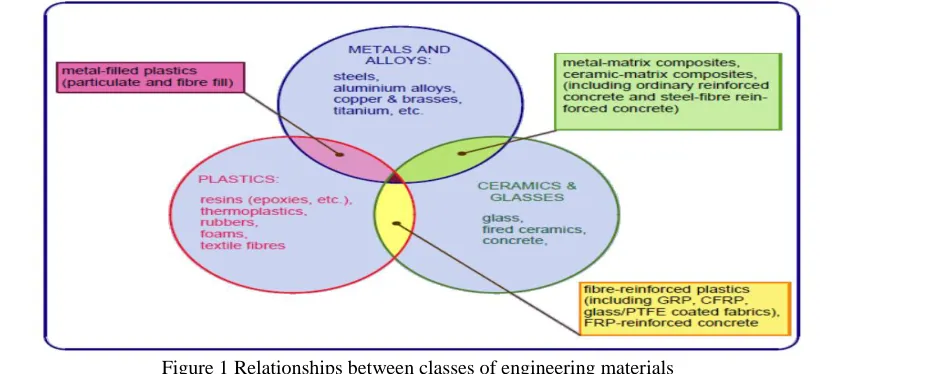
We have mentioned some more familiar one, but figure 1.1 has given a simple idea for simplicity which is available to the content scientist and his client, design engineer. First of all, each group of materials - metal, ceramic and polymer – is already some familiar materials that can be described as composites. (2)
AMMC’s one of the most suitable composite material that fulfills the need of present requirement. Aluminum has low density. Due to this the AMMC’s composite also have low density.
In the present research an iron aluminide composite are prepare with the use of WC as reinforcement in this composite. WC has high strength, greater hardness value, and high melting point. In this composite aluminum provide low density and tungsten carbide provides high strength and hardness. Iron also use in this composite. This composite is prepared by the use of stir casting method.
II.
LITERATURE REVIEW
Gomez deals with analysis of boron carbide aluminium matrix composites Boron carbide (B4C) is obtained by solid-state processes (powder metallization and extrusions) as the reinforcement of aluminum matrix composites (AMCs). Two different reinforcements were considered: B4C for the purpose of this study and for direct comparison of results, SiC The aluminum alloy AA6061 was used as the matrix in all cases. Comparative analysis between both SiC and B4C composites was focused on mechanical and tribological properties and correlated to microstructural features It concludes that with the volume fraction of reinforcement, the hardness and strength for composites increased, its maximum value reached 10% B4C. Regarding tribology, composites showed increased dynamic friction coefficient, but lower wear rate than unrelated aluminum alloy. Applications for the automotive industry as a break disk are predictive. [4]
Ravi Kant deals with the analysis aluminium matrix composites. In this four Alloy are prepared by the mixing of different reinforcement in the Iron aluminide(FeAl). Sliding wear behavior of the Alloy is tested. During the testing they find that Alloy-1 have low strength and hardness because of the graphite present in the Alloy-1. Alloy-2 and Alloy-3 exhibit comparable values of strength and hardness but higher than those of Alloy-1 dueto the presence of hard ZrC and TiC carbides, respectively. Lower volume fraction of carbides results in lower strength and hardness in Alloy-2 compared with Alloy-3. Alloy-4, which has the highest carbon (and carbide) content, exhibited the highest values of hardness and strength. Thus strength of these Alloys is determined by the volume fraction and hardness of carbides present. [5]
Ryoichi Furushima and KiyotakaKatouhas studies on the wear behavior of FeAl composite which is
sintered by PCS technique (pulse current sintering) and vacuum sintering technique. The use of pulse current sintering techniques enables to density the WC-FeAl composite at a temperature lower than that of FeAl liquid phase formation. That difference of sintering temperature results in crucial difference of the microstructure of the composites. Whereas some WC grain growth and huge FeAl phases are observed from the sample of vacuum sintering technique. As a result, superior mechanical properties such as Vickers hardness and bending strength are obtained from the samples of the pulse current sintering technique in the WC-FeAl system. [6]
M ADrewrymake a wind turbine by using the composite material. They were always attended, sometimes inhabited and, largely, manually controlled. They were integrated within the community, designed for frequent replacement of certain components and efficiency was of little importance. In this they used NDT testing methods to examine rotor blades. The analysis of damage in most towers shows that it occurs under a wind of medium intensity, and the reason is fatigue failures. In this study, a wireless system using a tiny oscillation circuit for detecting delamination of carbon/epoxy composites is proposed. [7]
III.
EXPERIMENTAL PROCEDURE
For the preparation of composite use aluminum plate, iron powder and tungsten carbide. The plate of aluminum plate (Aluminum 6063- T6) obtained from “vijayprakashgupta and sons New Delhi”, iron powder obtained from Gangotri Inorganic Pvt. Ltd Ahmedabad Gujarat India and WC particles from UNITED WOLFRAM Surat Gujarat India.
Firstly the aluminum plate is cut into small size.to be easily placed in crucible for melting. The crucible was placed in the electric furnace for melting the aluminum. So after two hours the temperature inside the furnace reached 750℃, which was shown on the control panel display and measured by thermocouple. At this 750℃ temperature, the matrix material was melted.
After the melting of aluminum in the furnace mix iron powder equal to the weight of aluminum and then heated. After 2 hours its temperature are reaches upto 1550℃ which was shown on control panel display.
35
This work is licensed under Creative Commons Attribution 4.0 International License.
Fig 2 Complete stir casting setup
After then minute the molten metal ate poured into the sand mold which are already prepared. The casting of these metals is showed in to the size of specimen for the testing of strength in tensile and makes another sample for the testing of compressive strength.
Similar process is repeated with change the percentage of reinforcement. And make other sample for testing. The percentage of reinforcement is varying from 0%, 1%, 2%, and 3%.
IV.
RESULT AND DISCUSSION
Tensile Testing: - Tensile testing is done on the on UTM.Tensile testing is used to provide information that will be used in design calculations or to demonstrate that the material complies with the requirements of appropriate specifications - so it can be either quantitative or qualitative test. Tensile strength of the specimen is measured by tensile
testing. In this research tensile testing is carried out on universal testing machine.
The test is done by applying the continuous growing uni-axial load by holding the ends of the standardized test piece, properly prepared in a tensile test machine and then on failure. As per ASTM standard the size of test piece is based on the following
relation:-L0 = k√A
Where
L0 = Original gauge length, the portion of sample with
minimum diameter (m)
k = constant (value of k varies from 5 to 6, we take it 5.65) A0 = Original area of cross-section at gauge length (m2)
In present experiment the tensile test are conducted on aluminium MMCs. Following formulas are used. σ = P/A0
e = (Lf-L0)/L0 = (A0 – Af)/A0
σu = maximum load /cross-sectional area
Table 1 Tensile strength of specimen at different % of Reinforcement
S No. Specimen composition (% weight) Tensile strength (MPa)
Al Fe WC Test 1 Test 2 Test 3 Average
1. 50 50 0 315 317 320 317
2. 49.5 49.5 1 302 307 311 307
3. 49 49 2 295 298 301 298
36
This work is licensed under Creative Commons Attribution 4.0 International License.
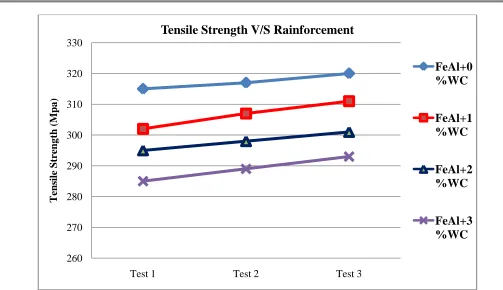
Fig.5.2 Tensile strength of specimen at different % of Reinforcement
Compressive Testing: - Compressive strength of the specimen is measured by Compressive testing. Compressive strength test, mechanical test measuring the maximum amount of compressive load a material can bear before fracturing. The test piece, usually in the form of a cube, prism, or cylinder, is compressed between the platens of a compression-testing machine by a gradually applied
load. In this research Compressive testing is carried out on universal testing machine.
In present study the compressive test are conducted on aluminium MMCs. Following formulas are used.
σ = P/A0
e = (Lf-L0)/L0 = (A0 – Af)/A0
σu = maximum load /cross-sectional area
Table 2 Compressive strength of specimen at different % of Reinforcement
S No. Specimen composition (% weight) Compressive Strength (MPa)
Al Fe WC Test 1 Test 2 Test 3 Average
1. 50 50 0 180 190 197 189
2. 49.5 49.5 1 220 229 238 229
3. 49 49 2 290 303 317 303
4. 48.5 48.5 3 400 409 417 409
260 270 280 290 300 310 320 330
Test 1 Test 2 Test 3
Tens
il
e
St
re
ngt
h
(Mp
a)
Tensile Strength V/S Rainforcement
FeAl+0
%WC
FeAl+1
%WC
FeAl+2
%WC
37
This work is licensed under Creative Commons Attribution 4.0 International License.
Fig.5.3 Compressive strength of specimen at different % of Reinforcement
In alloy 1 when no reinforcement added in base material (FeAl) their tensile strength is 317 Mpa but in alloy 2 when the percentage of reinforcement reaches 1% their tensile strength decrease reaches at 307 MPa. In alloy 3 percentage of reinforcement is 2 % their tensile strength decrease at 298 mpa. And in alloy 4 at 3% of reinforcement added in base metal their tensile strength reaches at 289 mpa.
In alloy 1 when no reinforcement added in base material (FeAl) their compressive strength is 189 Mpa but in alloy 2 when the percentage of reinforcement reaches 1% their compressive strength increase, reaches at 229 MPa. In alloy 3 percentage of reinforcement is 2 % their tensile strength decrease at 303 mpa. And in alloy 4 at 3% of reinforcement added in base metal their compressive strength reaches at 409 mpa.
V.
CONCLUSION
From all this result it is clearly specify that at the increase of reinforcement in the base material its tensile strength decrease slowly but compressive strength increase rapidly.
WC- FeAl composite was successfully developed by stir casting method.
On the basis of above result it is clearly specify that at 3 % of reinforcement compressive strength
reaches at 409 mpa. But on other hand at 3 % of reinforcement tensile strength reaches at 289 mpa.
Due to high compressive strength it is suitable to use for the manufacturing of machine base and can be replaced cast iron.
It is a ductile material due to presence of iron and steel and its tensile strength in not very less so it is useful as a shock absorbing material.
AMMC’s has low density and tungsten carbide has high strength and melting point. Due to this such material has combine property of both materials.
REFERENCES
[1] D. Hull & T. W. (1996). Clyne. An introduction to
composite materials. Cambridge University Press.
[2] B. Harris. (1999). Engineering composite materials. London: IOM.
[3] L. E. Asp & E. S. Greenhalgh. (2014). Structural power composites. Composites Science and Technology, 101, 41-61.
[4] L. Gómez, D. Busquets-Mataix, & V. Amigó. (2009). Analysis of boron carbide aluminum matrix composites.
Journal of Composite Materials. Available at:
https://journals.sagepub.com/doi/10.1177/00219983080977 31.
[5] Ravi Kant, Ujjwal Prakash, Vijaya Agarwala, & V V Satya Prasad. (2016). Microstructure and wear behaviour of
160 200 240 280 320 360 400 440
Test 1 Test 2 Test 3
C
om
pres
si
ve
Str
engt
h
(Mpa)
Compressive Strength V/S Rainforcement
FeAl+0
%WC
FeAl+1
%WC
FeAl+2
%WC
38
This work is licensed under Creative Commons Attribution 4.0 International License.
FeAl-based composites containing in-situ carbides Indian
Academy of Sciences, 39(7), 1827-1834.
[6] Ryoichi Furushima, KiyotakaKatou, Koji Shimojima, Hiroyuki Hosokawa, & Aikihiro Matsumoto. (2015). Effect of sintering technique on mechanical propertys of WC-FeAl
composite. Available at:
https://link.springer.com/chapter/10.1007/978-3-319-48127-2_132.
[7] M A Maleque, A AAdebisi, & N Izzat. (2017). Analysis of fracture mechanism for Al-Mg/SiC
p composite materials. IOP Conference Series: Materials Science and
Engineering. Available at:
https://iopscience.iop.org/article/10.1088/1757-899X/184/1/012031/pdf.
[8] Sable, A.D. & Deshmukh, S.D. (2017). Preparation of MMCs by stir casting method. International Journal of
Mechanical Engineering and Technology, 3(3), 404-411.
[9] Rajesh Kumar & Parshuram M. (2014). Preparation of aluminum matrix composite by using stir casting method.
International Journal of Current Engineering and
Technology, Special Issue-3, 148-155.
[10] J. Hashim & L. Looney. (1999). Metal matrix composites: Production by the stir casting method. Journal
of Materials Processing Technology, 92-93, 1-7.