Linking Consideration of Future Consequences to Ethical Priorities and
Orientations
Tina L. Robbins
Department of Management
College of Business and Behavioral Science
Clemson University
United States of America
Abstract
A significant stream of research has focused attention on determining the factors that influence ethical decision making in business and other contexts. Cognitive processing, situational influences, as well as personality traits have all been the subject of discussion and analysis. Surprisingly however, one’s consideration of future consequences (CFC), established as a fairly stable and measureable personality characteristic, has been surprisingly neglected given the probable link between the two. The results of this study suggest that CFC is linked to ethical orientation as well as one’s perceived importance of ethics and social responsibility in business.
Keywords
:
consideration of future consequences, business ethicsIntroduction
There is a general consensus among professionals, academics and governing bodies that there is a need for increased emphasis on ethical behavior in business education (e.g., Thomas, 2004). There is however some disagreement about whether ethics can be taught (e.g., Kerr & Smith, 1995) and some empirical evidence to the contrary (McCarthy, 1997). The ethical transgressions of late reflect top executives who “seem to have no qualms about taking unethical steps, disregarding the harm to employees, investors, their profession, or even themselves during the pursuit of wealth and prosperity” (Madison, 2002). Would ethical instruction have prevented these actions? Or are these actions attributable to individual differences that are relatively stable and resistant to change?
Much of the emphasis on ethical instruction in business has focused on the choices that are made in an attempt to develop decision making competencies that would result in ethical behavior. Situational influences on these decisions have also been analyzed (e.g., Haines & Leonard, 2007). There has been much less focus on character traits and more specifically, stable personality attributes that would certainly interact, at a minimum, with situational factors to affect ethical behavior. In fact, the more stable individual constructs may moderate the effectiveness of ethics training and education.
Individual role expectations, determined in part by values, moral principles and personality are at the center of many of the comprehensive models (e.g., Kinicki & Kreitner, 2005) of ethical behavior in the workplace. The prominent role of individual difference variables is consistent with the opinion of many (e.g., Bradshaw, 2003) who believe that corporate scandals are mostly attributable to the personality of the executive. However, scant research has addressed this issue. One exception (Sankaran & Bui, 2003) found that Type A and competitiveness were positively correlated with unethical tendencies.
© Centre for Promoting Ideas, USA www.ijbhtnet.com
Although this research is exploratory in nature, general predictions, based on theory and findings in this stream of research, can be made. First and most importantly, one’s CFC is predicted to be positively correlated with the importance one’s places on ethics and social responsibility in business. A commitment to ethics and social responsibility is often associated with the recognition that short-term gains may need to be sacrificed for a focus on more significant long-term consequences. Unethical conduct is more likely to occur when managers and executives are willing to sacrifice long term consequences for short term or immediate benefits. Many have suggested that there is a significant correlation between shortsightedness and ethical compromising when faced with the competitive pressure to think and plan for the short term (e.g., Gilbert, 2005). For example, CEO Bernie Ebbers told Fortune in an interview that WorldCom’s goal was not to capture market share or be global rather to be the No. 1 stock on Wall Street. To achieve that he had to maintain revenue and earnings growth so the company would meet or exceed stock analyst expectations. Of course this type of pressure for short-term results led to one of the biggest accounting scandals in US history.
Risking future negative consequences in order to meet short-term goals reflects one who has little future time perspective (i.e., low CFC). Certainly much of the white collar crime is attributable to executives who focus on the short term gains at the expense of maintaining ethical business behavior. In sum it is predicted that those who have more of a future time perspective are more likely to believe that ethics and social responsibility are important for the long-term success of the firm (Singhapakdi, Kraft, Vitell, and Rallapalli, 1995).
Although idealism as an ethical orientation (Forsyth, 1980) does not consider time-frame specifically, a focus on positive consequences and an assumption that they can most always be achieved would be inclusive of those that might occur in the future. In other words, idealists are consequent-oriented (Forsyth, 1980) and they may assume that desirable consequences, whether immediate or future, can always be obtained. Therefore the expectation is that idealism and CFC should be significantly and positively correlated.
On the other hand, those with a relativist ethical orientation focus on the given situation and the setting (Douglas, Davidson & Schwartz, 2001). Those who are more pragmatic and situational would seem to consider immediate circumstances and concerns at the expense of long-term consequences. Some specific findings lend support for a negative relationship between CFC and relativism. Prior research suggests that relativists are more likely to engage in short sighted behaviors such as budgetary slack creation (Douglas & Wier, 2000).
It would also reason that those who are both high in idealism and low in relativism (absolutists) would be more likely to consider future consequences. In the same respect, subjectivists (high in relativism and low in idealism) would be less likely to consider future consequences. The purpose of this study is to analyze these relationships between CFC, ethical orientations, and the perceived importance of ethics and social responsibility.
Method
Eighty two subjects anonymously completed surveys measuring the variables analyzed in this study. Twenty three of these subjects were enrolled in a business ethics course and the remaining subjects were enrolled in a junior/senior level management course. The CFC scale was developed and validated by Strathman, et al. (1994) and is shown in Appendix A. The Ethics Position Questionnaire (EPQ) which measures one’s ethical orientation was originally developed by Forsyth (1980) and has been validated with use of college students as well as practicing accountants. The PRESOR scale (Appendix B) was developed by Singhapakdi, et al. (1995) to measure the perceived relative importance of ethics and social responsibility in business.
Results
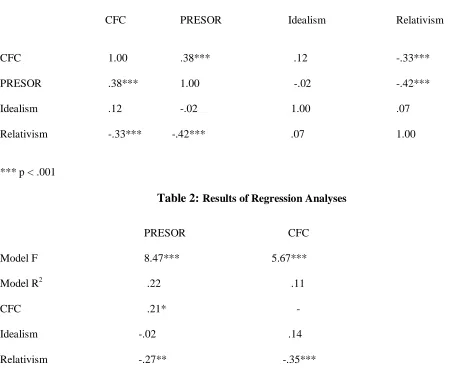
Table 1:
Pearson Correlation Coefficients for Consideration of Future Consequences (CFC), Ethics Position Questionnaire (Idealism or Relativism)Perceived Role of Ethics and Social Responsibility (PRESOR)
CFC PRESOR Idealism Relativism
CFC 1.00 .38*** .12 -.33***
PRESOR .38*** 1.00 -.02 -.42***
Idealism .12 -.02 1.00 .07
Relativism -.33*** -.42*** .07 1.00
*** p < .001
Table 2:
Results of Regression AnalysesPRESOR CFC
Model F 8.47*** 5.67***
Model R2 .22 .11
CFC .21* -
Idealism -.02 .14
Relativism -.27** -.35***
As recommended in prior research, we used median splits to formulate the four classes of ethical orientations. An ANOVA was conducted and although the means (as shown in Table 3) were in the predicted direction (absolutist having higher CFC than subjectivists), the differences were not significant.
Table 3
Means
N CFC PRESOR
Absolutist 17 3.70 4.12
Exceptionist 21 3.67 3.96
Situationist 19 3.55 3.62
Subjectivist 18 3.41 3.95
Discussion
© Centre for Promoting Ideas, USA www.ijbhtnet.com
The knowledge of one’s own “intrinsic proclivities” may be work as effective caution against unethical conduct (Sankaran & Bui, 2003). These results also corroborate prior research evidence (Axinn, Blair, Heorhiadi, & Thach, 2004; Singhapakdi et al., 1995) that relativism negatively influences the perceived important of ethics and social responsibility in achieving organizational effectiveness.
Caution must be used with any assumptions about cause and effect with the findings of this study. It is important for future research to enhance our understanding with more specific knowledge about the role of each variable in a predicting ethical behavior. It would also be interesting and useful to examine how they interact with external inputs (e.g., organizational culture) in a comprehensive model of ethical behavior. All may offer some unique influence on ethical behavior and may explain the most variance when considered in combination. Previous research supports better predictability when both personality variables and ethical orientations are considered.
The stability of the three constructs analyzed in this paper is also an important area for future research. Although prior research (Strathman, et al., 1994) suggests that CFC is developed by the time students reach college, it has also been suggested to be a characteristic that can change. Low CFC may be attributable to the inability of some individuals to focus on the abstract and ambiguousness of the future (Strathman, et al., 1994). Ethics educators could benefit from knowing whether one or more of these variables are more susceptible to influence from education and/or training. It has been suggested that one’s propensity with CFC may change with a critical event and the subsequent experience of some major consequence (Strathman, et al., 1994). Perhaps then education and knowledge of the severity of actual future consequences (e.g., monetary fines, jail time, environmental disasters) of unethical decisions may work vicariously to change one’s CFC propensity to some degree or at least a shift from a total proximal focus to a more distant one.
The next step in this line of research is to analyze the effect of CFC on actual ethical judgments (using case studies, hypothetical scenarios, etc.) of managers, executives, as well as business students. If the CFC scale is found to be a significant predictor of ethical judgments, researchers and human resource professionals may eventually be able to work together to validate it as a useful selection tool. The use of personality testing in general, and integrity tests more specifically, have become increasingly used selection tools with prevention of unethical behavior as a goal. The CFC scale may be a more specific reliable predictor of ethical conduct in the context of susceptible top management and accounting professions, particularly given their increased ethical responsibilities under the Sarbanes-Oxley Act. The actions of CEOs, CFOs, auditors, etc. have been, and will continue to be very closely monitored with little tolerance for actions that result from short-term thinking.
References
Axinn, C., Blair, M., Heorhiadi, A. & Thach, S. (2004) Comparing Ethical Ideologies Across Cultures, Journal of Business Ethics, 54: 103 – 119.
Bradshaw, D. (2003). Scandals are a matter of personality: Corporate Ethics: The Aspen survey reflects the changing attitudes of MBA students to corporate culture, reports Della Bradshaw. The Financial Times, May 26: 11. Douglas, P., Davidson, R. & Schwartz, B. (2001). The effect of organizational culture and ethical orientation on
accountants’ ethical judgments, Journal of Business Ethics, 34: 101-121. Douglas, P. C. , and B. Wier (2000). Integrating ethical dimensions into a model of budgetary slack creation. Journal Of Business Ethics 28(3): 267-277.
Forsyth, D. 1980. A taxonomy of ethical ideologies, Journal of Personality and Social Psychology, 39: 175-184. Gilbert, E. (2005). Short-term thinking puts insurance pros in ethical pickle. National Underwriter Life &
Health-Financial Services Edition. Dec. 17, 51: 15-16. In reference to a quotes by Norman A. Baglini, president and
chief executive officer of the American Institute for Property and Liability Underwriters, Malvern, Pa. & Robbin Derry, C. Lamont Post Professor of Ethics and the Professions at the America College.
Haines , R. & Leonard, L.N. (2007). Situational influences on ethical decision-making. Information and Management, 44: 313-320.
Kerr, D. & Smith, L. (1995). Importance of and approaches to incorporating ethics into accounting Classroom, Journal of Business Ethics, 14: 987-998.
Kinicki, A. & Kreitner, R. (2005). Organizational Behavior: Key concepts, Skills & Best Practices. McGraw-Hill, Irwin.
McCarthy, I. (1997). Professional ethics code conflict situation: Ethical and value orientation of collegiate accounting students, Journal of Business Ethics, 16: 1467-1473.
Petrocelli, J. (2003). Factor Validation of the Consideration of Future Consequences Scale: Evidence for a Shorter Version, Journal of Social Psychology, Aug, 143, 4: 405-413.
Rappange, D., Werner, B.F. & Van Exel, N.J. (2009). Back to the consideration of the future consequences scale: Time to reconsider? Journal of Social Psychology, 149, 5: 562-584.
Sankaran, S. & Bui, T. (2003). Relationship between student characteristics and ethics: Implications for educators,
Journal of Instructional Psychology, Sept, 30, 3: 240-243.
Singhapakdi, A., Kraft, K., Vitell, S. & Rallapalli, K. (1995). The perceived importance of ethics and social responsibility on organizational effectiveness: a survey of marketers, Journal of the Academy of Marketing Science, Winter, 23, 1: 49-56:
Strathman, A., Gleicher, F., Boninger, D. & Edwards, C. (1994). The consideration of future consequences: Weighing immediate and distant outcomes of behavior, Journal of Personality & Social Psychology, Apr, 66, 4: 742-752. Thomas, C. (2004). An inventory of support materials for teaching ethics in the Post-Enron era, Issues in Accounting
Education, Feb, 19, 1: 27-52.
Appendix A - CFC Scale
For each of the statements below, please indicate whether or not the statement is characteristic of you. If the statement is extremely uncharacteristic of you (not at all like you) please type a "1" to the left of the question; if the statement is extremely characteristic of you (very much like you) please type "5" next to the question. And, of course, use the numbers in the middle if you fall between the extremes. Please keep the following scale in mind as you rate each of
the statements below.
1 2 3 4 5
extremely somewhat uncertain somewhat extremely
uncharacteristic uncharacteristic characteristic characteristic
____1. I consider how things might be in the future, and try to influence those things with my day to day behavior.
____2. Often I engage in a particular behavior in order to achieve outcomes that may not result for many years.
____3. I only act to satisfy immediate concerns, figuring the future will take care of itself.
____4. My behavior is only influenced by the immediate (i.e., a matter of days or weeks) outcomes of my actions.
____5. My convenience is a big factor in the decisions I make or the actions I take.
____6. I am willing to sacrifice my immediate happiness or well-being in order to achieve future outcomes.
____7. I think it is important to take warnings about negative outcomes seriously even if the negative outcome will not occur for many years.
____8. I think it is more important to perform a behavior with important distant consequences than a behavior with less-important immediate consequences.
© Centre for Promoting Ideas, USA www.ijbhtnet.com
____10. I think that sacrificing now is usually unnecessary since future outcomes can be dealt with at a later time.
____11. I only act to satisfy immediate concerns, figuring that I will take care of future problems that may occur at a later date.
____12. Since my day to day work has specific outcomes, it is more important to me than behavior that has distant outcomes.
Appendix B - PRESOR Scale
For each of the statements below, please indicate the extent to whether you agree or disagree based on the following scale.
1 2 3 4 5
Strongly agree agree neutral disagree strongly disagree
1. If the survival of a business enterprise is at stake, then you Must forget about ethics and social responsibility.
2. If the stockholders are unhappy, nothing else matters.
3. The most important concern for a firm is making a profit, even if it means bending or breaking the rules.
4. To remain competitive in a global environment, business firms will have to disregard ethics and social responsibility.
5. Efficiency is much more important to a firm than whether or not the firm is seen as ethical or socially responsible.
6. Although output quality is essential to corporate success, ethics and social responsibility are not.
7. The ethics and social responsibility of a firm is essential for long-term profitability.
8. Business ethics and social responsibility are critical to the survival of a business enterprise.
9. The overall effectiveness of a business can be determined to a great extent by the degree to which it is ethical and socially responsible. S1
10. Communication is more important to the overall effectiveness of an organization than whether it is concerned with ethics and social responsibility.
11. Social responsibility and profitability can be compatible.
12. Good ethics is often good business.
13. Business has a social responsibility beyond making a profit.