377
Volume-4, Issue-4, August-2014,
ISSN No.: 2250-0758
International Journal of Engineering and Management Research
Available at:
Page Number: 377-381
Assessment of Toxicity of Mercuric Chloride in Terms of Body Weight,
Liver Weight and Ratio of Liver Weight/Body Weight in Albino Rat
Neetu Singh
Assistant Professor (Zoology) R.B.A. Govt. Degree College, Gajraula , Amroha, Uttar Pradesh, INDIA
ABSTRACT
The assessment of changes in physical parameters of biological tissues is an important way in the study of toxicity of heavy metals. It is the study which evaluate toxic effects of mercuric chloride in terms of body weight , liver weight and liver weight /body weight ratio in albino rats after acute and sub-acute treatment of it. For experiment the rats were grouped into 4 sets; one acute & 3 sub-acute (7, 14 and 21 days) and each set considered 4 rats . Control sets were runs simultaneously with each treated set. Body weight show very highly significant decrease in prior two treatments whereas liver weight show highly significant decline through the experiment. Ratio of liver weight /body weight decrease highly significant during prior 3 treatments and very highly significant in last treatment . Mercuric chloride is a systemic poison and whole animal get affected even very minute intake of it.
Keywords--- Physical parameters , biological tissues , mercuric chloride , albino rat , systemic poison .
I.
INTRODUCTION
Mercury is one of the oldest toxic metals known to men . Mercury is a silver white metal existing in a number of physical and chemical forms. The occurrence of mercury in the environment is by three sources . Alkyl mercurial is found in agricultural pesticides . Aryl mercurial is found in paints and is used in the manufacturing of paper and inorganic divalent mercury from chlor-alkali plants. Mercuric chloride is an inorganic compound that has been used in agriculture as fungicide, in medicine as topical antiseptic and disinfectant and in chemistry as an intermediate in the production of other mercury compounds . Hg1+ and Hg2+ of these two oxidation states , Hg2+
II.
MATERIAL AND METHODS
is the more reactive readily forming complexes with organic legands , notably sulfhydryl groups . The distribution of mercury varies considerably depending on the chemical form and to a lesser extent on the route of administration . Biological half-life of inorganic mercury is about 40 days in man.
Animals are usually more sensitive to heavy metal contamination than are plants . The humans are universally considered as the most sensitive , as well as the most important target species . But due to much more limitations for using humans as a experimental organisms , albino rat (Rattus norvagicus ) has been taken into consideration which is physiologically very close to humans.
The aim of present investigation is to study the effects of mercuric chloride an inorganic compound on body weight , liver weight and their ratio in albino rat.
Captivated and acclimated albino rats (Rattus
norvagicus) used in the present experimental studies have
been selected from inbred colony. Healthy 32 albino rats of almost equal size and weight representing both the sexes were kept in clean polypropylene cages. The rats were kept at the temp. of 25±50C and relative humidity 60±5% and photoperiod 10 hrs /day . The rats were fed on feed obtained from Hindustan Antibiotic Ltd. & water was provided ad libitum.
As mercuric chloride has been taken as test compound . Their LD50 was calculated as 9.26 Mg/Kg
weight .
For experiment the rats were grouped into 4 sets (one acute and 3 sub-acute sets) 7 each set consisted of 4 rats . The control sets were run simultaneously for acute and sub-acute studies having 4 rats in all 4 groups .
The all rats of acute set were given a sub lethal dose ( 1
10𝑡𝑡ℎ of LD50 ) for acute treatment (one day )
whereas other three sub-acute sets of rats were given sub lethal dose divided by 21 days i.e. 0.44 mg/kg body weight of mercuric chloride for 7, 14 and 21 days .
378
The weight of liver was taken after autopsy ofboth treated and control.
The liver weight body weight ratio of each rat was estimated for both control and experimental sets.
Results of experiment were presented as the mean ± S.Em. values of 𝑝𝑝> 0.05 were regarded as statistically highly and very highly significant.
Fig. 1: Body weight of albino rats after mercuric chloride intoxication
379
Fig. 2: Liver weight of albino rats after mercuric chloride intoxication .380
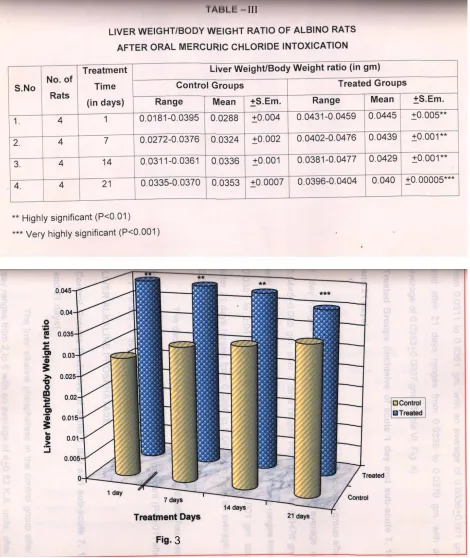
Fig. 3 : Liver weight/Body weight ratio of albino rats after mercuric chloride intoxication** Highly significant ***Very highly significant
381
Albino rats treated with mercuric chloride showeda significant decrease in body weight , liver weight and in liver weight/body weight ratio.
Body weight reflects the overall state of metabolism and the capability of the organism to maintain its normal growth and developmental activities .
Treated rats show very high significant decrease in body weight after one and 7 days while highly significant decrease after 14, 21 days (Table 1 & Fig. 1 ). The decline in body weight is caused by the reduced food and water intake . The result is in accordance with the previous findings (NTP, 1993; Arunadevy et al, 1999 and Ramalingam et al, 1999) .
Reduction in body weight is accompanied with decline in liver weight . Liver is an important organ for transformation of xenobiotics where microsomal enzymes are involved in controlling many physiological and pathological processes . Thus any change in physiology of liver is bound to affect liver weight . The reduction in liver weight has probably been linked to degenerative capacity of mercuric chloride . Treated rats show highly significant throughout the experiment i.e. at 1, 7, 14 and 21 days after intoxication (Table 2 , Fig. 2) . This is due to degenerative capacity of mercuric chloride in accordance to Saber (1985).
Decrease in liver weight /body weight ratio is highly significant after 1,7,14 days and very highly significant after 21 days (Table 3, Fig. 3) . The decrease in the ratio can be correlated with decrease in body weight and liver weight . These results are in accordance to Saber 1985 , Ramalingam et al. 1999, Arunadevy et al 1999. Thus present findings of decrease body weight , liver weight & liver weight/ body weight ratio are the useful information on the mode of action of mercuric chloride is ascertained which highlights its toxicity in albino rat.
REFERENCES
[1] Addya , S.K. Chakravarti, A. Basu, M. Santa, S. Holder and G.C. Chatterjee. 1984. Effects of mercuric chloride on several scavenging enzymes in rat kidney and influence of vitamin E supplementation. Acta. Vitaminol. Enzymol., 6 (2): 103-108.
[2] Atkinson, A., S.J. Thompson, A.T. Khan, T.C. Graham, S. Ali, C. Shannon, O. Clarke and L. Upchurch. 2001. Assessment of a two generation reproductive and
fertility study of mercuric chloride in rats. Food chem.. Toxicol., 39 (1): 73-84.
[3] Berlin, M. and S. Ullberg. 1963. Accumulation and retention of mercury in the mouse. I-III. Arch . Environ . Health, 6: 589-616.
[4] Britton, R. 1996. Metal-induced hepatotoxicity . Semin. Liver Wis. , 16 (1): 3-12.
[5] Calabrese, E.J., L.A. Baldwin, D.A. Leonard and X.Q. Zhao. 1965. Decrease in hepatotoxicity by leas exposure is not explained by its mitogenic response. J.Appl. Toxicol., 15(2): 129-132.
[6] Clarkson, T.W. 1972. The pharmacology of mercury compounds Ann. Rev. Pharmacol., 12:375-406.
[7] Clarkson , T.W. 1997 . The toxicology of mercury. Crit. Rev. Clin. Lab. Sci., 34: 369-403.
[8] Clarkson, T.W. 2002. The three modern faces of mercury . Rev. Environ. Health, 110(1):11.
[9] Dantizg, P.I. 2003. A new cutaneous sign of mercury poisoning . Anna. Int. Med., 139(1):78.
[10] Ellen, J. and O. Flahrty. 1998. Physiologically based models of metal kinetics. Crit. Rev. Toxicol., 28(3):271-317.
[11] Farina , M., F.A. Soares and A. Feoli. 2003. In Vitro effects of selenite and mercuric chloride on liver thiobarbituric acid reactive substance and non-protein thiols from rats.
[12] Fukino, H. 1986 Interaction of mercuric chloride. J. Toxicol. Environ. Health ., 19 (1): 75-90.
[13] Huang, I.Y., A. Yoshida , H. Tsunoo and H. Nakajima. 1977. Mouse liver metallothionines. J. Biol. Chem./ 252:8217-8221.
[14] Khan, A.T., A. Alfonza , G.C. Thomson and F.S. Kaniz. 2001. Uptake and distribution of mercury in rats after repeated administration of mercuric chloride. J. Environ. Sci. Hlth., 36 (10) : 2039-2045.
[15] Ramalingam, V., O.M.A. Suganthy, R. Arunadevy and A. Jaya. 1999. Mercuric chloride induced biochemical changes in the liver of mature male albino rats. Indian . J. Env. Toxicol., 9 (2) : 56-58.
[16] Saber, A. 1985. Pyrethriod inhalation induced hepatotoxicity in albino rats. Toxicol ., 46 (1) : 112-115. [17] Webb, M. and D. Holt. 1982. Endogenous metal binding proteins in relation to the difference in absorption and distribution of mercury in newborn and adult rats. Arch. Toxicol., 49 : 237-245.