Original Research Article
Depression and religiosity among urban elderly population of
western Uttar Pradesh, India
Anshumali Singh, S. K. Kaushal*, S. K. Misra, Renu Agrawal
INTRODUCTION
With increasing life expectancy, the proportion of elderly is increasing and it is estimated that by 2050, globally, population over 60 years will nearly double from 12% to 22%.1 As the age increases, the burden of non-communicable diseases and mental disorders also increase, especially geriatric depression. Geriatric depression is associated with presence or absence of factors like elderly abuse, financial dependence, marital status, spirituality etc.2-5
Spirituality in older adults most often manifests as religiosity or religiousness. Religiosity may have a protective effect on mental health by various mechanisms like religious coping, i.e. the individual collaborates with ‘God’ in coping with stress, is related with the greatest improvement in mental health. Religious views may allow a person to remount or understand happenings that are seen as uncontrollable, in such a way as to make them less stressful or more meaningful. In the light of this background the study was planned to find out role of religiosity in geriatric depression.
ABSTRACT
Background: India is a country with rich cultural and spiritual background. Research suggests that engagement in religious activity, or religiosity, may protect against depression. This cross-sectional study examines whether religiosity is associated with depression in elderly. The objectives of the study were to assess the presence of depression among elderly population of urban Agra and to find the association between religiosity and depression amongst urban elderly.
Methods: This community based cross-sectional study was conducted on a sample of 355 community dwelling older
adults residing in urban Agra. One municipal ward was randomly chosen, further three residential colony from the ward was randomly selected. All the houses of colonies were visited sequentially. One person, chosen randomly from eligible family members was invited to participate. After establishing rapport and obtaining written informed consent from participants, the information was recorded in a semi-structured, pre-designed and pre-tested questionnaire.
Results: The mean age of the participants was 68.05 years with 52.96% males and 47.04% females. Overall,
depression was found in 51.1% among study population. Depression was more among non-religious (60.61%) and among those who were not involved in any extrinsic or intrinsic religious activity.
Conclusions: Findings suggest that both organizational and non-organizational forms of religiosity affect depression
in the study group. Important strategies to prevent and relieve depression among older adults may include improving access and transportation to places of worship among those interested in attending services.
Keywords: Geriatric depression, Mental health, Elderly, Geriatric depression score, Religiosity, Extrinsic, Intrinsic
Department ofCommunity Medicine, Sarojini Naidu Medical College, Agra, Uttar Pradesh,, India
Received: 30 January 2018
Accepted: 05 March 2018
*Correspondence:
Dr. S. K. Kaushal,
E-mail: [email protected]
Copyright: © the author(s), publisher and licensee Medip Academy. This is an open-access article distributed under
the terms of the Creative Commons Attribution Non-Commercial License, which permits unrestricted non-commercial use, distribution, and reproduction in any medium, provided the original work is properly cited.
METHODS
This cross–sectional, community based study was carried out among population of individuals who have completed 60 years of their life and were residing in the urban Agra for 6 months and above. Study was carried out over duration of one year, from January 2017 to December 2017. Data was collected by first author herself. Statistically valid sample size was drawn, based on reported 36% as the prevalence rate of depression among elderly Indian population of Bengaluru by Sanjay et al.3 The sample size (N) calculation,
N = 4pq/ d2
Where, p=expected prevalence of depression in elderly by previous study; q=100-p; d=maximum allowable error (relative) which is taken as 15% of p for this study.
Here p=36; q=64; d=15% of p.
Sample size thus yielded is 316. Adding a figure of 10% to it for incomplete interviews, the total number came out to be 348, which were rounded off to 350. While data collection process, the lane had five more houses with elderly individuals willing to participate in our study so a total of 355 participants aged 60 year or above were included in the current study.
Sampling technique
Multistage random sampling was used to reach sample. In first stage, one ward i.e. Jaipur House was chosen randomly. In second stage, three residential colonies from the ward were randomly selected as Manas Nagar Colony, Parashuram Nagar and Janta Colony. All the houses of first and second residential colony were visited, sequentially for the purpose of interview. Sequential visits to all houses of these colonies were made until required numbers of participants were included. Five more individuals willingly participated from the lane from which last participant was taken. In third stage of multistage random sampling, if more than one eligible
person existed in the household, then the study participant was selected randomly by lottery method. The process was repeated until desired sample size was achieved.
Data was collected in pre-designed and pretested schedule which consisted of questions about socio-demographic profile religiosity of respondents and GDS-30 to screen for depression in elderly.6 Data was suitably analyzed using SPSS, version 22 for our aim and objectives.
Elderly: A person who had completed 60 years, or more, of age was considered as elderly.
Religiosity: The respondents who perceived themselves to be religious were recorded as being religious and those who did not consider themselves to be religious were recorded as non-religious.
Extrinsic religiosity is characterized as religion that primarily serves other more ultimate ends rather than central religious beliefs per se which is usually manifested as visiting place of worship and attending religious congregations.
Intrinsic religiosity is characterized as religion that is an end in itself, a master motive. Intrinsic religiosity generally manifests as private prayer sessions, meditation, reading religious/spiritual books and other such activities which can be termed as personal religious pursuits.
RESULTS
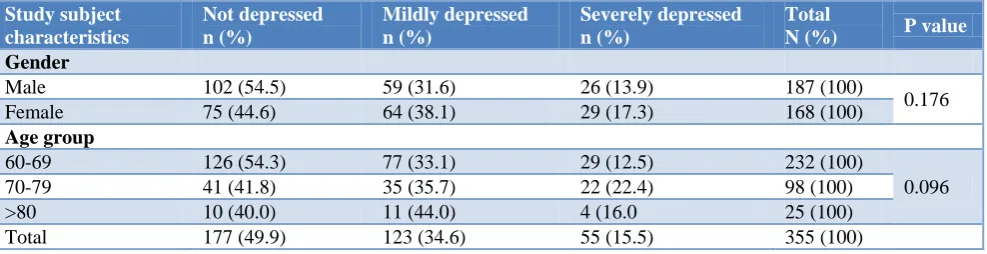
Out of 355 study subjects, 52.7% are males and 47.3% females. Mean age of the study subjects is 68.05 years. Almost half (50.1%) of the study population had depression as per geriatric depression scale score interpretations. 15.5% of total study population had severe depression. Depression was found more in females. With increase in age depression increased but it was statistically insignificant (Table 1).
Table 1: Prevalence of depression and study subject characteristics. Study subject
characteristics
Not depressed n (%)
Mildly depressed n (%)
Severely depressed n (%)
Total
N (%) P value
Gender
Male 102 (54.5) 59 (31.6) 26 (13.9) 187 (100)
0.176
Female 75 (44.6) 64 (38.1) 29 (17.3) 168 (100)
Age group
60-69 126 (54.3) 77 (33.1) 29 (12.5) 232 (100)
0.096
70-79 41 (41.8) 35 (35.7) 22 (22.4) 98 (100)
>80 10 (40.0) 11 (44.0) 4 (16.0 25 (100)
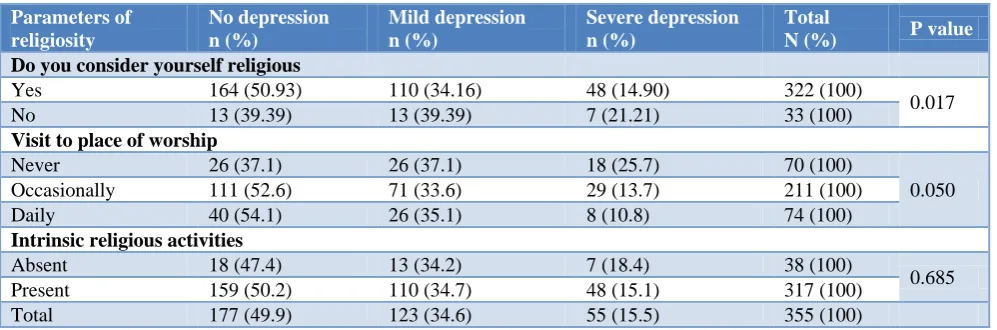
Table 2: Religiosity and depression in the study population. Parameters of
religiosity
No depression n (%)
Mild depression n (%)
Severe depression n (%)
Total
N (%) P value
Do you consider yourself religious
Yes 164 (50.93) 110 (34.16) 48 (14.90) 322 (100)
0.017
No 13 (39.39) 13 (39.39) 7 (21.21) 33 (100)
Visit to place of worship
Never 26 (37.1) 26 (37.1) 18 (25.7) 70 (100)
0.050
Occasionally 111 (52.6) 71 (33.6) 29 (13.7) 211 (100)
Daily 40 (54.1) 26 (35.1) 8 (10.8) 74 (100)
Intrinsic religious activities
Absent 18 (47.4) 13 (34.2) 7 (18.4) 38 (100)
0.685
Present 159 (50.2) 110 (34.7) 48 (15.1) 317 (100)
Total 177 (49.9) 123 (34.6) 55 (15.5) 355 (100)
Lesser percentage of subjects with self-perception of being religious (49.07%) suffered from depression (GDS≥10) as compared to the subjects who considered themselves to be non-religious (60.61%). Only 10.8% of subjects attending to organizational extrinsic religious activities daily had severe depression, while among those who don’t attend such activity 25.7% of individuals had similar GDS interpretation. These differences were found to be significant on statistical analysis. Slightly more severe depression was seen in individuals without intrinsic religiosity (18.4%), when compared with subjects involved in intrinsic religious activities (15.1%), but the different was not significant statistically (Table 2).
DISCUSSION
Geriatric depression is a complex disorder with many
bio-psychosocial risk factors. Prevention and
management of geriatric depression begins at home with healthy and respectful family environment. It requires collaborative efforts and holistic approaches by healthcare providers. The present study was carried out to find the protective role of religiosity on geriatric depression. It was found that out of total study participants 50.1% had depression. Which was more among females (55.4%) in comparison to males (45.5%), and it was found that percentage of depression increased with increasing age. Pushparani et al, in their study among the elderly in Kancheepuram district of Tamil Nadu, Ravindra et al in elderly population of urban Bangalore and D’Souza et al found the prevalence of depression to be 47.8%,44.8% and 51.9% respectively.7-9 The results of these studies are in consonance to our study. However, Mandolikar et al conducted a study in urban area of Dakshina Kannada district of Karnataka and found the prevalence of depression among the elderly to be 75.5%.10 They reported higher prevalence of depression which could be largely attributed to cultural variations and due to difference in socio-economic status of study subjects in both the studies. Sharma et al
the prevalence of depression to be 35.7%.11 The difference may be due to the rural settings of the study by Sharma et al. Rural communities are usually more close-knit and with more frequent social interactions which may be the reason of less depression in these setting. Similar observations were made by Udyar et al in rural area of Chittor, Karnataka.12 Our study found, 34.6% of the study subjects were mildly depressed, while 15.5% were severely depressed. Pushparani et al, in their study among the elderly in Kancheepuram district of Tamil Nadu observed that 33.9% had mild and 13.8% had severe depression.7 These findings are similar to our study where mild depression is more in study population than severe depression. In the current study, the proportion of female respondents with mild (38.1%) and severe (17.3%) depressive symptoms was more than the percentage of male respondents (31.6% &13.9% respectively). This falls in line with the WHO report on mental health on risk factors of depression where female gender is more likely to get depressed when compared to males.13 Zalavadiya et al conducted a study at Rajkot city of Gujarat and found out that the proportion of males and females being depressed was 24.7% for males and 37.9% for females.14 The findings are similar to our study. In the current study, number of subjects with GDS score suggestive of mild depression gradually increased with increasing age from 31.5% for 60-65 years to 44.0% for >80 years of age. Zalavadiya et al, in urban areas of Rajkot city, observed that a positive correlation was found with rising age and levels of depression, which is in concurrence with studies by Mandolikar et al (2017), in urban area of Dakshina Kannada district of Karnataka, and Sengupta, Benjamin, in rural area of Ludhiana, where the prevalence of depression was found to increase with adding number of years in respondent’s age.10,14
perception of being religious (49.07%) suffer from depression as compared to the subjects who considered themselves to be non-religious (60.61%). Only 10.8% of subjects attending to organizational extrinsic religious activities daily have severe depression, while among those who don’t attend such activity 25.7% of individuals have similar GDS interpretation. Inferring the same, a study by Zalavadiya et al conducted at Rajkot, found that the prevalence of depression was higher in those who 'did not pray’.14
Gupta et al performed a study to find a relationship between religiosity and psychopathology in patients with depression and found a significant negative correlation between the levels of religiosity and depression and suicidality.16 Chokkanathan observed that religiosity significantly influences the well-being of older adult respondents and it suggested the crucial role of religiosity in influencing the well-being of older adults.17 Ronneberg found protective effects of religiosity on depression in older adults of Massachusetts Boston.5 At 45% and 37%, respectively, high frequency of religious service attendance was more likely to be reported by non-depressed than depressed respondents, whereas depressed respondents were more likely to report low or no service attendance than their non-depressed counterparts.
CONCLUSION
A high percentage of older adults living in urban area of Agra had GDS scores indicative of depression. Nearly half of the study subjects were found having depression, out of which, one third were having severe depression. Findings suggest that religiosity and its extrinsic form affect presence and severity of depression in the study group. Therefore, strategies to prevent depression among elderly may include improving access and transportation to places of worship among those interested in attending services. These centers of religious activities can also double up as centers for social interactions as well as moral and emotional support. Further studies in this direction are needed to establish clear relationship between religiosity, different forms of religiosity and spirituality.
Limitations
The study has examined a simplistic construct of religiosity, which is a subjective phenomenon, with different definitions and notions, even in individuals practicing the same religion.
The definitions and concepts of religiosity used for this research are largely borrowed from Christian context.
ACKNOWLEDGEMENTS
We would like to acknowledge Dr Vishal Sinha, Associate Professor and Head, Department of Psychiatry,
S.N. Medical College, Agra, for his precious insights into the subject of this research work.
Funding: No funding sources Conflict of interest: None declared
Ethical approval: The study was approved by the Institutional Ethics Committee of Sarojini Naidu Medical College, Agra.
REFERENCES
1. WHO. Ageing and health. Factsheet no: 404; 2017. Available at: http://www.who.int/mediacentre/ factsheets/fs404/en/. Accessed on 22 June 2017. 2. Skirbekk V, James KS. Abuse against elderly in
India – The role of education. BMC Public Health. 2014;14:336.
3. Sanjay TV, Jahnavi R, Gangaboraiah B, Lakshmi P, Jayanthi S. Prevalence and factors infl uencing depression among elderly living in the urban poor locality of Bengaluru city. Int J Health Allied Sci. 2014;3:105-9.
4. Pilania M. Prevalence and Predictors of Depression in Community-Dwelling Elderly in Rural Haryana, India Indian J Community Med. 2017;42(1):13–8. 5. Ronneberg CR, Miller EA, Dugan E, Frank P. The
Protective Effects of Religiosity on Depression: A 2-Year Prospective Study. The Gerontologist, 2014: 1–12.
6. Yesavage JA, Brink TL, Rose TL, Lum O, Huang V, Adey M, et al. Development and validation of a geriatric depression screening scale: A preliminary report. J Psychiatr Res. 1983;17:37-49.
7. Pushparani JP, Chitrasena S, Ramasubramanian R. A study on the prevalence of depression and its
associated factors among the elderly in
Kancheepuram district, South India. Nat J Res Community Med. 2017;6(4).
8. Ravindra NR, Rashmi MR, Maheswaran R. Risk factors for depression among elderly in Bangalore urban district: a case control study. Int J Community Med Public Health. 2017;4:2696-700.
9. D’souza L, Ranganath T.S, Thangaraj S. Prevalence of depression among elderly in an urban slum of Bangalore, a cross sectional study. International Journal of Interdisciplinary and Multidisciplinary Studies (IJIMS). 2015;2(3):1-4.
10. Mandolikar RY, Naik P, Akram MDS, Nirgude AS.
Depression among the elderly: A cross-sectional study in an urban community. Int J Med Sci Public Health. 2017;6:318-22.
11. Sharma R. Depression among the elderly Population in a Rural Community: A Study of its Prevalence and Correlates. Indian Medical Gazette. 2012: 464-472.
13. World Health Organization. Depression: A Global Crisis. Available at: http://www.who.int/mental_ health/management/depression/wfmh_paper_depres sion_wm hd_2012.pdf. Accessed on 20 June 2017.
14. Zalavadiya DD, Banerjee A, Sheth AM,
Rangoonwala M, Mitra A, Kadri AM. A comparative study of depression and associated risk factors among elderly inmates of old age homes and community of Rajkot: A Gujarati version of the geriatric depression scale-short form (GDS-G). Indian J Community Med. 2017;42:204-8.
15. Sengupta P, Benjamin AI. Prevalence of depression and associated risk factors among the elderly in urban and rural field practice areas of a tertiary care
institution in Ludhiana. Indian J Public Health. 2015;59:3-8.
16. Gupta S, Avasthi A, Kumar S. Relationship between religiosity and psychopathology in patients with depression. Indian J Psychiatry. 2011;53:330-5. 17. Chokkanathan S. Religiosity and well-being of older
adults in Chennai, India. Aging Mental Health. 2013;17(7):880-7.
Cite this article as: Singh A, Kaushal SK, Misra SK,