16 Volume-4, Issue-1, February-2014,ISSN No.: 2250-0758 International Journal of Engineering and Management Research
Available at:
Page Number: 16-21
A Review on Optimization of MIG Welding Parameters using Taguchi’s
DOE Method
Satyaduttsinh P. Chavda1, Jayesh V.Desai2, Tushar M.Patel3 1
M.E Scholar, Department of Mechanical Engineering, KSV University, Gandhinagar, INDIA 2
Assistance Professor,Department of Mechanical Engineering, KSV University, Gandhinagar, INDIA 3
Associate Professor, Department of Mechanical Engineering, KSV University, Gandhinagar, INDIA
ABSTRACT
The MIG welding parameters are the most important factors affecting the quality, productivity and cost of welding. This paper presents the influence of welding parameters like welding current, welding voltage, Gas flow rate, wire feed rate, etc. on weld strength, weld pool geometry of Medium Carbon Steel material during welding. By using DOE method, the parameters can be optimize and having the best parameters combination for target quality. The analysis from DOE method can give the significance of the parameters as it give effect to change of the quality and strength of product or does not. A plan of experiments based on Taguchi technique has been used to acquire the data. An Orthogonal array and analysis of variance (ANOVA) are employed to investigate the welding characteristics of Medium Carbon Steel material and optimize the welding parameters. Finally the conformations tests have been carried out to compare the predicated values with the experimental values confirm its effectiveness in the analysis of weld strength and Depth of penetration.
Keywords: MIG welding, medium carbon steel, DOE method
I.
INTRODUCTION
Metal Inert Gas welding as the name suggests, is a process in which the source of heat is an arc formed between a consumable metal electrode and the work piece, and the arc and the molten puddle are protected from contamination by the atmosphere (i.e. oxygen and nitrogen) with an externally supplied gaseous shield of inert gas such as argon, helium or an argon-helium mixture. No external filler metal is necessary, because the metallic electrode provides the arc as well as the filler metal. It is often referred to in abbreviated form as MIG welding. MIG is an arc welding process where in coalescence is obtained by heating the job with an electric arc produced between work piece and metal electrode feed continuously. A metal inert gas (MIG) welding process consists of heating, melting and solidification of parent metals and a filler material in localized fusion zone by a transient heat source to form a joint between the parent
metals. Gas metal arc welding is a gas shielded process that can be effectively used in all positions.
A. GMAW can be done in three different ways:
Semiautomatic Welding - equipment controls only the electrode wire feeding. Movement of welding gun is controlled by hand. This may be called hand-held welding. Machine Welding - uses a gun that is connected to a manipulator of some kind (not hand-held). An operator has to constantly set and adjust controls that move the manipulator. Automatic Welding - uses equipment which welds without the constant adjusting of controls by a welder or operator. On some equipment, automatic sensing devices control the correct gun alignment in a weld joint.
B. WORKING PRINCIPLE OF MIG WELDING :
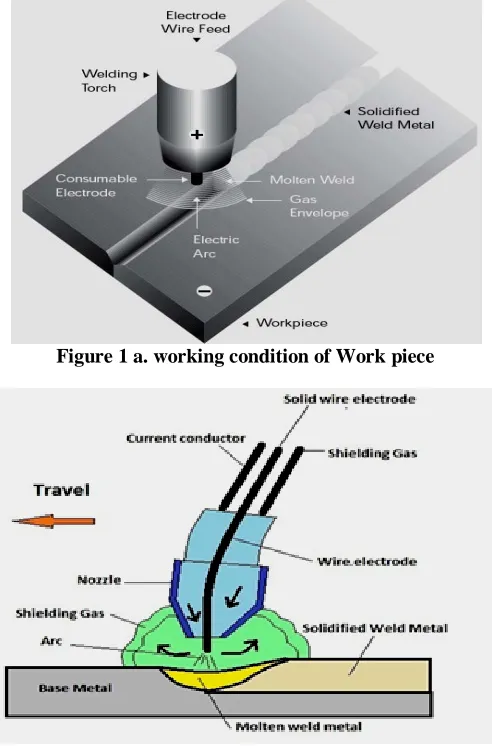
As shown in fig. the electrode in this process is in the form of coil and continuously fed towards the work during the process. At the same time inert gas (e.g. argon, helium, or𝐶𝐶𝐶𝐶2) is passed around electrode from the same torch. Inert gas usually argon, helium, or a suitable mixture of these is used to prevent the atmosphere from contacting the molten metal and HAZ. When gas is supplied, it gets ionized and an arc is initiated in between electrode and work piece. Heat is therefore produced. Electrode melts due to the heat and molten filler metal falls on the heated joint.
17 Figure 1 a. working condition of Work piece
Figure 1. B Working principles of GMAW
The gas shield around it does not ionized, which prevents weld against atmospheric co contamination and surface oxidation. Some torch has water cooling systems.MIG welding is also called Gas Metal Arc Welding. The filler metal is transmitted from electrode to joint by different methods. It is dependent on the current passing through the electrode and voltage.
C. GMAW / MIG welding applications :
MIG may be operated in semiautomatic, machine, or automatic modes. All commercially important applicable metals such as carbon steel, high-strength, low-alloy steel, and stainless steel, aluminum, copper, titanium, and nickel alloys can be welded in all positions with this process by choosing the appropriate shielding gas, electrode, and welding variables.
D. MIG Welding Effecting parameters :
Weld quality and weld deposition rate both are influenced very much by the various welding parameters and joint geometry. Essentially a welded joint can be produced by various combinations of welding parameters as well as joint geometries. These parameters are the process variables which control the weld deposition rate and weld quality. The weld bead geometry, depth of penetration and overall weld quality depends on the following operating variables.
• Electrode size, Welding current, Arc voltage • Arc travel speed, Welding position
• Gas Flow rate, Shielding Gas composition • Electrode extension (length of stick out) 1) Electrode Size:
The electrode diameter influences the weld bead configuration (such as the size), the depth of penetration, bead width and has a consequent effect on the travel speed of welding. As a general rule, for the same welding current (wire feed speed setting) the arc becomes more penetrating as the electrode diameter decreases. To get the maximum deposition rate at a given current, one should have the smallest wire possible that provides the necessary penetration of the weld. The larger electrode diameters create weld with less penetration but welder in width. The choice of the wire electrode diameter depends on the thickness of the work piece to be welded, the required weld penetration, the desired weld profile and deposition rate, the position of welding and the cost of electrode wire.
Commonly used electrode sizes are (mm): 0.8, 1.0, 1.2, 1.6 and 2.4. Each size has a usable current range depending on wire composition and spray- type arc or short- circuiting arc is used. [7]
2) Welding Current:
The value of welding current used in MIG has the greatest effect on the deposition rate, the weld bead size, shape and penetration. In MIG welding, metals are generally welded with direct current polarity electrode positive (DCEP, opposite to TIG welding), because it provides the maximum heat input to the work and therefore a relatively deep penetration can be obtained. When all the other welding parameters are held constant, increasing the current will increase the depth and the width of the weld penetration and the size of the weld bead. [7]
3) Welding Voltage:
The arc length (arc voltage) is one of the most important variables in MIG that must be held under control. When all the variables such as the electrode composition and sizes, the type of shielding gas and the welding technique are held constant, the arc length is directly related to the arc voltage. High and low voltages cause an unstable arc. Excessive voltage causes the formation of excessive spatter and porosity, in fillet welds it increases undercut and produces narrower beads with greater convexity, but an excessive low voltage may cause porosity and overlapping at the edges of the weld bead. And with constant voltage power source, the welding current increase when the electrode feeding rate is increased and decreased as the electrode speed is decreased, other factors remaining constant.
18 4) Shielding Gas:
The primary function of shielding gas is to protect the arc and molten weld, pool from atmosphere oxygen and nitrogen. If not properly protected it forms oxides and nitrites and result in weld deficiencies such as porosity, slag inclusion and weld embrittlement. Thus the shielding gas and its flow rate have a substantial effect on the following:
Arc characteristics, Mode of metal transfer, penetration and weld bead profile, speed of welding, cleaning of action, weld metal mechanical properties. Argon, helium and argon-helium mixtures are used in many applications for welding non-ferrous metals and alloys. Argon and Carbon dioxide are used in Carbon steel. [7]
5) Arc Travel Speed:
The travel speed is the rate at which the arc travels along the work- piece. It is controlled by the welder in semiautomatic welding and by the machine in automatic welding. The effects of the travel speed are just about similar to the effects of the arc voltage. The penetration is maximum at a certain value and decreases as the arc speed is varied.
For a constant given current, slower travel speeds proportionally provide larger bead and higher heat input to the base metal because of the longer heating time. The high input increases the weld penetration and the weld metal deposit per unit length and consequently results in a wider bead contour. If the travel speed is too slow, unusual weld build-up occurs, which causes poor fusion, lower penetration, porosity, slag inclusions and a rough uneven bead.
The travel speed, which is an important variable in MIG, just like the wire speed (current) and the arc voltage, is chosen by the operator according to the thickness of the metal being welded, the joint fit-up and welding position. [7]
.
II.
LITERATURE REVIEW
G. Haragopal, P V R Ravindra Reddy and J V Subrahmanyam presented a method to design process parameters that optimize the mechanical properties of weld specimen for aluminium alloy (Al-65032), used for construction of aerospace wings. The process parameters considered for the study were gas pressure, current, groove angle and pre-heat temperature. Process parameters were assigned for each experiment. The experiments were conducted using the L9 orthogonal array. Optimal process parameter combination was obtained. Along with this, identification of the parameters which were influencing the most was also done. This was accomplished using the S/N analysis, mean response analysis and ANOVA. Mechanical properties obtained for three samples of each run were obtained. Signal to noise ratio for each quality (S/N) ratio for each quality characteristic was calculated, significant parameters were identified and optimum input parameter for each quality characteristic were predicted from S/N values and mean response. Analysis of variance (ANOVA) ascertained significant parameters identified through S/N analysis. A confirmation test was conducted at optimum conditions to ensure correctness of analysis [1].
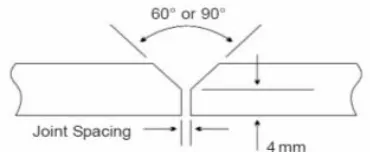
Omar Bataineh, Omar Barqawi was identified and optimized the main factors that have significant effect on weld joint strength through factorial design experiments. Welding experiments were carried out using MIG Welding process and An ER1100 filler wire with 1.2 mm in diameter was used as a consumable electrode. The shielding gas used was 100% pure Argon. Test specimens were composed of two pieces each, and each piece was 100 mm × 50 mm × 8 mm in size and made of 1070 aluminum alloy.
Figure 2 Joint geometry for the welding specimens
The factors that were studied are arc voltage, filler feed rate, gas flow rate, specimen edge angle and preheat temperature. Results of factorial design experiments and the analysis of variance (ANOVA) showed that arc voltage and filler feed rate are the only significant factors of the five. Optimal settings of arc voltage and filler feed rate were reached using regression analysis at 24 V and 7 in/s, respectively, at which the mean weld strength is maximum. [2].
Izzatul Aini Ibrahim, Syarul ashraf mohamat, Amalina.amir,et. al performed experiments in the effects of different parameters on welding penetration, micro structural and hardness measurement was measured in mild steel that having the 6mm thickness of the base metal by using the robotic gas metal arc welding. The variable parameters are arc voltage, welding current and welding speed. The penetration, microstructure and hardness were measured for each specimen after the welding process and the effect it was studied. As a result, it obvious that increasing the parameter value of welding current increased the value of depth of penetration. Other than that, arc voltage and welding speed is another factor that influenced the value of depth of penetration. In these experiments use 100 % 𝐶𝐶𝐶𝐶2 shielding gas and wire electrode is ER70S 6 with 1.2 diameter nozzle to work distance is 12mm and only one pass on weld plate. In Figure ,The effect of welding current on penetration was present in welding speed as constant as 20 cm/min and the value of penetration was increased by increasing the value of welding current 90, 150 and 210 A. The highest penetration is 2.98 mm at 22 V and 210 A. Welding speed as constant as 40 cm/min and the value of penetration was increased by increasing the value of welding current 90, 150 and 210 A. The highest penetration is 3.26 mm at 22 V and 210 A. The change in the value depth of penetration is similar at voltage of 26V and 30V. The welding speed as constant as 60 cm/min and the value of penetration was increased by increasing the value of welding current 90, 150 and 210 A. The highest penetration is 2.79 mm at 26 V and 210 A.
19 increased welding current, welding speed and arc voltage the
grain size of microstructure also different from one point to another point.
Figure. 3. Penetration vs. Welding Current & voltage
So by these experiments we can conclude that depth of penetration increased by increasing the value of welding current. Welding current is a factor that will determine the penetration. Penetration also influences by the factors from welding speed and arc voltage. The grain boundaries of microstructures changes from bigger size to smallest size when the variable welding parameters changed [3].
Pawan kumar,Dr.B.K.Roy was worked carried out on plate welds AISI 304 & Low Carbon Steel plates using gas metal arc welding (GMAW) process. Taguchi method is used to formulate the experimental design. Design of experiments using orthogonal array is employed to develop the weldments. The input process variables considered here include welding current, welding voltage & gas flow rate. A total no of 9 experimental runs were conducted using an L9 orthogonal array and the ideal combination of controllable factor levels was determined for the hardness to calculate the signal-to-noise ratio. After collecting the data signal-to-noise (S/N) ratios were calculated and used in order to obtain optimum levels for every input parameter. The Nominal-the-better quality characteristic is considered in the hardness prediction. The Taguchi method is adopted to solve this problem. Subsequently, using analysis of variance the significant coefficients for each input parameter on tensile strength & Hardness (WZ & HAZ) were determined and validated[4].
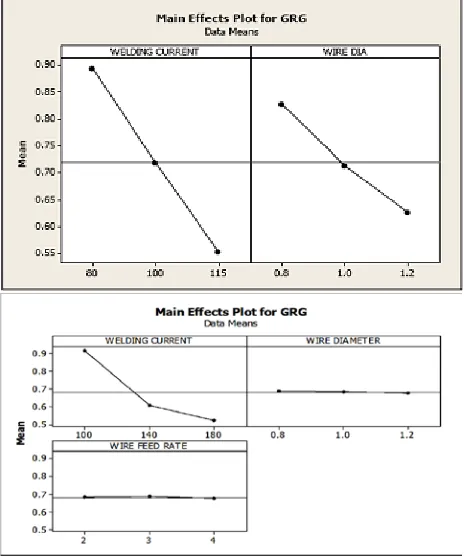
Chandresh N.. Patel used Full factorial method for Design of Experiment for optimization work. By use of the experimental data optimal process parameter combination was achieved by grey relational analysis (GRA) optimization technique. In this work, input parameters for MIG welding were welding current, wire diameter and wire feed rate and the output parameter is hardness. Also the input parameters for TIG welding are welding current, wire diameter and the output parameter was hardness. AISI 1020 or C20 material was used for welding. Experiments were performed on plates of thickness 5 mm and double V-groove joint is used. And input parameters for MIG welding were welding current, wire diameter and wire feed rate and the output parameter is
hardness. Also the input parameters for TIG welding are welding current, wire diameter and the output parameter was hardness. For Experimental design full factorial method (L=mⁿ) was used to find out number of readings. To find out percentage contribution of each input parameter for obtaining optimal conditions, we were used analysis of variance (ANOVA) method. Grey relational analysis (GRA) optimization technique was used for optimization of different values. A grey relational grade obtained from the grey relational analysis is used to optimize the process parameters.
By use of ANOVA analysis the percentage contribution of MIG welding for welding current is obtained 94.01 %, wire diameter of 0.402 % and wire feed rate of 0.016 % and the error is of 5.56 %. This error is due to human ineffectiveness and machine vibration. By use of ANOVA analysis the percentage contribution of TIG welding for welding current is 73.36 % and wire diameter of 23.90 % and the error is of 2.74 %. This error is due to human ineffectiveness and machine vibration. From the ANOVA it is conclude that the welding current is most significant parameter for MIG and TIG welding.
Figure 4. Main Effect Plot of GRG for MIG and TIG
20 value is 80 Amp welding current and 0.8 mm wire diameter
for TIG welding [5].
K. SRINIVASULU REDDY was investigated on in submerged arc welding (SAW), weld quality is greatly affected by the weld parameters are closely related to the geometry of weld bead, a relationship which is thought to be complicated because of the non-linear characteristics. Bead-on-plate welds were carried out on mild steel plates using semi automatic SAW machine. Input parameter are used like, weld current, voltage, weld speed, electrode stick out with output parameter are carried out penetration, weld width, weld hardness using Taguchi’s DOE. Data were collected as per Taguchi’s Design of Experiments and L8 orthogonal Array, analysis of variance (ANOVA) was carried to establish input–output relationships of the process. By this relationship, an attempt was made to minimize weld bead width and maximum penetration is one objective and developing artificial neural network (ANN) models to predict the weld bead properties accurately along with sensitivity analysis is also the prime objective to determine optimal weld parameters. The optimized values obtained from these techniques were compared with experimental results and presented. Modular network model predicts accurately and corresponding sensitivity analysis revels that bead width is highly sensitive to welding current, weld reinforcement and bead hardness are sensitive to electrode stick out and depth of penetration is sensitive to welding speed [6].
III.
DESIGN OF EXPERIMENT [DOE]
Design of Experiments (DOE) is a powerful statistical technique introduced by R. A. Fisher in England in the 1920's to study the effect of multiple variables simultaneously.The DOE using Taguchi approach can economically satisfy the needs of problem solving and product/process design optimization projects. By learning and applying this technique, engineers, scientists, and researchers can significantly reduce the time required for experimental investigations. DOE is a technique of defining and investing all possible combinations in an experiment involving multiple factors and to identify the best combination. In this, different factors and their levels are identified. Design of experiments is also useful to combine the factors at appropriate levels, each with the respective acceptable range, to produce the best results and yet exhibit minimum variation around the optimum results.
Therefore, the objective of a carefully planned designed experiment is to understand which set of variables in a process affects the performance most and then determine the best levels for these variables to obtain satisfactory output functional performance in products.
• Numbers of trials is significantly reduced.
The advantages of design of experiments are as follows:
• Important decision variables which control and improve the performance of the product or the process can be identified.
• Optimal setting of the parameters can be found out. • Qualitative estimation of parameters can be made. • Experimental error can be estimated.
• Inference regarding the effect of parameters on the characteristics of the process can be made.
Thus Design of experiment (DOE) is a method to identify the important factors in a process, identify and fix the problem in a process, and also identify the possibility of estimating interactions.
1) Full factorial technique
DOE for study of process parameter effects in welding
Following are the DOE techniques used process parameter optimization work in welding.
2) Fractional factorial technique 3) Taguchi orthogonal array
4) Response Surface method (Central Compsite deisgn)
ANOVA stands for Analysis for Variance and it is the tool used for the analysis of contribution of each process parameter on response parameter. Mathematical models are used to establish the relationship between the input and output parameters in welding processes.“MINITAB” and “Design Expert” are the softwares used for DOE techniques and ANOVA.
IV.
CONCLUDING REMARK
There are many researches done on DOE or optimization techniques for Process parameter for mechanical Properties and weld penetration, weld bead geometry. But I found that are very few researches done on AISI1045 Medium carbon steels so we want to do research on this material. We like to use Design of experiment for parametric optimization.
Welding current, arc voltage, welding speed, type of shielding gas, gas flow rate, wire feed rate, diameter of electrode etc. are the important control parameters of Metal Inert Gas Welding process. They affect the weld quality in terms of mechanical properties and weld bead geometry. The value of depth of penetration increased by increasing the value of welding current and the grain boundaries of the microstructure are varied when the welding parameters are changed.
21 functions in optimization, help in data analysis and The
purpose of the analysis of variance (ANOVA) is to examine which design parameters significantly affect the quality characteristic and estimation of optimum results.
The Factorial Design, Taguchi Method, Response surface method can be applied as the DOE (Design of Experiment). And we can also use Optimization techniques like, artificial neural network, Grey relation analysis, Genetic algorithm, S/N ratio etc. MINITAB software is a useful aid for the above purpose.
V.
SCOPE OF THE WORK
Metal inert gas welding is one of the widely used techniques for joining ferrous and non ferrous metals. MIG welding offers several advantages like joining of dissimilar metals, low heat affected zone, there is no slag to clean off after welding because no flux used.MIG weld quality is strongly characterized by weld bead geometry.
In MIG Welding method, we will optimize other parameters which are not used in this experiment and This experiment will be done for same method or workpice by other DOE method or other optimization techniques and also if you can be compared Experimental result with prediction result by using Finite Element Analysis.
Taguchi’s DOE or ANOVA, Orthogonal Array shall be used to conduct the experiments. The parameters selected for controlling the process are welding voltage, current and gas flow rate, wire feed rate, wire diameter. Strength of welded joints shall be tested by a UTM. From the results of the experiments, DOE- FEA models shall be developed to study the effect of process parameters on tensile strength and weld pool geometry. Optimization shall be done to find optimum welding conditions to maximize tensile strength and weld pool geometry, depth of penetration etc. of welded specimen. Confirmation tests shall also be conducted to validate the optimum parameter settings.
REFERENCES
[1] G. Haragopal, , P V R Ravindra Reddy, G Chandra Mohan Reddy and J V Subrahmanyam, “Parametric design for MIG welding of Al-65032 alloy using Taguchi Technique
”, Journal of Scientific and Industrial
Research, Vol. 70, October 2011, pp.844-858[2] Omar Bataineh, Anas Al-Shoubaki; Omar Barqawi
“
Optimising Process Conditions in MIG Welding of Aluminum Alloys Through Factorial Design Experiments” Latest Trends in Environmental and Manufacturing Engineering,ISBN: 978-1-61804-135-7 [3] Izzatul Aini Ibrahim, “The Effect of Gas Metal Arc Welding (GMAW) processes on different welding parameters”, International Symposium on Robotics and Intelligent Sensors 2012 (IRIS 2012), 2012.07.342[4] Pawan Kumar, “Parametric Optimization of Gas Metal Arc Welding of Austenitic Stainless Steel (AISI 304) & Low Carbon Steel using Taguchi’s technique”, International Journal of Engineering Research and
Management research, Vol. 3, Issue 4, Aug 2013, pp.18-22
[5] Chandresh N. Patel, “Parametric Optimization of Weld Strength of Metal Inert Gas Welding and Tungsten Inert Gas Welding By Using Analysis of Variance and Grey Relational Analysis” Modern Engineering and Emerging Technology, Vol. 1, Issue: 3, April-2013. [6] K.Srinivasulu Reddy, “Optimization & Prediction of Welding Parameters and Weld bead Geometry In Submerged Arc Welding” International Journal of Applied Engineering Research And Development (IJAERD), Vol.3 Issue3, Aug2013, PP,1-6
[7] Ador Welding Limited, “Modern Arc Welding Technology”, Oxford &IBH Publishing Co. Pvt. Ltd (Book).