Research Article
The Correlation between Calcium Serum and Calcium Urine Level
with the Blood Pressure in Preeclampsia
Hubungan antara Kadar Kalsium Darah dan Kadar Kalsium Urin
dengan Tekanan Darah pada Preeklampsia
Deni W. Suryono, Firman F. Wirakusumah, Anita D. Anwar
Department of Obstetrics and Gynecology Faculty of Medicine University of Padjadjaran/
Dr. Hasan Sadikin Hospital Bandung
INTRODUCTION
Preeclampsia is a multi organ disorder in preg-nancy, and until now the pathogenesis and etiology are still unknown. There have been many theories attempting to explain the pathogenesis and etiol-ogy, but there is no theory that could answer it for certain.
The incidence of preeclampsia in different coun-tries varies between 2.6% - 7.3%, but worldwide, according to WHO is about 12%. The incidence of preeclampsia in Indonesia in 1980 - 2001 is be-tween 6 to 8% of all pregnancies, with mortality rate ranging from 9.8 to 25%. In some hospitals in Indonesia, the incidence of preeclampsia is highly
Abstract
Objective: To analyze the differences of calcium serum and calcium urine level in preeclampsia and normal pregnancy, and to analyze the correlation between calcium serum and calcium urine level with blood pressure.
Method: This study is a cross sectional study with 44 women with preeclampsia and 45 women with normal pregnancies, that meet our inclusion criteria. The samples were obtained from Dr. Hasan Sadikin Hospital and six satellite hospitals from June to September 2011. The comparison of mean calcium serum and calcium urine level of the preeclampsia group was calculated using Mann-Whitney test, and the correlation between calcium serum and calcium urine level and preeclampsia were calculated using Rank Spearman corre-lation test.
Result: The result of the characteristic test in two groups of study shows that both groups are homogenic and comparable. The mean of calcium serum level in women with preeclampsia (7.97 mg/dl) is lower than in normal pregnancy (8.82 mg/dl) with p<0.0001 and the mean of calcium urine level in women with preeclampsia (1.725 mg/dl) is lower than normal pregnancy (2.809 mg/dl) with p<0.0001. There is a negative correlation between calcium serum level (rs = –0,62; p<0,001) and calcium urine level (rs = –0,68; p<0,001) with systolic pressure in preeclampsia. There is also a negative correlation between calcium serum level (rs = –0,65; p<0,001) and calcium urine level (rs = –0,68; p<0,001) with diastolic pressure in preeclampsia.
Conclusion: There is a negative correlation between calcium serum level and calcium urine level with systolic and diastolic pressure in preeclampsia, meaning that the lower the calcium serum and cal-cium urine level is, the higher systolic and diastolic pressure. [Indones J Obstet Gynecol 2012; 36-1:3-7]
Keywords: blood pressure, calcium blood level, calcium urine level, preeclampsia
Abstrak
Tujuan: Menganalisis perbedaan kadar kalsium darah dan kadar kal-sium urin pada preeklampsia dan kehamilan normal dan menganali-sis korelasi antara kadar kalsium darah dan kadar kalsium urin de-ngan tekanan darah pada preeklampsia.
Metode: Rancangan penelitian ini adalah uji potong lintang (cross sectional) terhadap 44 subjek dengan preeklampsia dan 45 subjek dengan kehamilan normal yang memenuhi kriteria inklusi, yang datang ke RS Dr. Hasan Sadikin Bandung dan enam rumah sakit jeja-ring periode Juni – September 2011. Perbandingan rerata kadar kal-sium darah dan kalkal-sium urin preeklampsia dengan kehamilan normal dihitung menggunakan uji Mann-Whitney, dan korelasi antara kadar kalsium darah dan kadar kalsium urin dengan tekanan darah pada preeklampsia dihitung menggunakan uji korelasi Rank Spearman. Hasil: Uji karakteristik pada kedua kelompok penelitian menunjukkan kedua kelompok homogen dan dapat diperbandingkan. Rerata kadar kalsium darah pada preeklampsia lebih rendah (7,97 mg/dl) diban-dingkan dengan kehamilan normal (8,82 mg/dl) dengan p<0,001. Rerata kadar kalsium urin pada preeklampsia lebih rendah (1,725 mg/dl) dibandingkan dengan kehamilan normal (2,809 mg/dl) de-ngan p<0,001). Terdapat korelasi negatif antara kadar kalsium darah (rs = – 0,62; (p<0,001) dan kadar kalsium urin (rs = – 0,68), (p<0,001) dengan tekanan darah sistolik pada preeklampsia. Terdapat korelasi negatif antara kadar kalsium darah (rs = – 0,65; (p < 0,001) dan kadar kalsium urin (rs = – 0,68; p < 0,001) dengan tekanan darah diastolik pada preeklampsia.
Kesimpulan: Terdapat hubungan negatif antara kadar kalsium da-rah dan kadar kalsium urin dengan tekanan dada-rah sistolik dan dias-tolik pada preeklampsia, yang berarti semakin rendah kadar kalsium darah dan kadar kalsium urin semakin tinggi tekanan darah sistolik dan diastolik.
(Maj Obstet Ginekol Indones 2012; 36-1:3-7]
Kata kunci: kalsium darah, kalsium urin, preeklampsia, tekanan darah
variable. For example, in Dr. Cipto Mangunkusumo hospital, in 2002, the incidence is 9.17%, while based on annual reports from 2008 to 2009 De-partment of Obstetrics and Gynecology Faculty of Medicine University of Padjadjaran/Dr. Hasan Sadikin Hospital Bandung, the incidence of preeclampsia is about 11%.1-5
Preeclampsia does not show a rise in blood pres-sure until second trimester of pregnancy but the effect of vasoconstriction may occur earlier, and the change in vascular reactivity may be detected at 20 weeks of gestation. According to a survey, women who eventually developed preeclampsia had blood pressure slightly higher than normal threshold in second trimester of pregnancy.6
Etiol-ogy and pathogenesis of preeclampsia are impor-tant to understood, so that the diagnosis of pree-clampsia can be established as early as possible and therefore, clinicians can do a preventive ma-nagement.1,6 Preeclampsia preventions consist of
interventions of the changes that occur in progres-sion of disease, so that the complications are not even worse.1,6
Calcium is a mineral with the highest content in the human body. Nearly 99% of calcium in human body found in bone. The rest of it is found in blood plasma, in a bond with the protein and in ions form. Calcium plays important roles in various physiological functions of the human body, such as in the blood clotting process, maintaining cell membrane alongside sodium and potassium, as a signal transductor between hormone receptors, in neuromuscular activity, in enzymatic reactions, in the process of neurotransmission, maintaning the bone structure, and preservation of the calcium needed in the body.7
In pregnant woman, the need for calcium in-creases especially for bone formation of the fetus. In pregnant woman, normal level of total calcium in the blood increases in first trimester and then decline in the last trimester while blood calcium ion level increases. The highest level is reached in the last trimester. At birth, both total calcium level and blood calcium ion are lower.8 Calcium is an
im-portant component in diet and the imim-portant regu-lator of cellular process including the vascular function. The change in calcium metabolism will cause a different calcium level in each component blood or urine.8
Calcium and preeclampsia are connected by cal-cium intake and metabolism of pregnant woman.
Research about this correlation had been done and it proved that there was a correlation between cal-cium and preeclampsia.9,10 Bellizan JM et al
showed an increase in intracellular calcium level of smooth muscle of blood vessels will cause vasocon-striction easily that stimulate a rise of blood pres-sure.10 Yoshida et al revealed the different levels of hipocalciuri in preeclampsia and normal preg-nancy, chronic hypertension, and gestational hy-pertension.11 Irani YA showed that there was
cor-relation between Angiotensinogene 1 type athletic-autoantibody (AT1-AA) with preeclampsia and
cal-cium. Another research showed that there was no correlation between calcium and preeclampsia.12
Until now, the mechanism and the correlation of calcium and preeclampsia are still unknown. 9,10
METHOD
This study is a cross sectional study with 44 women with preeclampsia and 45 normal pregnan-cies, who meet the inclusion criteria. The samples were obtained from Dr. Hasan Sadikin Hospital Bandung and six-satellite hospitals from June to September 2011. The inclusion criterias in pree-clampsia group include pregnant woman, viable fe-tus, > 28 weeks of gestation based on LMP and di-agnosed as having preeclampsia, whilst the inclu-sion criteria in the control group are pregnant woman, viable fetus, >28 weeks of gestation based on LMP and diagnosed as a normal pregnancy. The exclusion criterias are pregnancy with complica-tion, such as diabetes mellitus, renal disease, heart disease, pulmonary disease, chronic hypertension, and parturition.
The result of One Sample Kolmogorov Smirnov Test with Lilliefors Significance Correction test shows that the data is not distributed normally (p≤0.05). Therefore, the comparison of mean levels of blood and urinary calcium in pre-eclampsia with normal pregnancy are analyzed using the Mann-Whitney test, and the correlation between blood calcium and urinary calcium level with blood pres-sure in preeclampsia are analyzed using Rank Spearman correlation test.
RESULTS
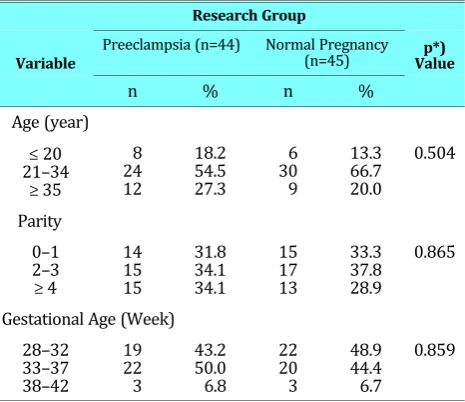
Table 1. Characteristics of Research Subjects
Variable
Research Group
p*) Value Preeclampsia (n=44) Normal Pregnancy
(n=45)
n % n %
Age (year) ≤20 21–34
≥ 35
8 24 12
18.2 54.5 27.3
6 30 9
13.3 66.7 20.0
0.504
Parity 0–1 2–3 ≥ 4
14 15 15
31.8 34.1 34.1
15 17 13
33.3 37.8 28.9
0.865
Gestational Age (Week) 28–32
33–37 38–42
19 22 3
43.2 50.0 6.8
22 20 3
48.9 44.4 6.7
0.859
Note: *)Chi Square test
Table 2 shows that there is significant difference in blood calcium level (p<0.001) and in urinary cal-cium level (p<0.001) between preeclampsia and normal pregnancy.
Table 2. Comparison of Blood Levels of Calcium and Urine Calcium Levels in Preeclampsia and Normal Pregnancy
Variable
Research Group p*) Value Preeclampsia
(n=44) Normal Pregnancy(n=45)
Blood Calcium (mg/dl) Mean (SD)
Median Range
7.970 ( 0.3670 ) 7.900 6.9 – 8.8
8.822(0.4497) 8.900
7.5 – 9.5 < 0.001 Urine Calcium (mg/dl)
Mean (SD) Median
Range
1.725 (0.4509 ) 1.800 0.8 – 2.9
2.809(0.3103) 2.800 2.0 – 3.2
< 0.001
Note: *) Mann Whitney test
Table 3 shows that there is a significant corre-lation between blood calcium levels with systolic blood pressure (p<0.001), with a negative correla-tion coefficient of 0.62 which indicates a very strong relationship between the decrease in blood calcium levels and increase in systolic blood pressure. There is also a significant relationship between urine cal-cium level with systolic blood pressure (p<0.001), with a negative correlation coefficient of 0.68, which indicates a very strong relationship between the decrease in urinary calcium levels and an in-crease in systolic blood pressure.
Table 3. Correlation between calcium serum level and calcium urine level with systolic pressure
Correlation with
systolic blood pressure coefficient (r)Correlation Valuep*)
Calcium blood level (mg/dl) – 0.62 < 0.001
Calcium urine level (mg/dl) – 0.68 < 0.001
Note: *) Rank Spearman Correlation test
Table 4 shows that there is a significant corre-lation between blood calcium level with diastolic blood pessure (p <0.001), with a negative correla-tion coefficient of 0.65, which indicates a very strong correlation between the decrease in blood calcium levels and the increase in diastolic blood pressure. There is also a significant correlation be-tween urine calcium levels with diastolic blood pressure (p <0.001), with a negative correlation co-efficient of 0.68 which indicates a very strong re-lationship between the decrease of urinary calcium levels and the increase of diastolic blood pressure.
Table 4. The relationship between blood calcium levels and urinary calcium levels with diastolic blood pressure
Correlation with
diastolic blood pressure coefficient (r)Correlation Valuep*)
Calcium blood level (mg/dl) – 0.65 < 0.001
Calcium urine level (mg/dl) – 0.68 < 0.001
Note: *) Rank Spearman Correlation test
DISCUSSION
Subjects Characteristics
Comparison of Levels of Blood Calcium and
Levels of Urine Calcium in Preeclampsia
and Normal Pregnancy
McCarron revealed a decrease in blood calcium lev-els in hypertension when compared with normal pregnancies.9 Bellizan and Punthumapol also
re-veals a decrease of blood calcium in patient with preeclampsia. State of low blood calcium is likely due to the lack of calcium intake or other patho-physiological processes in the body, resulting in an increase in parathyroid hormone (PTH). The in-crease of parathyroid hormone would lead to an increased intracellular calcium through a process of increasing cell membrane permeability to cal-cium and the activation and enhancement adenyl-cyclase cAMP (cyclic adenosine monophosphate), a consequence of mitochondrial calcium released into the cytosol. Intracellular calcium increasing in vascular smooth muscle would cause the blood vessels to be easily stimulated to vasoconstrict, which will eventually lead it to increase.10,13
Study by Yoshida et al revealed a decrease in urinary calcium in patient with preeclampsia.11,14
In preeclampsia there is a change in almost all or-gan systems of the body, especially the cardiovas-cular, renal, hematologic and immunologic system. These changes are believed to be associated with an inadequate synthesis of vasoactive prosta-glandin, which can cause uteroplacental circula-tion, kidney tissue and renal perfusion distur-bance.14,15 Hipocalciuria that occurs in
preeclamp-sia is the expression of tubular dysfunction. Sanchez-Ramos et al studied the value of urinary calcium in 103 preeclamptic patients and found that in patient who later will develop preeclampsia, the excreted urinary calcium was significantly less than normal pregnancy.16 Adjidé VS did a
case-trol studies of 47 preeclampsia patient and 50 con-trol women and concluded that preeclampsia has hipocalciuria which is significantly lower than con-trols.15 The occurrence of hipocalciuria in
pree-clampsia as sequences of events can be explained as follows: first, the decrease in vitamin D3 1.25 (dehydrocholesterol) or less calcium intake will re-duce the absorption of calcium from the intestine, resulting in a decrease of ionized calcium in serum. Furthermore, it will cause an increase in parathy-roid hormone and inhibition of transcription, which decreased it to an even lower level. Finally, parathyroid hormone causes increasing calcium re-absorption in the distal tubule, where hipocalciuria occured.14,15
In this study, there were differences in blood cal-cium levels and urinary calcal-cium levels in pree-clampsia compared to normal pregnancies. The blood calcium levels and urinary calcium level in preeclampsia is lower in normal pregnancies.
The Relationship between Blood Calcium
Levels and Urinary Calcium Levels with
Systolic Blood Pressure
Meta-analysis randomized control trial study from Bucher et al revealed a decrease in systolic blood pressure of –5.40 mmHg (95%CI, –7.81 for –3.00 mmHg; p < 0.001).17 Irani RA describes the
in-volvement of the renin-angiotensin system in pree-clampsia, with the known role of angiotensin II type I (AT1-AA) that involved in the
pathophysiol-ogy of preeclampsia such as deposition of fibrin in endothelial cells and sub epithelium of renal that lead to the decrease of glomerular filtration rate (GFR), which causes kidney damage, and further-more lead to disturbance of hemodynamic of the body system. The role of autoantibody angiotensin type 1 (AT1-AA) is to increase calcium mobilization
that stimulated from an increase in intracellular calcium in preeclampsia, resulting in an impaired calcium metabolism which cause a disruption of endothelial cells on the blood vessel, resulting in vasoconstriction of blood vessels.12 Another
mechanism of calcium and preeclampsia patho-genesis has been described by many other re-searcher.9,10,13
This study obtains a negative correlation be-tween blood calcium levels and systolic blood pres-sure, which shows a strong correlation between the decrease of blood calcium levels and the increase of systolic blood pressure, which can be explained that the lower blood calcium levels, the higher sys-tolic blood pressure could be reached. There is also a negative correlation between urinary calcium lev-els and systolic blood pressure, which shows a strong correlation between the decrease of urinary calcium levels and the increase of systolic blood pressure, which can be explained that the lower uri-nary calcium levels, the higher systolic blood levels could be reached.
The Relationship between Blood Calcium
Levels and Urinary Calcium Levels with
Diastolic Blood Pressure
of calcium on diastolic blood pressure, which is a decrease in diastolic blood pressure by 3.1 mmHg at 6th week and 2.4 mmHg.18 The correlation and
the influence of calcium on blood pressure can also be explained by Irani RA research, who revealed the role of AT1-AA in preeclampsia, which is causing
a vasoconstriction of blood vessels.12 Bucher et al
also revealed a decrease in diastolic blood pressure of 0.24 mmHg.17 The other researches explain
an-other pathogenesis of calcium and preeclamp-sia.9,10,13 Another mechanism of calcium and
pree-clampsia pathogenesis has been described.
This study obtains a negative correlation (rs = –0.65, p < 0.001) between blood calcium levels and diastolic blood pressure, which shows a strong cor-relation between the decrease in blood calcium lev-els and an increase in diastolic blood pressure, meaning that the lower blood calcium levels, the higher diastolic blood pressure could be reached. This study also found a negative correlation (rs = – 0.68, p < 0.001) between urinary calcium levels and diastolic blood pressure, which shows a strong correlation between the decrease in urinary cal-cium levels and an increase in diastolic blood pres-sure, which can be explained that the lower urinary calcium levels, the higher diastolic blood pressure could be reached.
CONCLUSION
There is a negative correlation between calcium se-rum level and calcium urine level with systolic and diastolic blood pressure in preeclampsia, which means that the lower calcium serum and calcium urine level is, the higher systolic and diastolic pres-sure.
REFERENCES
1. Cunningham F, Leveno KJ, Bloom SL, Hauth JC, G. LC and Wenstrom KD. Hypertensive disorders in pregnancy, in Wil-liam Obstetrics .23rd Ed, McGraw Hill : New York. 2010;
1429 - 36.
2. Suhaimi D, Mose JC. Evaluasi penanganan kasus-kasus preeklampsia berat dan eklampsia di RS Dr. Hasan Sadikin Bandung periode 2006-2007. Presented at: PIT Fetomater-nal IX; Jakarta; 2008.
3. Roeshadi RH. Upaya Menurunkan Angka Kesakitan dan Angka Kematian Ibu pada Preeklampsia dan Eklampsia, Pi-dato Pengukuhan Jabatan Guru Besar Tetap Bidang Ilmu Kebidanan dan Kandungan FK Universitas Sumatera Utara, 2006; 15.
4. Annual Report 2008. Bandung: Obstetrics and Gynecology Medical Faculty University of Padjadjaran. Dr. Hasan Sadikin Hospital Bandung. 2009.
5. Annual Report 2009. Bandung: Obstetrics and Gynecology Medical Faculty University of Padjadjaran. Dr. Hasan Sadikin Hospital Bandung. 2010.
6. Pangemanan WT. Diagnosis dan prediksi hipertensi dalam kehamilan. PIT POGI 1996.
7. Agus P. Sambo, John MF Adam. Metabolisme Kalsium. Buku Ajar Ilmu Peny Dalam. 2006; 452: 2009-10.
8. Repke JT. Prevention of preeclampsia. Clin Perinatol. 1991; 18: 779-92.
9. McCarron DA, Morris CD. Metabolic consideration and cel-lular mechanism related to calcium’s antihypertensive ef-fects 1986. 45: 2734-8.
10. Belizan JM, Villar J, Repke J. The Relationship between cal-cium intake and pregnancy induced hypertension: up to date evidence. Am J Obstet Gynecol 1988; 158: 898-902. 11. Yoshida A et al. Urinary calcium excretion in toxemia of
pregnancy. Nipon Jinso Bakkaishi. 1989; 31(4): 327-34 12. Irani RA, Y Xia. The Functional role of the renin-angiotensin
system in pregnancy and preeclampsia. Placenta. 2008; 29(9): 763-71.
13. Punthumapol C, Kittichotpanich B. Serum Calcium, Magne-sium and Uric Acid in preeclampsia and normal pregnancy. J Med Assoc Thai. 2008. 91(7): 968-73.
14. Kazerooni T, Hamze-Nejadi S. Calcium to creatinine ratio in a spot sample of urine for early prediction of pre-eclampsia, Int J Gynecol Obstet. 2003; 80: 279-83.
15. Sanchez-Ramos L, Jones DC, Cullen MT. Urinary calcium as an early marker for preeclampsia. Obstet Gynecol. 1991. 77(5): 685-8.
16. Adjide VS, Venditteli F, David S, Bredent-Bangou J, Janky E. Calciuria and Preeclampsia, Case-control Study. Gynecol Ob-stet Biol Reprod J Eur, 2006. 125: 193-8.