188
Copyright © 2018. IJEMR. All Rights Reserved.
Volume-8, Issue-2, April 2018
International Journal of Engineering and Management Research
Page Number: 188-192
DOI: doi.org/10.31033/ijemr.v8i02.11650
Impact of Microfinance Programme on Employment Status of the
Participants
Ruchi Joshi1 and Dr. C.S. Joshi2
1Research Scholar, Department of Management Studies, Kumaun University, Nainital, INDIA 2Professor & HOD, M.B.P.G College, Haldwani, Kumaun University, Nainital, INDIA
1Corresponding Author: [email protected]
ABSTRACT
Microfinance has emerged as a ray of hope among the various measure to wipe out poverty. In India, failure of formal finance to the poor has led to the growth of microfinance. Numerous traditional and informal system of credit was already in existence before microfinance came into vogue. NABARD a regulatory body defined microfinance as “the provision of thrift, saving, credit and financial services and products of very small amount to the poor in rural, semi-urban and urban areas for enabling them to raise their income levels and improve their standard of living”(Sen,2008). The paper also provide the progress of microfinance programme in Uttarakhand on the basis of secondary data. The present paper examines the impact of microfinance programme on employment status of the respondents in the State of Uttarakhand on the basis of primary data collected from the field. As the programme has increased the engagement of SHG group members i.e.; participants of the programme economic activities which result in the increase level of employment. Microfinance play an important role in the development of the state as the programme increased the employment status which result beneficiaries to come out of poverty and the standard of living also raised by accessing the basic requirements.
Keywords-- Microfinance, Employment, Self Help
Group, Uttarakhand
I.
INTRODUCTION
Uttarakhand, formerly known as Uttaranchal, is a state in the northern part of India. On 9 November 2000, the state of Uttarakhand, came into being as the 27th State of the Union of India. The density of
population is 189/km2 (490/sq mi). Uttarakhand has a population of 10116752, making it the 19th most populous state in India as per census 2011. Uttarakhand has a total area of 53,483 km2 of which 86 per cent is mountainous and 65 per cent is covered by forest. The state is divided into two divisions: Garhwal and Kumaon. There are 13 districts in the state which are grouped into two divisions.Kumaon Division consist of 6 districts namely Almora, Bageshwar, Champawat, Nainital, Pithoragarh, Udham Singh Nagar and Gharwal division consist of 7 districts namely: Chamoli, Dehradun, PauriGharwal, Rudraprayag, TehriGarhwal, Uttarkashi.
II.
PROGRESS OF MICROFINANCE
IN UTTARAKHAND
After the formation of Uttarakhand, dynamic effort have been made to promote self-help groups with a vision to grab Uttarakhand’s problem. NABARD estimates that about 51067 SHGs have been formed in the state (2015) and about 41143 SHGs have been credit linked with banks and the total number of SHGs formed in the state was 42595 as on March 31, 2016. The number of SHGs having credit linked has been increased twenty-seven per cent (8765) of the last year. The figure was 32378 credit linked with banks as on March 31, 2015.
Public and private agencies are contributing in the progress of microfinance programme in Uttarakhand. These agencies include Public commercial banks, private commercial banks, Regional Rural Banks and Cooperative banks.
Table 1: Progress of SBLP in Uttarakhand
Financial Year Number of SHGs Number of members Saving Amount
2011-12 48141
(8.68)
392863 (9.15)
5913.27 (49.12)
2012-13 40316
(-16.25)
330109 (-15.97)
189
Copyright © 2018. IJEMR. All Rights Reserved.
2013-14 37294
(-7.49)
312858 (-5.22)
3903.04 (-18.06)
2014-15 51067
(36.9)
428605 (37)
5038.41 (29)
2015-16 42595
(-16)
357825 (-16)
5024.88 (-.26)
Source: NABARD annual report 2015-16
The table presents the total number of group formed and linked to the bank under the Self Help Bank Linkage Programme. Table shows that during the financial year 2011-2012 48141 groups were formed with the growth rate of 8.68 per cent, though in the financial year 2012-2013 number of group formed declined the figure was 40316 and the growth rate is
negative 16.25. However, again in the financial year 2013-14 the figure drop to 37294 with the negative growth rate of 7.49 in the financial year 2014-2015 the number of group formed were 51067 with the growth rate of 36.93 per cent, however in the next financial year 2015-2016 the growth rate was negative 16.58 and the total group formed during the year was 42595.
Number of group members in the financial year 2011-2012 was 392863 with the growth rate of 9.15 per cent, however in the next financial year 2012-2013 the number of group member figure decline to 330109 with the negative growth rate of 15.97 per cent, again in the next financial year 2013-2014 the number of members of
the group decline to 312858 with the negative growth rate of 5.22per cent. The number of member figure in the financial year 2014-2015 is increase to 51067 with the growth rate of 36.9 per cent, but in the next financial year 2015-16 the figure comes down to 42595 with the negative growth rate of 16 per cent.
In the financial year 2011-2012 savings of the group was Rs. 5913.27 lakh with the growth rate of 49.12 per cent, which is decreased to Rs. 4763.57 lakh in the financial year 2012-2013 with the negative growth rate of 5.22, again in the next financial year 2013-2014 the growth rate decreased by 18.06 per cent and the
190
Copyright © 2018. IJEMR. All Rights Reserved.
Financial year 2014-2015 was the finest year asthe number of groups, number of members and total amount deposit was the highest as compared to all the financial year.
III.
LITERATURE SURVEY:
MICROFINANCE AND EMPLOYMENT
Microfinance and Employment
Microfinance targets people who are often unemployed or otherwise excluded from traditional banking system and who wish to start their own business. Studies show that microfinance significantly contributes to self-employment and job creation. However little is known about its impact on employment and the condition under which beneficiaries operate micro-entrepreneurs. This is due to the diversity of microfinance operators and their methods of interventions, as well as the variability in the loan amount granted.
Self-employment opportunities in rural areas are generated by microfinance programme. In this programme, credit support is made available to those who are excluded from traditional banking system through the SHGs in the form of micro-loans. The microfinance sector is significant for the creation and preservations of the jobs in developing countries. As microfinance is about more than safe guarding employment choosing potentially successful micro-enterprise with the potential to create jobs is often not the primary concern when local financial institution grants loans. Microfinance stimulates the entrepreneurial activity of borrowers.
Hossain (1988) noted that about one third of the members were unemployed before they joined microfinance programme. With loans, these members involved in self-employment activities and the resulting effects on income were impressive.
Impact study conducted by Neil et al. (1994) in Kenya concluded that 22 per cent of increase in employment rate among K-REP clients.
Study conducted by Khandker and Chaudhary (1995) in Bangladesh on Grameen Bank’s clients noted that increase in self- employment among the poor with access to credit has resulted in increase in rural wages.
Khandker, Samad and Khan (1998) mention that microfinance programme has positive impact on
income, production and employment particularly in rural non-formal sector.
Dunn and Arbuckle (2001) conducted study in Peru found on average nine days of extra employment per month, where approximately 40,000 clients have over 4.3 million work days per year or the equivalent of 17,414 full the jobs of which 6259 are paid positions for non-households members.
Dunn (2005) in his impact study conducted in Bosnia and Herzegonia concluded a positive impact of microfinance on respondents and their households income, employment, business investment, business registration and warm transition.
As mentioned by Kuiper and Ree (2005) from International Labour Office, Geneva, that nothing is more fundamental to poverty reduction than employment. Microfinance programme all over the world provide small amount of working capital to promote self-employment for people who are excluded from the services offered by commercial banks.
Panda (2009) conducted a study in India noted a significant increase in borrowers household income (11.41 per cent) asset position was 9.75 per cent higher than non- participants and savings increased by 42.53 percent. Study also concluded an increase in annual employment days among the clients.
To establish the impact of microfinance on employment there are some operational challenges. As participants of the programme have freedom to make use of the loan which they get from the bank. There may be generation of self-employment if the loan is invested for productive purpose or in an enterprise. If the beneficiary spend the loan amount in the consumption activity or repaying old debts, then there will be no additional employment generated.
IV.
EXPERIMENTAL WORK
191
Copyright © 2018. IJEMR. All Rights Reserved.
impact of microfinance programme by comparing theparticipants of the programme with the non-participants. SHG members availing banks loan at the time of survey are termed as participants. Whereas non-participants are those members of the programme have not availed bank loans up to the time of survey as their entry to the SHG is new. For the study primary data is collected from 1185 participants and equal number of non-participants all the way through multistage random sampling method from Almora and TehriGharwal District of Uttarakhand.
V.
RESULTS AND DISCUSSIONS
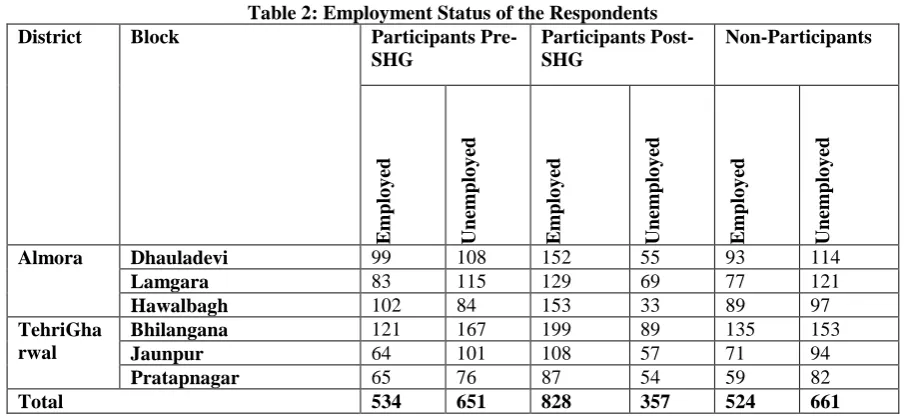
Employment status of the Respondents:
Table shows the status of employment of the participants increase their level after joining the microfinance programme. Table shows that before joining the microfinance programme forty-five per cent of the participants were employed and fifty-five per cent of the participants were unemployed. The microfinance programme has helped participants to increase their level of employment by utilising the loan for productive purpose. As a result, seventy per cent of the participants are employed in post-SHG situation. Hence, twenty-five per cent of the participants who were unemployed in pre-SHG situation gained employment.
Table 2: Employment Status of the Respondents
District Block Participants
Pre-SHG
Participants Post-SHG
Non-Participants
E
mp
lo
y
ed
Unempl
o
y
ed
E
mp
lo
y
ed
Unempl
o
y
ed
E
mp
lo
y
ed
Unempl
o
y
ed
Almora Dhauladevi 99 108 152 55 93 114
Lamgara 83 115 129 69 77 121
Hawalbagh 102 84 153 33 89 97
TehriGha rwal
Bhilangana 121 167 199 89 135 153
Jaunpur 64 101 108 57 71 94
Pratapnagar 65 76 87 54 59 82
Total 534 651 828 357 524 661
Source: Field Survey (2014-15)
Impact of the microfinance programme was measured by comparing the status of employment of participants and non-participants. As a result, employment status of the non-participants is almost
similar to the participant employment status in their pre-SHG situation i.e; forty-five per cent of the participants are employed and fifty-five per cent of the participants are unemployed.
Figure 4 reveals that forty-four per cent of the non-participants are employed while fifty-six per cent of the non-participants are unemployed. The significant difference among the participants and non-participants regarding their level of employment is shown by Chi-square (2) test. Many other studies also show the similar
result of increase in employment status of the participants of the microfinance programme as compared to non-participants.
192
Copyright © 2018. IJEMR. All Rights Reserved.
The contribution of Uttarakhand inmicrofinance programme is decreasing. But thevalue of MPI indicate that penetration of microfinance programme in Uttarakhand is positive in terms of population outreach as well as poverty outreach.
The analysis of the primary data showed that microfinance programme has increase the employment status of the participants of the programme in their post-SHG condition. Before joining the microfinance programme forty-five per cent of the participants were employed and fifty-five per cent of the participants were unemployed. The microfinance programme has helped participants to increase their level of employment by utilising the loan for productive purpose. As a result, seventy per cent of the participants are employed in post-SHG situation. Hence, twenty-five per cent of the participants who were unemployed in pre-SHG situation gained employment.
Impact of the microfinance programme was measured by comparing the status of employment of participants and non-participants. As a result, employment status of the non-participants is almost similar to the participant employment status in their pre-SHG situation i.e. forty-five per cent of the participants are employed and fifty-five per cent of the participants are unemployed. Impact of microfinance programme on employment shows positive impact in increasing the employment.
REFERENCES
[1] Panda K. D. (2009). Participation in the group based Microfinance and its impact on rural households: A Quasi experimental evidence from an indian state.
Global Journal of Finance and Management, 1(2),
171-183.
[2] Sen, M. (2008). Assessing social performance of microfinance institutions in india. The Icfai Journal of
Applied Finance, 14(86), 77-80.
[3] Banerjee, Abhijit, & Abhijit Duflo. (2007). The economic lives of the poor. Journal of Economic
Perspectives, 21(1), 141–167.
[4] Hasan, M. E. (2003). Implication of financial innovations for poorest of the poor in the rural area: experience from northern bangladesh. Journal of
Microfinance, 5, 56–78.
[5] Wright, Graham A.N. (2000). Microfinance systems:
Designing quality financial services for the poor.
London and New York: Zed Books Ltd., and Dhaka: The University Press Limited.
[6] R. Radhakrishna & Shovan Ray. (2005). Handbook of poverty in India: Perspectives, policies and