Volume 3, Issue 1, January 2014
Page 364
A
BSTRACTReliability is the important aspect of software system. Reliable software is able to achieve the better performance and allows software to work properly in a specified environment. It is very difficult to test the software in order to make it hundred percent defect free or bug free. Many software reliability growth models have been proposed to assess the reliability of software. Software reliability growth models (SRGM) have been introduced to evaluate software reliability measures like number of remaining faults, software failure rate & software reliability. And there is no universally accepted SRGM. Each model can estimate reliability measures according to different context. In this paper we try to improve the reliability of software through the use of mathematical model based on non-homogeneous Poisson process. And we also apply quality metric analyzer to analyze quality metrics along with defect tracking system.
Keywords: software reliability growth model (SRGM), non homogeneous Poisson process, defect tracking system, quality metric, reliability.
1.
I
NTRODUCTIONThe software is an essential need for today’s age and it may be application level software or system level software. The software allows user to perform their intended task. Fields such as business organization, banks government agencies, and institutions uses software at large extent to perform their operations. Software such as simulation software has somewhat complex functionality so while designing this type of software it should be properly validated before put into the operation. So it is necessary to develop the defect free and reliable software. Reliable software is the software which is able to perform its task properly within specified time.
In this paper we try to improve reliability of software with quality metrics and defect tracking system. Quality metric mainly put focus on quality aspects of product, process and project. So, quality metrics generally classified as follows [1]
1. Product metric 2. Process metric 3. Project metric
Product metric estimates characteristics of product such as size of software, complexity in code, features of design, performance of product etc.
Process metric focuses on improving software development process and performance. Project metric focuses on characteristics of project and execution.
Defect tracking is a process of detecting the defects or bugs in a product and store it in the form of database. So the defect tracking system is nothing the repository of bugs or defects. Lethbridge at al. [2] implied that software developers review defect tracking applications as an important libraries (repositories) of historical information. Developers deliberately compose the value judgment that place defect tracking system in prime location of documentation. Their research based on interactions with software developers. They conclude that defect tracking system consists of most frequently modified or updated documents in practice. So defect tracking documentation composes an exact and up to date account of the task that has been performed.
Practically it is very difficult to develop the software which exactly meets the customer needs because sometimes user states requirements ambiguously and that results into the defect. And at some point for some input to the software these defects or faults gets activated. This activation of fault or defect may cause software to deviate from its intended behavior. So, deviation in software’s behavior can force system to fail. Hence, software reliability growth model (SRGM) has been developed to describe software failures as a random process with the help of mathematical expression. SRGM
Software reliability improvement with quality
metric and defect tracking
Madhavi Mane1, Manjusha Joshi2, Prof. Amol Kadam3, Prof. Dr. S.D. Joshi4,
1
M.Tech Student, Computer Engineering Department BVDUCOE Pune-43(India)
2
Research Scholar, Computer Engineering Department BVDUCOE Pune-43(India) 3
Asst. Professor, Computer Engineering Department BVDUCOE Pune-43(India)
4
Volume 3, Issue 1, January 2014
Page 365
Jelinski-Mornada de-eutrophication model (J-M) [5] is considered as a pioneering attempt in developing software reliability growth model. This model assumes that fault is exponentially distributed over system.This model encompasses following assumptions:
1. Failures are not related and the times between failures are sovereign and exponentially distributed random variables. 2. Fault elimination on failure occurrences is spontaneous and can not introduce any new faults into the software under
test.
3. The hazard rate z(t) of every fault is time invariable and as well as constant (φ). Moreover, every fault is assumed to
be equally likely to cause a failure.
4. N initial faults in the code preceding to test are a fixed but known value.
According to these assumptions hazard rate Z(t/ ti-1) after elimination of fault (i – 1)st fault being pro-portional to the number of faults remaining in the software (N –M(t i-1)). So we have
Z(t/ ti-1) = (N – M(ti-1))………...(1) Mean value function for this model can be calculated as:
(t) = N (1 – e - t)………...(2) Where,
(t) is mean value function for SRGM and it represents expectation of the number of failure expected by time t as evaluated by model.
N is Initial number of faults present in the software preceding to test.
is per fault hazard rate which represents the possibility that a fault had not been activated so far, will cause a failure
instantaneously when activatedFailure intensity (t) can be estimated as
(t)= (N – (t))………..(3) And hence software reliability obtained for this model can be expressed as
R(t
i) = e
-φ (N – (i – 1) ti ……….(4)Software reliability growth models have been categories into two types [4]: 1. Concave
2. S-Shaped
Both of these models have asymptotic behavior. The concave model consider the following assumptions 1. The defect detection rate is proportional to the defect count in the code.
2. Every time defect is repaired, there is reduction of defects in code and hence defect detection rate reduces as the number of defects identified or repaired increases.
The S-shaped model considers following assumptions
1. Initial testing is not as efficient as later testing, so there is a ramp up period during which the detection rate of defect increases.
Volume 3, Issue 1, January 2014
Page 366
Figure 2. S-shaped model[4]According to nature of failure process software reliability growth models are categorized as follows[6]:
I. Times between failure models:
In this type of model the times between failures has been considered for the system under study. This model assumes that the time between two consecutive failures follows a distribution whose parameters depend on the number of faults that remaining in the program during this time interval. Evaluations of the parameters are obtained from the observed values of times between failures and evaluations of software reliability, mean time to next failure, etc., are then obtained from the fitted model. Example of this type is Jelinski-Mornada de-eutrophication model
II. Failure count model:
The Failure count model considers the number of faults or failures in specified time interval. And this type assumes that failure counts follow a known stochastic process with a time dependent discrete or continuous failure rate. Parameters required for the failure rate can be evaluated from the observed values of failure counts. Example of this type of model is Goel-Okumoto (G-O) non-homogeneous Poisson process (NHPP) model
A.Goel-Okumoto (G-O) non-homogeneous Poisson process (NHPP) model [5]. This model encompasses following assumptions
1. Software failure count that occur in(t, t) is proportional to the expected number of faults that are not detected. 2. Failure count detected in inter-failure intervals (0,t1),(t1,t2),……,(tn-1,tn) is not correlated.
3. The per fault rate is constant as well as time invariant.
4. Fault elimination process when failures are detected is instantaneous and perfect.
The assumptions lead to mean value function to be developed for the expected number of failures observed by time t.
(t)=N(1-e-φt)………..(5) Where,
(t) is mean value function for SRGM and it represents expectation of the number of failure expected by time t as evaluated by model.
N is Initial number of faults present in the software preceding to test
is per fault hazard rate which represents the possibility that a fault had not been activated so far, will cause a failure
instantaneously when activatedAnd failure intensity (t) can be estimated as
(t)=φ(N-(t))………...(6)
III. Fault seeding model:
The basic concept of this model is to seed a known number of faults in a program which is assumed to have number of indigenous faults which are not known. Seeded and indigenous faults are counted which are observed and the program is tested. According to these, an estimation of the fault content of the program preceding to seeding is obtained and used to assess software reliability and other relevant measures. Mills Hyper geometric model is one the model of the type fault seeding [7].
A. Mills Hyper geometric model
This model is based on approach that number of known faults be randomly seeded in the program to be tested. The program is then tested for some interval of time. Original indigenous fault count can be evaluated from the numbers of indigenous and seeded faults uncovered during the test by using the hyper geometric distribution.
IV. Input domain based model
Volume 3, Issue 1, January 2014
Page 367
3. PROPOSED SYSTEM
We propose the new software reliability growth model based on non-homogeneous Poisson process and we call this model as modified non-homogeneous Poisson process model (MNHPP).
Modified Non-homogeneous Poisson process model(MNHPP)
Earlier reliability models assumes that fault elimination process is perfect i.e. fault elimination process remove fault with certainty and does not introduce new fault. But practically it is not possible due to complexity of software, ambiguous requirements stated by end user and poor understanding of requirements. So we consider imperfect debugging i.e. identified fault is not removed completely or remains unchanged after fault elimination process. And we also assume that fault is exponentially distributed over system. Hence
(t)= (M(t)+Fa) e-φt ……….(8) Where,
(t) is mean value function for SRGM and it represents expectation of the number of failure expected by time t as evaluated by model
Fa is the number of faults that likely to be activated for some inputs.
is per fault hazard rate which represents the possibility that a fault had not been activated so far, will cause a failure instantaneously when activated.
And Failure intensity (t) can be estimated as follows:
(t)= Ne-φt (M(t)+Fa)……….(9) Where
N is original number of faults exists in software prior to test
So, if we assume that system experience the mth failure at time tm and (m-1)th failure at time tm-1 then hazard rate Z(tm) is
estimated as follows:
Z(tm)=[( M(t)+Fa)-Id(m-1)] (t)………...(10)
Where,
Id is probability of imperfect debugging.
System architecture
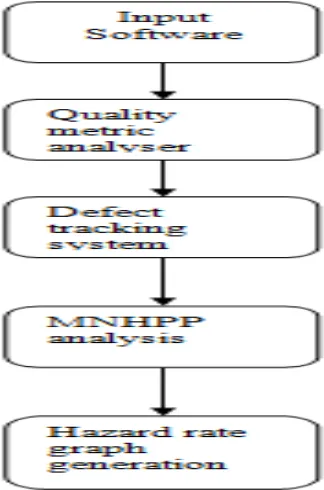
Architecture of our system is shown in figure 1. And figure also depicts the flow of proposed system. System architecture encompasses following components
1. Quality metric analyzer
Quality metric is the quality aspect of software. In proposed system we measure the quality metrics such as total line count of code, class count, and method count and cyclomatic complexity
2. Detect tracking system
This system fixes the bugs or defect within system and make a database of the defect that contains severity and priority of bugs or defects.
3. MHNPP analysis
This component estimates the reliability of given software by using modified non-homogeneous Poisson process model.
4. Hazard rate graph generation
Volume 3, Issue 1, January 2014
Page 368
Figure 1.System architecture
4.
CONCLUSION
This paper presents a modified non-homogeneous Poisson process model which is based on imperfect debugging and also considers the faults which may be activated for some set of input. And along with it we implement our project with defect tracking and quality analyzer which definitely helps in increasing reliability of software.
REFERENCES
[1] Stephen H. Kan, “Metrics and Models in Software Quality Engineering” Addison-Wesley Professional publication second edition
[2] Lethbridge, T. C., J. Singer, et al. (2003). "How Software Engineers Use Documentation: The State of the Practice." IEEE Software Volume 20 (Issue 6).
[3] P. K. Kapur, Sameer Anand, Kalpana Yadav, “A Unified Approach for Developing Software Reliability Growth Models in the Presence of Imperfect Debugging and Error Generation”, IEEE TRANSACTIONS ON RELIABILITY, VOL. 60, NO. 1, MARCH 2011
[4] Alan wood, “Software reliability growth models”, Technical report September 1996.
[5] Ganesh pai, “A survey of software reliability models”, Department of ECE University of Virginia December 2006
[6]
Razeef Mohd, Mohsin Nazir, “ Software Reliability Growth Models: Overview and Applications”, Journal ofEmerging Trends in Computing and Information Sciences VOL. 3, NO. 9, SEP 2012
[7] H. D. Mills, "On the statistical validation of computer programs, "IBM Federal Syst. Div., Gaithersburg, MD, Rep. 72-6015, 1972.
AUTHORS
Madhavi Mane received the B.E. degree in information technology from Pune University and currently M.tech.degrees in Computer Engineering from Bharati Vidyapeeth University College of Engineering Pune.
![Figure 2. S-shaped model[4]](https://thumb-us.123doks.com/thumbv2/123dok_us/9757185.1960466/3.595.214.391.91.229/figure-s-shaped-model.webp)