The Thirty-Third AAAI Conference on Artificial Intelligence (AAAI-19)
Efficient Concept Induction for Description Logics
Md Kamruzzaman Sarker, Pascal Hitzler
Data Semantics (DaSe) Laboratory, Dept. of Computer Science and Engineering,
Wright State University
{sarker.3, pascal.hitzler}@wright.edu
Abstract
Concept Induction refers to the problem of creating complex Description Logic class descriptions (i.e., TBox axioms) from instance examples (i.e., ABox data). In this paper we look particularly at the case where both a set of positive and a set of negative instances are given, and complex class expressions are sought under which the positive but not the negative ex-amples fall. Concept induction has found applications in on-tology engineering, but existing algorithms have fundamen-tal performance issues in some scenarios, mainly because a high number of invokations of an external Description Logic reasoner is usually required. In this paper we present a new algorithm for this problem which drastically reduces the num-ber of reasoner invokations needed. While this comes at the expense of a more limited traversal of the search space, we show that our approach improves execution times by up to several orders of magnitude, while output correctness, mea-sured in the amount of correct coverage of the input instances, remains reasonably high in many cases. Our approach thus should provide a strong alternative to existing systems, in par-ticular in settings where other systems are prohibitively slow.
Introduction
With the rise of the Web Ontology Language OWL (Hit-zler et al. 11 December 2012), description logics have be-come the leading paradigm for the representation of ontolo-gies (Hitzler, Kr¨otzsch, and Rudolph 2010). The knowledge acquisition bottleneck, in the form of acquisition of descrip-tion logic knowledge bases, thus becomes an issue also for the field of ontology engineering and applications. Ontology Learning is a term often used for this in the Semantic Web context, and a relatively recent overview of the many facets of this subfield can be found in (Lehmann and V¨olker 2014). In this paper, we study one of the subproblems of on-tology learning, commonly known as Concept Induction or Concept Learning. Generally speaking, this problem can be described as one of generating complex description logic class expressionsS from a given description logic knowl-edge base (or ontology)Oand setsP andN of instances, understood as positive and negative examples, such that
O |=S(a)for alla∈P, andO 6|=S(b)for allb∈N. In a practical ontology engineering process, solutions sought are
Copyright c2019, Association for the Advancement of Artificial Intelligence (www.aaai.org). All rights reserved.
often approximate, i.e., they will not satisfyO |= S(a)for alla∈P, but for as many as possible, and will not satisfy
O 6|=S(b)for allb∈N, but for as many as possible. Concept Induction is traditionally studied with meth-ods derived from Inductive Logic Programming, and an overview of corresponding results and systems can be found in (Lehmann et al. 2014). The most mature and recent sys-tem for this type of Concept Induction we are aware of is DL-Learner, as presented in (B¨uhmann, Lehmann, and Westphal 2016) and based on the algorithms from (Lehmann and Hitzler 2010; Lehmann et al. 2011). Concept Induction has been employed for ontology engineering, in particular in the context of ontology and knowledge graph refinement, see e.g. (Lehmann and B¨uhmann 2010; Paulheim 2017) and the use case descriptions in (B¨uhmann, Lehmann, and West-phal 2016). Another recent use case in the context of ex-plaining deep learning systems was described in (Sarker et al. 2017).
However, while DL-Learner is an excellent and very use-ful system, its algorithm – which comes with theoretical cor-rectness results (Lehmann and Hitzler 2010) – has major performance issues in some scenarios, such as the one de-scribed in (Sarker et al. 2017). In fact, it was the application need for scalability exposed through our experiments in the scenario from (Sarker et al. 2017) which primarily prompted the investigations which we report herein. The key problem is that in a single execution, the DL-Learner system will make a significant number of external calls to a description logic reasoner. While the latter have become rather efficient in recent years, the accumulated time needed, in particular if the input ontologies are large, can be prohibitive for the use of the approach. For example, as we will report in the evaluation section, for the scenario described in (Sarker et al. 2017) a single run of DL-Learner can easily take over two hours, while the scenario easily necessitates thousands of such runs.
through-out the rest of the algorithm. Furthermore, we depart from the established tradition in Concept Induction in that we do not use a refinement-operator-based approach to produce candidate solutions. As a consequence, our approach saves up to several orders of magnitude on large input ontologies, as compared to DL-Learner. At the same time, accuracy of the solutions provided by our approach remains reasonably high, which indicates a favorable trade-off between accuracy and efficiency, for application scenarios where such a trade-off is desired.
The rest of the paper is organized as follows. We first de-scribe a high-level perspective of our approach and algo-rithm.Then we describe the concrete algorithm which we have implemented, together with some formal results. Af-ter that, we present our experimental evaluation in Af-terms of a comparison with DL-Learner, and finally we conclude.
The General Algorithm
In terms of terminology, we generally follow (Lehmann and Hitzler 2010) where appropriate. The general learning prob-lem we address isconcept inductionas described in the fol-lowing, where we assume that some description logicLhas been fixed: Given an ontologyO(consisting of an ABox and a TBox) overLand two setsPandN of individuals called positiverespectivelynegative examples, we seek a (possibly complex) class expressionSoverLsuch thatO |=S(a)for alla∈ P (we say thatCcoversa), andO 6|=S(b)for all
b∈N. We callSasolutionfor this.
The most prominent refinement-operator based approach to concept induction, as provided in the DL-Learner system (B¨uhmann, Lehmann, and Westphal 2016), essentially fol-lows a generate-and-test paradigm: Based on a so-called re-finement operator, an idea borrowed from Inductive Logic Programming (Nienhuys-Cheng and de Wolf 1997), subse-quent candidate concepts are generated and tested as to the degree to which they come close to a solution, and following some strategy the next candidate concepts are generated un-til eventually, a full solution is found or some approximate solution has been created. The testing and assessment steps involve the calling of an external description logic reasoner, while the number of generated potential candidates can be very large. Since description logic reasoners generally have to run rather complex algorithms,1the repeated testing
nec-essary amounts for the majority of the runtime used. In some application scenarios for DL-Learner such as the one presented in (Sarker et al. 2017), however, it turns out that due to the sheer amount of tests required this approach takes a very long time so that the data space cannot be suffi-ciently explored – we provide runtime data in the evaluation section below. Some aspects of the scenario are as follows. (a) It requires many runs with changing example sets, while
the ontology remains unchanged.
(b) The positive and negative examples do not include en-tities with complex property relationships. Rather, for each exampleathe corresponding ABox statements are only of the formR(a, b), withRsome role andbsome
1
Worst-case computational complexities for these algorithms are typically rather high (Hitzler, Kr¨otzsch, and Rudolph 2010).
(other) individual, together with statements of the form
A(a)andB(b), whereAandBare atomic classes. We call such examplesstar-shaped.
(c) It is more important to quickly arrive at relatively simple solutions, if such simple solutions exist, rather than to comprehensively explore the space of possible complex solutions. I.e., it seems favorable to trade some com-pleteness for higher efficiency.
In this paper, we are going to show how the performance issue can be addressed in such scenarios. We will now first describe our approach in a general way, and in the next sec-tion we will describe the concrete algorithm.
Our new approach consists of the following three steps: 1. Select a finite set{C1, . . . , Cn}of complex class
expres-sions overL, and setO0=O∪{Ai≡Ci|i= 1, . . . , n},
where theAiare atomic classes not yet occurring inO. 2. Use a reasoner to compute membership in atomic classes
fromO0of all individuals occuring in examples. Note that
this includes the newly added atomic classes from step 1. 3. Generate candidate class expressions (possibly, itera-tively) using only the constructorsu,tand¬and atomic classes, and test using the results from step 2 to what ex-tent they constitute approximate solutions, using the as-sessment to guide iterative generation of candidates. Let us briefly consider the pros and cons of this approach.
• Steps 1 and 2 need to be performed only once for each set of examples, providedOdoes not change. I.e., they can be considered pre-processing steps.
• Depending on the underlying logicL, step 2 can take con-siderable time, but this preprocessing overhead would be outweighed by time saved in step 3, as it will not be nec-essary to invoke a reasoner for each candidate solution.
• Testing in step 3 is in general not equivalent to using a full reasoner. Our algorithm isapproximate onein the sense that we trade some completeness for improved efficiency.
• We could also allow some use of existential and universal quantification, but for ease of comprehensibility of solu-tions we chose not to, currently. Quantifiers can of course be included in the complex classes generated in step 1.
• Our approach will necessarily miss solutions also because there are infinitely many possible complex class expres-sions involving quantifiers, while in step 1 we generate only a finite number of class expressions involving quan-tifiers. We implemented our approach based on the hy-pothesis that the benefit of significantly improved runtime will outweigh this drawback in many relevant scenarios.
• In our approach, preprocessing runtime can effectively be controlled by selecting more or fewer complex class expressions in step 1. Selecting more will mean that we include the exploration of more possible solutions but increase pre-processing time, while selecting fewer will have the opposite effect.
on fixed background knowledge, and displayed next to clus-ters. Another scenario in the context of explainable artificial intelligence is about exploring the space of activation pat-terns of hidden layer neurons in deep learning systems as in the already mentioned (Sarker et al. 2017), and we will include corresponding evaluation data below.
Let us now revisit the properties (a) through (c) of our setting mentioned above.
Regarding property (a), a key difference between our ap-proach and the algorithms employed in DL-Learner is that we only have to use a reasoner once for computing Step 2, while the DL-Learner algorithm would have to invoke a rea-soner for every candidate solution.
Regarding property (b), we understand that this seems to be a severe restriction. However, some settings can be com-piled into the star-shaped format which we require, by mak-ing some minor additions to the ontology, e.g. by means of role chain expressions. Practically speaking, many of the known scenarios where concept learning has been applied seem to fit our requirement, and we will further elucidate this in the evaluation section.
Regarding property (c), this trade-off will not be a good one for all scenarios, but it will when time is of the essence.
Efficient Concept Induction from Instances
We now provide a concrete instance of the algorithm de-scribed in generic terms in the previous section. We call it the “Efficient Concept Induction from Instances” algorithm, ECII (pronounced like “easy”). We consider again the same three steps, and we assumeOto be an OWL DL ontology (Hitzler et al. 11 December 2012), i.e., essentially a knowl-edge base expressed in the description logicSROIQ.2 In
the description we will use some parameters, which are nat-ural numbers ni andki, and we will refer to them in our exhibition.
In step 1 of the algorithm, we select as additional complex class expressions all class expressionsCwhich are formed
by the grammarC ::= B | C1uC2 | ∃R.C whereB is
atomic, R is a role, and which contain at most n1 occur-rences of theusymbol and at mostn2 occurrences of the
∃symbol (in our system, bothn1 andn2default to 3, but can be set differently). The rationale behind this choice is simply that we wanted to remain within theEL++language
which allows for very efficient (and polynomial time) rea-soning.(Hitzler et al. 11 December 2012) However, ifOis not in OWL EL, which is the case for most of our evaluation data on which we will report later, then this does not neces-sarily lead to any advantage, and we could also allow other complex classes from OWL DL which are not in OWL EL – that does not fundamentally modify the approach.
In step 2 of the algorithm we compute the materializa-tion for all relevant individuals, i.e., the membership of all individuals from the examples in all atomic classes from
O0. There are several good algorithms and systems for this,
which can be used off-the-shelf. If the ontologyOis already
2
For background on description logics, see (Baader, Brandt, and Lutz 2005; Hitzler, Kr¨otzsch, and Rudolph 2010)
in OWL EL, then this reasoning task is in fact worst-case polynomial in the size of the input.
In order to explain what we do in step 3 of the algorithm, we need a bit of preparation. First, some definitions.
A negated disjunct is a class expression of the form
¬(D1 t · · · tDk), where theDi are atomic classes from O. Aconjunctive Horn clauseis a class expression of the formBu D, whereBis an atomic class fromO0andDis a
negated disjunct. Acandidate classis a class expression of the formFm
i=1Hi,with conjunctive Horn clausesHi. As the term suggests, step 3 of the algorithm will gener-ate solution candidgener-ates which involve candidgener-ate classes, and will check whether they are solutions. The candidate classes are not the solution candidates; the latter will be defined be-low. We restrict ourselves to candidate classes of the men-tioned form because we think that conjunctive Horn clauses can easily be understood by humans, and our intention was to provide solutions in such an easily ingestible form. We will return to this issue in the evaluation section.
We narrow the concept induction problem to the follow-ing, which fits our scenarios of interest, as described earlier. Given an ontologyO(consisting of an ABox and a TBox) over L, an example is an individuala together with a set
A(a)of ABox statements (not necessarily contained inO) of the formsA(a),R(a, b)orB(b), for any rolesR, individ-ualsband atomic classes B. We call two setsP andN of examples the set ofpositiverespectivelynegative examples
and setA=S
a∈P∪NA(a). We now seek to find a
(possi-bly complex) class expressionSoverLsuch thatO |=S(a) for alla∈P (and in this case we say thatCcoversa), and also thatO 6|=S(b)for allb∈N. We callSasolutionfor this learning problem.
Now letR1, . . . , Rlbe all roles occurring in all (positive and negative) examples. Asolution candidateis a class ex-pression of the formAudl
i=1∃Ri.Cior
Au l
l
i=1
∃Ri.
m
G
j=1
(Bjiu ¬(D1t. . .tDjik))
(1)
where theCiare candidate classes and whereAand all the
BjandDjare atomic classes inO0.
In order to now spell out step 3 of the algorithm, we have to present how the solution candidates are generated, and how they are checked whether they are solutions.
Let us first turn to the algorithm for checking whether a solution candidate is a solution. What we in fact do, is to determine the individuals which fall under the candidate classes which are part of a solution candidate.
Let
C=
m
G
j=1
(Bju ¬(D1t. . .tDjk))
XwithR(a, b)∈ A(a)}.We also set
R+= [
a∈P
R(a) R−= [
a∈N
R(a) R=R+∪R−
for each roleR. Theextension↓B of an atomic classB is defined as↓B={b|B(b)∈ A}. The extension of the class candidateCgiven above is then defined as
↓C=
m
[
j=1
(↓Bj∩ \(↓D1∪. . .∪ ↓Djk)).
Now if
S =Au l
l
i=1
∃Ri.Ci
is a solution candidate, then let
↓S=↓A∩ l
\
i=1
R−i (↓Ci).
We now call a solution candidateSanapproximate solu-tionif and only if both of the following hold.
1. a∈ ↓Sfor all positive examplesainP. 2. a6∈ ↓Sfor all negative examplesainN.
Note that checking whether a solution candidate is an ap-proximate solution can be done simply by means of a num-ber of straightforward set-theoretic operations, which is eas-ily implemented. In the general case, approximate solutions will of course not be (full) solutions, and whether or not this is a reasonable thing to do depends on the use case, and in particular on the question whether the runtime improvments for the use case outweigh the severity of the reasoning mis-takes we get in return. We will better understand this trade-off when we discuss our evaluation results.
Let us now turn to the generation of solution candidates. Essentially, the set of all possible solution candiates can be understood as a search space, within which we want to locate solutions or at least approximate solutions which are highly accurate in terms of coverage or not of the examples.
The DL-Learner system, which is our primary compar-ison, is based on traversing the search space by means of a so-calledrefinement operator, an idea borrowed from In-ductive Logic Programming (Nienhuys-Cheng and de Wolf 1997): Given a solution candidate, the refinement operator produces a set of new solution candidates. These are all as-sessed as to their accuracy in terms of coverage or not of the examples, and the best are kept and the process is iterated. The DL-Learner system calls an external reasoner each time the accuracy of a candidate solution is to be assessed.
Our approach, however, dispenses of the need to call an external reasoner as discussed above. We could now of course use a refinement-operator approach to iteratively cre-ate solution candidcre-ates and check them. However since ac-curacy assessment in our setting is very quick, and since our solutions are of very specific forms, we instead opted for a direct assembly of solution candidates from its parts, as de-scribed in the following.
Recall that our solution candidates are of the form (1). Our algorithm for constructing solution candidates consists of
three consecutive steps: (I) Select a set of conjunctive Horn clauses. (II) Select a set of candidate classes constructed from the selection in step (I). (III) Select a set of candidate solutions constructed from the selection in step (II).
These three steps, each of which we are going to describe in detail shortly, depend on five user-defined parameters
k1, . . . , k5which are natural numbers. Their default values arek1=k2 =k3= 3andk4 =k5 = 50, but they can be changed by the user. There is another user-defined parame-terskeepCommonT ypes, which defines whether to keep or delete thecommonT ypes(which are the set of atomic con-cepts which appear both in positive and negative instances). Default value for it isf alse.
(I) For every roleRoccuring in the examples, setNR = {B|Bis an atomic class inO0and there isb∈Rwithb∈ ↓B}. Then, for each role R, construct the set H0,R of
all conjunctive Horn clauses, each of which contains only atomic classes fromNR, and at mostk1of such classes each. Then, for eachH∈H0,R, calculate the accuracy ofH as
α1(H) =|R +
∩ ↓H|+|R−\ ↓H|
|R| .
Finally, let HR be the set of the k4 conjunctive Horn clauses fromH0,Rwhich have the highest accuracy; if two
clauses are of the same accuracy, then we use those of shorter length, where length is measured in the number of atomic classes occuring in the conjunctive Horn clause.HR
is the set of conjunctive Horn clauses selected in this step. (II) For every roleRoccuring in the examples, setC0,R
to be the set of candidate classes assembled as disjunctions of maximallyk2conjunctive Horn clauses fromHReach.
Then, as before, we select the setCRof thek6candidate classes fromC0,R which have the highest accuracy, and if
two candidate classes are of the same accuracy, then we use those of shorter length.
(III) Construct the set of candidate solutions S0 = n
Audk3
i=1∃Ri.Ci
Ci∈CRi, Aan atomic class inO 0o.
Our output set S consists of the best candidate solutions from S0 again selected by means of highest accuracy and shortest length, where the accuracy for eachC∈Sis
α2(C) =|P∩ ↓C|+|N\ ↓C|
|P∪N| .
Let us make some remarks. In (I), we essentially brute-force the search for good conjunctive Horn clauses for each set ofR-fillers, andNRare all the classes relevant for these R-fillers. Accuracy is simply measured by coverage ofR -fillers from the positive examples and non-coverage of the
computations in all steps are straightforward arithmetic or set operations.
Due to the already mentioned deliberate decision to trade completeness for runtime improvements, our approach will of course not necessarily find all solutions or best solutions. It is to be understood as a heuristics which delivers a favor-able trade-off between accuracy and speed, as we argue in the evaluation section below.
Experimental Evaluation
The goal of our experimental evaluation was to test the hy-pothesis that the ECII algorithm leads to a favorable trade-off between runtime improvements and loss in accuracy, compared to DL-Learner. We expected to see runtime im-provements of 2 or more orders of magnitude for large in-put ontologies, while we expected that accuracy would only moderately decrease in many test cases.
To evaluate our approach, we implemented the ECII sys-tem in Java (version 1.8) which makes it platform indepen-dent. We made use of the OWL API (Horridge and Bech-hofer 2011) (version 4.5), which is an open source imple-mentation for manipulating OWL 2 ontologies. As external reasoner for step 1 of the algorithm we used Pellet (Sirin et al. ) In principle, ECII can also use other reasoners. We used Apache Maven as build system. The ECII system and all experimental data and results, including ontologies and configuration files are available online.3
All experiments were conducted on a 2.2. GHz core I7 machine with 16GB RAM.
For DL-Learner we used the CELOE (Lehmann et al. 2011) algorithm and the fast instance check (DL FIC) vari-ation of it, which is another approximvari-ation approach which trades time for correctness. We terminated DL-Learner at the first occurance of a solution with accuracy 1.0, mak-ing use of the stopOnFirstDefinition parameter. For some large ontologies DL-Learner could not produce a solution with accuracy 1.0 within 4,500 seconds (i.e., 75 minutes); in these cases we terminated the algorithm after 4,500 sec-onds, using themaxExecutionTimeInSecondsparameter. For the FIC mode of DL-Learner, the time limit was set to be the execution time of the ECII system. For ECII we used the default settings, forKs i.e.,k1 = k2 = k3 = 3 and
k4 =k5 = 50and varied thekeepCommonT ypesas true and false, as mentioned earlier. We use ECII to denote the ECII system with default parameters, and DL-Learner to de-note DL-Learner with full reasoner (CELOE setting) unless otherwise mentioned. Note that a runtime comparison for the cases where DL-Learner does not produce a solution with accuracy 1.0 is difficult to do, since DL-Learner would sim-ply keep producing candidate solutions for a very long time, while ECII by design tests only a limited number of candi-date solutions. Our 75-minute cap on DL-Learner runtime is unavoidably somewhat arbitrary.
As evaluation scenarios we used all evaluation scenar-ios (except Carcinogesis) from the original DL-Learner al-gorithm paper (Lehmann and Hitzler 2010), as well as the scenario from (Sarker et al. 2017) which makes use of the
3
https://github.com/md-k-sarker/ecii-expr.
ADE20k (Zhou et al. 2017) dataset. We cannot describe all these scenarios in detail, and the reader is asked to refer to (Lehmann and Hitzler 2010; Sarker et al. 2017) for de-tails. The evaluation scenarios from (Lehmann and Hitzler 2010) were Michalski’s trains (Michalski 1980), Forte Fam-ily (Richards and Mooney 1995), Poker (http://www.ics.uci. edu/∼mlearn/MLRepository.html), Moral Reasoner (http://
mlearn.ics.uci.edu/databases/moral-reasoner/), and Yinyang family relationship (Iannone, Palmisano, and Fanizzi 2007), which are benchmark scenarios from Inductive Logic Pro-gramming. Carcinogesis was excluded because according to (Lehmann and Hitzler 2010) it did not work with a full rea-soner under DL-Learner, and we encountered the same prob-lem.
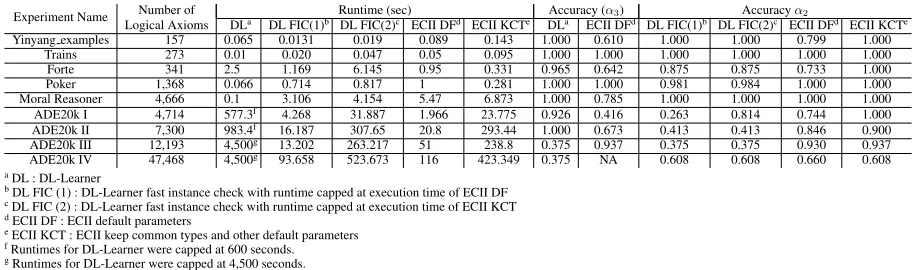
We will now briefly discuss each of the scenarios in turn, before we summarize; Table 1 provides an overview of the results. Runtimes were averaged over 3 runs. Accuracy of a solutionSwas assessed as
α3(S) = |PS|+|NS|
|P∪N| , where
PS ={a∈P | O ∪ A |=S(a)}and NS ={b∈N | O ∪ A 6|=S(b)},
using a full reasoner. DL-Learner fast instance check (DL FIC) is compared with theα2 accuracy score (see above) of ECII system with default (ECII DF) and keeping com-mon types (ECII KCT). In Table 1, the accuracy value for DL-Learner is always the one with the best solution. Theα3 accuracy score for DL-Learner is the score of the result re-turned by DL-Learner with the highest such score. Theα2 score for ECII is the average score over three runs, where for each run the solution with the bestα2score is used for the average. Theα3accuracy score for ECII has been com-puted by taking all (or if more than five, a random section of five) of the results returned by ECII which score maximally in terms ofα2. For each of these, theα3score has been cal-culated using a full reasoner (in fact, Pellet), and averaging over these results.
The Yinyang family relationship problem is about creat-ing descriptions for family relationship types from instance data. This dataset includes a small ontology with 157 logi-cal axioms. We notice that ECII with default parametes per-forms worse than DL-Learner in this task both in terms of runtime and in terms ofα3accuracy, but ECII KCT obtains sameα2score as DL FIC when keeping the common types. The Michalski’s train dataset ontology has 273 axioms. On this task, ECII is significantly outperformed by DL-Learner in terms of runtime, while both find perfect solu-tions. The reason that DL-Learner is quicker lies in the fact that it quickly comes up with solution by making a good choice in the refinement operator steps, thus leading to a quick termination. This is not necessarily an indication that DL-Learner runtime will always be significantly quicker for problems of this input size – see e.g. the next paragraph.
Experiment Name Number of Runtime (sec) Accuracy (α3) Accuracyα2
Logical Axioms DLa DL FIC(1)b DL FIC(2)c ECII DFd ECII KCTe DLa ECII DFd DL FIC(1)b DL FIC(2)c ECII DFd ECII KCTe
Yinyang examples 157 0.065 0.0131 0.019 0.089 0.143 1.000 0.610 1.000 1.000 0.799 1.000 Trains 273 0.01 0.020 0.047 0.05 0.095 1.000 1.000 1.000 1.000 1.000 1.000 Forte 341 2.5 1.169 6.145 0.95 0.331 0.965 0.642 0.875 0.875 0.733 1.000 Poker 1,368 0.066 0.714 0.817 1 0.281 1.000 1.000 0.981 0.984 1.000 1.000 Moral Reasoner 4,666 0.1 3.106 4.154 5.47 6.873 1.000 0.785 1.000 1.000 1.000 1.000 ADE20k I 4,714 577.3f 4.268 31.887 1.966 23.775 0.926 0.416 0.263 0.814 0.744 1.000
ADE20k II 7,300 983.4f 16.187 307.65 20.8 293.44 1.000 0.673 0.413 0.413 0.846 0.900
ADE20k III 12,193 4,500g 13.202 263.217 51 238.8 0.375 0.937 0.375 0.375 0.930 0.937
ADE20k IV 47,468 4,500g 93.658 523.673 116 423.349 0.375 NA 0.608 0.608 0.660 0.608 aDL : DL-Learner
bDL FIC (1) : DL-Learner fast instance check with runtime capped at execution time of ECII DF cDL FIC (2) : DL-Learner fast instance check with runtime capped at execution time of ECII KCT dECII DF : ECII default parameters
eECII KCT : ECII keep common types and other default parameters fRuntimes for DL-Learner were capped at 600 seconds. gRuntimes for DL-Learner were capped at 4,500 seconds.
Table 1: Runtime and accuracy comparison of DL-Learner and ECII. Some figures are averages as described in the text.
were taken from this dataset by varying the numbers of posi-tive and negaposi-tive individuals, and the score is averaged. ECII outperforms DL-Learner in terms of runtime but dips in ac-curacy. For approximation accuracy ECII (α2 = 1.00) out-performs DL-Learner fast instance check (α2 = 0.87) ver-sion by settingkeepCommonT ypestotrue.
The Poker dataset has 1,368 axioms and thus a slightly larger ontology. (Lehmann and Hitzler 2010) defined two problems using this dataset namely learning the definition of a pair and of a straight. With the same (1.0) accuracy, DL-Learner is significantly quicker, presumably for similar reasons as for the Trains dataset.
The Moral Reasoner dataset has 4,666 axioms and is of medium size as part of our set of scenarios. In (Lehmann and Hitzler 2010), several versions of this scenario were ex-plored, and we chose the one using all instances and which did not modify the original set of atomic classes which can be used to construct solutions. For this problem one of the solutions with accuracy 1.0 found by DL-Learner consists of the single atomic class “guilty,” while ECII average ac-curacy is only 0.785. One of the solutions found by ECII, with accuracy 0.91, is¬plan knownt ¬carefultguilty. DL-Learner was significantly quicker. We see that DL-DL-Learner outperforms ECII on this task, and the runtime performance of DL-Learner can be explained as in the Trains example. Regarding accuracy, ECII did not come up with “guilty” as candidate solution, presumably because itsα2 score is not high enough. Indeed, the ontology for this dataset contains a significant numer of class disjunctions, which causes diffi-culties for our approximate reasoning procedure. This seems to explain both why ECII does not produce “guilty” as a so-lution and also why it would construct a complicated solu-tion using disjuncsolu-tions which scores well with respect toα2 but not well with respect toα3-accuracy.
The ADE20k dataset contains over 20,000 images of scenes which are preclassified in terms of scene type. Each image may have several annotations of objects which have been provided by humans. For our evaluation we used the dataset from (Sarker et al. 2017) where the ADE20k dataset, with annotations, was cast into an OWL ontology and aligned with the Standard Upper Merged Ontology SUMO4.
4
http://www.adampease.org/OP/
In (Sarker et al. 2017), sets of positive and negative exmples were selected from the images, and DL-Learner was used to generate corresponding class expressions. Only a handful of such experiments was reported in (Sarker et al. 2017): As we see below and in Table 1, the scenario yields to prohibitively long runtimes for DL-Learner, which makes a thorough in-vestigation along the lines of (Sarker et al. 2017) impossible. In order to compare performances, we used this scenario to create four problem classes with varying input sizes, as listed in Table 1.
For the smallest problem class, ontology size 4,714 ax-ioms, ECII took on average 1.966 seconds to terminate and come up with solutions having average accuracy of 0.416. DL-Learner took 300 seconds to produce solutions with av-erage accuracy of 0.926. As DL-Learner did not find solu-tions with accuracy 1.0 within a reasonable time span we capped execution at 10 minutes or 600 seconds. DL-Learner then took on average 577.3 seconds and the average accu-racy obtained within this time was 0.926 which is the same as of 300 seconds. For one representative problem, a solu-tion found by ECII had an accuracy of 1.0. The highest ac-curacy obtained by DL-Learner within this time limit on that same problem was 0.88. We notice that accuracy of ECII lags behind that of DL-Learner on average, but with this in-put size we already see significant runtime improvements, and sometimes even higher accuracy. ECII outperforms DL FIC interms ofα2score.
For the medium size setting – ontology with 7,300 ax-ioms, we used exactly the settings reported in (Sarker et al. 2017). DL-Learner was able to come up with solutions with accuracy 1.0, but the time required to produce these solutions was 983 seconds average. The runtime for ECII was 20.8 seconds on average, and the average accuracy was 0.673. Accuracy of ECII on these is less than DL-Learner but runtime is very significantly improved. Approximate ac-curacy is better for ECII compared to DL FIC.
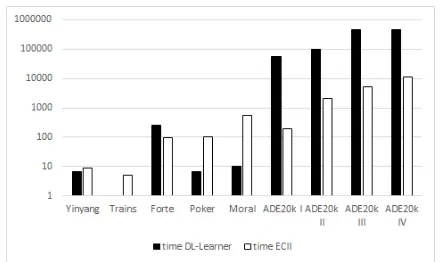
ax-Figure 1: Runtime comparison between DL-Learner and ECII. The vertical scale is logarithmic in hundredths of sec-onds, and note that DL-Learner runtime has been capped at 4,500 seconds for ADE20k III and IV. For ADE20k I it was capped at each run at 600 seconds.
ioms.
For the validation data ontology, DL-Learner was not able to find a solution with accuracy 1.0, and we terminated DL-Learner after 4,500 seconds (i.e., 75 minutes). DL-DL-Learner produced a solution with accuracy of 0.375. ECII took 51 seconds to run and produced soultions with an average ac-curacy of 0.937. In fact, it turns out that DL-Learner did produce ∃imageContains.> as solution, which essentially means that it did not manage to take even a few refine-ment steps. One solution found by ECII had an accuracy of 0.90. ECII system also outperforms DL Fast instance check (DL FIC), in terms ofα2score. DL FIC was able to achive
α2 score as 0.375 while ECII system achives significantly higher score.
For the training data ontology, DL-Learner was also ter-minated after 4,500 seconds. It procuded the same solution as before with accuracy of 0.375. ECII took 116 seconds producing an averageα2-score of 0.66. Due to the size of the ontology, we were not able to run a reasoner to compute theα3accuracy value for the solutions provided by ECII.
From the last two tasks, we see that ECII provides a very significant runtime improvement over DL-Learner, and is in fact able to produce approximate solutions in cases where DL-Learner can only return a trivial guess such as>.
Let us summarize the results using some charts. Figure 1 displays a runtime comparison over all experiments; the experiments are sorted from left to right in increasing in-put size. The DL-Learner curve has much higher variance, which presumably is because runtime is capped whenever a 1.0 accuracy solution is found, while runtime is significantly higher for comparable sizes if this is not the case. ECII has an algorithm which is quicker in those test cases where DL-Learner did not find a 1.0 accuracy solution, i.e., for Forte and all ADE20k experiments, and is several orders of mag-nitudes quicker for the large input ontologies.
Figure 2 visualizes the accuracy (α3) comparison results. While ECII achieves 1.0 accuracy, as does DL-Learner, in some cases (Train, Poker), it usually achieves only a lower accuracy for all cases where DL-Learner is able to
pro-Figure 2: Accuracy (α3) comparison between DL-Learner and ECII. For ADE20k IV it was not possible to compute an accuracy score within 3 hours for ECII as the input ontology was too large.
Figure 3: Approximation accuracy (α2) comparison between DL-Learner fast instance check and ECII.
duce non-trivial solutions. When DL-Learner produces only a trivial result, as in ADE20k III, ECII in fact is able to do better than DL-Learner. It is reasonable to assume that this would indeed happen in many cases where DL-Learner is simply not able to process a large input size.
Figure 3 shows the approximate accuracy (α2) compar-ison results. We can see that ECII always outperforms DL FIC system.
Conclusions and Future Work
When we initially set out to develop the ECII algorithm and system, our goal was to provide an alternative to DL-Learner which trades some accuracy for speed. We anticipated that our approach would only be slightly less accurate but with one or two orders of magnitude in runtime improvements.
So overall, based on the evaluation, ECII indeed seems to provide a reasonable alternative to DL-Learner in some cases, and in fact provides reasonable solutions even in cases where DL-Learner is unable to do so. From this perspective, we have achieved what we set out to do.
Our analysis of course also raises rather obvious points for further investigations and improvements. Further exper-iments in fact should shed further light on the strengths and weaknesses of ECII, and this needs to be explored. We have not varied the ECII default parameters, but we conjecture that we can move the time-accuracy trade-off in both direc-tions by changing them. We have also not yet made full use of the theoretical results for OWL EL, but only looked at the obvious evaluation datasets for a fair comparison.
As discussed in the evaluation section, it also turns out that the solutions with the highestα2-score are not always the best ones with respect to the correct α3-accuracy. Of course, calculating theα3-accuracy requires a full reasoner, and thus significant time, but by doing a few such checks one may be able to improve accuracy at the expense of some of the runtime gains. As a further alternative, a post-processing step could be added to the ECII algorithm which takes a somewhat larger number of the solution candidates which perform high with respect to α2-score, and returns only those among them which also score high onα3-accuracy.
References
Baader, F.; Brandt, S.; and Lutz, C. 2005. Pushing the EL envelope. In Kaelbling, L. P., and Saffiotti, A., eds., IJCAI-05, Proceedings of the Nineteenth International Joint Con-ference on Artificial Intelligence, Edinburgh, Scotland, UK, July 30 – August 5, 2005, 364–369. Professional Book Cen-ter.
B¨uhmann, L.; Lehmann, J.; and Westphal, P. 2016. DL-Learner – A framework for inductive learning on the seman-tic web.J. Web Sem.39:15–24.
Hitzler, P.; Kr¨otzsch, M.; Parsia, B.; Patel-Schneider, P.; and Rudolph, S., eds. 11 December 2012.OWL 2 Web Ontology Language: Primer (Second Edition). W3C Recommenda-tion. Available at http://www.w3.org/TR/owl2-primer/.
Hitzler, P.; Kr¨otzsch, M.; and Rudolph, S. 2010. Founda-tions of Semantic Web Technologies. Chapman & Hall/CRC. Horridge, M., and Bechhofer, S. 2011. The OWL API: A java API for OWL ontologies. Semantic Web2(1):11–21. Iannone, L.; Palmisano, I.; and Fanizzi, N. 2007. An algo-rithm based on counterfactuals for concept learning in the semantic web.Applied Intelligence26(2):139–159.
Lehmann, J., and B¨uhmann, L. 2010. ORE – A tool for re-pairing and enriching knowledge bases. In Patel-Schneider, P. F.; Pan, Y.; Hitzler, P.; Mika, P.; Zhang, L.; Pan, J. Z.; Hor-rocks, I.; and Glimm, B., eds.,The Semantic Web – ISWC 2010 – 9th International Semantic Web Conference, ISWC 2010, Shanghai, China, November 7-11, 2010, Revised Se-lected Papers, Part II, volume 6497 of Lecture Notes in Computer Science, 177–193. Springer.
Lehmann, J., and Hitzler, P. 2010. Concept learning in
de-scription logics using refinement operators.Machine Learn-ing78(1-2):203–250.
Lehmann, J., and V¨olker, J. 2014.Perspectives on Ontology Learning, volume 18 ofStudies on the Semantic Web. IOS Press.
Lehmann, J.; Auer, S.; B¨uhmann, L.; and Tramp, S. 2011. Class expression learning for ontology engineering.Web Se-mantics: Science, Services and Agents on the World Wide Web9(1):71–81.
Lehmann, J.; Fanizzi, N.; B¨uhmann, L.; and d’Amato, C. 2014. Concept learning. In Lehmann, J., and V¨olker, J., eds., Perspectives on Ontology Learning, volume 18 ofStudies on the Semantic Web. IOS Press, Amsterdam. 71–91.
Michalski, R. S. 1980. Pattern recognition as rule-guided inductive inference. IEEE Transactions on Pattern Analysis and Machine Intelligence(4):349–361.
Nienhuys-Cheng, S., and de Wolf, R., eds. 1997. Foun-dations of Inductive Logic Programming, volume 1228 of Lecture Notes in Computer Science. Springer.
Paulheim, H. 2017. Knowledge graph refinement: A sur-vey of approaches and evaluation methods. Semantic Web 8(3):489–508.
Richards, B. L., and Mooney, R. J. 1995. Automated refine-ment of first-order horn-clause domain theories. Machine Learning19(2):95–131.
Sarker, M. K.; Xie, N.; Doran, D.; Raymer, M.; and Hitzler, P. 2017. Explaining trained neural networks with seman-tic web technologies: First steps. In Besold, T. R.; d’Avila Garcez, A. S.; and Noble, I., eds.,Proceedings of the Twelfth International Workshop on Neural-Symbolic Learning and Reasoning, NeSy 2017, London, UK, July 17-18, 2017.,
vol-ume 2003 ofCEUR Workshop Proceedings. CEUR-WS.org.
Sirin, E.; Parsia, B.; Grau, B. C.; Kalyanpur, A.; and Katz, Y. Pellet: A practical OWL-DL reasoner.J. Web Sem.5(2):51– 53.