A Theological Ritual Analysis
of the Practical Order, Ritual Function, and Theological Purpose
of the Daily Divine Service
according to the Priestly Tradition in the Pentateuch
By
Robert Daniel Macina
...
B.A., M.Div., S.T.M.
...
A thesis submitted in fulfilment of the
requirements for the degree of doctor of philosophy
...
University of Divinity
Copyright © 2014 by Robert D. Macina
Abstract
This study investigates data from the priestly tradition in the Pentateuch to determine the sequence in which the divinely instituted rites of the daily service were performed, how they functioned in relation to each other within the service, and what God intended to accomplish through each rite as well as the whole service. Since Israel’s daily service is no longer enacted, this investigation is based on the texts that prescribe and describe its ritual activities. These passages are analysed ritually to determine the sequential order, practical function, and theological purpose of each of the divinely instituted acts within the whole service.
Declaration
I declare that the word length of this thesis is 98,532 words. This does not exceed the maximum length of 100,000 words specified in the regulations for the doctor of philosophy degree, which includes footnotes but excludes bibliography, tables, appendices, and illustrations.
I declare that the bibliography format is consistent and conforms to the requirements of the
Turabian Style (Turabian, Kate L. 2007. A manual for Writers of Research Papers, Theses, and
Dissertations, 7th ed. University of Chicago Press.); or that, alternatively, permission has been granted to employ another style.
Statement of Originality
I hereby certify that this thesis contains no material which has been accepted for the award of any other degree or diploma in any university or other institution, and affirm that to the best of my knowledge, the thesis contains no material previously published or written by another person, except where due reference is made in the text of the thesis.
Signed: _________________________________
Acknowledgments
i
Contents
List of Figures...v
Chapter 1 The Daily Divine Service in the Pentateuch...1
1.1 Categories of Burnt Offerings...2
1.2 The Foundation of Israel’s Perpetual Divine Service...2
1.3 Summary of Scholarship...6
1.4 Present Study and Its Organisation...16
1.5 Methodology...17
1.6 Presentation...20
Chapter 2 The Practical Order of the Daily Divine Service...22
2.1 The Initial Rites...24
2.1.1 The Fire Rite...24
2.1.2 The Presentation Rite...29
2.2 The Central Rites...35
2.2.1 The Blood Rite...35
2.2.2 The Incense Rite...39
2.2.3 The Burning Rite...46
2.3 The Concluding Rites...50
2.3.1 The Blessing Rite...50
2.3.2 The Meal Rite...55
2.4 Conclusions to Chapter Two...60
Chapter 3 The Ritual Function of the Daily Divine Service...62
3.1 The Fire Rite...63
3.1.1 The Divine Institution of the Fire Rite...63
ii
3.1.2.1 Ritual Agents...65
3.1.2.2 Ritual Acts...67
3.1.2.3 Ritual Materials...69
3.1.2.4 Ritual Times...71
3.1.2.5 Ritual Locations...71
3.1.2.6 Summary of the Ritual Function...74
3.1.3 The Theological Purpose of the Fire Rite...74
3.1.4 Conclusion...76
3.2 The Presentation Rite...78
3.2.1 The Divine Institution of the Presentation Rite...78
3.2.2 The Ritual Function of the Presentation Rite...81
3.2.2.1 Ritual Agents...81
3.2.2.2 Ritual Acts...82
3.2.2.3 Ritual Materials...85
3.2.2.4 Ritual Times...87
3.2.2.5 Ritual Locations...88
3.2.2.6 Summary of the Ritual Function...89
3.2.3 The Theological Purpose of the Presentation Rite...90
3.2.4 Conclusion...91
3.3 The Blood Rite...93
3.3.1 The Divine Institution of the Blood Rite...93
3.3.2 The Ritual Function of the Blood Rite...95
3.3.2.1 Ritual Agents...95
3.3.2.2 Ritual Acts...97
3.3.2.3 Ritual Materials...99
3.3.2.4 Ritual Times...100
3.3.2.5 Ritual Locations...101
3.3.2.6 Summary of the Ritual Function...102
3.3.3 The Theological Purpose of the Blood Rite...103
3.3.4 Conclusion...109
iii
3.4.1 The Divine Institution of the Incense Rite...111
3.4.2 The Ritual Function of the Incense Rite...115
3.4.2.1 Ritual Agents...115
3.4.2.2 Ritual Acts...116
3.4.2.3 Ritual Materials...118
3.4.2.4 Ritual Times...123
3.4.2.5 Ritual Locations...124
3.4.2.6 Summary of the Ritual Function...125
3.4.3 The Theological Purpose of the Incense Rite...125
3.4.4 Conclusion...129
3.5 The Burning Rite...130
3.5.1 The Divine Institution of the Burning Rite...130
3.5.2 The Ritual Function of the Burning Rite...132
3.5.2.1 Ritual Agents...132
3.5.2.2 Ritual Acts...133
3.5.2.3 Ritual Materials...136
3.5.2.4 Ritual Times...137
3.5.2.5 Ritual Locations...137
3.5.2.6 Summary of the Ritual Function...139
3.5.3 The Theological Purpose of the Burning Rite...139
3.5.4 Conclusion...143
3.6 The Blessing Rite...145
3.6.1 The Divine Institution of the Blessing Rite...145
3.6.2 The Ritual Function of the Blessing Rite...146
3.6.2.1 Ritual Agents...146
3.6.2.2 Ritual Acts...147
3.6.2.3 Ritual Materials...147
3.6.2.4 Ritual Times...148
3.6.2.5 Ritual Locations...148
3.6.2.6 Summary of the Ritual Function...149
iv
3.6.4 Conclusion...152
3.7 The Meal Rite...154
3.7.1 The Divine Institution of the Meal Rite...154
3.7.2 The Ritual Function of the Meal Rite...155
3.7.2.1 Ritual Agents...156
3.7.2.2 Ritual Acts...156
3.7.2.3 Ritual Materials...157
3.7.2.4 Ritual Times...157
3.7.2.5 Ritual Locations...158
3.7.2.6 Summary of the Ritual Function...159
3.7.3 The Theological Purpose of the Meal Rite...159
3.7.4 Conclusion...161
3.8 Conclusions to Chapter Three...162
Chapter 4 The Theological Purpose of the Daily Divine Service...163
4.1 The System of Ritual Agents...163
4.2 The System of Ritual Acts...167
4.3 The System of Ritual Materials...170
4.4 The System of Ritual Times...174
4.5 The System of Ritual Locations...178
4.6 Thesis Conclusion...182
4.7 Summary of Findings...186
v
Figures
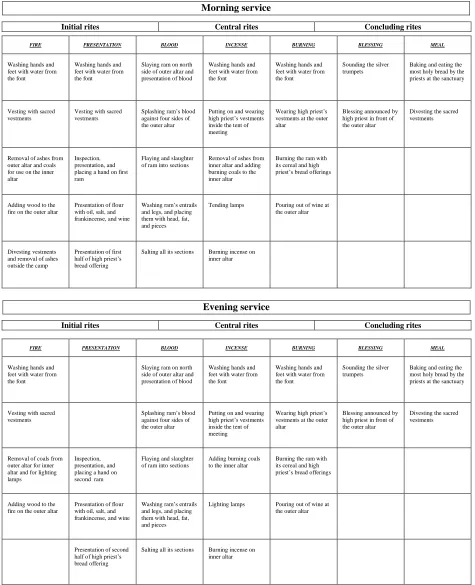
Figure 1. The sequential order for the daily divine service...59
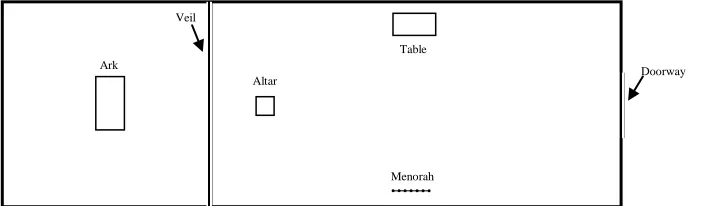
Figure 2. The tabernacle ground plan...73
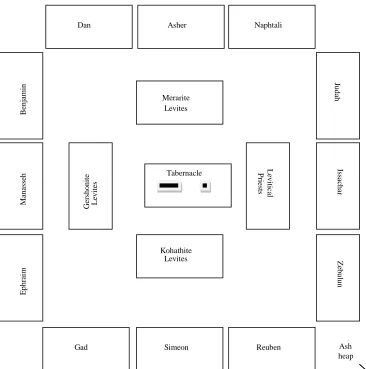
Figure 3. The camp of Israel...73
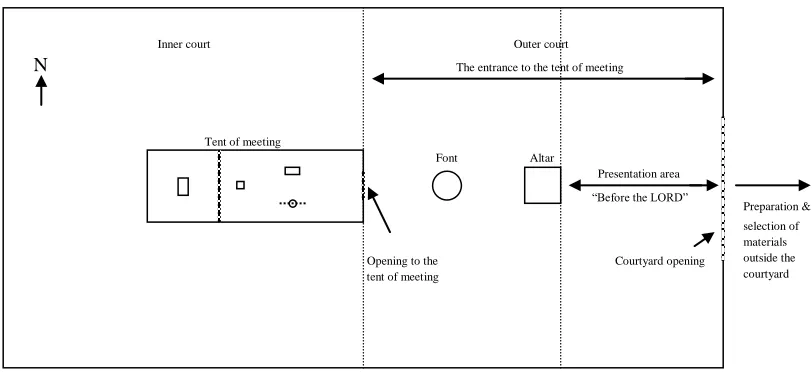
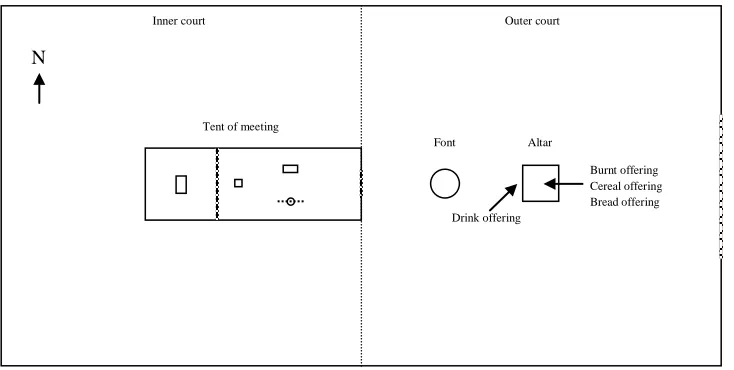
Figure 4. The tent of meeting and the courtyard...89
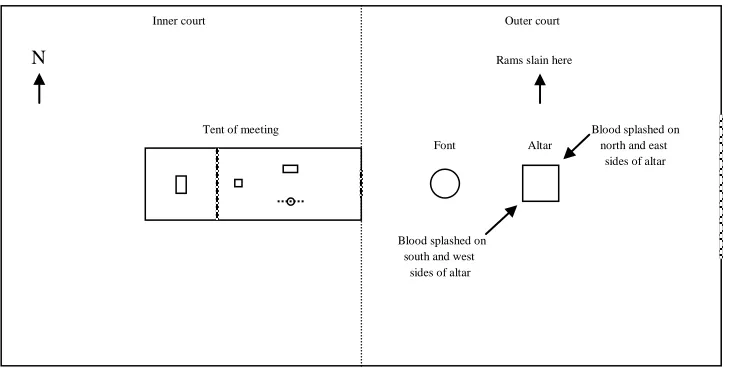
Figure 5. The altar and its north side...102
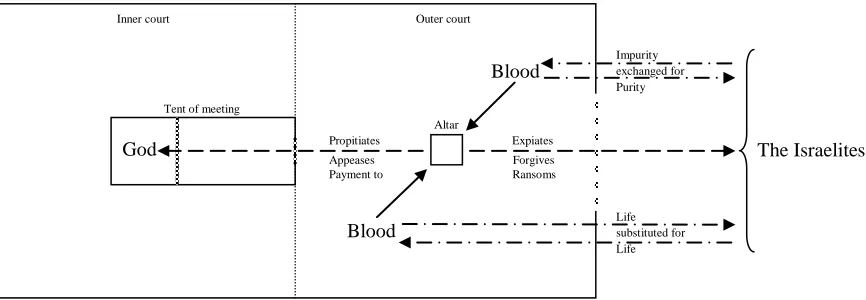
Figure 6. The rite of atonement...106
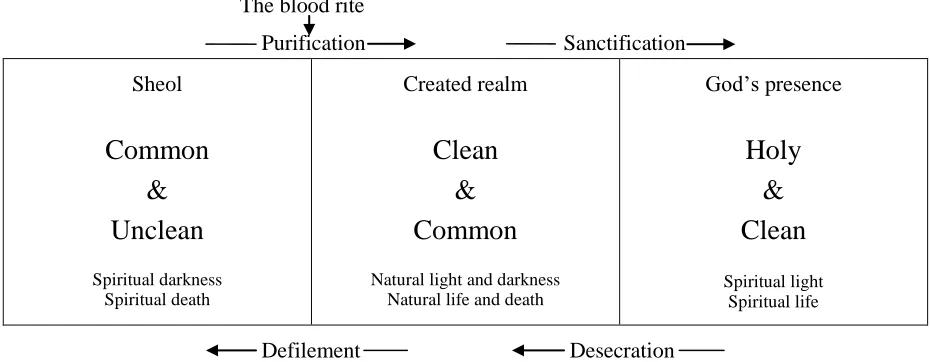
Figure 7. The relation of the blood rite to the three ritual spheres...109
Figure 8. The ritual locations of the incense rite...125
Figure 9. The burning rite at the altar...139
Figure 10. The ritual locations of the blessing rite...149
Figure 11. The location of the meal rite...159
Figure 12. Unauthorised approach...166
Figure 13. Authorised mediation...166
Figure 14. The Levitical barrier between the Israelites and the tabernacle...166
Figure 15. The theological purpose of the main parts of the system of ritual acts...169
Figure 16. The theological and anthropological systems...172
Figure 17. The LORD’s means of purification and sanctification through the system of ritual materials...173
Figure 18. The states of the rites of passage...176
Figure 19. The purification rites of passage...176
Figure 20. The sanctification rites of passage...176
Figure 21. The states of the divine service’s complex rite of passage every morning and evening...176
Figure 22. The stages of rites of passage...177
Figure 23. The stages of the daily service’s complex rite of passage every morning and Evening...177
Figure 24. Israel’s status in relation to the stages of the divine service according to the complex rite of passage every morning and evening...177
vi
Figure 26. Holy and common, unclean and clean locations...181
Figure 27. The centrality of the most holy place in the system of ritual locations...181
1
CHAPTER ONE
The Daily Divine Service in the Pentateuch
After the exodus of the ancient Israelites from Egypt they camped at Mount Sinai where the
LORD1 called Moses to come to the top of the mountain, which was covered by a cloud filled with the
LORD’s glory (Exod. 24:12–17).2
On top of that mountain during a period of forty days and forty nights
the LORD revealed to Moses his plans for constructing a tabernacle as his dwelling place on earth and
prescribed the main rites that the Israelites would enact in it (Exod. 24:18–31:18).3 This legislation
includes ritual activities that must be carried out daily, every morning and every evening at the tabernacle.
Smoking up burnt offerings and burning incense form the basic acts that the LORD commanded to be
performed every day at his earthly dwelling place (Exod. 29:38–42; 30:7–8). Additional enactments were
prescribed for the daily service after the tabernacle had been erected and the LORD established his
residence there (Exod. 40:34–38; Lev. 1:1ff.). The rites and ritual activities of that daily divine service are
the focus of this study.
The daily service of ancient Israel with all of its correlated ritual acts has been almost entirely
ignored by modern scholarship. Analyses of its various components are often given in great detail, but
these tend to be piecemeal. No contemporary study has attempted to reconstruct the entire daily service,
examine the function of all of its rites, and determine its divine purpose on the basis of the priestly
tradition in the Pentateuch. This neglect is astounding, especially if one considers the centrality of the
ritual system of ancient Israel as it is consistently portrayed throughout the biblical writings. Perhaps
scholarship in this area has been lacking due to the difficulties of doing so. Nowhere does the Pentateuch
spell out the entire order of the daily service, much less explain the function of its parts and its theological
1
Throughout this thesis the divine name, הוהי, is usually rendered LORD unless it is necessary to use the Hebrew word itself or its transliteration YHWH.
2
The biblical references in this thesis are the chapter and verse numbering in the modern English translations, except for places where the Hebrew chapter and verse is different. These are marked [MT], referring to the Masoretic Text.
3
2
purpose. The priestly tradition itself presents the daily service in pieces rather than as a whole. Attempts
at reassembling the daily divine service is like trying to find hidden pieces of a puzzle before determining
where they must be placed. This is no easy task! There is, however, enough evidence in the Pentateuch
and other sources to reconstruct the basic order of the daily divine service, examine its ritual function, and
determine its divine purpose. This study aims to stimulate a renewed interest in and shed new light upon
a topic that has bewildered scholars.
Categories of Burnt Offerings
Without a general knowledge of the entire daily service, scholars frequently fail to recognize, on
the one hand, the organic connection between the various kinds of offerings and, on the other hand, a
distinction between the functions of the same kinds of offerings for different circumstances. The daily
public burnt offerings must be distinguished from the occasional public burnt offerings and from
individual burnt offerings. The public daily burnt offering was offered every day of the year in the
morning and in the evening (Num. 28:1–8). Public burnt offerings were also prescribed for other regular
occasions (Num. 28:9–39). They were presented in addition to the daily burnt offering every Sabbath, on
the first day of every month, and at special times of the year, such as Passover, Pentecost, the Day of
Acclamation, the Day of Atonement, and in the Feast of Tabernacles. Any Israelite could also present
individual burnt offerings any time they desired as a personal devotion to God (Lev. 1:1–17). In addition,
other kinds of offerings, such as peace, sin, and guilt offerings, that were burned on the altar should not be
incorrectly referred to as “burnt offerings.” Only small portions of these offerings were smoked up,
however, while burnt offerings were entirely incinerated. This thesis limits the term burnt offering [הָלֹע]
only to those offerings that are burned completely.4 Even though all of the offerings of the entire ritual
system were co–ordinately enacted, this thesis only examines the public daily burnt offering and the other
ritual activities that were conducted every day.
The Foundation of Israel’s Perpetual Divine Service
The present study is based on data from the priestly tradition in the Pentateuch, which critical
scholars identify as the literary source P. The ritual sections in Exodus, Leviticus, and Numbers are
examined to determine the practical order, the ritual function, and theological purpose of the daily divine
4
3 service in ancient Israel.
The texts in the Pentateuch that deal with the daily service may be divided into three categories.
First is the primary prescriptive source, which consists of Exodus 25–30. Since this legislation was given
by God to Moses on Mount Sinai, it may be viewed as the foundational regulation which establishes
Israel’s performance of the rites and activities at the tabernacle. This section of the Pentateuch is the most
important among the three main sources of this thesis because, on the one hand, it is the first place where
the Pentateuch prescribes Israel’s rites and, on the other hand, because the other sections presuppose it
and build upon it. The next significant legislation for the daily divine service is the secondary prescriptive
material found in Leviticus 6:8–23 [MT 6:1–16]; 24:1–9; Numbers 6:22–27; 10:1–10; and 28:1–8. The
LORD did not give these regulations to Moses on Mount Sinai but at the tabernacle after its construction.
They may, therefore, be understood as supplementary prescriptions for the daily divine service. The final
category of data in the Pentateuch that provides information about the daily service is the descriptive
material in Exodus 40:1–35 as well as Leviticus 8–9. Whereas the prescriptive sources record the
institution the ritual acts of ancient Israel, the descriptive sources tell how they enacted what had been
previously legislated. The prescriptive and descriptive texts in the Pentateuch provide the foundation for
this study.
The Pentateuch employs three different technical terms to indicate that certain parts of the divine
service are intended to be performed perpetually as founded by the LORD through Moses. First, there is
the legislation for future generations [םָֹתֹרֹֹדְל/םֹ כיֵתֹֹרֹדְל].5 Not only were Moses and his contemporaries to
carry out the regulations for the ritual system in their own time, all of the descendants of Israel were
obligated to keep performing the divine service throughout their generations. Every generation of the
Israelites must conduct the main parts of the daily divine service (Exod. 27:21; 29:42; 30:8, 21; Lev. 6:18
[MT 6:11]; 24:3; Num. 10:8) as well as observe services at feast times throughout the year and follow the
stipulations for the entire ritual system (Exod. 12:14, 17, 42; 16:32, 33; 30:10, 31; 31:13, 16; 40:15; Lev.
3:17; 7:36; 10:9; 17:7; 21:17; 22:3; 23:14, 21, 31, 41, 43; Num. 9:10; 15:14, 15, 21, 23, 38; 18:23).
The second technical term is Israel’s perpetual ritual statutes [ ָֹלוֹעֹ תַּקֻחם ].6 These, like the first
5
The related terms ָֹתֹרֹדְלם / ֹ כי ֵתֹרֹדְלם , for your/their generations, are used in the Pentateuch to indicate those things that are not merely a one–time occurrence but which must be carried out perpetually from one generation to the next. Freedman and Lundbom claim that the concluding formula in Numbers 35:29 includes the entire ritual legislation in the Pentateuch as instructions for all the generations of Israel (1978, 178–79).
6
4
term, apply to the ongoing enactment of the daily divine service (Exod. 27:21; 28:43; Lev. 24:3; Num.
10:8) and to other occasions and conditions (Exod. 12:14, 17; 29:9; Lev. 3:17; 7:36; 10:9; 16:29, 31, 34;
17:7; 23:14, 21, 31, 41; Num. 15:15; 18:23). They are the ritual ordinances that the LORD commanded to
be kept ceaselessly from the time of their institution onward.
The final term concerns the perpetual ritual provisions [ ָֹלוֹע־קָחְלם ].7 One of the reasons the LORD
established the divine service was to provide for his people (Exod. 12:24), his priests (Exod. 29:28; 30:21;
Lev. 6:18 [MT 6:11]; 7:34; 10:15; 24:9; Num. 18:8), and for their families (Num 18:11, 19). The
perpetual ritual provisions were also part of the daily divine service (Exod. 30:21; Lev. 6:18, 22 [MT
6:11, 15]). These three terms are used in the priestly tradition of the Pentateuch to ensure that the divine
service and the entire ritual system must be observed in perpetuity throughout the generations of the
Israelites.
An examination of the aforementioned technical terms reveals that there are four interconnected
parts of the divine service that were instituted for the perpetual [ ָֹלוֹעם ] observance of the Israelites. The
first involves the daily service and its ritual acts that were required to be performed regularly [די ִמ ָת].8 The
lamps inside the tent of meeting must be tended and lit (Exod. 27:21; Lev 24:3), the burnt offering of an
unblemished yearling ram9 must be smoked up at the outer altar (Exod. 29:42; Num. 15:14, 15), fragrant
incense must burn in the holy place (Exod. 30:8), the bread offering of the high priest must be smoked up
on the altar (Lev. 6:22 [MT 6:15]), and the priests must sound the silver trumpets over the offerings
(Num. 10:8). The LORD instituted each of these ritual acts to be performed throughout the generations of
the Israelites.
The second has to do with the priesthood that the LORD instituted to serve on behalf of Israel and
for their benefit. The priests are required to regularly [ ָֹלוֹעם ] wear their vestments at the tabernacle (Exod.
28:43), conduct the divine service (Exod. 29:9), refrain from drinking alcoholic beverages while they are
serving at the sanctuary (Lev. 10:9), and bear the iniquity of the Israelites along with their fellow Levites
(Num. 18:23). They were also responsible throughout their generations [ ָֹתֹרֹדְלם / ֹ כי ֵתֹרֹדְלם ] for excluding
7םָֹלוֹע־קָחְֹל
, perpetual ritual provisions, refer to the parts of the offerings that are assigned to the priests as their legal allotted portion. The prescriptions in the Pentateuch that use this terminology spell out the ongoing obligation of the Israelites to provide for the livelihood of the priests (Ringgren 1986, 144).
8
The Hebrew term for ritual acts that must be performed regularly or daily is די ִמ ָת. This is the name by which the daily divine service was called later in Daniel (8:11, 12, 13; 11:31; 12:11) and in the Mishnah. This term is discussed further in chapter two.
9
5
blemished priests from presenting offerings (Lev. 21:17) and ritually impure priests from serving at the
tabernacle (Lev. 22:3) The priests were responsible for keeping these regulations throughout the history
of Israel.
The third concerns the perpetual [ ָֹלוֹעם ] observance of the ritual calendar in each successive
generation [ ָֹתֹרֹדְלם / ֹ כי ֵתֹרֹדְלם ]. The Israelites are commanded to not fail to keep the Sabbath (Exod. 31:13,
16), observe the Passover and Feast of Unleavened Bread (Exod. 12:14, 17, 42; cf. Num. 9:10), offer the
first fruits of their produce and commemorate the Feast of Pentecost (Lev. 23:14, 21), uphold the Day of
Atonement (Exod. 30:10; Lev. 16:29, 31, 34; 23:31), celebrate the Feast of Tabernacles (Lev. 23:41, 43),
and keep the year of Jubilee (Lev. 25:30). All the Israelites throughout their generations were responsible
for observing the ritual calendar perpetually.
The last part involves the perpetual [ ָֹלוֹעם ] legislation that is specifically for the Israelite laity.
They are prohibited from eating fat or blood from animals (Lev. 3:17). The Israelites are required to give
the priests their portion of peace offerings (Lev. 7:36). They must present their offerings at the tabernacle
rather than anywhere else (Lev. 17:7). The laity are prohibited from eating bread from new grain before
they present their first fruits at Pentecost (Lev. 23:14). They are prohibited from working on Pentecost
(Lev. 16:29, 34; 23:21) and on the Day of Atonement (Lev. 23:31). The Israelites are required to fast on
the Day of Atonement (Lev. 16:29). They must celebrate the Feast of Tabernacles for seven days (Lev.
23:41). Finally, the Israelites are required to purify themselves from ritual uncleanness with the water for
cleansing from the ashes of a red heifer (Num. 19:10, 21). The LORD commanded the laity to observe
these ritual decrees without ceasing.
It is clear from the ritual legislation regarding each of these overlapping parts of the divine
service that the LORD instituted them for Israel to observe in perpetuity.
There is evidence for the perpetual enactment of the daily divine service in texts outside of the
Pentateuch. After Joshua led the community of Israel across the Jordan River into the land of Canaan,
they gathered at Shiloh and erected the tabernacle (Josh. 18:1). Since the LORD was present there (Josh.
18:10; 19:51, Judg. 18:31), the Israelites carried out the divine service in Shiloh (Judg. 21:19; 1 Sam 1:3;
2:13–17). The tabernacle also resided in Shechem for a while and the divine service conducted there
(Josh. 24:1, 25–26). Following this, the tent of meeting was set up at Gibeon and the regular service
enacted in that place even though some time later the ark was removed from it and placed in a different
tent in Jerusalem (1 Kings 3:4; 1 Chron. 16:39; 21:29; 2 Chron. 1:3–6, 13). After the temple in Jerusalem
6
the temple and placed inside it. From then on the priests conducted the LORD’s ministry there (1 Kings
8:1–13; 62–66; 12:27; 1 Chron. 16:39–40; 22:19; 2 Chron. 2:4; 3:1; 5:7–14; 7:1–11; 29:35; 30:1, 15).
Likewise, the divine service was re–established after the Israelites returned from exile and the temple was
rebuilt in Jerusalem (Ezra 1:2–11; 3:2–6; 6:22; Neh. 10:28–39; Sir. 50:5–21). Most importantly, after the
exile the Israelites turned to the Pentateuch to discover how to perform the divine service and to justify
why they enacted it. They did not merely regard the Pentateuch as a historical account or legislation only
for the tabernacle in the desert; they believed it to be a canonical template for the enactment of the divine
service in the first and second temples in Jerusalem (1 Chron. 6:49; 16:39–40; Ezra 3:2–6; Neh. 10:29). It
may be concluded, therefore, that the divine service was conducted as intended across the generations in
ancient Israel according to the LORD’s institution of it in the Pentateuch.
Summary of Scholarship
It is difficult to categorize those scholars who have written about the daily divine service in
ancient Israel. This is because of two main reasons. On the one hand, very few scholars have shown much
interest in the order of the daily service. On the other hand, hardly any of them have focused on the entire
daily service and have mainly examined its individual parts. The author of the study at hand, therefore,
has combed through vast amounts of material in an effort to find data that is relevant to this topic. After
examining this array of scholarship, it has been difficult to classify how various scholars have dealt with
this topic. In part, this is due to the fact that these scholars do not all approach their study of the
Pentateuch from the same perspective. Researchers approach the topic with different presuppositions and
use different methods by which they come to their conclusions.10 Despite that, however, they, by and
large, have examined the divine service from three fundamental perspectives: the narrative, the critical,
and the ritual.
Narrative scholarship shows little interest in the ritual function or theological purpose of the daily
divine service, although it does attempt to examine the service as a whole rather than merely its parts.
These scholars recognise the law of Moses as the legal basis for the establishment of the divine service
and are content to write detailed descriptions of its ritual activities.
One of the foundational works for this view is the Mishnah’s Tamid, which describes the daily
service at the second temple in Jerusalem. Even though the liturgical practice at the second temple was
most likely not identical with the worship at the tabernacle, the Tamid offers insights about how the
10
7
legislation for the divine service was understood and enacted in the second temple before its destruction
in 70 A.D. It portrays two chief things. First, the daily service that was performed at the temple is based
on the ritual law in the Pentateuch. Although the Tamid does not quote the Scriptures, scholars with a
working knowledge of the ritual texts in the Pentateuch will recognise that its writers are thoroughly
familiar with the biblical basis for the ritual activities of the regular daily service and constantly interact
with them. Second, it was written to preserve and pass on to future generations a description of the
procedures for the daily service if the temple is ever rebuilt (Tam. 7:3).11 This document at first appears to
be a prescriptive text but since the temple no longer exists it is a description of the service that was once
enacted there. The Tamid in the Mishnah is instructive for the current topic because, on the one hand,
much of it is relevant for reconstructing the order of the daily service and, on the other hand, it assumes
that the daily service was divinely instituted according to the ritual laws in the Pentateuch. The Tamid is
mainly descriptive and offers no theological analysis of the service or its parts.
The medieval commentator, Maimonides, bases his account of the daily divine service on its
legislation in the Pentateuch. He employs sets of positive and negative commands from the ritual law to
prove the divine authorisation of the daily service. Interestingly, however, he quotes the Mishnah
verbatim in most of his comments about the divine service. It appears that Maimonides tries to supply the
Scriptural basis for the Mishnah’s Tamid, since that document assumes such a basis without stating it
(Code 6:1–6). Like the Mishnah, Maimonides does not examine the daily service to tell of its
significance, function, or purpose. He merely narrates how the service must be enacted.
Edersheim builds on the previous two works. Although he relies heavily upon Maimonides, his
writing more closely resembles the Mishnah in its descriptive approach. Edersheim moves beyond the
previous two examinations by interpreting the typological and symbolical meaning of the rites of the daily
service. He fails, however, to discuss the ritual function or theological purpose of the service. Like other
narrative scholars, he does not ask why the service and its ritual acts must be performed or what God
accomplishes through them. Rather, he is primarily interested in describing the daily divine service as it
occurred at the second temple.12
Narrative scholarship assumes the Mosaic authorship of the Pentateuch and is not concerned
about questions of its historicity. Rather, these scholars are satisfied to describe the daily divine service as
if it is sufficient to know how it is enacted rather than why.
11
See Blackman (1983, 496).
12
8
Critical scholars show little interest in what the rites of the daily divine service do or accomplish
on a practical level. Their scholarship tends to focus on the isagogical issues related to the Pentateuch as
well as analysing the ritual texts developmentally rather than rites as such or how they were to be enacted,
and why.
Whereas narrative scholars assume the Mosaic authorship and divine authority of the Pentateuch,
critical scholars, such as Wellhausen, hold just the opposite view. Wellhausen believes that the priestly
tradition in the Pentateuch postdates Moses and is a construct of Jewish priests after the Babylonian
captivity. His main thesis is that the law of Moses is not the starting point for the history of ancient Israel
but it is rather the history of post–exilic Judaism, which he understands as a distinct religion from the pre–
exilic Yahwism of Israel. This is a complete rejection of the narrative assumption that the daily service
was divinely instituted. Wellhausen asserts that the corporate service in the Old Testament was an
abrogation and institutionalisation of the more free and individualistic worship of Israel’s early period.
Those offerings and sacrifices that were once given to the deity in joyful celebration have become
obligatory acts of atonement under the priesthood so that they can provide for their own livelihood.
Although Wellhausen acknowledges that daily public offerings may have existed in the pre–exilic period,
he holds that freewill private offerings held much more prominence than the “later” period of the Mosaic
law, which requires public offerings for the daily service. He laments that the spontaneity of individual
offerings has been replaced with the monotonous seriousness of daily congregational offerings. Since
Wellhausen rejects the divine institution of the daily service he shows little interest in examining its
function or purpose.13
Baxter objects to Wellhausen’s views about the historical development of the Pentateuch. He
claims that Wellhausen violates the principles of higher criticism and true scientific study of the text by
replacing them with entirely unsubstantiated opinions. True critical scholarship, he maintains, is not based
on a person’s own imaginations but upon the object of its examination, which in this case is the
Pentateuch. Thus, Baxter takes Wellhausen to task point by point to disprove all of his assertions. In so
doing, however, Baxter does not offer any new insights into the daily service of ancient Israel. Rather, he
practically re–establishes the narrative position by defending the Mosaic authorship of the Pentateuch and
the divine institution of the ritual system. He holds that the divine service does not drive a wedge between
the individual and the corporate offerings, as Wellhausen holds, but, on the contrary, affirms the proper
place of both of them based on the ritual laws in the Pentateuch. Those offerings that were originally
13
9
enacted by individuals were later incorporated into the public divine service to establish the Israelites as a
priestly community. Corporate worship does not take away the freedom and spontaneity of the individual
but enhances them. Although Baxter effectively challenges the stated positions of Wellhausen about the
daily service as portrayed in the Pentateuch, he too falls short of examining the ritual function and
theological purpose of the divine service. By his own admission, his sole task is to refute the claims of
Wellhausen so as to reaffirm that the foundation for scientifically and critically analysing the Pentateuch
is in the divine authority of the Scriptures rather than in a person’s own ideas.14
Von Rad holds that the Pentateuch was compiled from various oral and written sources and edited
late in Israel’s history but he believes that its creedal forms are drawn from early periods. He denies that
the Pentateuch originally consisted of a well–thought–out ritual system but rather that it portrays a later
systematic categorisation of different kinds of offerings. Although he inquires about the function of the
different kinds of offerings, von Rad does not deal specifically with the daily divine service. He
determines that the offerings of the Israelites may accomplish three distinct things. They can function
either as a gift, or as the means of atonement, or as recognition of communion between two or more
parties, but he does not rule out that on some occasions the offerings may perform more than one function
at a time. Von Rad is sharply critical of any magical notion of ritual function, which he also designates as
a “dynamistic” understanding of the world. In this view, man sees himself in relation to other things in the
world and he strives to maintain his status with them through objects by which he influences those around
him including the deity. Von Rad claims that the Pentateuch supersedes any notion of magic by
emphasising the moral responsibility of individuals. He does, however, acknowledge the saving aspect of
the offerings of Israel. He objects to the neo–Protestant suspicion that the offerings are effective simply
by enacting them, opera operata, and states that they become saving events because the divine word is
added to them. Although he makes a limited effort to analyse the ritual function and theological purpose
of the offerings, von Rad’s chief interest lies in their theological meaning. He believes that more
important than what the offerings do is what they mean; the theological ideas expressed by the offering
and the reasons for offering it are far more significant than what they actually accomplish. Thus, von Rad
holds that a distinction must be made between the basic idea of an offering and the reason for its
performance. For him, the significance of the offering and the motive for offering it are its most important
spiritual aspects, not the act itself. So von Rad offers many new insights about the cultus of Israel, but his
14
10
views lead to a dead end because they focus on the meaning of rites instead of what they accomplish
ritually.15
Eichrodt challenges the conclusions of historical–critical scholarship, such as that of Wellhausen,
by insisting that developments in the ritual system of Israel must coincide with its history. On the one
hand, he claims that overemphasising the historical development of the Pentateuch has led to a
diminishment of the meaning of the texts and the rites they describe. Thus, such developmental analysis
must be replaced with systematic synthesis to properly interpret the religious phenomena of the Old
Testament in their deepest significance. On the other hand, he is critical of the methodology employed by
some scholars who coordinate proof–texts with an extensive system of typology for the purpose of
demonstrating a coherence of dogmatic instruction by the various biblical writers. As opposed to this,
Eichrodt prefers a systematic approach, which is dominated by a covenant theology that holds up the
relationship of Israel with God as the central focus of the Old Testament. Because of this, all of the ritual
laws in the Pentateuch are subservient to the covenant. Furthermore, he believes that rites of ancient Israel
are significant in two separate areas of human life. One is in the emotional life of the spirit within the
individual and the other is in the physical and corporate social life of a human being. He acknowledges
that the ritual acts of Israel are media of divine power through which God’s blessing is communicated to
them. Yet, he denies that such effectiveness is due to magic. Eichrodt’s main interest lies in determining
the symbolic significance attached to the ritual act, as if the outward enactment were primarily a means of
entry into the human spirit that animates them. The outward act affects the physical existence of people,
while the meaning of the act affects their inner being. He does not believe, however, that God always
influences either the outward or the inward human being through every kind of ritual activity. In addition,
Eichrodt holds that there are four ideas that the Old Testament conveys about the ritual system: feeding,
gift, communion, and atonement. Of these four, he only sees the communal offerings as divine gifts to
humans, and this is merely because of God’s declaration of grace pronounced by the priest. Eichrodt’s
sole mention of the daily divine service refers to it as an offering of human gifts to God, leaving out the
remaining three notions about feeding, atonement, and communion. While Eichrodt significantly
advances Old Testament scholarship toward the recognition of the function of its ritual system, he fails to
acknowledge that the daily service is chiefly an act of God upon humans or that it affects the whole of
them, both their inner and outer beings. Although he moves critical scholarship beyond investigations of
15
11
the historical development of Old Testament texts to delve into their deeper significance, he still comes
short of a full blown analysis of the ritual system of ancient Israel.16
Since critical scholars mostly focus on the meaning of ritual texts instead of on what rites do or
accomplish ritually, they show little interest in offering detailed analyses of the regular divine service in
ancient Israel. This can result in generalisations that place ritual activities into broad categories without
recognising that the same ritual acts often have different functions when they are enacted at different
times and in different contexts. One such failure of distinction is between the corporate burnt offering in
the daily service and a burnt offering of an individual or one offered corporately at another time in the
liturgical calendar. Each of these specific offerings functions differently within the ritual system and vary
in what God accomplishes through them. If the only concern, however, is what a burnt offering means or
signifies then discussion and analysis of its ritual function and theological purpose will be lacking. This is
the void in ritual studies left by critical scholarship.
Ritual biblical scholars analyse the rites that are described in the Pentateuch and other biblical
writings. Most of these scholars have been heavily influenced by anthropological ritual analysts, such as
Douglas, van Gennep, and Turner,17 and have borrowed methods of ritual interpretation from them. In
anthropology, however, ritual analysts have traditionally conducted field studies to observe the rites and
ceremonies within a particular culture or society that they intend to analyse. Since the daily divine service
in ancient Israel is no longer enacted, ritual analysts can only examine its rites based on the written
accounts in the biblical texts. Thus, biblical ritual scholars are chiefly concerned with analysing the ritual
acts legislated or described in the Scriptures rather than examining the development of the texts that
portray them. The Pentateuch and other Old Testament writings are usually taken at face value by biblical
ritual scholars since they are the primary sources for analysing the ritual system of ancient Israel.
Haran is the most important scholar who has examined the ritual activities inside the tabernacle in
the daily divine service. More than anyone else, he has laid the foundation for discovering the function of
all of the acts performed by the high priest in the holy place at the incense altar, lampstand, and table.
This is due primarily to his belief that the rites inside the tabernacle are more holy than those performed
in the courtyard at the font and altar for burnt offering. He holds that the closer to the ark of the testimony
that ritual acts are conducted the more sacred they are, and the further away from the ark the less sacred
they are. Thus, while the ritual activities at the lampstand and the table are more holy than those at the
16 See Eichrodt (1961, 11–19, 25–35, 73, 98–177, 419–24, 512–20).
12
font or outer altar, burning the spiced incense in the holy place every morning and evening is the most
sacred act that is conducted in the daily divine service. One of Haran’s most insightful and
groundbreaking observations is that the ornate vestments of the high priest are not merely garments with
which he clothes himself in preparation to perform his sacred tasks, but each vestment makes a different
ritual enactment. Bearing the names of the tribes of Israel on his shoulder pieces and on his breastplate
accomplishes something ritually, as do the urim and thummim as well as the bells and pomegranates on
his robe and, most especially, the golden crown with the divine name on his head. The ritual acts that are
conducted every day inside the holy place function as part of the daily divine service. Haran, however,
does not entirely abandon either the discussion about historical development or the emphasis on meaning
by critical scholarship; he spends much time discussing the symbolism and significance of the rites in the
daily service. Rather than viewing it as actions of God toward his people, Haran understands the rites of
the divine service as means to provide for the “needs” of God. Although, in the opinion of this thesis,
Haran does not altogether accurately interpret the ritual acts of the daily service inside the tabernacle, the
magnitude of his scholarly contribution to ritual studies and specifically to the daily divine service of
ancient Israel cannot be diminished. His work is of the greatest significance for this area of scholarship.18
Milgrom has laid the foundation for biblical ritual studies that pertain to the daily ritual activities
primarily at the altar for burnt offering in the courtyard.19 Although he identifies himself as a critical
scholar, his extensive analysis of the ritual system of ancient Israel has pioneered new interest in ritual
studies. Milgrom’s synchronistic approach seeks to view the rites of Israel systemically by how they
relate to one another organically. Ritual acts can have more than one meaning and perform more than one
function. They are multi–faceted. This leads him to conclusions that are very different from the
systematic approach of placing its rites into specific categories. He disagrees with some critical scholars
who dismiss the ritual texts in the Pentateuch as meaningless, and he is willing to examine and expound
these texts in detail. His main thesis is that the ritual acts of ancient Israel function ethically. Milgrom’s
interpretation of them, therefore, tends to probe their symbolic value. He notes that anthropology has
taught how cultures and societies express and preserve their values ritually. Whereas words can easily be
forgotten, the repetition of ritual acts ensure the endurance of what they teach symbolically because they
are visual and participatory, being reinforced with each enactment. Rites, he claims, must signify
18
See Haran (1985, v–viii, 1–12, 58–275).
19
13
something beyond themselves. The ritual system, therefore, is a system of meaning that reveals a web of
values that not only model how people must relate to God and to one another, but actually help them to do
so. Milgrom does not believe that rites exercise magical power by which the priests and people of Israel
are able to manipulate God or others. For example, the system of purity is not meant to deal with the
demonic power of impurity, but rather aims to curb the free will of the Israelites and promote their
obedience to God. Thus, Israel is not caught between God and demonic forces; they deal with God alone
at his sanctuary, which symbolises his presence among them. Their daily offerings, therefore, serve as
gifts to God with several and complex purposes, including propitiation, expiation, devotion, and possibly
many others. For Milgrom, the offerings are always gifts that the Israelites offer to God and not gifts that
God gives to them. If atonement results from offerings, then it is because the Israelites have shown their
devotion to God by giving him their gifts. He believes that the offerings summon God to help them but,
unlike in other cultures, their offerings do not feed him, or assimilate the life force of animal victims into
the people, or effect communion between the Israelites and God. Their ritual system functions ethically to
instruct what the people of God must do in accordance with his will. Although Milgrom’s approach to
biblical studies is mainly from a critical perspective, his extensive examination of the rites at the outer
altar in the daily divine service places him among the most important contemporary ritual scholars.20
Levine has challenged commonly held ideas about the functional nature of the ritual activities in
the divine service. Whereas other scholars have rejected the notion of magic in the ritual system of
ancient Israel, Levine has embraced it. He thinks that there are different kinds of magic, both good and
bad, that can accomplish their intended purposes. While he condemns magic that is used for evil, he
maintains that the ritual acts that God has instituted function magically for the good of his people. For
Levine, magic is another way to refer to the potent effects of ritual functions. In opposition to some
critical scholars, such as Kaufmann, who claim that Israel’s rites mostly concern their covenant
relationship with God,21 Levine holds that in the daily service and other times at the sanctuary ritual
activities ward off demonic powers. He further explains his position with an example of one of the main
enactments in the daily service. The manipulation of blood at the sanctuary brings about the ritual
purification of the Israelite community by removing from them evil forces that are opposed to God.
Levine holds that the objection by scholars to the use of magic in the divine service usually centres on an
overemphasis of monotheism. It is believed that if there is only one God, then he is the only spiritual
20
See Milgrom (1983, 75–84, 104–118; 1991, 1–67, 378–400, 440–57; 2001, 2080–2101; 2004, xi–xiii, 1– 6, 62–69, 288–91).
21
14
force with whom people must interact. Demons and the deities of pagans are nonexistent, it is argued.
Levine points out that the Hebrew Bible nowhere states that there is no other power of any sort except for
the God of Israel. There are statements about the LORD being the only true deity who created the
universe, who was victorious over other gods such as those of the Egyptians, who works great wonders
and acts of deliverance and healing, and who knows all things; but nowhere does the Old Testament
declare that the LORD’s rule is completely without opposition from other supernatural forces. Evil
powers exist, yet God is capable of controlling them for his own purposes and employs his agents to
exercise his authority over them through the ritual acts that he has instituted. Levine explains that the Old
Testament is not opposed to all forms of magic, but only to certain varieties of it, such as divination and
sorcery. The four explicit statements against magic in the Pentateuch (Exod. 22:7; Lev. 19:26–28, 20:6;
Deut. 18:9–11) all exclude prohibitions against apotropaic and prophylactic magical activities. While
magic that harms another person is forbidden, magic in the form of ritual acts and those that benefit the
health of a person are employed according to the word of God. As a force of God, magic does not
contradict the biblical conception of monotheism. Therefore, ritual impurity is not merely a moral defect
but rather a demonic power that may only be purged with divinely established enactments of purification.
Although his main contribution to ritual biblical scholarship rests in his views of magic, Levine also
emphasises the order of ritual activities within the divine service and he especially investigates how they
function in relation to each other. His belief, however, that the ritual activities of the Israelites are
primarily human actions in obedience to God, prevents him from investigating the theological purpose of
the divine service and what God accomplishes for his people through it. The chief value of his ritual
research is his elevation of the functional aspect of the ritual activities in the divine service of ancient
Israel.22
More than any other modern scholar Kleinig has promoted an integrative approach to analysing
the ritual system of ancient Israel. He has contributed to ritual studies by identifying four interrelated
components of the daily service of ancient Israel: its divine institution, its sequential order, its ritual
function, and its theological purpose. First, Kleinig holds that all of the activities in the divine service are
instituted by God through his authoritative word that he spoke to the Old Testament lawgiver, Moses.
Unlike many of the critical scholars, who hold that a specific class of Israelite people invented the
corporate ritual system late in Old Testament history, he believes that the divine service was authorised
and instituted by God. Although Kleinig maintains that the Pentateuch may have been compiled and
22
15
canonised after the Babylonian exile, nonetheless its contents are divinely authoritative and were part of
the oral tradition that began with God speaking to Moses at Sinai and then to both Moses and Aaron at the
tabernacle. Second, Kleinig observes that the rites of ancient Israel follow a prescribed sequence. The
order of the daily service and all the parts of the ritual system follow a basic pattern that often specifies
their function and purpose, even though the biblical text does not explicitly state them. It is important to
determine the correct sequence to ascertain the implied significance, function, and purpose of the service.
Kleinig is the only modern scholar who has written about the order of the daily divine service and has
attempted to reconstruct its sequence, although he has not taken the opportunity to extensively examine
the ritual function and theological purpose of all of its parts. Third, Kleinig emphasises the function of the
rites in the divine service, not merely their meaning. To find out what rites do, he identifies five main
areas of investigation: the ritual agents involved in the service, the ritual activities that are enacted and in
what order, the ritual materials utilised in the performance of the ritual acts, the occasion or time of their
enactments, and the locations where they take place. These components are interrelated and aid in
properly analysing the parts of the divine service to determine their functions within it. Fourth, Kleinig
has introduced a topic of ritual investigation that is mostly lacking in other scholars, the theological
purpose of the service and all its rites. Whereas some scholars have focused on the divine institution or
order of at least some of the parts of the service, and other scholars have advanced an interest in how rites
function, Kleinig is the first to seriously inquire about what God does or accomplishes through the divine
service. Most scholars assume that the purpose of a rite is for someone to do something for God. Kleinig,
however, holds that God instituted Israel’s ritual system, established its sequential order, and spelled out
its ritual functions for theological purposes. The objective of the divine service is for God to do
something to or for his people. Kleinig classifies them under five main headings: atonement, acceptance,
approval, blessing, and provision. By his integrative analysis of the divine institution, sequential order,
ritual function, and theological purpose of the divine service, Kleinig has opened up new areas of research
that require further exploration.23
Ritual biblical scholars investigate the activities in the divine service of ancient Israel from
different perspectives and with varying results. They hold in common, however, the desire and interest to
examine the rites that are described in the Bible. Unlike some scholars, who think that the corporate
divine service in the Old Testament is meaningless and unimportant for the religious experiences of
individuals, ritual scholars appreciate the significance and function of its ritual system. This thesis stands
23
16
in that trend, yet its focus is not on the meaning of rites but on what God does and accomplishes for his
people through them.
The priestly tradition in the Pentateuch asserts that the daily divine service was instituted by God
and that it followed a set order with specific functions so that he could accomplish his purposes through
its ritual activities. Furthermore, the daily divine service was foundational to and integrated with all of the
other occasional rites that the Israelites were required to perform. Thus, the daily service can hardly be
unimportant or insignificant for the worshipping community of Israel. Yet, most Old Testament scholars
have paid little attention to the daily service as a whole. Apart from inquiries by Kleinig as well as
passing observations by Haran, Levine, and Milgrom, no scholars have yet investigated the priestly
tradition in the Pentateuch to reconstruct the sequence of rites in the daily divine service of ancient Israel,
to determine its ritual functions, and to ascertain what God accomplished through them. That is the aim of
this study.
Present Study and Its Organization
The present study seeks to answer this question: what was the order of ancient Israel’s divinely
instituted public daily service, its ritual function, and its theological purpose? This assumes four things.
First, there was a daily public divine service in ancient Israel. Second, God instituted all the ritual
activities performed in the service. Third, it followed a set order, though with variations for festivals and
other occasions. Fourth, God accomplished his purposes through it. These assumptions are based on the
data from the priestly tradition in the Pentateuch. In this thesis, the origin of the priestly tradition is not
analysed nor is its historical development. The content of the canonical texts are synchronically examined
to determine the order, function, and purpose of the rites performed in the daily divine service of ancient
Israel.
The ritual legislation in the Pentateuch authorizes the public daily burnt offering as well as
occasional public and individual offerings, which could only be offered in connection with the daily
service. Occasional offerings include burnt, sin, guilt, and peace offerings. An Israelite presents them
either at various times within the liturgical calendar, or as consequences of ritual impurity or desecration.
People normally present individual burnt and peace offerings any day immediately following the morning
public burnt offering, and never after the evening offering. The priests conduct the rites for the regular
burnt offering twice per day. They offer two yearling rams without blemish, one in the morning and the
17
offering of fine wheat flour mixed with oil and salt, with a token portion of frankincense on top of it, the
daily bread offering of the high priest cooked in oil, with salt and frankincense added on top, and a drink
offering of wine. In addition to the ritual acts performed at the altar for burnt offering in the courtyard, the
priest performs duties in the holy place, such as burning incense, and tending or lighting the lamps. Since
legislation for all the parts of the daily divine service is not found in only one pericope in the Pentateuch,
a number of passages must be examined to determine the order, function, and purpose of the service.
The ritual sources in the Pentateuch fall into two basic categories. Levine has identified them with
his insightful distinction between prescriptive and descriptive ritual texts. A prescriptive text institutes
ritual activities. Descriptive texts describe the activities after someone performs them. Levine argues that
one must always treat the ritual sources in the Bible, especially the Pentateuch, either as divine command
presented prescriptively, or as an event presented in narrative form descriptively.24 His student, Rainey,
expands on this distinction between prescriptive and descriptive ritual texts. He further divides the
prescriptive category into legislative and prophetic, and the descriptive category into narrative and
formulaic.25 The legislative are mostly found in the Pentateuch, while the prophetic are contained in the
prophets, especially Ezekiel. A point of discrepancy exists between Rainey and his teacher in that Levine
identifies Leviticus 6:8–7:38 [MT 6:1–7:38] as prescriptive, while Rainey views it as descriptive. This
thesis holds that Rainey has misidentified this text, a criticism that Levine has made about other scholars
too.26 The prescriptive texts authorize and institute the ritual activities, while the descriptive texts explain
how the agents carry out what God institutes. In addition, other sources outside the Pentateuch shed
further light on the sequential order, ritual function, and theological purpose of the daily divine service.
Yet, the basis for the present study remains in the prescriptive and descriptive passages in the Pentateuch.
Methodology
The methodology for interpreting the daily divine service in the Pentateuch is ritual analysis.
Ritual scholars engage in ritual analysis in different ways.27 Some of them employ ritual analysis to
24
See Levine (1965). Trudinger appears to employ the distinction between prescriptive and descriptive ritual texts, but he does not limit these categories to Biblical texts (2004, 29–34).
25
See Rainey (1970). Levine mentions this distinction between two kinds of descriptive texts, but gives no further explanation of formulaic ritual texts (1965, 313). Since Rainey’s article primarily examines the distinction between the legislative and prophetic prescriptive texts, he provides no further explanation for Levine’s formulaic category.
26
See Rainey (1970, 487) as well as Levine and Hallo (1967, 17–18).
27
18
understand rites within communities culturally, such as van Gennep28 and Turner,29 while others, such as
Haran30 and Milgrom,31 use it as a tool to explain a theology that a person or group expresses ritually.
Some scholars utilize ritual analysis as a hermeneutical tool for understanding how rites shape society,
such as Douglas,32 while others employ it to determine the theological purpose of the rites prescribed in
biblical ritual texts, such as Klingbeil33 and Kleinig.34 This thesis builds on the work of each of these
scholars, yet its specific methodology is a form of theological ritual analysis.
Van Gennep has influenced many scholars through his form of analysing ritual activities. He
holds that rites of passage have three stages, separation, transition, and incorporation, through which
people move from one condition or status to another.35 Furthermore, van Gennep applies ritual analysis
only to rites of passage.36 This study argues that one may employ the three stages in a more general sense.
Ritual acts generally involve three stages: a beginning, middle, and an end. The three stages of the daily
divine service of ancient Israel are designated in this thesis as initial rites, central rites, and concluding
rites.
Douglas,37 Milgrom,38 and Bell39 understand rites systemically. They distinguish between a
systemic and a systematic means of interpreting them. A systematicapproach classifies ritual enactments
other traditions. Old Testament scholars have applied this method of interpretation by borrowing techniques from various approaches in anthropology. For an extensive survey of ritual scholars and their teachings, see Bell (1997).
28
See van Gennep (1960).
29
See Turner (1969).
30
See Haran (1985).
31
See Milgrom (2004).
32
See Douglas (1966; 1973)
33
See Klingbeil (2007).
34
See Kleinig (1993; 2003a).
35
See van Gennep (1960, 21). Turner does not describe them as transitional stages but as states of transformation (1969, 94). He proposes that rites have a dramatic structure, a plot, with a linear movement from one state of being to another. He challenges the ritual theorists, such as Eliade [1957], who treat rites in terms of circular imagery, and he holds that the movement from one rite to another is irreversible (1980, 161–3). For a succinct summary of Turner’s position of the three states, see Grimes (1990, 176–77). Douglas proposes that the transition from one state to another is hazardous because initiates die to their old life and are reborn to a new one (2002, 119– 20). Kavanagh applies Turner’s concept of transformation from anti–structure, through liminality, and into communitas to the passing from death to life (1982, 199–200).
36
Kleinig recognizes that ritual acts both constitute and maintain communities by founding new communities, initiating people into existing communities, integrating people with each other, and ordering the operation of communities (1988, 15). Gorman identifies three kinds of rites: founding, maintenance, and restoration rites (1990, 53–55).
37
See Douglas (1966).
38
See Milgrom (1990).
39
19
into categories under certain headings.40 Systematically, all burnt offerings purportedly have the same
characteristics, function, and purpose. A systematic method of interpretation fails to recognize that within
a ritual category there may be several distinct uses of a rite to perform different functions. Systemically,
however, the daily public burnt offering presented by a priest performs a different function than a private
burnt offering brought by an Israelite layman. The priests offer the public burnt offering on behalf of the
entire nation of Israel, while they offer the individual burnt offering on behalf of the one who presents it.
This approach understands that in any given ritual system, each rite functions in relation to other rites.
They function as parts of an organic whole, just as the circulatory, nervous, digestive, and respiratory
systems of a human body work together.
The rites that make up the divine service also function relationally to one another within a ritual
system. The ritual system of Israel consists of everything related to the divine service, including the entire
liturgical calendar with its daily, weekly, monthly, yearly, seasonal, and occasional rites. This system is
comprised of sub–systems, such as the various burnt offerings with their accompanying grain and drink
offerings, the peace offerings, the sin offerings, and the guilt offerings. The sub–systems contain the
distinct rites within the daily divine service, including all the activities within each one. Thus, a systemic
method of ritual analysis takes into account every aspect of the entire ritual system.
The ritual system of ancient Israel functions like the solar system, especially the relation of the
sun to the earth and the moon. The sun distinguishes night from day by the rotation of the earth, season
from season by the tilt of its poles and year from year by the circuit of the earth around it, just as by its
relation to the moon it marks out month from month and week from week on earth. Like the solar system,
the ritual system is multi–dimensional. The daily divine service within the ritual system may be compared
to the sun within the solar system. The daily service corresponds to the morning and evening rites, daily,
to the Sabbath rites, weekly, to the new moon rites, monthly, and to specific days of certain months,
yearly. It is also tied to the specific times of the year, seasonally. The daily divine service is the regular
rite to which all other rites are oriented, like the sun is to the earth and the moon. In addition, the solar
system is organically connected with the ritual system to such an extent, that the solar and lunar cycles,
together with polar alternation, regulate the ritual calendar.
40