The Thirty-Third AAAI Conference on Artificial Intelligence (AAAI-19)
Graph Based Translation Memory for Neural Machine Translation
Mengzhou Xia
∗Carnegie Mellon University [email protected]
Guoping Huang
Tencent AI Lab [email protected]
Lemao Liu
Tencent AI Lab [email protected]
Shuming Shi
Tencent AI Lab [email protected]
Abstract
A translation memory (TM) is proved to be helpful to improve neural machine translation (NMT). Existing ap-proaches either pursue the decoding efficiency by merely ac-cessing local information in a TM or encode the global infor-mation in a TM yet sacrificing efficiency due to redundancy. We propose an efficient approach to making use of the global information in a TM. The key idea is to pack a redundant TM into a compact graph and perform additional attention mecha-nisms over the packed graph for integrating the TM represen-tation into the decoding network. We implement the model by extending the state-of-the-art NMT, Transformer. Extensive experiments on three language pairs show that the proposed approach is efficient in terms of running time and space occu-pation, and particularly it outperforms multiple strong base-lines in terms of BLEU scores.
Introduction
A translation memory (TM) typically consists of bilingual sentence pairs that are most similar to the sentence to be translated (Robinson 2012). In computer-aided translation, professional translators are able to quickly figure out the faithful translation by standing on top of a TM instead of translating from scratch. In statistical machine trans-lation (SMT), various research work have also been de-voted to making use of a TM to improve translation qual-ity (Simard and Isabelle 2009; Koehn and Senellart 2010; Ma et al. 2011).
Recent years have witnessed an evolutionary shift from SMT to neural machine translation (NMT), and many no-table works investigate on how to integrate a TM into neural translation models (Li, Zhang, and Zong 2016; Zhang et al. 2018; Gu et al. 2018). For example, Zhang et al. (2018) pro-pose a simple approach which defines a quantity over a TM to bias word selection for NMT decoding. The quantity is calculated based on n-gram matching between a TM and the sentence to be translated. This method indeed captures help-ful local patterns from a TM while inescapably omitting sig-nificant global information such as long distance reordering
∗
Work was done when Mengzhou Xia was interning at Tencent AI Lab.
Copyright c2019, Association for the Advancement of Artificial Intelligence (www.aaai.org). All rights reserved.
in a TM. In addition, it introduces an additional hyperpa-rameter to balance the contribution of a TM and the NMT model. The sensitive hyperparameter is required to be tuned manually for each specific task by selecting a suitable devel-opment set. On the other hand, Gu et al. (2018) propose an alternative approach to making full use of the global infor-mation in a TM. The method encodes all bilingual sentences in a TM into a key-value memory, in which each target word and its corresponding context vector represent a pair of value and key. Nevertheless, the integration of the memory leads to considerable inefficiency in terms of both computational time and space occupation due to redundant words in both source and target side of a TM.
In this paper, we propose a new approach to integrating a translation memory into NMT which utilizesglobal infor-mation within a TM in anefficientfashion. The key to the proposed approach is to represent a TM using a compact structure. Specifically, our approach retrieves a translation memory consisting of multiple bilingual sentences from our training corpus. As the source sentences in a TM are similar to the input sentence, we directly ignore the source side of a TM and only focus on representing the target side. To avoid redundancy in the target side of a TM, we further pack the target side into a directed graph, where each target sentence in a TM indicates a path from the beginning to the end. Then we incorporate this packed graph into the decoding network by performing a self-attention mechanism over the graph in-spired by Veliˇckovi´c et al. (2018).
Our approach is more efficient while keeping global in-formation because it performs an attention mechanism over fewer attentive nodes in the packed graph, compared with the large key-value memory in Gu et al. (2018). Further-more, our approach is more robust in practice because it does not introduce additional sensitive hyperparameters to be manually tuned like Zhang et al. (2018).
To validate the effectiveness of the proposed approach, we implement our idea on top of the state-of-the-art model Transformer (Vaswani et al. 2017). Extensive experiments on six translation tasks demonstrate the following advan-tages of the proposed approach:
• It is more efficient than the approach in Gu et al. (2018) in terms of both running time and space occupation;
in-cluding Transformer and both approaches in Zhang et al. (2018) and Gu et al. (2018).
Preliminary
Supposex=
x1, . . . , x|x|is a source sentence with length
|x|andy=
y1, . . . , y|y|
is the corresponding target sen-tence ofxwith length|y|. Generally, for a givenx, the neu-ral machine translation baseline, Transformer, aims to gen-erate a translationyaccording to the conditional probability
P(y|x)defined by neural networks:
P(y|x) =
|y|
Y
i=1
P(yi|y<i,x), (1)
where y<i = hy1, . . . , yi−1i denotes a prefix of y with lengthi−1. To expand each factorP(yi|y<i,x)in Eq.(1), Transformer adopts the encoder-decoder framework similar to the standard sequence-to-sequence learning in (Bahdanau, Cho, and Bengio 2014).
In encoding x, an encoder employs L layers of neural networks, each layer consisting of different sub-layers, i.e. multi-head attention, residual connection, layer normaliza-tion, and feed-forward network as mentioned in (Vaswani et al. 2017). The output of thelthlayer is obtained from the output of the(l−1)thlayer via four sub-layers as follows:
hEj,l=RL◦F◦RL◦MH(hEj,l−1,hE,l−1) (2)
wherehEj,l indicates thejth hidden unit with dimensiond after passing l layers during the encoding phase and par-ticularlyhEj,0 denotes the word embedding plus positional encoding ofxj;hE,l =hhE,l
1 ,· · ·, h E,l
n idenotes an(|x|, d )-matrix, i.e. a sequence of hidden units with dimension of
d; ◦ denotes the composition operator between two func-tions;MH,RLandFrespectively denote the functions cor-responding to the sub-layers of multi-head attention, resid-ual connection plus layer normalization, and feed-forward network with parameters omitted for easier understanding.
Note thatRLandF maps a vector to another vector and we refer enthusiastic readers to Vaswani et al. (2017) for de-tailed definitions.MH(hj,h)maps a vectorhjand a matrix hinto another vector as follows:
MH(hj,h) =ϕ(head1,· · · ,headK) (3) whereϕis a linear projection function, and
headk= softmax
hjWk1 hWk2
> √
d
!
hWk3 (4)
where W1
k, Wk2 and Wk3 are transformation matrices for headkanddis the dimension of vectorhj.
During decoding phase, Transformer similarly employsL
layers of neural networks, yet each layer consisting of six sub-layers as follows:
hDi,l=RL◦F◦RL◦
MH RL◦MH(hDi,l−1,h<iD,l+1−1),hE,L
(5)
wherehDi,l indicates theith hidden unit atlthlayer in the decoding phase, and in particular hDi,0 denotes the word embedding ofyi−1plus its positional encoding for the first layer; all other functions are defined as in Eq.(2). Note that Eq.(5) differs from Eq.(2) in an additional multi-head atten-tion mechanism over the hidden unit sequencehE,Lderived from the encoding phase.
Finally, the factorP(yi|y<i,x)in Eq.(1) is defined as follows:
P(yi |y<i,x) = softmax
φ(hDi,L) (6)
whereφis a linear network to project the hidden unit to a vector with dimension of the target vocabulary size.
Graph Representation of TM
For a source sentencexto be translated, we firstly use the off-the-shelf search engine Lucene to retrieve a set of sen-tences{xi|i∈[1, M]}together with its translations{yi|i∈ [1, M]}. Following Gu et al. (2018) and Zhang et al. (2018), we prune the retrieved set to anN-best list (M N) by the fine-grained similarity score based on the edit-distance:
1− dist(x,x
i)
max(|x|,|xi|) (7) wheredistdenotes the edit-distance. ThisN-best list is re-ferred to as a translation memory in this paper, which is rep-resented by{(xi,yi)|i∈[1, N]}.
Gu et al. (2018) encode each word in both the source and target sides of TM as a neural memory, and repeatedly ac-cess the memory during decoding. Unfortunately, since a word even a phrase may appear repeatedly in both source and target side of a TM, redundant words are encoded mul-tiple times, leading to a large key-value memory, where the key value pairs are determined by target words. This large memory makes the attention computation inefficient in speed, and also consumes a considerable GPU memory, which is expensive for machines in practice.
To address these issues, we propose an effective approach to representing a TM in a compact way by the following two steps in this paper.
Ignoring source side
Src: Esta enmienda no afecta la versión inglesa.
Source Encoding Target Side Self Attn.
Encoder-Decoder Attn.
Encoder-Decoder-TM Encoding
This amendment does not …
TM 1 Src: Esta enmienda no afecta la versión danesa.
Ref: This amendment does not affect the Danish version.
TM 2 Src: Esta enmienda solo afecta el texto danés.
Ref: This amendment only affects the Danish text.
This amen-dment
does not affect
only affects
the Danish version
text
.
Ref: This amendment does not affect the English version.
… affect …
TM Graph Attn.
affect
not the
the
affect
affects
Danish
Danish
the
version
text
Multi-head Attention
Add & Norm Attn.
Feed Forward Network
Add & Norm Encoding
L×
L×
… …
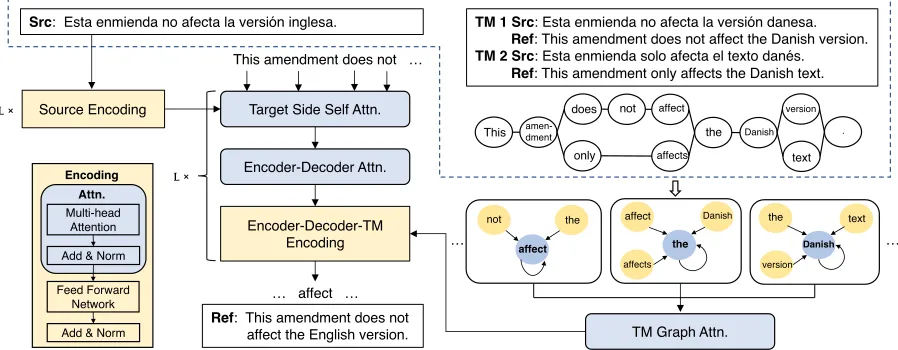
Figure 1: The architecture of the proposed NMT with graph based TM. 1) Graph representation - The part in the dashed box is a concrete example of the graph representation of a TM. The source and target languages are Spanish and English respectively. Src is the source sentence and Ref is the corresponding target sentence. Note that only 2 TM pairs are used in this example for simplicity. 2) Model architecture - The part outside of the dashed box shows the core components of the model architecture. A light blue box consists of a multi-head attention mechanism and a residual connection plus a layer normalization. A light yellow box consists of one more free-forward network and a residual connection plus a layer normalization. Specifically, the graph attention operation is presented with three selected nodes.Lis the number of repetition of each part.
Packing target side
Secondly, instead of sequentially encoding target sentences in a TM, we pack them into a compact graph such that some words in different sentences may correspond to the same node in the graph, which is inspired by the notion of lat-tice or hypergraph in statistical machine translation (Koehn 2009). To this end, we convert the target side in a TM into a confusion network by using the algorithm proposed by Mangu, Brill, and Stolcke (1999) and Mangu, Brill, and Stolcke (2000). The basic idea is to cluster each word into an equivalent class, and organize all the classes according to an order defined over classes. Finally, we can obtain a graph via computing the dual of the confusion network, by treating edges as nodes (West and others 2001).
Figure 1 shows an example of a resulting graph for a TM (including two sentences for simplicity), where each node represents a word. In the graph, the nodes representing the words ”This”, ”amendment”, ”the”, ”Danish”, and ”.” ap-pear in both sentences, but only apap-pear once in the graph. In terms of both space and speed, it is more efficient to encode the graph, compared with the representation of all source and target words of a TM in Gu et al. (2018).
NMT with Graph based TM
Suppose G = (v,e)is the directed graph obtained from a translation memory, where v = hv1,· · ·, v|v|i is a
se-quence of nodes, and e = he1,· · · , e|e|i is a sequence
of edges. In addition, ni = hni
1,· · · , ni|ni|i denotes a se-quence of first-order neighborhood nodes ofvi in graphG including vi itself. Nodes are arranged in topological or-der. For example, as illustrated in Figure 1,v1 = T his,
n1 =hT his, amendmentiandv
2 =amendment,n2 =
hT his, amendment, does, onlyi.
Generally, the enhanced Transformer shares the similar architecture as the baseline but with two major differences in encoding and decoding phases. The model structure is il-lustrated in figure 1.
Enhanced Graph Encoding
Besides encoding the input sequencex, the proposed model also encodesvfromGby usingLlayers of networks in a similar fashion to the encoding of the inputx. SupposehGi,l
denotes the hidden units atlthlayer regarding the nodevi. Inspired by the graph attention in Veliˇckovi´c et al. (2018),
hGi,l is calculated by the hidden units at l −1th layer as follows:
hiG,l =RL◦F◦RL◦MH(hiG,l−1,hG,l−1[ni]) (8) whereRL,F andMH are functions corresponding to sub-layers of residual connection plus layer normalization, feed-forward network and multi-head attention mechanism de-fined in Eq.(2). hG,l−1[ni] is a matrix obtained by taking the slice over the matrixhg,l−1along the first axis viani.
Based on the encoding schema elaborated above, there are different variations of the graph encoding in real practice. We can choose to fix the graph encoding after L layers’ com-putation and introduce the fixed encoding to each decoding layer, which is the same as the encoding of the source sidex. We can also introduce a flexible encoding to each decoding layer, which is calculated as follows:
hGi,l=RL◦MHl(h G,0 i ,h
G,0[ni])
encoding is applied, each decoding layer gets its own unique graph encoding. Besides, the outermost componentsRLand
Fare removed from flexible encoding to reduce complexity. Because the directed graphGroughly records the global order of nodes, which somehow captures the reordering in the original TM, it would be helpful to encode the direc-tional information for translating the inputx. In this paper, we index the nodesvin topological order and integrate addi-tional posiaddi-tional encoding signal before the graph attention similar to the encoding ofxas in the standard Transformer architecture. In detail, the first layer of graph encoding is the sum of the word embedding ofviand position encoding ofi (Vaswani et al. 2017).
Enhanced Decoding
SupposehE,Lis the hidden unit sequence encoded fromx andhG,L is that encoded fromG. As metioned in the last subsection,hG,Lcould be a fixed graph encoding or a flex-ible one. Similar to Transformer, the proposed model em-ploysLlayers of networks in the decoding phase, but each layer includes two additional sub-layers (MH andRL) to incorporatehG,L, besides other six sub-layers. We place the extra two layers nearest to the output of the decoder net-work in order to let the graph encoding fully influence the decoding process. Formally, at thelthlayer in the decoding phase, the hidden unithDi,lis computed fromhDi,l−1,hE,L andhG,Las follows:
hDi,l=RL◦F◦RL◦MH
RL◦
MHRL◦MH(hiD,l−1,hD<i,l+1−1),hE,L,hG,L (10)
This equation Eq.(10) is similar to Eq.(5) except two extra sub-layers includingMH overhG,Land its immediateRL. By applying these additional layers, the model is able to dy-namically extract favorable semantic and syntactic informa-tion from translainforma-tion memory for each time step.
Note that in encodingvi, the sequence ofnionly includes the nodes which are directly adjacent tovi, one might argue that the hidden unithGi,l ignores information far away from the nodevi. Indeed, we tried to resetnito include higher or-der neighbors ofvi, but we did not observe additional gains in translation quality. The possible reason is that the long distance information is captured by the multi-layer structure.
Related Work
This section reviews the mostly related works, according to the following three research lines.
TM based SMT
Many research works are devoted to integrating a translation memory into the statistical machine translation paradigm. For example, Koehn and Senellart (2010) extract bilin-gual segments from a TM which matches the source sen-tence to be translated, and constrain SMT to decode for those unmatched parts of the source sentence. Unlike Koehn and Senellart (2010) employing a heuristic score to decide
whether the extracted segments should be used as decod-ing constraints or not, Ma et al. (2011) design a fine-grained classifier to predict the score for making more reliable deci-sions. In addition, Simard and Isabelle (2009), Wang, Zong, and Su (2013) and Wang, Zong, and Su (2014) add the ex-tracted bilingual segments to the translation table of SMT, and then decode the source sentence with the augmented translation table, which bias the decoder in a soft constraint manner instead of a hard one as in Koehn and Senellart (2010) and Ma et al. (2011).
TM based NMT
Recently, TM based neural machine translation has been witnessed increasing interests. As NMT does not explic-itly rely on the translation rules as SMT, many works resort to different approaches. For example, Li, Zhang, and Zong (2016) and Farajian et al. (2017) make use of a translation memory to fine tune the NMT model which is pre-trained on the entire training corpus in advance, similar to that in Liu et al. (2012) in SMT. As different testing sentences may have different TMs, this approach has to fine-tune the model on-the-fly during testing. In order to avoid the on-on-the-fly tuning, Zhang et al. (2018) define a quantity based on then-gram in TM to directly bias the word selection for NMT. Although this approach is efficient, it can only captures local informa-tion in a hard manner while ignoring the global informainforma-tion in TM, leading to inferior performance to ours. Gu et al. (2018) propose an additional encoder to encode the global information (i.e. the entire sentences) in TM into vectors for all words, and make use of the encoded vectors to decode a target word by an additional attention mechanism. To some extent, our approach is an extension of Gu et al. (2018) in which we pack the sequential TM into a graph, which in-cludes much fewer nodes, leading to a more efficient atten-tion computaatten-tion.
Graph based NMT
There are many works involving graph structures to improve NMT. For instance, Stahlberg et al. (2016) implicitly em-ploys a translation graph (i.e. lattice) generated by SMT by rewarding the words which have high posterior probabilities over the lattice. Meanwhile, Khayrallah et al. (2017) explic-itly use a lattice generated by SMT to constrain the decoding space and rerank to select the best translation from this con-strained lattice. Both approaches obviously differ from ours in that they do not encode the discrete graph into the continu-ous vectors from the point view of neural networks. Ma et al. (2018) and Su et al. (2017) encode a packed parse forest or a word segmentation lattice of a source sentence. However, the focus of our work is oriented to a translation memory instead of a parse tree or word segmentation. Furthermore, we inte-grate the encoded vectors into the strong Transformer, which leads to nontrivial implementations compared with attention operations in recurrent networks.
Experiments
Zhang et al. (2018) with the help of global information from translation memory; and it is more efficient than the model in Gu et al. (2018) in terms of running time and memory consumption mainly because of the compact graph repre-sentation of translation memory.
Settings
Data Preparation Following the previous works investi-gating on incorporating TM into NMT models, we use the JRC-Acquis corpus for training and evaluating our proposed model. The JRC-Acquis corpus is a collection of parallel legislative text of European union Law applicable in the EU member states. The highly related text in the corpus is suit-able for us to make evaluations. To fully explore the effec-tiveness of our proposed model, we conduct translation ex-periments on three language pair bidirectionally, namely, en-fr, en-es, and en-de.
We manage to obtain preprocessed datasets from Gu et al. (2018). For each language pair, we randomly select 3000 samples to form a development and a test set respectively. The rest of the pairs are used as the training set. Sentences longer than 80 and 100 are removed from the training and development/test set. The technique of Byte-pair Encoding (Sennrich, Haddow, and Birch 2016) is applied and the vo-cabulary size is set to be 20K for all the experiments.
Baseline Systems The proposed TM graph based model is built on transformer (Vaswani et al. 2017), and it is denoted byG-TFM. We also propose and implement another simpler TM representation based transformer,SEQ-TFMwhich se-quentially encodes all target sentences in a TM as one of the baseline models. Specifically, each target sentence in TM goes through a multi-head mechanism and an immedi-ate residual connection plus layer normalization inlthlayer, which is calculated as follows:
hlk,i=RL◦MHl(h0k,i,h0k) (11)
wherehl
k,i is theithhidden unit of thekthsentence in the TM;h0
k,iis the word embedding plus positional encoding of
kthsentence in TM. The derived representations for these sentences are then concatenated to form the representation of the translation memoryhS,l, which can be utilized flexi-bly inlthdecoding layer.
Besides, as the proposed model is directly built upon the Transformer architecture, Transformer itself provides a nat-ural baseline, which is referred to asTFMin this paper. In addition, following Zhang et al. (2018) and Gu et al. (2018), we implement two translation memory based systems on top of Transformer for fair comparison and we refer them to P-TFMandSEG-TFM, respectively.1For the broader
com-parison, we reproduce the model (denoted by P-RNN) in
1
Note that due to the architecture divergence between based NMT and Transformer, SEG-TFG differs from the RNN-based counterpart in that two quantitiesctandztin Gu et al. (2018) are replaced by the hidden units obtained from the multi-head at-tention over the encoding units and the decoding hidden state units before the softmax operator.
Word embedding 512
Layers 6
TM dropout 0.6
Other dropout 0.1
Beam size 5
Label smoothing 0.1
Batch size (tokens) 8192
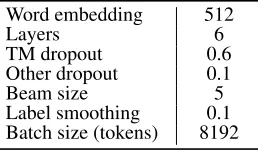
Table 1: Hyper-parameters for training baselines and the proposed model on top of the transformer architecture.
Zhang et al. (2018) on top of our in-house RNNsearch sys-tem (denoted byRNN).2
Training systems For each sentence, we retrieve 100 translation pairs from the training set by using Apache Lucene. We score the source side of each retrieved pair against the source sentence x with fuzzy matching score in Eq. (7) and select topN = 5 translation sentence pairs as a translation memory for the sentencexto be translated. Sentences from the target side in the translation memory are used to form a graph, with each word represented as a node and the connection between adjacent words in a sentence represented as an undirected edge.
For training all systems, we maintain the same hyper-parameters as shown in Table 1 for comparison. Besides, we adopt the same training algorithm to learn the models as follows. We use a customized leaning rate decay paradigm following Tensor2Tensor(Vaswani et al. 2018) package. The learning rate increases linearly on early stages for a certain number of steps, known as warm-up steps, and decay expo-nentially later on. We set the warm-up step to be 5 epochs and we early stop the model after training 20 epochs, typ-ically the time when the development performance varies insignificantly.
Furthermore, since there is a hyperparameter in the sys-tem P-TFM of Zhang et al. (2018) which is sensitive to the specific translation task, we tune it carefully on the develop-ment set for all translation tasks. Its optimized value is 0.7 for es and de tasks while it is 0.8 for fr task.3
Results and analysis on es-en task
Translation accuracy Table 2 shows the experiment re-sults of all the systems on the es-en task in terms of BLEU. Several observations can be made from the results. First, the baseline TFM achieves substantial gains over RNN and even outperforms P-RNN by around 1 BLEU point on the test set. Compared with the strongest baseline P-TFM, the proposed SEQ-TFM and G-TFM are able to obtain some gains up to 1.9 BLEU points on the test set. This result verifies that our
2
We did not reimplement the model in Gu et al. (2018) on top of our in-house RNN, because it was clearly demonstrated in Zhang et al. (2018) that P-RNN works comparable to or even better than Gu et al. (2018) on the same JRC-Acquis corpora as conducted in our experiments.
3
RNN P-RNN TFM P-TFM SEG-TFM SEQ-TFM G-TFM
Dev 57.74 60.87 62.78 63.97 63.16 64.81 66.37
Test 58.06 61.52 62.68 64.30 62.94 65.16 66.21
Table 2: Translation accuracy in terms of BLEU on the es-en task.
TFM SEG-TFM SEQ-TFM G-TFM
Train (s) 4579 44238 21920 8692
Test (s) 0.20 2.68 1.25 0.36
Words (#) 68.28 374.52 214.97 129.18
BLEU 62.68 62.94 65.16 66.21
Table 3: Running time and memory. Training time reports the time in seconds for training one epoch on average, and testing time reports the time in seconds for translating one sentence on average. Words (#) denotes the number of words encoded in the neural models on average.
compact representation of TM is able to guide the decoding of the state-of-the-art model.
Second, it is observed that SEG-TFM is only compara-ble to TFM on this task, although its RNN based counter-part brought significant gains as reported in Gu et al. (2018). This fact shows that the transformer architecture may need a sophisticated way to well define a key-value memory for TM encoding, which can be significantly different from that on RNN architecture. This is beyond the scope of this pa-per. Fortunately, this paper provides an easy yet effective approach to encode a TM, i.e. G-TFM, which does not rely on a context-based key-value memory.
Running time Since the retrieval time can be neglected compared with the decoding time as found in Zhang et al. (2018), we thereby eliminate the retrieval time and directly compare running time for neural models as shown in Table 3. From this table, we observe that the proposed graph based model G-TFM saves significant running time compared with SEG-TFM and SEQ-TFM while achieving better translation performance.
Memory consumption Ideally, the total memory con-sumed by a system is proportional to the size of the com-putational tensor graph. However, it is impossible to ex-actly compare the complexity of the computational graph, because it is dependent on the coding implementation.4As
a result, we roughly evaluate the memory consumption in terms of the number of words encoded by the models, which corresponds to a part of the nodes in the computational graph and can be calculated.
Table 3 depicts the total number of source and target words encoded by the corresponding model for each test sentence on average. It’s observed that SEG-TFM needs to encode approximately 3 times and SEQ-TFM encodes approximately 2 times the number of words of our
pro-4
Different implementation may lead to different computational graphs due to temporary variables.
Similarity Sents Percent TFM P-TFM G-TFM
[0,0.1) 2 0.19% 54.17 68.43 58.22
[0.1,0.2) 138 11.40% 36.08 36.46 37.49 [0.2,0.3) 462 20.76% 44.94 45.99 45.30 [0.3,0.4) 305 14.56% 51.19 51.98 51.75 [0.4,0.5) 272 12.83% 60.72 62.86 62.10
[0.5,0.6) 206 7.82% 66.31 66.41 70.66
[0.6,0.7) 203 7.40% 71.38 73.73 76.17
[0.7,0.8) 188 7.05% 77.48 78.78 83.37
[0.8,0.9) 377 10.90% 83.81 85.52 88.71
[0.9,1) 432 7.09% 87.81 88.02 93.21
[0,1) 2585 100% 62.68 64.30 66.21
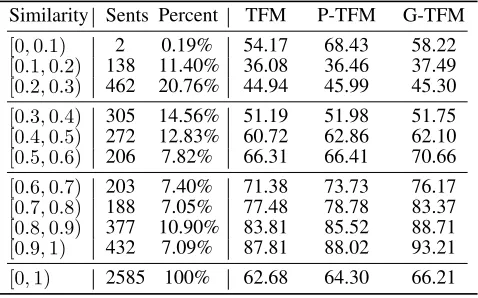
Table 4: Translation quality on es-en task for the divided subsets according to similarity. The averaged similarity for the entire test set is 0.48.
TFM P-TFM G-TFM
BLEU 62.68 65.00 90.25
Table 5: Translation results when adding reference to TM.
posed model, G-TFM. There’s no wonder that TFM takes the fewest words to encode because no extra TM is included. These statistics indicate that under the scenario of incorpo-rating TM in NMT, our model requires the least memory.
Influence on similarity Intuitively, the performance of our proposed model is supposed to vary on the basis of the similarity between the sentences to be translated and the retrieved translation memory. To verify the hypothesis, we divided the test set into bucketed subsets based on the averaged similarity of each sentence in the retrieved trans-lation memory. From the results reported in Table 4, it is observed that the proposed G-TFM outperforms the base-line TF on all bucketed subsets in general. As the similarity score increases, G-TFM leads to more significant ments than those of the baseline TFM. In detail, the improve-ments over TFM are up to 5 BLEU points when similarity is around 0.9; while the improvements are less than 1 BLEU as the similarity score is between 0.2 and 0.3. This fact shows that the translation memory indeed brings improvements of translation quality over all similarity buckets. And the more similar the TM is, the better it will do.
Example Fuzzy Matching Score:0.31, T1 BLEU:0.53, T2 BLEU:0.56, T3 BLEU:0.75
S Dentro de los l´ımites establecidos en el anexo III , se conceder´a un suplemento del pago por superficie de 344,5 euros por hect´area por las superficies sembradas de trigo duro en las zonas tradicionales de producci´on que figuran en la lista del anexo II .
T1 Within the limits laid down in Annex III , a supple-ment to the area paysupple-ment of EUR 344,5 per hectare shall be granted for the areas sown with durum wheat in the traditional production zones listed in Annex II .
R A supplement to the area payment of EUR 344,50 per hectare shall be paid for the area down to durum wheat in the traditional production zones listed in Annex II ,
subject to the limits fixed in Annex III .
T2 Within the limits laid down in Annex III, a supple-ment to the area paysupple-ment of EUR 344,5 per hectare shall be granted for the areas sown to durum wheat in the tra-ditional production zones listed in Annex II .
TMshall be paid for the area down to durum wheat in the traditional production zones listed in Annex X ,subject to the following limits:
T3A supplement to the area payment of EUR 344,5 / ha for the areas down to durum wheat in the traditional produc-tion zones listed in Annex II ,subject to the limits fixed in Annex III.
Table 6: An example of effects on using global information from es-en test set.SandRrespectively denote source and reference sentences,TMshows only one sentence in the given translation memory,T1,T2andT3represent TFM, P-TFM and G-TFM.
BLEU en-fr fr-en en-de de-en en-es
Dev TFM 66.33 65.95 53.32 58.54 60.43
P-TFM 68.90 68.61 55.54 60.10 61.50
G-TFM 69.69 70.65 57.43 61.85 62.50
Test TFM 66.36 66.96 53.29 58.86 60.52
P-TFM 68.73 68.70 55.14 60.26 61.56
G-TFM 69.59 70.87 56.88 61.72 62.76
Table 7: Translation Results on both development and test sets across other 5 translation tasks.
One main reason is that P-TFM is highly sensitive to the value of the reward defined in Zhang et al. (2018), which is determined by the sentence similarity and the hyperparame-ter. To further support this, we add the reference into TM for testing to evaluate the performance of a well-trained existing model. We compare the translation results of P-TFM and G-TFM again. Table 5 shows that the gap between P-G-TFM and G-TFM is substantially enlarged. This result shows that our proposed G-TFM is able to adaptively make use of transla-tion memory. A well-trained existing model can deliver al-most absolutely correct translations when a extremely simi-lar translation memory is available. But for P-TFM, the hy-perparameter previously tuned on the development set is not suitable for the translation task where the TM is very similar to test sentences. In other words, the success of P-TFM also depends on the selection of a development set.
Case study on global information In the example shown in Table 6, it is clear that there is a long distance reorder between the main and subordinate clauses, and the base-line TFM fails to figure out this reorder as the reference. Since the reward score of anyn-gram defined in Zhang et al. (2018) is all the same and irrelevant to its position infor-mation, P-TFM can not encourage to make a long-distance reordering decision. G-TFM succeeds to capture the long distance reordering with positional encoding in this case by learning from the similar pattern contained in the TM, which
indicates that G-TFM indeed is able to utilize the global in-formation in TM.
Results on other tasks
We pick stronger baselines from the es-en task, i.e. TFM and P-TFM, and compare them with the proposed G-TFM model on other 5 translation tasks. Table 7 summarizes their results on both the development and test sets. From this ta-ble, we can see that on the test set, G-TFM steadily outper-forms TFM by up to 3 BLEU points across all these 5 tasks, In addition, contrast to P-TFM, G-TFM demonstrates better performance by exceeding at least 1 BLEU point across all these tasks except the en-fr task. These results are consistent with the results on es-en task and further validates the effec-tiveness of integrating graph-based translation memory into the Transformer model.
Conclusion
We have proposed an approach to augmenting the neural machine translation by a translation memory. The proposed approach firstly packs the translation memory into a com-pact graph, where each node may correspond to multiple words for different sentences in a TM, and then it encodes the packed graph into a deep representation during the de-coding phase. The proposed approach is able to make use of the global information from TM and is also efficient enough even if the size of TM increases. Extensive experiments on six tasks with three language pairs show that the proposed approach is effective when compared with the strong base-line Transformer: it not only gains over the basebase-line with a large margin, but also consistently outperforms the ap-proaches in Zhang et al. (2018) and Gu et al. (2018).
Acknowledgments
References
Bahdanau, D.; Cho, K.; and Bengio, Y. 2014. Neural ma-chine translation by jointly learning to align and translate.
arXiv preprint arXiv:1409.0473.
Farajian, M. A.; Turchi, M.; Negri, M.; and Federico, M. 2017. Multi-domain neural machine translation through un-supervised adaptation. InProceedings of the Second Con-ference on Machine Translation, 127–137.
Gu, J.; Wang, Y.; Cho, K.; and Li, V. O. K. 2018. Search engine guided neural machine translation. InProceedings of the Thirty-Second AAAI Conference on Artificial Intelli-gence, New Orleans, Louisiana, USA, February 2-7, 2018. Khayrallah, H.; Kumar, G.; Duh, K.; Post, M.; and Koehn, P. 2017. Neural lattice search for domain adaptation in ma-chine translation. InProceedings of the Eighth International Joint Conference on Natural Language Processing (Volume 2: Short Papers), volume 2, 20–25.
Koehn, P., and Senellart, J. 2010. Convergence of translation memory and statistical machine translation. InProceedings of AMTA Workshop on MT Research and the Translation In-dustry, 21–31.
Koehn, P. 2009.Statistical machine translation. Cambridge University Press.
Li, X.; Zhang, J.; and Zong, C. 2016. One sentence one model for neural machine translation. arXiv preprint arXiv:1609.06490.
Liu, L.; Cao, H.; Watanabe, T.; Zhao, T.; Yu, M.; and Zhu, C. 2012. Locally training the log-linear model for smt. In Proceedings of the 2012 Joint Conference on Empiri-cal Methods in Natural Language Processing and Compu-tational Natural Language Learning, 402–411. Association for Computational Linguistics.
Ma, Y.; He, Y.; Way, A.; and van Genabith, J. 2011. Consis-tent translation using discriminative learning: a translation memory-inspired approach. InProceedings of the 49th An-nual Meeting of the Association for Computational Linguis-tics: Human Language Technologies-Volume 1, 1239–1248. Association for Computational Linguistics.
Ma, C.; Tamura, A.; Utiyama, M.; Zhao, T.; and Sumita, E. 2018. Forest-based neural machine translation. In Proceed-ings of ACL.
Mangu, L.; Brill, E.; and Stolcke, A. 1999. Finding consen-sus among words: Lattice-based word error minimization. In
Sixth European Conference on Speech Communication and Technology.
Mangu, L.; Brill, E.; and Stolcke, A. 2000. Finding con-sensus in speech recognition: word error minimization and other applications of confusion networks.Computer Speech & Language14(4):373–400.
Robinson, D. 2012.Becoming a translator: An introduction to the theory and practice of translation. Routledge. Sennrich, R.; Haddow, B.; and Birch, A. 2016. Neural ma-chine translation of rare words with subword units. In Pro-ceedings of the 54th Annual Meeting of the Association for Computational Linguistics (Volume 1: Long Papers), 1715–
1725. Berlin, Germany: Association for Computational Lin-guistics.
Simard, M., and Isabelle, P. 2009. Phrase-based machine translation in a computer-assisted translation environment.
Proceedings of the Twelfth Machine Translation Summit (MT Summit XII)120–127.
Stahlberg, F.; Hasler, E.; Waite, A.; and Byrne, B. 2016. Syntactically guided neural machine translation. In Proceed-ings of the 54th Annual Meeting of the Association for Com-putational Linguistics (Volume 2: Short Papers), 299–305. Berlin, Germany: Association for Computational Linguis-tics.
Su, J.; Tan, Z.; Xiong, D.; Ji, R.; Shi, X.; and Liu, Y. 2017. Lattice-based recurrent neural network encoders for neural machine translation. InProceedings of the Thirty-First AAAI Conference on Artificial Intelligence, February 4-9, 2017, San Francisco, California, USA., 3302–3308.
Vaswani, A.; Shazeer, N.; Parmar, N.; Uszkoreit, J.; Jones, L.; Gomez, A. N.; Kaiser, Ł.; and Polosukhin, I. 2017. At-tention is all you need. InAdvances in Neural Information Processing Systems, 6000–6010.
Vaswani, A.; Bengio, S.; Brevdo, E.; Chollet, F.; Gomez, A. N.; Gouws, S.; Jones, L.; Kaiser, Ł.; Kalchbrenner, N.; Parmar, N.; et al. 2018. Tensor2tensor for neural machine translation.arXiv preprint arXiv:1803.07416.
Veliˇckovi´c, P.; Cucurull, G.; Casanova, A.; Romero, A.; Li`o, P.; and Bengio, Y. 2018. Graph attention networks. In Pro-ceedings of ICLR.
Wang, K.; Zong, C.; and Su, K.-Y. 2013. Integrating trans-lation memory into phrase-based machine transtrans-lation during decoding. InProceedings of the 51st Annual Meeting of the Association for Computational Linguistics (Volume 1: Long Papers), volume 1, 11–21.
Wang, K.; Zong, C.; and Su, K.-Y. 2014. Dynamically inte-grating cross-domain translation memory into phrase-based machine translation during decoding. In Proceedings of COLING 2014, the 25th International Conference on Com-putational Linguistics: Technical Papers, 398–408.
West, D. B., et al. 2001. Introduction to graph theory, vol-ume 2. Prentice hall Upper Saddle River.