BOLTON BUSINESS SCHOOL
Performance
Management
within the NHS
Dissertation submitted in part fulfilment of the Master of Business Administration
ACKNOWLEDGEMENTS
The author would like to thank…
Family and friends, for their continuous support and for putting up with changeable moods - particularly, close to submission time
Dr Peter Moran, Dr Mustafa Rashid and Martin McAreavey, for their guidance and support throughout my learning experience at the university
Colleagues in the Electronics & Biomedical Engineering Department for their understanding over the last three years
The dedicated staff at East Lancashire Hospitals NHS Trust, who provide exceptional care for the local community and rarely receive the appropriate praise.
‘The ultimate goal is to manage quality. But you cannot manage it until you have a way to measure it, and you cannot measure it until you can monitor it’”
TABLE OF CONTENTS
Acknowledgements ... I Table of Contents ... II Table of Figures... VI Abstract ... VII
Chapter 1: Introduction ... 2
1.1: Background ... 2
1.2: Area of investigation ... 3
Research scope ... 3
Research question and objectives... 5
Chapter 2: Literature Review ... 7
Introduction ... 7
2.1: The concept of performance... 8
NHS performance - quality healthcare ... 9
Section summary... 11
2.2: Measuring performance ... 12
The CQC performance framework ... 13
CQC’s PM method and processes: ... 14
2.3: Modelling performance ... 15
Mapping the A&E department ... 15
An open systems perspective ... 18
Open systems themes and components ... 19
2.4: Conceptual framework ... 24
Constructing the framework ... 24
Chapter 3: Research Methodology ... 28
Introduction ... 28
3.1: Research philosophy ... 29
A critical realism philosophy for this study ... 31
3.2. Research approach, strategy and design ... 33
Research approach ... 33
Mixed methods strategy ... 33
Research design ... 34
3.3 Data collection ... 35
Self-completion questionnaire (SCQ) ... 35
Semi-structured interviews (SSI) ... 36
Secondary data analysis (SDA)... 37
Sampling ... 38
3.4 Data analysis ... 41
Chapter 4: Findings and Analysis ... 44
Participant demographics ... 44
4.1: Factor 1 - Vision, mission and values: ... 47
Factor 1: SCQ results ... 47
Factor 1: SDA ... 48
Factor 1: SSI feedback ... 48
Factor 1: Discussion ... 49
4.2: Factor 2 - Leadership and culture ... 50
Factor 2: SCQ results ... 50
Factor 2: SDA ... 51
Factor 2: SSI feedback ... 51
Factor 2: Discussion ... 52
4.3: Factor 3 - Work environment, management and control systems ... 53
Factor 3: SQC results ... 53
Factor 3: SDA ... 54
Factor 3: SSI feedback ... 54
4.1: Factor 4 - Human resource management ... 58
Factor 4: SCQ results ... 58
Factor 4: SDA ... 59
Factor 4: SSI feedback ... 61
Factor 4: Discussion ... 63
4.5: Factor 5 - External/environmental influences ... 65
Factor 5: SCQ results ... 65
Factor 5: SDA ... 66
Factor 5: SSI feedback ... 70
Factor 5: Discussion ... 71
Chapter summary ... 73
Chapter 5: Conclusion ... 75
Objective 1: ... 75
Objective 2: ... 76
Factor 1: Vision, mission and values ... 76
Factor 2: leadership and culture ... 76
Factor 3: Work environment and management systems ... 77
Factor 4: Human resource management ... 78
Factor 5: External/environmental influences ... 79
Areas for further research ... 79
Senior managers on-call ... 79
Introducing coefficients ... 80
Final thoughts ... 81
Chapter 6: Recommendations ... 83
Chapter 7: Appendices ... 89
Appendix 1: Four prevalent models of organisational effectiveness ... 89
Appendix 2: Three examples of open systems models ... 91
Appendix 3: The Honeycomb methodology of research expanded ... 97
Appendix 4: Self-completion questionnaire (transcript from online survey) ... 98
Chapter 8: Bibliography ... 103
Part 2 of the Dissertation ... 124
Introduction ... 125
Structure of this reflective summary ... 125
Stage 1: Focus on meta-abilities ... 126
Personal skills developed ... 126
Stage 2: Personal transition ... 129
The role of the learning set ... 129
Constraints in the workplace ... 129
Stage 3: Focussed transition ... 130
Auto-critique of the methods used ... 130
Stage 4: Organisational relevance ... 131
Auto-critique of the conceptual framework ... 131
End of Part 2 ... 133
TABLE OF FIGURES
Figure 1: Methodical review of the literature ... 7
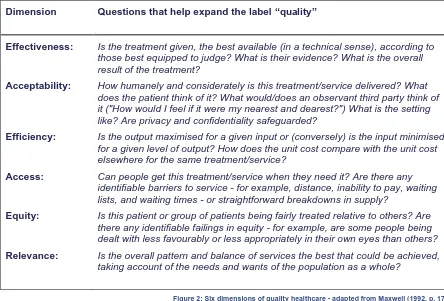
Figure 2: Six dimensions of quality healthcare - adapted from Maxwell (1992, p. 171) ... 9
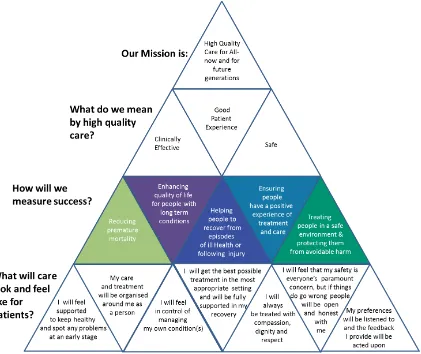
Figure 3: Dimensions of quality healthcare (NHS England, 2016) ... 10
Figure 4: ‘10-dimension of SERVQUAL’ - adapted from Zeithaml, et al. (1990, pp. 21-22) ... 11
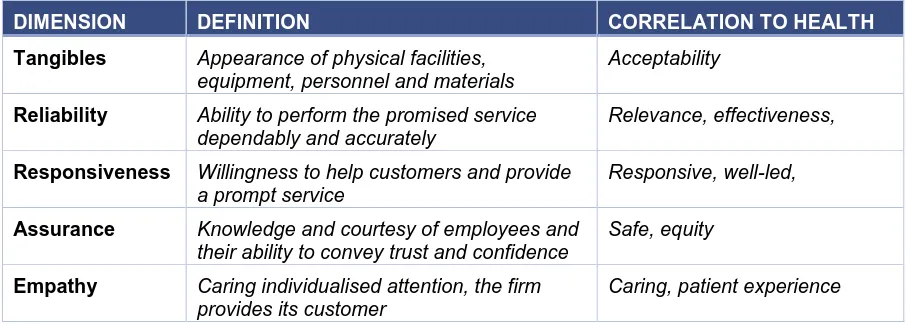
Figure 5: ‘5-dimensions of SERVQUAL’ with links to health (Zeithaml, et al., 1990, p. 26) ... 11
Figure 6: CQC's questions and dimensions (2015, p. 8) ... 13
Figure 7: CQC's performance regulation model ... 14
Figure 8: Comparing models of OE - adapted from Martz (2013, pp. 394-395) ... 17
Figure 9: ‘Open systems perspective’ - adapted from Burke & Litwin (1992) ... 18
Figure 10: Assumptions of open systems - adapted from Cawsey, et al. (2015) ... 18
Figure 11: Analysis of three ‘open systems’ models and the CQC framework ... 23
Figure 12: An outline for A&E performance management CF ... 24
Figure 13: The conceptual framework ... 25
Figure 14: ‘The Honeycomb of Research Methodology’ - adapted from Wilson (2014) ... 28
Figure 15: Comparing research philosophies adapted from Saunders, et al. (2009) ... 29
Figure 16: Purpose of questionnaires ... 35
Figure 17: Scaling methods used - adapted from Ekinci (2015, p. 52) ... 35
Figure 18: Comparative analysis of questionnaires - adapted from Ekinci (2015, p. 16) ... 37
Figure 19: Sampling techniques - adapted from Malhotra and Birks (2006, p. 374) ... 38
Figure 20: Sampling process - adapted from Malhotra and Birks (2006, p. 358) ... 39
Figure 21: Comparative analysis of data collection methods ... 40
Figure 22: Reliability and validity ... 41
Figure 23: Outline implementation programme... 87
Figure 24: 'Six box model' adapted from Weisbord (1976) ... 91
Figure 25: Diagnostic approach of 'six box model - adapted from Weisbord (1976) ... 92
Figure 26: Congruence Model - adapted from Nadler et al. (1982, p. 44) ... 93
Figure 27: Congruence Model explained - adapted from Nadler, et al. (1982, pp. 39-41) ... 94
Figure 28: Causal Model - adapted from Burke and Litwin (1992, p. 528) ... 95
Figure 29: Factors of the Causal Model - adapted from Burke & Litwin (1992) ... 96
Figure 30: The Honeycomb expanded - adapted from Wilson (2014) ... 97
Figure 31: Definition of reflective practice - adapted from Fook, et al (2006, p. 12) ... 125
Figure 32: Four stages of personal development for managers (Atkinson, 1999)... 125
Figure 33: Focus on meta-abilities - adapted from Atkinson ... 126
Figure 34: Explanation of cognitive skills ... 127
ABSTRACT
Summary: A performance measurement (PM) system should exemplify an organisation’s activities, so it can learn and adapt based on its
assessment (Otley, 1999; Adler, 2011; Agostino & Arnaboldi, 2012).
This paper investigates ‘to what extent NHS performance can be measured’ in the confines of the Accident and Emergency (A&E)
department, at East Lancashire Hospitals NHS Trust.
The NHS constitution stipulates ‘95% of patients should be seen and discharged within 4-hours’; hence, this is widely regarded as the ‘key metric’ of A&E performance (The King's Fund, 2016; NHS England,
2013).Since 2013, performance across all areas of health and social
care in England, is externally regulated by the Care Quality Commission
(CQC, 2015).
In 2015/16 ELHT’s emergency services treated over 185,000 patients,
placing it in the top-twenty busiest units in the country. Unfortunately, its
4-hour target for the same period was 92.5% and its emergency services were classified as ‘requiring improvement’ by the CQC (HSCIC, 2016;
CQC, 2014).
Literature relating to performance was critically reviewed, alongside theories of organisational effectiveness (OE). The CQC’s performance
regulatory framework was appraised against theoretical models and considered to support PM from an ‘internal process’ perspective (of OE). Conversely, A&E was deemed to align with an ‘open systems’ model i.e.
its individuals, groups, processes and interactions are interconnected
with the rest of the hospital and the external environment (Stacey &
Mowles, 2016).
After evaluating various models of ‘open systems’, key components of
A&E performance were aggregated and conceptualised into an
appropriate framework. Subsequently, research was undertaken in the
Methods used: A critical realist research philosophy was applied to a case study design, which incorporated self-completion questionnaires,
semi-structured interviews and secondary data collection methods.
Findings: Research identified some good practices, particularly in relation to A&E’s internal processes i.e. policies and procedures. Other areas
included improvements in competency training and medical device technologies. Staff’s professionalism and sense of purpose to
providing exceptional care was also very strong.
This mood was offset by a sense of disengagement from the
organisation that echoed through the factors of the conceptual
framework, leading to the following recommendations:
Reinforce vision and values to A&E staff
Create a bespoke A&E mission statement
Review A&E leadership structure and training programme
Budget training for senior A&E clinical staff
Roll-out of e-Rostering training
Update of job descriptions against workplace demands
Review of appraisal process
Upgrade of IT systems
An area for further research was uncovered relating to producing a standardised ‘A&E coefficient’, which captures all elements of open
systems performance, allowing fair comparison for A&E
departments across the country.
Introducing some context and scope for this study
Chapter 1 - introduction
CHAPTER 1: INTRODUCTION
1.1: BACKGROUND
The National Health Service (NHS) was inaugurated in 1948, by Aneurin Bevan - its
foundations solidified on three core principles:
that it meet the needs of everyone
that it be free at the point of delivery
that it be based on clinical need, not the ability to pay
(GOV.UK, 2015)
Throughout its evolution, these principles - albeit extended and revised to form the ‘NHS Constitution’ - are still representative of its raison d'être; though, arguably, the
benevolent philosophies by which the service was founded, are now overshadowed
by accounts of hardship, threats of privatisation and performance management.
Despite recurrent “rollercoaster rides of reforms” (Ham, 2014, p. 8), the recent climate
of adverse financial and clinical depiction, could be the worse faced by the institution
in its (near) 70-year history.
At present, 79% of NHS Trusts are in the red, with an overall deficit of £2.3bn expected
by 2015/16 fiscal yearend (Nuffield Trust, 2015; NHE, 2016). These woes are heightened, due to a £20bn ‘cost efficiency savings’ target, set by the government for 2012 to 216 (Hurst & Williams, 2012). It would be safe to assume that simply ‘pumping’
more money into the NHS, is not an option; ‘doing more with less’ is the new modus
operandi.
Financial indicators alone, should not be a representation of overall performance (Waggoner, et al., 1999). Nonetheless, recent reports on ‘failings at Mid-Staffordshire NHS Trust’ and ‘persistent outliers of high mortality rates’ respectively, have propelled
adverse clinical performance into the media and into public awareness (Francis, 2013;
Keogh, 2013).
Consequently, performance in the NHS can be highly-emotive, with the potential to
polarise opinions and whether-or-not it meets the needs of everyone, is now the
Chapter 1 - introduction
1.2: AREA OF INVESTIGATION
RESEARCH SCOPE
Since the ‘new public sector’ era of the 1990’s, ‘high accountability’ and ‘cost efficiencies’, are benchmarks set by central government to improve NHS performance and better justify taxpayer’s contributions (Brignall & Modell, 2000).
It is widely accepted that performance management and quality improvement are
heavily interlinked (Beitsch, 2015). Evaluating performance involves “comparing a performance to a standard”; and setting this standard, in turn, involves setting one or
more “cut scores”, by which “performance is judged” (Stufflebeam & Coryn, 2014, p.
18). Likewise, performance management systems should be an embodiment of an organisation’s activities; helping to plan, coordinate and offer indications for corrective
action if necessary (Adler, 2011).
The aftermath of these publicised inquiries has undoubtedly caused NHS performance reporting to become more ‘open and transparent’. From 2013, performance across all
areas of health and social care in England, is externally regulated by the Care Quality
Commission (CQC) - who have introduced their own assessment framework (CQC, 2015). Nowadays, NHS Trusts display their respective ‘CQC ratings’ on their
promotional literature and websites alike - accentuating accordingly, depending on
classification (CQC, 2016).
About A&E
For this study, focus tapers down to the services of an ‘Accident and Emergency’
(A&E) department, which is considered by central government to be a critical
performance indicator (NHS England, 2016).
A&E departments are responsible for facilitating ’24-7’ emergency care for acutely ill
patients (Department of Health, 2013). When patients are unable to gain access into
A&E and equally, gain access to a hospital bed after leaving A&E (i.e. patient flow),
overcrowding occurs - the terms ‘access block’ and ‘exit block’ describe these
conditions respectively (RCEM, 2014). Not only is the general quality of care and
patient dignity effected by overcrowding, mortality rates also rise (Silvester, et al.,
Chapter 1 - introduction
Long waiting times compromise patient safety and reduce ‘clinical effectiveness’ of care (NHS England, 2013). The NHS constitution’s operational standard, stipulates ‘95% of patients should be seen and discharged within 4-hours’; hence, this is widely
regarded as the ‘key metric’ of A&E performance (The King's Fund, 2016; NHS
England, 2013). Nationally collated statistics, report 19.6million people attended A&E
in 2014/15, (an increase of 6% from the previous year); trended data since 2002/3
implies the persistently breached, 4-hour target is in steady decline (NHS England,
2015; HSCIC, 2016).
Research setting
This investigation focussed exclusively on the A&E department at East Lancashire Hospitals NHS Trust (ELHT). In the absence of a ‘standard NHS effectiveness model’,
a selection of academic theories and perspectives were critically evaluated to explore
the elemental factors of performance, before a model for A&E was conceptualised.
The CQC’s regulatory framework, was then comparatively analysed against these
factors, with the intention of ascertaining if all contributing elements of performance
were captured; and if there were areas for improvement and/or further research
About ELHT
East Lancashire Hospitals NHS Trust (ELHT) was established in 2003, when ‘Burnley Healthcare’ and ‘Blackburn, Hyndburn and Ribble Valley’ Trusts integrated their
respective services. The Trust employs over 7000 staff and is a specialist centre for
Hepatobiliary, Head and Neck and Urological Cancer services. It also offers specialist Cardiology services and is a network provider of ‘Level 3’ Neonatal Intensive Care
(BAPM, 2014; ELHT, 2012). Its key commitment is to deliver high quality, ‘safe, personal and effective’ healthcare to the residents of East Lancashire and Blackburn
with Darwen, which have a shared population of around 530,000 (ELHT, 2012).
Since November 2010, ‘major illness and injury’ emergency care is delivered at Royal Blackburn Hospital’s A&E department and ‘minor illness and injury’ shared across
Urgent Care Centres (UCCs) at Blackburn, Burnley and Accrington (ELHT, 2011). In
2015/16 its emergency services treated over 185,000 patients, placing it in the
top-twenty busiest units in the country. Unfortunately, its 4-hour target for the same period was 92.5% and its emergency services were classified as ‘requiring improvement’ by
Chapter 1 - introduction
About the author
The author is a professionally registered Healthcare Scientist, working in the Clinical
Engineering field (The RCT, 2016; Health Education England, 2016). As department
head, duties involve providing leadership and strategic direction in the field of medical
device management to ELHT; communicating regularly with a range of stakeholders
to offer support on all matters relating to medical equipment.
Joining the Trust in 1995 as an Engineer, the author has extensive experience of the
acute NHS hospital environment.
This study was undertaken over a six-month period, with a bilateral purpose. Coinciding with the pre-requisite of completing an Executive MBA, was the author’s
ambition to make a difference at ELHT, by applying these newly acquired skills onto a
problematic, real-life situation.
RESEARCH QUESTION AND OBJECTIVES
As suggested by Johnson and Harris (2003), the commencement of research in any
field starts with a question or problem that in turn underpins philosophies, direction
and choices. In this particular instance, it asks:
To facilitate research, the following objectives were applied:
“To what extent can we measure A&E performance?”
1. Critically evaluate academic models of ‘organisational effectiveness’ and
‘performance measurement’ - identifying linkages and key components,
which contribute towards A&E performance measurement
2. Rigorously analyse whether ELHT, the CQC regulatory framework and
4-hour national targets account for all these contributing factors when
Appraising various different sources of information, and conceptualising to gain an understanding of the subject matter
Chapter 2 - literature review
CHAPTER 2: LITERATURE REVIEW
INTRODUCTION
Given the impassioned undertones of the subject and its importance to the author,
conducting a comprehensive literature review to ascertain ‘proof-of-knowledge’ into
the problem is the heart-line of this paper (Randolph, 2009). Condensing a
multi-faceted topic such as A&E performance is challenging. Therefore, by sequentially
directing channels of enquiry, the author will seek to gain methodological insight into
demarcating the research problem (Cooper, 1988; Gall, et al., 2006):
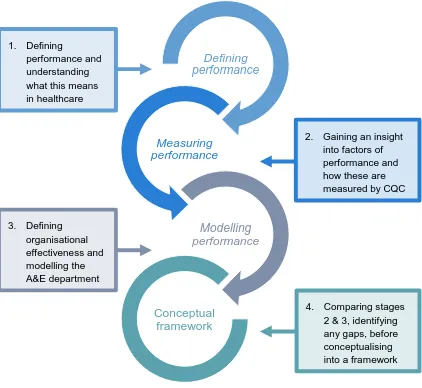
Figure 1: Methodical review of the literature Defining
performance
Measuring performance
Modelling performance
Conceptual framework
1. Defining
performance and understanding what this means in healthcare
2. Gaining an insight into factors of performance and how these are measured by CQC
3. Defining organisational effectiveness and modelling the A&E department
Chapter 2 - literature review
2.1: THE CONCEPT OF PERFORMANCE
The term ‘performance’ is recognised as being indistinct and without simplified
definition (Otley, 1999). Nevertheless, the idea of performance measurement and
subsequent management, are essential components accepted by organisations worldwide (Hoque, 2010; Salem, 2003). The challenge facing today’s managers is
maintaining optimum performance in an ever-changing workplace and global economy
(Al-Khouri, 2010). In response, academics and theorists have assembled a plethora
of tools to evaluate organisational performance (Martz, 2013). The 1990’s saw an
upsurge in the topic; especially its linkages to embedding corporate strategy
throughout an organisation (Neely, 1999; Kaplan & Norton, 1996; Labovitz &
Rozansky, 1997; Bourne, et al., 2000; Adler, 2011). As per many private-sector firms,
the NHS was also awakening to such ideologies - as analysing key metrics would
provide evidence for decision-makers to enhance quality of care and public
accountability (Gallani, et al., 2015; Strome, 2013). Similarly, Patel, et al. (2006), state
PM systems assist under-pressure NHS managers to maintain effective levels of
performance, whilst juggling limited staff and resources.
If an organisation’s ‘effectiveness’ (or ‘dynamism’), is regarded as a conduit for
success, sustainability and ultimately, survival (Verma, 2012; Iwu, et al., 2015) - then
performance measurement becomes its gauge, representing the achievement of
organisational tasks against predetermined standards (Wadongo & Abdel-Kader,
2014). Folan and Browne (2005), expand this to propose organisational performance
as being the relationship between performance measuring (PM), by means of
performance indicators (PIs) or metrics, within a performance measurement
framework (PMF); all of which, is fundamental for businesses to improve processes,
capabilities and profitability. When two or more PM frameworks are combined - one structural, one procedural - a ‘performance measurement system’ (PMS) is formed,
which customarily utilises software, databases and valid procedures to facilitate clear
and accurate PM (Lohman, et al., 2004).
Conversely, Ferreira and Otley (2009), argue the complexities of PM - when simplified
into a strategically misaligned system - causes conflicting results and ambiguity. In healthcare, this is supported by Patel, et al. (2006), who claim ‘lack of knowledge’ on
such systems by administrating managers, and ‘lack of causal effect’ between
Chapter 2 - literature review
NHS PERFORMANCE - QUALITY HEALTHCARE
Regardless of the specific type of PM system an organisation adopts to evaluate its
success, it is imperative that its critical components are setting ‘key performance measures’ and appropriate ‘targets’ that are derived from organisational objectives
(Otley, 1999; Stringer, 2007).
For NHS performance, the overarching element of any PM system, is to safeguard the
delivery of cost-effective, ‘quality healthcare’ (NHS England, 2016), which becomes
heightened in an increasingly complex, public milieu (OECD, 2010).
When asked about specifying quality, Thomas Pyzdek (1990), suggested, even
proclaimed experts in this field could not agree upon a standard definition. A significant
shift in healthcare occurred since the 1980s, where terms and standards of quality
previously defined by caregivers, gave way to a more ‘patient-centred’ characterisation
(Carey & Lloyd, 2001).
Maxwell (1984; 1992), stresses the importance of adopting a multi-dimensional
approach to quality of care, identifying six dimensions:
Dimension Questions that help expand the label “quality”
Effectiveness: Is the treatment given, the best available (in a technical sense), according to those best equipped to judge? What is their evidence? What is the overall result of the treatment?
Acceptability: How humanely and considerately is this treatment/service delivered? What does the patient think of it? What would/does an observant third party think of it ("How would I feel if it were my nearest and dearest?") What is the setting like? Are privacy and confidentiality safeguarded?
Efficiency: Is the output maximised for a given input or (conversely) is the input minimised for a given level of output? How does the unit cost compare with the unit cost elsewhere for the same treatment/service?
Access: Can people get this treatment/service when they need it? Are there any identifiable barriers to service - for example, distance, inability to pay, waiting lists, and waiting times - or straightforward breakdowns in supply?
Equity: Is this patient or group of patients being fairly treated relative to others? Are there any identifiable failings in equity - for example, are some people being dealt with less favourably or less appropriately in their own eyes than others?
Relevance: Is the overall pattern and balance of services the best that could be achieved, taking account of the needs and wants of the population as a whole?
Chapter 2 - literature review
Both the CQC and NHS refer to quality care as combining ‘safe, effective, caring,
responsive and well-led’, with a ‘good patient experience’ (CQC, 2016). Singh and
Singh (2014), infer quality healthcare as being a ‘total, systematic characteristic’. They
continue in a similar vein to Maxwell, the NHS and CQC, but imply eight dimensions
make up their system - adding ‘equity’ and ‘continuity-of-care’ into the mix.
Figure 3, illustrates a culmination of these dimensions, which was created in
partnership with Clinical Directors and Care Commissioners, and encapsulates the modern NHS’ mission; its ‘definitions of quality’; and how its ‘success will be measured’
- all of which, should transpose across every NHS establishment in England (NHS
England, 2016).
Figure 3: Dimensions of quality healthcare (NHS England, 2016)
These dimensions allow care providers to be suitably incentivised and equally, allows
access to formal performance assessments of care - a belief internationally supported
by umbrella organisations like the World Health Organisation (WHO) and Organisation
Chapter 2 - literature review
The message is very similar in the commercial world too; as categorised by Zeithaml,
et al. (1990) - who originally constituted ‘service quality’ (within their ‘SERVQUAL’
framework), as having ten dimensions; before fine-tuning these to just five. Although
indicators appear to be related, Cook and Faberowski (2004, p. 743), argue industrial
techniques for quality management, when applied to healthcare, have been “somewhat elusive”.
DIMENSION DEFINITION
Tangibles Appearance of physical facilities, equipment, personnel and materials
Reliability Ability to perform the promised service dependably and accurately
Responsiveness Willingness to help customers and provide a prompt service
Competence Possession of the required skills and knowledge to perform the service
Courtesy Politeness, respect, consideration and friendliness of service personnel
Credibility Trustworthiness, believability, honesty of the service provider
Security Freedom from danger, risk, or doubt
Access Approachability and ease of contact
Communication Keeping customers informed in language the can understand and listening
Understanding Making the effort to know customers and their needs
Figure 4: ‘10-dimension of SERVQUAL’ - adapted from Zeithaml, et al. (1990, pp. 21-22)
DIMENSION DEFINITION CORRELATION TO HEALTH
Tangibles Appearance of physical facilities, equipment, personnel and materials
Acceptability
Reliability Ability to perform the promised service dependably and accurately
Relevance, effectiveness,
Responsiveness Willingness to help customers and provide a prompt service
Responsive, well-led,
Assurance Knowledge and courtesy of employees and their ability to convey trust and confidence
Safe, equity
Empathy Caring individualised attention, the firm provides its customer
Caring, patient experience
Figure 5: ‘5-dimensions of SERVQUAL’ with links to health (Zeithaml, et al., 1990, p. 26)
SECTION SUMMARY
With an outline of performance and evident dimensions of quality healthcare
established, the next stage is to explore how NHS performance is regulated by the
Chapter 2 - literature review
2.2: MEASURING PERFORMANCE
The principal function of performance measurement (PM), is to support
decision-making by timely delivery of dependable information - strategic PM relates to an organisation’s long-term vison; and operational, or applied PM covers departments,
processes, teams, and individuals (Ukko, et al., 2007). Although there are contrasting
opinions on embedding performance measurement systems (PMS) into an
organisation, particularly surrounding culture and leadership (i.e. does the PMS affect
the style of management and the individual, or vice versa) - the general consensus is: PMS’ are pivotal in aligning strategic and operational objectives to the behaviour and
attitudes of individuals - then changing these accordingly (Neely, et al., 1997; Martinez,
2005; Ukko, et al., 2007). Thus, underlining the value of adopting and correctly implementing the ‘best-fit’ PMS to ensure data is turned into useful and useable
information (Evans, 2004).
The Balanced Scorecard
Kaplan and Norton propose “what you measure is what you get”. They also posit the view that ‘measurement’ has been a central function of ‘management’ since the early
20th century - when Frederick Taylor’s conception of ‘Scientific Management’, studied ‘optimum time versus output’ capacity of workers (Kaplan & Norton, 1992, p. 71; 2003). Their ‘Balanced Scorecard’ (BSC) approach, validates performance, by means of
asking four essential questions, via four perspectives (Kaplan & Norton, 1992). The
popularity of the BSC is widespread; with industry, businesses, governments, and
(until the CQC) the NHS embracing it as both a strategic planning tool and PMS
(Grigoroudis, et al., 2012; NHS Institute for Improvement and Innovation, 2013).
Opponents argue the BSC is conceptually and practically flawed i.e. the design of its
indicators (perspectives) are too broad, not universally relevant, and (because of no
measuring units) lacking control - which effectively, represent key mechanisms for
managers and PM (Awadallah & Allam, 2015; Kopecka, 2015; Neely, et al., 2008).
This sentiment is echoed in healthcare by Patel, et al. (2006), who also debate a lack
of publications and guidance - either academically or from the government - on
causality between perspectives, makes it difficult to apply the BSC to the NHS’
Chapter 2 - literature review
THE CQC PERFORMANCE FRAMEWORK
Since 2013, the CQC’s PM framework has replaced the BSC as the NHS’ overarching
PMS. In the absence of academic critique, the author alludes to its analogous approach to the BSC’s ‘setting of perspectives’ and ‘asking relevant questions’ within
these perspectives (CQC, 2016). The major difference being, the CQC’s PM
framework is crafted singularly for regulating the quality of health and social care. Their
literature suggests:
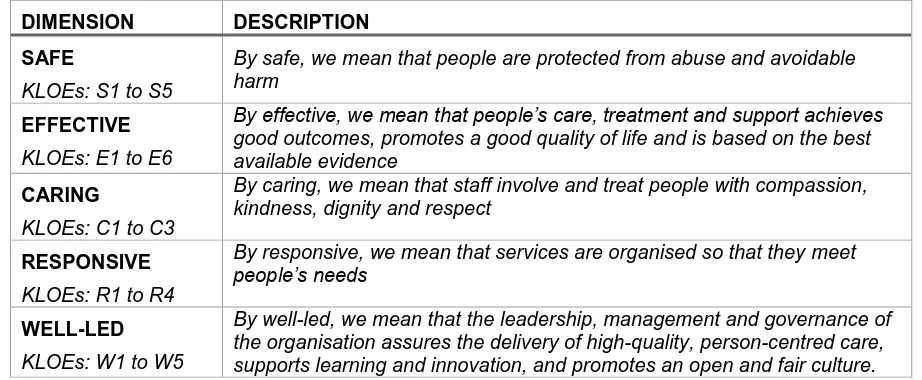
Formulation of ‘ratings’ are accomplished using ‘intelligent monitoring’ (CQC, 2015),
based on the following dimensions:
DIMENSION DESCRIPTION
SAFE
KLOEs: S1 to S5
By safe, we mean that people are protected from abuse and avoidable harm
EFFECTIVE
KLOEs: E1 to E6
By effective, we mean that people’s care, treatment and support achieves good outcomes, promotes a good quality of life and is based on the best available evidence
CARING
KLOEs: C1 to C3
By caring, we mean that staff involve and treat people with compassion, kindness, dignity and respect
RESPONSIVE
KLOEs: R1 to R4
By responsive, we mean that services are organised so that they meet people’s needs
WELL-LED
KLOEs: W1 to W5
By well-led, we mean that the leadership, management and governance of the organisation assures the delivery of high-quality, person-centred care, supports learning and innovation, and promotes an open and fair culture.
Figure 6: CQC's questions and dimensions (2015, p. 8) Within each dimension, there are a subset of pertinent questions, or ‘key lines of enquiry’ (KLOE), specific to individual areas of an acute NHS Trust; these are
representative of its PM (CQC, 2015, p. appendices). It is worth noting, the dimensions
(and subsequent KLOEs) are not too dissimilar from those previously mentioned by
Maxwell, Singh and Singh, and Zeithaml, et al.
To get to the heart of people’s experiences of care, the focus of our inspections is on the quality and safety of services, based on the things that matter to people. We always ask the following five questions of services:
Are they safe?
Are they effective?
Are they caring?
Are they responsive to people’s needs?
Are they well-led?
Chapter 2 - literature review
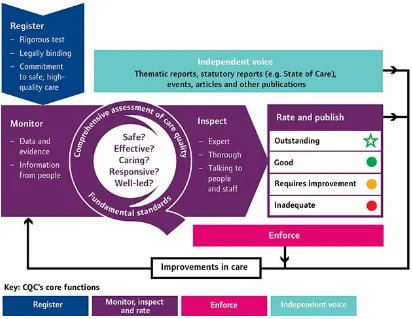
CQC’S PM METHOD AND PROCESSES:
Figure 7: CQC's performance regulation model
Conforming to the framework above, the CQC inspects all core services of the NHS
using the following methods:
Gathering the views of people who use services and from staff
Observing care and individual care pathways.
Reviewing records and looking at documents and policies
Inspecting the places where people are cared for.
Once the necessary information is gathered, a “credible, comparable rating” is given
to the respective organisation ranging from ‘inadequate’ to ‘excellent’ (CQC, 2015;
2015). The framework used for critical review and pertinent to A&E, is
Chapter 2 - literature review
2.3: MODELLING PERFORMANCE
The NHS is continually responding to the demands of society when designing the
delivery of responsive services (Fulop, et al., 2001). This inexorable need to efficiently manage resources and demonstrate accountability, ensures ‘performance’ is the
bedrock of ‘organisational effectiveness’ (OE) (Martz, 2013). Varying literature on
conceptualisation and measurement of OE is contradictory and inconclusive (Rahim,
2001; Iwu, et al., 2015). However, both literature and empirical evidence support the
notion that a valuable PMS, must wholly represent the characteristics of an
organisation, in order to effectively measure its ability to deliver strategic and
operational objectives (Otley, 1999; Agostino & Arnaboldi, 2012).
After critiquing four extant perspectives of OE: ‘Goal’, ‘Open Systems’, ‘Internal Processes’ and ‘Strategic Constituencies’ (see appendix 1), two points became
noticeable:
1. the most suitable OE model for A&E, is ‘open systems’; and
2. due to the lack of consideration for ‘inputs’, the CQC framework was consistent to measuring ‘internal processes’ not open systems, (see figure 11).
The next stages of the literature review will elaborate these points.
MAPPING THE A&E DEPARTMENT
A&E departments are complex, with detailed linkages to many internal, organisational
components, combined with significant external interaction (Cawsey, et al., 2015).
The most important differentiator to the other perspectives is A&E’s interaction with
the environment. Daft (2013), describes this as an influential function of an ‘open systems perspective’.
Starnes (2008), continues, by stating the strategic importance of “acquiring inputs from
the environment, transforming them in some way, and discharging them back into the environment”, which also (inadvertently), describes the patient’s journey through A&E
(RCEM, 2014). By considering external, environmental factors, open systems are
adept at viewing organisations ‘as-a-whole’ - a prominent feature both strategically
Chapter 2 - literature review
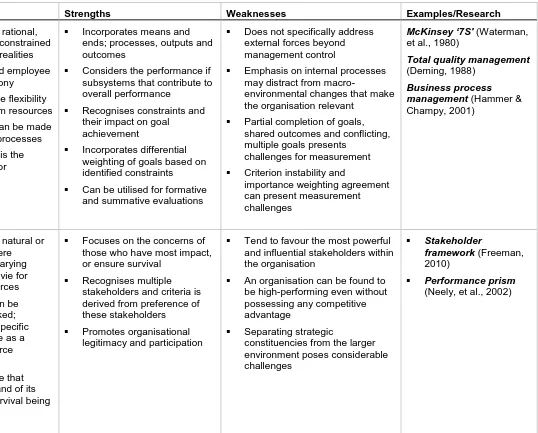
An evaluative summary of the four models of OE to identify A&E’s ‘best-fit’:
Perspective Presuppositions Strengths Weaknesses Examples/Research
Goal Organisations are rational, deliberate and goal seeking
Goals are specific,
measurable, operative and meaningful
Goals reflect outcomes and are different to constraints
Goal attainment is the organisation’s primary criterion
Goals are accepted as part of organisational culture and design
Alignment with purpose and strategy provides legitimacy for evaluating performance
Summative conclusion based on organisational activity
Preference is given to values and not others i.e. ‘narrow value premise’
Partial completion of goals, shared outcomes and conflicting, multiple goals presents challenges for measurement
Side effects and side impacts cannot be measures within goals
Criterion model
(Wallace, 1965; Blum & Naylor, 1968)
Behavioural objectives
approach (Gagné, 1962;
Briggs, 1968)
Management by
objectives(Drucker,
1985)
Open Systems
Organisations are natural or open systems that interact with the environment
System boundaries can be identified
A clear connection is present between the organisation’s inputs and outputs
The successful acquisition of scarce and valued resources suggests an effective
organisation
Incorporates means and ends; processes, outputs and outcomes
Focuses on balance of resources and sustainability; growth and survival
Considers the performance if subsystems that contribute to overall performance
Can be applied to networked and loosely coupled
organisations
Concentrating on maximising efficiencies of subsystems, may lead to ‘myopic’,
inward-focussed organisations
Potential neglect of primary beneficiaries when they are not explicitly part of a system
External factors not specifically addressed may cause false, or inaccurate measurement
Six Box model
(Weisbord, 1976)
Congruence model
(Nadler, et al., 1980)
Causal model (Burke &
Chapter 2 - literature review
Perspective Presuppositions Strengths Weaknesses Examples/Research
Internal Processes
Organisations are rational, goal-seeking and constrained by environmental realities
Organisational and employee goals are in harmony
Managers have the flexibility to allocate program resources
Causal linkages can be made between internal processes
Goal optimisation is the primary criterion for performance
Incorporates means and ends; processes, outputs and outcomes
Considers the performance if subsystems that contribute to overall performance
Recognises constraints and their impact on goal
achievement
Incorporates differential weighting of goals based on identified constraints
Can be utilised for formative and summative evaluations
Does not specifically address external forces beyond management control
Emphasis on internal processes may distract from
macro-environmental changes that make the organisation relevant
Partial completion of goals, shared outcomes and conflicting, multiple goals presents
challenges for measurement
Criterion instability and
importance weighting agreement can present measurement challenges
McKinsey ‘7S'(Waterman,
et al., 1980)
Total quality management
(Deming, 1988)
Business process
management(Hammer &
Champy, 2001)
Strategic constituencies
Organisations are natural or open systems where participants with varying degrees of power vie for control over resources
Constituencies can be identified and ranked; preferences of a specific constituency serve as a primary value source
A high-performing organisation is one that satisfies the demand of its constituencies; survival being ultimate
Focuses on the concerns of those who have most impact, or ensure survival
Recognises multiple stakeholders and criteria is derived from preference of these stakeholders
Promotes organisational legitimacy and participation
Tend to favour the most powerful and influential stakeholders within the organisation
An organisation can be found to be high-performing even without possessing any competitive advantage
Separating strategic
constituencies from the larger environment poses considerable challenges
Stakeholder
framework(Freeman,
2010)
Performance prism
(Neely, et al., 2002)
Chapter 2 - literature review
AN OPEN SYSTEMS PERSPECTIVE
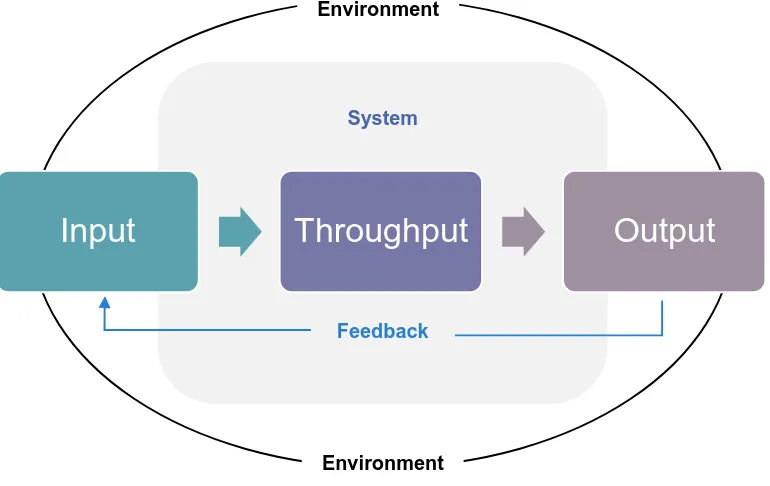
Open systems are identified by three distinct, interrelating elements:
Figure 9: ‘Open systems perspective’ - adapted from Burke & Litwin (1992)
Burke and Litwin (1992) simplify these as:
1. Input: how the external environment affects the organisation
2. Throughput: everything that happens in the organisation; and
3. Output: what the organisation produces
Further properties of an open-systems perspective, state that it…:
Figure 10: Assumptions of open systems - adapted from Cawsey, et al. (2015) exchanges information, material, and energy with their environment. As such, a system
interacts with and is not isolated from its environment
is the product of its interrelated and interdependent parts and represents a complex set of interrelationships, rather than a chain of linear, cause-effect relationships?
seeks equilibrium, and one that is in equilibrium will change only if some energy is applied.
may have individuals within a system whose views of its function and purpose differ greatly from the views held by others
views occurrences within and/or to open systems (such as issues, events, forces), not in isolation, but as interconnected, interdependent components of a complex system.
Input
Throughput
Output
Feedback System
Environment
Chapter 2 - literature review
OPEN SYSTEMS THEMES AND COMPONENTS
The ‘Six Box’, ‘Congruence’ and ‘Causal’ models are currently used by the NHS to
shape OE (NHS NW Leadership Academy, 2016). Although these are relatively dated,
they are still functional to establish common performance factors of ‘open systems’
organisations (see appendix 2). To make juxtaposition against the CQC framework
easier, the author has accumulated five conventional OE themes from these models
(see figure 11), and their applicability to A&E:
1. Vision, mission and values
Mirvis, et al. (2010), claim these underlying components of OE guide the organisation and offer purpose for its employees; they adapt Peter Senge’s (1990) ideas, to simplify
(from an organisational perspective) each as:
Vision: is the ‘what’ i.e. the picture of the future we seek to create
Mission: is the ‘why’ i.e. the organisation's answer to why we exist (purpose) Values: are the ‘how’ i.e. how we act to achieve our vision
(Mirvis, et al., 2010, p. 317)
The above components are impracticable if the organisation cannot define specific
objectives to fulfil them, and convey these throughout its workforce; hence, the
importance of a cohesive strategy (Raynor, 1998). A&E takes its overarching vision,
mission and values from the NHS constitution, when striving to deliver “health and high quality care for all, now and future generations” (NHS England, 2016, p. 4). More technical details relating to ‘standards of care’ are also comprehensively covered by
the National Institute for Health and Care Excellence (NICE, 2012).
2. Leadership and Culture
Leadership is a multi-faceted, complex and highly-regarded commodity (Northouse,
2012). Evidence also supports the positive effects of transformational leadership
behaviour on organisational performance (Katou, 2015). Strong leadership, is
necessary to traverse organisational culture, which Edgar Schein (2010, p. 7)
describes as abstract, yet producing “powerful forces outside our awareness”.
Moreover, Aguinis, et al. (2012, p. 385), assert culture should always be considered
Chapter 2 - literature review
Deficient NHS leadership and silo cultures were exposed (together with catastrophic
consequences) in the aforementioned public enquiries. As a result, considerable
resources have been allocated towards developing its leaders, and their competencies towards promoting an institution-wide, ‘collaborative’ culture (sharing information and
decision-making), to sustain patient-centred, high-quality care (NHS Leadeship
Academy, 2015; Snow, 2015; West, et al., 2015).
3. Work environment and management systems
Robert Anthony (1965; 1988), referred to this feature of OE, as how managers
effectually manipulate resources to execute the organisation’s strategy. In short,
optimum design and integration of these management ‘systems’ - i.e. policies,
procedures, budgetary processes, technology, and flow of information - ensures
optimal management ‘control’; understandably, it is here, where a large portion of PMS’ focus their attention (Ferreira & Otley, 2009; Zanibbi, 2011).
The work environment is a crucial for the caregiver to operate effectively and an
integral part of the patient experience. It should be safe, to prevent harm; clean, to
prevent infections; and equipment should in good condition and maintained correctly
(NHS Choices, 2014; NHS England, 2016). Medical devices deploy some of the most
advanced technology available, which undoubtedly improves patient outcomes; despite this, the NHS’ adaptation of the latest technologies, has known to be sluggish and indifferent between Trusts (Liddell, et al., 2008). A ‘systems thinking’ approach,
using Information Management and Technology (IM&T), i.e. electronic records,
prescribing and Decision Support Systems (DSS), enhance performance by streamlining the constant flow of information to the caregiver’s fingertips (Senge, 1990;
Gupta & Malik, 2005; Brown, et al., 2012).
Alongside principal operational policies and procedures, A&E’s systems and control mechanisms, focus on the minutiae of ‘care administration’ and are cross-referenced to numerous, national clinical policies and guidelines. The NHS’ ‘safety thermometer’, ‘duty of candour’, and recommendations by the Royal College of Emergency Medicine
are just some of these (NHS Quality Observatory, 2013; CQC, 2015; RCEM, 2016). Likewise, ‘clinical governance’ is a pivotal framework (for staff and patients) to
collectively monitor quality care, covering: education, training, risk management,
audits, complaints, evidence-based practice and, research and development
Chapter 2 - literature review
4. Human Resource Management (HRM)
There have been many studies on the relationship between people management and
performance output. According to Abraham Maslow, “human potential is the primary source of competitive advantage in almost every industry” (Maslow, 1998, p. xv). In
2003, the Chartered Institute of Personnel and Development (CIPD) published their ‘black box’ research into this subject - which (without claiming to fully understand
causation) uncovered strong evidence linking robust, synchronised HRM (i.e. job
design, training, competencies, motivation, and rewards etc.), to positive influences
on organisational performance (Purcell, et al., 2003; Hutchinson, 2013; Katou, 2008).
Boyatzis (1982; 2008, p. 6), defines competency as “capability or ability”, and believes
individual performance improves, once aligned with job design and demands of the
workplace. Motivation arises from an individual’s needs; and organisations should
encourage satisfaction of these needs, to stimulate the individual to perform (Maslow,
1998; Karami, et al., 2013). Rewards systems, if properly conceived, also increase
productivity - especially when incentives are specifically coupled to individual needs
(Yinghong, et al., 2012; Karami, et al., 2013).
Staff commitment (as written in the NHS Constitution), combined with annual,
Personal Development Reviews (PDRs); a Knowledge and Skills Framework (KSF);
and (where applicable) Continuous Professional Development (CPD), should account for A&E staff’s HRM needs (Department of Health, 2013; NHS Employers, 2015;
2016). A dedicated NHS workforce, is not usually concerned with bonuses and perks
(Bullas & Ariotti, 2002); however, studies have recognised motivated and engaged
staff, improve patient experience and outcomes (Maben, 2013).
5. External/environmental influences
Described by Martz (2013, p. 389), as “forces beyond management’s control that can impact the organisation”, this last section covers external, environmental factors of an ‘open system’ model. Whilst designing their modified version of the ‘causal model’,
Spangenberg and Theron (2013) debated these factors in a spherical context, surrounding the entire model. In A&E’s case, the majority of external factors affect its
input, and are relative to patients who present themselves in A&E i.e. the social
Chapter 2 - literature review
Since the 1980’s, a compounded view of health recognised the impact of its “social determinants” i.e. “the economic, political, social conditions under which people live and which determine their health” (Larkin, 2011, p. 6). An overview of these and other,
environmental elements are as follows:
a. Age of the local population: the elderly and the very young are at higher risk for
emergency care (Purdy, 2010).
b. Ethnicity of the local population: emergency admissions rates are increased for individuals from ‘minority ethnic’ backgrounds (Moudgil, et al., 2000)
c. Socioeconomic deprivation: higher demand for emergency services has been
concentrated in areas of socioeconomic deprivation (Hull, et al., 1997; Purdy, 2010;
Scantlebury, et al., 2015)
d. Comorbidity: refers to ‘multiple-illnesses’ with increased clinical and financial
consequences (Valderas, et al., 2009). The Department of Health (2014, p. 6)
states comorbidity “is one of the most important issues facing health systems in the developed world” and categorises it as:
i. Clinically dominant: where one illness overshadows another;
ii. Synergistic: linking causality and treatment; and
iii. Coincidental: no obvious relationship and separate management
e. Residential area: rural communities have lower rates of emergency admissions
than inner-cities (Purdy, 2010). Also, geographic locality to A&E departments
(combined with factors like access to transport) effects admission rates and
patient-condition on arrival (Comber, et al., 2011).
f. Environmental conditions: adverse weather conditions and air pollution have
changeable effects across patient diseases such as respiratory conditions and
coronary heart disease; which ultimately increases demand on A&E (Marno, et al.,
2006; Maheswaran, et al., 2005; Purdy, 2010).
g. Inappropriate admission: people thinking they require emergency care and attend
A&E unnecessarily, when they could be treated elsewhere and/or leave without
requiring any treatment (The King's Fund, 2016; Blunt, et al., 2015).
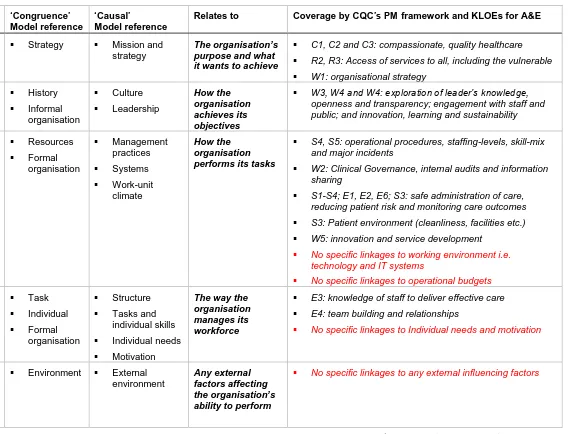
The author instigated an in-depth critique of the CQC’s KLOE for A&E, in comparison
to the academic models mentioned earlier. Figure 11 condenses this, reinforcing the
viewpoint that ‘inputs’ (along with additional highlighted factors) are not accounted
Chapter 2 - literature review Generic outline ‘Six Box’ Model reference ‘Congruence’ Model reference ‘Causal’ Model reference
Relates to Coverage by CQC’s PM framework and KLOEs for A&E
Vision, mission and values
Purpose Strategy Mission and strategy
The organisation’s purpose and what it wants to achieve
C1, C2 and C3: compassionate, quality healthcare
R2, R3: Access of services to all, including the vulnerable
W1: organisational strategy
Culture and Leadership
Leadership History
Informal organisation Culture Leadership How the organisation achieves its objectives
W3, W4 and W4: exploration of leader’s knowledge, openness and transparency; engagement with staff and public; and innovation, learning and sustainability
Work environment, management systems and control Helpful mechanisms Resources Formal organisation Management practices Systems Work-unit climate How the organisation performs its tasks
S4, S5: operational procedures, staffing-levels, skill-mix and major incidents
W2: Clinical Governance, internal audits and information sharing
S1-S4; E1, E2, E6; S3: safe administration of care, reducing patient risk and monitoring care outcomes
S3: Patient environment (cleanliness, facilities etc.)
W5: innovation and service development
No specific linkages to working environment i.e. technology and IT systems
No specific linkages to operational budgets
Human resource management Relationships Rewards Structure Task Individual Formal organisation Structure
Tasks and individual skills
Individual needs
Motivation
The way the organisation manages its workforce
E3: knowledge of staff to deliver effective care
E4: team building and relationships
No specific linkages to Individual needs and motivation
External influences
Environment Environment External environment
Any external factors affecting the organisation’s ability to perform
No specific linkages to any external influencing factors
Chapter 2 - conceptual framework
2.4: CONCEPTUAL FRAMEWORK
CONSTRUCTING THE FRAMEWORK
The literature review has provided enough material to understand, key factors that
substantiate the research problem; which in turn, provides a sound theoretical
foundation (Levy & Ellis, 2006; Bordage, 2009). In conjunction with literature, the author will look to construct a ‘lens’, or ‘set of lenses’ in an attempt to simplify the
complexity of A&E’s OE and PM within a ‘Conceptual Framework’ (CF) - this is
fundamental to explore and develop these theoretical ideas (Ravitch & Riggan, 2011;
Connelly, 2014).
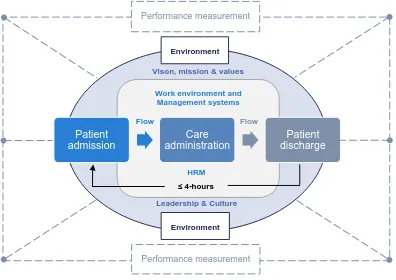
Figure 25, represents a culmination of theories, perspectives and models from
literature, to demarcate a typical A&E setting:
Figure 12: An outline for A&E performance management CF
Accepting the ‘standardised output’ for A&E is quality care (as stipulated in the CQC framework for A&E), delivered in ≤ 4-hours of the patient being admitted to being
discharged, this model will now be conceptualised (Mintzberg, 1978; CQC, 2015). Patient
admission
Care administration
Patient discharge
≤ 4-hours
Work environment and Management systems
Environment
Environment
Performance measurement
Performance measurement Vison, mission & values
Leadership & Culture
HRM
Flow
Chapter 2 - conceptual framework
Figure 13: The conceptual framework Age
Ethnicity Socioeconomic Comorbidity Residential area
Environmental conditions Inappropriate admissions
A B C
FLOW FLOW ≤ 4-hours
INPUT THROUGHPUT OUTPUT
ENVIRONMENT
Performance output (C) =
Factors of A (input)
+
Factors of B (throughput) Dischargeor
hospital admission
Vision, mission &
values Leadership
& Culture Work environment & management systems
Human Resource Management
P
atien
t ind
ic
ato
Chapter 2 - conceptual framework
The conceptual framework (CF), contours the A&E department within an open
systems model to show interlinked concepts i.e. relationship between input,
throughput and output (Jabareen, 2009):
Part A (input): exhibits congruent environmental indicators of patients coming to A&E. As per any open systems model, these inputs represent the ‘external energies’, which
have significant bearing on performance (Martz, 2013).
Part B (throughput): the organisation’s ‘energy conversion unit’ (Katz & Kahn, 1978),
incorporating the systems, subsystems and activities needed for productivity
(Mintzberg, 1978). This area also holds the majority of ‘measurable components’, hence the focus of A&E’s PM (Otley, 1999; Martz, 2013).
Part C (output): is the product of parts A and B, which for A&E (because the performance characteristic is predefined), conforms to Henry Mintzberg’s principle of being a ‘standardised output’ i.e. the patient is either admitted to hospital, or sent home
within 4-hours; and given the appropriate quality of care (Mintzberg, 1978).
Lastly, the ‘flow’ of patients through A&E (patient’s journey), is tantamount to Mintzberg’s “operating work flow”, i.e. symbolic representation of an organisation’s “input, processing and output functions”, (Mintzberg, 1978, p. 38).
CHAPTER SUMMARY
Literature has drawn attention to theories of performance in general and in a healthcare context. The CQC’s performance regulatory framework was appraised
against these theoretical models and considered to support PM from an ‘internal process’ perspective, due to not taking into account any ‘inputs’. Conversely, A&E was deemed to align with an ‘open systems’ organisation. The CF elaborated this notion,
bringing together all contributing factors of A&E performance - thus accomplishing
objective one.
Research will now concentrate on objective two, where the factors of the CF will be investigated for application and relevancy of A&E’s performance measurement in an
applied setting.
Discussion and justification of the philosophy, strategy and methodology used for this study
Chapter 3: research methodology
CHAPTER 3: RESEARCH METHODOLOGY
INTRODUCTION
Investigating key factors of NHS performance, meant facilitating effective processing
of these issues; adopting appropriate research methods, ensured the accurate
provision of the information (Zikmund, et al., 2013). Additionally, it aided the overall
understanding and “purpose of the project as a whole” (Vassallo, 2004, p. 277).
In order to formulate the correct, holistic approach, Wilson’s (2014, p. 8) ‘Honeycomb of Research’ was adopted as a three-dimensional, ‘methodology’ framework to explain
some of the theory behind the individual components of social science research:
Figure 14: ‘The Honeycomb of Research Methodology’ - adapted from Wilson (2014)
Within this framework, there are two important relationships between the first three
(ideological) and last three (practical) components (Wilson, 2014). The framework,
(expanded upon in appendix 3), also forms a template for this chapter.
Research
Methodology
Research philosophy
Research approach
Research strategy
Research design Data
Chapter 3: research methodology
3.1: RESEARCH PHILOSOPHY
To identify the appropriate research philosophy, it is important to recognise how each one ties-in with a researcher’s outlook on society, science and their research
objectives (Saunders, et al., 2009; Burrell & Morgan, 1979; Johnson & Clark, 2006):
POSITIVISM REALISM INTERPRETIVISM
Epistemology: The researcher’s view regarding what constitutes acceptable knowledge Only observable phenomena can provide credible data,
facts. Focus on causality and law like
generalisations, reducing phenomena
to simplest elements
Observable phenomena provide credible data, facts.
Insufficient data means inaccuracies in sensations
(direct realism). Alternatively, phenomena create sensations which can
be misinterpreted (critical realism). Focus is on explaining within a context(s)
Subjective meanings and social phenomena.
Focus upon the details of situation, a reality behind these details, subjective meanings motivating actions
Ontology: The researcher’s view of the nature of reality or being
External, objective and independent of
social actors
Is objective. Exists independently of human
thoughts and beliefs or knowledge of their existence
(direct realist), but is interpreted through social conditioning (critical realist)
Socially constructed, subjective, may change,
multiple
Axiology: The researcher’s view of the role of values in research
Research is undertaken in a
value-free way, the researcher is independent of the data and maintains an
objective stance
Research is value laden; the researcher is biased by world views, cultural experiences
and upbringing. These will impact on the research
Research is value bound, the researcher is
part of what is being researched, cannot be separated and so will be
subjective Methodology: Data collection techniques most often used Highly structured, large samples. Quantitative, but can
use qualitative
Methods chosen must fit the subject matter, quantitative or
qualitative
Small samples, in depth investigations,
qualitative
Figure 15: Comparing research philosophies adapted from Saunders, et al. (2009)
While figure 15, offers an overview - scrutinising the subject of management research
philosophies and their consequent paradigms, presents a “tautological dilemmatic confusion” (Mikansi & Acheampong, 2012, p. 132) of exactly of ‘how, when and why’
Chapter 3: research methodology
Positivism
Positivists believe in knowledge through facts and scientific laws to search for
regularity and causality (Burrell & Morgan, 1979). Epistemologically, according to
Kincheloe and Tobin (2009, p. 518) positivists’ knowledge is worthwhile to the degree that it is derived from ‘objective information’ that corresponds to or reflects the world”.
Houghton (2008), claims positivism has a pre-occupied commitment towards directly
observing the testable and measurable. This objective position guides further
assumptions that “social entities exist in reality external to social actors” (Saunders, et
al., 2009, p. 110); and “implicitly or explicitly that reality can be measured by viewing it through a one-way, value free mirror” (Sobh & Perry, 2006, p. 1196).
Smith (2009), underlines positivisms’ long and established history in social science
research; though he also diagnoses its greatest drawback - disregarding substantial
knowledge gained from experiences that are neither naturally scientific, nor directly
observed.
Interpretivism
Interpretivists repudiate the opinion that scientific processes used to obtain “objective facts and established truths” can be used to study people; because human behaviour is heavily influenced by environmental perceptions i.e. their ‘subjective reality’ (Gray,
2014, p. 21; Crotty, 1998; Willis, 2007).
This leads to the view that “social phenomena are created from the perceptions and consequent actions of social actors” (Saunders, et al., 2009, p. 111). Likewise, within a ‘socially constructed’ world, establishing reality is better-achieved by means of the researcher’s subjective comprehension and experience of these constructs (Sobh &
Perry, 2006; Aliyu, et al., 2014; Andrade, 2009).
Conversely, it is this subjective standpoint adopted to cognise the “accounts of people”
(Arnold, 2002) that attracts critics of interpretivism. Since data is mostly qualitative -
lack of exact analysis and therefore, reliability (in terms of repeatability) are potential