Catalyst Free, Solvent Mediated, Facile and Efficient
One-pot Multicomponent Synthesis of Acridin-1,8-diones
Mangalavathi and M. A. Pasha*
Department of Studies in Chemistry,
Central College Campus, Palace Road, Bangalore University, Bengaluru 560001, INDIA. *email: [email protected]
(Received on: July 31, 2018)
ABSTRACT
A simple, efficient, inexpensive, solvent mediated and novel route to the synthesis of acridin-1,8-diones by a one-pot four-component cyclocondensation of aromatic/hetero-aromatic aldehydes, dimedone and ammonium acetate/substituted anilines is reported. The reaction is carried out by using DMSO as a solvent to get the respective products in excellent yield in short durations.
Keywords: 9-Aryl-hexahydroacridin-1,8-diones, 9,10-bis -aryl-tetrahydroacridin-1,8-diones aromatic/heteroaromatic aldehydes, dimedone, ammonium acetate, DMSO.
1. INTRODUCTION
One-pot multicomponent reactions (MCRs) have thoroughly justified their role in the field of modern organic synthesis and in developing large libraries of organic molecules. Multicomponent domino reactions are useful in the total syntheses of natural products and for the synthesis of versatile building blocks of varied reactivity. Thus, the synthesis of highly functionalized complex products using simple reactants has been the scope of one-pot MCRs.1
owing to its wide biological spectrum and application in various fields, and a number of tetrahydroacridin-1,8-diones are derived from Hantzsch-type condensation. The variants of this heterocycle, such as: quinacrine, acriflavine, proflavine, ethacridine, amsacrine, nitracine and tacrine play a significant role in the medicinal chemistry. Acridinediones exhibit various biological activities such as: antibacterial2, antiinflammatory3, antimicrobial4, antitubercular5,
neuroprotectant6, and insecticidal activities7. A series of acridine derivatives have found
application as dyes8, fluorescent materials for visualization of biomolecules9, and in laser
technology10. These derivatives are also commercially in use as calcium channel blockers for
the treatment of cardiovascular diseases including hypertension.11 Generally, one-pot MCRs,
have effectively been adapted in the synthesis of tetrahydroacridin-1,8-diones using various catalysts such as: : p-sulfonic acid calyx-4-arene12, acetic acid13, salicylic acid14, alkonic acid15,
K2CO3 16; and heterogeneous catalysts such as ZrO2 17, TiO2 18, ZnCl2 19 and ZnFe2O4 20.
However, the utility of these protocols and their scope is still limited and are accompanied with one or the other deterrents such as: the use of hazardous reaction conditions, preparation of the catalyst, use of expensive catalysts, prolonged reaction time and insufficient yield. This prompted us to accentuate the need to search for a new efficient synthetic route which is capable of complementing the green principles towards the rapid access of these important molecules under mild reaction conditions.
In pursuit of developing efficient synthetic approaches for the synthesis of acridine-1,8-diones (4, Scheme 1), we, from our laboratory have reported the use of ceric ammonium nitrate21, SiO
2-I 22 and CuSO4.5H2O 23 under different reaction conditions; now, herein, we
report a one-pot four-component cyclocondensation of aldehyde/hetero-aromatic aldehydes, dimedone and ammonium acetate/substituted anilines in DMSO as shown in the Scheme 1.
Scheme 1: Synthesis of acridin-1,8-diones
2. MATERIAL AND METHODS
All the chemicals are commercially available and were used without further purification, except liquid aldehydes and anilines which were distilled before use. The progress of the reactions was monitored on TLC [analytical silica gel plates (Merck 60 F120)]. 1H NMR
respectively in DMSO-d6 and CDCl3 as solvents and TMS as an internal standard. All the
products were characterized by 1H NMR, 13C NMR and Mass spectral analysis. Melting points
were measured on a Raaga, INDIAN make melting point apparatus. ESI-MS analysis was carried out for all the novel products using ESI-Q TOF instrument.
3. General procedure for the synthesis of 9-(aryl)-3,3,6,6-tetramethyl-2,4,5,7-tetrahydroacridin-1,8 (9H,10H)-diones and 9,10-bis-(aryl)-3,3,6,6-tetramethyl-2,4,5,7-tetrahydroacridin-1,8 (9H)-diones:
In a 50 mL round bottom flask, a mixture of 2-hydroxybenzaldehyde (1 mmol), dimedone (2 mmol), ammonium acetate/aniline (1 mmol) was taken and DMSO (2 mL) was added drop wise with stirring at 25 °C. The RBF was then placed on a preheated oil bath and the contents were stirred for about 2 h at 120 °C. After the completion of the reaction [monitored by Thin layer chromatography (TLC) using hexane:ethyl acetate (7:3) as an eluent], the mixture was poured onto crushed ice. The solid thus separated was filtered and dissolved in EtOAc (10 mL) and dried using anhydrous Na2SO4. The organic layer was then
concentrated under vacuum and the residue was purified by recrystallization from EtOAc.
3.1. Spectral data of acridine-1,8-diones:
9-(2'-Hydroxyphenyl)-3,3,6,6-tetramethyl-2,4,5,7-tetrahydroacridin-1,8(9H,10H)-dione
(4a):
1H NMR (400 MHz, CDCl
3): δ 0.99 (6H, s, 2 × CH3), 1.02 (3H, s, CH3), 1.23 (3H, s, CH3)
2.58–2.33 (8H, m, 4 × CH2), 2.62 (1H, s, OH), 4.67 (1H, s, CH), 6.99–7.03 (2H, m, Ar-H),
7.14 (1H, t, J = 6 Hz, Ar-H), 7.17 (1H, t, J = 8 Hz, Ar-H), 9.69 (1H, s, NH) ppm;
13C NMR (100 MHz, CDCl
3): δ 27.2, 31.7, 40.2, 43.1, 51.9, 111.9, 114.2, 121.8, 125.8, 130.0,
134.5, 149.5, 159.1, 198.1 ppm.
9-(2'-Chlorophenyl)-3,3,6,6-tetramethyl-2,4,5,7-tetrahydroacridin-1,8(9H,10H)-dione
(4b):
1H NMR (400 MHz, CDCl
3): δ 1.02 (6H, s, 2 × CH3), 1.12 (6H, s, 2 × CH3), 2.00–1.90 (4H,
m, 2 × CH2), 2.62–2.33 (4H, m, 2 × CH2), 5.03 (1H, s, CH), 6.99–7.15 (4H, m, Ar-H), 10.4
(1H, s, NH) ppm;
13C NMR (100 MHz, CDCl
3): δ 26.7, 30.6, 33.2, 42.2, 51.2, 110.0, 115.7, 122.1, 122.9, 125.0,
131.4, 149.4, 156.4, 198.0 ppm.
9-(Thiophen-2'-yl)-3,3,6,6-tetramethyl-2,4,5,7-tetrahydroacridin-1,8(9H,10H)-dione
(4c):
1H NMR (400 MHz, CDCl
3): δ 1.04 (6H, s, 2 × CH3), 1.09 (6H, s, 2 × CH3),2.04–2.40 (8H,
m, 4 × CH2), 5.47 (1H, s, CH), 6.80–6.98 (3H, m, Ar-H), 10.12 (1H, s, NH) ppm; 13C NMR (100 MHz, CDCl
3): δ 26.7, 29.9, 32.3, 41.6, 50.2, 113.8, 122.5, 123.8, 126.8, 130.4,
9-(4'-Nitrophenyl)-3,3,6,6-tetramethyl-2,4,5,7-tetrahydroacridin-1,8(9H,10H)-dione
(4d):
1H NMR (400 MHz, DMSO): δ 0.86 (6H, s, 2 × CH
3), 1.00 (6H, s, 2 × CH3), 1.99–2.44 (8H,
m, 4 × CH2), 4.69 (1H, s, CH), 6.92 (2H, d, J = 7.2 Hz, Ar-H), 6.52 (2H, d, J = 6.4Hz, Ar-H),
δ 9.21 (1H, s, NH) ppm;
13C NMR (100 MHz, CDCl
3): δ 24.2, 31.0, 40.2, 43.5, 52.2, 111.9, 115.7, 129.4, 132.0, 149.4,
157.2, 198.3 ppm.
9-(3',4'-Dimethoxyphenyl)-3,3,6,6-tetramethyl-2,4,5,7-tetrahydroacridin-1,8(9H,10H)-dione (4e):
1H NMR (400 MHz, DMSO): δ 0.88 (6H, s, 2 × CH
3), 1.01 (6H, s, 2 × CH3), 1.98–2. 46 (8H,
m, 4 × CH2), 3.63 (3H, s, OCH3), 3.65 (3H, s, OCH3), 4.75 (1H, s, CH), 6.64 (H, s, Ar-H),
6.74 (2H, d, J = 7.2Hz, Ar-H), 9.26 (1H, s, NH) ppm;
13C NMR (100 MHz, CDCl
3): δ 26.9, 32.5, 32.9, 40.6, 50.9, 55.6, 55.8, 110.6, 111.7, 113.1,
119.9, 139.62, 147.1, 148.4, 149.4, 196.2 ppm.
9-(4'-Hydroxyphenyl)-3,3,6,6-tetramethyl-2,4,5,7-tetrahydroacridin-1,8(9H,10H)-dione
(4f):
1H NMR (400 MHz, CDCl
3): δ 0.88 (6H, s, 2 × CH3), 1.00 (6H, s, 2 × CH3), 1.97–2.45 (8H,
m, 4 × CH2), 4.73 (1H, s, CH), 6.53 (4H, m, Ar-H), 9.03 (1H, s, OH), 9.24 (1H, s, NH) ppm; 13C NMR (100 MHz, CDCl
3): δ 29.7, 31.7, 32.2, 41.6, 50.2, 115.3, 115.7, 129.4, 138.9, 147.6,
157.5, 196.2 ppm.
9-(4'-chlorophenyl)-3,3,6,6-tetramethyl-2,4,5,7-tetrahydroacridin-1,8(9H,10H)-dione
(4g): 1H NMR (400 MHz, CDCl
3): δ 0.98 (6H, s, 2 × CH3), 1.06 (6H, s, 2 × CH3), 2.17–2.40
(8H, m, 4 × CH2), 5.62 (1H, s, CH), 7.18–7.38 (4H, m, Ar-H), 11.9 (1H, s, NH) ppm; 13C NMR (100 MHz, CDCl
3): δ 27.2, 30.5, 34.5, 42.2, 51.2, 111.1, 123.1, 123.8, 127.9, 145.0,
149.0, 198.8 ppm.
10-(4'-Aminophenyl)-9-(4''-hydroxyphenyl)-3,3,6,6-tetramethyl-2,4,5,7-tetrahydroacridin-1,8(9H)-dione (4h)†:
1H NMR (400 MHz, CDCl
3): δ 0.99 (s, 6H, 2 × CH3), 1.09 (s, 6H, 2 × CH3), 2.05–2.25 (m,
8H, 4 × CH2), 3.72 (s, 1H, OH), 4.66 (s, 1H, CH), 5.94 (s, 2H, NH2), 6.59 (d, J = 8.0 Hz, 2H,
H), 6.76 (d, J = 8Hz, 2H, H), 7.10 (d, J = 8Hz, 2H, H), 7.17 (d, J = 8.4Hz, 2H, Ar-H) ppm;
13C NMR (100 MHz, CDCl
3): 27.0, 31.0, 32.3, 40.9, 50.8, 115.3, 115.9, 129.4, 133.2, 135.5,
140.2, 155.9, 162.3, 197.2 ppm; Mass (m/z): [M]+ 456.24.
9-(4'-Chloro-3'-fluorophenyl)-3,3,6,6-tetramethyl-2,4,5,7-tetrahydroacridin-1,8(9H,10H)-dione (4i):
1H NMR (400 MHz, CDCl
3): δ 1.36 (6H, s, 2 × CH3), 1.60 (6H, s, 2 × CH3), 2.19–2.28 (8H,
m, 4 × CH2), 5.28 (1H, s, CH), 7.19 (1H, s, Ar-H), 7.36–7.33 (1H, d, J = 2 Hz, Ar-H), 7.50
13C NMR (100 MHz, CDCl
3): δ 27.6, 29.5, 31.4, 41.9, 50.3, 111.4, 116.20, 116.23, 124.6,
128.0, 140.1, 151.4, 169.4, 196.9 ppm.
9-(3',4',5'-Trimethoxyphenyl)-3,3,6,6-tetramethyl-2,4,5,7-tetrahydroacridin-1,8(9H,10H)-dione (4j):
1H NMR (400 MHz, CDCl
3): δ 1.12 (6H, s, 2 × CH3), 1.24 (6H, s, 2 × CH3), 2.42 – 2.35 (8H,
m, 4 × CH2), 3.75 (6H, s, 2 × OCH3), 3.81 (3H, s, OCH3), 5.49 (1H, s, CH), 6.34 (2H, s,
Ar-H), 12.0 (1H, s, NH) ppm;
13C NMR (100 MHz, CDCl
3): δ 27.2, 30.1, 39.7, 42.0, 51.1, 56.1, 56.9, 106.1, 111.0, 131.0,
132.0, 149.3, 150.0, 198.0 ppm.
10-(4'-Aminophenyl)-9-(3'',4''-dimethoxyphenyl)-3,3,6,6-tetramethyl-2,4,5,7,-tetrahydroacridin-1,8(9H)-dione (4k)†:
1H NMR (400 MHz, CDCl
3): δ 0.80 (6H, s, 2 × CH3), 0.94 (6H, s, 2 × CH3), 1.87–2.24 (8H,
m, 4 × CH2), 3.46 (3H, s, OCH3), 3.48 (3H, s, OCH3), 5.25 (1H, s, CH), 6.66 (s, 2H, NH2),
6.77 (1H, s, Ar-H), 6.93–6.95 (d, J = 8Hz, 2H, Ar-H), 7.02–7.04 (d, J = 7.6 Hz, 2H, Ar-H), 7.28–7.30 (d, 8 Hz, 2H, Ar-H) ppm;
13C NMR (100 MHz, CDCl
3): δ 26.7, 29.7, 32.5, 32.9, 40.6, 50.9, 55.6, 55.8, 110.6, 111.7,
113.1, 119.9, 122.9, 136.8, 139.6, 147.1, 148.4, 149.4, 155.1, 196.2 ppm; Mass (m/z): [M]+ 500.71.
10-(4'-Aminophenyl)-9-(4''-nitrophenyl)-3,3,6,6-tetramethyl-2,4,5,7-tetrahydroacridin-1,8(9H,10H)-dione (4l)†:
1H NMR (400 MHz, CDCl
3): ): δ 1.01 (6H, s, 2 × CH3), 1.08 (6H, s, 2 × CH3), 1.90–2.23 (8H,
m, 4 × CH2), 5.66 (1H, s, CH), 6.76 (s, 2H, NH2), 6.85–6.86 (d, J = 4Hz, 2H, Ar-H), 6.87–
6.88 (d, J = 4Hz, 2H, Ar-H), 7.00 –7.02 (d,5.6Hz, 2H, Ar-H) ppm;
13C NMR (100 MHz, CDCl
3): δ 26.7, 31.7, 32.2, 41.6, 50.2, 113.4, 115.3, 115.7, 128.7, 129.4,
130.4, 138.9, 147.6, 151.0, 157.5, 196.2 ppm; Mass (m/z): [M]+.485.91.
4. RESULTS AND DISCUSSION
A model reaction of 2-hydroxybenzaldehyde, dimedone and ammonium acetate was selected under the solvent-free condition and noticed that, the reaction did not proceed to offer the desired product 4a under solvent-free condition (Table 1, entry 1). In order to understand the effect of various solvents, the present reaction was carried out in MeOH, ethanol, water, n-hexane, xylene, CH3CN, THF, DMF and DMSO (entries2‒10). From the results presented
Table 1: Effect of solvent on the synthesis of 9-(2'-Hydroxyphenyl)-3,3,6,6-tetramethyl-2,4,5,7-tetrahydroacridin-1,8(9H,10H)-dione (4a).
Entry Solventa Temperature (°C) Time (h) Yieldb (%)
1 No solvent 90 4 ND
2 MeOH 40 3 45
3 EtOH 70 3 58
4 H2O 60 4 50
5 Xylene 120 2 ND
6 n-hexane 60 3 ND
7 CH3CN 95 3 30
8 THF 98 4 30
9 DMF 120 3 45
10 DMSO 120 2 98
a2 mL; bIsolated yield; ND = Not detected.
The above result prompted us to further optimize the reaction conditions; and screening of different amounts of DMSO was taken up, and it was found that, 2 mL of DMSO gave the maximum yield of the product (Table 2, entry 3). Further, increasing the amount of solvent had no significant effect on the rate of the reaction and the yield of the product (entry 4).
Table 2: Optimization of the amount of the solvent for the synthesis of 4a. Entry Solventa (mL) Time (h) Yieldb (%)
1 1.0 2 70
2 1.5 2 80
3 2.0 2 98
4 2.5 2 98
a DMSO; b Isolated yield.
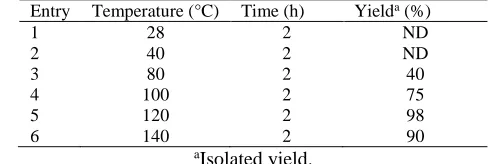
It was also observed that, use of DMSO under different reaction temperatures influenced the rate of the reaction and the yield of the product as shown in the Table 3, and 120 °C was found to be most suitable for the reaction (entry 5).
Table 3: Optimization of the reaction temperature for the synthesis of 4a. Entry Temperature (°C) Time (h) Yielda (%)
1 28 2 ND
2 40 2 ND
3 80 2 40
4 100 2 75
5 120 2 98
6 140 2 90
aIsolated yield.
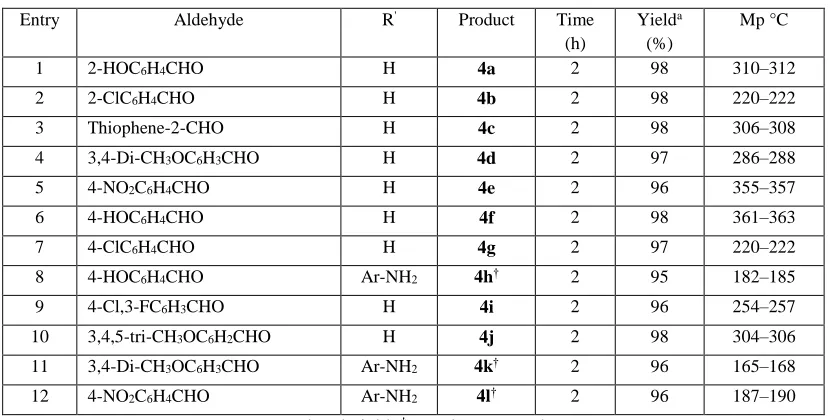
anilines in DMSO as a solvent and carried out the reaction at 120 C, and the results of this study are presented in the Table 4. From the data present in this Table, it is clear that, the electron donating and electron withdrawing groups present in the aromatic aldehydes did not show any adverse effect on the rate of the reaction and yield of the products; and the products were obtained in excellent yield.
Table 4: The synthesis of acridinediones (4a–l)using DMSO at 120 C.
Entry Aldehyde R' Product Time
(h)
Yielda (%)
Mp °C
1 2-HOC6H4CHO H 4a 2 98 310–312
2 2-ClC6H4CHO H 4b 2 98 220–222
3 Thiophene-2-CHO H 4c 2 98 306–308
4 3,4-Di-CH3OC6H3CHO H 4d 2 97 286–288
5 4-NO2C6H4CHO H 4e 2 96 355–357
6 4-HOC6H4CHO H 4f 2 98 361–363
7 4-ClC6H4CHO H 4g 2 97 220–222
8 4-HOC6H4CHO Ar-NH2 4h† 2 95 182–185
9 4-Cl,3-FC6H3CHO H 4i 2 96 254–257
10 3,4,5-tri-CH3OC6H2CHO H 4j 2 98 304–306
11 3,4-Di-CH3OC6H3CHO Ar-NH2 4k† 2 96 165–168
12 4-NO2C6H4CHO Ar-NH2 4l† 2 96 187–190
aIsolated yield. †Novel compound.
5. CONCLUSIONS
In conclusion, we have herein, devised a simple, efficient, rapid and economical approach for the synthesis of a series of acridin-1,8-diones by a one-pot four-component reaction of aromatic/hetero-aromatic aldehydes, dimedone and ammonium acetate/substituted anilines. The capable salient features of this strategy are: minimization of waste, simple product isolation which avoids tedious and hazardous column purification steps, it is inexpensive and follows green principles and easy to handle. Use of DMSO as a solvent has proved to be an improvisation over existing methods which provides excellent yield of the products in short time durations.
6. ACKNOWLEDGEMENTS
REFERENCES
1. Guillermo, M. A., Muhammad, A., Federico, M., Christopher, H., Synthesis of Diverse Nitrogen-Enriched Heterocyclic Scaffolds Using a Suite of Tunable One-Pot Multicomponent Reactions. J. Org. Chem., 79: 5153−5162 (2014).
2. Sirisha, K., Bikshapathi, D., Achaiah, G., Reddy, V. M., Synthesis, antibacterial and antimycobacterial activities of some new 4-aryl/heteroaryl-2,6-dimethyl-3,5-bis-N -(aryl)-carbamoyl-1,4-dihydropyridines. Eur. J. Med. Chem., 46: 1564−1571 (2011).
3. Poupelin, J. P., Saint-Ruf, G., Foussard-Blanpin, O., Narcisse. G., Uchida-Ernouf, G., Lacroix, R., Synthesis and anti-inflammatory properties of bis (2-hydroxyl-1- naphthyl) methane derivatives. J. Med. Chem.,13: 67−71 (1978).
4. Murthy, Y. L, N., Rajack, A., Taraka, R. M., Jeson, B. J., Praveen, C., Aruna, L. K., Design, solvent free synthesis, and antimicrobial evaluation of 1,4 dihydropyridines.
Bioorg. Med. Chem. Lett., 22: 6016−6023 (2012).
5. Trivedi, A., Dodiya, D., Dholariya, B., Kataria, V., Bhuva, V., Shah, V., Synthesis and Biological Evaluation of Some Novel 1,4‐Dihydropyridines as Potential Anti-tubercular Agents. Chem. Biol. Drug. Des., 78: 881−886 (2011).
6. Klusa, V., Study of Fe2O3, CuO, ZnO catalyzed efficient Hantzsch reaction under different
conditions. Drugs. Fut., 20: 135−138 (1995).
7. Krishna, C., Insecticidal Activity of Some New Acridines Containing Fluorine. Agr. Biol. Chem., 38: 1165−1167 (1974).
8. Hilderbrand, S. A., Weissleder, R., One-pot synthesis of new symmetric and asymmetric xanthene dyes. Tetrahedron Lett., 48: 4383−4385 (2007).
9. Knight, C. G., Stephens, T., Xanthene-dye-labelled phosphatidylethanolamines as probes of interfacial pH. Studies in phospholipid vesicles. J. Biochem., 258: 683−687 (1989).
10. Pohlers, G., Scaiano, J. C., A novel photometric method for the determination of photoacid generation efficiencies using benzothiazole and xanthene dyes as acid sensors. Chem.
Mater., 9: 3222−3230 (1997).
11. Furuta, T., Shibata, S., Kodama, I., Yamada, K., Cardiovascular effects of FR34235, a new dihydropyridine slow channel blocker, in isolated rabbit myocardium and aorta. J. Cardiovasc. Pharmacol., 5: 836−841 (1983).
12. Hamed, T., Moslem, M. L., Mona, R., p-Sulfonic acid calix[4]arene as an efficient and reusable catalyst for the synthesis of acridinediones and xanthenes. Inter. J. Med. Chem., Volume 2015, Article ID 738202, 8 pages (2015).
13. Irach, B., Synthesis of the p-nitrophenyl ester of acridine-2-acetic acid. J. Heterocyclic.
Chem., 19: 1557–1559 (1982).
14. Imene, A. K., Wassima, G., Zineb, I. D., Raouf, B., Bertrand, C., Abdelmadjid, D., Solvent-Free Synthesis of Dihydropyridines and Acridinediones via a Salicylic Acid– Catalyzed Hantzsch Multicomponent Reaction. Synth Commun., 44: 959–967 (2014). 15. Irach, B., Joel, M. K., Taraporewala., Synthesis and structure–activity relationships of
16. Isabel, S., Rosa, R., Daniel, H. C., Pierre, R., Maria, D., Synthesis and biological evaluation of modified acridines: the effect of N-and O-substituent in the nitrogenated ring on antitumor activity. Eur. J. Med. Chem., 41, 340−352 (2006).
17. Amoozadeh, A., Salman, R., Mehrnoosh, B., Fatemeh, B. A., Elham., Nano-zirconia as an excellent nano support for immobilization of sulfonic acid: a new, efficient and highly recyclable heterogeneous solid acid nanocatalyst for multicomponent reactions. New J. Chem., 40: 770−780 (2016).
18. Eidi, E., Kassaee, E., Nasresfahani, M. Z., Nanocrystalline TiO2, via green combustion
synthesis, as an efficient and reusable catalyst for the preparation of 1,8-dioxooctahydroxanthenes and 1,8-dioxodecahydroacridines. Appl. Organomet. Chem., 29: 793−797 (2015).
19. Soliman., Hanan, A., Mubarak., Ahmad, Y., El-Mekabati., Elmorsy., Saad. S., SiO2/ZnCl2-Catalyzed Heterocyclic Synthesis: Green, Rapid and Efficient One-Pot
Synthesis of 14-H-dibenzo[a,j]xanthenes, octahydroxanthenes and 1,8-Dioxo-decahydroacridines Under Solvent-Free Conditions. Chem. Sci. Trans., 3: 819−825 (2014).
20. Das, P., Dutta, A., Bhaumik, A., Mukhopadhyay, C., Heterogeneous ditopic ZnFe2O4
catalyzed synthesis of 4H-pyrans: further conversion to 1,4-DHPs and report of functional group interconversion from amide to ester. Green. Chem., 16: 1426−1435 (2014). 21. Pasha, M. A., Sudha, S., A Facile Synthesis of N-H- and N-Substituted
Acridine-1,8-diones under Sonic Condition. Scientific World Journal. 2013: 6 pages (2013).
22. Pasha, M. A., Ramesh, K. B., Study on one-pot four-component synthesis of 9-aryl-hexahydroacridine-1,8-diones using SiO2–I as a new heterogeneous catalyst and their
anticancer activity. Bioorg. Med. Chem. Lett., 24: 3907−3913 (2014).
23. Pasha, M. A., Riyaz-ur-R, K., Ramesh, K. B., CuSO4•5H2O-catalysed green and