UP
PADOVA
PHRG
Peace Human
Rights Governance
Volume 2, Issue 1, March 2018
Fixing Responsibility to Protect: Lessons from and
Proposals for the Case of Libya
Nicolò Cantini and Dmitry Zavialov
Research Articles*
DOI:
10.14658/pupj-phrg-2018-1-4
How to cite:
Cantini, N., Zavialov, D. (2018), Fixing Responsibility to Protect: Lessons from and Proposals for the Case of Libya, Peace Human Rights Governance, 2(1), 75-96.
Article first published online
March 2018
Fixing Responsibility to Protect: Lessons from and
Proposals for the Case of Libya
Nicolò Cantini* and Dmitry Zavialov**
Abstract
The intervention of the international community into the developments of the Libyan civil war in 2011 has presented the scholarship with the chance to analyse an exemplary case of application of the principle of Responsibility to Protect. The authors of this research inquire into the theoretical background of this principle, examine the way it was implemented in Libya, discuss the political, legal and moral sides of the phenomenon and scrutinize the impact of the 2011 intervention on the dramatic events witnessed in the country thereafter. The authors support their speculations on the latter issue by conducting the analysis of the problems related to the uncontrolled refugee situation in Libya and the reaction of the international community to this matter within the context of the implementation of the principle of Responsibility to Protect. The paper proposes instances of reform for the institutional apparatus implementing Responsibility to Protect, concrete tools for addressing the current refugee crisis in Libya and set the marker for further research.
Keywords: Responsibility to Protect, Libya, Refugees, Migration, UNHCR, SPCP.
* University of Padova MA Student in Human Rights and Multi-level Governance, e-mail: [email protected].
Introduction
With the document that first incepted the principle almost hitting the major age, it is today impossible to deny the impact that Responsibility to Protect (henceforth RtoP) had, and is still having, on international politics and relations, through the debate held by scholars in academia and in the practice of States and the United Nations.
The pre-eminence that this cluster of proposed norms gained during the years stemmed at first from the commitment of the then Secretary General Kofi Annan in pushing ‘In Larger Freedom’ through rounds of discussions, bringing to a unanimous adoption the inclusion of RtoP principles in paragraphs 138 and 139 of the 2005 UN World Summit Outcome (UNGA 2005).
In 2009, the newly appointed SG Ban-Ki Moon furthered the understanding of the concept and its potential application within the UN system with its report ‘Implementing the Responsibility to Protect’ in which, among other things, he designed the three pillars structure that holds as the main interpretation on RtoP application still today (UNSG 2009). In the understanding of the Secretary General, RtoP has a threefold role in:
a. rendering sovereign actors responsible towards their population; b. designing an extensive international community role in enacting
preventive actions of State building and peace keeping, with an eminent role of the SG as decision maker;
c. justifying the external use of the force as a last resort for protective measure aimed at avoiding atrocities.
Responsibility to Protect seemed to be the right response to the increasing need of the international community to provide a systematic legal basis for human protection aimed interventions, the kind of which could not be deployed in Bosnia and Rwanda in the 90’s, stressing in an unprecedented way the responsibility for UN incapacity to take action against gruesome bloodsheds.
Nonetheless, RtoP proved to be a rather controversial material to work with, and its sole ‘hard’ employment, involving a third-pillar intervention against the will and interests of the government of Libya in 2011, confirmed the presence of major conundrums when operating with external military intervention policies.
This paper is composed of four parts, covering a theoretical and practical critique of RtoP as a norm, its implementation in Libya and the effects of that intervention, proposals for its fixing from an institutional point of view and suggestions concerning desirable tools under the RtoP umbrella that can be delivered to address situations in dire need for human protection. Specifically, the first part of this study addresses the idiosyncrasies within the conception that the RtoP system proposes of sovereignty, grounding on it the justification for external military interventions.
Secondly, we will start tackling our case study focusing on the case of Libya, touching the RtoP-justified intervention in its practical aspects and consequences, establishing an empirical evaluation, showing the inconsistencies between principles and objectives of RtoP and the achievements of the Libyan intervention. The case of Libya is paramount, as it shows both the massively distorted effects of the miscarriage of an external military intervention but also the further need for international efforts to provide human protection in the country after its systematic failure.
Third, it is going to be the time for our pars construens: the aim of this paper is in fact to offer suggestions for the institutional fixing of RtoP in order to reiterate its importance as a comprehensive framework for the implementation of international measures providing human protection in situation of widespread violations of human rights and especially in contexts of state fragility.
Having tackled RtoP in general from different sides and having furthered a systematic analysis of the flaws of the human protection framework, the last part of this study will research international tools for the delivery of humanitarian relief in the ambit of the refugee crisis that Libya has been at the centre of in last years.
1. Critically Assessing RtoP
The theoretical background for the application of the RtoP lies in the concepts surrounding the idea of sovereignty. In fact, the shift in the understanding of the concept of sovereignty can be considered as one of the major results that RtoP wants to achieve as a system of norms (Luck 2015b, 504). From the idea of sovereignty as a licence conferred upon a certain regime to act freely from the pressure of external actors, RtoP promotes a responsibility centred approach entailing three main steps:
a. the obligation of a national government to provide a certain degree of safety and welfare for its own national population, b. the presence of a double link of accountability: internally towards
c. the establishment of responsibility for both commission and omission of acts breaching that obligation, to be held by state actors and ultimately individuals covering official charges (ICISS 2001, 12-13).
As sovereignty is conferred upon the people, and in the light of the link of accountability that bounds governing actors to their national community, the breach of the duty of protection by a government justifies instances of external intervention. In particular, the obligation to protect the population passes from the national government to the international community when that same government is extensively violating its own people’s right to safety or it is unable to provide protection or enforce the law against occurring widespread violations of human rights (Glanville 2015, 88).
This proposal can find roots in the jus-naturalist literature covering the relation between the governed and the governing. In the idea of Hobbes, the citizens accept to be subdued to the regnant actor because of a social contract guaranteeing their right to safety. Once the deal is broken, there is nothing keeping the people from revolting against its ruling class. Same argument can be found in Locke, that explicitly pronounces a right of the people to an Appeal to Heaven in case of abuses of the liberal order by the regnant.
What changed in the centuries is that we are now provided with an international order that claims to have the instruments to avoid bloody massacres and atrocities committed by sovereigns not willing to give up their power in front of popular uprisings in non-democratic regimes.
Sure is, addressing a situation in which the government and a part or wide segments of a national population are in conflict with a policy of external intervention implies necessarily the existence of an authority that, in order: claims responsibility for the protection of civilians from atrocities, has the capacity to intervene in a civil war or in a similar context, but most importantly, that is able to distinguish between friends and enemies and to restore rule of law empowering one side of the belligerents over the other.
In fact, there cannot be such a thing as a not factious intervention in a country torn by civil war. Ultimately, the intervening actors will need to assess the cause of the rupture of the protection/obedience rule and intervene in favour of restoring the pre-existing regime or support the uprising factions and causing the toppling of the current government.
In one way or the other, the presence of a large-scale crisis in a state preludes the existence of what we may call a sovereign or constituent moment in which, as Schmitt would say, the norm is suspended and there is no pursuable truly legitimate course of action. Nor is it possible to solve this impasse relying on ‘responsible actions’, as it would be absurd to require from a regime to protect those who in the first place are trying to end its rule.
At the same time, it is not possible to legally assess which side can claim post-conflict legitimacy, as being the takeover of a country during a civil war an action grounded on an unaccountable measure of strength, the situation lies in a constitutional void. In this sense, the legitimate actor will be solely the one with enough power to restore the order, which will necessarily be a result of the series of irresponsible acts. In this context, in taking part in the conflict and backing a side, the international community is not just taking over a RtoP, but is intrinsically substituting itself as the sovereign actor in charge of deeming what is the new legitimate course of action, de facto overriding sovereignty as a prerogative of the people.
Nonetheless, it is important to recall the third point of the new conception of sovereignty at this point, as acting in an unaccountable juridical situation does not and cannot mean that actors are to be considered as behaving in a regime of impunity. The overall unaccountability of a Sovereign moment shall not free those formerly responsible of and individually accountable for the gross violations of human rights and atrocities.
This idea has been remarked already by the former special adviser on RtoP to the SG, E. Luck in his efforts to propose an Individual Responsibility to Protect (IRtoP) (Luck 2015a, 207). In this sense, it is important to endorse and promote the role of the International Criminal Court in prosecuting state officials and heads of state for the crimes they are imputable for; we will turn to provide some considerations on this point further in this paper.
Summing up, grounding the justification of external intervention in a new conception of Sovereignty does not ultimately lift classic controversies around external intromissions in the national sphere. As much as it might be based on humanitarian reasons, intervention under the RtoP legal system maintains a destabilizing effect on the constitutional order of a country. The arguable theoretical basis of RtoP is gravened by the problematic issue of authority.
Moses argues that bestowing on the SC the power to decide on RtoP interventions provides the body with a widened monopoly in the use of international force that reads together with a renewed push for international interventionism fostered by the RtoP narrative and strengthening its hegemonic role (Moses 2014, 49-50). In fact, conceding veto players with the power of de facto exercising sovereign power on weak states in situations of political turbulence, as we explained, with no checks and balance system designed to hold them accountable puts them in a position that is clearly easy to abuse.
Relying on the SC has as a secondary consequence the obvious discriminatory application of RtoP, rendering it impossible to proceed with an intervention in any of the Great Powers in case they were to violate their citizens’ human rights on a massive scale. The result is the presence of an annoying double standard that the ICISS does not deny but puts in a pragmatic perspective, when discussing reasonable prospect of interventions, writing: “…the reality that interventions may not be able to be mounted in every case where there is justification for doing so, is no reason for them not to be mounted in any case” (ICISS 2001, 37).
In fact, the ICISS commission itself, reaffirming the core role of the SC, highlights the evident limits of relying on this body alone, and recalls as alternatives the doctrine of Constructive Abstention in using veto prerogatives and the 1950’s United for Peace mechanism.
Both these suggestions do not tackle directly the issue coming from the centralization of the decision-making onto the SC as they practically do not counter the risks of abuses by simply relying on the good faith of powerful actors.
Discussing the case of Libya, Bellamy and Williams individuate the mediation role played by regional organizations a gatekeeping function, providing frames to understand and better capture the desirable actions and eventually paving the way for external actors to successfully propose the use of the force, tempering the centralized role of the SC (Bellamy and Williams 2011, 847). This interpretation would picture the decision to step up the game in favour of a RtoP intervention as a concerted one, easing, procedurally speaking, the hegemonic role of the SC. Unfortunately, there are no existing institutional means for regional organizations to weight in in the decisions of the SC and the Libyan case, as we will describe, is not a limpid example of inclusive decision-making also when it comes to the initiatives of different regional organizations.
sovereignty in times of civil turmoil. The absence of ways for the ICJ or regional organizations to control the operate of the SC is the major flaw that a more mature international governance system should address.
2. Intervening in Libya
2011 was a strikingly benchmark year for the practice of Human Protection as the UNSC allowed in two major occasions the deployment of interventions with a mandate to protect civilian populations relying on all necessary means, in the context of political crisis in Libya and Côte d’Ivoire. Peculiarly, the case of Libya stands alone in its kind as it marks the first international humanitarian intervention that breaches the principle of State consent, inaugurating a new modus operandi in the implementation of international security practices.
Notwithstanding the theoretical critique we have projected, there is no doubt that when it comes to the purpose of humanitarian interventionism, the international community has reached a comfortable level of clarity and consensus on the necessity for a more evolved and human-centred security system, after the 1990’s taught us how sorrowful UN tardiness and indecision can turn out to be with gruesome memories from Bosnia and Rwanda.
Nonetheless, the same cannot be said over the ways and actions pursuable for that end. As E. Luck suggested, RtoP is no more a question of if but more and more a question of how (Luck 2015b, 501).
2.1 The Libyan Intervention
The harshening of the Libyan civil conflict and the use of trenchant wording by the Libyan leader Muhammar Ghaddafi on the upcoming suppression of the oppositions and purification of the country from the rebels in early 2011, suddenly brought the fear of soon to be committed crimes against humanity in the country to the international attention.
The perceived escalation of violence brought to a first SC resolution in late February, urging the regime to meet its responsibility to protect, stop the violence and allow humanitarian operations to be safely conducted in the areas of most imminent need. Furthermore, it enabled a first round of sanctions under chapter VII of the UN charter, still not entailing any use of the force (UNSC 2011a).
the threats posed by the Libyan ruler (Kuperman 2015), suddenly timely and viable options shrunk in the view of the SC, quickly changing the register and tones of the discussions revolving from then on around tougher solutions.
The strongest proponents of the no-fly zone and of an ‘all necessary means’ kind of resolution were France and the UK, first actors to propose a draft in this sense (Jones 2011, 53), together with the regional organizations of Gulf Countries Cooperation (GCC) and the League of Arab States (LAS), that played a key role in pushing for a swift resolution of the conflict, changing the perspective of veto players and convincing them to abstain from vetoing resolution 1973 (Bellamy and Williams 2011, 839). This practice seems to follow the scheme of ‘gatekeeping’ depicted by Bellamy. Doubts remain concerning the motives that moved the LAS, an organization traditionally stuck on political positions of non-intrusion, to strongly deviate from its classic stance.
Furthermore, the efforts of the African Union to pursue a distinct solution that incidentally clashed with the main course of action triggered by NATO after the approval of resolution 1973, trace a somehow different picture, as allied forces indeed enforced the no-fly zone just before representatives of the AU could envoy a special diplomatic mission to Libya meant to propose to the attention of Ghaddafi a roadmap to peace already drafted by the end of February (De Waal 2011, 369-370).
The stated objective of the new resolution was to call an immediate ceasefire and to allow for all necessary means to protect civilians in the areas under threat without the deployment of a full-pledged field occupation, reiterating the freezing of economic assets, arms control and opening the possibility to enforce a no-fly zone as tools to hamper the Libyan regime, sought to be in the process to lead mass atrocities to repress revolutionaries in the city of Benghazi. The resolution described a mission conceived as limited in the purpose and calling for the protection of those in immediate danger (UNSC 2011b).
The implementation of the no-fly zone and the actions taken for the protection of civilians by the NATO led mission has been nonetheless questionable: the Libyan intervention failed two fundamental tests of the theory of Just War embedded in the RtoP discipline: the criteria of proportional meansand the reasonable prospect of success test (ICISS 2001, 37).
for Libyan armed forces to engage in operations harmful for civilians but at the same time rendering the loyalist side defenceless.
Even if considered legal in the heat of the moment (Akande 2011), this display of force marches over the security capacity of the country indistinctly from the ruling regime; it is excessive in breadth and partially indiscriminate as it caused civilian casualties (Serrano 2011, 97), built over the misguided belief that security concerns stemming from partial areas of the Libyan territory needed a country-scale response that ultimately severely unbalanced the result of the civil war and caused the targeted killing of the Libyan leader.
On this last point, it is important to highlight how disabling the capacity of a head of state to harm and commit atrocities towards its own population may indeed most easily pass from overthrowing the regime itself, with a move that as illegal as it is, can be considered as essential in order to ultimately fulfil the mandate of protection (Global Centre for Responsibility to Protect 2011, 4). But not only working with that aim is outside any international legal standard, and in this case, abusive of resolution 1973, but pushing for such an objective inconsiderately of the consequences it may cause, with no agreed plan regarding the political future of the country and with the consciousness that no peace keeping mission is going to be deployed on the field afterwards, makes it hard not to label the overall intervention as irresponsible.
2.2 Aftermath
Causing the toppling of the government actor in Libya had the counterproductive effect to severely undermine the maintaining of order and rule of law in the country. This meant to increase the degree of instability of a nation waged by civil war and in which the level of political divisions among armed factions had clear security concerns overtones. The intervention of NATO prolonged the length of the hostilities in Libya, greatly expanded the death-toll and gravened the Human Rights situation for a long time to come (Kuperman 2013).
No intervening country had in any moment foreseen a commitment following the neutralization of the Libyan official army forces and the extensive funding and equipping of revolutionaries. Neither resolution 1973, nor PMs of the allied forces, ever mentioned potential operations on the ground to foster peace-making or capacity-building once the regime collapse had been determined.
As Hobson summarized it:
necessarily reliable or united, that there were considerable dangers from removing Gaddafi without a clear idea of what would follow, and that it would be unlikely that the international community would heavily commit resources to make up for these significant deficiencies (Hobson 2016, 450)”.
The long-term consequences of the intervention have been devastating: Libya is nowadays considered one of the worst countries in the world for its governance indicators. Taking the Fragile States Index as a reference, Libya has been the worse trend setter of the last 10 years scoring the most worrying records in security and political indicators (Fragile State Index 2017).
The consequences of the collapse of Libya can be summarized as a not-yet-ended civil war and dire political fragmentation, featuring extensive terrorist infiltrations; long-term effects on the security of neighbouring countries; and unprecedented migration pressures with massive flows of refugees through the Mediterranean.
The internal political crisis Libya suffered in the aftermath of the 2011 civil war has not ended yet. The outbreak of a second civil war in 2014 and the failure of negotiators to bring together the different factions claiming authority over Libya still characterize the current situation. It is not in the scope of this paper to go through events and accounts for the convoluted Libyan political crisis; it is enough to recall the presence of two main contenders in the scene: the Government of National Accord (GNA) backed by international organizations UN and EU in primis, that elected Fayez Al-Sarraj as its Prime Minister in 2015, and a government formation based in Tobruk and supported by the armed forces joint by General Haftar, having control of wide portions of territory and enjoying international support by Egypt and the UAE mainly thanks to its leading role in the fight against the remnants of Daesh in Libya and its anti-political Islam stance.
The rearrangements of the armed fronts and the spreading of weapons from Ghaddafi arsenals through unguarded borders had international effects as well: Northern Mali secessionist groups were refuelled and supported by southern Libya armed forces dismissed by the regular army, determining a bloody political crisis and attempted secession in the country that required further armed intervention by the French army in 2012 (Thurston and Lebovich 2013, 5). The crisis has de-escalated in recent years but terrorist attacks and recrudescence are still not uncommon in chronicles regarding the country.
migration directed to Italy, not to mention the numerous tragedies and dramatic operations of Italian and Maltese coast guards that defined the media coverage of last years in Europe.
The number of migrants reaching the shores of Italy from Libya reached a first peak in 2011 with around 60 thousand arrivals, topped from 2014 by an unprecedented increase: 170 thousand arrivals and a trend that remained on those numbers through the last 4 years. In 2016 the number of arrivals reached 181.436, the 82% of which composed by migrants that set sails from Libya (UNHCR 2017e).
In February 2017, Italy and the GNA reached a EU-backed memorandum of understanding to tackle the migration situation and enhance cooperation between the countries concerning efforts for capacity-building of the Libyan government in the management of borders. Following the agreement, the rate of arrivals in Italy has dropped: in July 2016, arrivals have been more than 23 thousand while at the same time this year ‘only’ 11 thousand people reached Italy. The overall data highlights a decrease of 33% in migrants’ flows (Ministero degli Interni 2017).
Unfortunately, as the practical implication of this agreement is the safekeeping on the Libyan side of the flows of refugees and the empowerment of the Libyan coastal guard in dealing with on-sea operations, international observers have witnessed the installation of refugee camps where the conditions of migrants have been wildly criticized by NGOs for being inhumane, fostering trafficking and slavery (Medecins sans Frontieres 2017).
In the last part of this paper we will practically address this issue proposing international tools for the delivery of human protection and the safeguard of human rights concerning the refugee situation in Libya that would result from a comprehensive approach to RtoP.
2.3 Assessment
The understanding of the current Libyan situation forcibly goes together with strong scepticism towards RtoP, as far as it has been mentioned several times as to be the main reason why key SC members strongly opposed similar resolutions to tackle the civil crisis in Syria (Adams 2015, 3).
Nonetheless, it is RtoP as a whole that is suffering the political backlash of the miscarriage of the Libyan intervention, as it showed the world how fostering new interventionism with no caution can have abusive and misleading consequences.
It is our view that this should not be the case and that tools for international human protection shall be conceived under a comprehensive framework that a new conception of RtoP can offer. But to tackle abusive practices, RtoP and the UN system need to undertake a reforming path.
3. Fixing Responsibility to Protect
To what extent should the international community be responsible for the reconstruction of a country subject to a breach of its national sovereignty? How can it be held accountable for the omission of aid after its commitment to the use of the force against the sovereign sphere of a state?
Adequate answers to these questions would put a great deal of responsibility on the shoulders of potentially intervening countries. Enforcing a regime of post-intervention responsibility might have the favourable effect of determining a more thoughtful and weighted approach to proposals of breaches to national sovereignty. At the same time, it would discourage protectors countries, in cases where protection is needed, as they would hardly want to bear the financial and political costs of long-lasting capacity building missions following armed interventions.
Some argue that the answer to this conundrum would be to abrogate tout court the III pillar from the RtoP system, in order to put the stress on peace and state-building in a preventive dimension. With Morris’s words:
‘…[T]he excision of hard pillar three responses from the R2P repertoire offers the best prospect for the future, removing a moribund element which carries with it little more than the danger of wider normative contamination. In this way, the possibility of muscular humanitarianism is left no weaker while RtoP’s preventive, capacity-building and assistive elements are inoculated against the toxicity of debate over the non-consensual deployment of military forces” (Morris 2013, 1282).’
to it (Hobson 2016, 436). One way to cope with this would be to engage with a meaningful effort to establish short-term aims and mechanisms of cycle review of capacity building missions, perhaps on the model of human rights treaty bodies compliance methods.
Sure is, the willingness of states to allow international missions on their soil might not always be present as whatever kind of intromission by international corps can be seen as an intrusion in their national sphere of interests. However, were we to apply the resolve of potential armed intervention to the severe application of preventive measures when needed, the UN might find consensus for a new interventionist narrative, strongly enforcing the second pillar of RtoP.
As we will show in our case study, most humanitarian crises share security concerns that need to be addressed with a human protection approach. Leaving it to unable or unwilling governments to deal with widespread violations of human rights especially in contexts of dire state fragility is not a realistic response to a need for protection. The situation in Libyan refugees’ camps desperately deserves wide humanitarian relief efforts and must be sided by enforced protection of beneficiaries and humanitarian personnel. This is what we mean by preventive measures under the second pillar of RtoP. Examples will be provided in the last section.
Naked of its most controversial element, RtoP would find itself as falling short on its proposal to address ‘spot’ violations and hard to anticipate humanitarian crisis and government-led atrocities. If “avoiding another Srebrenica” may turn to be impossible, at the same time the knowledge of the impossibility and even illegality of spot interventions might foster a desirable commitment of the international community in promoting preventive measures.
The second point regards the logical impossibility to intervene in a non-factious manner into civil war contexts. Where the intervention against gruesome leaders cannot be avoided, adequate support in backing previously-individuated actors able to govern and stabilize the country after a crisis is rather a coherent path and would strip the UN off of the myth of neutrality that is logically impossible to combine with a policy of intervention. We did criticize the seemingly targeted toppling of the Ghaddafi regime in Libya, and we stand by that position, but realistically we would have rather see a pushed-by-UN emerging government immediately after the first civil war in front of 6 years of war between factions and never-ending political fragmentation.
right after the end of the hostilities and made it possible for peace building efforts to work effectively as much as allowing the country in 2016 to held peacefully democratic elections that saw Ouattara elected for a second term (International Coalition for the Responsibility to Protect 2017).
A third suggestion is to institutionalize checks and balances to the hegemonic role of the SC. As we have stressed, it is cogent to acknowledge the potentially illegal profile of ill-performed interventions and the individual accountability of international actors stemming from an irresponsible conduct.
In this sense, another measure to countereffect a bad perception and misuse of RtoP passes from the legal accountability for protectors’ misdeeds. As far as we will not be able to rely on an ICJ judicial review Security Council resolutions, we can stress the role that the ICC should have in judging and assessing where RtoP ends and where Crime of Aggression starts. In 2017, the ICC has inaugurated its jurisdiction over the Crime of aggression and speculations about how it would affect the global security system have already proliferated (see Rijke 2014).
Notwithstanding its clear desirability, the dialectic between international justice and peace and security operations is not as smooth as it may sound. In fact, the bald statements of General Prosecutor Moreno-Ocampo in the wake of the referral to the ICC of the Ivorian situation may had the unpleasant consequence of making Gbagbo fight until the endgame, harshening the intensity of the conflict and making actors exclude diplomatic solutions, thus prolonging the hostilities. In both Libyan and Ivorian cases, the referral to the ICC of the situation happened during the civil crisis and had clear justicialist overtones, perceived then as a threat for the present regime that consequently will prefer to fight until the end rather than work for a negotiated exit from the scene just to end up subject of international criminal justice.
Following the discourse on sovereign moments we reported in the first part of this paper has as the logical consequence that justice shall chronologically come after the achievement of peace, in order to ground its application on a sovereign and constituted legal order.
Lastly, the role of regional organizations as gatekeepers for international communities’ interventions in breach of national sovereignty should be institutionalized through channels of dialogue within the SC, in order to reach a more integrated and multi-level governance approach to international security.
in a solidly governed and regulated international mechanism, hopefully clearing away abusive practices and malicious interpretations. Once the international community reaches a new level of global governance, RtoP may unveil its potential in fostering and promoting peace and security and give an enforcing arm to the narrative of human protection.
In this sense, the last point we would like to make concerns positive proposals that a new practice of RtoP may play with regard to the Libyan crisis, deriving specific tools from the RtoP umbrella and applying them through a cooperative and preventive approach to tackle the refugee crisis.
4.
Delivering Human Protection
The discussion of the betterment of RtoP cannot be considered complete without the thorough examination of the tools with which the protection of the population exposed by wrongful application of RtoP is delivered. Thus, sticking with the narrative of human protection efforts employable under the umbrella of RtoP to provide relief in Libya, we will evaluate the practical side of the actions put in place to resolve one of the most controversial humanitarian crisis the international community faces nowadays – the uncontrolled refugee flows.
The following passage will address the implementation of the second pillar of RtoP – “international assistance and capacity-building” (UNSG 2009) – by examining one of the examples of the efforts the international community invested into resolving the problems connected with the refugee crisis in the Mediterranean Sea. Specifically, we will examine the attempts of the international community (represented herein onwards by the responsible international body designed to assist refugees – United Nations Refugee Agency) to alleviate the problems encircling the continuous refugee flows in Libya, which were, to a great extent, rooted in the involvement of third-party actors in the Libyan civil war.
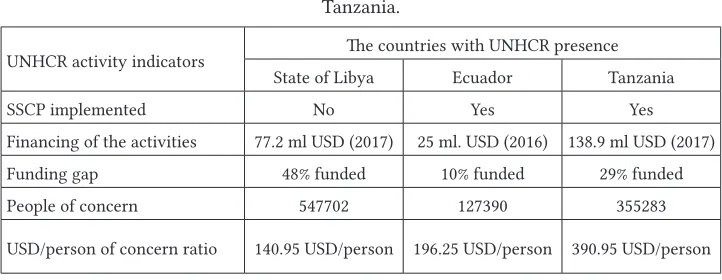
The very first thing to be addressed should be the scrutiny of the UNHCR activities in Libya. Analysing the UNHCR presence and UNHCR activities in the country, we will fill in the comparison table (Table 1) of the UNHCR activities in Libya and in countries that face similar challenges connected to the uncontrolled refugee flows. What is more, we will assess the need for the UNHCR interference and the resources allocated for such interference. Moreover, the appropriateness of the allocation of the resources will also be assessed.
political context in these countries, we address these countries as they all share the same very set of unresolved problems linked to the refugee influxes in these countries. Moreover, Ecuador and Tanzania were selected for the cross-country analysis due to the fact that in both of these countries UNHCR is implementing the Strengthening Protection Capacity Projects (SPCPs) which will be discussed further on.
The comparison will allow us to critically assess the efficiency of the UNHCR operations in Libya and answer the question of whether the activities done under the auspices of UNHCR in Libya may be labelled as the exemplary case of international community realizing action to pursue a Responsibility to Protect.
For the purposes of such an analysis, the primary source of data was chosen to be UNHCR statistics. This was done to avoid the inconsistencies in the gathered primary statistics.
To compare the UNHCR activities across the set of selected countries, we suggest using following indicators: total allocated funds for the activities in these countries, the financing gap (to address the effectiveness of the program implementation in financial terms), the number or the people of concern (i.e. refugees in need of international protection) and the rough calculation of the ratio of the allocated funds to the number of people of concern.
Table 1. The comparison of UNHCR activities across Libya, Ecuador and Tanzania.
UNHCR activity indicators The countries with UNHCR presence State of Libya Ecuador Tanzania
SSCP implemented No Yes Yes
Financing of the activities 77.2 ml USD (2017) 25 ml. USD (2016) 138.9 ml USD (2017)
Funding gap 48% funded 10% funded 29% funded
People of concern 547702 127390 355283
USD/person of concern ratio 140.95 USD/person 196.25 USD/person 390.95 USD/person
Based on UNHCR reports of 2016-2017.
funding gap is significantly higher than those in Ecuador and Tanzania), demonstrate corporately lower allocated assistance amount per person in need, with the activities of UNHCR in Tanzania planned to provide almost 2.8 times more financial assistance for a person of concern than in Libya.
We should notice that the lowest rate of funding gap in UNHCR activities in Libya can be interpreted as a demonstration of the fact that the international community asserts the importance of the necessity of resolving the problems linked with uncontrolled refugee flows in Libya. Highlighting the fact that international community is in fact interested in resolving problems in Libya, such an interpretation may allow one to assume that the claimed funding goal and the related indicator of funding per person of concern should be comparatively substantive. However, the discrepancy between the rates of the successful financing of UNHCR operations and the claimed funding makes us doubt whether the practical side of realization of RtoP by UNHCR in Libya can be labelled as the exemplary case of international community realizing the taken RtoP.
Moreover, the efforts that UNHCR devotes towards the discussed aspect of humanitarian assistance in Libya are not incorporated in the SPCP framework, unlike as in the cases of Ecuador and Tanzania. Defined as a tool to facilitate “national responses to protection problems through a process of protection assessment, dialogue and joint planning” (UNHCR 2017b), SPCPs have been praised for their methodology, which allows for mapping the needs and addressing them (Turk and Eyster 2010, 169). Despite one may make the case of SPCP for Somali refugees as the demonstration that the implementation of SPCP may contradict the very purposes of the project (Betts and Milner 2007), we seek to explore the possibilities and project the outcomes of the SPCP launch in Libya in the further consequent works.
improving the legislation regarding the refugees in Libya. While Libya is still not a party to 1951 Refugee Convention, the application of Voluntary Humanitarian Returns instrument created within the legislation of another important stakeholder, African Union, (established by the Article 5 of 1969 OAU Convention Governing the Specific Aspects of Refugee Problems in Africa) can be seen as an example of the compromise in a bid to resolve the problems linked with upholding the humanitarianism causes while treating the refugees.
Incentivizing Libya to sign and ratify the 1951 Convention and adopt the additional subsidiary protection mechanisms down the road should be a priority in a dialogue of EU with Libya. While this may not address the problem Libya in short-term, we assume that this will have a positive effect on the situation with refugee flows in the long run.
With what regards other examples of the actions taken to alleviate the current problems, one may address the experience of the international reaction towards the Second Ivorian Civil War of 2010-2011. While the long-lasting UN mission to Cote d’Ivoire can be harshly criticized in a justified manner for its inability to prevent the civil war, one cannot deny the positive and decisive role UN had in stopping the conflict, which would otherwise last for decades (taking into account the complexities of the ethnic composition of Cote d’Ivoire), and the post-conflict management in the country (Oved 2011).
Due to the escalation of Ivorian conflict, the international community could observe the emergence of what Kreijen called ‘black holes’ of instability, where “regional authorities’, armed factions, and warlords continue to create chaos and instability, as a result of their contest for power” (Kreijen 2004, 73). One of the primary outcomes of the UN intervention was downsizing such ‘black holes’ and providing a protection for the people living on the territories defined by the absence of the legitimate power.
While bearing in mind the previously discussed features of sovereignty the RtoP initiatives possess, we would like to underscore here the character of the intervention and efforts in the post-conflict reconciliation. As both intervention and post-conflict peacebuilding were aimed at protecting the citizens, these actions reaffirmed the potential of the international community to provide protection for the people in need.
very specific category of the people, one can still discuss the possibility to increase the scope and funding of the international humanitarian operations to assist refugees, in which the UN takes on the responsibility to instil the norms of the international refugees law. Reconsidering the scales of the needed humanitarian action in Libya shall aim to secure the rights of the migrants currently in no way protected by the 1951 Convention, as if Libya was a party to the Convention. At the same time, it should not aim to deal with local power balances (as in the case of UN’s Côte d’Ivoire intervention) and instead shall promote and enforce the rights envisaged by international refugees’ law for migrants in Libya. While we are generalizing the proposal here, further study needs to address feasibility and impact down the road.
Findings
Keeping in mind the outcomes of the analysis presented in the passage above, we shall next come to make a set of the recommendations for boosting the framework of the humanitarian protection of the vulnerable groups of refugees in Libya. We should note right at the start, that each of the recommendations presented below is subject to further research and verification of the feasibility of implementation. However, we are sure that the recommended roadmap for solution of the problems related to refugees in Libya present the valuable contribution towards the academic discussion of the post-conflict management in fragile states.
First, we stand firm in saying that the financial part of UNHCR activities in Libya should be revised with an aim to increase both the target funding and the effective funding of the activities. As the refugee situation in Libya should be addressed shortly, the country should be prioritized within the geographical scope of UNHCR activities.
Second, we argue that the possibility of the implementation of SPCP in Libya should be taken into a serious consideration. Bearing in mind the presented argumentation in favour of such a move, we look forward to conducting a follow up research on the feasibility of this recommendation.
Third, the European powers should activate the diplomatic muscles to urge Libyan authorities towards acceding the 1951 Refugee Convention and create a system of subsidiary protection, as this should pave the way for long-term reforming potential and to make viable more sustainable normative on refugees in Libya as to provide better humanitarian relief.
References
Adams, S. (2015) ‘Failure to Protect: Syria and the UN Security Council’, Global Centre for the Responsibility to Protect, Occasional Paper Series, No. 5, March.
Akande, D. (2011) ‘What does UN Security Council Resolution 1973 permit?‘, 23 March, retrieved from: https://www.ejiltalk.org/what-does-un-security-council-resolution-1973-permit/ (accessed: 07/11/2017). Bellamy, A., and Williams, P. D. (2011) ‘The new politics of protection? Cote
d’Ivoire, Libya and the responsibility to Protect’, International Affairs, 87:4, 825-850.
Betts, A., and Milner, J. (2007) The Externalisation of EU Asylum Policy: The Position of African States. Copenhagen: Danish Institute for International Studies Brief.
Call, C. (2010) ‘Beyond the ‘failed state’: Toward conceptual alternatives’, European Journal of International Relations, 17:2, 303-326.
De Waal, A. (2013) ‘African Roles in the Libyan conflict of 2011’, International Affairs, 89:2, 365-379.
Fund for Peace (2017) ‘Fragile States Index: decade trends’, retrieved from: http://fundforpeace.org/fsi/decade-trends/ (accessed: 09/12/2017). Glanville, L. (2015) ‘The Myth of Traditional Sovereignty’, International
Studies Quarterly, 57, 79-90.
Global Centre for the Responsibility to Protect, (2012) ‘Responsibility to Protect after Libya and Cote d’Ivoire’, 20 July, retrieved from: http:// www.globalr2p.org/media/files/background-briefing-r2p-after-libya-and-cote-divoire.pdf. (accessed: 08/12/2017).
Hobson, C. (2016) ‘Responding to Failure: The Responsibility to Protect after Libya’, Millennium: Journal of International Studies, 44:3, 433-454. International Commission on Intervention and State Sovereignty (2001) The
Responsibility to Protect, Ottawa: International Development Research Centre, December.
Kreijen, G. (2004) State Failure, Sovereignty and Effectiveness: Legal Lessons from the Decolonization of Sub-Saharan Africa. Leiden: Martinus Nijhoff Publishers.
Kuperman, A. J. (2013) ‘A model humanitarian intervention? Reassessing NATO’s Libya campaign’, International Security, 38:1, 105–136.
Lambert, H. (2013) ‘European refugee law and transnational emulation’, in H. Lambert, J. McAdam, and M. Fullerton, The Global Reach of European Refugee Law, Cambridge: Cambridge University Press, 1-23
Luck, E. (2015a) ‘The Individual Responsibility to Protect’ in Rosenberg, S., Galis, T., and Zucker, A (eds), Reconstructing Atrocity Prevention, New York: Cambridge University Press, 207-249.
Luck, E. (2015b) ‘R2P at Ten: ‘A New Mindset for a New Era?’, Global Governance 21, 499–504.
Medecines Sans Frontieres (2017) ‘Libya: Open letter – European governments are feeding the business of suffering’, 6 September, retrieved from: http://www.msf.org/en/article/libya-open-letter-european-governments-are-feeding-business-suffering (accessed: 01/12/2017). Ministero degli interni (2017) ‘Cruscotto statistico giornaliero’, 11 December,
retrieved from: http://www.interno.gov.it/sites/default/files/ cruscotto_statistico_giornaliero_11-12-2017.pdf (accessed: 12/12/17). Morris, J. (2013) ‘Libya and Syria: Responsibility to Protect and the spectre of
the swinging pendulum’, International Affairs, 89:5, 1265–1283.
Moses, J. (2014) Sovereignty and Responsibility: Power, Norms and Intervention in International Relations, London: Palgrave Macmillan UK.
Newman E. (2007) ‘Weak States, State Failure, and Terrorism’, Terrorism and Political Violence, 19:4, 463-488.
Orford, A. (2011) International Authority and the Responsibility to Protect, New York: Cambridge University Press.
Oved, M. C. (2011) ‘In Côte d’Ivoire, a Model of Successful Intervention’, 9 June, retrieved from: https://www.theatlantic.com/international/ a rc h i ve / 2 0 1 1 / 0 6 / i n c t e d i vo i re a m o d e l o f s u c c e s s f u l -intervention/240164/ (accessed: 10/12/17).
Rijke, N. (2014) ‘Intervention in Libya: A Crime of Aggression?’, International Crime Database, brief 4, March.
Serrano, M. (2011) ‘The Responsibility to Protect: Libya and Cote d’Ivoire’, Amsterdam Law Forum, 3:3, 92-101.
Thakur, R. (2013) ‘R2P after Libya and Syria: Engaging Emerging Powers’, The Washington Quarterly, 36:2, 61-76.
Thakur, R. (2016) ‘The Responsibility to Protect at 15’, International Affairs, 92:2, 415–434.
Turk, V., and Eyster, E. (2010) ‘Strengthening Accountability in UNHCR’, International Journal of Refugee Law, 22:2, 159–172.
UNGA (2005) ‘2005 World Summit Outcome’, UN Doc. A/RES/60/1, 24 October. UNHCR (2016) ‘Ecuador Operation Funding Update’, 29 November, retrieved
from: http://reporting.unhcr.org/sites/default/files/UNHCR%20 Ecuador%20Factsheet%20-%20February%202017.pdf (accessed: 10/12/17).
UNHCR (2017a) ‘Ecuador’, retrieved from: http://reporting.unhcr.org/ node/2543 (accessed: 10/12/17).
UNHCR (2017b) ‘Strengthening Protection Capacity’, retrieved from: http:// www.unhcr.org/strengthening-protection-capacity.html (accessed: 10/12/17).
UNHCR (2017c) ‘Tanzania – Refugee Population Update’, 14 August, retrieved from: https://data2.unhcr.org/en/documents/download/58879 (accessed: 10/12/17).
UNHCR (2017d) ‘Tanzania Operation Funding Update’, 28 November, retrieved from: http://reporting.unhcr.org/sites/default/files/ United%20Republic%20of%20Tanzania%20Funding%20Update%20 28%20November%202017.pdf (accessed: 10/12/17).
UNHCR (2017e) ‘UNHCR Libya Response in 2017’, 11 December, retrieved from: http://reporting.unhcr.org/sites/default/files/UNHCR%20 Libya%20Dashboard%20%20-%2011DEC17.pdf (accessed: 10/12/17). UNSC (2011a) ‘Resolution 1970 (2011) adopted by the Security Council at its
6491st meeting, on 26 February 2011’, S/RES/1970.
UNSC (2011b) ‘Resolution 1973 (2011) adopted by the Security Council at its 6498th meeting, on 17 March 2011’, S/RES/1973.