DOI 10.15415/jce.2016.31003
Journal of Chemistry, Environmental Sciences and its Applications Vol. 3, No. 1 September 2016 pp. 35–43
Optical and Structural Modifications of γ irradiated
Cr-39 Polymers
D P GUPTA
School of Applied sciences, Chitkara University, Rajpura, Patiala, 140401, India
*Email: [email protected]
Received: October 09, 2016 | Revised: October 11, 2016 | Accepted: October 19, 2016
Published Online: September 05, 2016
The Author(s) 2016. This article is published with open access at www.chitkara.edu.in/publications
Abstract The UV-Visible absorption spectra of CR-39 polymer, unirradiated
and irradiated to gamma radiation up to 500 kGy dose were studied. The development of new peaks, shifting of absorption bands and their broadening as a result of gamma irradiation were observed and analyzed. The values of optical constant like direct and indirect band gaps have been determined. The values of indirect band gap have been found to have lower values then the corresponding values of direct band gap. The increase in carbon conjugation length and size of carbon clusters has also been pointed out from the results of UV-Visible spectroscopy.
1.INTRODUCTION
CR-39 is a polymer formed from diallyl monomer made by polymerization of diethyleneglycol bis allylcarbonate (ADC) in presence of diisopropyl peroxydicarbonate (IPP) initiater. The presence of the allyl groups allows the polymer to form cross- links; therefore, it is a thermoset resin. CR-39 is transparent in the visible spectrum and is almost completely opaque in the UV range. It has high abrasion /scratch resistance and has weight about half of the glass. It is an advantageous material for making eyeglasses and sunglasses. CR-39 is also resistant to most solvents and other chemicals, and to material fatigue. It is also used in a number of industrial and medical applications. The most recent studies with CR-39 involve neutron gamma and high energy ion irradiation induced changes in its structure and properties.
Gupta, DP volatile species (1–3). Chong et al. (4) has been made a study on the UV-VIS and FTIR spectra of CR-39 plastics irradiated with 50 kVp tube X-rays in the dose range 0 and 45 MR. The optical transmittance over the wavelength region of 200–1000 nm was found to decrease with the X-ray exposure, much greater decrease being observed in the UV region. The IR absorption spectra of the irradiated samples show the presence of two new strong absorption bands at the frequencies 655 and 2340 cm−1 i.e. an indicative of the gas CO
2 produced inside the plastic. The absorbance of these bands increases linearly with the X-ray dose. Fink et al. made an attempt of FTIR studies on low energy Ar ion irradiated Polycarbonate [5] using nuclear magnetic resonance spectroscopy. Malek et al. studied the X-ray and γ- ray induced degradation of Cr-39. They studied the diffusion of CO2 with time. Navarro et al (7) showed that PC irradiation is accompanied with the preferential release of carbon monoxide followed by minor production of hydrogen, carbon dioxide and methane.
The effects of 320 keV Ar and 130 keV He ions at fluences ranging from
1 × 10¹³ to 2 × 10¹⁶ ions/cm2 ion-beam bombardment on the physical and chemical properties of poly CR-39 have been investigated by Abdul-Kader et al. (8). UV–VIS spectra of bombarded samples reveal that the optical band
gap decreases with increasing ion fluence for both Ar and He ions. In the
FTIR spectra, changes in the intensity of the bands on irradiation relative to pristine samples occurred with the appearance of new bands. XRD analyses showed that the degree of ordering of the CR-39 polymer is dependent on
the ion fluence. Changes of surface layer composition and an increase in the
number of carbonaceous clusters produced important change in the energy gap and the surface wettability. The surface hardness increased from 10.54 MPa for pristine samples to 28.98 and 23.35 MPa for samples bombarded
with Ar and He ions at the highest fluence, respectively. The physical and
chemical properties of polymer electrolyte (PEO-CdCl2) films irradiated with γ- rays were investigated by Raghu et al. (9). The degradation of
the irradiated films was observed mainly due to chain scission/cross
linking. The thermal stability and crystallinity were also found to decrease
Optical and Structural
Modifications of γ irradiated Cr-39 Polymers
In the present work we investigated physical and chemical response of γ-radiation on CR-39 polymer, specially the modification in the optical,
chemical and structural properties through UV/Vis spectrometry.
2.EXPERIMENTAL
The samples of about 30×30 mm size of CR-39 were cut from flat sheets of
thickness 250 micron. These samples were put in polyethylene sachets and irradiated with γ- radiation from a 60Co γ- source in air at room temperature at a dose rate 2.76 kGy/h at Bhabha Atomic Research Center, Mumbai (India). The samples were irradiated for various time periods to obtain the total accumulated γ- radiation doses as 1, 2, 5, 10, 20, 50, 117, 199 and 500 kGy
respectively.
The optical absorption spectra were recorded at room temperature in the wavelength range 190 to 900 nm with the help of Shimadzu Double Beam Double Monochromator UV- Visible spectrophotometer (UV-2550) with a resolution of 0.05 nm. The samples were placed in the integrating sphere assembly ISR-240A attached with the spectrophotometer. The air was taken as reference. From these data the optical constants such as optical band gap (both direct and indirect) were determined.
3.RESULTS AND DISCUSSIONS
The unirradiated CR-39 samples are colorless. The visual observations of
irradiated films indicate that the CR-39 samples above 50 kGy turn yellow
with the increase of γ radiation dose and ultimately turn to dark brown at 500 KGy γ absorbed radiation dose. The CR-39 films also become brittle with increasing dose of γ radiation.
The UV- Visible absorption spectra of unirradiated and γ irradiated CR-39 films with a dose of 20, 50, 117, 199, and 500 KGy in the wavelength range
190 to 350 nm in terms of absorbance (α) Vs γ-radiation dose are shown in Figure 1. Since at lower doses (1, 2, 5 and 10 kGy) there was no significant
difference in the spectra of irradiated CR-39 samples, therefore for simplicity their spectra are not shown.
It is clear from the Figure 1 that above 350 nm, no significant absorption occurs and a flat plateau region is observed for all radiation doses. Above 20
Gupta, DP
chemical species as a result of energy deposition from the incident γ- rays. This energy deposition may lead to the ionization and excitation leading to the breaking of original bonds, chain scission, radical formation, cross linking etc. [2, 7, 8]. This in turn results in the formation of radicals, cations, anions, double/ triple bonds or aromatic species etc. The other possibility for red shift and coloration of CR-39 can be due to the increase in conjugation of double bonds (polyene formation) and formation of carbonaceous clusters with the
increase in γ absorbed dose as reported earlier by other workers also [8].
3.1 Determination of Energy Band Gap
The study of optical absorption gives information about the band structure
of solids. The insulators/ semiconductors are generally classified into two
Optical and Structural
Modifications of γ irradiated Cr-39 Polymers
form of a photon of light. This is a radiative transition. In indirect band gap materials the transition across the band gap does not conserve momentum and is forbidden. This recombination occurs with the mediation of a third body, such as a phonon or a crystallographic defect, which allows the conservation of momentum. This recombination often releases band gap energy as phonon instead of photon. Davis and Shilliday (11) showed that near the fundamental band edge, both direct and indirect transitions occur. These can be determined by plotting α1/2 and α2 against frequency where α is called absorbance. According to Thutupalli and Tomlin (12) the direct and indirect band gap (Egd and Egi respectively), of a semiconductor are related to the absorbance (α) as follows:
(nαhν) = A (hν- Egd) 1/2 (nαhν) = B (hν- Eg
i) 2
Where hν is the photon energy, n is the refractive index and A and B are constants. These relations have also been found to hold good for polymers also (13).
For the determination of nature and width of direct and indirect band gaps (αhν)2 and (αhν)1/2 were plotted as a function of photon energy (hν)
Figure 2: (αhν)2 versus photon energy (hν) eV curves of unirradiated and irradiated
Gupta, DP
respectively, taking into account the linear portion of the fundamental absorption tail of the UV- visible spectra as shown in Figures 2-3. The direct band gap energies were determined by extrapolating the linear portions of the (αhν)2 vs. hν (photon energy) curves, from the intercepts of the best fit lines on hν axis as shown in Figure 2.
Figure 3: (αhν)1/2 versus photon energy (hν) eV\ curves of unirradiated and irradiated
CR-39films.
Table 1: Direct and indirect optical band gaps of unirradiated and irradiated CR-39films.
γ- radiation
dose (kGy)
Band Gap (eV) Regression
Coefficient ‘R’
Direct indirect
Unirradiated 4.23 3.52 0.99
20 4.19 3.50 0.99
50 4.18 3.46 0.99
117 4.15 3.42 0.99
199 4.12 3.35 0.99
Optical and Structural
Modifications of γ irradiated Cr-39 Polymers
The indirect band gaps were obtained from the (αhν)1/2 versus (hν) photon energy curves in the similar manner as shown in Figure 4.
These values along with their slandered errors have been determined for unirradiated and CR-39 samples irradiated to different doses of γ- radiation and the values of direct and indirect band gaps are presented in Table 1.
The magnitude of regression coefficient, have been found to be greater than 0.99 for the fitted lines as shown in Figures [2–3] for the determination of
absorption edge, direct band gap and indirect band gaps. This in turn clearly indicates the simultaneous existence of direct and indirect band gap in CR-39 polymer with decreasing tendency with the increasing γ- radiation dose. The values of indirect band gap have been found to be lower than the corresponding values of the direct band gap in the CR-39 polymer subjected to γ- radiation.
3.2 Conjugation Length:
From the abscissas of (αhν)1/2 versus photon energy (hν) plots in Figure 3 of irradiated CR-39 the number of carbon atoms per conjugation length has been calculated using Robertson’s and O’reilly relation (13, 14) given by equation (1)
N Eg
=2βπ (1)
Where, N is the number of carbon atoms per conjugation length for a linear chain polymer. 2β is the band structure energy of a pair of adjacent π site. The value of β is taken to be -2.9 eV as it is associated with π- π* optical transition in C=C structure. Eg was taken as the lower value of band gap i.e. the indirect
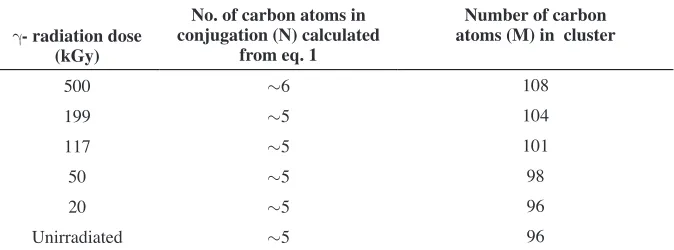
Table 2: The number of carbon atoms in conjugation calculated from eq. 1 along with the data number of carbon atoms (M) in cluster.
γ- radiation dose (kGy)
No. of carbon atoms in conjugation (N) calculated
from eq. 1
Number of carbon atoms (M) in cluster
500 ~6 108
199 ~5 104
117 ~5 101
50 ~5 98
20 ~5 96
Gupta, DP energy band gap. The number of carbon atoms in conjugation (N) calculated from above equation in the present work at different doses of γ -radiation is given in Table 2.
It is evident from Table 2 that the results calculated from eq. 1 show increase in the C=C conjugation length as reported earlier also (2).
3.3 Carbon Cluster Size:
It is also understood (Fink et al.) (3) that theRobertson’s equation underestimates the cluster size in the irradiated polymers. They have accordingly assumed the structure of the clusters to be buckministerfullerene, i.e. comprising of C60 rings instead of C6, arriving at the relation
E
M
g= 34 3. ,
Where M is the number of carbon atoms per cluster. The above relation can be used to obtain the number of carbon atoms per cluster in irradiated polycarbonate. Thus,
M
Eg
=
(
34 3)
2
2
.
(2)
CONCLUSIONS
The visual inspection of CR-39 films exposed to γ radiation show yellowing of the samples with the increase of γ absorbed dose. UV-Vis spectrometric studies of virgin and γ- irradiated CR-39polymer reveals the coexistence of
direct and indirect band gaps simultaneously. The indirect band gap values are found lower as compared to the corresponding values of direct band gap in the unirradiated and γ- irradiated CR-39 polymer. Both types of the optical band gap energies have decreasing tendency with the increasing γ radiation dose. The intensity patterns of various bands appearing in the UV-Vis and FTIR spectra of γ irradiated CR-39 show the structural modifications that
Optical and Structural
Modifications of γ irradiated Cr-39 Polymers REFERENCES
[1] Gupta D. P, Chauhan R. S, Kumar Shyam, Diwan P. K, Khan S. A, Tripathi A, Singh F, Ghosh S, Avasthi D. K and Mittal V. K (2006) Radiat. Effects and Defects in Solids 161,
331.
[2] Gupta D. P, Kumar Shyam, Kalsi P. C, Manchanda V. K and Mittal V. K, (2012) Radiat. Effects and Defects in Solids 167, 149.
[3] Fink D, Klett R, Chadderton L. T, Cardoso J, Montiel R, Vazquez H and Karanovich A.
A, (1996) Nucl. Instrum. and Methods B 111, 303.
[4] Chong C. S, Ishk I, Mahat R. H and Amin Y. M, (1997) Radiat. Meas. 28, 119.
[5] Fink D,Muller M, Cannington P. H, Elliman R. G and Macdonalt D. C, (1996) Radiat. Effects and Defects in Solids 132, 313.
[6] Malek M. A and Chong C. S, (2002) Radiat. Effects and Defects in Solids 35 203.
[7] Navarro-Gonzalez R, Aliev R, (2000) Polym Bull 45, 79.
[8] Abdul-Kader A. M, Basma A. El-Badry, Zaki M. F, Tarek M. Hegay and Hany M. Hasem, (2010) Philosophical Magazine 90, 2543.
[9] Raghu S, Archana K, Sharanappa C, Ganesh S, Devendrappa H (2015),Journal of Non-Crystalline Solids 426, 55.
[10] Sinha Dipak, (2012) Advances in Applied Science Research, 3(3),1365-1371
[11] Davis P. W and Shilliday T. S, (1960) Phys. Rev. 118, 1020.
[12] Thutupalli G. K. M and Tomlin S. G, (1976)J. Phys. D: Appl. Phys. 91, 639. [13] Phukan T, Kanjilal D, Goswami T. D and Das H. L, (2003) Rdiat. Meas. 36, 611. [14] Fink D, Chang W. H, Klett R, Schmolt A, Cardoso J, Montiel R, Vazquez M. H, Wang L,
Hosoi F, Omochi H, Oppelt-Langer P, (1995) Radiat. Effects and Defects in Solids 133,