INTRODUCTION
Regardless of a wide range of surgical tech-niques applied within all surgical specialties, any surgeon’s job is essentially connected with cut-ting through tissues and joining them. The most common implant material is a surgical suture which, being a biomaterial intended for the im-plantation into tissues of a human body, needs to have proper physiomechanical and functional properties as well as meet specific biological re -quirements [6, 8].
The application of suture material of unsuit-able mechanical properties can compromise phy-sicians’ efforts, whereas premature separation of wound edges can jeopardise patient’s health or even life. The suture must retain an adequate level of tensile strength during the whole period of im-plantation. In the case of non-absorbable sutures, decrease in tensile strength can lead to suture fail-ure, as a consequence of postoperative
progres-sive oedema or overly dynamic movements of a patient. Premature strength loss on account of suture material absorption occurring before the healing process completes results in wound dehis-cence. On the other hand, excessively low tensile properties may contribute to the suture acting like a surgical knife, cutting through surrounding tissues. Another significant factor characteris -ing available sutures is easy handl-ing, which comprises tissue penetration, smooth knot run-down and repositioning as well as knot hold-ing capacity. The aim of the study is to deter-mine the influence of environmental factors on strength properties of selected surgical sutures in a series of static tensile strength tests, the results of which are subjected to statistical analysis and presented [1, 2, 5, 7, 9]. The concept concern-ing the history of surgery and materials used for joining tissues as well as a detailed classifi -cation of such materials are described in more detail in literature [3, 4].
EFFECT OF RINGER’S SOLUTION ON TENSILE STRENGTH OF
NON-ABSORBABLE, MEDIUM- AND LONG-TERM ABSORBABLE SUTURES
Robert Karpiński1, Jakub Szabelski2, Jacek Maksymiuk3
1 Department of Machine Design and Mechatronics, Faculty of Mechanical Engineering, Lublin University of Technology, Nadbystrzycka 36, 20-618 Lublin, Poland, e-mail: [email protected]
2 Section of Biomedical Engineering, Institute of Technological Systems of Information, Faculty of Mechanical Engineering, Lublin University of Technology, Nadbystrzycka 36, 20-618 Lublin, Poland
3 Orthopedic Department, Łęczna Hospital, Krasnystawska 52, 21-010 Łęczna, Poland, e-mail: jacek@ maksymiuk.pl
Research Journal
Volume 11, Issue 4, December 2017, pages 11–20
DOI: 10.12913/22998624/76084 Research Article
ABSTRACT
The paper presents an experimental and correlational study of mechanical prop-erties of selected surgical sutures. The research methods employed in the study consisted in conducting tensile strength tests on suture material and subjecting the obtained data to statistical analysis. The changes in tensile strength of absorbable sutures measured in tests were subsequently collated with results for suture material samples that were not exposed to Ringer’s solution. The results were, furthermore, compared with manufacturer’s specifications concerning suture absorption time in the body. The detailed analysis of differences between results presented in the study allowed us to formulate conclusions regarding the impact of exposure to Ringer’s solution on the strength of surgical sutures.
Keywords: surgical sutures, biomaterials Received: 2017.07.25
MATERIALS AND METHODS
To identify the impact of selected environ-mental factors on mechanical properties of surgi-cal sutures, physisurgi-cal tests were carried out. The study consisted in loading the suture material in tension to measure its linear tensile strength im-mediately after unpacking (pre-immersion), and collating the results with the second group of suture samples that were exposed to Ringer’s solution for a particular period of time (post-im-mersion). The sutures were tested and stored at a temperature of 22°C.
There were nine different types of surgical sutures selected for testing. They were divided according to absorption time in the body into non-absorbable and absorbable sutures. The two groups were additionally subdivided into monofil -ament and multifil-ament, based on their structure. The intervals between subsequent tensile strength tests reflected periods of mass suture absorption declared by particular manufacturers. Tests em-ployed Ringer’s solution, i.e. an isotonic solution, of identical osmotic potential as plasma, 1000 ml of which contains 8.6 g of sodium chloride, 0.3 g of potassium chloride, 0.33 g of calcium chloride dihydrate which corresponds to the fol-lowing electrolyte levels: sodium – 147 mmol/l, potassium – 4 mmol/l, calcium – 2.2 mmol/l, chlorides – 156 mmol/l.
All non-absorbable sutures were subjected to tests immediately after unpacking (W0) and following specified Ringer’s solution exposure time periods (W1-W4). Letter W paired with a number indicates a corresponding number of weeks during which a suture was placed in a solution. The testing conditions in the case of absorbable sutures were identical, except that in short-term absorbable sutures the intervals be-tween subsequent test series were shortened with a view to providing a more detailed observation of undergoing changes. In the case in question, the series was marked with letter D paired with a number corresponding to the number of days im-mersed in a solution.
The sutures were cut into 20 cm long pieces. The diameter was measured with a micrometer by MIB, model IP 54 with the accu-racy of 0.001 mm. Afterwards, the measured ten-sile strength was compared with the one provided on the packaging.
The testing was carried out on a test set-up comprising MTS Bionix – Servohydraulic Test
System universal testing machine located in the Institute of Technological Systems of Informa-tion. MTS TestWorks software allowed us to adjust the tensile loading speed according to the structure of the suture under examination – 10 mm/min for multifilament and 25 mm/min for monofilament materials. The test was automati -cally stopped when the load dropped by 75% at a short interval (suture failure). In order to verify the occurrence of discrepancies between the re-sults obtained for a particular suture, statistical analysis was conducted in Statistica 12.5.
TENSILE STRENGTH OF
NON-ABSORBABLE SUTURES
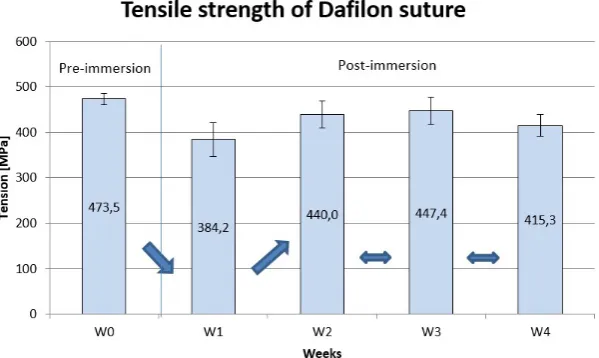
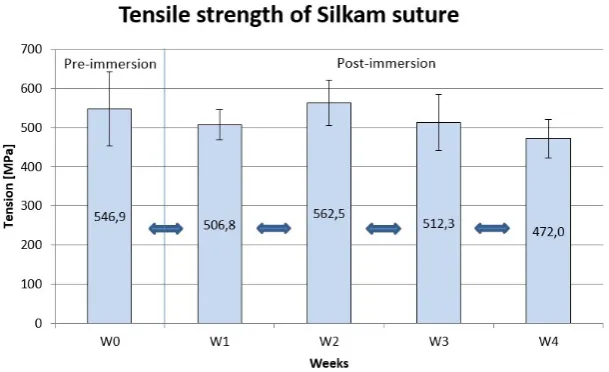
Average arithmetic values of non-absorbable suture tensile strength, accounting for the coef-ficient of variation for each test sample during particular weeks, are presented in Fig. 1–4. The results for particular test series were divided into material tested pre-immersion and post-immer-sion.The coefficient of variation for each non-absorbable suture was lower than 20%. Conse-quently, the scatter of the results was rather low.
Based on statistical analysis of shear strength test results for non-absorbable sutures, it was observed that all values were of normal distribu-tion (for the Kolmogorov-Smirnov, Lilliefors and Shapiro-Wilk tests p > α = 0.05). There is no rea -son to reject the hypothesis concerning the normal distribution of the obtained results, which makes it possible to employ t-Student tests to evaluate the differences between average results.
Tests conducted on non-absorbable suture material lead to the following observations: • statistical analysis of Dafilon sutures strength
test results shows substantial differences be -tween series of samples tested pre-immersion (W0), post-immersion and samples exposed to Ringer’s solution for 7 days (W1), certain dis-crepancy was also observed between W0 and W4 as well as W1 and W2 series.
•
results for Premilene, PremiCron and
Silk-am sutures were broadly consistent,
inas-much as there were no statistically signifi
-cant differences between the strength of
either of suture material groups
(pre-im-mersion and post-im(pre-im-mersion), including
samples following longer exposure time
to Ringer’s solution.
consecutive sample series within a given suture, arrows were placed in Fig. 1–4 to illustrate the change. In the case of no substantial differences, the arrows between the bars representing consec-utive series were horizontal, increasing strength was represented by up arrow and down arrow il-lustrated decreasing strength.
TENSILE STRENGTH OF ABSORBABLE
SUTURES
Absorbable sutures were additionally divided into two groups based on the time of their absorp-tion into:
• short-term absorbable sutures (Monosyn Quick and Safil Quick), complete absorption of suture mass in less than 56 days
• medium-term and long-term absorbable su-tures (Novosyn, Monosyn, MonoPlus), com-plete absorption of suture mass is more than 56 days.
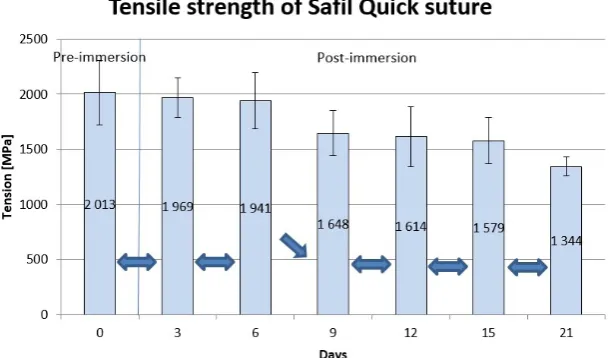
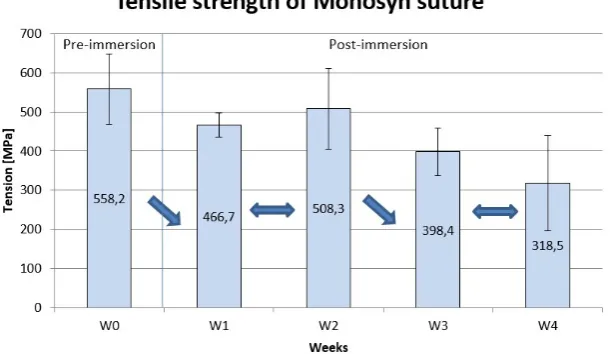
Average arithmetic values of absorbable su-ture tensile strength, accounting for the coeffi -cient of variation for each test sample over par-ticular weeks, are presented in Fig. 5–6 (short-term absorbable sutures), 7–9 (medium-(short-term and long-term absorbable sutures). The results for individual series are demonstrated on the bar graphs below focusing on the division into su-tures tested pre-immersion and post-immersion in Ringer’s solution.
The coefficient of variation for all short-term absorbable suture material was lower than 20%,
therefore the scatter of results is rather low. The coefficient of variation in medium-term and long-term absorbable sutures amounted to even 40%, which means the results are moderately varied.
Statistical analysis of tensile strength of short-, medium- and long-term absorbable sutures shows that all measured values were of normal distribu-tion, for the Kolmogorov-Smirnov, Lilliefors and Shapiro-Wilk tests p > α = 0.05. Therefore there is no reason to reject the formulated hypothesis about the normal distribution of obtained results.
Tests and analysis conducted on absorbable suture material lead to the following observations: • statistical analysis of Monosyn Quick sutures,
showed no substantial differences between the pre-immersion (D0) and post-immersion sam-ple series, including samsam-ples exposed to solu-tion for three (D3), six (D6), nine (D9) and 12 days (D12). Major discrepancies, however, occurred between the series tested during the 12th (D12) and 15th (D15) day of immersion. There were no significant differences between the series under examination during the 15th (D15) and 21st (D21) day in the solution. • statistical analysis of Safil Quick sutures
showed that no substantial differences between the pre-immersion samples (D0), including samples exposed to the solution for three days (D3) and six days (D6). Major discrepancies, however, occurred between the series tested during the 6th (D6) and 9th (D9) day of im-mersion. There were no significant differences
between the series under examination
dur-ing the 9th (D9), 12th (D12), 15th (D15)
and 21st (D21) day in the solution.
Fig. 3. Tensile strength of PremiCron suture material, including results of verification of equality of average values between consecutive sample series
Fig. 4. Tensile strength of Silkam suture material, including results of verification of equality of average values between consecutive sample series
Tests and analysis of medium-term and long-term absorbable suture material lead to the fol-lowing observations:
• statistical analysis of Novosyn sutures showed substantial differences between the series pre-immersion samples of suture material (W0) and samples at exposure time of seven days (W1). There were no significant differences between the series under examination during the 7th (W1), 14th (W2), 21st (W3), 28 (W4) and 35th (W5) day of immersion the solution. • statistical analysis of Monosyn sutures
showed that there were substantial differences between the series of pre-immersion samples (W0) and samples immersed for seven days (W1). There were no significant differences
between post-immersion after 7 (W1) and 14 (W2) days of exposure to the solution. Major discrepancies, however, occurred between the samples after 14 (W1) and 21 (W3) days in the solution. There were no significant differences noted between the samples tested in tension on the 21st (W3) and 28th (W4) day from immer-sion in the solution.
• statistical analysis of MonoPlus sutures showed no substantial differences between pre-immersion and post-immersion samples, as well as between the samples which re-mained in the solution and were tested weekly. Following the analysis of obtained values, at a standard significance level (α=0.05), for consecu -tive sample series within a given suture, arrows Fig. 5. Tensile strength of Monosyn Quick suture material, including results of verification of equality of average
values between consecutive sample series
were placed in Fig. 5–9 to illustrate the change. In the case of no substantial differences, the arrows between the bars representing consecutive series were horizontal, increasing strength was repre-sented by up arrows and down arrow illustrated decreasing strength.
COMPARISON OF STRENGTH OF SHORT-TERM ABSORBABLE SUTURES
Strength of short-term absorbable sutures was compared with percentage decrease in tensile strength. Initial strength was the strength of pre-immersion specimens, not subjected to Ringer’s solution (D0). The results of the comparison are shown in Fig.10.
The reference value for the comparison was the average tensile strength of suture mate-rial measured in the first series of tests. After 3 days, the strength of braided multifilament Safil Quick suture decreased by mere 2%, whereas in monofilament Monosyn Quick suture, the de -crease was more significant, amounting to 11%. After 6 days’ exposure to Ringer’s solution, the strength of Safil Quick was equal to 96% of initial strength, and in the case of Monosyn Quick, 88%. Average strength of Safil Quick suture material tested on 9th, 12th and 15th day in the solution was equal to 82%, 80% and 72% respectively; the respective values for the Monosyn Quick were: 88%, 87% and 72%. After 21 days, the decrease in strength for both suture materials was
compa-Fig. 7. Tensile strength of Novosyn suture material, including results of verification of equality of average values between consecutive sample series
rable, amounting to 33% in Safil Quick and 36% in Monosyn Quick.
COMPARISON OF STRENGTH OF MEDIUM-TERM AND LONG-MEDIUM-TERM ABSORBABLE SUTURES
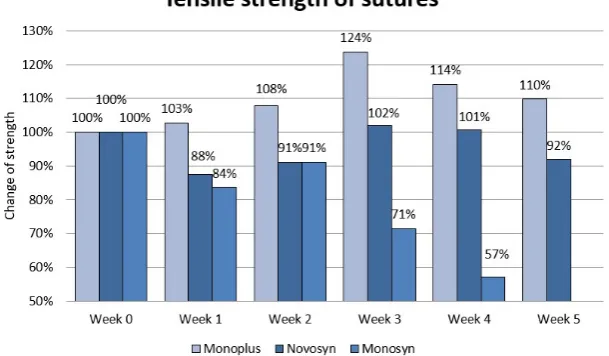
Degradation of strength of medium-term absorbable sutures was measured in percentage points and compared for different sutures test -ed. The reference value was the average tensile strength of suture material immediately after un-packing, and not subjected to Ringer’s solution (W0). The results of the comparative analysis are shown in Fig. 11.
The reference value for the comparison was the average tensile strength of suture mate-rial measured in the first series of tests. Average
strength of particular suture material samples af-ter 7 days’ exposure time was as follows: Novo-syn – 88%, MonoNovo-syn – 84%, MonoPlus – 103%. Average strength of sutures after 14 days of ex-posure time was higher, compared to the former series of tests, and amounted to 91% of the refer-ence value for Novosyn and Monosyn, and 108% in the case of MonoPlus.
On the third week of exposure to Ringer’s so-lution these were MonoPlus samples that exhib-ited the highest strength (124% of the reference value), which, however, began to decrease in the following weeks (114% after 28 days and 110% of the reference value after 35 days of exposure). Tensile strength of Novosyn suture increased to 102% after 3 weeks, noted a slight decrease to 101% after 4 weeks, which was subsequently fol-lowed by a further decrease to 92% after 5 weeks’ Fig. 9 Tensile strength of MonoPlus suture material, including results of verification of equality of average val
-ues between consecutive sample series
exposure time. Average tensile strength of Mono-syn suture was the lowest recorded in tests and amounted to 71% of initial strength after 21 days in Ringer’s solution, and 57% after 4 weeks.
CONCLUSIONS
Statistical analysis of tensile strength test re-sults for non-absorbable sutures Dafilon, Premi -Cron, Premilene and Silkam, at a standard signifi -cance level, α = 0.05, did not show statistically significant change in tensile strength. Therefore, tensile strength retention declared by the manu-facturer was confirmed in tests, which proves that the sutures retain their strength properties throughout exposure to body fluids until the re -moval of stitches (usually 7-10 days).
Statistical analysis of tensile strength test re-sults for short-term absorbable sutures demon-strated significant differences between both su -ture materials. Monosyn Quick retained its initial tensile strength until the 12th day of immersion in the solution, after which time the strength notably decreased in the period of 12–15 days. Between days 15 and 20, no major differences in tensile strength were observed. Initial tensile strength of Safil Quick suture was retained for the period of 6 days of exposure to Ringer’s solution. Af-terwards, between days 6 and 9, a considerable loss of tensile strength was observed, after which time (and between days 9 and 21) no significant changes in tensile strength of the suture material were recorded. These observations are further-more confirmed in statistical analysis, conducted
at a significance level α = 0.05. A comparative analysis of tensile strength of tested short-term absorption suture material, consisting in relating average strength of sutures recorded in particu-lar tests to the average strength of pre-immersion material, shows that exposure time of 21 days significantly affects its tensile strength properties. The strength of Monosyn Quick in that period of time amounted to 64% of initial strength, whereas in the case of Safil Quick 67%.
According to tensile strength retention de-clared by the manufacturer, Safil Quick should demonstrate 50% of initial strength for the first five days in the body, and 0% in 10–14 days post implementation. Results from our own statisti-cal analysis show that significant loss of tensile strength occurs between 12th and 15th day of exposure, whereas the strength of suture mate-rial after 15 days demonstrated 78% of initial tensile strength. In Monosyn Quick, the manufac-turer declared tensile strength retention of 50% throughout the first 7 days post implementation, and complete absorption after 21 days. Our analy-sis, at the assumed level of tolerance, showed de-crease in tensile strength between 6–9 days’ post-immersion. The tensile strength of suture material not exposed to the solution, however, showed the decrease by 12% on day 9, and by 36% on day 21.
Statistical analysis of tensile strength of me-dium- and long-term absorbable sutures showed considerable decrease in the strength of the for-mer suture material, represented by Novosyn and Monosyn sutures. Finally, no significant change in tensile strength of long-term absorbable Mono-Plus suture was observed in the tests. In tests, ten-Fig. 11 Strength retention of medium- and long-term absorbable sutures relative to Ringer’s solution exposure
sile strength of Novosyn suture demonstrated an initial decrease by 12%, compared to pre-immer-sion material, which was recorded on the 7th day of exposure. Tensile strength of the suture mate-rial in question in successive weeks was equal to the respective: 92% in week 2, 102% in week 3, 101% in week 4 and 92% of initial strength in week 5. The comparison of tensile strength was conducted on data representing average tensile strength of suture material measured in particular test series and did not account for coefficient of variation. In Novosyn suture material, statistical analysis showed a marked decrease after the first 7 days of post-immersion, whereas no significant changes were observed between days 7 and 35 of exposure. According to manufacturer’s data, No-vosyn suture should retain 75% of initial strength in 14 days post implementation, and absorb com-pletely in between 56–70 days.
Analysis of tensile strength retention of Mono-syn suture material shows that after 7 days expo-sure to Ringer’s solution the decrease in strength was equal to 16%. After 14 days the material demonstrated 92% of initial strength, 72% after 21 days and 57% after 28 days. Statistical analy-sis of tensile strength test results of Monosyn su-ture material showed a significant decrease after 7 days exposure time, no notable changes between day 7 and 14, and tensile strength loss between days 14 and 21. Finally, no further strength loss was observed between days 21 and 28. According to manufacturer’s data, Monosyn should demon-strate 50% initial tensile strength throughout the first 14 days of exposure, and complete degrada -tion of strength reten-tion should occur between day 60 and 90 post implementation.
Long-term absorbable MonoPlus suture ten-sile strength retention pattern was characterised by a significant increase from the period of 7 days and 103%, 108% after 14 days, 124% af-ter 21 days, and 114% at 28 days, to 110% at 35 days of exposure time. The presented values were obtained by collating the initial tensile strength of pre-immersion suture material. It ought to be remarked that the comparison was based on av-erage values, and did not account for the coef-ficient of variation (in the range of 3%-25% for particular data obtained at a significance level α = 0.05), which showed no significant tensile strength change between particular series of su-ture material tests. Data provided by the manufac-turer states that the suture should retain 50–70% of initial tensile strength for the period of 35 days
post implementation, and fully absorb in between 180 and 210 days.
The comparison of tensile strength values obtained in tests with manufacturer’s data should account for the fact that the suture material was stored and tested at 22°C, and immersed in Ringer’s solution, therefore, the natural condi-tions in the human body were not represented. Nevertheless, the study proves that in the condi-tions created in the tests the processes of hydro-lytic decomposition of suture material occurs at a considerably lower rate and sutures retain initial mechanical properties for a longer period of time than in the natural conditions in the body.
Average values of tensile strength of non-absorbable sutures (of the same size range) that were not exposed to environmental conditions indicate that multifilament sutures demonstrate higher strength than monofilament material. The highest average tensile strength for pre-immer-sion suture material (W0) was measured for Pre-miCron (796.83 MPa), and then respectively for: Silkam (546.92 MPa), Dafilon (473.48 MPa) and Premilene (438.70 MPa).
Average values of tensile strength of short-term absorbable sutures (of the same size range) that were not exposed to environmental con-ditions indicate that, similarly as in the case of non-absorbable suture material, multifilament su -tures demonstrate higher strength than monofila -ment material. Multifila-ment Safil Quick suture provides the strength of 2013.37 MPa, which is nearly four times greater than in monofilament Monosyn Quick, with 549.15 MPa.
Similar observations were made for medi-um-term and long-term absorbable sutures (of the same size range). The highest strength in the group was determined for pre-immersion Novo-syn multifilament suture material (1081.18 MPa). Average tensile strength measured for monofila -ment sutures Monosyn and MonoPlus amounted to 466.66 MPa and 428.34 MPa respectively.
The highest strength in monofilament suture group was measured for Monosyn Quick gly-conate, made of glyconate (72% glycolide, 14% trimethylene carbonate, 14% Ɛ-caprolactone). The remaining monofilament sutures, ordered by tensile strength, are: Dafilon (polyamide), Mono -syn (glyconate: 72% glycolide, 14% trimethylene carbonate, 14% Ɛ-caprolactone), Premilene (poly -propylene) and MonoPlus (poly-p-dioxanone).
was demonstrated by Safil Quick (poly-p-diox -anone) suture. The second strongest suture was Novosyn (Poly-(glycolide-co-L-lactid 90 / 10), followed by PremiCron (polyester) and Silkam (natural silk fabric).
The analysis of literature and data obtained in our study provided the information regarding the impact of environmental factors on the strength properties of surgical sutures. The results from our study show that its aims and objectives were achieved.
Further research planned in this area will fo-cus on recreating natural conditions of human body so that the impact of environmental features on mechanical properties of sutures is analysed at a greater accuracy, and including the knotting performance of sutures, as this is the knot that is the weakest link in the stitch.
REFERENCES
1. Bollom T, Meister K. Surgical principles: biode-gradable materials in sports Medicine. In: DeLee JC, Drez DJ, Miller MD, editors. eds. DeLee & Drez’s Orthopaedic Sports Medicine: Principles and Practice. 2nd edn Philadelphia, PA: Saunders; 2003. 2. Casey D.J., Lewis O.G.: Absorbable and nonab-sorbable sutures, [in:] A.F. von Recum (ed.)
Hand-book of biomaterials. Scientific and clinical testing of implant materials, Macmillan, New York, 1986. 3. Karpiński R., Górniak B., Szabelski J., Szala M.:
Charakterystyka i podział materiałów szewnych, [w:] Zdunek B., Szklarczyk M. (red): Wybrane za-gadnienia z biologii molekularnej oraz inżynierii materiałowej, Lublin 2016, 127–139.
4. Karpiński R., Górniak B., Szabelski J., Szala M.: Historia chirurgii i materiałów szewnych, [w:] Zdunek B., Szklarczyk M. (red): Wybrane zagad-nienia z biologii molekularnej oraz inżynierii ma -teriałowej, Lublin 2016, 140–150.
5. Kuś H., Kędra H.: Biomateriały do zespalania tka -nek, [w:] M. Nałęcz (red.): Problemy Biocyberne -tyki i Inżynierii Biomedycznej, t. 4. Biomateriały. Wyd. Komunikacji i Łączności, Warszawa 1990, 230–246.
6. Murawski M., Staniszewska – Kuś J., Rutowski R,: Ocena nici chirurgicznych o krótkim okresie resorpcji w zespoleniach jajowodowych z zasto-sowaniem technik mikrochirurgicznych. Badania eksperymentalne.
7. Rowiński W. (red.): Chirurgia ogólna. Wyd. Urban & Partner, Wrocław 1998.
8. Staniszewska-Kuś J., Rutowski R., Paluch D.: Ba -danie odczynu tkanek na nici chirurgiczne z zasto-sowaniem własnej metody punktowej. Polim. Med. (1997), 27, 1–2, 3–15.