FOG, A RISK PHENOMENON FOR THE RIVER TRAFFIC ON THE
DANUBE-BLACK SEA CANAL
Claudia Ilie
„Nicolae Titulescu” Technical College Medgidia/ “Nicolae Bălcescu” Theoretical Highschool, Medgidia/ 1 Dezrobirii Street, Medgidia, 905600, Romania
Abstract
Fog is a meteorological process quite frequent along, the Danube- Black Sea Canal, the average number of fog days being 45-48 days a year. In the lower layers of the atmosphere, entering in contact with the active underlying surface, after clear warm days during which intensive processes of evaporation occur, often the fog phenomenon arises, due to the droplets of water or ice crystals which are in suspension. The average number of fog days occurs differently from one season to another, the highest frequency being encountered during winter and autumn. Fog is most frequent at night, especially during the first hours after sunset and before sunrise. We may say that fog is a phenomenon which arises partly because of the water and because the region has an aisle character. During foggy days the river traffic on the Danube- Black Sea Canal is hindered or even stopped when the fog is very dense.
Key words:radiative - advection fog, thermal inversion, upwelling phenomenon
Introduction
The main purpose of the present paper is to synthesize the knowledge acquired during specialized field training and after data gathering from the meteorological stations from the area. This analysis intends to became a synthesis of the fog problem, presenting the causes of its formation, the types of genetic fog which arises alongside the Danube- Black Sea Canal and the monthly and annual variation of this risk phenomenon. Also, the author proposes to present the impact of this meteorological risk phenomenon onto the river traffic.
Materials and methods
For this analysis, the fog periods between 2000 and 2010 were firstly established using the daily climate data base from the Meteorological Weather Stations in Cernavodă, Medgidia, Constanţa and Valu lui Traian. This article endeavors to materialize observation data about fog from 2000 to 2010 and to synthesize these data, highlighting the average number of foggy days, the monthly and annual maximum number of foggy days and the evolution of this phenomenon in 24 hours as well as its duration. To complete this material, besides direct observation data, other bibliographic sources with general character were used. Results
1. Conditions of fog production and types of fog
phenomenon quite frequent in the Danube- Black Sea Canal area, the average number of foggy days being approximately 45 to 48.4 days a year (Iliescu, 1983).
In the lower layers of the atmosphere, at the contact with the active underlying surface, after clear and warm days in which intense processes of evaporation occur, the fog phenomenon arises because of the droplets of water or the ice crystals which are in suspension.
The following conditions are necessary to produce fog: - to have sources of evaporation;
- the air humidity to overcome the state of saturation;
- a cool air advection to be produced on a warmer active surface; - to produce a mixture of cool air and warm air;
- the temperature to drop below the value of the dew point.
In the case of positive temperatures, the relative air humidity is close to 100% (usually 95-100%) and in the case of negative temperatures this is usually lower than 100%.
Genetically, the most frequent types of fog are: - advection fog;
- radiation fog;
- radiative- advection fog; - mixture fog (coastal fog);
- urban or industrial fog, formed by increasing the condensation cores (Văduva, 2002).
Advection fog. It is produced because of the movement of warm and humid air masses above cooler regions. When the hot air enters cooler regions, the thermal inversion phenomenon is produced, which favors the condensation process of water vapours, right at the level of the land area.
The most important conditions in which advection fog is formed are:
- the relative humidity arisen in the air mass which will travel on the cooler underlying surface;
- the great difference of temperature between the air mass which moves forward and the underlying surface on which the movement is made;
- the average speed of the wind, 8 m/s at most.
When the wind speed is higher, the turbulent exchange is intensified and the production of fog is prevented.
humidity after water evaporation from the sea surface, from the Danube, from the Danube- Black Sea Canal, from the surface of the lakes. It is possible that fog may appears after the evaporation of the water from the soil moistened by rain.
Radiation fog. It is formed during clear and relatively calm nights, when the wind speed does not exceed 2m/s (a situation which usually occurs during anticyclone regime). The main cause of air cooling from the vicinity of the soil and of radiation fog formation is the loss of the nearby heat, from the land area through nocturnal radiation. The more pronounced cooling of the air from the vicinity of the land area generates the thermal inversion phenomenon. This plays a decisive role in the way fog is produced and the way fog acts. According to the position of the inversion layer, two types of radiation fog are distinguished: low and high (Bogdan, Mihai, 1972).
A special type of fog, genetically seen, is that which appears together with the upwelling phenomenon, alongside the Romanian coast (Văduva, 2002).
The cool air masses raised through this process produce a drop in air temperature, enough to get to a foggy air and sometimes even to fog. Some of the foggy air days which occur in summer are due to this process. All these types of fog have a common feature- they reduce horizontal visibility to less than 1 km, which causes great difficulties in the activity of river and marine transport.
2. Te average number of foggy days
The average number of foggy days is unevenly distributed, being influenced by the local processes caused by the mountainous region and the presence of water basins (theBlack Sea, the Danube, the Danube- Black Sea Canal).
Annually, the average number of foggy days ranges from 57.9 days in Constanţa, 52.6 days in Valu lui Traian, 51,1 days in Medgidia and 48.4 days at in Cernavodă (Table 1).
Table 1. The monthly and annually average number of foggy days in the Danube-Black Sea Canal area (2000-2010).
(Source. The archive of the National Meteorology Administration.)
Table 2. The seasonal frequency of the number of foggy days in the Danube- Black Sea Canal area (2000-2010).
(Source. The archive of the National Meteorology Administration.)
Generally, the physical processes which lead to fog production in the Danube-Black Sea Canal area are more frequent in the cold semester of the year, this being reflected in the higher monthly average number of foggy days from this period and in its persistence during winter. Thus, starting with October, the monthly average number of foggy days suddenly increases (4.5 days in October, to 2.1 days in September in Cernavodă; 2.8 days to 1.6 days in Constanţa), reaching in December the highest frequency of foggy days. In December we record, on average, over 7.5 foggy days, ranging from 7.6 days in Valu lui Traian and 8.7 days in Constanţa. A slightly reduced, but appreciable frequency, is shown by this phenomenon in January when we can record 6.7 foggy days in Valu lui Traian and 7.8 days in Medgidia. Only at the Constanţa station the frequency is higher in January.
The frequency of this phenomenon is greatly reduced in April- May, when the average number of foggy days ranges from 2.3 to 5.7 days. In summer, especially in June and July, when the fog producing conditions appear rarely, this phenomenon has the lowest frequency. Thus, in Valu lui Traian, the monthly average number ranges between 0.8- 1.1 days and in Constanţa, from 1.4 to 1.6 days. Once the air temperature drops in autumn, the fog frequency rises, reaching in November, on average, 6.9 and 7.2 foggy days in Medgidia, respectively in Constanţa.
From the compared analyses of recorded data in the four observation points results as an essential conclusion the fact that during the October–February period, in Cernavodă and Constanţa the frequency of the fog phenomenon is higher (23%) than in Medgidia (20.9%) and in Valu lui Traian (19.8%). This is explained by the movement of cooler air over the surface of the Danube and Black Sea, which is hotter and more humid, thus creating conditions of producing evaporation fog.
During the period March-September, the fog frequency is higher in Constanţa (10.7%) and in Medgidia (8.7%) than Cernavodă (6.2%) and Valu lui Traian (7.2%).
The phenomenon is explained by the presence in the local atmosphere of an impressive number of solid cores of condensation (caused by “Lafarge-Romcim” Medgidia and the Factory of precast concrete and lime from Constanţa) which favour fog production even when the wet conditions are relatively lower than 90-100% (www.lagarge.com).
The seasonal average number of foggy days appear differentially from one season to another (Table 2).
In summer, about 2.8-5.1 foggy days are recorded.
The fog is formed by water vapour condensation at temperatures between -5 and 5° Centigrade, relative humidity over 100% and light wind (below 4m/s) or at relative humidity of 80-100%, when there are numerous cores of condensation or by the sublimation of water vapours at temperatures of -30° and relative humidity lower than 80%. Fog frequency is higher at night, especially in the first hours after sunset and before sunrise. It appears rarely during afternoon hours and in summer (Măhăra, 2001).
3. The monthly and annually maximum number of foggy days
These constitutes an essential element is characterizing the fog regime along the Danube-Black Sea Canal. Over the years, the annual maximum number of foggy days oscillated between 109 in Cernavodă and 128 in Constanţa.
The situation of the number of foggy days at the weather stations from the Danube- Black Sea Canal area is presented below.
Table 3. The average of the maximum number of foggy days at the weather stations from the Danube-Black Sea Canal area (2000-2010).
(Source. The archive of the National Meteorology Administration.)
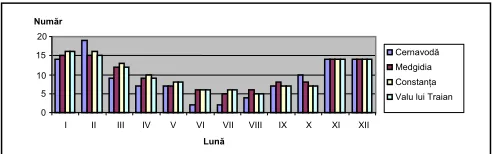
In the course of the year, the monthly maximum number of foggy days is recorded in winter, when 16 foggy days occurred in Constanţa in January and February, and 19 days occurred in Cernavodă, in February. In spring and autumn, the monthly maximum number of foggy days is reduced, ranging from 7 to 12 days in Medgidia and 7 to 10 days in Cernavodă. In summer, the monthly maximum number of foggy days is larger in Constanţa than the one in Cernavodă and Medgidia (Table 3, Figure 1).
Figure 1. The average of the maximum number of foggy days at the weather stations from the Danube-Black Sea Canal area (2000-2010).
4. The evolution of the fog phenomenon in the course of 24 hours
Whatever the season of the year and the thermal threshold analyzed, the largest frequency of the fog phenomenon, at the four observation points is recorded at 7 in th morning. At this hour, the average frequency of foggy days varies according to the thermal
0 5 10 15 20
I II III IV V VI VII VIII IX X XI XII
Lună Număr
threshold and the weather station analyzed between maximum one day during the summer months, and 2.1-2.2 days, during autumn and the winter months. In winter, a higher frequency of fog occurrence is recorded during the night (1.1-1.7 days at 1 o'clock). Between April-September, during the night, the fog frequency drops significantly (0.1-0.2 days), and during the day, especially in Cernavodă, appears only incidentally.
5. Fog duration
It is the time period calculated between the beginning and the end of the phenomenon visually reported in the area where the station is located, expressed in hours and tenths of hours. Data originated from observations referring to fog, made at the weather stations from the studied region in the period between 2000 and 2010 were used.
The monthly average of fog duration in the area of the Danube-Black Sea Canal totals over 250 hours (representing about 3% from the number of hours from a year). The maximum values of the annual fog duration are about 400 hours even higher, revealing the irregular character of this phenomenon procedure in different years.
In the course of the year, the fog duration varies from one month to another, presenting mean values, the highest ones, in the cold period, when over 20 hours of fog are monthly recorded. The biggest month duration appears in January or December (over 45-50 hours), and the smallest one in July (less than 5 hours). A higher duration of fog is noticed in April and May, on the seaside and a smaller duration in October, as a result of the thermal regime in the Black Sea basin.
The monthly maximum duration displays considerable values, at least double from the average ones. Thus during the cold period more than 50-60 monthly hours were recorded, and during the hot one, over 15-20 monthly hours. The maximum fog duration in 24 hours indicates the possibility of its persistence in some cases the whole day from November to February. The possible maximum duration in 24 hours drops a lot in the hot season of the year, recording only 10-15 hours. Because the fog can extend appreciably over the course of 2-3 days, the maximum duration of a fog case was analyzed. From the whole period of the years studied in the investigated region, there were cases when the fog lasted over 60 even 100 hours, without interruption. The longest durations being reached in the cold period October-March, when fog can last for 28 hours consecutively. In the hot period, April-October, the maximum duration of a fog case lasts, generally, under 20 hours.
6. The daily evolution of fog production
In the course of 24 hours, a considerable growth of fog duration is noticed, especially during the morning hours, approximately between 5 a.m. and 10 a.m., followed by its reduction during the afternoon hours, with a minimum between 2 p.m. and 10 p.m. . Of course, the time periods of fog production vary more frequently from one month to another. Thus, in the cold period of the year the maximum fog duration appears between 7 a.m. and 10 a.m., and between 5 a.m. and 8 a.m. in the hot season. During the afternoon hours and at the beginning of the night, the fog frequency is reduced, and the phenomenon is missing in the hot season of the year.
7. The monthly and annually frequency of foggy days with different durations
noticed that fogs lasting up to 6 hours (over 40-50% monthly) and those lasting up to 12 hours are predominant.
The cases of fog extension over 12 hours are relatively rare and are encountered, especially, during the cold period of the year. Also during the winter months it is possible, exceptionally, to have fog extending over 60 hours ( Constanţa: 61.4 hours).
In the Danube-Black Sea Canal area the fog phenomenon is frequent especially in winter, when it has negative repercussions on the navigation.
Case study
The fog on the Canal and its impact on the navigation
Days with dense fog were recorded on April, 3. 2008 (Figure 2), on December, 20. 2008, April, 19. 2010, February, 18. 2010. For the date of Aprilie, 3. 2008, starting with 5.30 a.m., the maneuvers in Constanţa South and North ports, marine an river, were suspended, due to low visibility, which was under a half of nautical mile (www.ziare.ro).
Figure 2. The fog on the Danube- Black Sea Canal (photo: Claudia Ilie).
Also, for of the same reason the traffic on the Danube- Black Sea Canal was blocked by the shuttle from Agigea. Alongside the Canal the river and road traffic were greatly hindered. The activity was resumed at 7.30 a.m. in the Constanţa South river port and the maneuvers at Constanţa North and South maritime ports were resumed at 8 a.m. , the barge traffic by Agigea shuttle was also resumed (Ilie, 2012).
Conclusions
We can conclude the fact that the fog is a risk phenomenon which influences greatly the river activity on the Danube- Black Sea Cannal. The fog is intense over the canal and in its vicinity, due to the presence of the water and due to the aisle character of the region. The fog phenomenon recorded especially during the cold periods of the year entails the impairing or blocking of the traffic when the visibility is very reduced. This fact leads to economic losses. Bibliography
1. Bogdan, Octavia, Mihai, Elena (1972), Ceaţa – condiţii de formare şi tipuri genetice, BSSGR, LXXI, p. 243-248.
3. Ilie, Claudia (2012), Impactul Canalului Dunăre – Marea Neagră asupra mediului. Editura Ex Ponto, Constanţa, 66-67.
4. Iliescu, Maria (1983), Ceaţa, în cap. Clima, din vol. Geografia României, vol.I, Geografia Fizică, Editura Academiei, Bucureşti.
5. Măhăra, Gh. (2001), Meteorologie, Editura Universităţii din Oradea.
6. Văduva, Iulica (2002), Frecvenţa ceţii pe Canalul Dunăre – Marea Neagră în perioada 1985-2000, Analele Universităţii „Spiru Haret”, 4, Bucureşti, 49-55. 7. Arhiva A.N.M. , 2000-2010.