This study examined whether justification of violence beliefs and social problem solving mediated between maltreatment experiences and aggressive and delinquent behavior in adolescents. Data were collected on 191 maltreated and 546 nonmaltreated adolescents (ages 14 to 17 years), who completed measures of justification of violence beliefs, social problem-solving dimensions (problem orientation, and impulsivity/carelessness style), and psychological problems. Findings indicated that maltreated adolescents’ higher levels of delinquent and aggressive behavior were partially accounted for by justification of violence beliefs, and that their higher levels of depressive symptoms were partially mediated by a more negative orientation to social problem-solving. Comparisons between boys and girls indicated that the model linking maltreatment, cognitive variables, and psychological problems was invariant.
Keywords: maltreatment, problem-solving, beliefs, aggressive and delinquent behaviors, depression
Este estudio examinó si las creencias justificadoras de la violencia y la resolución de problemas sociales mediaban entre las experiencias de maltrato y la conducta agresiva y delincuente en adolescentes. Se obtuvieron datos de 191 adolescentes que habían experimentado maltrato y 546 adolescentes no maltratados (edades entre 14 y 17 años). Completaron medidas de creencias justificadoras de la violencia, dimensiones de solución de problemas (orientación al problema, y estilo impulsivo) y problemas psicológicos. Los resultados indicaron que los mayores niveles de conducta agresiva y delincuente entre los adolescentes maltratados estaban parcialmente explicados por las creencias justificadoras de la violencia, y que sus mayores niveles de síntomas depresivos estaban mediados parcialmente por una orientación más negativa a los problemas sociales. Las comparaciones entre chicos y chicas indicaron que el modelo de asociación entre maltrato, variables cognitivas y síntomas psicológicos era invariante.
Palabras clave: maltrato, resolución de problemas, creencias, conducta agresiva y delincuente, y depresión
Justification of Violence Beliefs and Social Problem-Solving
as Mediators between Maltreatment and Behavior Problems
in Adolescents
Esther Calvete
Universidad de Deusto (Spain)
This research was supported by two grants from the Departamento de Justicia, Trabajo y Seguridad Social (Basque Government). The author thanks Dr. Thomas D’Zurilla and Dr. Alberto Maydeu-Olivares for allowing the use of the Spanish version of the SPSI-revised, Dr. Serafín Lemos for his help with the normative data of the YSR in the Spanish sample, and Dr Meifen Wei for helping with the bootstrap procedure. Sincere thanks also go to Susana Corral, Ana Estévez, Maribel Angulo, Carmen López, Olga Cardeñoso, and Maria Pérez, for their cooperation and assistance in many stages of this research.
Correspondence concerning this article should be addressed to Esther Calvete, Universidad de Deusto, Departamento de Psicología, Apdo. 1, 48080 Bilbao (Spain). E-mail: [email protected]
Child maltreatment is a significant social and clinical problem in many countries. It includes various types of harmful experiences, such as physical abuse, sexual abuse, emotional abuse, and neglect (Cicchetti & Toth, 2000; Feindler, Rathus, & Silver, 2003). A broad array of studies has documented the link between child maltreatment and various later maladaptive outcomes, including aggressive behavior (e.g., Malinosky-Rummell & Hansen, 1993; Moe, King, & Bailly, 2004; Muller & Diamond, 1999; Shields & Cicchetti, 1998, 2001), antisocial behavior (e.g., De Paul & Arruabarrena, 1995), and depression (e.g., Toth & Cicchetti, 1996; Toth, Manly, & Cicchetti, 1992). Recently, research has begun to explore the mediating mechanisms that explain the relation between child abuse and later maladaptive outcomes (Herrenkhol, Huang, Tajima, & Whitney, 2003; Kim & Cicchetti, 2004; Widom, 2000). The present study focuses on cognitive mediation as a potential mechanism through which abuse and neglect lead to aggressive and delinquent behavior in adolescents.
The hypothesis of cognitive mediation derives in part from the attachment theory (Bowlby, 1980). Bowlby proposed that infants form working models of interpersonal relationships based on their attachment experiences with primary caregivers, and that these models are used to guide behavior, interpret experiences, and respond to others in new settings. In consequence, early experiences of maltreatment may result in dysfunctional cognitive styles, which in turn increase the risk for a range of emotional and behavior disorders among the victims.
Whereas the cognitive mechanisms through which child abuse and neglect predict later depression have received considerable attention (e.g., Gibb, 2002; Ingram, 2003), relatively few studies have addressed cognitive mediation for aggressive and delinquent behavior. Dodge, Pettit, Bates, and Valente (1995) proposed a cognitive mediating mechanism to explain the link between child abuse and neglect and violent behavior. Their findings indicated that abused children, through repeated exposure to physical abuse and neglect, develop a dysfunctional social information-processing style, which makes them prone to violence. This style, which is characteristic of highly aggressive children, includes traits such as hostile attributional biases about others’ intentions and evaluations that aggressive acts lead to positive outcomes (e.g., Crick & Dodge, 1994; Zelli, Dodge, Lochman, Laird, & Conduct Problems Prevention Research Group, 1999).
Recent research has shown that the above aggressive individuals’ deviant processing is guided by underlying latent antisocial mental structures (Dodge & Pettit, 2003; Zelli et al., 1999). These structures take the form of normative beliefs about the social appropriateness of aggression (Huesmann & Guerra, 1997). For instance, these beliefs include the idea that the use of the aggression is justified (e.g., because the other deserves it) and leads to positive outcomes for the individual (e.g., because it serves to gain others’ respect).
In their harmful relationships with caregivers, maltreated children may develop the belief that coercion and violence are fundamental to all relationships (Cicchetti & Lynch, 1995), or a parental privilege (Maker, Shah, & Agha, 2005). Moreover, in an attempt to give meaning to the maltreatment experience, children may think that, if their parents use the violence against them, then the use of violence must be adequate. In fact, abusive parents often try to justify their aggressive acts, expressing reasons such as “you behaved wrong and you deserve it” or “it’s for your own good”. Thus, it can be hypothesized that child abuse leads to developing dysfunctional cognitive schemas about the use of violence, and that these schemas guide ulterior aggressive behavior. However, only one study has assessed directly whether beliefs about the use of violence mediate between child abuse and violent behavior (Herrenkhol et al., 2003). On the other hand, a number of studies have linked aggressive and delinquent behavior with social problem-solving deficits (e.g., Lochman & Dodge, 1994; Lochman, Wayland, & White, 1993). Social problem solving includes both a general motivational problem orientation and a set of problem-solving skills, such as problem definition, generation of alternative solutions, decision-making and solution implementation, and verification. Various studies demonstrate that, when confronting a social problem, aggressive adolescents often display an impulsive style, which is characterized by a poor definition of the problem, a deficient range of solution alternatives, and quick and careless evaluation of their consequences (Calvete & Cardeñoso, 2005; D’Zurilla, Chang, & Sanna, 2003). To date, no study has assessed whether problem-solving deficiencies mediate between child maltreatment experiences and aggressive behavior, despite the evidence that children who have experienced abuse and neglect are likely to develop an orientation toward the present, which prevents them from delaying gratification and controlling impulses (Dodge & Pettit, 2003; Tyler, Allison, & Winsler, 2006).
Prasad-Gaur, Hughes, & Cavell, 2001). Thus, whereas negative self-cognitions are positively associated with depression, they could also be negatively associated with aggressive behavior.
A number of studies have addressed gender differences in the impact of child abuse on psychological problems with mixed results. For instance, whereas some studies indicate that, among children exposed to parental violence, more boys than girls manifest psychological problems (Jaffe, Wolfe, Telford, & Austin, 1986), other studies do not find gender differences (Maxwell & Maxwell, 2003), or even suggest that girls display more aggressive behavior than do boys (Cummings, Pepler, & Moore, 1999). Despite these mixed findings, the existence of gender differences in cognitive vulnerability to psychological problems (e.g., Calvete & Cardeñoso, 2005; Hankin & Abramson, 2001) suggests that the cognitive processes through which abuse impacts on maladjustment could be different for boys and girls.
The main purpose of this study was to test whether justification of violence beliefs and problem-solving dimensions mediate between maltreatment and aggressive and delinquent behavior in adolescents. In particular, it was hypothesized that maltreated adolescents’ higher levels of aggressive and delinquent behavior would be accounted for by higher scores on justification of violence and impulsive style of problem solving. In addition, the role of problem orientation was explored. It was expected that maltreatment would be linked with a more negative orientation to social problems and that this negative orientation, in turn, would be associated positively with depressive symptoms but negatively with violent behavior. Lastly, the study assessed gender differences under the hypothesis that cognitive mediation for aggressive and delinquent behavior would be more evident among boys.
The investigation focused on adolescents who had experienced abuse and neglect. Adolescents have received very little attention in the literature about maltreatment, with most of the studies based either on children or adult samples. Behavior problems arise during this developmental period (Lahey et al., 2000), likely due to the rapid increase in the number of stressors experienced during middle to late adolescence (Hankin & Abramson, 2001). In addition, long-term consequences of maltreatment may manifest in adolescence (Malinosky-Rummell & Hansen, 1993). These characteristics make adolescence a critical period to study the impact of maltreatment on maladjustment.
Method
Participants
Participants consisted of 191 maltreated adolescents (109 girls and 82 boys) and 546 nonmaltreated adolescents (301 girls and 245 boys). Maltreated adolescents (aged 14 to 17) had been identified through the Department of Social Services
of the regional council of Bizkaia (Spain). At the moment of the study, all the maltreated adolescents were housed in 26 residential centers for victims. According to data provided by the Department of Social Services, the adolescents showed a high overlap in the type of maltreatment experienced, with 75% experiencing two or more of the maltreatment types. Overall, 76.5% had experienced neglect, 45% had been physically abused, 2% had experienced sexual abuse, and 19.93% had suffered emotional abuse. All the adolescents who were present in the centers at the moment of the data collection participated in the study. They represented the 82% of the total population of the adolescents who were housed in residential centers for victims.
A comparison group of 546 adolescents aged 14-17 who studied in public schools near the centers for victims was selected. According to the information provided by the school staff, these schools were characterized by low and low-medium socio-economic levels. There were no differences between the maltreated and the nonmaltreated sample in gender, χ2(1, N
= 737) = 2.21, ns, and age, t(735) = 1.90, ns (M = 15.68 years and SD = 1.23 vs. M = 15.80 years and SD = 1.15, respectively for maltreated and nonmaltreated adolescents).
Measures
The Short Form of the Social Problem-Solving Inventory Revised (SPSI-R Short Form, D’Zurilla, Nezu, &
Maydeu-Olivares, 1998) is a 25 item self-report instrument that measures both adaptive and dysfunctional problem-solving dimensions. Each item is rated on a 5-point Likert type scale ranging from 0 (not at all true of me) to 4 (extremely true
of me). In this study, the SPSI-R was used to assess 3
dimensions: positive problem orientation, negative problem orientation, and impulsivity/carelessness style. The Positive
Problem Orientation dimension involves both the belief that
problems are solvable (optimism) and the self-confidence to solve problems successfully (high self efficacy). In contrast, Negative Problem Orientation reflects the general tendency to expect problems to be unsolvable (pessimism) and the lack of self-efficacy to solve problems successfully. Finally, the Impulsivity/Carelessness Style is a problem-solving pattern characterized by active, impulsive, careless, and incomplete attempts to solve problems. A study with the Spanish version of the SPSI-R Short Form has confirmed its factor structure and obtained adequate alpha coefficients for the five subscales (Calvete & Cardeñoso, 2001). In this study, the alpha coefficients were .67, .72, and .75 for positive problem orientation, negative problem orientation, and impulsivity/carelessness style, respectively.
The Justification of Violence subscale of The Irrational
Beliefs Scale for Adolescents (IBSA; Cardeñoso & Calvete,
among peers (e.g., “It is better to have a row than let them think I am a coward”). Previous research has shown that this subscale is associated with aggressive and delinquent behavior (Calvete & Cadeñoso, 2005). In this study, the alpha coefficient of the Justification of Violence subscale was .72. The Youth Self-Report (YSR, Achenbach, 1991) measures an array of emotional and behavior problems. The instrument has shown excellent reliability and validity, and discriminates between adolescents referred and not referred to mental health services. The Spanish version of the YSR has been studied in a large sample of Spanish adolescents (N = 2833) and has shown satisfactory psychometric properties (Lemos, Vallejo, & Sandoval, 2002). Behavior problems were assessed by the Aggressive Behavior and Delinquent Behavior subscales of the YSR. The Aggressive Behavior subscale includes symptoms such as temper, arguing a lot, demanding attention, and screaming. The Delinquent Behavior subscale includes symptoms such as drinking alcohol, using drugs, stealing, and vandalism. Depressive symptoms were assessed by the Affective Problems subscale of the YSR. This DSM-oriented subscale was constructed based on items selected to be consistent with the diagnostic categories of major depression and dysthymic disorder by experts around the world (Achenbach, Dumenci, & Rescorla, 2000). The Affective Problems subscale includes symptoms such as crying, feelings of worthlessness, sadness, and self-harm. In this study, the alpha coefficients for the Aggressive Behavior, Delinquent Behavior, and Affective Problems scales were .78, .75 and .82, respectively.
Procedure
Responses were anonymous in order to promote honesty and participation was voluntary. Maltreated adolescents filled in the questionnaires in small groups in the residential centers, whereas the nonmaltreated adolescents completed the questionnaires in their classrooms. The study was presented as a research about the way young people think and behave in
several areas of their lives. Participants were encouraged to ask questions if they had any trouble answering the items. The questionnaires took between 30 and 45 minutes to complete. Because there were no student names included on the surveys, the school staff chose to collect passive consent from parents. Parents were notified and given the option of refusing to allow their son/daughter’s participation. The participation rate in the schools was 98%. In the case of maltreated adolescents, authorization was provided by the Department of Social Services, which, according to national legislation, was the legal guardian of the adolescents. The permission did not include access to the individual history of the adolescents.
Results
Differences in Psychological Symptoms and
Cognitive Variables among Maltreated and
Nonmaltreated Adolescents
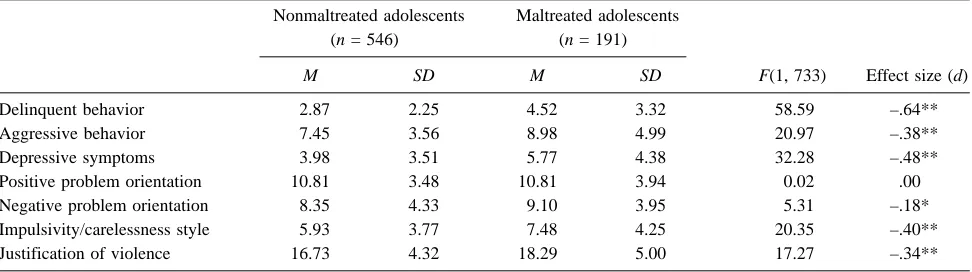
A series of analyses of variance was conducted to investigate the main effects of maltreatment status (maltreated vs. nonmaltreated), gender, and the interaction between maltreatment and gender on the study variables. The maltreated adolescents showed higher levels of delinquent and aggressive behavior and depressive symptoms than did nonmaltreated adolescents (see Table 1). The interpretation of the differences focused on effect sizes. Cohen (1988) proposed small, medium, and large effect sizes (.2, .5, and. 8) as a guide to interpreting results. Using this guideline, the differences were medium for delinquent behavior and depression. Male adolescents scored higher than female adolescents on delinquent behavior (M = 3.83 and SD = 2.67 vs. M = 2.88 and SD = 2.59, for boys and girls, respectively), F(1, 735) = 23.37, p < .001, whereas adolescent girls scored higher on depressive symptoms (M = 3.43 and SD = 3.50 vs. M = 5.25 and SD = 3.90, for boys and girls, respectively), F(1, 735) = 35.02, p < .001.
Table 1
Descriptive Statistics and Effect Sizes for Differences in Psychological Symptoms and Cognitive Variables Between Maltreated and Nonmaltreated Adolescents
Nonmaltreated adolescents Maltreated adolescents
(n = 546) (n = 191)
M SD M SD F(1, 733) Effect size (d)
Delinquent behavior 2.87 2.25 4.52 3.32 58.59 –.64**
Aggressive behavior 7.45 3.56 8.98 4.99 20.97 –.38**
Depressive symptoms 3.98 3.51 5.77 4.38 32.28 –.48**
Positive problem orientation 10.81 3.48 10.81 3.94 0.02 .00
Negative problem orientation 8.35 4.33 9.10 3.95 5.31 –.18*
Impulsivity/carelessness style 5.93 3.77 7.48 4.25 20.35 –.40**
Justification of violence 16.73 4.32 18.29 5.00 17.27 –.34**
Regarding problem solving and justification of violence, maltreated adolescents scored significantly higher on negative orientation, impulsivity/carelessness style and justification of violence. Overall, the effect sizes were low. Results showed main gender effects for all cognitive variables, with girls scoring higher on negative orientation (M = 7.92 and
SD = 3.07 vs. M = 9.71 and SD = 4.04, for boys and girls,
respectively), F(1, 735) = 25.22, p < .001, and boys scoring higher on positive orientation (M = 11.80 and SD = 3.39 vs. M = 10.01 and SD = 3.58, for boys and girls, respectively), F(1, 735) = 32.99, p < .001; impulsivity (M = 6.80 and SD = 3.70 vs. M = 5.94 and SD = 4.10, for boys and girls, respectively), F(1, 735) = 4.15, p < .05; and justification of violence (M = 18.12 and SD = 4.86 vs. M = 16.32 and SD = 4.12, for boys and girls, respectively),
F(1, 735) = 21.09, p < .001. None of the Maltreatment ×
Gender interactions was significant.
Cognitive Mediation of Relations between
Maltreatment Status and Psychological Symptoms
Structural equation modeling was used to study associations between maltreatment status, problem solving, justification of violence, and symptoms of behavior problems (aggressive and delinquent behavior) and depression. Positive problem orientation was dropped from the model due to the lack of significance for the difference between maltreated and nonmaltreated adolescents. In addition, because the results were very similar for aggressive and delinquent behavior, a composite measure that included all the items of both scales was used for the analyses. This measure was called antisocial problems. In the hypothesized model, maltreatment status was linked with antisocial problems and depressive symptoms both directly and indirectly. Negative
orientation, impulsivity and justification of violence were proposed to mediate between maltreatment and antisocial behavior. And negative orientation was expected to mediate between maltreatment and depression.
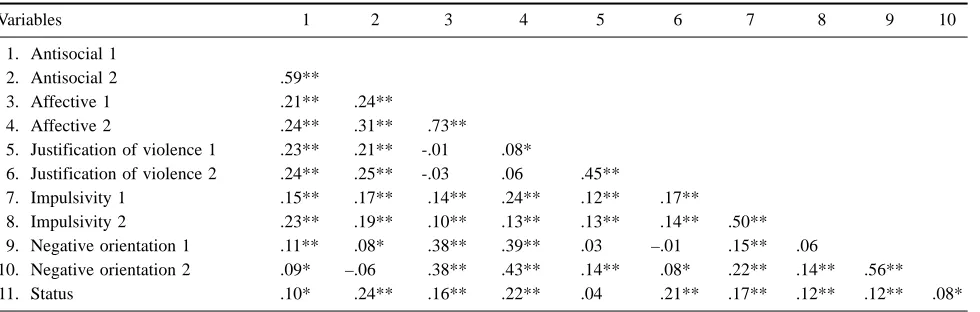
Maltreatment status was indicated by 0 (nonmaltreatment) and 1 (maltreatment) and two split-half measures were used as indicators for each of the other latent variables in the model by randomly assigning items from each subscale into two parallel halves, following the procedure described by Jöreskog and Sörbom (2001). Thus, in total, 11 indicators were used to measure the hypothesized structural model using maximum likelihood (ML) estimation. In all models, the matrix of correlations between independent latent variables and the matrix of correlations between dependent latent variables were freely estimated. Table 2 presents zero order correlations between indicators.
Following the recommendations of Hu and Bentler (1999) for ML models obtained in large samples (N > 250), goodness of fit was assessed by the comparative fit index (CFI; values of .95 or greater indicate that the model adequately fits the data), the root mean squared error of approximation (RMSEA; values of .06 or less indicate that the model adequately fits the data), and the standardized root-mean-square residual (SRMR; values of .08 or less indicate that the model adequately fits the data).
First, a preliminary confirmatory factor analysis indicated the appropriateness of measuring the latent variables with the indicators, and that the factor loadings were significantly different from zero. Next, the hypothesized structural model was tested. The fit indexes were satisfactory for the model,
χ2(35, N = 737) = 141.17, RMSEA = .068, CFI = .96,
SRMR = .048. Maltreatment was positively associated with negative orientation to problems, impulsivity, justification of violence, and symptoms of antisocial problems and
Table 2
Zero-Order Correlations between the Observed Variables Used in the Structural Equation Model
Variables 1 2 3 4 5 6 7 8 9 10
1. Antisocial 1
2. Antisocial 2 .59**
3. Affective 1 .21** .24**
4. Affective 2 .24** .31** .73**
5. Justification of violence 1 .23** .21** -.01 .08*
6. Justification of violence 2 .24** .25** -.03 .06 .45**
7. Impulsivity 1 .15** .17** .14** .24** .12** .17**
8. Impulsivity 2 .23** .19** .10** .13** .13** .14** .50**
9. Negative orientation 1 .11** .08* .38** .39** .03 –.01 .15** .06
10. Negative orientation 2 .09* –.06 .38** .43** .14** .08* .22** .14** .56**
11. Status .10* .24** .16** .22** .04 .21** .17** .12** .12** .08*
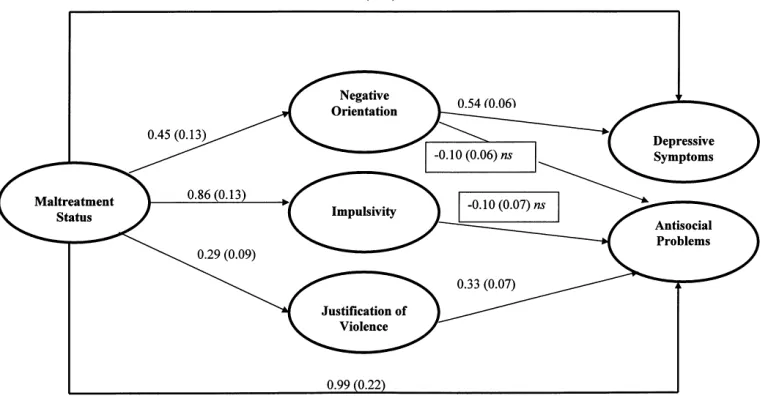
Figure 1. Model linking maltreatment status, justification of violence, problem-solving, and psychological symptoms in the total sample (N = 737).
Note. Values given are unstandardized coefficients with standard error in parentheses. All the coefficients are statistically significant except those included in boxed cells.
depression. In addition, justification of violence was significantly related to antisocial problems and negative orientation with depressive symptoms, indicating that these variables could act as mediators between maltreatment and psychological symptoms (see Figure 1). Recently, MacKinnon, Lockwood, Hoffman, West, and Sheets (2002) have criticized the use of Sobel’s formula for testing the significance of the indirect effects because it has low statistical power. As an alternative, Shrout and Bolger (2002) have suggested a bootstrap procedure. Bootstrapping offers an empirical method of determining the significance of statistical estimates, but there is no requirement for the sampling distribution to be symmetrical (Efron & Tibshirani, 1993). The approach relies on resampling the data set to generate an empirical sampling distribution of the indirect effects, which is used to test hypotheses and derive confidence intervals. In this study, the procedure described by Wei, Heppner, Russell, and Young (2006) was followed. The first step was to create 1,000 bootstrap samples from the original data set by random sampling with replacement. The second step was to conduct the structural model 1,000 times with these 1,000 bootstrap samples to yield 1,000 estimations of each path coefficient. The third step was to use the LISREL saved output of the 1,000 estimations of each path coefficient to calculate an estimate of the indirect effects. The final step was to see whether the 95% confidence interval (CI) for the estimated indirect effects included zero. According to Shrout and Bolger’s suggestion, an indirect effect is significant at the .05 level if the 95% confidence level does not include zero. The results from the bootstrap procedure indicated that both the indirect effect of maltreatment on antisocial problems via justification of
violence beliefs (95% CI: .11-.14) and the indirect effect of maltreatment on depression via negative orientation (95% CI: .14-.16) were statistically significant.
To test whether justification of violence beliefs partially or fully mediated the association between maltreatment and antisocial problems, a fully mediated model, in which the direct path from maltreatment status to behavior problems was constrained to zero, was compared with a partially mediated model in which no constraint was placed on this path. If the chi-square is significantly larger for the constrained model, the partially mediated model fits the data better than the fully mediated model (Holmbeck, 1997). The constriction to zero of the direct path between maltreatment status and antisocial problems significantly increased chi-square, ∆χ2(1, N = 737) = 190, p < .001, indicating that
maltreatment has direct effects on these problems. An identical procedure was used to test whether negative orientation mediated partially or fully between maltreatment and depressive symptoms. In this case, the constriction to zero of the direct path significantly increased chi-square,
∆χ2(1, N = 737) = 270, p < .001.
Moderation by Gender
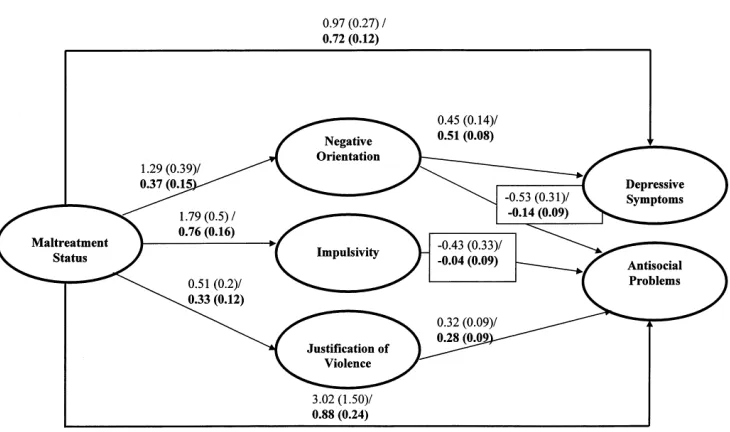
To test whether cognitive mediation of the association between maltreatment and symptoms was different in girls and boys, the model was estimated in each subgroup separately (see Figure 2). Model fit indexes were adequate for boys and girls, χ2(33, N = 327) = 76.69, RMSEA = .063,
CFI = .96, SRMR = .054 and χ2(33, N = 410) = 91.90,
To further explore the cross-sample replication of the model, the next step was to test for invariance of relations between maltreatment, cognitive variables, and psychological symptoms across both samples. First, an unconstrained model was tested both in girls and boys simultaneously, providing an adequate fit to the data representing both samples, χ2(66,
N = 737) = 168.60, RMSEA = .065, CFI = .96, SRMR =
.055. Next, the unconstrained model was compared with a model in which the pattern of factor loadings was constrained to be equal in both samples. This imposition did not significantly increase chi-square, ∆χ2(5, N = 737) = 4.27,
ns. Finally, a more constrained model was estimated by
imposing equality constraints on all structural paths between maltreatment, cognitions and psychological symptoms. The comparison of this model with the unconstrained model yielded a nonsignificant ∆χ2(14) = 13.65, supporting the
invariance hypothesis, and indicating that the general pattern of relations between maltreatment, cognitive variables and psychological symptoms was similar for both girls and boys.
Discussion
This study showed that the predominance of antisocial problems among maltreated adolescents was partially mediated by justification of violence beliefs. Maltreated adolescents exhibited higher levels of justification of violence, which in turn were associated with more aggressive and delinquent behaviors. In their destructive relationships with caregivers, maltreated children’s attempts to find a meaning to their adverse circumstances may result in the
development of beliefs that coercion, violence, and exploitation are fundamental to all relationships (Shields & Cicchetti, 2001), and that these tactics are socially appropriate (Huesmann & Guerra, 1997). Justification of violence has been proposed as an underlying cognitive structure which guides ulterior information processing (Zelli et al., 1999). Thus, this study extended the previous finding that dysfunctional cognitions mediate between maltreatment and aggressive behavior (Dodge et al., 1995; Herrenkhol et al., 2003).
Although maltreatment was associated with a more impulsive style of problem solving, this variable did not contribute to explain the higher scores on antisocial problems among the adolescents who had experienced maltreatment. Several explanations could account for the higher scores on impulsivity among the maltreated adolescents. For instance, according to the social learning theory (Bandura, 1977), these adolescents could more likely learn this form of behavior because their parents behave the same way. A higher prevalence of brain injury, as a consequence of physical abuse, may also lead to difficulties in regulating behavior. In addition, the disturbance of maltreated children’s basic trust in abusive primary caretakers has been proposed to lead to an inability to self-regulate behavior (Salzinger et al., 2002). Nevertheless, as mentioned, impulsive style did not mediate the relation between maltreatment and aggressive and delinquent behavior, as findings did not replicate previous evidence that impulsive style is associated with antisocial problems (e.g., Calvete & Cardeñoso, 2005; D’Zurilla et al., 2003; Lochman et al. 1993)
Figure 2. Model linking maltreatment status, justification of violence, problem-solving, and psychological symptoms in the male (n =327) and female (n = 410) subsamples.
Maltreatment was also positively related to a more negative orientation to social problems, which in turn was positively associated with depressive symptoms. The higher scores on negative orientation among maltreated adolescents are consistent with studies indicating less self-competence and self-esteem among abused children (e.g., Kim & Cicchetti, 2004; Shonk & Cicchetti, 2001). This association between negative orientation and depressive symptoms has been revealed in preceding studies based on the same measure (e.g., McCabe, Blankstein, & Mills, 1999; Spence, Sheffield, & Donovan, 2002), and is consistent with cognitive models of depression (Beck, 1976).
Although the results indicated that the association between negative orientation and antisocial problems tended to be negative, this path was nonsignificant. Thus, in contrast with other studies (Edens, Cavell, & Hughes, 1999), these findings do not contribute to confirm that positive rather than negative self-cognitions are characteristic of aggressive individuals. It has sometimes been suggested that maltreatment leads to aggressive behavior among boys and to a greater risk of victimization among girls (Shonk & Cicchetti, 2001). Nonetheless, findings of this research were consistent with other studies that indicate that maltreatment places both boys and girls at risk for elevated levels of aggressive and delinquent behavior (Maxwell & Maxwell, 2003; Muller & Diamond, 1999; Shields & Cicchetti, 2001). Although the boys scored higher than the girls on delinquent behavior and justification of violence beliefs, these findings indicated that the pattern of associations between these variables was similar for girls and boys. This result is consistent with the study of Guerra, Huesmann, and Spindler (2003), who found that the effects of exposure to violence on subsequent aggression and aggressive cognitions are not different for boys and girls.
This study has some limitations. First, although the participation of adolescents who were identified as maltreated by social service agencies increases the validity of the diagnosis of abuse, it involves problems. For instance, a number of authors suggest that this type of sample may be a biased sample of the population of maltreated adolescents, because maltreated children who live in the most dysfunctional families or display deviant behaviors are the most likely detected by social services (Dodge et al., 1995; Shonk & Cicchetti, 2001).
Second, the maltreated group of adolescents was compared with a convenience sample that has some shortcomings. Although this sample was selected based on characteristics, such as higher prevalence of low and low-medium socio-economic levels and public management of the schools, equivalence was not assured. For instance, according with the available data, a vast majority of families of the maltreated adolescents were receptors of public assistance. Another limitation is the size of the samples, with the comparison group being much larger than the maltreated group. Last, the data collected did not allow us to detect whether, within the comparison sample, some of the adolescents were also victims
of maltreatment. In any case, to the extent that this occurred, it would have worked against the hypotheses of the study, providing conservative tests of the impact of maltreatment on symptoms and cognitive variables.
Third, the fact that individual histories were not available prevented examining the impact of specific types of maltreatment (e.g., physical abuse, emotional abuse, and neglect) on symptoms and cognitions. Overall, the maltreated adolescents of this study were characterized by an overlapping of different types of maltreatment, with a predominance of neglect and physical abuse. Although the role of neglect in the development of antisocial behavior has received less attention than that of physical abuse, various studies have indicated that it is also associated with antisocial child behavior (de Paul & Arruabarrena, 1995; Knutson, DeGarmo, & Reid, 2004), distorted cognitions about aggression (Lansford, Criss, Pettit, Dodge, & Bates, 2003), and deficiencies in social problem-solving (Tyler et al., 2006).
Fourth, this study indicated strong direct paths between maltreatment and both antisocial problems and depression, which could be explained by omitted variables. Several ecological and biological conditions associated with child maltreatment may increase the likelihood of antisocial problems. For instance, factors such as the heritability of aggression, families characterized by poverty and unemployment, the exposure to aggressive peers and neighborhood community violence are well documented risk factors for the development of aggressive behavior (Dodge & Pettit, 2003; Knutson, DeGarmo, & Reid, 2004). Moreover, exposure to community violence can also affect aggressive behavior via its impact on beliefs about the legitimacy of aggression (Guerra et al., 2003).
Finally, due to the cross-sectional nature of the study, these findings only indicate that cognitive and behavioral variables are statistically associated. A longitudinal study should show that pre-existing cognitions in maltreated adolescents lead to behavior and emotional problems.
Despite the limitations, the findings of this study have important clinical implications. The high prevalence among victims of beliefs legitimizing violence in social interactions, and their role as cognitive antecedent of aggressive and delinquent behavior make these beliefs a key focus for interventions. Thus, psychological interventions for maltreated children and adolescents should assess and dispute these underlying beliefs. In addition, therapies for maltreated adolescents should also include the goal of improving those components of social problem solving in which they show deficiencies.
References
Achenbach, T.M. (1991). Integrative guide for the 1991 CBCL/4-18, YSR, and TRF profiles. Burlington, VT: University of Vermont.
Achenbach, T.M., Dumenci, L., & Rescorla, L.A. (2000). Ratings of relations between DSM-IV diagnostic categories and items of the CBCL/6-18, TRF, and YSR. Burlington VT: University of Vermont. Research Center for Children, Youth, and Families. Available at www.aseba.org.
Bandura, A. (1977). Self-efficacy: Toward a unifying theory of behavioral change. Psychological Review, 84, 191-205. Beck, A.T. (1976). Cognitive therapy and the emotional disorders.
Madison, WI: International Universities Press.
Bowlby, J. (1980). Attachment and loss: Loss, sadness, and depression. New York: Basic Books.
Calvete, E., & Cardeñoso, O. (2001). Creencias, resolución de problemas y correlatos psicológicos. Psicothema, 13, 95-100. Calvete, E., & Cardeñoso, O. (2005). Gender differences in cognitive vulnerability to depression and behavior problems in adolescents. Journal of Abnormal Child Psychology, 33, 179-192.
Calvete, E., & Connor-Smith, J. (2005). Automatic thoughts and psychological symptoms: A cross-cultural comparison of American and Spanish students. Cognitive Therapy and Research, 29, 201-207.
Cardeñoso, O., & Calvete, E. (2004). Desarrollo del Inventario de Creencias Irracionales para adolescentes. Psicología Conductual, 12, 289-304.
Cicchetti, D., & Lynch, M. (1995). Failures in the expectable environment and their impact on individual development: The case of child maltreatment. In D. Cicchetti & D.J. Cohen (Eds.), Developmental Psychopathology. Vol. 2: Risk, disorder, and adaptation (pp. 32-71). New York: Wiley.
Cicchetti, D., & Toth, S.L. (2000). Development processes in maltreated children. Nebraska Symposium on Motivation, 46, 85-160.
Cohen, J. (1988). Statistical power analysis for the behavioral sciences (2nded.). Hillsdale, NJ: Erlbaum.
Crick, N.R., & Dodge, K.A. (1994). A review and reformulation of social information processing mechanisms in children’s social adjustment. Child Development, 66, 80-97.
Cummings, J.G., Pepler, D.J., & Moore, T.E. (1999). Behavior problems in children exposed to wife abuse. Gender differences. Journal of Family Violence, 14, 133-156.
De Paul, J., & Arruabarrena, M.I. (1995). Behavior problems in school-aged physically abused and neglected children in Spain. Child Abuse and Neglect, 19, 409-418.
Dodge, K.A., & Pettit, G.S. (2003). A biopsychological model of the development of chronic conduct problems in adolescence. Developmental Psychology, 39, 349-371.
Dodge, K.A., Pettit, G.S., Bates, J.E., & Valente, E. (1995). Social information-processing patterns partially mediate the effect of early physical abuse on later conduct problems. Journal of Abnormal Psychology, 104, 632-643.
D’Zurilla, T.J., Chang, E.C., & Sanna, L.J. (2003). Self-esteem and social problem-solving as predictors of aggression in college students. Journal of Social and Clinical Psychology, 22, 424-440.
D’Zurilla, T.J., Nezu, A.M., & Maydeu-Olivares, A. (1998). Manual for the Social Problem-Solving Inventory Revised (SPSI-R), North-Tonawanda, NY: Multi-Health Systems.
Edens, J.F., Cavell, T.A., & Hughes, J.N. (1999). The self-systems of aggressive children: A cluster-analytic investigation. Journal of Child Psychology and Psychiatry, 40, 441-453.
Efron, B., & Tibshirani, R. (1993). An introduction to the bootstrap. New York: Chapman & Hall/CRC.
Feindler, E.L., Rathus, J.H., & Silver, L.B. (2003). Assessment of family violence: A handbook for researchers and practitioners. Washington: American Psychological Association.
Gibb, B.E. (2002). Childhood maltreatment and negative cognitive styles: A quantitative and qualitative review. Clinical Psychology Review, 22, 223-246.
Guerra, N.G., Huesmann, L.R., & Spindler, A. (2003). Community violence exposure, social cognition, and aggression among urban elementary school children. Child Development, 74, 1561-1576.
Hankin, B.L., & Abramson, L.Y. (2001). Development of gender differences in depression: An elaborated cognitive vulnerability-transactional stress theory. Psychological Bulletin, 127, 773-796. Herrenkohl, T.I., Huang, B., Tajima, E.A., & Whitney, S.D. (2003). Examining the link between child abuse and youth violence. An analysis of mediating mechanisms. Journal of Interpersonal Violence, 18, 1189-1208.
Holmbeck, G.N. (1997). Toward terminological, conceptual, and statistical clarity in the study of mediators and moderators: Examples from the child-clinical and pediatric psychology literatures. Journal of Consulting and Clinical Psychology, 65, 599-610.
Huesmann, L.R., & Guerra, N.G. (1997). Children’s normative beliefs about aggression and aggressive behavior. Journal of Personality and Social Psychology, 72, 408-419.
Hughes, J.N., Cavell, T.A., & Grossman, P.B. (1997). A positive view of self and others: Risk or protection for aggressive children? Development and Psychopathology, 9, 75-94. Ingram, R.E. (2003). Origins of cognitive vulnerability to
depression. Cognitive Therapy and Research, 27, 77-88. Jaffe, P.G., Wolfe, D.A., Telford, A., & Austin, G. (1986). The
impact of police charges in incidents of wife abuse. Journal of Family Violence, 1, 37-49.
Jöreskog, K.G., & Sörbom, D. (2001). LISREL8 user’s reference guide (2ndedition). Lincolnwood, IL: Scientific Software
International.
Hu, L. & Bentler, P.M. (1999). Cutoff criteria for fit indexes in covariance structure analysis: Conventional criteria versus new alternatives. Structural Equation Modeling, 6, 1-55.
Knutson, J.F., DeGarmo, D.S., & Reid, J.B. (2004). Social disadvantage and neglectful parenting as precursors to the development of antisocial and aggressive child behavior: Testing a theoretical model. Aggressive Behavior, 30, 187-205. Lahey, B.B., Miller, T.L., Schwab-Stone, M., Goodman, S.H.,
Waldman, I.D., Canino, G., Rathouz, P.J., Dennis, K.D., Bird, H., & Jensen, P.S. (2000). Age and gender differences in oppositional behavior and conduct problems: A cross-sectional household study of middle childhood and adolescence. Journal of Abnormal Psychology, 109, 488-503.
Lansford, J.E., Criss, M.M., Pettit, G., Dodge, K.A., & Bates, J.E. (2003). Friendship quality, peer group affiliation, and peer antisocial behavior as moderators of the link between negative parenting and adolescent externalising behavior. Journal of Research on Adolescence, 13, 161-184.
Lemos, S., Vallejo, G., & Sandoval, M. (2002). Estructura factorial del Youth Self Report (Youth Self-Report factor structure). Psicothema, 14, 816-822.
Lochman, J.E. & Dodge, K.A. (1994). Social-cognitive processes of severely violent, moderately aggressive, and nonaggressive boys. Journal of Consulting and Clinical Psychology, 62, 366-374.
Lochman, J., Wayland, K.K., & White, K. J. (1993). Social goals: Relationship to adolescent adjustment and to social problem solving. Journal of Abnormal Child Psychology, 21, 135-151. MacKinnon, D.P., Lockwood, C.M., Hoffman, J.M., West, S.G., & Sheets, V. (2002). A comparison of methods to test mediation and other intervening variable effects. Psychological Methods, 7, 83-104.
Maker, A.H., Shah, P.V., & Agha, Z. (2005). Child physical abuse: Prevalence, characteristics, predictors, and beliefs about parent-child violence in South Asian, Middle Eastern, East Asian, and Latina women in the United States. Journal of Interpersonal Violence, 20, 1406-1428.
Malinosky-Rummell, R., & Hansen, D.J. (1993). Long-term consequences of childhood abuse. Psychological Bulletin, 114, 68-79.
Maydeu-Olivares, A. & D’Zurilla, T.J. (1996). A factor-analytic study of the Social Problem-Solving Inventory: An integration of theory and data. Cognitive Therapy and Research, 20, 115-133. Maxwell, C.D., & Maxwell, S.R. (2003). Experiencing and
witnessing familial aggression and their relationship to physically aggressive behaviors among Filipino adolescents. Journal of Interpersonal Violence, 18, 1432-1451.
McCabe, R.E., Blankstein, K.R., & Mills, J.S. (1999). Interpersonal sensitivity and social problem-solving: Relations with academic and social self-esteem, depressive symptoms, and academic performance. Cognitive Therapy and Research, 23, 587-604. Moe, B.K., King, A.R., & Bailly, M.D. (2004). Retrospective
accounts of recurrent parental physical abuse as a predictor of adult laboratory-induced aggression. Aggressive Behavior, 30, 217-228.
Muller, R.T., & Diamond, T. (1999). Father and mother abuse and child aggressive behaviour in two generations. Canadian Journal of Behavioural Science, 31, 221-228.
Prasad-Gaur, A., Hughes, J.N., & Cavell, T. (2001). Implications of aggressive children’s positively biased relatedness views for future relationships. Child Psychiatry and Human Development, 31, 215-231.
Salzinger, S., Feldman, R.S., Ng-Mak, D.S., Mojica, E., Stockhammer, T., & Rosario, M. (2002). Effects of partner violence and physical child abuse on child behavior: A study of abused and comparison children. Journal of Family Violence, 17, 23-52.
Shields, A., & Cicchetti, D. (1998). Reactive aggression among maltreated children: The contribution of attention and emotion dysregulation. Journal of Clinical Child Psychology, 27, 381-395.
Shields, A., & Cicchetti, D. (2001). Parental maltreatment and emotion dysregulation as risk factors for bullying and victimization in middle childhood. Journal of Clinical Child Psychology, 30, 349-363.
Shonk, S.M., & Cicchetti, D. (2001). Maltreatment, competency deficits, and risk for academic and behavioral maladjustment. Developmental Psychology, 37, 3-17.
Shrout, P.E., & Bolger, N. (2002). Mediation in experimental and nonexperimental studies: New procedures and recommendations. Psychological Methods, 7, 422-445. Spence, S.H., Sheffield, J., & Donovan, C. (2002). Problem-solving
orientation and attributional style: Moderators of the impact of negative life events on the development of depressive symptoms in adolescence? Journal of Clinical Child Psychology, 31, 219-229.
Toth, S.L., & Cicchetti, D. (1996). Patterns of relatedness, depressive symptomatology, and perceived competence in maltreated children. Journal of Consulting and Clinical Psychology, 64, 32-41.
Toth, S.L., Manly, J.T., & Cicchetti, D. (1992). Child maltreatment and vulnerability to depression. Development and Psychopathology, 4, 97-112.
Tyler, S., Allison, K., & Winsler, A. (2006). Child neglect: Developmental consequences, intervention, and policy implications. Child & Youth Care Forum, 35, 1-20.
Wei, M., Heppner, P.P., Russell, D.W., & Young, S.K. (2006). Maladaptive perfectionism and ineffective coping as mediators between attachment and future depression: A prospective analysis. Journal of Counseling Psychology, 53, 67-79. Widom, C.S. (2000). Childhood victimization: Early adversity,
later psychopathology. National Institute of Justice Journal, 242, 2-9.
Zelli, A., Dodge, K.A., Lochman, J.E., Laird, R.D., & Conduct Problems Prevention Research Group. (1999). The distinction between beliefs legitimizing aggression and deviant processing of social cues: Testing measurement validity and the hypothesis that biased processing mediates the effects of beliefs on aggression. Journal of Personality and Social Psychology, 77, 150-166.