Presentation of an Intelligent Method for
Estimating DOA Signal Radar Based on Hybrid
Expectation Maximization Approach
Farid Sardari
*and M.R. Moniri
Department of Telecommunication Engineering, Yadegar Imam Khomeini (RAH), Shahr-e-Ray Branch, Islamic Azad University, Tehran, Iran.
Date of publication (dd/mm/yyyy): 17/01/2019
Abstract – Localization of multiple sources and the reception of the signals emitted by those sources are fundamental problems of sensor array processing. Direction-of-Arrival (DOA) estimation has been largely used in many fields, as a case in point: localization and target monitoring and the like. The EM-MUSIC method could scrupulously improve the direction finding accuracy and resolution with low SNR in comparison with the classical MUSIC algorithm which is an uncorrelated algorithm. The method discussed in this paper no longer requires the direct calculation of the inverse covariance matrix and it is an iterative procedure based on Expectation Maximization (EM) algorithm that acts regarding the coherent and non-coherent signal. Moreover, an adaptive compressive processing (CSP) scheme is applied to low-sampling rate and a computationally inexpensive operation in the antenna array processing. In addition, Signal subspace focusing (SSF) algorithm is proposed for use in the coherent signal subspace method for computing the correlation matrices. To verify the performance of the proposed method, simulations were built in Matlab software and final results show the benefits that are achieved.
Keywords – Adaptive Compressive Processing (CSP), Direction of Arrival Algorithm (DOA), EM-MUSIC method, Signal Subspace Focusing (SSF).
I.
I
NTRODUCTIONII.
C
OMPRESSIVES
ENSINGA.
The Principle of CS
Statistical models and distribution functions for radar signals are considered in various aspects of radar estimation and detection that are capable of a more comprehensive and accurate modeling of the target signal and its parameters. Because in many radar applications, the samples received from the target are result of a radar radiated signal and the target at different points collision, and then their scatteration. The radar signal can be modeled in a sparse way, therefore, the compressive sensing method for receive signal sampling got used. On the other hand, Compressive sensing processing adds an additional error in estimation, particularly, when the process is aware of the received waveform characteristics [18]. In order to improve the estimation error due to the use of compressed measurements use waveforms with side lobes lower than the ones of the conventional waveforms used in the radar [19].
B.
CSP with an Adaptive Measurement Matrix
After having considered all available information, compressive sampling is performed. This approach differs from existing adaptive compressive sensing methods as presented in [20] where the sampling process is adapted during the acquisition process. One approach is using particle filter (PF) which is based on Monte Carlo sampling. Thus, according to the information that acquired sequentially, a tracker based on PF identifies, at each discrete time step 𝑘 of the tracking mission and for each sensor 𝑢, a finite set of delay-Doppler pairs that are probably to correspond to the correct target state. The kinematic model limited this set and the posterior distribution on the target state at time step 𝑘 − 1, as [21] provides a full account of that. The set elements are indexed as 𝑙 𝑢,𝑘 =
0, . . . , 𝐿𝑢,𝑘 − 1, where 𝑘 = 1, . . . , 𝐾 and𝑢 = 1, . . . , 𝑈. 𝐿𝑢,𝑘 is the cardinality of the set which rises as the uncertainty on target state ascents each index 𝑙𝑢,𝑘 is then associated with a delay-Doppler pair{𝜏𝑙,𝑢,𝑘, 𝜈𝑙,𝑢,𝑘}. In the set described above, a dictionary of 𝐿𝑢,𝑘 delay-Doppler shifted versions of the transmitted waveform 𝑠(𝑚), 𝑚 =
0, . . . , 𝑀 − 1 is built at every time step k and for each radar sensor𝑢. The dictionary is expressed as a 𝑀𝑑 × 𝐿𝑢,𝑘
matrix 𝑺𝑢,𝑘 with columns 𝑠𝑢,𝑘(𝑙, 𝑚) = 𝑠(𝑚 − 𝜏𝑢,𝑘)𝑒 𝑗2𝜋𝑚𝜈𝑢,𝑘
𝑀𝑑
⁄
, 𝑚 = 0, . . . , 𝑀𝑑− 1, 𝑙 = 0, . . .,𝐿𝑢,𝑘 − 1. The length 𝑀𝑑 > 𝑀 is chosen to accommodate the maximum delay of a radar return waveform. 𝑈 radar sensors receive delay-Doppler shifted versions of the transmitted waveform due to the target’s range and range-rate, at time step 𝑘 of a tracking mission.
The radar waveform 𝑠(𝑚) is considered as a multicarrier phase-coded (MCPC) [22] sequence consisting of Bj𝑜̈rck constant amplitude autocorrelation (CAZAC) sequences [21]. MCPC waveforms can be adaptively configured at each time step of the tracking mission, based on the possible delay- Doppler shifts in𝑆𝑢,𝑘, to have zero AF side lobes [23].
0, . . . , 𝐶 − 1 of length𝐶. A Bj𝑜̈rck CAZAC that is cyclically shifted in time by 𝜏 and Doppler shifted by 𝜈, where
the pair {τ, ν} corresponds to an index 𝑙, is given by 𝑞(𝑐, 𝑙) = 𝑞(𝑐 − 𝜏)𝐶𝑒𝑗2𝜋𝑐𝜈⁄𝐶, 𝑐 = 0, . . . , 𝐶 – 1, 𝑙 =
0, . . . , 𝐿𝑘 − 1. The time index is taken modulo C denoted as(𝑐 − 𝜏) 𝐶. The choice of CAZACs as columns in 𝑄𝑢,𝑘, that provide the almost orthogonal set (low AF side lobes), should not be confused with the transmitted waveform which may also be a CAZAC. For the adaptive CSP, 𝐶 is restricted to be a prime number [21] to construct the CAZAC in 𝑄𝑢,𝑘.
Reference [18] shows that CSP with adaptive measurement matrix outperforms CSP with random measurement matrix.
III.
S
UB-S
PACEB
ASEDM
ETHODIn the classical beam forming method, it is attempted at each moment to direct the beams in a particular path and calculate the output power in that direction. Accordingly, the direction in which the maximum power is achieved, could be one of the sources of signaling paths. The classical beam forming method requires a large number of elements to achieve high resolution. When the number of sources is greater than one and their distance is low, this method is not accurate. When there is more than one signal source, the output power of the array from undesired signals in other directions will also be affected, while in the Capon method, the undesirable interference will be decreased by minimizing the total antenna output power and fixing the signal power in the desired viewing angle direction. Generally, when the resources are dependent, this method does not provide the correct response, and even for high SNR, it is not possible to separate two signals at close angles. While the performance of the Capon beam forming method which has a better performance than the classic one, is significantly influenced by the number of antenna elements and the SNR of the input signal, it should be considered that this method is not suitable to calculate the correlated resources. This method requires the calculation of an inverse covariance matrix, which is difficult for large arrays. Capon spatial spectrum is defined by:
𝑃𝑐𝑎𝑝𝑜𝑛(𝜙) =𝑎𝐻𝑅𝑢𝑢−11𝑎(𝜙) (1)
Where 𝑅𝑢𝑢 is the autocorrelation matrix of the array received signal and 𝑎(𝜙)is the steering vector. Although classical beam forming techniques, such as the Capon method, are generally successful and widely has been used, these methods have fundamental constraints on high precision resolution. The proposed technique with high resolution by Schmidt is called the Multiple Signal Classification algorithm (MUSIC).
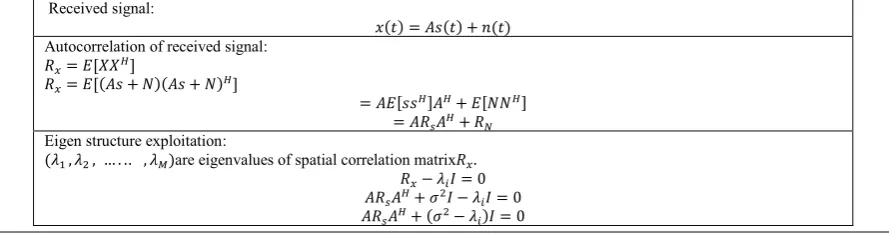
MUSIC algorithm: Multiple signal classification is a subspace approach according to the Eigen structure exploitation of input covariance matrix [24] for DOA estimation. MUSIC algorithm equations are described in Table I.
Table I. MUSIC Algorithm Implementation. Received signal:
𝑥(𝑡) = 𝐴𝑠(𝑡) + 𝑛(𝑡) Autocorrelation of received signal:
𝑅𝑥= 𝐸[𝑋𝑋𝐻]
𝑅𝑥= 𝐸[(𝐴𝑠 + 𝑁)(𝐴𝑠 + 𝑁)𝐻]
= 𝐴𝐸[𝑠𝑠𝐻]𝐴𝐻+ 𝐸[𝑁𝑁𝐻]
= 𝐴𝑅𝑠𝐴𝐻+ 𝑅𝑁
Eigen structure exploitation:
(𝜆1 , 𝜆2 , … . .. , 𝜆𝑀)are eigenvalues of spatial correlation matrix𝑅𝑥.
𝑅𝑥− 𝜆𝑖𝐼 = 0
𝐴𝑅𝑠𝐴𝐻+ 𝜎2𝐼 − 𝜆𝑖𝐼 = 0
Therefore, eigenvectors 𝜈𝑖of 𝐴𝑅𝑆 𝐴𝐻 are obtained using:
𝜈𝑖= 𝜎2− 𝜆𝑖
MUSIC spatial spectrum:
𝑃𝑚𝑢𝑠𝑖𝑐(𝜃) = 1 𝑎𝐻(𝜃)𝐸
𝑁𝐸𝑁𝐻𝑎(𝜃)
IV.
P
ROPOSEDM
ETHODA
. Signal Subspace Focusing (SSF)
The focusing matrix plays a decisive role in correlated methods. Depending on the matrix used in the correlated methods, various algorithms for direction are obtained. In many of these ways, it has tried to reduce to the lowest the focusing loss in a situation where it has errors in the angles estimation. A new method for finding a focusing matrix is expressed which is robust to a false initial estimation of resource angles. In this paper, the SSF algorithm will be used to calculate the angles of entry in the correlated form, which calculates the transition matrix T without the need to calculate the initial angles. The basis of this method is based on the transfer of the signal subspace related to the power spectral density matrix to the signal subspace, which is transmitted by the focusing matrix, according to the following conditions:
𝑇(𝑓𝑘)𝐸𝑠(𝑓𝑘) = 𝐸𝑠(𝑓0) (2)
In the above equation, 𝐸𝑠(𝑓0) and𝐸𝑠(𝑓𝑘) can be defined as follows:
𝐸𝑠(𝑓𝑘) = [𝑒1(𝑓𝑘), 𝑒2(𝑓𝑘), … , 𝑒𝐷(𝑓𝑘)] (3)
∀𝑖 = 1,2, … , 𝐷
𝐸𝑠(𝑓0) = [𝑒1(𝑓0), 𝑒2(𝑓0), … , 𝑒𝐷(𝑓0)] (4)
∀𝑖 = 1,2, … , 𝐷
𝑒𝑖(𝑓0) and 𝑒𝑖(𝑓𝑘) vectors are equal to the eigenvectors corresponding with D, the initial eigenvalue (descending order).The focusing matrix T should be a unitary matrix and apply in the following circumstances [25]:
min
𝑇(𝑓𝑘)‖𝐸𝑠(𝑓0) − 𝑇(𝑓𝑘)𝐸𝑠(𝑓𝑘)‖𝐹 𝑘 = 1,2, … , 𝐾
𝑇𝐻(𝑓
𝑘)𝑇(𝑓𝑘) = 𝐼 (5)
Reference [25] shows the solution of the above equation is obtained as follows:
𝑇(𝑓𝑘) = 𝑉(𝑓𝑘)𝑈𝐻(𝑓𝑘) (6)
𝑉(𝑓𝑘) and 𝑈(𝑓𝑘) respectively, are the left and right singular vectors of the matrix 𝐸𝑠(𝑓𝑘)𝐸𝑠𝐻(𝑓0). By multiplying (5) in 𝑋(𝑓𝑘), the output of the array is as follows:
𝑌(𝑓𝑘) = 𝑇(𝑓𝑘)𝑋(𝑓𝑘) 𝑘 = 1,2, … , 𝐾 (7)
In order to calculate the focusing matrix T, as we know, if the resources are independent of each other, we will have:
𝑠𝑝𝑎𝑛{𝑒1(𝑓𝑘), 𝑒2(𝑓𝑘), … , 𝑒𝐷(𝑓𝑘)} = 𝑠𝑝𝑎𝑛{𝑎(𝜃1, 𝑓𝑘), … , 𝑎(𝜃𝐷, 𝑓𝑘) } (8)
Given the above relationships, we can define𝐸𝑠(𝑓𝑘) as follows:
𝐸𝑠(𝑓0) = 𝐴(𝜃, 𝑓0)𝐵(𝑓0) (10)
That 𝐵(𝑓𝑘) is a matrix 𝐷 × 𝐷, with order 𝐷(𝑟𝑎𝑛𝑘 𝐵(𝑓𝑘) = 𝐷). we also define the column vectors of matrix
𝐵(𝑓𝑘)as follows:
𝑏𝑖(𝑓𝑘) =𝑃𝑆(𝑓𝑘)𝐴
𝐻(𝜃,𝑓 𝑘)𝑒𝑖(𝑓𝑘)
𝜆𝑖(𝑓𝑘)−𝜎2(𝑓𝑘) (11)
Where 𝜆1≥ 𝜆2≥ ⋯ ≥ 𝜆𝐷≥ 𝜆𝐷+1= ⋯ = 𝜎2(𝑓𝑘) ،are eigenvalues of the power spectral density matrix of received signal which is expressed as 𝑃𝑥(𝑓𝑘) and arranged in descending order.
The proposed algorithm for calculating covariance matrix is described in the following: 1. Calculate 𝑋(𝑓𝑘)of input data by calculating FFT (FFT Filter Bank).
2. Calculate the matrix 𝑃𝑥(𝑓𝑘) from 𝑋(𝑓𝑘).
3. Calculate 𝐸𝑠(𝑓𝑘) and 𝐸𝑠(𝑓0) by decomposition of 𝑃𝑥(𝑓𝑘) into eigenvectors and eigenvalues based on (9) and (10).
4. Calculate (6) using left and right singular vectors of the matrix 𝐸𝑠(𝑓𝑘)𝐸𝑠𝐻(𝑓0).
5. Calculate 𝑌(𝑓𝑘) based on (7).
6. Calculate the covariance matrix:
𝑅𝑦(𝜃) = ∑𝐾𝑘=1𝑌𝐻(𝑓𝑘)𝑌(𝑓𝑘)
B
. EM-MUSIC Method
Expectation Maximization (EM) algorithm is an iterative method that is trying to find an estimate with a maximum likelihood for the parameters of a parametric distribution. This algorithm is a common method when some random variables are latent. EM algorithm in primitive work of Dempster, Larid, and Rubin (1977) [26] Shumway and Stoffer (1982) [27] was introduced to estimate the parameters in space state. The method is mentioned above, is an iterative maximum likelihood method is applicable to patterns with missing data, as well as latent ones here. Although the above equations are not mathematically identifiable in the form of a space state, for each nonsingular Hermitian matrix H, we can construct a pattern corresponding to a rotation in the factors and upload the corresponding coefficients with:
𝑥(𝑡) = 𝐴𝑠(𝑡) + 𝑛(𝑡) (12)
The result of using this pattern and imposing some limitations, it is possible to estimate a unique set of pattern parameters with the data. This is a common problem in classical factor analysis and the main approach to dynamic factor analysis by H. Stock and W. Watson. However, the linear Gaussian space state model of equations can well be represented in the framework of a Kalman filter and the parameters are estimated using the EM algorithm.
V.
S
IMULATIONAssuming that the arrays are consist of the M sensors (ULA), and the received data in the output of these arrays are obtained from sampling at different moments by compressive sensing with an adaptive measurement matrix. The data received by the FFT filter bank separated to K narrowband frequency bin. Then MUSIC and EM-MUSIC algorithms calculate for each of the narrowband frequency bin, and finally calculates the output by averaging. The DOA estimation of non-coherent and coherent signals based on MUSIC and EM-MUSIC algorithms were analyzed through Matlab simulation. Four signals with low frequency 𝑓𝑙= 80 MHz, high frequency 𝑓ℎ= 120 MHz and bandwidth 40 MHz have simulated two times based on tableII which is defined bellow.
Table II. Simulation States
State Entry Angles (𝜃) SNR(dB)
1 10,30,35,65 20 , 10
2 10,33,35,65 20 , 5
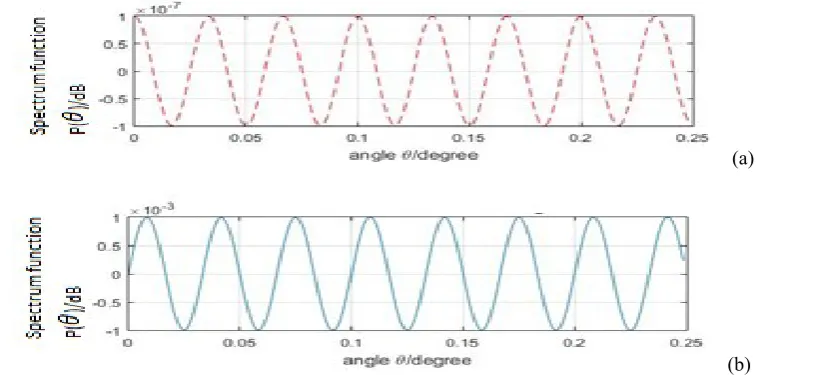
As Fig. 1 and 2 shown, the simulation output in this case is represented for SNR = 20dB. As can be seen, in the lower SNRs, EM-MUSIC algorithm accurately detect sources and acts regarding to the coherent and non-coherent signal. It accurately detects resources at a 35 degree angle.
(a)
(b)
Fig. 1. Comparison between (a) EM-MUSIC and (b) MUSIC algorithms for Non-coherent signals.
(a)
(b)
In fact, the SNR of the received signal and the separation of the angle of input of the signals into the antenna array are two important parameters in the rate of operation of the orientation of each algorithm. In low SNRs and resources at close angles, the EM-MUSIC method provides a better result than the MUSIC method.
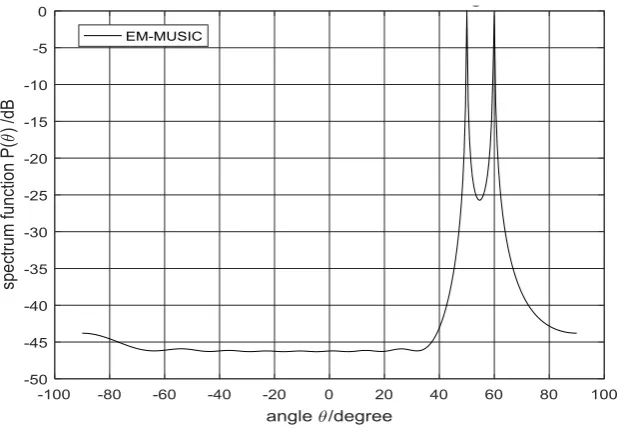
As Fig. 3 and 4 shown, it is assumed that two coherent signals incident to ULA with 50◦and 60◦ respectively. The elements number is M=10, the sampling number is N=100 and SNR= 5dB.
Fig. 3 DOA estimation on MUSIC algorithm
Under the above conditions, the MUSIC algorithm is unable to separate and detect two sources at a distance of 10 degrees.
Fig. 4 DOA estimation on EM-MUSIC algorithm
Whereas under the same conditions, the proposed algorithm is capable of detecting and localization two sources at angles 50 and 60 degree.
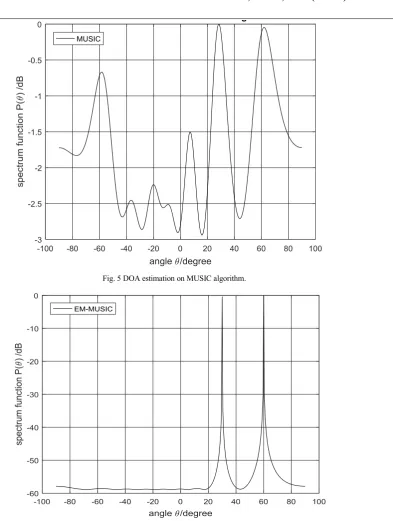
Fig. 5 DOA estimation on MUSIC algorithm.
Fig. 6 DOA estimation on EM-MUSIC algorithm
A quick glance at the provided snapshots highlights that, while EM-MUSIC can achieve the DOA estimation the coherent signal source, the MUSIC algorithm to fail.
VI.
C
ONCLUSIONR
EFERENCES[1] R. Kozick, B. Sadler, R. Blum, “Array processing in non-Gaussian noise with the EM algorithm,” Proceedings of the 1998 IEEE, International Conference on Acoustics, Speech and Signal processing (ICASSP).
[2] Zhang Yong, Ahange Li-Yi, Han Jian-Feng, Ban Zhe, Yang Yi, “A New DOA Estimation Algorithm Based on Compressed Sensing,” cluster computing, pp.1-9, Jan 2018.
[3] Yan Gao, Wenjing Chang, Zeng Pei, Zhengjiang Wu, “An improved Music Algorithm for DOA Estimation of Coherent Signals,” Sensors and Transducers, vol 175, Issue 7, pp. 75-82, July 2014.
[4] P. T. Eswar and K. Y. Krishna, “Performance analysis of direction of arrival estimation algorithms in smart antennas,” International journal of advanced research in electronics and communication engineering, vol. III, no. 6, pp. 664 - 670, June 2014.
[5] A. B. Nauman and B. M. Mohammad, “Comparison of direction of arrival (DOA) estimation techniques for closely spaced targets,” International journal of future computer and communication, vol. II, no. 6, pp. 654-659, December 2013.
[6] M. H. Mohammad, “Direction of arrival estimation using maximum likelihood method and the effect of element selection on system performance,” Master’s thesis, Concordia University, Electrical and Computer Engineering, Montreal, Quebec, Canada, August 2015. [7] R. K. Aniket, D. Ganage and S. Wagh, “Subspace based DOA estimation techniques,” International journal of research in engineering
and technology, vol. IV, no. 6, pp. 560 - 564, June 2015.
[8] Yan, F.G., Jin, M., Qiao, X., “Low-complexity DOA estimation based on compressed MUSIC and Its performance analysis,” IEEE Transaction on Signal Processing. vol.61, Issue.8, pp. 1915–1930, April 2013.
[9] Rahman, M.U., “Performance analysis of MUSIC DOA algorithm estimation in multipath environment for automotive radars,” International Journal of Applied Science and Engineering. 14(2), 125–132, 2016.
[10] Ren, S., Ma, X., Yan, S., et al., “ 2-D unitary ESPRIT-like direction of arrival estimation for coherent signals with a uniform rectangular array Sensors, ” 13(4), 4272–4288 ,2013.
[11] Qian, C., Huang, L., So, H.C., “Computationally efficient ESPRIT algorithm for direction-of-arrival estimation based on Nyström method,” Signal Processing .vol. 94, pp.74–80, Jan 2014.
[12] D. Yimin, Q. Si and G. Moeness, “DOA estimation exploiting co-prime arrays with sparse sensor spacing," 2014 IEEE International Conference on Acoustics, Speech and Signal Processing (ICASSP)
[13] Qian, C., Huang, L., So, H.C., “Improved unitary root-MUSIC for DOA estimation based on pseudo-noise resampling,” IEEE Signal Process. Letters. vol.21, Issue.2, pp.140–144, Feb2014.
[14] Amin Sedighfar, M.R. Moniri, “ Battery State of Charge and State of Health Estimation for VRLA Batteries Using Kalman Filter and Neural Networks,” 2018 5th International Conference on Electrical and Electronic Engineering, pp. 41-46.
[15] H. Wang and M. Kaveh, “Coherent signal-subspace processing for the detection and estimation of angles of arrival of multiple wideband source,”IEEE Transactions on. Acoustics, Speech, and Signal Processing. vol.33, Issue.4, pp.823-831, Aug1985.
[16] Peng, C., et al, “New wideband DOA estimation algorithm for planar arrays,” 2007 International Symposium on Intelligent Signal Processing and Communication Systems (ISPACS).
[17] E. J. Candes and M. B. Wakin, “An introduction to compressive sampling,” IEEE Signal Processing Magazine, vol. 25, no. 2, pp. 21– 30, 2008.
[18] I. Kyriakides, “Adaptive compressive sensing and processing for radar tracking,”2011 International Conference on Acoustic, Speech, and Signal processing (ICASSP).
[19] I. Kyriakides, “Radar tracking performance when sensing and processing compressive measurements,” 13th Conference on Information Fusion, July 2010.
[20] J. D. Haupt, R.G. Baraniuk, R. M. Castro, and R. D. Nowak, “Compressive distilled sensing: Sparse recovery using adaptivity in compressive measurements,” 43nd Asilomar Conference on Signals, Systems and Computers, pp. 1551– 1555, 2009.
[21] I. Kyriakides, I. Konstantinidis, D. Morrell, J. J. Benedetto, and A. Papandreou Suppappola, “Target tracking using particle filtering and cazac sequences,” International Waveform Diversity and Design conference, pp. 367–371, 2007.
[22] N. Levanon and E. Mozeson, Radar signals. John Wiley & Sons, 2004.
[23] I. Kyriakides, T. Trueblood, D. Morrell, and A. Papandreou-Suppappola, “Multiple target tracking using particle filtering and adaptive waveform design,” 42nd Asilomar Conference on Signals, Systems and Computers, pp. 1188–1192, 2008.
[24] N. A. Dhering and B. Bansode, “Performance evaluation and analysis of direction of arrival estimation using MUSIC, TLS ESPRIT, and Pro ESPRIT algorithms,” International journal of advanced research in electrical, electronics and instrumentation engineering. vol. IV, no. 6, pp. 4948 - 4958, June 2015.
[25] Hung, H., M.J.I.T.o.A. Kaveh, “Focussing matrices for coherent signal-subspace processing.” IEEE Transaction on Acoustics, Speech,
and Signal Processing.vol.36, Issue.8, Aug 1988
.
[26] A. P. Dempster, N. M. Laird, and D. B. Rubin, “Maximum likelihood from in- complete data via the EM algorithm,” Journal of the Royal Statistical Society. Series B, vol.39, no.1, pp.1–38, November 1977.
[27] R. H. Shumway, D. S. Stoffer, “An approach to time series smoothing and forecasting using the EM algorithm,” J. Time Series Anal.vol.3, no. 4, pp. 253-264, 1982.
A
UTHORSP
ROFILE’
Farid Sardari Obtained his BS degree on electronic engineering in 2013 from Islamic Azad university of Yadegar Emam branch and now
undergraduate MS in telecommunication engineering from Islamic Azad University of Yadegar Emam branch. His interests are radar systems and detection theory.
M.R. Moniri Obtained his PhD on Telecommunication engineering. Currently he holds a position of associate professor in