Analyzing The Effect of Tangential Slots of Piston Bowl
on Various Parameters of Engine
Varahagiri V S J Bhaskar
1*and Dr. Mohammad Israr
21, Ph.D. Scholar, Department of Mechanical Engineering, OPJS University, Churu, Rajasthan India. 2, Professor, Department of Mechanical engineering, OPJS University, Churu, Rajasthan- India.
Date of publication (dd/mm/yyyy): 01/02/2017
Abstract — This paper is the continuation of previous papers {[IJERMCE-IFERP-DOI-802] and ISSN (Online): 2456-1290} Volume 1, Issue 2, May 2016, and {[IJERMCE-IFERP-DOI-803] and ISSN (Online): 2456-1290} Vol 1, Issue 3, July 2016 as we found in paper 1- Mexican Hat is the best piston bowl for efficiency, in paper 2 – we found Mexican Hat 120cc is the best in performance.
In this paper we have added 3mm Tangential Slottes, total 04 in numbers. We are unable to find the Result and Analysis of Slotted Piston bowl in IC Engine Solver V15.0 That’s why we have used Transient Thermal Analysis for finding the relation of different parameters of engine i.e. Turbulent Kinetic Energy, Turbulent Intensity and Turbulent Dissipation Rate for Mexican Hat 120cc piston which were compared with different configurations of Models like AVL, Hasselman, Mitsubishi, Pan and Shallow Hasselman. CFD analysis is carried out on a diesel engine using different configuration pistons which was found 120cc Mexican Hat four stroke engine have best performance. Corresponding to previous work-study of 120cc engine. This part deals with effect of Transient Thermal Analysis i.e. Temperature and Total Heat Flux on the different parameters of engine as mentioned above. So, in the continuation with previous work, the Intensification of the temperature and Total Heat Flux is studied on the Crown of the piston cylinder air-cooled and constant speed with Temperature range 25°C to 2000°C and Stagnant Water – simplified case with film coefficient 1.2e-003 W/mm2°C as Convection.
Now, the results of Mexican Hat 120cc obtained in previous paper is compared with Transient Thermal Factors and Analytical study continues to finalize the improvement for better efficiency and performance of selected piston bowl geometry.
UG-NX 9.0 parametric software is used for design and Transient Thermal Analysis Ansys 15.0 is used for Analysis, Tangential Slottes.
Keywords — Total Heat Flux, Temperature, UG-NX 9.0, Transient Thermal Analysis - Ansys 15.0, 120cc Mexican Hat.
I.
I
NTRODUCTIONTemperature and Total Heat Flux calculated in this analysis is used to investigate 1. Factor of safety Life of the piston improve piston design reduce manufacturing time this will lead to reduce cost. Effect of temperature is maximum on the piston head and effect found minimum on the piston skirt. It will optimize the piston with reduction of piston weight. This will help to find the deformation of skirt having
not enough stiffness to avoid cracks which may split the piston vertically.
II.
T
OTALH
EATF
LUXHeat flux or thermal flux is the rate of heat energy transfer through a given surface per unit time. The SI derived unit of heat rate is joule per second, or watt.
The heat flux associated with a temperature profile T(x) in a material of thermal conductivity- k is given by,
Fourier's law in one dimension, Øq = -k.𝑥
The negative sign shows that heat flux moves from higher temperature regions to lower temperature regions.
Total heat flux conducted through combustion chamber walls then convected from walls of piston to be coolant 10 MW/m2. Component of combustion chamber in contact with high temperature generally experience highest heat flux. Thermal stress must specific level that would cause failure or serious engine damage. Swirl motion increases gas velocity, resulting in a higher heat transfer coefficient which causes higher heat flux. Increase in temperature of inlet air increases the heat flux. The gas temperature throughout the working cycle is increased. Increase of 100 °K gives about 10% to 15% increase in heat flux.
Heat flux in IC Engine can be described by using following equation:
n e
u
C
R
k
l
h
N
……….[1])
(
T
maxT
minH
Q
……….[2]Where,
Nu = non dimensional nusselt number
H= overall heat transfer coefficient L = length scale
K = thermal conductivity
Total heat flux q can be calculated by h.f. coefficient (h) and maximum temperature and minimum temperature is nothing but temperature range used in transient thermal analysis. When volumetric efficiency increased from 0.5 to 0.9 heat flux increases from 1500kw/m2 to 2800 kw/m2 and
Heat Flux through the Piston Head (H) The heat flow through the piston head is calculated using the formula
H = 12.56THK (Tc-Te) --KJ/sec
Where K=thermal conductivity of material, Which is K =174.15W/mk
Tc = temp. at center of piston head in °C. Te = temp. at edges of piston head in °C.
Rate of change in Total Heat Flux is greater and its phasing is earlier at high loads and high engine speed.
As Heat Transfer Coefficient increases the temperature of system increases and as temperature increases Total heat Flux increases.
So, we can say that,
H α T α Q
Heat Flux is always remains large in Compression stroke than during expansion.
III.
S
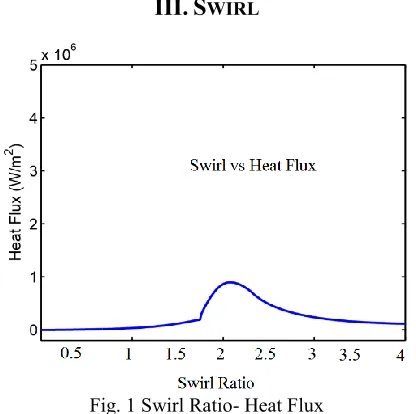
WIRLFig. 1 Swirl Ratio- Heat Flux
Heat flux changes from 2% to 3% when swirl changes from low to high. The swirl are of three type’s high swirl, medium swirl and low swirl. When swirl changes from high to low the reverse effect show as mentioned above. Piston head will never affected by swirl it effects crown part of bowl.
IV.
T
URBULENTI
NTENSITYTurbulent intensity affects the heat transfer when engine speed varies. Temperature varies as speed of engine varies from low to high. It indicates that temperature is directly proportional to temperature and turbulent intensity. When temperature increases by 2% then turbulent intensity increases by 3% to 4%. So that,
Fig. 2 Temperature- Turbulent Intensity
Temperature α Turbulent Intensity
Accurate prescription of TKE as initial conditions in CFD simulations are important to accurately predict flows, especially in high Reynolds-number simulations.
2
)
(
2
3
I
U
k
A smooth duct example is given below Where,
I = turbulence intensity [%] U = velocity magnitude
Fig. 3 Heat Flux- Turbulent Intensity
Estimating the Turbulent Intensity
some examples of common estimations of the turbulence intensity:
High-turbulence: High-speed flow inside complex geometries typically the turbulence intensity is between 5% and 20%
Medium-turbulence: Flow in not-so-complex devices typically the turbulence intensity is between 1% and 5% Low-turbulence: Flow originating from a fluid that stands still, typically the turbulence intensity is very low, well below 1%.
V. T
URBULENTK
INETICE
NERGYTurbulence kinetic energy (TKE) is the mean kinetic energy per unit mass associated with eddies in turbulent flow. Physically, the turbulence kinetic energy is
0 2 4 6
2 4 6 8
characterized by measured root-mean-square (RMS) velocity fluctuations.
The total mass within the boundary layer,
dr
A
ρ
m
r 0
Where the area A ∼ r σ for the different coordinate systems. The velocity in the direction of increasing r will therefore be given by,
dt
dm
A
u
1
, , 0 ,)
(
)
(
1
dr
r
A
r
dt
d
A
r
rr
r
dr
dt
d
r
0 , , ,)
(
1
When combustion occurs. Turbulent Thermal Conductivity,
t t p t
c
K
Pr
Turbulent Prandtl number correlations, Prt = 0.85+ BPr-1
Where B=0.012 to 0.05 and applied for Re=2104
Turbulent Viscosity Correlation,
In the two-equation k − ω model, k is the turbulence kinetic energy and ω is
The specific dissipation rate which can be calculated using the following expression,
09
.
0
* *
energy
kinetic
Turbulence
rate
n
dissipatio
Turbulence
This correlation is proposed by Wilcox and is widely used in the definition of ω. The Wilcox k−ω model gives good results
Fig. 4 Heat Flux- Turbulent K. Energy
The turbulence energy production rate is given by,
dt
dV
V
k
V
V
A
F
P
c c P c P1
3
2
|
|
3
Where,
Fp = 0.03 --- during combustion
VI. T
URBULENTD
ISSIPATIONR
ATEThe specific turbulence dissipation, is the rate at which turbulence kinetic energy is converted into thermal internal energy per unit volume and time. Sometimes the specific turbulence dissipation, , is also referred to as the mean frequency of the turbulence. This is mainly based on dimensional analysis. The SI unit of
is.1𝑠There is no strict mathematical definition of the specific turbulence dissipation, (at least none known by the author, please add one here if you know it). Instead it is most often defined implicitly using the turbulence kinetic energy and the turbulence dissipation, :
*
k
Where
*a model is constant, most often set to:09
.
0
*
C
Please note that some models/codes instead use a different definition without the model constant:
k
Turbulent dissipation rate = TKE X SDR X β Finally we can say,
TDR = 0.09 X TKEX SDR
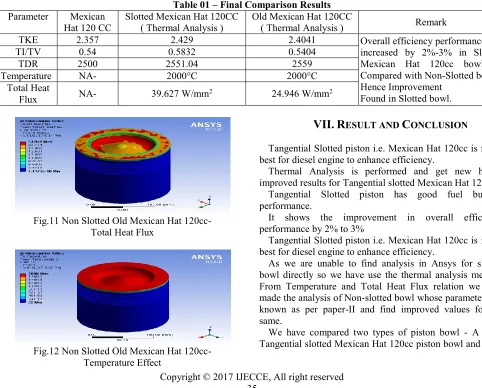
Fig.5 Heat Flux-Turbulent Dissipation Rate
Fig.7 Tangential Slotted Mexican Hat 120cc- Total Heat Flux
Fig.8 Top View- Tangential Slotted Mexican Hat 120cc- Total Heat Flux
Fig.9 Meshed F.V. - Tangential Slotted Mexican Hat
120cc- Total Heat Flux
Fig.10 Sectional View- Tangential Slotted Mexican
Hat 120cc- Total Heat Flux
Table 01 – Final Comparison Results Parameter Mexican
Hat 120 CC Slotted Mexican Hat 120CC ( Thermal Analysis ) Old Mexican Hat 120CC ( Thermal Analysis ) Remark
TKE 2.357 2.429 2.4041 Overall efficiency performance
increased by 2%-3% in Slotted Mexican Hat 120cc bowl as Compared with Non-Slotted bowl. Hence Improvement
Found in Slotted bowl.
TI/TV 0.54 0.5832 0.5404
TDR 2500 2551.04 2559
Temperature NA- 2000°C 2000°C
Total Heat
Flux NA- 39.627 W/mm2 24.946 W/mm2
Fig.11 Non Slotted Old Mexican Hat 120cc- Total Heat Flux
Fig.12 Non Slotted Old Mexican Hat 120cc- Temperature Effect
VII.
R
ESULT ANDC
ONCLUSIONTangential Slotted piston i.e. Mexican Hat 120cc is found best for diesel engine to enhance efficiency.
Thermal Analysis is performed and get new higher improved results for Tangential slotted Mexican Hat 120cc
Tangential Slotted piston has good fuel burning performance.
It shows the improvement in overall efficiency performance by 2% to 3%
Tangential Slotted piston i.e. Mexican Hat 120cc is found best for diesel engine to enhance efficiency.
As we are unable to find analysis in Ansys for slotted bowl directly so we have use the thermal analysis method. From Temperature and Total Heat Flux relation we have made the analysis of Non-slotted bowl whose parameters are known as per paper-II and find improved values for the same.
Non-slotted Mexican Hat 120cc piston bowl of diesel Engine with each Other and proved the best one.
Temperature and Total Heat Flux from transient thermal analysis in ANSYS 15.0 proved the effectiveness over IC ENGINE SOLVER 15.0
For future scope we can increase the tangential slots on piston head to study and analyze the effect on performance by various analysis software.
R
EFERENCE[1] Varahagiri V S J Bhaskar, Ph.D. Scholar, OPJS University, Churu, Rajasthan, “Analyzing the Effect of Various Piston Bowl Geometries on the Different Parameters of Engine” [IJERMCE-IFERP-DOI-802] Volume 1, Issue 2, May 2016, ISSN: 2456-1290. [2] Varahagiri V S J Bhaskar, Ph.D. Scholar, OPJS University, Churu,
Rajasthan, Analyzing the Effect of Various Piston Bowl Geometries on the Different Parameters and Size of Engine International Journal of Engineering Research in Mechanical and Civil Engineering [IJERMCE-IFERP-803] Vol 1, Issue 3, July 2016, ISSN (Online) 2456-1290.
[3] Vinay Kumar Attar, INTERNATIONAL JOURNAL OF
ENGINEERING SCIENCES & RESEARCH TECHNOLOGY “TRANSIENT THERMAL ANALYSIS OF INTERNAL COMBUSTION ENGINE PISTON IN ANSYS WORKBENCH BY FINITE ELEMENT METHOD” ISSN: 2277-9655
[4] Gordon Fru, Germany Impact of Turbulence Intensity and Equivalence Ratio on the Burning Rate of Premixed Methane–Air Flames, ISSN 1996-1073
[5] Internal Combustion Engine Heat Transfer-Transient Thermal Analysis, A thesis submitted by Abdalla Ibrahim Abuniran Agrira, University of Southern Queensland Faculty of Engineering & Surveying, Doctor of Philosophy May, 2012
[6] Lokesh Singh FINITE ELEMENT ANALYSIS OF PISTON IN ANSYS, ISSN 2349-9745
[7] NX 9 for Engineers and Designers by Prof. Sham Tickoo, Purudue University Calumet, USA, and Chapter 6: Advanced Modeling Tools-I, Chapter 7: Advanced Modeling Tools-II, Chapter 8Editing Features and Advanced Modeling Tools-III, ISBN: 978-93-5119-724-9
[8] ANSYS Workbench 15.0 for Engineers and Designers (A Tutorial Approach), by Prof. Sham Tickoo, Purudue University Calumet, USA.ISBN:978-93-5004-674-6
[9] Heat Flux and Temperature Distribution Analysis of I C Engine Cylinder Head Using ANSYS,International Journal of Advanced Research Foundation, Volume 2, Issue 5, May 2015
[10] CFD modeling of the in-cylinder flow in Direct-injection Diesel engine by H.Sushma, International Journal of Scientific and Research Publications, Volume 3, Issue 12, December 2013,ISSN 2250-3153