503
Information Technology and Control 2018/3/47
A New Hybrid Genetic
Algorithm for the Grey Pattern
Quadratic Assignment Problem
ITC 3/47
Journal of Information Technology and Control
Vol. 47 / No. 3 / 2018 pp. 503-520
DOI 10.5755/j01.itc.47.3.20728 © Kaunas University of Technology
A New Hybrid Genetic Algorithm for the Grey Pattern
Quadratic Assignment Problem
Received 2018/05/02 Accepted after revision 2018/07/16
http://dx.doi.org/10.5755/j01.itc.47.3.20728
Corresponding author: [email protected]
Alfonsas Misevičius
Kaunas University of Technology, Department of Multimedia Engineering, Studentų st. 50-416a/400, LT-51368 Kaunas, Lithuania, tel. + 370-37-300372, [email protected]
Evelina Stanevičienė
Kaunas University of Technology, Department of Multimedia Engineering, Studentų st. 50-416a/408, LT-51368 Kaunas, Lithuania, tel. + 370-37-300373, [email protected]
In this paper, we propose an improved hybrid genetic algorithm for the solution of the grey pattern quadratic as-signment problem (GP-QAP). The novelty is the hybridization of the genetic algorithm with the so-called hierar-chical iterated tabu search algorithm. Very fast exploration of the neighbouring solutions within the tabu search algorithm is used. In addition, a smart combination of the tabu search and adaptive perturbation is adopted, which enables a good balance between diversification and intensification during the iterative optimization process. The results from the experiments with the GP-QAP instances show that our algorithm is superior to other heuristic algorithms. Many best known solutions have been discovered for the large-scaled GP-QAP instances.
KEYWORDS: computational intelligence, heuristics, hybrid genetic algorithms, tabu search, combinatorial optimization, grey pattern quadratic assignment problem.
Introduction
The grey pattern quadratic assignment problem (GP-QAP) is a special case of the well-known combinato-rial optimization problem, the quadratic assignment problem (QAP) [2]. GP-QAP can be formulated as fol-lows [15]. Given two matrices A = (aij)n×n and B = (bkl)n×n
and the set Πn of permutations of the integers from 1 to n, find a permutation p ∈Πn that minimizes
A New Hybrid Genetic Algorithm for the Grey Pattern Quadratic Assignment
Problem
Alfonsas Misevičius
1,
Evelina Stanevičienė
2Kaunas University of Technology, Department of Multimedia Engineering,
Studentų st. 50−{416a/4001, 4082}, LT−51368 Kaunas, Lithuania
tel. {+ 370-37-3003721, + 370-37-3003732}, {[email protected], [email protected]2}
Corresponding author: [email protected]
In this paper, we propose an improved hybrid genetic algorithm for the solution of the grey pattern quadratic assignment problem (GP-QAP). The novelty is the hybridization of the genetic algorithm with the so-called hierarchical iterated tabu search algorithm. Very fast exploration of the neighbouring solutions within the tabu search algorithm is used. In addition, a smart combination of the tabu search and adaptive perturbation is adopted, which enables a good balance between diversification and intensification during the iterative optimization process. The results from the experiments with the GP-QAP instances show that our algorithm is superior to other heuristic algorithms. Many best known solutions have been discovered for the large-scaled GP-QAP instances.
KEYWORDS: computational intelligence, heuristics, hybrid genetic algorithms, tabu search, combinatorial optimization, grey
pattern quadratic assignment problem.
Introduction
The grey pattern quadratic assignment problem (GP-QAP) is a special case of the well-known combinatorial optimization problem, the quadratic assignment problem (QAP) [2]. GP-QAP can be formulated as follows [15]. Given two matrices 𝑨𝑨𝑨𝑨= (𝑎𝑎𝑎𝑎𝑖𝑖𝑖𝑖𝑖𝑖𝑖𝑖)𝑛𝑛𝑛𝑛×𝑛𝑛𝑛𝑛 and 𝑩𝑩𝑩𝑩= (𝑏𝑏𝑏𝑏𝑘𝑘𝑘𝑘𝑘𝑘𝑘𝑘)𝑛𝑛𝑛𝑛×𝑛𝑛𝑛𝑛 and the set Π𝑛𝑛𝑛𝑛 of permutations of the integers from 1 to 𝑛𝑛𝑛𝑛, find a permutation𝑝𝑝𝑝𝑝 ∈ Π𝑛𝑛𝑛𝑛that minimizes
𝑧𝑧𝑧𝑧(𝑝𝑝𝑝𝑝) =∑𝑖𝑖𝑖𝑖=1𝑛𝑛𝑛𝑛 ∑𝑛𝑛𝑛𝑛𝑖𝑖𝑖𝑖=1𝑎𝑎𝑎𝑎𝑖𝑖𝑖𝑖𝑖𝑖𝑖𝑖𝑏𝑏𝑏𝑏𝑝𝑝𝑝𝑝(𝑖𝑖𝑖𝑖)𝑝𝑝𝑝𝑝(𝑖𝑖𝑖𝑖) (1)
where 𝑎𝑎𝑎𝑎𝑖𝑖𝑖𝑖𝑖𝑖𝑖𝑖 = 1for 𝑖𝑖𝑖𝑖,𝑗𝑗𝑗𝑗= 1, … ,𝑚𝑚𝑚𝑚(1≤ 𝑚𝑚𝑚𝑚<𝑛𝑛𝑛𝑛)1and 𝑎𝑎𝑎𝑎𝑖𝑖𝑖𝑖𝑖𝑖𝑖𝑖 = 0otherwise. The values of the matrix(𝑏𝑏𝑏𝑏𝑘𝑘𝑘𝑘𝑘𝑘𝑘𝑘)𝑛𝑛𝑛𝑛×𝑛𝑛𝑛𝑛may be seen as distances between every pair of 𝑛𝑛𝑛𝑛objects (elements),𝑏𝑏𝑏𝑏𝑘𝑘𝑘𝑘𝑘𝑘𝑘𝑘=𝑏𝑏𝑏𝑏𝑘𝑘𝑘𝑘𝑘𝑘𝑘𝑘,𝑏𝑏𝑏𝑏𝑘𝑘𝑘𝑘𝑘𝑘𝑘𝑘= 0, 𝑘𝑘𝑘𝑘,𝑙𝑙𝑙𝑙= 1, … ,𝑛𝑛𝑛𝑛. In the context of the GP-QAP, the values𝑏𝑏𝑏𝑏𝑘𝑘𝑘𝑘𝑘𝑘𝑘𝑘are defined according to the following rule [15]:
𝑏𝑏𝑏𝑏𝑘𝑘𝑘𝑘𝑘𝑘𝑘𝑘 =𝑏𝑏𝑏𝑏(𝑟𝑟𝑟𝑟−1)𝑛𝑛𝑛𝑛2+𝑠𝑠𝑠𝑠 (𝑡𝑡𝑡𝑡−1)𝑛𝑛𝑛𝑛2+𝑢𝑢𝑢𝑢=𝜔𝜔𝜔𝜔𝑟𝑟𝑟𝑟𝑠𝑠𝑠𝑠𝑡𝑡𝑡𝑡𝑢𝑢𝑢𝑢,𝜔𝜔𝜔𝜔𝑟𝑟𝑟𝑟𝑠𝑠𝑠𝑠𝑡𝑡𝑡𝑡𝑢𝑢𝑢𝑢=𝑤𝑤𝑤𝑤1,𝑤𝑤𝑤𝑤max2∈{−1,0,1}{1 ((⁄ 𝑟𝑟𝑟𝑟 − 𝑡𝑡𝑡𝑡+𝑤𝑤𝑤𝑤1𝑛𝑛𝑛𝑛1)2+ (𝑟𝑟𝑟𝑟 − 𝑡𝑡𝑡𝑡+𝑤𝑤𝑤𝑤1𝑛𝑛𝑛𝑛1)2)} (2)
where 𝑟𝑟𝑟𝑟,𝑡𝑡𝑡𝑡= 1, … ,𝑛𝑛𝑛𝑛1,𝑠𝑠𝑠𝑠,𝑢𝑢𝑢𝑢= 1, … ,𝑛𝑛𝑛𝑛2, 𝑛𝑛𝑛𝑛1×𝑛𝑛𝑛𝑛2=𝑛𝑛𝑛𝑛. The interpretation of the quantity 𝜔𝜔𝜔𝜔𝑟𝑟𝑟𝑟𝑠𝑠𝑠𝑠𝑡𝑡𝑡𝑡𝑢𝑢𝑢𝑢 is as follows (see also [15]). We may consider𝑚𝑚𝑚𝑚electrons that have to be put on grid's squares. Then, 𝜔𝜔𝜔𝜔𝑟𝑟𝑟𝑟𝑠𝑠𝑠𝑠𝑡𝑡𝑡𝑡𝑢𝑢𝑢𝑢may be thought of as a quantity proportional to repulsion force between two electrons𝑖𝑖𝑖𝑖and 𝑗𝑗𝑗𝑗(𝑖𝑖𝑖𝑖,𝑗𝑗𝑗𝑗= 1, … ,𝑛𝑛𝑛𝑛) located in the grid positions𝑘𝑘𝑘𝑘=𝑝𝑝𝑝𝑝(𝑖𝑖𝑖𝑖)and 𝑙𝑙𝑙𝑙=𝑝𝑝𝑝𝑝(𝑗𝑗𝑗𝑗) with the coordinates (𝑟𝑟𝑟𝑟,𝑠𝑠𝑠𝑠) and (𝑡𝑡𝑡𝑡,𝑢𝑢𝑢𝑢). The electrons are to be arranged in such a way that the sum of the intensities of the repulsion forces is minimized.
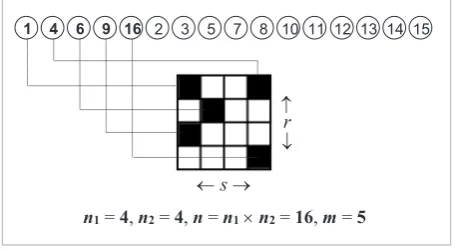
So, there is a grid of dimensions𝑛𝑛𝑛𝑛1 by𝑛𝑛𝑛𝑛2. In the grid, there are 𝑛𝑛𝑛𝑛=𝑛𝑛𝑛𝑛1×𝑛𝑛𝑛𝑛2 squares: there are𝑚𝑚𝑚𝑚black squares while the rest of the squares are white. This forms a grey pattern of density𝑚𝑚𝑚𝑚 𝑛𝑛𝑛𝑛⁄ . We seek to have a grey pattern where the black points are distributed in the most uniform possible way along the grid.
According to the above formulation, p denotes a permutation and 𝑝𝑝𝑝𝑝(𝑖𝑖𝑖𝑖), 𝑝𝑝𝑝𝑝(𝑗𝑗𝑗𝑗) denote the corresponding items (elements) of the permutation. The first𝑚𝑚𝑚𝑚items of every feasible permutation may be considered as a solution of the GP-QAP. In this way, the objective is to find the best available, optimal solution, i.e., the permutation items 𝑝𝑝𝑝𝑝(1), … ,𝑝𝑝𝑝𝑝(𝑚𝑚𝑚𝑚) (1≤ 𝑝𝑝𝑝𝑝(𝑖𝑖𝑖𝑖)≤ 𝑛𝑛𝑛𝑛,𝑖𝑖𝑖𝑖= 1, … ,𝑚𝑚𝑚𝑚) such that the sum∑𝑚𝑚𝑚𝑚𝑖𝑖𝑖𝑖=1∑𝑚𝑚𝑚𝑚𝑖𝑖𝑖𝑖=1𝑏𝑏𝑏𝑏𝑝𝑝𝑝𝑝(𝑖𝑖𝑖𝑖)𝑝𝑝𝑝𝑝(𝑖𝑖𝑖𝑖) (considered as an objective function of the GP-QAP) is as minimal as possible, that is:
𝑧𝑧𝑧𝑧(𝑝𝑝𝑝𝑝) =∑𝑖𝑖𝑖𝑖=1𝑚𝑚𝑚𝑚 ∑𝑚𝑚𝑚𝑚𝑖𝑖𝑖𝑖=1𝑏𝑏𝑏𝑏𝑝𝑝𝑝𝑝(𝑖𝑖𝑖𝑖)𝑝𝑝𝑝𝑝(𝑖𝑖𝑖𝑖) →minimum (3)
In formulation (3), only the matrix Band the values of𝑛𝑛𝑛𝑛,𝑚𝑚𝑚𝑚are necessary; meanwhile, the matrix𝑨𝑨𝑨𝑨is not needed at all. In our work, we use this formulation, rather than the general formulation (1). Also, note that the GP-QAP-solution (the elements 𝑝𝑝𝑝𝑝(1), … ,𝑝𝑝𝑝𝑝(𝑚𝑚𝑚𝑚)) can be associated with an m-(sub)set 𝑀𝑀𝑀𝑀 such that 𝑀𝑀𝑀𝑀= {𝑝𝑝𝑝𝑝(𝑖𝑖𝑖𝑖):𝑖𝑖𝑖𝑖= 1, … ,𝑚𝑚𝑚𝑚}, |𝑀𝑀𝑀𝑀| =𝑚𝑚𝑚𝑚 (see [5]). Analogously, the elements 𝑝𝑝𝑝𝑝(𝑚𝑚𝑚𝑚+ 1), … ,𝑝𝑝𝑝𝑝(𝑛𝑛𝑛𝑛) can be related to an n−m-(sub)set 𝑁𝑁𝑁𝑁, where 𝑁𝑁𝑁𝑁= {𝑝𝑝𝑝𝑝(𝑖𝑖𝑖𝑖):𝑖𝑖𝑖𝑖=𝑚𝑚𝑚𝑚+ 1, … ,𝑛𝑛𝑛𝑛},|𝑁𝑁𝑁𝑁| =𝑛𝑛𝑛𝑛 − 𝑚𝑚𝑚𝑚.
Exchanging two black (or two white) squares with each other does not change the value of the objective function, thus many permutations with the same objective value,𝑧𝑧𝑧𝑧(𝑝𝑝𝑝𝑝), may exist. So, there exist at least 𝑚𝑚𝑚𝑚!optimal solutions.
1In our work, we will consider 𝑚𝑚𝑚𝑚 ≤ 𝑛𝑛𝑛𝑛⁄2.
Information Technology and Control 2018/3/47 504
where aij= 1 for i, j = 1, ..., m (1 ≤m <n)1 and aij= 0 oth-erwise. The values of the matrix (bkl)n×n may be seen as distances between every pair of n objects (elements), bkl = blk, bkk = 0, k, l = 1, ..., n. In the context of the GP-QAP, the values bkl are defined according to the fol-lowing rule [15]:
A New Hybrid Genetic Algorithm for the Grey Pattern Quadratic Assignment
Problem
Alfonsas Misevičius
1,
Evelina Stanevičienė
2Kaunas University of Technology, Department of Multimedia Engineering,
Studentų st. 50−{416a/4001, 4082}, LT−51368 Kaunas, Lithuania
tel. {+370-37-3003721, +370-37-3003732}, {[email protected], [email protected]2}
Corresponding author: [email protected]
In this paper, we propose an improved hybrid genetic algorithm for the solution of the grey pattern quadratic assignment problem (GP-QAP). The novelty is the hybridization of the genetic algorithm with the so-called hierarchical iterated tabu search algorithm. Very fast exploration of the neighbouring solutions within the tabu search algorithm is used. In addition, a smart combination of the tabu search and adaptive perturbation is adopted, which enables a good balance between diversification and intensification during the iterative optimization process. The results from the experiments with the GP-QAP instances show that our algorithm is superior to other heuristic algorithms. Many best known solutions have been discovered for the large-scaled GP-QAP instances.
KEYWORDS: computational intelligence, heuristics, hybrid genetic algorithms, tabu search, combinatorial optimization, grey
pattern quadratic assignment problem.
Introduction
The grey pattern quadratic assignment problem (GP-QAP) is a special case of the well-known combinatorial optimization problem, the quadratic assignment problem (QAP) [2]. GP-QAP can be formulated as follows [15]. Given two matrices 𝑨𝑨𝑨𝑨= (𝑎𝑎𝑎𝑎𝑖𝑖𝑖𝑖𝑖𝑖𝑖𝑖)𝑛𝑛𝑛𝑛×𝑛𝑛𝑛𝑛 and 𝑩𝑩𝑩𝑩= (𝑏𝑏𝑏𝑏𝑘𝑘𝑘𝑘𝑘𝑘𝑘𝑘)𝑛𝑛𝑛𝑛×𝑛𝑛𝑛𝑛 and the set Π𝑛𝑛𝑛𝑛 of permutations of the integers from 1 to 𝑛𝑛𝑛𝑛, find a permutation 𝑝𝑝𝑝𝑝 ∈ Π𝑛𝑛𝑛𝑛 that minimizes
𝑧𝑧𝑧𝑧(𝑝𝑝𝑝𝑝) =∑𝑛𝑛𝑛𝑛𝑖𝑖𝑖𝑖=1∑𝑛𝑛𝑛𝑛𝑖𝑖𝑖𝑖=1𝑎𝑎𝑎𝑎𝑖𝑖𝑖𝑖𝑖𝑖𝑖𝑖𝑏𝑏𝑏𝑏𝑝𝑝𝑝𝑝(𝑖𝑖𝑖𝑖)𝑝𝑝𝑝𝑝(𝑖𝑖𝑖𝑖) (1)
where 𝑎𝑎𝑎𝑎𝑖𝑖𝑖𝑖𝑖𝑖𝑖𝑖 = 1 for 𝑖𝑖𝑖𝑖,𝑗𝑗𝑗𝑗= 1, … ,𝑚𝑚𝑚𝑚 (1≤ 𝑚𝑚𝑚𝑚<𝑛𝑛𝑛𝑛)1 and 𝑎𝑎𝑎𝑎𝑖𝑖𝑖𝑖𝑖𝑖𝑖𝑖= 0 otherwise. The values of the matrix (𝑏𝑏𝑏𝑏𝑘𝑘𝑘𝑘𝑘𝑘𝑘𝑘)𝑛𝑛𝑛𝑛×𝑛𝑛𝑛𝑛 may be seen as distances between every pair of 𝑛𝑛𝑛𝑛 objects (elements), 𝑏𝑏𝑏𝑏𝑘𝑘𝑘𝑘𝑘𝑘𝑘𝑘=𝑏𝑏𝑏𝑏𝑘𝑘𝑘𝑘𝑘𝑘𝑘𝑘, 𝑏𝑏𝑏𝑏𝑘𝑘𝑘𝑘𝑘𝑘𝑘𝑘= 0, 𝑘𝑘𝑘𝑘,𝑙𝑙𝑙𝑙= 1, … ,𝑛𝑛𝑛𝑛. In the context of the GP-QAP, the values 𝑏𝑏𝑏𝑏𝑘𝑘𝑘𝑘𝑘𝑘𝑘𝑘 are defined according to the following rule [15]:
𝑏𝑏𝑏𝑏𝑘𝑘𝑘𝑘𝑘𝑘𝑘𝑘 =𝑏𝑏𝑏𝑏(𝑟𝑟𝑟𝑟−1)𝑛𝑛𝑛𝑛2+𝑠𝑠𝑠𝑠 (𝑡𝑡𝑡𝑡−1)𝑛𝑛𝑛𝑛2+𝑢𝑢𝑢𝑢=𝜔𝜔𝜔𝜔𝑟𝑟𝑟𝑟𝑠𝑠𝑠𝑠𝑡𝑡𝑡𝑡𝑢𝑢𝑢𝑢,𝜔𝜔𝜔𝜔𝑟𝑟𝑟𝑟𝑠𝑠𝑠𝑠𝑡𝑡𝑡𝑡𝑢𝑢𝑢𝑢 =𝑤𝑤𝑤𝑤 max
1,𝑤𝑤𝑤𝑤2∈{−1,0,1}{1 ((𝑟𝑟𝑟𝑟−𝑡𝑡𝑡𝑡+𝑤𝑤𝑤𝑤1𝑛𝑛𝑛𝑛1)
2+(𝑟𝑟𝑟𝑟 −𝑡𝑡𝑡𝑡+𝑤𝑤𝑤𝑤 𝑛𝑛𝑛𝑛 )2)
⁄ } (2)
where 𝑟𝑟𝑟𝑟,𝑡𝑡𝑡𝑡= 1, … ,𝑛𝑛𝑛𝑛1, 𝑠𝑠𝑠𝑠,𝑢𝑢𝑢𝑢= 1, … ,𝑛𝑛𝑛𝑛2, 𝑛𝑛𝑛𝑛1×𝑛𝑛𝑛𝑛2=𝑛𝑛𝑛𝑛. The interpretation of the quantity 𝜔𝜔𝜔𝜔𝑟𝑟𝑟𝑟𝑠𝑠𝑠𝑠𝑡𝑡𝑡𝑡𝑢𝑢𝑢𝑢 is as follows (see also [15]). We may consider 𝑚𝑚𝑚𝑚 electrons that have to be put on grid's squares. Then, 𝜔𝜔𝜔𝜔𝑟𝑟𝑟𝑟𝑠𝑠𝑠𝑠𝑡𝑡𝑡𝑡𝑢𝑢𝑢𝑢 may be thought of as a quantity proportional to repulsion force between two electrons 𝑖𝑖𝑖𝑖 and 𝑗𝑗𝑗𝑗 (𝑖𝑖𝑖𝑖,𝑗𝑗𝑗𝑗= 1, … ,𝑛𝑛𝑛𝑛) located in the grid positions 𝑘𝑘𝑘𝑘=𝑝𝑝𝑝𝑝(𝑖𝑖𝑖𝑖) and
𝑙𝑙𝑙𝑙=𝑝𝑝𝑝𝑝(𝑗𝑗𝑗𝑗) with the coordinates (𝑟𝑟𝑟𝑟,𝑠𝑠𝑠𝑠) and (𝑡𝑡𝑡𝑡,𝑢𝑢𝑢𝑢). The electrons are to be arranged in such a way that the sum of the
intensities of the repulsion forces is minimized.
So, there is a grid of dimensions 𝑛𝑛𝑛𝑛1 by 𝑛𝑛𝑛𝑛2. In the grid, there are 𝑛𝑛𝑛𝑛=𝑛𝑛𝑛𝑛1×𝑛𝑛𝑛𝑛2 squares: there are 𝑚𝑚𝑚𝑚 black squares while the rest of the squares are white. This forms a grey pattern of density 𝑚𝑚𝑚𝑚 𝑛𝑛𝑛𝑛⁄ . We seek to have a grey pattern where the black points are distributed in the most uniform possible way along the grid.
According to the above formulation, p denotes a permutation and 𝑝𝑝𝑝𝑝(𝑖𝑖𝑖𝑖), 𝑝𝑝𝑝𝑝(𝑗𝑗𝑗𝑗) denote the corresponding items (elements) of the permutation. The first 𝑚𝑚𝑚𝑚 items of every feasible permutation may be considered as a solution of the GP-QAP. In this way, the objective is to find the best available, optimal solution, i.e., the permutation items
𝑝𝑝𝑝𝑝(1), … ,𝑝𝑝𝑝𝑝(𝑚𝑚𝑚𝑚) (1≤ 𝑝𝑝𝑝𝑝(𝑖𝑖𝑖𝑖)≤ 𝑛𝑛𝑛𝑛, 𝑖𝑖𝑖𝑖= 1, … ,𝑚𝑚𝑚𝑚) such that the sum ∑𝑚𝑚𝑚𝑚𝑖𝑖𝑖𝑖=1∑𝑚𝑚𝑚𝑚𝑖𝑖𝑖𝑖=1𝑏𝑏𝑏𝑏𝑝𝑝𝑝𝑝(𝑖𝑖𝑖𝑖)𝑝𝑝𝑝𝑝(𝑖𝑖𝑖𝑖) (considered as an objective function
of the GP-QAP) is as minimal as possible, that is:
𝑧𝑧𝑧𝑧(𝑝𝑝𝑝𝑝) =∑𝑚𝑚𝑚𝑚𝑖𝑖𝑖𝑖=1∑𝑚𝑚𝑚𝑚𝑖𝑖𝑖𝑖=1𝑏𝑏𝑏𝑏𝑝𝑝𝑝𝑝(𝑖𝑖𝑖𝑖)𝑝𝑝𝑝𝑝(𝑖𝑖𝑖𝑖) →minimum (3)
In formulation (3), only the matrix B and the values of 𝑛𝑛𝑛𝑛, 𝑚𝑚𝑚𝑚 are necessary; meanwhile, the matrix 𝑨𝑨𝑨𝑨 is not needed at all. In our work, we use this formulation, rather than the general formulation (1). Also, note that the GP-QAP-solution (the elements 𝑝𝑝𝑝𝑝(1), … ,𝑝𝑝𝑝𝑝(𝑚𝑚𝑚𝑚)) can be associated with an m-(sub)set 𝑀𝑀𝑀𝑀 such that 𝑀𝑀𝑀𝑀= {𝑝𝑝𝑝𝑝(𝑖𝑖𝑖𝑖):𝑖𝑖𝑖𝑖= 1, … ,𝑚𝑚𝑚𝑚}, |𝑀𝑀𝑀𝑀| =𝑚𝑚𝑚𝑚 (see [5]). Analogously, the elements 𝑝𝑝𝑝𝑝(𝑚𝑚𝑚𝑚+ 1), … ,𝑝𝑝𝑝𝑝(𝑛𝑛𝑛𝑛) can be related to an n−m-(sub)set 𝑁𝑁𝑁𝑁, where 𝑁𝑁𝑁𝑁= {𝑝𝑝𝑝𝑝(𝑖𝑖𝑖𝑖):𝑖𝑖𝑖𝑖=𝑚𝑚𝑚𝑚+ 1, … ,𝑛𝑛𝑛𝑛}, |𝑁𝑁𝑁𝑁| =𝑛𝑛𝑛𝑛 − 𝑚𝑚𝑚𝑚.
Exchanging two black (or two white) squares with each other does not change the value of the objective function, thus many permutations with the same objective value, 𝑧𝑧𝑧𝑧(𝑝𝑝𝑝𝑝), may exist. So, there exist at least 𝑚𝑚𝑚𝑚! optimal solutions.
1 In our work, we will consider 𝑚𝑚𝑚𝑚 ≤ 𝑛𝑛𝑛𝑛⁄2.
2 2
A New Hybrid Genetic Algorithm for the Grey Pattern Quadratic Assignment
Problem
Alfonsas Misevičius
1,
Evelina Stanevičienė
2Kaunas University of Technology, Department of Multimedia Engineering,
Studentų st. 50−{416a/4001, 4082}, LT−51368 Kaunas, Lithuania
tel. {+370-37-3003721, +370-37-3003732}, {[email protected], [email protected]2}
Corresponding author: [email protected]
In this paper, we propose an improved hybrid genetic algorithm for the solution of the grey pattern quadratic assignment problem (GP-QAP). The novelty is the hybridization of the genetic algorithm with the so-called hierarchical iterated tabu search algorithm. Very fast exploration of the neighbouring solutions within the tabu search algorithm is used. In addition, a smart combination of the tabu search and adaptive perturbation is adopted, which enables a good balance between diversification and intensification during the iterative optimization process. The results from the experiments with the GP-QAP instances show that our algorithm is superior to other heuristic algorithms. Many best known solutions have been discovered for the large-scaled GP-QAP instances.
KEYWORDS: computational intelligence, heuristics, hybrid genetic algorithms, tabu search, combinatorial optimization, grey
pattern quadratic assignment problem.
Introduction
The grey pattern quadratic assignment problem (GP-QAP) is a special case of the well-known combinatorial optimization problem, the quadratic assignment problem (QAP) [2]. GP-QAP can be formulated as follows [15]. Given two matrices 𝑨𝑨𝑨𝑨= (𝑎𝑎𝑎𝑎𝑖𝑖𝑖𝑖𝑖𝑖𝑖𝑖)𝑛𝑛𝑛𝑛×𝑛𝑛𝑛𝑛 and 𝑩𝑩𝑩𝑩= (𝑏𝑏𝑏𝑏𝑘𝑘𝑘𝑘𝑘𝑘𝑘𝑘)𝑛𝑛𝑛𝑛×𝑛𝑛𝑛𝑛 and the set Π𝑛𝑛𝑛𝑛 of permutations of the integers from 1 to 𝑛𝑛𝑛𝑛, find a permutation 𝑝𝑝𝑝𝑝 ∈ Π𝑛𝑛𝑛𝑛 that minimizes
𝑧𝑧𝑧𝑧(𝑝𝑝𝑝𝑝) =∑𝑛𝑛𝑛𝑛𝑖𝑖𝑖𝑖=1∑𝑛𝑛𝑛𝑛𝑖𝑖𝑖𝑖=1𝑎𝑎𝑎𝑎𝑖𝑖𝑖𝑖𝑖𝑖𝑖𝑖𝑏𝑏𝑏𝑏𝑝𝑝𝑝𝑝(𝑖𝑖𝑖𝑖)𝑝𝑝𝑝𝑝(𝑖𝑖𝑖𝑖) (1)
where 𝑎𝑎𝑎𝑎𝑖𝑖𝑖𝑖𝑖𝑖𝑖𝑖 = 1 for 𝑖𝑖𝑖𝑖,𝑗𝑗𝑗𝑗= 1, … ,𝑚𝑚𝑚𝑚 (1≤ 𝑚𝑚𝑚𝑚<𝑛𝑛𝑛𝑛)1 and 𝑎𝑎𝑎𝑎𝑖𝑖𝑖𝑖𝑖𝑖𝑖𝑖 = 0 otherwise. The values of the matrix (𝑏𝑏𝑏𝑏𝑘𝑘𝑘𝑘𝑘𝑘𝑘𝑘)𝑛𝑛𝑛𝑛×𝑛𝑛𝑛𝑛 may be seen as distances between every pair of 𝑛𝑛𝑛𝑛 objects (elements), 𝑏𝑏𝑏𝑏𝑘𝑘𝑘𝑘𝑘𝑘𝑘𝑘=𝑏𝑏𝑏𝑏𝑘𝑘𝑘𝑘𝑘𝑘𝑘𝑘, 𝑏𝑏𝑏𝑏𝑘𝑘𝑘𝑘𝑘𝑘𝑘𝑘= 0, 𝑘𝑘𝑘𝑘,𝑙𝑙𝑙𝑙= 1, … ,𝑛𝑛𝑛𝑛. In the context of the GP-QAP, the values 𝑏𝑏𝑏𝑏𝑘𝑘𝑘𝑘𝑘𝑘𝑘𝑘 are defined according to the following rule [15]:
𝑏𝑏𝑏𝑏𝑘𝑘𝑘𝑘𝑘𝑘𝑘𝑘 =𝑏𝑏𝑏𝑏(𝑟𝑟𝑟𝑟−1)𝑛𝑛𝑛𝑛2+𝑠𝑠𝑠𝑠 (𝑡𝑡𝑡𝑡−1)𝑛𝑛𝑛𝑛2+𝑢𝑢𝑢𝑢=𝜔𝜔𝜔𝜔𝑟𝑟𝑟𝑟𝑠𝑠𝑠𝑠𝑡𝑡𝑡𝑡𝑢𝑢𝑢𝑢,𝜔𝜔𝜔𝜔𝑟𝑟𝑟𝑟𝑠𝑠𝑠𝑠𝑡𝑡𝑡𝑡𝑢𝑢𝑢𝑢 =𝑤𝑤𝑤𝑤 max
1,𝑤𝑤𝑤𝑤2∈{−1,0,1}{1 ((𝑟𝑟𝑟𝑟−𝑡𝑡𝑡𝑡+𝑤𝑤𝑤𝑤1𝑛𝑛𝑛𝑛1)
2+(𝑟𝑟𝑟𝑟 −𝑡𝑡𝑡𝑡+𝑤𝑤𝑤𝑤 𝑛𝑛𝑛𝑛 )2)
⁄ } (2)
where 𝑟𝑟𝑟𝑟,𝑡𝑡𝑡𝑡= 1, … ,𝑛𝑛𝑛𝑛1, 𝑠𝑠𝑠𝑠,𝑢𝑢𝑢𝑢= 1, … ,𝑛𝑛𝑛𝑛2, 𝑛𝑛𝑛𝑛1×𝑛𝑛𝑛𝑛2=𝑛𝑛𝑛𝑛. The interpretation of the quantity 𝜔𝜔𝜔𝜔𝑟𝑟𝑟𝑟𝑠𝑠𝑠𝑠𝑡𝑡𝑡𝑡𝑢𝑢𝑢𝑢 is as follows (see also [15]). We may consider 𝑚𝑚𝑚𝑚 electrons that have to be put on grid's squares. Then, 𝜔𝜔𝜔𝜔𝑟𝑟𝑟𝑟𝑠𝑠𝑠𝑠𝑡𝑡𝑡𝑡𝑢𝑢𝑢𝑢 may be thought of as a quantity proportional to repulsion force between two electrons 𝑖𝑖𝑖𝑖 and 𝑗𝑗𝑗𝑗 (𝑖𝑖𝑖𝑖,𝑗𝑗𝑗𝑗= 1, … ,𝑛𝑛𝑛𝑛) located in the grid positions 𝑘𝑘𝑘𝑘=𝑝𝑝𝑝𝑝(𝑖𝑖𝑖𝑖) and
𝑙𝑙𝑙𝑙=𝑝𝑝𝑝𝑝(𝑗𝑗𝑗𝑗) with the coordinates (𝑟𝑟𝑟𝑟,𝑠𝑠𝑠𝑠) and (𝑡𝑡𝑡𝑡,𝑢𝑢𝑢𝑢). The electrons are to be arranged in such a way that the sum of the
intensities of the repulsion forces is minimized.
So, there is a grid of dimensions 𝑛𝑛𝑛𝑛1 by 𝑛𝑛𝑛𝑛2. In the grid, there are 𝑛𝑛𝑛𝑛=𝑛𝑛𝑛𝑛1×𝑛𝑛𝑛𝑛2 squares: there are 𝑚𝑚𝑚𝑚 black squares while the rest of the squares are white. This forms a grey pattern of density 𝑚𝑚𝑚𝑚 𝑛𝑛𝑛𝑛⁄ . We seek to have a grey pattern where the black points are distributed in the most uniform possible way along the grid.
According to the above formulation, p denotes a permutation and 𝑝𝑝𝑝𝑝(𝑖𝑖𝑖𝑖), 𝑝𝑝𝑝𝑝(𝑗𝑗𝑗𝑗) denote the corresponding items (elements) of the permutation. The first 𝑚𝑚𝑚𝑚 items of every feasible permutation may be considered as a solution of the GP-QAP. In this way, the objective is to find the best available, optimal solution, i.e., the permutation items
𝑝𝑝𝑝𝑝(1), … ,𝑝𝑝𝑝𝑝(𝑚𝑚𝑚𝑚) (1≤ 𝑝𝑝𝑝𝑝(𝑖𝑖𝑖𝑖)≤ 𝑛𝑛𝑛𝑛, 𝑖𝑖𝑖𝑖= 1, … ,𝑚𝑚𝑚𝑚) such that the sum ∑𝑚𝑚𝑚𝑚𝑖𝑖𝑖𝑖=1∑𝑚𝑚𝑚𝑚𝑖𝑖𝑖𝑖=1𝑏𝑏𝑏𝑏𝑝𝑝𝑝𝑝(𝑖𝑖𝑖𝑖)𝑝𝑝𝑝𝑝(𝑖𝑖𝑖𝑖) (considered as an objective function
of the GP-QAP) is as minimal as possible, that is:
𝑧𝑧𝑧𝑧(𝑝𝑝𝑝𝑝) =∑𝑚𝑚𝑚𝑚𝑖𝑖𝑖𝑖=1∑𝑚𝑚𝑚𝑚𝑖𝑖𝑖𝑖=1𝑏𝑏𝑏𝑏𝑝𝑝𝑝𝑝(𝑖𝑖𝑖𝑖)𝑝𝑝𝑝𝑝(𝑖𝑖𝑖𝑖) →minimum (3)
In formulation (3), only the matrix B and the values of 𝑛𝑛𝑛𝑛, 𝑚𝑚𝑚𝑚 are necessary; meanwhile, the matrix 𝑨𝑨𝑨𝑨 is not needed at all. In our work, we use this formulation, rather than the general formulation (1). Also, note that the GP-QAP-solution (the elements 𝑝𝑝𝑝𝑝(1), … ,𝑝𝑝𝑝𝑝(𝑚𝑚𝑚𝑚)) can be associated with an m-(sub)set 𝑀𝑀𝑀𝑀 such that 𝑀𝑀𝑀𝑀= {𝑝𝑝𝑝𝑝(𝑖𝑖𝑖𝑖):𝑖𝑖𝑖𝑖= 1, … ,𝑚𝑚𝑚𝑚}, |𝑀𝑀𝑀𝑀| =𝑚𝑚𝑚𝑚 (see [5]). Analogously, the elements 𝑝𝑝𝑝𝑝(𝑚𝑚𝑚𝑚+ 1), … ,𝑝𝑝𝑝𝑝(𝑛𝑛𝑛𝑛) can be related to an n−m-(sub)set 𝑁𝑁𝑁𝑁, where 𝑁𝑁𝑁𝑁= {𝑝𝑝𝑝𝑝(𝑖𝑖𝑖𝑖):𝑖𝑖𝑖𝑖=𝑚𝑚𝑚𝑚+ 1, … ,𝑛𝑛𝑛𝑛}, |𝑁𝑁𝑁𝑁| =𝑛𝑛𝑛𝑛 − 𝑚𝑚𝑚𝑚.
Exchanging two black (or two white) squares with each other does not change the value of the objective function, thus many permutations with the same objective value, 𝑧𝑧𝑧𝑧(𝑝𝑝𝑝𝑝), may exist. So, there exist at least 𝑚𝑚𝑚𝑚! optimal solutions.
1 In our work, we will consider 𝑚𝑚𝑚𝑚 ≤ 𝑛𝑛𝑛𝑛⁄2.
2 2
(2)
where r, t = 1, ..., n1, s, u = 1, ..., n2, n1×n2 = n . The in-terpretation of the quantity ωrstu is as follows (see also [15]). We may consider m electrons that have to be put on grid’s squares. Then, ωrstu may be thought of as a quantity proportional to repulsion force between two electrons i and j ( i, j = 1, ..., n) located in the grid posi-tions k = p(i) and l = p(j) with the coordinates (r, s) and (t, u). The electrons are to be arranged in such a way that the sum of the intensities of the repulsion forces is minimized.
So, there is a grid of dimensions n1 by n2. In the grid, there are n = n1×n squares: there are m black squares while the rest of the squares are white. This forms a grey pattern of density m/n. We seek to have a grey pattern where the black points are distributed in the most uniform possible way along the grid.
According to the above formulation, p denotes a permutation and p(i), p(j) denote the correspond-ing items (elements) of the permutation. The first m items of every feasible permutation may be consid-ered as a solution of the GP-QAP. In this way, the ob-jective is to find the best available, optimal solution, i.e., the permutation items p(1), ..., p(m) ( 1 ≤p(i)≤n, i = 1, ..., m) such that the sum
A New Hybrid Genetic Algorithm for the Grey Pattern Quadratic Assignment
Problem
Alfonsas Misevičius
1,
Evelina Stanevičienė
2Kaunas University of Technology, Department of Multimedia Engineering, Studentų st. 50−{416a/4001, 4082}, LT−51368 Kaunas, Lithuania
tel. {+ 370-37-3003721, + 370-37-3003732}, {[email protected], [email protected]2}
Corresponding author: [email protected]
In this paper, we propose an improved hybrid genetic algorithm for the solution of the grey pattern quadratic assignment problem (GP-QAP). The novelty is the hybridization of the genetic algorithm with the so-called hierarchical iterated tabu search algorithm. Very fast exploration of the neighbouring solutions within the tabu search algorithm is used. In addition, a smart combination of the tabu search and adaptive perturbation is adopted, which enables a good balance between diversification and intensification during the iterative optimization process. The results from the experiments with the GP-QAP instances show that our algorithm is superior to other heuristic algorithms. Many best known solutions have been discovered for the large-scaled GP-QAP instances.
KEYWORDS: computational intelligence, heuristics, hybrid genetic algorithms, tabu search, combinatorial optimization, grey
pattern quadratic assignment problem.
Introduction
The grey pattern quadratic assignment problem (GP-QAP) is a special case of the well-known combinatorial optimization problem, the quadratic assignment problem (QAP) [2]. GP-QAP can be formulated as follows [15]. Given two matrices 𝑨𝑨𝑨𝑨= (𝑎𝑎𝑎𝑎𝑖𝑖𝑖𝑖𝑖𝑖𝑖𝑖)𝑛𝑛𝑛𝑛×𝑛𝑛𝑛𝑛 and 𝑩𝑩𝑩𝑩= (𝑏𝑏𝑏𝑏𝑘𝑘𝑘𝑘𝑘𝑘𝑘𝑘)𝑛𝑛𝑛𝑛×𝑛𝑛𝑛𝑛 and the set Π𝑛𝑛𝑛𝑛 of permutations of the integers from 1 to 𝑛𝑛𝑛𝑛, find a permutation𝑝𝑝𝑝𝑝 ∈ Π𝑛𝑛𝑛𝑛that minimizes
𝑧𝑧𝑧𝑧(𝑝𝑝𝑝𝑝) =∑𝑖𝑖𝑖𝑖=1𝑛𝑛𝑛𝑛 ∑𝑛𝑛𝑛𝑛𝑖𝑖𝑖𝑖=1𝑎𝑎𝑎𝑎𝑖𝑖𝑖𝑖𝑖𝑖𝑖𝑖𝑏𝑏𝑏𝑏𝑝𝑝𝑝𝑝(𝑖𝑖𝑖𝑖)𝑝𝑝𝑝𝑝(𝑖𝑖𝑖𝑖) (1) where 𝑎𝑎𝑎𝑎𝑖𝑖𝑖𝑖𝑖𝑖𝑖𝑖 = 1for 𝑖𝑖𝑖𝑖,𝑗𝑗𝑗𝑗= 1, … ,𝑚𝑚𝑚𝑚(1≤ 𝑚𝑚𝑚𝑚<𝑛𝑛𝑛𝑛)1and 𝑎𝑎𝑎𝑎𝑖𝑖𝑖𝑖𝑖𝑖𝑖𝑖= 0otherwise. The values of the matrix(𝑏𝑏𝑏𝑏𝑘𝑘𝑘𝑘𝑘𝑘𝑘𝑘)𝑛𝑛𝑛𝑛×𝑛𝑛𝑛𝑛may be seen as distances between every pair of𝑛𝑛𝑛𝑛 objects (elements),𝑏𝑏𝑏𝑏𝑘𝑘𝑘𝑘𝑘𝑘𝑘𝑘=𝑏𝑏𝑏𝑏𝑘𝑘𝑘𝑘𝑘𝑘𝑘𝑘,𝑏𝑏𝑏𝑏𝑘𝑘𝑘𝑘𝑘𝑘𝑘𝑘 = 0,𝑘𝑘𝑘𝑘,𝑙𝑙𝑙𝑙= 1, … ,𝑛𝑛𝑛𝑛. In the context of the GP-QAP, the values𝑏𝑏𝑏𝑏𝑘𝑘𝑘𝑘𝑘𝑘𝑘𝑘are defined according to the following rule [15]:
𝑏𝑏𝑏𝑏𝑘𝑘𝑘𝑘𝑘𝑘𝑘𝑘=𝑏𝑏𝑏𝑏(𝑟𝑟𝑟𝑟−1)𝑛𝑛𝑛𝑛2+𝑠𝑠𝑠𝑠 (𝑡𝑡𝑡𝑡−1)𝑛𝑛𝑛𝑛2+𝑢𝑢𝑢𝑢=𝜔𝜔𝜔𝜔𝑟𝑟𝑟𝑟𝑠𝑠𝑠𝑠𝑡𝑡𝑡𝑡𝑢𝑢𝑢𝑢,𝜔𝜔𝜔𝜔𝑟𝑟𝑟𝑟𝑠𝑠𝑠𝑠𝑡𝑡𝑡𝑡𝑢𝑢𝑢𝑢=𝑤𝑤𝑤𝑤1,𝑤𝑤𝑤𝑤max2∈{−1,0,1}{1 ((⁄ 𝑟𝑟𝑟𝑟 − 𝑡𝑡𝑡𝑡+𝑤𝑤𝑤𝑤1𝑛𝑛𝑛𝑛1)2+ (𝑟𝑟𝑟𝑟 − 𝑡𝑡𝑡𝑡+𝑤𝑤𝑤𝑤1𝑛𝑛𝑛𝑛1)2)} (2) where 𝑟𝑟𝑟𝑟,𝑡𝑡𝑡𝑡= 1, … ,𝑛𝑛𝑛𝑛1,𝑠𝑠𝑠𝑠,𝑢𝑢𝑢𝑢= 1, … ,𝑛𝑛𝑛𝑛2, 𝑛𝑛𝑛𝑛1×𝑛𝑛𝑛𝑛2=𝑛𝑛𝑛𝑛. The interpretation of the quantity 𝜔𝜔𝜔𝜔𝑟𝑟𝑟𝑟𝑠𝑠𝑠𝑠𝑡𝑡𝑡𝑡𝑢𝑢𝑢𝑢 is as follows (see also [15]). We may consider𝑚𝑚𝑚𝑚electrons that have to be put on grid's squares. Then, 𝜔𝜔𝜔𝜔𝑟𝑟𝑟𝑟𝑠𝑠𝑠𝑠𝑡𝑡𝑡𝑡𝑢𝑢𝑢𝑢may be thought of as a quantity proportional to repulsion force between two electrons𝑖𝑖𝑖𝑖and 𝑗𝑗𝑗𝑗(𝑖𝑖𝑖𝑖,𝑗𝑗𝑗𝑗= 1, … ,𝑛𝑛𝑛𝑛) located in the grid positions𝑘𝑘𝑘𝑘=𝑝𝑝𝑝𝑝(𝑖𝑖𝑖𝑖)and
𝑙𝑙𝑙𝑙=𝑝𝑝𝑝𝑝(𝑗𝑗𝑗𝑗) with the coordinates(𝑟𝑟𝑟𝑟,𝑠𝑠𝑠𝑠) and (𝑡𝑡𝑡𝑡,𝑢𝑢𝑢𝑢). The electrons are to be arranged in such a way that the sum of the intensities of the repulsion forces is minimized.
So, there is a grid of dimensions𝑛𝑛𝑛𝑛1by𝑛𝑛𝑛𝑛2. In the grid, there are𝑛𝑛𝑛𝑛=𝑛𝑛𝑛𝑛1×𝑛𝑛𝑛𝑛2squares: there are𝑚𝑚𝑚𝑚black squares while the rest of the squares are white. This forms a grey pattern of density𝑚𝑚𝑚𝑚 𝑛𝑛𝑛𝑛⁄ . We seek to have a grey pattern where the black points are distributed in the most uniform possible way along the grid.
According to the above formulation, p denotes a permutation and 𝑝𝑝𝑝𝑝(𝑖𝑖𝑖𝑖), 𝑝𝑝𝑝𝑝(𝑗𝑗𝑗𝑗) denote the corresponding items (elements) of the permutation. The first𝑚𝑚𝑚𝑚items of every feasible permutation may be considered as a solution of the GP-QAP. In this way, the objective is to find the best available, optimal solution, i.e., the permutation items
𝑝𝑝𝑝𝑝(1), … ,𝑝𝑝𝑝𝑝(𝑚𝑚𝑚𝑚)(1≤ 𝑝𝑝𝑝𝑝(𝑖𝑖𝑖𝑖)≤ 𝑛𝑛𝑛𝑛,𝑖𝑖𝑖𝑖= 1, … ,𝑚𝑚𝑚𝑚) such that the sum∑𝑚𝑚𝑚𝑚𝑖𝑖𝑖𝑖=1∑𝑚𝑚𝑚𝑚𝑖𝑖𝑖𝑖=1𝑏𝑏𝑏𝑏𝑝𝑝𝑝𝑝(𝑖𝑖𝑖𝑖)𝑝𝑝𝑝𝑝(𝑖𝑖𝑖𝑖) (considered as an objective function of the GP-QAP) is as minimal as possible, that is:
𝑧𝑧𝑧𝑧(𝑝𝑝𝑝𝑝) =∑𝑖𝑖𝑖𝑖=1𝑚𝑚𝑚𝑚 ∑𝑚𝑚𝑚𝑚𝑖𝑖𝑖𝑖=1𝑏𝑏𝑏𝑏𝑝𝑝𝑝𝑝(𝑖𝑖𝑖𝑖)𝑝𝑝𝑝𝑝(𝑖𝑖𝑖𝑖) →minimum (3) In formulation (3), only the matrix Band the values of𝑛𝑛𝑛𝑛,𝑚𝑚𝑚𝑚are necessary; meanwhile, the matrix𝑨𝑨𝑨𝑨is not needed at all. In our work, we use this formulation, rather than the general formulation (1). Also, note that the GP-QAP-solution (the elements 𝑝𝑝𝑝𝑝(1), … ,𝑝𝑝𝑝𝑝(𝑚𝑚𝑚𝑚)) can be associated with an m-(sub)set 𝑀𝑀𝑀𝑀 such that 𝑀𝑀𝑀𝑀= {𝑝𝑝𝑝𝑝(𝑖𝑖𝑖𝑖):𝑖𝑖𝑖𝑖= 1, … ,𝑚𝑚𝑚𝑚}, |𝑀𝑀𝑀𝑀| =𝑚𝑚𝑚𝑚 (see [5]). Analogously, the elements 𝑝𝑝𝑝𝑝(𝑚𝑚𝑚𝑚+ 1), … ,𝑝𝑝𝑝𝑝(𝑛𝑛𝑛𝑛) can be related to an n−m-(sub)set 𝑁𝑁𝑁𝑁, where
𝑁𝑁𝑁𝑁= {𝑝𝑝𝑝𝑝(𝑖𝑖𝑖𝑖):𝑖𝑖𝑖𝑖=𝑚𝑚𝑚𝑚+ 1, … ,𝑛𝑛𝑛𝑛},|𝑁𝑁𝑁𝑁| =𝑛𝑛𝑛𝑛 − 𝑚𝑚𝑚𝑚.
Exchanging two black (or two white) squares with each other does not change the value of the objective function, thus many permutations with the same objective value,𝑧𝑧𝑧𝑧(𝑝𝑝𝑝𝑝), may exist. So, there exist at least 𝑚𝑚𝑚𝑚!optimal solutions.
1In our work, we will consider 𝑚𝑚𝑚𝑚 ≤ 𝑛𝑛𝑛𝑛⁄2.
(con-sidered as an objective function of the GP-QAP) is as minimal as possible, that is:
A New Hybrid Genetic Algorithm for the Grey Pattern Quadratic Assignment
Problem
Alfonsas Misevičius
1,
Evelina Stanevičienė
2Kaunas University of Technology, Department of Multimedia Engineering, Studentų st. 50−{416a/4001, 4082}, LT−51368 Kaunas, Lithuania
tel. {+ 370-37-3003721, + 370-37-3003732}, {[email protected], [email protected]2}
Corresponding author: [email protected]
In this paper, we propose an improved hybrid genetic algorithm for the solution of the grey pattern quadratic assignment problem (GP-QAP). The novelty is the hybridization of the genetic algorithm with the so-called hierarchical iterated tabu search algorithm. Very fast exploration of the neighbouring solutions within the tabu search algorithm is used. In addition, a smart combination of the tabu search and adaptive perturbation is adopted, which enables a good balance between diversification and intensification during the iterative optimization process. The results from the experiments with the GP-QAP instances show that our algorithm is superior to other heuristic algorithms. Many best known solutions have been discovered for the large-scaled GP-QAP instances.
KEYWORDS: computational intelligence, heuristics, hybrid genetic algorithms, tabu search, combinatorial optimization, grey
pattern quadratic assignment problem.
Introduction
The grey pattern quadratic assignment problem (GP-QAP) is a special case of the well-known combinatorial optimization problem, the quadratic assignment problem (QAP) [2]. GP-QAP can be formulated as follows [15]. Given two matrices 𝑨𝑨𝑨𝑨= (𝑎𝑎𝑎𝑎𝑖𝑖𝑖𝑖𝑖𝑖𝑖𝑖)𝑛𝑛𝑛𝑛×𝑛𝑛𝑛𝑛 and 𝑩𝑩𝑩𝑩= (𝑏𝑏𝑏𝑏𝑘𝑘𝑘𝑘𝑘𝑘𝑘𝑘)𝑛𝑛𝑛𝑛×𝑛𝑛𝑛𝑛 and the set Π𝑛𝑛𝑛𝑛 of permutations of the integers from 1 to 𝑛𝑛𝑛𝑛, find a
permutation𝑝𝑝𝑝𝑝 ∈ Π𝑛𝑛𝑛𝑛that minimizes
𝑧𝑧𝑧𝑧(𝑝𝑝𝑝𝑝) =∑𝑖𝑖𝑖𝑖=1𝑛𝑛𝑛𝑛 ∑𝑛𝑛𝑛𝑛𝑖𝑖𝑖𝑖=1𝑎𝑎𝑎𝑎𝑖𝑖𝑖𝑖𝑖𝑖𝑖𝑖𝑏𝑏𝑏𝑏𝑝𝑝𝑝𝑝(𝑖𝑖𝑖𝑖)𝑝𝑝𝑝𝑝(𝑖𝑖𝑖𝑖) (1) where 𝑎𝑎𝑎𝑎𝑖𝑖𝑖𝑖𝑖𝑖𝑖𝑖 = 1for 𝑖𝑖𝑖𝑖,𝑗𝑗𝑗𝑗= 1, … ,𝑚𝑚𝑚𝑚(1≤ 𝑚𝑚𝑚𝑚<𝑛𝑛𝑛𝑛)1and 𝑎𝑎𝑎𝑎𝑖𝑖𝑖𝑖𝑖𝑖𝑖𝑖 = 0otherwise. The values of the matrix (𝑏𝑏𝑏𝑏𝑘𝑘𝑘𝑘𝑘𝑘𝑘𝑘)𝑛𝑛𝑛𝑛×𝑛𝑛𝑛𝑛 may be seen
as distances between every pair of𝑛𝑛𝑛𝑛objects (elements),𝑏𝑏𝑏𝑏𝑘𝑘𝑘𝑘𝑘𝑘𝑘𝑘=𝑏𝑏𝑏𝑏𝑘𝑘𝑘𝑘𝑘𝑘𝑘𝑘,𝑏𝑏𝑏𝑏𝑘𝑘𝑘𝑘𝑘𝑘𝑘𝑘= 0,𝑘𝑘𝑘𝑘,𝑙𝑙𝑙𝑙= 1, … ,𝑛𝑛𝑛𝑛. In the context of the
GP-QAP, the values𝑏𝑏𝑏𝑏𝑘𝑘𝑘𝑘𝑘𝑘𝑘𝑘are defined according to the following rule [15]:
𝑏𝑏𝑏𝑏𝑘𝑘𝑘𝑘𝑘𝑘𝑘𝑘=𝑏𝑏𝑏𝑏(𝑟𝑟𝑟𝑟−1)𝑛𝑛𝑛𝑛2+𝑠𝑠𝑠𝑠 (𝑡𝑡𝑡𝑡−1)𝑛𝑛𝑛𝑛2+𝑢𝑢𝑢𝑢=𝜔𝜔𝜔𝜔𝑟𝑟𝑟𝑟𝑠𝑠𝑠𝑠𝑡𝑡𝑡𝑡𝑢𝑢𝑢𝑢,𝜔𝜔𝜔𝜔𝑟𝑟𝑟𝑟𝑠𝑠𝑠𝑠𝑡𝑡𝑡𝑡𝑢𝑢𝑢𝑢=𝑤𝑤𝑤𝑤1,𝑤𝑤𝑤𝑤max2∈{−1,0,1}{1 ((⁄ 𝑟𝑟𝑟𝑟 − 𝑡𝑡𝑡𝑡+𝑤𝑤𝑤𝑤1𝑛𝑛𝑛𝑛1)2+ (𝑟𝑟𝑟𝑟 − 𝑡𝑡𝑡𝑡+𝑤𝑤𝑤𝑤1𝑛𝑛𝑛𝑛1)2)} (2)
where 𝑟𝑟𝑟𝑟,𝑡𝑡𝑡𝑡= 1, … ,𝑛𝑛𝑛𝑛1,𝑠𝑠𝑠𝑠,𝑢𝑢𝑢𝑢= 1, … ,𝑛𝑛𝑛𝑛2, 𝑛𝑛𝑛𝑛1×𝑛𝑛𝑛𝑛2=𝑛𝑛𝑛𝑛. The interpretation of the quantity 𝜔𝜔𝜔𝜔𝑟𝑟𝑟𝑟𝑠𝑠𝑠𝑠𝑡𝑡𝑡𝑡𝑢𝑢𝑢𝑢 is as follows (see also
[15]). We may consider𝑚𝑚𝑚𝑚electrons that have to be put on grid's squares. Then, 𝜔𝜔𝜔𝜔𝑟𝑟𝑟𝑟𝑠𝑠𝑠𝑠𝑡𝑡𝑡𝑡𝑢𝑢𝑢𝑢 may be thought of as a quantity
proportional to repulsion force between two electrons𝑖𝑖𝑖𝑖and 𝑗𝑗𝑗𝑗(𝑖𝑖𝑖𝑖,𝑗𝑗𝑗𝑗= 1, … ,𝑛𝑛𝑛𝑛) located in the grid positions𝑘𝑘𝑘𝑘=𝑝𝑝𝑝𝑝(𝑖𝑖𝑖𝑖)and
𝑙𝑙𝑙𝑙=𝑝𝑝𝑝𝑝(𝑗𝑗𝑗𝑗) with the coordinates(𝑟𝑟𝑟𝑟,𝑠𝑠𝑠𝑠) and (𝑡𝑡𝑡𝑡,𝑢𝑢𝑢𝑢). The electrons are to be arranged in such a way that the sum of the intensities of the repulsion forces is minimized.
So, there is a grid of dimensions𝑛𝑛𝑛𝑛1 by𝑛𝑛𝑛𝑛2. In the grid, there are𝑛𝑛𝑛𝑛=𝑛𝑛𝑛𝑛1×𝑛𝑛𝑛𝑛2 squares: there are𝑚𝑚𝑚𝑚black squares
while the rest of the squares are white. This forms a grey pattern of density𝑚𝑚𝑚𝑚 𝑛𝑛𝑛𝑛⁄ . We seek to have a grey pattern where the black points are distributed in the most uniform possible way along the grid.
According to the above formulation, p denotes a permutation and 𝑝𝑝𝑝𝑝(𝑖𝑖𝑖𝑖), 𝑝𝑝𝑝𝑝(𝑗𝑗𝑗𝑗) denote the corresponding items (elements) of the permutation. The first𝑚𝑚𝑚𝑚items of every feasible permutation may be considered as a solution of the GP-QAP. In this way, the objective is to find the best available, optimal solution, i.e., the permutation items
𝑝𝑝𝑝𝑝(1), … ,𝑝𝑝𝑝𝑝(𝑚𝑚𝑚𝑚)(1≤ 𝑝𝑝𝑝𝑝(𝑖𝑖𝑖𝑖)≤ 𝑛𝑛𝑛𝑛,𝑖𝑖𝑖𝑖= 1, … ,𝑚𝑚𝑚𝑚) such that the sum∑𝑚𝑚𝑚𝑚𝑖𝑖𝑖𝑖=1∑𝑚𝑚𝑚𝑚𝑖𝑖𝑖𝑖=1𝑏𝑏𝑏𝑏𝑝𝑝𝑝𝑝(𝑖𝑖𝑖𝑖)𝑝𝑝𝑝𝑝(𝑖𝑖𝑖𝑖) (considered as an objective function of the GP-QAP) is as minimal as possible, that is:
𝑧𝑧𝑧𝑧(𝑝𝑝𝑝𝑝) =∑𝑖𝑖𝑖𝑖=1𝑚𝑚𝑚𝑚 ∑𝑚𝑚𝑚𝑚𝑖𝑖𝑖𝑖=1𝑏𝑏𝑏𝑏𝑝𝑝𝑝𝑝(𝑖𝑖𝑖𝑖)𝑝𝑝𝑝𝑝(𝑖𝑖𝑖𝑖) →minimum (3) In formulation (3), only the matrix Band the values of𝑛𝑛𝑛𝑛,𝑚𝑚𝑚𝑚are necessary; meanwhile, the matrix𝑨𝑨𝑨𝑨is not needed at all. In our work, we use this formulation, rather than the general formulation (1). Also, note that the GP-QAP-solution (the elements 𝑝𝑝𝑝𝑝(1), … ,𝑝𝑝𝑝𝑝(𝑚𝑚𝑚𝑚)) can be associated with an m-(sub)set 𝑀𝑀𝑀𝑀 such that 𝑀𝑀𝑀𝑀= {𝑝𝑝𝑝𝑝(𝑖𝑖𝑖𝑖):𝑖𝑖𝑖𝑖= 1, … ,𝑚𝑚𝑚𝑚}, |𝑀𝑀𝑀𝑀| =𝑚𝑚𝑚𝑚 (see [5]). Analogously, the elements 𝑝𝑝𝑝𝑝(𝑚𝑚𝑚𝑚+ 1), … ,𝑝𝑝𝑝𝑝(𝑛𝑛𝑛𝑛) can be related to an n−m-(sub)set 𝑁𝑁𝑁𝑁, where
𝑁𝑁𝑁𝑁= {𝑝𝑝𝑝𝑝(𝑖𝑖𝑖𝑖):𝑖𝑖𝑖𝑖=𝑚𝑚𝑚𝑚+ 1, … ,𝑛𝑛𝑛𝑛},|𝑁𝑁𝑁𝑁| =𝑛𝑛𝑛𝑛 − 𝑚𝑚𝑚𝑚.
Exchanging two black (or two white) squares with each other does not change the value of the objective function, thus many permutations with the same objective value,𝑧𝑧𝑧𝑧(𝑝𝑝𝑝𝑝), may exist. So, there exist at least 𝑚𝑚𝑚𝑚!optimal solutions.
1In our work, we will consider 𝑚𝑚𝑚𝑚 ≤ 𝑛𝑛𝑛𝑛⁄2.
(1)
In formulation (3), only the matrix B and the values of n, m are necessary; meanwhile, the matrix A is not needed at all. In our work, we use this formulation, rather than the general formulation (1). Also, note
1 In our work, we will consider m ≤ n /2.
that the GP-QAP-solution (the elements p(1),…,p(m)) can be associated with an m-(sub)set M such that M= {p(i) : i = 1 ,…, m}, |M| = m (see [5]). Analogously, the el-ements p(m + 1),…,p(n) can be related to an n–m-(sub) set N, where N = {p(i) : i = m + 1, …, n}, |N| = n-m. Exchanging two black (or two white) squares with each other does not change the value of the objective function, thus many permutations with the same ob-jective value, z(p), may exist. So, there exist at least m! optimal solutions.
There can be other contexts of the problem defined by formula (1). For example, we can consider n points in the plane or n nodes of a network and we then may wish to find a cluster of m points, which minimizes the total distance between all pairs of points in the cluster. This cluster can be interpreted as the tightest cluster of m points [5]. This is similar to the max-cover problem [3] where one wishes to find the location of several facili-ties which cover the maximum number of points. The other example of applications includes the selec-tion of a group of m people out of n available people [5]. The distance between a pair of persons is a mea-sure of compatibility (a meamea-sure of the ability to work together). The ideal group will have the most mutual compatibility and the least potential for tension. For the solution of the GP-QAP, the computational intelligence approaches are well applicable, includ-ing the exact and heuristic algorithms. The exact al-gorithms are suited only for small-sized problems [5, 6]. For larger problem instances, heuristic algorithms are used: single-solution-based algorithms (local search, tabu search [5, 15]), population-based algo-rithms (genetic/evolutionary algoalgo-rithms [5, 15, 16]. Among heuristic algorithms, hybrid genetic/evolu-tionary algorithms have been shown to be very effec-tive [5, 11, 12, 14].
In this paper, we are attempting to further improve the performance of hybrid genetic algorithms by pro-posing some more new enhancements2. The main contributions are as follows.