P
RZEMYSŁAWW
ESTERSKI1, W
OJCIECHM
RÓWCZYŃSKI1, B
ARTŁOMIEJM
ROZIŃSKI2,
A
NDRZEJW
ODZIŃSKI1, R
AFAŁB
ARTKOWSKI1, M
AŁGORZATAP
AWELEC−W
OJTALIK3,
M
AŁGORZATAG
RZEŚKOWIAK4, A
LICJAŚ
NIATKOWSKA4, M
ICHAŁW
OJTALIK1Prediction of Postoperative
Pulmonary Hypertension in Children
Undergoing Cardiac Surgery*
Przewidywanie pooperacyjnego nadciśnienia płucnego
u dzieci leczonych kardiochirurgicznie
1Department of Pediatric Cardiac Surgery, Poznań University of Medical Sciences, Poznań, Poland. 2Department of Pediatric Cardiology, Poznań University of Medical Sciences, Poznań, Poland. 3Department of Pediatric Radiology, Poznań University of Medical Sciences, Poznań, Poland. 4Department of Pediatric Anesthesiology and Intensive Care, Poznań University of Medical Sciences,
Poznań, Poland.
Adv Clin Exp Med 2008, 17, 3, 313–319 ISSN 1230−025X
ORIGINAL PAPERS
© Copyright by Silesian Piasts University of Medicine in Wrocław
Abstract
Objectives.The aim of the study was to verify whether the prediction of postoperative pulmonary hypertension (PH) based on preoperative data is feasible.
Material and Methods.A total of 191 consecutive patients with diagnosed left−to−right shunting and preoperative pulmonary hypertension underwent surgery from Oct. 1, 1997, to Dec. 31, 2004. Their medical records were reviewed, including demographics, echocardiographic measurements (PulmAT, PulmaAT/RVET ratio, Qp:Qs, mean pulmonary artery pressures – PAP) and perioperative clinical data. The patients were divided into four PH groups: A with normal postoperative PAP and patients with a PH event: B1 with temporarily elevated PAP, B2 a PH crisis treated conventionally, and B3 a PH crisis treated with NO.
Results.Postoperative PH was found in 126 patients (B1: 21.5%, B2: 24.6%, B3: 19.9%). There were no differ− ences in sex, age, body surface area, or weight among the study groups. The median basic Aristotle Complexity Score (ACS) was significantly higher in group B1 than in group A (9 vs. 6, p< 0.001). PulmAT/RVET (0.32 ±0.1 vs. 0.25 ±0.9, p< 0.05) and PAP (48.2 ±8.1 vs. 53.7 ±10.5 mmHg, p< 0.05) were significantly different only between groups A and B3. The significant predictors of postoperative PH were basic ACS (OR: 1.42, 95%CI: 1.14–1.79, p= 0.002), year of operation (OR: 0.74, 95%CI: 0.61–0.80, p< 0.001), and inotropic support (OR: 1.1,95%CI: 1.03–1.17, p= 0.001).
Conclusions.An accurate prediction of postoperative PH severity based on preoperative data only is not feasible. Perioperative factors other than demographic and echocardiographic variables influence the postoperative course and independently modify the risk of postoperative PH and its intensity (Adv Clin Exp Med 2008, 17, 3, 313–319).
Key words:congenital heart defect, pulmonary hypertension, postoperative treatment, echocardiography
Streszczenie
Cel pracy. Zbadanie możliwości przewidywania pooperacyjnego nadciśnienia płucnego (NP) u dzieci leczonych z powodu wrodzonych wad serca.
Materiał i metody. W okresie od 1.10.1997 do 31.12.2004 zoperowano 191 dzieci z rozpoznaną przeciekową wa− dą serca i towarzyszącym nadciśnieniem płucnym (NP). Przeanalizowano ich dokumentację medyczną z uwzglę− dnieniem wskaźników demograficznych, pomiarów echokardiograficznych (PulmAT, stosunek PulmaAT/RVET, Qp:Qs, średnie ciśnienie w tętnicy płucnej – PAP) a także klinicznych danych okołoopercyjnych. Pacjentów podzielono na 4 grupy NP: A – chorzy z prawidłowym pooperacyjnym ciśnieniem w tętnicy płucnej i pacjenci
Despite significant progress in the surgery of congenital heart defects (CHDs), the outcome of surgical treatment can be influenced by CHD−relat− ed complications, including postoperative pul− monary hypertension (PH). The occurrence of this comorbidity was reduced in the majority of cases by the early correction approach [1]. However, in certain CDHs it is not always easy to combine early correction with satisfactory outcome due to patient and surgical constraints, e.g. neonatal tissue friabil− ity resulting in difficulties in valve reconstruction in an atrioventricular septal defect (AVSD). Postoperative PH can usually be controlled with the use of conventional treatment as well as with nitric oxide (NO) inhalation [2]. Although both modalities are currently available, postoperative PH still carries a risk of further postoperative com− plications (including infections), prolonged inten− sive care unit (ICU) stay, and death [2–5]. Thus additional resources are allocated for the treatment of these adverse events, which certainly burdens the hospital budget. The psychosocial dimension of this unsatisfactory outcome cannot be neglected, as it affects the patients’ parents.
The presence of preoperative symptoms of PH is a well−known risk factor for the development of postoperative PH events of different intensity [6]. More accurate preoperative prediction of postop− erative PH could therefore probably enhance and facilitate the perioperative management of at−risk patients and improve their outcomes. Therefore, the present study examined whether such a predic− tion based on preoperative echocardiographic parameters and demographic data is feasible.
Material and Methods
A total of 191 consecutive patients (90 boys and 101 girls) with diagnoses of preoperative pul− monary hypertension (PRPH) in the course of
CHD with left−to−right shunting were operated on from Oct. 1, 1997, to Dec. 31, 2004, at the Department of Pediatric Cardiac Surgery of Poznań University of Medical Sciences, Poland. The patients were identified using hospital data− base software. Children were enrolled according to the presence of the following echocardiograph− ic criteria of preoperative PH: pulmonary acceler− ation time (PulmAT) less than 100 ms, PulmAT to right ventricle ejection time (RVET) ratio less than 0.4, Qp:Qs ratio greater than 1, and mean pul− monary artery pressure (PAP) greater than 30 mm Hg. All patients undergoing biventricular correc− tion were enrolled, while patients with persistent fetal circulation and coexistent congenital pul− monary hypertension were excluded from the study. The medical records of the cohort were reviewed, including demographics, presence of tri− somy of chromosome 21, preoperative echocar− diographic studies, and perioperative clinical data. Postoperative PH was defined as a mean PAP exceeding half of the systemic arterial blood pres− sure (ABP). A PH crisis was observed when the mean PAP was greater than two thirds of the sys− temic ABP and accompanied by a parallel decrease in both ABP and arterial oxygen satura− tion.
The study cohort was divided into four groups. Group A were patients with normal postoperative PAP. The patients with postoperative PH events were subdivided into three subgroups: group B1 were patients with temporarily elevated pul− monary artery pressure without a PH crisis, group B2 were patients treated conventionally for a PH crisis, and group B3 were patients with a PH crisis treated with NO inhalation. The basic Aristotle Complexity Score (ACS) was calculated for each patient [7]. Inotropic score was calculated accord− ing to previous reports; the dosages of all inotropes (in µg/kg/h) were added after multiplica− tion by a factor of 1 in the case of dopamine and z epizodem NP; B1 – dzieci z przejściowo podwyższonym ciśnieniem w tętnicy płucnej, B2 – pacjenci z kryzą NP leczeni metodami konwencjonalnymi oraz B3 – pacjenci z kryzą NP leczeni tlenkiem azotu (NO).
Wyniki. Pooperacyjne NP stwierdzono u 126 pacjentów (B1 – 21,5%, B2 – 24,6%, B3 – 19,9%).
Poszczególne grupy nie różniły się istotnie pod względem płci, wieku, powierzchni i masy ciała. Mediana punkta− cji basic Aristotle Complexity Score (ACS) była znacząco wyższa w grupie B1 w porównaniu z grupą A (9 vs. 6, p < 0,001). Statystycznie istotne różnice dotyczące PulmAT/RVET (0,32 ±0,1 vs. 0,25 ±0,9; p < 0,05) oraz PAP (48,2 ±8,1 vs. 53,7 ±10,5 mm Hg; p < 0,05) stwierdzono tylko między grupami A i B3. Punktacja basicACS (OR:1,42; 95%CI:1,14–1,79; p = 0,002), rok operacji (OR:0,74; 95%CI:0,61–0,80; p < 0,001) oraz wskaźnik ino− tropowy (OR:1,1; 95%CI:1,03–1,17; p = 0,001) były znaczącymi predykatorami wystąpienia pooperacyjnego nad− ciśnienia płucnego.
Wnioski. Precyzyjne przewidywanie ciężkości pooperacyjnego NP na podstawie danych przedoperacyjnych nie jest możliwe. Czynniki inne niż zmienne demograficzne i parametry echokardiograficzne wpływają na przebieg pooperacyjny i niezależnie modyfikują ryzyko pooperacyjnego NP i jego nasilenia (Adv Clin Exp Med 2008, 17, 3, 313–319).
dobutamine and by a factor of 100 in the case of isoprenaline [8]. Early mortality included all deaths until the 30th postoperative day regardless
of discharge from the hospital. Presence of post− operative PH and early mortality were the main endpoints in this study.
All the patients underwent standard preopera− tive transthoracic echocardiographic evaluation. The following parameters were measured: right ventricle diastolic diameter (RVDD), RVDD expressed as a percentage of age norm, PulmAT, RVET, PulmAT/RVET ratio, mean PAP, Qp:Qs ratio, left ventricle shortening fraction (LVSF), and left ventricle ejection fraction (LVEF).
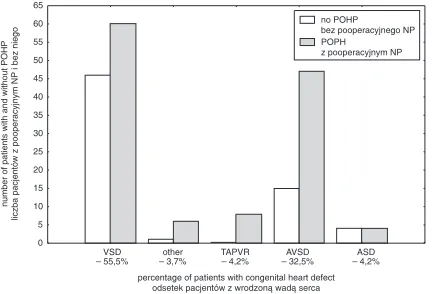
Standard anesthesia was employed. The patients were operated on through a median ster− notomy with the use of an aorto−bicaval cardiopul− monary bypass (CBP). Antegrade intermittent cold St. Thomas cardioplegia was the means of myocardial protection. The technique of surgical correction varied according to the CHD. A trans− thoracic 22−gauge pulmonary catheter was intro− duced through the right ventricle outflow tract infundibulum. Modified ultrafiltration (MUF) was carried out after weaning from the by−pass (not in all patients). The delayed sternal closure (DSC) was employed in cases of homodynamic instabili− ty. The spectrum of the operated CHDs is present− ed in Fig. 1.
Standard biochemical and physical monitoring
methods were supplemented by direct pulmonary pressure measurement in all patients. A unified postoperative protocol was applied in all patients with PRPH. This consisted of deep sedation and myorelaxation (continuous infusions of 0.1 mg/kg/h midazolam, 5 µg/kg/h fentanyl, and 0.1 mg/kg/h pipecuronium bromide) and moderate hyperventilation (with low positive end−expiratory pressure) in order to maintain partial carbon diox− ide between 25 and 30 mm Hg and the fraction of inhaled oxygen adjusted to obtain values of arteri− al partial pressure higher than 100 mm Hg. Vasodilators and catecholamines, including dopa− mine, dobutamine, and isoprenaline, were used when needed. After 24 h the patients were extu− bated if no signs of postoperative PH were detect− ed; otherwise the management was corrected and, for example, pulmonary vasodilators introduced.
A PH crisis was treated with adjustment of the ventilator parameters, deepening the sedation, and direct continuous intrapulmonary nitroprusside or nitroglycerin infusion. NO inhalations were used in patients refractory to conventional treatment (initial dose of 30–40 ppm, reduced subsequently to the lowest efficacious dose of 2–10 ppm). PH treatment withdrawal proceeded according to the standard methods.
The normality of the variable distribution was assessed by the Kolmogorov−Smirnov test. Numerical variables are expressed as the mean and standard deviation or as the median and range according to the normality of the distribution. Categorical variables are shown as percentages. The Pearson’s chi−squared test and Fisher’s exact test were used for comparison of categorical vari− ables. ANOVA was used to compare variables among the four groups of patients provided that the conditions of distribution normality and equal− ity of variances verified by the F−Levene test were fulfilled. Otherwise the Kruskal−Wallis nonpara− metric method was used. Post hoc comparisons were applied with the use of the Sheffé test and the Mann−Whitney Utest, respectively.
To investigate the influence of the demograph− ic, echocardiographic, and perioperative variables on mortality and the presence of postoperative PH, both the above−mentioned univariate analyses and logistic regression analyses were performed. Variables that significantly influenced the given outcome entered the model of logistic regression and were selected again by backward stepwise elimination to obtain the best model. The influence of predictive variables on outcome in these mo− dels was expressed as the odds ratio (OR) with 95% confidence intervals (CI). A two−tailed
pvalue less than 0.05 was considered significant in all tests.
Fig. 1.Congenital heart defect spectrum and number of patients with postoperative PH (POPH – postopera− tive pulmonary hypertension, VSD – ventricular septal defect, OTHER – remaining, less frequent defects, TAPVR – total anomalous pulmonary venous return, AVSD – atrioventricular septal defect, ASD – atrial septal defect of either the first or second type)
Ryc. 1.Zakres operowanych wad serca oraz liczba pa− cjentów z NP (POPH – pooperacyjne nadciśnienie płucne, VSD – ubytek międzykorowy, OTHER – inne, rzadsze wady serca, TAPVR – całkowity nieprawidło− wy spływ żył płucnych, AVSD – ubytek przedsionko− wo−komorowy, ASD – ubytek międzyprzedsionkowy pierwszego lub drugiego typu)
percentage of patients with congenital heart defect odsetek pacjentów z wrodzoną wadą serca 0 5 10 15 20 25 30 35 40 45 50 55 60 65 VSD – 55,5% other 3,7% – TAPVR 4,2% – AVSD 32,5% – ASD 4,2% – no POHP bez pooperacyjnego NP POPH
z pooperacyjnym NP
number of patients with and without POHP
liczba pacjentów z pooperacyjnym NP
Results
Demographics
and Perioperative
Characteristics
The median age of the cohort was 123 days (range: 3 days–8.6 years). One hundred sixty−nine children (88.5%) were less than 1 year old and 11 (5.8%) were neonates. The occurrence of postoper− ative PH was found in 126 patients (66%), includ− ing 41 children from group B1 (21.5%), 47 from group B2 (24.6%), and 38 from group B3 (19.9%). Group A consisted of the remaining 65 patients (34%). The demographic, echocardiographic, and perioperative data of the patients according to the PH groups are presented in Table 1.
There were no differences in sex, age, body surface area (BSA), weight, or the presence of tri− somy 21 among the study groups. Ventricular sep− tal defect was more common in group A, whereas atriventricular septal defect (AVSD) formed the majority of group B1. These differences were reflected by an increased basic ACS in the patients in group B1. Children of group B2 were treated predominantly in 1999. None of the echocardio− graphic variables except for the RVET−to−PulmAt ratio and mean PAP were significantly different among all the groups. Post hoc comparisons
revealed statistically significant differences in both these parameters only between groups A and B3.
CPB time was significantly longer in the patients in group B3 than in groups A and B2. Group A had a shorter CPB time than group B1. There was no difference in aortic cross−clamp time, degree of hypothermia, and number of patients undergoing MUF among all the studied groups. DSC occurred more frequently in groups B1 and B3 than in groups A and B2.
Postoperative Course
and Early Mortality
Groups B2 and B3 did not differ in the number of postoperative PH crises. Inotropic support was significantly lower in group A. Similarly, patients in group A were weaned from ventilation signifi− cantly earlier than the remaining groups. Groups B2 and B3 also had longer intubation times com− pared with group B1. The shortest hospital stay was found in group A. Early mortality was signif− icantly lower among the patients of group A than in the remaining groups.
The logistic regression models are presented in Table 2. Significant predictors of postoperative PH were basic ACS, year of operation, and inotropic support. No preoperative echocardio−
Legend:
* Significant difference among all groups in ANOVA, Kruskal−Wallis or Pearson’s chi−squared.
a Significant difference between A and B1, p < 0.05. b Significant difference between B1 and B2, p < 0.05. c Significant difference between B2 and B3, p < 0,05. d Significant difference between A and B3, p < 0.05. e Significant difference between A and B2, p < 0.05. f Significant difference between B1 and B3, p < 0.05.
A – patients with normal postoperative PAP, B1 – patients with temporarily elevated PAP and without PH crisis, B2 – patients treated conventionally for PH crisis, B3 – patients with HP crisis treated with NO, BSA – body surface area, AVSD – atrioventricular septal defect, ACS – Aristotle Complexity Score, RVEDD – right ventricle end−diastolic diameter, PulmAT – pulmonary acceleration time, RVET – right ventricle ejection time, Qp:Qs – pulmonary−to−systemic flow ratio, mPAP – mean pulmonary artery pressure, CPB – cardiopulmonary bypass, x−clamp – cross−clamp, MUF – modified ultrafil− tration, PO – postoperative, DSC – delayed sternal closure, LOS – length of stay.
Legenda:
* znacząca różnica między wszystkimi grupami (ANOVA, ANOVA Kruskala−Wallisa lub test chi kwadrat Persona). a – znacząca różnica między grupami A i B1, p< 0,05.
b – znacząca różnica między grupami B1 i B2, p< 0,05. c – znacząca różnica między grupami B2 i B3, p< 0,05. d – znacząca różnica między grupami A i B3, p< 0,05. e – znacząca różnica między grupami A i B2, p< 0,05. f – znacząca różnica między grupami B1 i B3, p< 0,05.
Table 1.Demographics, echocardiographic, and perioperative data in the studied groups
Tabela 1.Dane demograficzne, echokardiograficzne oraz okołooperacyjne badanych grup pacjentów
Variable A B1 B2 B3 p−value
(Zmienna)
Number of patients 65 (34%) 41 (21.5%) 47 (24.6%) 38 (19.9%) –
(Liczba pacjentów) Patient data:
(Zmienne demograficzne:)
female patients 36 (55.4%) 20 (48.8%) 21 (44.7%) 24 (63.2%) 0.34
(płeć żeńska)
patient age (days) 138 (17–3150) 106 (10–1013) 150 (24–1920) 112.5 (3–766) 0.43 (wiek (dni))
BSA (m2) 0.27 (0.18–0.94) 0.27 (0.18–0.44) 0.26 (0.18–0.75) 0.25 (0.18–0.82) 0.46
weight (kg) 4.5 (2.1–24.5) 4.7 (3–10) 4.9 (3–18) 4.4 (2.5–8.1) 0.69
(masa (kg))
trisomy 21 15 (23.1%) 6 (14.6%) 8 (17%) 5 (13.2%) 0.6
(trisomia 21)
VSD 46 (70.8%)a 15 (36.6%)a 24 (51.1%) 21 (55.3%)
AVSD 14 (21.5%)a 19 (46.3%)a 18 (38.3%) 11(29%)
ASD 4 (6.2%) 1 (2.4%) 2 (4.3%) 1 (2.6%)
TAPVR 0 (0%) 5 (12.2%) 1 (2.13%) 2 (5.3%)
other 1 (1.5%) 1 (2.4%) 2 (4.3%) 3 (7.9%)
(inne)
basic ACS 6 (3–9)a 9 (4–9)a 6 (3–10.3) 6 (3–11) 0.0008*
year of operation: median 2001e 2000b 1999bce 2000c 0.02*
(rok operacji: mediana) Echocardiography:
(Zmienne echokardiograficzne:)
RVDD (cm) 1.3 ±0.4 1.2 ±0.3 1.3 ±0.3 1.3 ±0.3 0.47
RVDD % of age norm 90.3 ±25.8 87.2 ±21.4 90.2 ±26 97 ±21.7 0.40 (RVDD % normy wiekowej)
PulmAT (s) 0.09 ±0.013 0.06 ±0.02 0.06 ±0.02 0.06 ±0.02 0.10
RVET (s) 0.22 ±0.03 0.22 ±0.03 0.23 ±0.03 0.22 ±0.03 0.48
PulmAT/RVET 0.32 ±0.1d 0.3 ±0.1 0.3 ±0.1 0.25 ±0.9d 0.01*
mean PAP (mm Hg) 48.2 ±8.1d 51.9 ±8.4 50.6 ±7 53.7 ±10.5d 0.02*
Qp:Qs 2.6 (1.4–5.7) 2.5 (1.4–5) 2.5 (1–8.5) 2.5 (1.1–4.9) 0.97
LVSF (%) 43.6 ±7.1 43.1 ±7.6 41.1 ±8.4 42.9 ±8.4 0.39
LVEF (%) 80 ±7.9 80 ±8.7 77.3 ±10.7 78.8 ±9.7 0.45
Operative data:
(Zmienne okołooperacyjne:)
CPB time (min) 83 (31–147)ad 100 (61–147)a 91 (25–178)c 108.5 (34–241)cd 0.002*
(czas CPB (min))
aortic x−clamp time (min) 39 (9–88) 47 (19–88) 43 (10–82) 52.5 (8–88) 0.65 (czas zaklemowania aorty (min))
hypothermia (°C) 30 (26–34) 29 (22–33) 30 (26–34) 29 (22–35) 0.12
(hipotermia (°C))
MUF 32 (49.2%) 24 (58.5%) 23 (48.9%) 25 (65.8%) 0.31
DSC 1 (1.5%)ad 7 (17.1%)a 2 (4.3%)c 9 (23.7%)cd 0.0007*
Postoperative data: (Zmienne pooperacyjne:)
highest PO mPAP (mm Hg) 20 (14–25)ade 41 (29–70)abf 54 (39–90)be 52 (43–98)df < 0.0001*
(najwyższe PO mPAP (mm Hg))
number of PH crises 0 0 2 (1–4) 1 (1–7) < 0.0001*
(liczba przełomów NP)
inotropic score 11.4 (0–24.8)ade 14.4 (1.2–31.6)a 15.5 (0–23.1)e 17.3 (6.7–27)d 0.006*
(skala inotropowa)
intubation time (days) 1 (0–27)ade 4 (1–68)abf 7 (1–21)be 9.5 (0–23)df < 0.0001*
(czas sztucznej wentylacji (dni))
LOS (days) 10 (2–31)ade 14 (4–101)a 14 (1–70)e 17 (1–86)d < 0.0001*
czas pobytu w szpitalu (dni)
mortality 2 (3.1%)de 2 (4.9%) 13 (27.7%)e 11 (29%)d < 0.0001*
graphic variables entered the model. The presence of a PH crisis with or without NO treatment was the only significant predictor of early death.
Discussion
This study shows that preoperative prediction of postoperative PH is not possible. This concerns especially the value of preoperative echocardio− graphic parameters. Moreover, their intensity could not discriminate between the various clinical degrees of postoperative PH used in the present study. Laitinen et al. studied the possibility of pre− dicting postoperative NO administration and found the predictive variables to be age, presence of Down’s syndrome, and amrinone medication [9]. However, these parameters had no influence on NO treatment prediction in this study. A possi− ble explanation of this discrepancy is the different criteria for commencing NO therapy, since the number of patients treated with NO inhalation is substantially higher (46% vs. 19.9% in the PHNO group) as a result of the unrestricted access to this modality and its sometimes prophylactic applica− tion. On the other hand, the effect of advanced age can also explain the more frequent NO use as
a result of more advanced pulmonary vascular dis− ease.
The basic ACS was a significant predictor of all postoperative PH events. This is not surprising since the pooled group of B1, B2, and B3 patients was constituted by overwhelming numbers of AVSD, TAPVR, and other more complex defects that by definition have higher basic ACSs. The presence of less complex defects, including VSD, was more common in group A. Similar findings were reported by Laitinen and colleagues [9], who observed a reduced incidence of NO use in this defect type. This can be explained by, for example, the lesser extent of postoperative pulmonary endothelial cell dysfunction connected with short− er CBP times in these patients [10].
Logistic regression analysis revealed the year of operation as a predictor of postoperative PH. The reason for this can be attributed to the higher operation age in group B2. Although this age dif− ference is not statistically significant, it is worth mentioning that in 1999 a substantial number of patients with delayed significant left−to−right shunt diagnosis was encountered. This resulted most probably in increased PH events in that year, despite similar treatment.
PH events in the present study were associat− ed with a higher degree of inotropic support. Catecholamines in elevated doses may play a sig− nificant role in pulmonary vasoconstriction despite the fact that the lungs are the place of their inacti− vation [11]. However, it is more likely that the higher inotropic index in groups B1−3 reflects the complexity of CHD and its more difficult repair connected with longer CPB time in patients with higher basic ASC.
CPB itself can be a factor that predisposes to postoperative PH events. It is known to cause pul− monary endothelial cell injury leading to dysfunc− tion of receptor−mediated endothelium−dependent vasodilatation [10]. On the other hand, CPB influ− ences the production of potent pulmonary vaso− constrictors [12].
Mortality was predicted by the presence of a PH crisis in the cohort of patients of the present study. This is in accord with other studies [13]. Aortic cross−clamp time is a factor found by other groups that impacts POPH−related mortality [2,13]. However, this was not observed in the pre− sent study. The variability of the aortic cross− clamp times encountered in the study cohort can be an explanation for this discrepancy.
Study Limitations
The current study is certainly biased by vari− ous factors, including its retrospectiveness and the
Table 2.Results of logistic regression models
Tabela 2.Wyniki analizy z użyciem modeli regresji logistycznej
Variables Odds ratio 95% CI p−value
(Zmienne) (Iloraz (war−
szans) tość p)
Prediction of postoperative PH (Pooperacyjne NP*)
basic ACS 1.42 1.14 – 1.79 0.002 (ACS)
year of operation 0.74 0.61 – 0.88 < 0.0001 (rok operacji)
inotropic score 1.1 1.03 – 1.17 0.001 (skala izotro−
powa) Prediction of early death (Śmiertelność wczesna*)
PH crisis 10 3 – 31 <0.0001
(przełom NP)
Legend: PH – pulmonary hypertension, ACS – Aristotle Complexity Score, CPB – cardiopulmonary bypass, CI
– confidence interval.
Legenda: NP – nadciśnienie płucne, basic ACS – Aristo− tle Complexity Score – podstawowa skala złożoności wa− dy serca, CPB – krążenie pozaustrojowe, CI– przedział ufności.
relatively small number of patients compared with other studies [2,9]. The non−homogenous spec− trum of CHDs and the non−uniform time of their correction are other issues. The division of the cohort into four categories can be assumed some− what artificial. However, it reflects the real clinical situation regarding methods of treatment and the complexity of the postoperative course.
The authors concluded that an accurate pre− diction of POPH severity based on only preopera− tive data is not feasible. Perioperative factors other than demographics and echocardiographic variables influence the postoperative course and independently modify the risk of POPH and its intensity.
References
[1] Lindberg L, Olsson AK, Jogi P, Jonmarker C:How common is severe pulmonary hypertension after pediatric cardiac surgery? J Thorac Cardiovasc Surg 2002, 123, 1155–1163.
[2] Journois D, Baufreton C, Mauriat P, Pouard P, Vouhe P, Safran D: Effects of Inhaled Nitric Oxide Administration on Early Postoperative Mortality in Patients Operated for Correction of Atrioventricular Canal Defects. Chest 2005, 128, 3537–3544.
[3] Mrowczynski W, Wojtalik M, Zawadzka D: Infection Risk Factors in Pediatric Cardiac Surgery. Asian Cardiovasc Thorac Ann 2002, 10, 329–333.
[4] Ma M, Gauvreau K, Allan CK, Mayer Jr JE, Jenkins KJ: Causes of death after congenital heart surgery. Ann Thorac Surg 2007, 83, 1438–1445.
[5] Brown KL, Ridout DA, Goldman AP, Hoskote A, Penny DJ:Risk factors for long intensive care unit stay after cardiopulmonary bypass in children. Crit Care Med 2003, 31, 28–33.
[6] Bando K, Turrentine MW, Sharp TG:Pulmonary hypertension after operations for congenital heart disease: analysis of risk factors and management. J Thorac Cardiovasc Surg 1996, 112, 1600–1609.
[7] Lacour−Gayet F, Clarke DRand the Aristotle Committee: The Aristotle method: a new concept to evaluate qual− ity of care based on complexity. Curr Op Ped 2005, 17, 412–417.
[8] Wernovsky G, Wypij D, Jonas RA:Postoperative course and hemodynamic profile after the arterial switch oper− ation in neonates and infants. A comparison of low−flow cardiopulmonary bypass and circulatory arrest. Circulation 1995, 92, 2226–2235.
[9] Laitinen PO, Rasanen J, Sairanen H:Postoperative Nitric Oxide Therapy in Children with Congenital Heart Disease. Can the Need be Predicted? Scand Cardiovasc J 2000, 34, 149–153.
[10] Kirshbom PM, Jacobs MT, Tsui SSL:Effects of cardiopulmonary bypass and circulatory arrest on endothelium− dependent vasodilatation in the lung. J Thorac Cardiovasc Surg 1996, 111, 1248–1256.
[11] Fullerton DA, Cyr JASt, Albert JD, Grover FL: Hemodynamic Advantage of Left Atrial Epinephirne Administration After Cardiac Operations. Ann Thorac Surg 1993, 56, 1263–1266.
[12] Kirshbom PM, Tsui SS, DiBernardo LR:Blockade of endothelin converting enzyme reduces pulmonary hyper− tension after cardiopulmonary bypass and circulatory arrest. Surgery 1995, 118, 440–445.
[13] Hopkins RA, Bull C, Haworth SG, de Leval MR, Stark J:Pulmonary hypertensive crises following surgery for congenital heart defects in young children. Eur J Cardiothorac Surg 1991, 5, 628–634.
Address for correspondence:
Wojciech MrówczyńskiDepartment of Pediatric Cardiac Surgery Karol Marcinkowski University of Medical Sciences Szpitalna 27/33
60−572 Poznań Poland
Tel.: +48 61 849 12 77
E−mail: [email protected]
Conflict of interest: None declared