Compiling Recursion to Reconfigurable Hardware using
CLaSH
Ruud Harmsen
University of Twente P.O. Box 217, 7500AE EnschedeThe Netherlands
[email protected]
ABSTRACT
Recursion is an important problem solving technique and implementing it on hardware is not trivial. In this research several methods on how to do this are discussed and one is implemented. The goal is to find out if it is possible to automate the process of making recursion possible on hardware and add this automation to the CλaSH compiler. The CλaSH compiler is a compiler from Haskell to VHDL, Haskell has a much higher level of abstraction than VHDL does, so should give an easier way to implement hardware designs. This compiler is still a work in progress, one of the missing things is support for recursion. This paper shows how to compile simple recursion to a stack-based framework which can be used in CλaSH.
Keywords
CλaSH, hardware recursion, FPGA
1.
INTRODUCTION
Recursion is an important and powerful problem solv-ing technique, which is used in important algorithms e.g. search and routing algorithms. Recursion is a method where the solution to a problem depends on solutions to smaller instances of the same problem. The power of re-cursion evidently lies in the possibility of defining an in-finite set of objects by a in-finite statement. Implementing recursion on reconfigurable hardware like an Field pro-grammable gate array (FPGA) is not trivial. Some ex-amples for implementing recursion on hardware (FPGA) is done by Mihhailov et al.[6], the study implemented a parallel sorting algorithm on an FPGA. Marauyama et al.[5] show 2 algorithms which shows that recursion can be faster on reconfigurable hardware, the speed of some sim-ple combinatorial algorithms are 4.1 to 6.7 times faster on a relatively slow FPGA (compared to a processor). The first attempt to do this was made by Tsutomu Maruyama
et al.[5], where recursion was implemented using stacks. Sklyarovet al.[10] show the difference between a recursive and iterative solution of some algorithms and the differ-ence in performance. Research on this topic is discussed in the Related Work section.
Programming an FPGA is done in a Hardware
Descrip-Permission to make digital or hard copies of all or part of this work for personal or classroom use is granted without fee provided that copies are not made or distributed for profit or commercial advantage and that copies bear this notice and the full citation on the first page. To copy oth-erwise, or republish, to post on servers or to redistribute to lists, requires prior specific permission and/or a fee.
17thTwente Student Conference on ITJune 25st, 2012, Enschede, The Netherlands.
Copyright2012, University of Twente, Faculty of Electrical Engineer-ing, Mathematics and Computer Science.
tion Language (HDL) like VHDL or Verilog. A relatively new HDL is CAES Language for Synchronous Hardware (CλaSH), this is a functional HDL created by the CAES-group [1]. CλaSH does not support recursion yet, this paper will give more insight in how to add recursion to this compiler. There are some HDL compilers available that can cope with recursion like theC to HDL compiler
by Maruyamaet al.[4], but C is not a functional language.
2.
RELATED WORK
Maruyamaet al.[5] implement recursion using stacks. The authors show as an example that an algorithm to solve the knapsack problem can be split in 2 parts, a recursive part and a loop instruction (tail recursion optimization). The study shows that this loop part of the algorithm can be put on a stack and executed parallel to the recursive part using multiple threads. In that way a greater performance was achieved because multiple calculations are executed at the same time. In the example of the knapsack problem this shows a speedup of 6.7 times using an FPGA in stead of normal sequential execution, even when the clock speed is much lower than the processor (35Mhz compared to 200Mhz).
Sklyarov suggests an implementation of recursive algo-rithms using Hierarchical Graph Scheme (HGS) [9] . His idea is to divide the algorithm to a discrete number of modules where each module is subdivided with a number of states. (See Figure 1). This is a Hierarchical Finite State Machine (HFSM). This idea uses 3 stacks, a Mod-ulestack where the different models (Zn in Figure 1) are stored, a Statestack (an in Figure 1) and the Datastack where the results are stored.
Every time a recursive module is called it is put on the stack. Therefore the stack can grow out of bounds if a function has to many recursive calls. Pipelining like [5] could decrease the stacks by multi-threaded execution. Feriziset al.[2] tried a different approach, no stacks in this case. This PhD study divides the recursive function in to a base part and a recursive part. The recursive part is then divided in a pre- and post recursive part. These are defined as the part before and after the recursive call is made. Due to dividing the algorithm in these parts, they are able to place recursive parts in a pipeline. One downside of this implementation is that this approach needs runtime configuration of the hardware, which is not possible on all types and takes precious time. The pipeline takes up a lot of space on the FPGA so the algorithm can’t be larger than the FPGA itself. The results they achieved where good, a quick-sort algorithm of 8000 items took only 17% of the clock cycles it would take on a stack-based solution. Ninos et al.[7] used the previous proposals and suggests a data-oriented approach. This basically is an algorithm that converts recursion to iteration with a stack (the same as it is executed using software), calledrecursion simplifi-cation operation. This doesn’t include parallel computing. The methods above are compared by Skliarovaet al.[8]. The conclusion of this study was that there is not opti-mal solution to go from recursion to reconfigurable hard-ware. All solutions require that the designer produces the hardware compatible code, the solutions only provide the theory (with exception to the C to HDL compiler of Maruyamaet al.[4])
Kegel [3] implemented the method of Sklyarov[9] using Haskell, as a start of adding recursion to the Cλ aSH-compiler. This still requires the designer to implement the method of Sklyarov[9] if recursion is used. Kegel sug-gests that the framework code should be generated by the compiler so the designer should not have to write the error-prone code. This research uses a simplified framework which could be extended to Kegel’s framework as Future Work.
2.1
CLaSH Compiler
The CλaSH compiler takes a subset of the Haskell lan-guage and converts this to basic VHDL. This VHDL code can be run on for example an FPGA. As the circuit de-scriptions, simulation code, and test input are also valid Haskell, complete simulations can be done by a Haskell compiler or interpreter, allowing high-speed simulation and analysis. The specifics are described in [1]. This is still a work in progress. One of the missing elements is the sup-port for recursion. This research gives insight on how this could be added and a simple example is given.
3.
THEORY
Mapping a recursive function on hardware is not a sim-ple task. There are several methods on how to imsim-plement this, the methods are discussed in the Related Work sec-tion. The most straight-forward method is the method of Sklyarov, this research uses a simplified version of his method. The method uses a stack to store the results in between of recursive calls. This framework can handle only simple recursion functions with 1 recursive call in the recursive case and 1 base case. It should give insight in how recursion can be handled and the possibility of more complex functions will be future work. This mimics the way recursion is solved in software.
3.1
Compiler
The aim for this paper is to provide a method to implement recursion into the CλaSH compiler. The CλaSH compiler takes a CλaSH source file, runs it trough the Haskell com-piler and compiles this to VHDL. Inside the comcom-piler sev-eral steps are needed to make this possible. One of these steps should be to convert recursive functions to hardware compatible code. In this research this step of converting recursive functions to hardware compatible code is done in a pre-compiler. This pre-compiler gets an Abstract Syntax Tree (AST) of the recursive function and converts it to a non-recursive Haskell code using the framework which is explained below.
3.2
Standard Form
Before a recursive function can be translated using the CλaSH compiler it has to be recognized. A simple recur-sive function can be described as below.
Listing 1. The Standard Form of a simple recursive function 1 f n | p n = a 2 | otherwise = g n ( f ( h n ) ) 3 −− g = main f u n c t i o n 4 −− a = b a s e c a s e e x p r e s s i o n 5 −− p = b a s e c a s e c o n d i t i o n o f n 6 −− h = f u n c t i o n a p p l i e d on n
The g,a,p,h parameters have to be determined in order to convert it to the framework explained below. The simple format is limited to only 1 recursive call and 1 initial pa-rameter. This limits the standard form to a few functions but it explains the basics. An example function is the fac-torial function which is used below. In order to use this on hardware, the different parameters have to be extracted from the function and have to be used in the framework explained below.
3.3
The Simple Framework
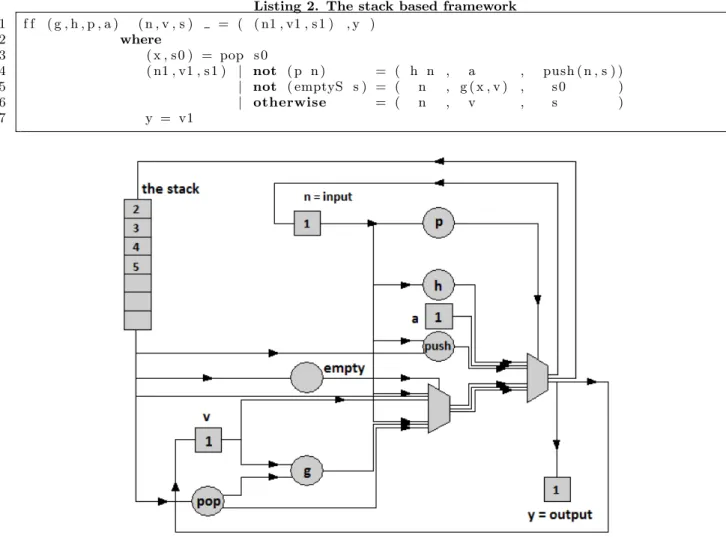
When the g,a,p,h parameters are determined they can be processed by the simple framework which will be explained here. Listing 2 shows the simple framework. It consists of a function ff which has 3 parameters.
• The parsed parameters (g,h,p,a)
• The state (n,v,s)
– n is the input argument
– v current value (during evaluation)
– s is the stack
• The input, can be anything, this is only important as clock-tick
The result after 1 clock cycle
• output y
• new state (n1,v1,s1)
The workings of the framework is explained below. An example using the factorial function is given later on. The function ff is called every clock cycle. When initiated, the first parameter is the tuple of parsed parameters, the second parameter is the state which has to be initiated, the third input is the clock input. The function ff will return a new state (s1) and the current output value(y), which
Listing 2. The stack based framework 1 f f ( g , h , p , a ) ( n , v , s ) = ( ( n1 , v1 , s 1 ) , y ) 2 where 3 ( x , s 0 ) = pop s 0 4 ( n1 , v1 , s 1 ) | not ( p n ) = ( h n , a , push ( n , s ) ) 5 | not ( emptyS s ) = ( n , g ( x , v ) , s 0 ) 6 | otherwise = ( n , v , s ) 7 y = v1
Figure 2. Framework graphical representation after 4 clock-cycles
is just a copy of the current value of the state (v1). The next call, which most likely will happen the next clock-cycle, calls the same function ff but the state(s1) from the last call will be used as input for this call.
The output state(s1) will change depending on the base case condition (p) or when there is nothing left to do (the stack is empty). The output state(s1) will be as follows:
not (p n) The base condition(p) is not met, the input ar-gument(n1) will be changed by function h, the cur-rent value (v1) is the base case expression (a) and the input value (n) is pushed onto the stack.
not (emptyS s) When the stack is not empty, the input argument(n1) does not change, the current value(v1) is the function g applied on parameters v and x where x is a value popped from the stack.
otherwise The stack is empty and the base condition(p) is met so there is nothing to work with and the out-put state is copied from the inout-put state.
A graphical representation of the framework is given in Figure 2.
3.4
Simple Recursion Function (Factorial)
Listing 3 shows the recursive definition of the Factorial function in the format of the standard form. This is re-quired for the grammar to recognize it as a recursive
func-tion. For easier processing, the code will be converted usingλ-abstractions. This is a simple 1 on 1 process.
Listing 3. Factorial function
1 f a c n | n==0 = 1 2 | otherwise = n ∗ f a c ( n−1) 3 −− g : n ∗ f a c ( n−1) 4 −− a : 1 5 −− p : ( n==0) 6 −− h : ( n − 1 )
For the factorial function this is done and the result is in Listing 4.
Listing 4. Factorial usingλ-abstraction
1 f a c n 2 | (\x−>x==0) n = 1 3 | otherwise = (\( x , y)−>(x∗y ) ) ( a , b ) 4 where a = n 5 b = f a c ( (\x−>x−1) n ) 6 −− g = \( x , y)−>(x∗y ) 7 −− a = 1 8 −− p = \x−>(x==0) 9 −− h = \x−>(x−1)
The conversions are as follows:
n== 0 The base condition, this is (λx→x== 0)n.
n∗f ac(n−1) This is a multiplication applied on n and fac. This corresponds with the lambda abstraction
λ(x, y)→x∗ywherex=n, y=f ac(n−1).
n−1 The next iteration of the input value, in lambda calculus this corresponds withλx→x−1
The g,h,p and a parameters will be as stated on lines[6..9] in Listing 4. When used in a simulation of the frame-work this will look something like Figure 2. This shows the factorial(5!) function with the first 4 cycles. During these 4 cycles the base condition is not met, n > 0 so n is pushed onto the stack. The output value(y) is the base case value. The output value of 10 clock cycles is [1,1,1,1,1,1,2,6,24,120], more clock cycles will just re-turn 120 because theotherwisecondition from the func-tion ff is met.
4.
IMPLEMENTATION
In this research a pre-compiler is used on a handmade AST. This is not the best solution but demonstrates how the grammar and framework works. Ideally the program-mer does not have to do anything special, like special an-notations in the code which has to be done in the C to HDL Compiler[4], to use recursion in CλaSH. The pre-compiler will parse the parameters out of the AST and paste’s them into the framework. The framework dis-played in Listing 2 is in Haskell syntax. The framework uses lists which are not compatible with CλaSH. These lists have to be converted to a vector. This conversion to CλaSH has been tried but not with success this is because of lack of knowledge of CλaSH. The output of this pre-compiler will consist of the framework code and the parsed functions (g,p,h,a). This output file is a valid Haskell file which can be compiled by the Haskell compiler. As men-tioned above, this is not CλaSH compatible. This is called a pre-compiler because it is run before the actual compi-lation.
4.1
Grammar
The grammar for this simple recursive standard form is shown in Listing 5. The functions that can be parsed by this grammar consist of a base-case and a recursive-case. This base-case consists of a condition and a value if this condition holds. The recursive-case consist of an expression on the input argument and the return value of the recursive call. As mentioned before, the grammar only accepts expressions in theλ-format.
5.
CONCLUSION
A best method of implementing recursion has still to be de-termined, but the a straight forward way to make CλaSH compatible with recursion is the method provided by Skl-yarov [9] because it mimics the method of how recursion works in software. This research shows that a simplified version of this method is possible to implement in an au-tomated way. There are still steps to be taken to add it completely to the CλaSH compiler, these steps are men-tioned in the future work section.
6.
FUTURE WORK
The process of adding recursion to the CλaSH compiler is not finished. What is missing will be mentioned here as future work. These missing features are:
• Extending the grammar to add support for all recur-sive functions, it currently only can handle simple recursive functions like factorial.
• Add it to the CλaSH compiler, the current process of adding recursion to CλaSH is to pre-compile a recursive function which then will be given to the CλaSH compiler, this should be incorporated in the said compiler.
• In this research a handwritten AST is used, the input should come from either the Haskell compiler or the CλaSH compiler.
• A simple framework is used in this research to ex-plain the process, a framework made in Haskell is available[3] and should be ported to CλaSH this then can be used with the extended grammar (which is also future work).
7.
ACKNOWLEDGMENTS
Without the help of J. Kuper and C.P.R. Baaij this re-search wouldn’t be possible. J. Kuper for guiding me and C.P.R. Baaij for all my CλaSH related questions.
8.
REFERENCES
[1] C. Baaij.Cλash: From haskell to hardware. PhD thesis, Universty of Twente, 2009.
[2] G. Ferizis and H. El Gindy. Mapping recursive functions to reconfigurable hardware. InField Programmable Logic and Applications, 2006. FPL’06. International Conference on, pages 1–6. IEEE, 2006.
[3] R. Kegel. Implementing Recursive Algorithms within Hardware using Finite State Machines. In
The 15th Twente Student Conference on IT, 2011. [4] T. Maruyama and T. Hoshino. A C to HDL
compiler for pipeline processing on FPGAs.
Engineering, pages 101–110, 2000.
[5] T. Maruyama, M. Takagi, and T. Hoshino. Hardware Implementation Techniques for Recursive Calls and Loops. InTechniques, pages 450–455, 1999. [6] D. Mihhailov, V. Sklyarov, I. Skliarova, and
A. Sudnitson. Parallel FPGA-Based Implementation of Recursive Sorting Algorithms.2010 International Conference on Reconfigurable Computing and FPGAs, pages 121–126, Dec. 2010.
[7] S. Ninos and A. Dollas. Modeling recursion data structures for FPGA-based implementation.Logic and Applications, 2008. FPL 2008., pages 11–16, 2008.
[8] I. Skliarova. Recursion in reconfigurable computing: A survey of implementation approaches.Field Programmable Logic and, pages 224–229, 2009. [9] V. Sklyarov. FPGA-based implementation of
recursive algorithms.Microprocessors and Microsystems, 28(5-6):197–211, Aug. 2004. [10] V. Sklyarov, I. Skliarova, and B. Pimentel.
FPGA-based implementation and comparison of recursive and iterative algorithms. InField Programmable Logic and Applications, 2005. International Conference on, pages 235–240. IEEE, 2005.
Listing 5. Appendix
1 data FuncDef = FuncDef I d e n t i f i e r Var BaseCase RecCase 2 data BaseCase = BaseCase App C o n d i t i o n Var Expr
3 data RecCase = RecCase Expr 4
5 data Expr = EVar Var 6 | EInt Int
7 | OpExpr O p e r a t o r Expr Expr 8 | AppExpr App FuncExpr Expr 9 | EFunc FuncExpr Expr
10 | App2Expr App FuncExpr ( Expr , Expr ) 11
12
13 type O p e r a t o r = String
14 type App = String
15 type Lam = Char
16
17 data FuncExpr = F I d e n t i f i e r String
18 | LamExpr Lam Var Expr
19 | Lam2Expr Lam ( I d e n t i f i e r , I d e n t i f i e r ) Expr 20
21 type Var = I d e n t i f i e r 22 type C o n d i t i o n = FuncExpr 23 type I d e n t i f i e r = String