The Journal of Threatened Taxa is dedicated to building evidence for conservation globally by publishing peer-reviewed articles online every month at a reasonably rapid rate at www.threatenedtaxa.org. All articles published in JoTT are registered under Creative Commons Attribution 4.0 International License unless otherwise mentioned. JoTT allows unrestricted use of articles in any medium, reproduction, and distribution by providing adequate credit to the authors and the source of publication.
OPEN ACCESS
www.threatenedtaxa.org
ISSN 0974-7907 (Online) | ISSN 0974-7893 (Print) Building evidence for conservation globally
Journal of Threatened Taxa
For Focus, Scope, Aims, Policies and Guidelines visit http://threatenedtaxa.org/index.php/JoTT/about/editorialPolicies#custom-0
For Article Submission Guidelines visit http://threatenedtaxa.org/index.php/JoTT/about/submissions#onlineSubmissions
For Policies against Scientific Misconduct visit http://threatenedtaxa.org/index.php/JoTT/about/editorialPolicies#custom-2 For reprints contact <[email protected]>
Communication
Comparative cross-sectional survey on gastrointestinal
parasites of captive, semi-captive, and wild Elephants of
Sri Lanka
Nirupama Abeysekara, R.P.V. Jayanthe Rajapkse & R.S. Rajakaruna
26 April 2018 | Vol. 10 | No. 5 | Pages: 11583–11594 10.11609/jott.3406.10.5.11583–11594
Member
Partners
Communica
tion
DOI:http://doi.org/10.11609/jott.3406.10.5.11583-11594 | ZooBank: urn:lsid:zoobank.org:pub:64AF5FAE-1424-42E0-B66A-6806925F945D
Editor: Heidi S. Riddle, Riddle’s Elephant and Wildlife Sanctuary, Arkansas, USA. Date of publication: 26 April 2018 (online & print)
Manuscript details: Ms # 3406 | Received 10 March 2017 | Final received 30 March 2018 | Finally accepted 04 April 2018
Citation:Abeysekara, N., R.P.V.J. Rajapkse & R.S. Rajakaruna(2018). Comparative cross-sectional survey on gastrointestinal parasites of captive, semi-captive, and wild elephants of Sri Lanka.Journal of Threatened Taxa 10(5): 11583–11594; http://doi.org/10.11609/jott.3406.10.5.11583-11594
Copyright: © Abeysekara et al. 2018. Creative Commons Attribution 4.0 International License. JoTT allows unrestricted use of this article in any medium, reproduc-tion and distribureproduc-tion by providing adequate credit to the authors and the source of publicareproduc-tion.
Funding: None.
Competing interests:The authors declare no competing interests.
Author Details: Nirupama Abeysekara: completed her B.Sc. (Hons.) in Zoology at the University of Peradeniya, Sri Lanka. She is Following her M.Sc. in Molecular and Applied Microbiology and a trainee at Veterinary Investigation and Research Center, Peradeniya, Sri Lanka and also volunteering as a Research Assistant at the Department of Zoology, University of Peradeniya. Rupika Subashini Rajakaruna: received her B.Sc. (Hons.) and MPhil degrees in Zoology from the University of Peradeniya and completed her Ph.D. at the Memorial University of Newfoundland, Canada. She has over 20 years of teaching and research experience and currently holds the Chair of Professor of Applied Zoology at the University of Peradeniya. R.P.V. Jayantha Rajapakse: graduated from the Faculty of Veterinary Medicine and Animal Sciences at the University of Peradeniya, Sri Lanka. He is currently a Senior Professor of Veterinary Parasitology at the Department of Veterinary Pathobiology, Faculty of Veterinary Medicine and Animal Sciences, University of Peradeniya.
Author Contribution: NA: Collected and analysed the fecal samples, Analysed data, wrote the manuscript; RPVJR: Supervised the parasite egg identification; RSR:
Designed the study, supervised and edited the manuscript.
Acknowledgements: Authors thank Shanmugasundaram Wijeyamohan for his support in elephant dung collection.
Comparative cross-sectional survey on gastrointestinal
parasites of captive, semi-captive, and wild Elephants of
Sri Lanka
Nirupama Abeysekara 1, R.P.V. Jayanthe Rajapkse 2& R.S. Rajakaruna 3
1,3 Department of Zoology, University of Peradeniya, Peradeniya, 20400, Sri Lanka
2 Department of Veterinary Pathobiology, Faculty of Veterinary Medicine and Animal Sciences, University of
Peradeniya, Peradeniya 20400, Sri Lanka
1 [email protected], 2 [email protected], 3 [email protected] (corresponding author)
ISSN 0974-7907 (Online) ISSN 0974-7893 (Print)
OPEN ACCESS
Journal of Threatened Taxa | www.threatenedtaxa.org | 26 April 2018 | 10(5): 11583–11594
Abstract: Parasites can influence the fitness of individuals particularly of small populations of endangered species. An island-wide, cross sectional, coprological survey was carried out from 03 January to 30 October 2015, to determine the gastrointestinal (GI) parasites of the Sri Lankan Elephant Elephas maximus maximus. Fresh fecal samples from wild, captive and semi-captive elephants were collected and analyzed using a modified salt floatation, Sheather’s sucrose floatation, direct iodine smears, and sedimentation methods. Species identification was done morphologically. Intensity of parasite infections was determined using McMaster technique. A total of 85 fecal samples (wild = 45, semi-captive = 20, captive = 20) were analysed; 58 (68.2%) samples were positive for GI parasites. Overall, helminth infections (60.0%) were more common than protozoan (37.6%) infections (Chi square test, χ2 = 8.499; p < 0.001). In the captive elephants, however, more protozoan infections were observed than helminthes, which could be due to anthelminthic treatment. A significantly higher prevalence of infection was observed in the wild elephants (93.3%) compared to semi-captive elephants (55.0%; χ2 = 13.516; p < 0.001) and captive elephants (25.0%; χ2 =32.289; p < 0.001) but there was no significant difference in the prevalence between captive and semi-captive elephants (χ2 =3.750; p = 0.053). Ten types of GI parasites were observed, nine of which were recorded in wild elephants. Among them the most common infection was strongyles (34.1%) with high intensity (440.1±295.2 EPG). Semi-captive elephants harbored five types of GI parasites, while captive elephants had only three types. One captive elephant at the Temple of the Tooth was infected with the tapeworm Anoplocephala sp. at low intensity of 50 EPG. Some of the GI parasites recorded are highly pathogenic while others are incidental.
INTRODUCTION
Globally, the Asian Elephant is listed as ‘Endangered’ in the IUCN Red List of Threatened Species (IUCN 2008) and is protected under the Convention on International Trade in Endangered Species (CITES) Act. Three subspecies of the Asian Elephant are currently recognized: the Sri Lankan Elephant Elephas maximus
maximus, the Indian Elephant Elephas maximus indicus
from the Asia mainland, and the Sumatran Elephant
Elephas maximus sumatranus from the island of
Sumatra in Indonesia (IUCN 2017). Among these, the Sri Lankan elephant has the highest genetic diversity (Fernando 2000; Fleischer et al. 2001). Sri Lanka has the highest density of elephants with over 10% of the global Asian Elephant population in less than 2% of elephant range (Leimgruber et al. 2003). In Sri Lanka, as in the rest of Asia, the elephant has been closely associated with humans and has played a central role in the country’s economy, conflicts, religion, and culture for many millennia (Jayewardene 1994). It also holds an important position in the religious and cultural traditions of the country and plays a significant and high profile role in the country’s conservation efforts (Jayewardene 1994).
Elephants in the wild are susceptible to many gastrointestinal (GI) parasites (Watve 1995; Dharmarajan 1999; Vidya & Sukumar 2002); in captivity they have enhanced susceptibility as they are often confined to small enclosures and/or maintained in damp unhygienic conditions (Chandrashekaran et al. 1995). Strongyles have been observed in African (Scott & Dobson 1985) and Asian wild elephants as the most common GI parasite (Vidya & Sukumar 2002). In the Asian elephant the helminthes, such as Parabronema, Brumptia,
Pseudodiscus, Paramphistomum, and Fasciola and
Anoplocephala, have been recorded (Bhalerao 1933;
Gupta 1974; Chandrashekaran et al. 2009). The most common protozoans recorded are Entamoeba and coccidian cysts. Injuries, parasitism, and gastrointestinal disease were reported as the most common syndromes responsible for elephant morbidity (Miller et al. 2015). In Kenya, necropsy of 11 fresh wild elephant carcasses revealed the death of the elephants were due to pathological lesions on the intestinal mucosa and haemorrhages which were linked to gastrointestinal parasitism (Obanda et al. 2011).
Studies carried out on Sri Lankan elephant GI parasites record many nematodes: Murshidia murshidia, M. falcifera, M. longicaudata, Quilonia renniei, Equinubria sipunculiformis, Decrusia additictia (Seneviratna 1955;
Fernando & Fernando 1961; Fowler & Mikota 2008),
Grammocephalus hybridatus, Parabromina smithi
(Seneviratna & Jayasinghe 1968; Perera et al. 2014),
Q. travancra, Choniangium epistomum, Amira pileata,
Bathmostpmum sangeri (Kuruwita & Vasanthathilake
1993), and trematodes: Cabboldia elephantis (Seneviratna & Jayasinghe 1968), liver fluke Fasciola
jacksoni (Perera & Rajapakse 2009), and schistosome,
Bivitellobilharzia nairi (Agatsuma et al. 2004). More
recent studies report strongyle infections in captive and wild elephants in Sri Lanka (Heinrich 2016; Abeysinghe et al. 2017), and unidentified protozoan cysts in captive elephants (Aviruppola et al. 2016). Except for the studies carried out in the 1950s and 1960s (Seneviratna 1955; Fernando & Fernando 1961; Seneviratna & Jayasinghe 1968), recent reports on elephant parasites are focused either on a specific parasite or a particular group of hosts. Here we carried out an island-wide, comparative, coprological survey of GI parasites collecting samples from the wild, captive, and semi-captive elephants of Sri Lanka.
MATERIALS AND METHODS
An island-wide collection of fecal samples from wild, captive, and semi-captive elephants was carried out from 03 January to 30 October 2015. According to the most recent island-wide survey of wild elephants in Sri Lanka carried out in 2011, a minimum of 5,879 animals was estimated (Dissanayake et al. 2012; Santiapillai & Wijeyamohan 2013). There are about 150 captive elephants and 45 semi-captive elephants in Sri Lanka (Fernando et al. 2011).
Wild Elephants
The wild elephants once found throughout Sri Lanka are restricted mainly to the lowland dry zone, which is approximately 60% of the island. Wild elephants are found in protected areas such as national parks including Wilpattu, Yala, Udawalawe, Maduru Oya, Minneriya, Wasgamuwa and Lunugamwehera. Some are not limited to protected areas and are found outside where food and water is plentiful. Wild elephants are free grazers or browsers and do not receive any veterinary care.
Captive Elephants
Elephant Foundation (MEF) in Kegalle, and National Zoological Gardens at Dehiwala. In addition, at the Temple of the Tooth in Kandy there are 12 elephants, all of which are males and consisting of two tuskers from India, two tuskers from Myanmar, one tusker from Thailand, and four tuskers and three non-tuskers from Sri Lanka. These elephants do not interact with wild ones. They have a great cultural and economic importance (Fernando et al. 2011). Elephants are used in religious festivals and parades; in the past they were used in the transport of timber. Elephants are of great economic value mainly for tourism. The MEF is a private enterprise, which serves as a retirement home for working elephants. Currently there are 10 elephants at MEF; the National Zoo in Dehiwala has eight elephants, while there are about 93 elephants in PEO. Veterinary care for captive elephants is provided and they are dewormed at least twice a year. Febantel (Rintal®) is a first line drug for deworming elephants and Mebendazole is also commonly used.
Semi-captive Elephants
The Department of Wildlife Conservation (DWC), Sri Lanka, has established the Elephant Transit Home (ETH) in Udawalawe where semi-captive elephants are kept (Santiapillai & Sukumar 2006). The aim is to conserve elephants outside the protected areas. Mostly, wild baby elephants that are orphaned due to the death of the mother or abandonment are brought to the ETH which takes care of them until they are fit enough to be released back to the wild, usually after 5–6 years. They do not interact with wild elephants while they are at the ETH. These elephants receive regular veterinary care (e.g., deworming, vaccinations), a standard diet, and bathing. Currently, there are 45 elephants in the ETH. They remain as a group during the day and are kept in a stall at night. All the elephants are bottle fed seven times throughout the day.
Study sites
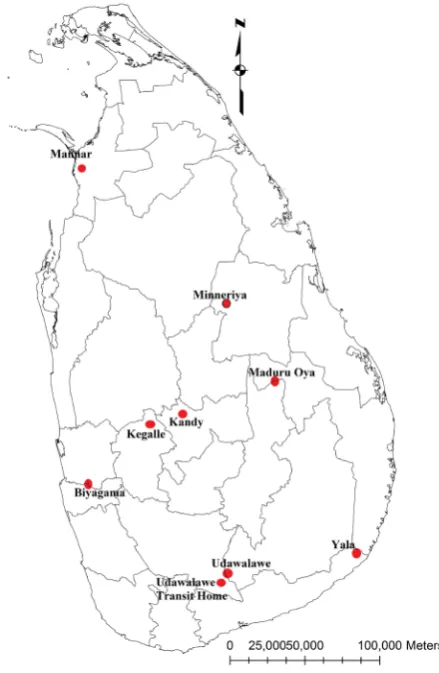
Fecal samples of wild elephants were collected from four national parks: Minneriya, Udawalawe, Maduru Oya, Yala, and from Mannar District closer to Wilpattu National Park. All the samples from semi-captive elephants were collected from the ETH in Udawalawa. Fecal samples from captive elephants were collected from the elephants in the Temple of the Tooth in Kandy, MEF in Kegalle, and from a private elephant owner in Biyagama (Fig. 1).
Udawalawe National Park contains 400 elephants and lies on the boundary of Sabaragamuwa and Uva
provinces in the Wet Zone of Sri Lanka. The park has an annual rainfall of 1,500mm, most of which falls during the months of October to January and March to May. The average annual temperature is about 27–28 0C,
while relative humidity varies from 70% to 82%. This national park spans approximately 31,000ha. Yala National Park is the most visited and second largest national park in Sri Lanka with 97,880ha and 350 elephants. It is located in Uva province with an elevation of 64m. It is situated in dry semi-arid climatic region and rain is received mainly during the northeast monsoon. The mean annual rainfall ranges between 500–775 mm while the mean temperature ranges between 26.40C in
January to 300C in April. Maduru Oya National Park is
located in Eastern and Uva provinces in the dry zone with about 200 elephants. Altitude ranges from 20– 60 m. The northeast monsoon is instrumental in the mean annual rainfall of 1,650mm, and the mean annual temperature is 270C. Maduru Oya National Park is
spread over 58,850ha with a special feature of an 8km long rocky range of hills to the southwest of the park. Mannar District is closer to Villpatthu National Park and is one of the 25 districts of Sri Lanka with 290C annual
temperature. The mean annual rainfall ranges between 550–580 mm whereas the area only experiences the tail end of the northeastern monsoon (Department of Wildlife Conservation 2015).
Sample collection
About 50g of fresh fecal samples were collected in a zip-locked plastic bag by inverting the bag and scooping the needed amount into the bag, and then samples were stored in a cooler. The collection was done soon after defecation whenever possible and each site was visited only once and each elephant was sampled once. Samples were labeled and brought to the laboratory and were stored at 40C until processed. Information on the
study animals was recorded using a questionnaire.
Sample analysis
the positive samples was calculated using McMaster counting technique; number of eggs or cysts/oocysts per gram (EPG/CPG/OPG) of feces was calculated.
Modified salt floatation method
About 50g of feces was measured and transferred into a 50ml capped centrifuge tube with 45ml distilled water. Feces were mixed thoroughly using a wooden applicator to get a clear solution. This suspension was centrifuged at 2,016g for 20min. The supernatant was removed using a suction pump. Again 45ml of distilled water was added and it was centrifuged for 20min at 2,016g. The supernatant was discarded. Once the supernatant was removed, 45ml of salt solution was added in to the pellet in the butt of the tube. This was centrifuged at 2,016g for 20min. Approximately, 5ml of the supernatant with floating parasitic eggs was removed in to a 15ml centrifuge tube. The total volume was made up to 15ml by adding distilled water and the tube was centrifuged at 2,016g for 10min at 160C.
Supernatant was removed and pipetted in to a 1.5ml Eppendorf® microfuge tube using a Pasteur pipette.
Distilled water was added to make it up to 1.5ml and the tube was centrifuged for 10min at 2,744g at 160C in
the micro centrifuge. The supernatant was decanted and the pellet was mixed thoroughly with 0.5ml of the supernatant. Microscope slides were prepared using about 0.1ml of the suspension and covered with a cover slip without staining. Three smears were observed from each sample under ×10 and ×40 objectives (WHO 1991).
Different stages of parasites (eggs, larvae, cysts) were morphologically identified with the aid of experts, standard keys, and literature (Soulsby 1982; Fowler & Mikota 2008). All stages were photographed and measurements were taken using Primostar Zeiss trinocular microscope.
Statistical analysis
The prevalence of parasitic infection in wild, semi-captive, and captive elephants was calculated using the following formula: Prevalence = (Infected number ÷ Individuals examined) x 100%. The prevalence of infections in wild, semi-captive, and captive elephants and the difference in helminth and protozoan infections were compared usinga Chi squared test.
RESULTS
A total of 85 fecal samples were collected: 45 from wild elephants, 20 from semi captive elephants, and 20 from elephants in captivity.
Prevalence of GI parasites
Of the samples collected 58 (68.2%) were infected with one or more GI parasites of nematodes, trematodes, cestodes, and protozoans. Overall, helminth infections (60.0%) were significantly more common compared to the protozoan (37.6%) infections (Chi square test, χ2 = 8.499, p < 0.001; Fig. 2). Among
the three host categories, the wild elephants had the highest prevalence (93.3%) of GI infections where 42 out of 45 individuals were infected. They all had helminth infections (93.3%) which were significantly higher than the protozoa infections (51.1%; χ2 = 19.994, p < 0.001).
All the wild elephants sampled from Minneriya National Park, Udawalawe National Park, and from Mannar District were infected with GI parasites (Table 1). The second highest prevalence of GI infections was recorded from semi-captive elephants (55.0%) where 11 elephants were positive. There was no difference between the helminths (40.0 %) and protozoan (25.0 %) infections (χ2
= 1.026, p = 0.311). When the prevalence of GI parasites
in the two groups was compared, a significantly higher prevalence of infection was observed in the wild elephants compared to the semi-captive elephants (χ2 =
13.516, p < 0.001). The captive elephants had the lowest GI infections (25.0%) among the three groups where only five elephants out of 20 were positive for GI parasites. Protozoan infections were more common (20.0 %) in captive elephants than helminth (5.0%) infections, but this difference was not statistically significant (χ2 =2.057; p = 0.151). Among the captive elephants, only one elephant sampled from Kandy (14.3%) had a helminth infection only (Table 1). There was a highly significant difference of parasitic prevalence between captive and wild elephants (χ2 = 32.289; p < 0.001) but not between
the captive and the semi-captive elephants (χ2 = 3.750; p = 0.053).
Types of GI parasites
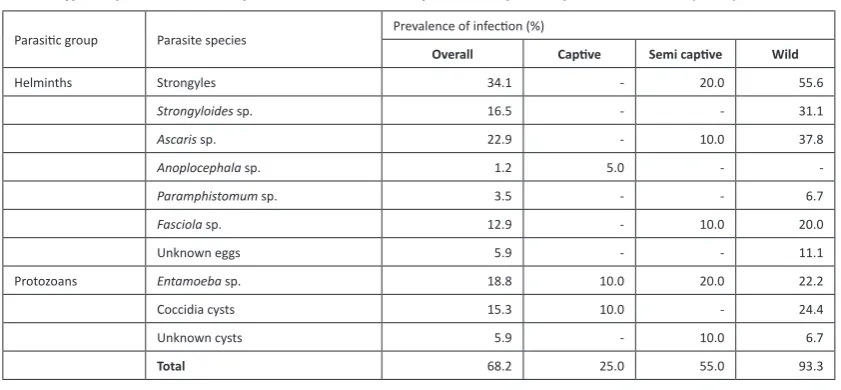
A total of 10 parasite species were found in the elephants (Table 2). Among them the most common helminth infection was strongyles (34.1%) followed by
Ascaris sp. (22.9%). Among the protozoans, Entamoeba
sp. (18.8%) was the most prevalent followed by coccidia cysts (15.3%). Wild elephants harbored more parasite species than the other two groups. Overall nine types: strongyles, Strongyloides sp., Ascaris sp., Fasciola sp.,
Paramphistomum sp., unidentified helminth eggs,
Entamoeba sp., coccidian cysts, and unidentified
protozoan cysts were recorded (Table 2). In semi-captive and semi-captive elephants five types and three types of parasites were recorded, respectively. The wild elephants had all the parasites recorded in the present study except Anoplocephala sp., which was recorded
only from one captive elephant from the Temple of the Tooth in Kandy. All the samples from Minneriya National Park were positive for strongyles. All three elephant groups had Entamoeba sp. infections. Among helminths, strongyles, Ascaris sp., and Fasciola sp. were recorded from both semi-captive and wild elephant categories (Table 2). Unidentified protozoan cysts were found in semi-captive and wild elephants (Image 1). The captive elephants harbored three parasite species
(Anoplocephala sp., Entamoeba sp., and coccidia cysts;
Table 2). None of the elephants in MEF and from private owners in Biyagama had GI helminths. Four samples were positive (20.0%) for protozoans (Entamoeba sp., coccidia cysts). Entamoeba sp. was found only in two elephants from MEF in Kegalle. None of the other captive elephants were positive for Entamoeba infection. Coccidia cysts were positive in 1 sample from Temple of
Table 1. Prevalence of helminths and protozoans in the fecal samples of captive, semi-captive, and wild elephants collected from different sites in Sri Lanka
Collection site (n) Prevalence (%)
Overall Helminths Protozoans
Wild
Yala NP (8) 87.5 87.5 62.5
Maduru Oya NP (10) 80.0 80.0 50.0
Minneriya NP (10) 100 100 40.0
Udawalawe NP (10) 100 100 50.0
Mannar (7) 100 100 57.1
Semi-Captive Udawalawe ETH (20) 55.0 40.0 25.0
Captive
Kandy - TTR (7) 28.6 14.3 14.3
Kegalle - MEF (10) 20.0 0.0 20.0
Biyagama (3) 33.3 0.0 33.3
Total (85) 68.2 60.0 37.6
NP = National Park; TTR = Temple of Tooth Relic; ETH= Elephant Transit Home; MEF= Millennium Elephant Foundation
the Tooth and in 1 sample from Biyagama.
Mixed infections
Mixed infections were more common (47.1%) than single infections (21.2%). The percentages of elephants having mixed infections of 2, 3, and 4 parasites were 24.7%, 17.6%, and 4.7%, respectively. Multiple infections of helminthes (30.6%) were more common than those of protozoans, which were found only in three elephants (3.5%). Multiple helminth infections were not recorded in semi-captive and captive elephants. Twenty-three wild elephants were infected with both helminth and protozoan infections. Eight semi-captive elephants were infected with single GI infection (40.0%) and three were infected with mixed infections (15.0%). Among the eight single infections, six samples were positive for helminths
and two samples were positive for protozoans.
Intensity of GI parasites
A high intensity of infection was recorded for strongyles in wild elephants (Table 3). The highest helminth egg count of 1,100 EPG of strongyles was recorded in a wild elephant from Minneriya National Park. In general, all the infections in wild elephants had a higher intensity than those in the captive and semi-captive animals. Highest number of cysts (340 OPG)
of Entamoeba sp. was recorded from a wild elephant
in Maduru Oya National Park. The intensity of all the infections in the wild elephants was higher compared to semi-captive and captive elephants. The intensity of common helminth and protozoans infections was lower in captive and semi-captive elephants than in wild
Table 2. Types of parasites and their prevalence in wild, semi-captive, and captive elephants in Sri Lanka (n =85)
Parasitic group Parasite species Prevalence of infection (%)
Overall Captive Semi captive Wild
Helminths Strongyles 34.1 - 20.0 55.6
Strongyloides sp. 16.5 - - 31.1
Ascaris sp. 22.9 - 10.0 37.8
Anoplocephala sp. 1.2 5.0 -
-Paramphistomum sp. 3.5 - - 6.7
Fasciola sp. 12.9 - 10.0 20.0
Unknown eggs 5.9 - - 11.1
Protozoans Entamoeba sp. 18.8 10.0 20.0 22.2
Coccidia cysts 15.3 10.0 - 24.4
Unknown cysts 5.9 - 10.0 6.7
Total 68.2 25.0 55.0 93.3
Table 3. Mean Eggs per gram (EPG) or Oocysts per gram (OPG) counts of different parasites in the captive, semi-captive, and wild elephants
Parasite species Mean EPG or OPG counts (±SD)
Captive Semi-captive Wild
Eggs Strongyles - 50.0±9.1 440.1±295.2
Strongyloides sp. - - 225.8±157.7
Ascaris sp. - 95.0±7.1 251.2±225.1
Anoplocephala sp. 40 -
-Paramphistomum sp. - - 123.3±94.5
Fasciola sp. - 60.0±14.1 152.2±97.7
Unknown eggs - - 82.5±34.9
Cysts Entamoeba sp. 75.0±35.4 58.0±22.2 169.8±125.4
Coccidia cysts 55.0±7.1 - 92.7±52.1
Unknown cysts - 30.0±14.1 65.0±35.4
Table 4. Percentage prevalence of single and mixed infections of gastrointestinal parasitic groups in wild, semi-captive, and captive elephants in Sri Lanka
Parastic group InfectionType
Prevalence of infection (%)
Overall Captive captiveSemi Wild
Helminths Single 29.4 5.0 40.0 35.6
Mixed 30.6 - 57.8
-Protozoans Single 34.1 20.0 20.0 46.7
Mixed 3.5 5.0 4.4
-Image 1. Types of protozoan cysts recorded during fecal analysis of wild (B, D, F, H, I), Semi-captive (A, G), and Captive (E, C) elephants, using modified salt flotation (A, B, E, F, G, I) and direct iodine smear (C, D, H) methods. A, B, C - Amoeboid parasites (Entamoeba sp.)
D, E, F - Coccidian cysts G, H,I - Unknown cysts
20μm 20μm
20μm
20μm 20μm
20μm
10μm
20μm
10μm
A
D
G
B
E
H
C
F
elephants. Unknown cysts were found in semi-captive and wild elephants; among them the lowest cyst count (50 OPG) was recorded from a semi-captive elephant in ETH (Image 1). Anoplocephala sp. was recorded at low EPG (40) in only one captive elephant at the Temple of the Tooth in Kandy. Coccidia cysts were found in wild and captive elephants; among them the lowest OPG (45) was recorded from a captive elephant in Biyagama (Image 2).
DISCUSSION
The present study reports an overall prevalence of 68.2% of GI parasites in elephants of Sri Lanka; the
infection in wild elephants (93.3%) was significantly higher than that of the captive (55.0%) and semi-captive elephants (25.0%). Unlike the wild elephants, the captive and semi-captive elephants receive regular deworming which is the main reason for having a low prevalence of GI parasites in these two groups. In general, oral deworming treatments are given two to three times per year with special treatments if elephants show clinical symptoms. Febantel and Mebendazole are the commonly used anthelminthics for both captive and semi-captive elephants in Sri Lanka (personal communication with the veterinarian). Febantel is a broad spectrum anthelminthic used against GI parasites including
Giardia, roundworms, hookworms, whipworm, ascarids,
and tapeworms (Tiwari & Rao 1996). Deworming of
Image 2. Helminth eggs recorded from captive and wild elephants using modified salt flotation (A, B, C, D, F), sedimentation - (G, H) and direct iodine smear (E, I) method. (A) Strongyloides sp., (B, C) Anoplocephala sp., (D, E) Unknown eggs, (F) Stongyles, (G) Paramphistomum
sp., (H) Fasciola sp., (I) Ascaris sp.
20μm 20μm
20μm
20μm 20μm
20μm 20μm
A
D
G
B
E
H
C
F
I
both adult elephants and calves is done with Febantel twice a year @ 5–10 mg/kg body weight. Mebendazole is a highly effective, broad-spectrum anthelmintic for the treatment of nematode infestations, including roundworm, hookworm, whipworm, threadworm, and the intestinal form of trichinosis prior to its spread into the tissues beyond the digestive tract (Tiwari & Rao 1996). The prevalence of helminth infections was higher in wild elephants than the other two groups. This could be because the anthelminthic drugs mainly target the helminths. Irrespective of regular deworming treatments, one third of Biyagama captive elephants were infected. This could be attributed to the method of deworming where individuals were treated separately, while the other captive elephants were treated simultaneously. Moreover, sampling of elephants in Biyagama was done five months after the last deworming while sampling of other two sites was carried out within 2 to 3 months after deworming. Furthermore, in Biyagama the space limitation for the captive animals can aggravate the prevalence of GI parasites. All the wild elephants sampled from Minneriya and Udawalawe National Parks were infected. Due to the water scarcity in these national parks, many elephants congregate and depend on a single water hole. This tends to increase the contamination rate as they defecate on the ground and there is a higher possibility of infection of the whole herd when one individual is infected. Potential factors determining the transmission of GI parasites in the wild include environmental conditions that affect the viability and behaviour of parasite propagules, as well as feeding, movement, and defecation patterns of the host, which determine the parasites encountered (Watve 1995; Vidya & Sukumar 2002).
A total of 10 species of GI parasites was found in the elephants. All the helminth species except
Anoplocephala were recorded in wild elephants. None
of the captive elephants had any helminths except
Anaplocephala. Semi-captive elephants had strongyles,
Ascaris, and Faciola infections. All three protozoans
recorded were found in wild elephants. Entamoeba was reported both in captive and semi-captive elephants. Strongyleswas the most common infection. The most common helminth was strongyle followed by Ascaris. A recent study carried out in Sri Lanka at Pinnawela Elephant Orphanage (PEO), Galgamuwa wild elephants, and with some privately owned elephants by Abeysinghe et al. (2017) reported that 100% of wild elephants and 90% of privately owned captive elephants were infected with strongyles, while only 38% of elephants in PEO harbored that infection. Vanitha et al. (2011) reported
the prevalence of strongyles as 37% in captive elephants in Tamil Nadu, India. They show that the prevalence varies significantly across seasons, with the highest rate during summer (49%) followed by monsoon (41%) and the lowest rate during winter (15%). Furthermore, they have shown that male elephants have a lower parasite prevalence compared to females, and the age classes show no difference. Previous studies from India also record strongyles as the most comment type of GI parasite (Watve 1995; Chandrasekharan et al. 1995; Vidya & Sukumar 2002; Chandrasekharan et al. 2009). Saseendran et al. (2003) reported 10% of captive elephants had strongyles in Kerala, India. There is a correlation between the pathogenecity of the parasite and the number of eggs that they produce. In the present study, the strongyles were not found in captive elephants. Anthelminthics against strongylosis in captive elephants are effective (Chandrasekharan 1992; Suresh et al. 2001).
Ascaris infections were recorded in wild and
semi-captive elephants. Ascaris sp. is known to evolve anthelminthic resistance, which could be a possible reason for the presence of the parasite in semi-captive elephants, even with regular anthelmintic treatments. It may also be due to treating with broad-scale anthelminthics at sub-curative dosages, which eventually leads to the development of resistance. Resistance has been recorded in both Asian and African Elephants in India (Bapu 1936), Nigeria (Mbaya et al. 2012), and Bangladesh (Rahman et al. 2014). The other helminth infections recorded were Strongyloides sp.,
Paramphistomum sp., Fasciola sp. These have also
been reported in elephants in India (Varadharajan & Kandasamy 2000) and in Borneo (Hing et al.2013).
eggs are difficult to find in fecal samples (Ihler et al. 1995; Nilsson et al. 1995) and suggest using modified methods and 30–40 g of feces.
Perera et al. (2014) recorded adult tapeworm
Anoplocephala sp. from wild elephants in the Udawalawe
National Park and the identifications were done using morphometric features and molecular characterization of its 2s and 28s genes. Anoplocephala has been found in both Asian and African captive elephants where Obanda et al. (2011) reported that Anoplocephala manubriata was common among wild African Elephants. It has been recorded in the Asian elephant in Kerala, India (Warren 1996), and in Tamil Nadu state in Mudumalai, Anamalai, and Sathyamangalam forests in India (Nishanth et al. 2012).
All protozoan parasites recorded in the present study (Entamoeba sp., Coccidian cysts, and unknown cysts) have been previously recorded in elephants in South Africa (Eloff & van Hoven 1980; Samuel 2001). Protozoans including coccidian parasites such as Eimeria sp., Isospora sp. (Mbaya 2013), are commonly found in a wide variety of species but rarely cause disease in free-living elephants (Samuel 2001). In addition, GI protozoans like Cryptosporidium, Cyclospora, and
Giardia have been reported in captive African and Asian
Elephants (Majewska et al. 1997) but were not found in the present study. There are some non-pathogenic protozoans that can be found in elephants, including in the amoeboid group (Begon 1995). They do not harm elephants, even those with weak immune systems. Symptomatic elephants that are found to have these protozoa in their feces should be examined for other causes of their symptoms.
All the wild elephants had mixed infections. A higher frequency of mixed infections in wild elephants could be due to animal movement and grazing behavior. When there is greater freedom of animal movement, it can result in feeding at a greater variety of locations and on more different types of fodder thus increasing exposure to a greater variety of endoparasites (Nunn et al.2003). Moreover, the presence of one parasite species may facilitate the presence of the other species (Fontanarrosa et al. 2006) since the elephants that have mixed infections with higher parasite intensities are known to have less immunity. Mixed infections of strongyles and Strongyloides sp. are common in wild elephants (Watve 1995; Dharmarajan 1999; Nishanth et al. 2012).
All gastrointestinal parasites are not equal, some are highly pathogenic and some are incidental. The presence of parasites in the fecal samples of elephants does not
necessarily mean they are sick, or will be sick, nor does it mean that the animal should be treated. Gaur et al. (1979) stated that wild animals in a free-living state are generally infected with numerous parasites, but these cause little harm to them unless they are physiologically or nutritionally stressed. Understanding the infections in wild animals is important since infections could result in die-offs of elephants during extreme stress conditions. In 1995, three Sumatran Elephants (Elephas
maximus sumatranus) died suddenly of helminth
infection in the Way Kambas National Park, Indonesia. Postmortem examination revealed that the GI tracts of all three animals were infected with Murshidia falcifera (Nematoda), Hawkesius hawkesi, Pfenderius papillatus (Digenea), and Cobboldia elephantis (Diptera) (Matsuo et al. 1998).
REFERENCES
Abeysinghe, K.S., A.N.F. Perera, J. Pastorini, K. Isler, C. Mammides & P. Fernando (2017). Gastrointestinal strongyle infections in captive
and wild elephants in Sri Lanka. Gajah 46: 21–27.
Agatsuma, T., R.P.V.J. Rajapakse, V.Y. Kuruwita, M. Iwagami & R.C. Rajapakse (2004). Molecular taxonomic position of the elephant
schistosome, Bivitellobilharzia nairi, newly discovered in Sri Lanka. Parasitology International 53(1): 69–75.
Aviruppola, A.J.M., R.P.V. Rajapakse & R. Rajakaruna (2016).
Coprological survey of gastrointestinal parasites of mammals in Dehiwala National Zoological Gardens, Sri Lanka. Ceylon Journal of
Science 45(1): 83–96; http://doi.org/10.4038/cjs.v45i1.7367
Bapu, S. (1936). A short note on elephants and a few of their common
diseases. Indian Veterinary Journal 13(1): 36–43.
Begon, M. & R.G. Bowers (1995). Beyond host-pathogen dynamics,
pp. 478–509. In: Grenfell, B.T. & A.P. Dobson (eds.). Ecology of
Infectious Diseases in Natural Populations. Cambridge University Press, Cambridge.
Bhalerao, G.D. (1933). The trematode parasites of the Indian Elephant,
Elephas indicus. Indian Journal of Veterinary Science and Animal
Husbandry 3: 103–115.
Chandrashekaran, K. (1992). Prevalence of infectious diseases in
elephants in Kerala and their treatment. In: Silas, E.G., M.K. Nair & G. Nirmalan (eds.). The Asian Elephant: Ecology, Biology, Diseases,
Conservation and Management. Kerala Agricultural University,
India.
Chandrasekharan, K., K. Radhakrishnan, J.V. Cheeran, K.N. Muraleedharan & T. Prabhakaran (1995). Review of the incidence,
etiology and control of common diseases of Asian elephants with special reference to Kerala, pp. 439–449. In: Daniel J.C. & H.S. Datye (eds.). A Week with Elephants. International Seminar on the Conservation of Elephant, India.
Chandrasekharan, K., K. Radhakrishnan, J.V. Cheeran, K.N. Muraleedharan & T. Prabhakaran (2009). Review of the incidence,
etiology and control of common diseases of Asian elephants with special reference to Kerala, pp. 92–100. In: Ajitkumar G., K.S. Anil & P.C. Alex (eds.). Healthcare Management of Captive Asian Elephants. Kerala Agriculture University, India.
Department of Wildlife Conservation (2015). Ecosystem conservation
and management.Electronic version, accessed on 10 September 2015.
Dharmarajan, G. (1999). Epidemiology of helminth parasites in wild
and domestic herbivores at the Mudumalai Wildlife Sanctuary, Tamil Nadu. M.V.Sc Thesis. Tamil Nadu Veterinary and Animal Sciences University, Chennai.
Dissanayake, S.R.B., R. Marasinghe, M. Amararathne, S. Wijeyamohan, P. Wijeyakoon & C. Santiapillai (2012). The First
National Survey of Elephants in Sri Lanka, p.113. A Report Prepared
for The Department of Wildlife Conservation. Center for the Study of Asian Elephant at Rajarata University of Sri Lanka, Mihintale, Sri Lanka.
Eloff, A.K. & W. van Hoven (1980). Intestinal protozoa of the African
Elephant Loxodonta africana (Blumenbach). South African Journal of
Zoology 15(2): 83–90.
Fernando, P. (2000). Elephants in Sri Lanka: past, present, and future.
Loris 22: 38–44.
Fernando, A. & C.H. Fernando (1961). Report on the helminth
parasites of an Asian Elephant which died in Singapore. Ceylon
Veterinary Journal 9(4): 99–106.
Fernando, P., J. Jayewardene, T. Prasad, W. Hendavitharana & J. Pastorini (2011). Current status of Asian elephants in Sri Lanka.
Gajah 35: 93–103.
Fleischer, R.C., E.A. Perry, K. Muralidharan, E.E. Stevensand & C.M.
Wemmer (2001). Phylogeography of the Asian Elephant (Elephas
maximus) based on mitochondrial DNA. Evolution 55(9): 1882–
1892.
Fontanarrosa, M.F., D. Vezzan, J. Basabe & D.F. Eiras (2006). An
epidemiological study of gastrointestinal parasites of dogs
from Southern Greater Buenos Aires (Argentina): age, gender, breed, mixed infections, and seasonal and spatial patterns.
Veterinary Parasitology 136: 283–295; http://doi.org/10.1016/j.
vetpar.2005.11.012
Fowler, M.E. & S.K. Mikota (2008).Biology, Medicine, and Surgery of
Elephants. Blackwell Publishing Ltd, Oxford, UK.
Gaur, S.N.S., M.S. Sethi, H.C. Tewari & O. Prakash (1979). A note on
the prevalence of helminth parasites in wild and zoo animals in Uttar Pradesh. Indian Journal of Animal Science 49(2): 159–161.
Gupta, S.M.R. (1974). A preliminary report on diseases and parasites
of zoo animals, birds and reptiles. Indian Journal of Animal Health
13(1): 15–24.
Heinrich, L. (2016). Prevalence and molecular identification of
helminths in wild and captive Sri Lankan Elephants, Elephas
maximus maximus. Future 19: 21.
Hing, S., N. Othman, S.K. Nathan, M. Fox, M. Fisher & B. Goossens (2013). First parasitological survey of Endangered Bornean
elephants Elephas maximus borneensis. Endangered Species
Research 21(3): 223–230.
Ihler, C.F., V. Rootwelt, A. Heyeraas & N.I. Dolvik (1995). The
prevalence and epidemiology of Anoplocephala perfoliata infection in Norway. Veterinary Research Communications 19(6): 487–494;
https://doi.org/10.1007/BF01839337
IUCN (2008).The IUCN Red List of Threatened Species. http://doi.
org/10.2305/IUCN.UK.2008.RLTS.T7140A12828813.en, Electronic Version accessed on 10 September 2015.
IUCN (2017). The IUCN Red List of Threatened Species. http://www.
catalogueoflife.org/col/details/species/id/6fb47237753f0901b5b b779c6e9e1369/source/tree, Electronic Version accessed on 29th
January 2018.
Jayewardene, J. (1994).The Elephant in Sri Lanka. Wildlife Heritage
Trust of Sri Lanka, Colombo, 112pp.
Kuruwita, V.Y. & V.W.S.M. Vasanthathilake (1993). Gastro-intestinal
[sic] nematode parasites occurring in free-ranging Elephants
(Elephas maximus ceylonicus) in Sri Lanka. Sri Lanka Veterinary
Journal 40: 15–23.
Leimgruber, P., J.B. Gagnon, C. Wemmer, D.S. Kelly, M.A. Songer & E.R. Selig (2003). Fragmentation of Asia’s remaining wildlands:
implications for Asian Elephant conservation. Animal Conservation 6: 347–359; http://doi.org/10.1017/S1367943003003421 Majewska, A.C., W. Kasprzak & A. Werner (1997). Prevalence of
Cryptosporidium in mammals housed in Poznan Zoological Garden, Poland. Acta Parasitologica 42: 195–198.
Matsuo, K., S. Hayashi & M. Kamiya (1998). Parasitic infections of
Sumatran Elephants in the Way Kambas National Park, Indonesia.
Japanese Journal of Zoo and Wildlife Medicine 3: 95–100.
Mbaya, A.W., G.K. Chuchan, F. Ballah & B. Garba (2012). Prevalence of
Helminthic Infections among Wild Animals in Yankari Game Reserve, Nigeria. Bulletin of Animal Health and Production in Africa 60(1): 45–55.
Mbaya, A.W., M. Ogwiji & H.A. Kumshe (2013). Effects of host
demography, season and rainfall on the prevalence and parasitic load of gastrointestinal parasites of free-living Elephants (Loxodonta
africana) of the Chad Basin National Park, Nigeria. Pakistan Journal
of Biological Sciences 16(20): 1152–1158.
Miller, D., B. Jackson, H.S. Riddle, C. Stremme, D. Schmitt & T. Miller
(2015). Elephant (Elephas maximus) health and management in
Asia: variations in veterinary perspectives. Veterinary Medicine
International 2015(1): 2–3; http://doi.org/10.1155/2015/614690
Nilsson, H.O., P. Aleljung, I. Nilsson, T. Tyszkiewicz & T. Wadström (1996). Immunomagnetic bead enrichment and PCR for detection
of Helicobacter pylori in human stools. Journal of Microbiological
Methods 27(1): 73–79.
Nishanth, B., S.R. Srinivasan, M.G. Jayathangaraj & R. Sridhar (2012).
Incidence of endoparasitism in free-ranging elephants of Tamil Nadu State. Tamilnadu Journal of Veterinary & Animal Sciences 8(6): 332–335.
Nunn, C.L., S. Altizer, K.E. Jones & W. Sechrest (2003). Comparative
Naturalist 162(5): 597–614; http://doi.org/10.1086/378721 Obanda, V., T. Iwaki, N.M. Mutinda & F. Gakuya (2011). Gastrointestinal
parasites and associated pathological lesions in starving free-ranging African Elephants. South African Journal of Wildlife 41: 167–172.
Perera, B.V.P. & R.P.V.J. Rajapakse (2009). Mortality and morbidity
of wild Elephants (Elephas maximus maximus) of Sri Lanka, as a result of Liver Flukes (Fasciola jacksoni) infestation. Proceedings of the International Conference on Diseases of Zoo and Wild Animals, Leibniz Institute for Zoo and Wildlife Research,Beekse Bergen, The Netherlands.
Perera, K.U.E., S. Wickramasinghe, B.V.P. Perera, & R.P.V.J Rajapakse (2014). Evaluation of morphometric features and molecular
characterization of its 2 and 28s genes of Anoplocephala sp. from a Sri Lankan Elephant. Proceedings of the Peradeniya University
International Research Sessions 18: 505; http://doi.org/10.4038/cjs.
v45i1.7367
Rahman, S.M., A.R. Dey, U.K. Kundu & N. Begum (2014). Investigation
of gastrointestinal parasites of herbivores at Dhaka National Zoological Garden of Bangladesh. Journal of Bangladesh Agricultural
University 12(1): 79–85.
Samuel, W.M., A.A. Kocan & M.J. Pybus (2001). Sarcoptes scabiei and
sarcoptic mange. Parasitic Diseases of Wild Mammals 2: 416–459.
Santiapillai, C. & R. Sukumar (2006). An overview of the status of the
Asian Elephant. Gajah 25: 3–8.
Santiapillai, C. & S. Wijeyamohan (2013). The First National Survey of
Elephants in Sri Lanka. Current Science 105(2): 153–154.
Saseeendran, P.C., S. Rajendran, H. Subramanian, M. Sasikumar, G. Vivek & K.S. Anil (2003). Incidence of helminthic infection among
annually dewormed captive elephants. Zoos Print Journal 19(3): 1422; http://doi.org/10.11609/JoTT.ZPJ.19.3.1422
Scott, M.E. & A. Dobson (1989). The role of parasites in regulating host
abundance. Parasitology Today 5: 176–183.
Seneviratna, P. (1955). A checklist of helminths in the Department
of Veterinary Pathology, University of Ceylon, Peradeniya. Ceylon
Veterinary Journal 3: 32–37.
Seneviratna, P. & J.B. Jayasinghe (1968). Some parasites from the
Ceylon Elephants (Elephasmaximus). Ceylon Veterinary Journal 15: 28.
Soulsby, E.J.L. (1982). Helminths, Arthropods and Protozoa of
Domesticated Animals. Bailliere Tindall, London, 809pp.
Suresh, K., P.C. Choudhuri, K.A. Ajithkumar, M.D. Hafeez & P.A. Hamza (2001). Epidimiological and clinico - therapeutic studies of
strongylosis in elephants. Zoos Print Journal 16(7): 539–540; http:// doi.org/10.11609/JoTT.ZPJ.16.7.539-40
Tiwari, S.P. & K.N.P. Rao (1996). Fenbendazole - a useful dewormer for
elephants. Zoo’s Print 9(4): 2–5.
Vanitha, V., K. Thiyagesan & N. Baskaran (2011). Social life of captive
Asian Elephants (Elephas maximus) in Southern India: implications for elephant welfare. Journal of Applied Animal Welfare Science
14(1): 42–58.
Varadharajan, A. & A. Kandasamy (2000). A survey of gastro-intestinal
parasites of wild animals in captivity in the V.O.C. Park and Mini Zoo, Coimbatore. Zoos’ Print Journal 15(5): 257–258; http://doi. org/10.11609/JoTT.ZPJ.15.5.257-8
Vidya, T.N.C. & R. Sukumar (2002). The effect of some ecological
factors on the intestinal parasite loads of the Asian Elephant
(Elephas maximus) in southern India. Journal of Biosciences 27(5):
521–528; http://doi.org/10.1007/BF02705050
Warren, K., J. Bolton, R. Swan, W. Gaynor & L. Pond (1996). Treatment
of gastrointestinal tract impaction of a 2-year-old Asian Elephant
(Elephas maximus). Australian Veterinary Journal 73:37–38; http://
doi.org/10.1111/j.1751-0813.1996.tb09956.x
Watve, M.G. (1995). Helminth parasites of elephants. Ecological
aspects, pp. 289–295. In: Daniel, J.C. & H. Datye (eds.). A Week with
Elephants Bombay. Oxford University Press, Bombay Natural History
Society, New Delhi.
World Health Organization (WHO) (1991). Basic laboratory methods
in medical parasitology. Geneva: World Health Organization.
Downloaded 14 March 2015.
ISSN 0974-7907 (Online); ISSN 0974-7893 (Print)
April 2018 | Vol. 10 | No. 5 | Pages: 11551–11702 Date of Publication: 26 April 2018 (Online & Print)
DOI: 10.11609/jott.2018.10.5.11551-11702
www.threatenedtaxa.org
The Journal of Threatened Taxa is dedicated to building evidence for conservation globally by publishing peer-reviewed articles online every month at a reasonably rapid rate at www.threatenedtaxa.org. All articles published in JoTT are registered under Creative Commons Attribution 4.0 International License
unless otherwise mentioned. JoTT allows unrestricted use of articles in any medium, reproduction, and distribution by providing adequate credit to the authors and the source of publication.
OPEN ACCESS
Article
Butterfly diversity in human-modified ecosystems of southern Sikkim, the eastern Himalaya, India
-- Prem Kumar Chettri, Kishor Sharma, Sailendra Dewan & Bhoj Kumar Acharya, 11551–11565
Communications
Contrasting human perceptions of and attitudes towards two threatened
small carnivores, Lycalopex fulvipes and Leopardus guigna, in rural
communities adjacent to protected areas in Chile
-- I. Sacristán, A. Cevidanes, F. Acuña, E. Aguilar, S. García, M.J. López, J. Millán & C. Napolitano, Pp. 11566–11573
Sighting trend of the Indian Skimmer (Charidiformes: Laridae: Rynchops
albicollis Swainson, 1838) in National Chambal Gharial Sanctuary (1984–
2016) reflecting on the feasibility of long-term ecological monitoring
-- L.A.K. Singh & R.K. Sharma, Pp. 11574–11582
Comparative cross-sectional survey on gastrointestinal parasites of captive,
semi-captive, and wild Elephants of
Sri Lanka
-- Nirupama Abeysekara, R.P.V. Jayanthe Rajapkse & R.S. Rajakaruna, Pp. 11583–11594
Short Communications
The extinction of Faure’s Broom Adenocarpus faurei Maire (Leguminosae) in
Algeria
-- Mohamed Djamel Miara, Mohammed Ait Hammou & Jah Skipper, Pp. 11595–11598
Conservation assessment of two rare gingers (Zingiberaceae) from Dampa Tiger Reserve, Mizoram, India
-- Pankaj Kumar & Priya Singh, Pp. 11599–11605
New records of bats (Mammalia: Chiroptera) from Assam, northeastern India with a distribution list of bat fauna of the state
-- Ananda Ram Boro, Prasanta Kumar Saikia & Uttam Saikia, Pp. 11606–11612
On the birds of Marivan County, western Iran: an update
-- Fatah Zarei, Seyed Naseh Hosseini, Jalal Pezeshk, Loghman Maleki & Hamid Reza Esmaeili, Pp. 11613–11617
Nesting pattern of birds in Jahangirnagar University Campus, Bangladesh
-- Israt Jahan, Sajeda Begum, Mohammad Mostafa Feeroz, Delip Kumar Das & Ashis Kumar Datta, Pp. 11618–11635
An annotated checklist of the birds of the upper Siang region, Arunachal Pradesh, India
-- Anirban Datta-Roy, Vivek Ramachandran & Karthik Teegalapalli, Pp. 11636– 11651
Report of the early winter migrants and resident birds in an inland wetland near Tundi Camp, Bajana, Gujarat
-- Abhishek Chatterjee, Sudeshna Ghoshal, Soumyajit Chowdhury & Pinakiranjan Chakrabarti, Pp. 11652–11658
The first report of two thread-legged assassin bugs (Hemiptera: Reduviidae: Emesinae) from India
-- Balasaheb V. Sarode, Swapnil S. Boyane & Hemant V. Ghate, Pp. 11659– 11664
Water striders, the genus Cylindrostethus Mayr (Insecta: Heteroptera:
Gerridae) from India with a new record
-- E. Eyarin Jehamalar, Kailash Chandra & G. Srinivasan, Pp. 11665–11671
The invasive aphid Pterochloroides persicae (Cholodkovsky, 1899)
(Hemiptera: Aphidoidea: Lachninae) recorded on important fruit trees in Kashmir Valley, India
-- Govindasamy Mahendiran, Shahid Ali Akbar & Mudasir Ahmad Dar, Pp. 11672–11678
Notes
Anemone trullifolia and Berberis angulosa as new records to the flora of
the western Himalaya, India
-- Ishwari Datt Rai, Gajendra Singh & Gopal Singh Rawat, Pp. 11679–11682
Notes on fairy orchids (Magnoliopsida: Asparagales: Orchidaceae:
Oberonia) of Sri Lanka: revision in regional distribution and documentation
on vegetative propagation
-- Menaka Ariyarathne & Deepthi Yakandawala, Pp. 11683–11685
Additional reports of solitary potter wasps (Hymenoptera: Vespidae: Eumeninae) in Bhutan
-- Tshering Nidup, Wim Klein, P. Girish Kumar & Phurpa Dorji, Pp. 11686– 11696
On the occurrence of the rare Long-nosed Stargazer Ichthyscopus lebeck
(Bloch & Schneider, 1801) (Uranoscopidae) in the coastal waters off Visakhapatnam, India
-- Govinda Rao Velamala & Muddula Krishna Naranji, Pp. 11697–11700
Correction
Corrigendum - Butterfly host plant Monograph, P. 11701
Miscellaneous
National Biodiversity Authority