ISSN 1392-2785 ENGINEERING ECONOMICS. 2006. No 1 (46)
COMMERCEOFENGINEERINGDECISIONS
The Problems of Identifying the Essential Business-to-Business E-Commerce
Environment Components
Tadas Šarapovas, Aurelijus Cvilikas
Kauno technologijos universitetas K. Donelaičio g. 73, LT-44029, Kaunas
Electronic commerce is treated as one of the most ef-ficient instruments for business processes optimization, based on more effective control of information flows. E-commerce infrastructure is that part of the total economic infrastructure that is needed to support e-commerce proc-esses and to conduct electronic commerce transactions. It includes investment in computers, routers and other com-puter hardware; satellite, wire and optical communica-tions and network channels; system and applicacommunica-tions software. It also includes expenditure for support ser-vices, such as web site development and hosting, consult-ing, electronic payment and certification services as well as human capital, such as programmers. In essence, e-commerce is the secure trading of goods, information or services. Contrary to popular opinion, an e-commerce solution is not simply a single component, rather a collec-tion of individual parts that together allow informacollec-tion exchange to take place across the electronic networks. The rapidity of e-commerce integration to economy shows that in the nearest future e-commerce will become the necessity for any and all business forms. E-commerce evolution is related to rapid perfection of information technologies, their growing possibilities of adoption in various areas and the cost of use decrease. The spread of e-commerce in various economy sectors is related to the modern business characteristics: huge and constantly growing competition, decreasing variety of competitive advantages, durable treatment of profit, as the result of cost reduction. As electronic commerce develops, it could have profound impacts on individual sectors of the econ-omy as well as on macroeconomic performance and eco-nomic policies. Electronic commerce growth could have significant effects on the structure and functioning of economies at the firm, and industry level as well. These changes are likely to have influence on prices as well as the composition of trade, labour markets and taxation revenues. E-commerce integration to business processes is considered as realistic possibility to strengthen the company’s position in the market, so in near future it is very believable for e-commerce to become the necessity (market entrance barrier) in some industry sectors, where e-commerce models can generate considerable cost econ-omy. In that case it can be concluded, that any company in a small and medium-sized business sector must evalu-ate possible benefits from e-commerce adoption in busi-ness processes. Traditional competitive advantages like modern technologies, low cost level or suitable geo-graphical location become less significant because of globalization process. But before making decisions of
e-commerce adoption in the company, it is important to define and assess the main aspects of e-commerce envi-ronment. The paper aims to analyze the problems of business-to-business e-commerce environment assess-ment and to identify the essential eleassess-ments of this envi-ronment.
Keywords: business-to-business electronic commerce, business environment, e-commerce environ-ment.
Introduction
E-commerce evolution is related to rapid perfection of information technologies, their growing possibilities of adoption in various areas and the cost of use decrease. Though e-commerce boom in 2000 – 2002 ended in bankruptcies of large companies who based their business solely on e-commerce, the impact of this for e-commerce spread was minimal and today e-commerce decisions more and more often are treated not like competitive ad-vantage, but like the necessity, trying not to lag behind competitors. Since the mid 90’s e-commerce conception evolved from the separate electronic transactions in goods purchase or resources supply, based on business-to-customer or business-to-business models, to dynamic business ecosystems, based on the merge of separate markets and value chains, created on the network com-munication framework. In the aspect of business proc-esses e-commerce can be defined as the use of electronic networks with the objective to simplify and fasten all phases of business processes: from the production of goods to the sale and delivery.
Problem and relevance. Since the mid 90’s e-commerce conception evolved from the separate elec-tronic transactions in goods purchase or resources supply, based on business-to-customer or business-to-business models, to dynamic business ecosystems, based on the merge of separate markets and value chains, created on the network communication framework.
Companies, which are trying to adopt e-commerce decisions, should notice that e-commerce is not only the tool for business perfection. Inadequate use of e-commerce decisions may result in business cost increase and business efficiency reduction. This situation may occur because of various crucial factors, acting in the environment of e-commerce systems.
Research objective is to identify the essential ele-ments of business-to-business e-commerce environment, that are the most important factors for decision making within the specific e-commerce system.
Research methods – systematic, logical and com-parative analysis of scientific literature.
In this article there are analyzed the works of recently internationally known authors (F.Cacheda, J.Coppel, A.J.Davies, K.C.Laudon, R.Šertvytis, C.C.Krüger et al), researching the business-to-business e-commerce model performance environment.
Technological environment
E-commerce, as one of the results of modern tech-nologies spread in almost all business sectors, is closely connected to the abilities of technological environment. As C.C.Krüger (2003) states, one of the background factors of e-commerce environment is appropriate technological equipment, treated as the base for e-commerce decisions realisation. The main elements of e-commerce in techno-logical structure viewpoint are as follow (Ivezic, 2003):
1. Computer systems. This is the background for the
information technologies, where the e-commerce system is formed. Computer systems usually are described by their technological features, which are one of the main boundaries for e-commerce re-alisation.
2. Electronic networks. Those networks supplement computer systems and create the possibility of e-commerce use by eliminating the distance factor. E-commerce can be efficient only in the case when individual computer systems can be connected to a conjoint network. The best known electronic net-work, which is often treated as the only e-commerce technological environment, is internet, where the “global accessibility” idea is realised (MacInnes, 2003; Benbunan-Fich, 2004; King, 2004). But it is important to assess the fact, that internet is not the only environment for e-commerce existence. The e-e-commerce decisions can also be realised using other types of electronic networks (i.e. intranet) (Bogdanovych, 2004).
3. Software. The software is the instrument for
e-commerce functionality realisation. Software can be treated as the environment that guarantees the encryption of information transmitted in the way that is acceptable for information user. The func-tionality of software ensures the lower probability of mistakes, related to human factor or cultural barriers (i.e. unclear terms, language barrier and other), and also guarantees the precision of infor-mation processing (UWA Consortium, 2002; Ca-vusoglu, 2004). Besides, the software creates the possibility to connect the information receivable with internal information flows that allows com-pany’s processes optimization.
The other aspect of e-commerce decisions installation and support is the need for information technologies special-ists (Mayer-Gull, 2001). The installation of information technologies requires special knowledge and this creates the
demand for information technologies specialists in various business sectors. The fast improvement of information tech-nologies and the variety of their adoption areas conditions the appearance of information technologies specialists’ labor cost. E-commerce adoption process is skilled labour inten-sive, which means that labour cost is one of the main com-ponents of e-commerce adoption cost. R.Šertvytis (2004) presents three stages of the adoption of e-commerce, treated as the use of internet for business practice:
1. The procurement of proper software. 2. The creation of products catalogue.
3. The registration of new internet site name or the adding of needed link in already existing site. As the additional tasks for e-commerce adoption are presented the e-commerce connection to current products accounting system; e-commerce marketing; payoff through internet integration to e-commerce. It is clear that R.Šertvytis (2004) treats e-commerce very narrowly, as the release of products catalogue in internet for final user, but the author presents the elements of e-commerce sys-tem adoption process, which quite precisely represent the nature of e-commerce adoption costs. The experts of “Oracle” (2004), while evaluating the need of knowledge and skills in e-commerce adoption process, recommend outsourcing the functions of e-commerce system support. This decision would guarantee the higher level of e-commerce efficiency, which can be reached by using lower costs for information technologies maintenance, bigger attention to the main company’s performance, higher level of flexibility, faster reaction to the changes of market situation and lower investment to the renewal or upgrade of information technologies.
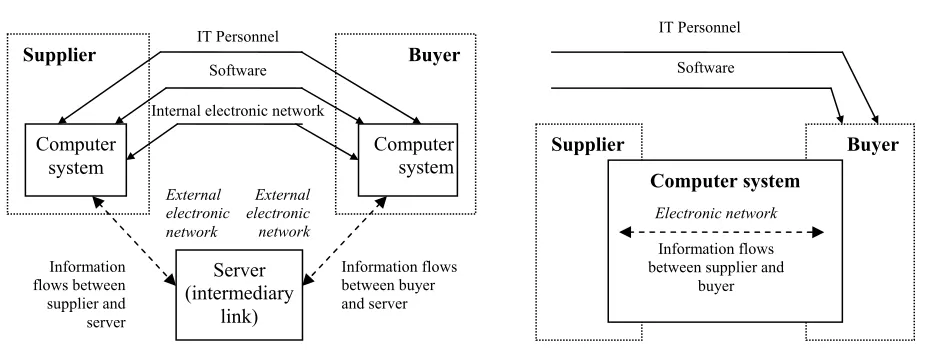
In the analysis of e-commerce functionality realisa-tion in technological aspect, it is important to notice that the technological equipment that company has is only a part of the necessary information technologies network, whose level of spread determine the popularity of e-commerce. In the case of technological aspect F.Cacheda (2002) presents two types of e-commerce functioning. In the first case (figure 1) the direct relation between the seller and buyer is very week, because information is transmitted through the intermediary link (server), which can be treated as database, working independently from buyer or seller.
Other situation appears in the case of direct contact between seller and buyer.
In this case it is important to ensure the compatibil-ity between buyer’s and seller’s e-commerce techno-logic equipment, because this technotechno-logic equipment, which is used for e-commerce transactions execution, can be treated as entire computer system with integrated electronic network that connects buyer’s and seller’s systems.
F.Cacheda (2002) states that in the case of such inte-gration it is important to ensure the compatibility of soft-ware and integrity of computer systems. B.R.Katzy (2002) in this situation accents that compatibility does not mean the need of the same software or technological system use, but it is important to ensure the reciprocity of different systems (i.e. the seller and buyer can use differ-ent software, but it is necessary to ensure that those types of software would recover identical information).
Figure 1. E-commerce technological system: two possible cases (Cacheda, 2002)
The thorough analysis of the presented possible tech-nological systems of e-commerce allows stating that there are two different viewpoints in case of e-commerce envi-ronment analysis. The main differences between those two possibilities, presented in figure 1, are the relation with the regular business environment elements. If busi-ness-to-business e-commerce is implemented using direct contact, then the effect of economic, political, cultural, etc. environment components on e-commerce transac-tions is minimal. This situation appears because of close relations between business-to-business e-commerce users, avoiding third parties’ participation in transactions. But in case of intermediary link such an effect becomes more important, because the relation between e-commerce partners is not so close and partly indirect.
So, it can be stated, that in case of business-to-business e-commerce decisions realization, the more at-tractive alternative is the use of e-commerce technologi-cal system, based on direct contact.
In the analysis of business-to-business e-commerce environment elements identifying problem it is important not to concentrate only on technological environment, because it is not the only important environment compo-nent in e-commerce decisions area. It is important to identify the main components of micro- and macro- e-commerce environment.
Micro- and macro- economic environment The analysis of business-to-business e-commerce performance environment it is important to assess micro- and macro- economic changes, which are conditioned by the growing speed of e-commerce spread.
The very first e-commerce impact on business results is treated as the reduction of products or services prices. This means that the adoption of various e-commerce models has a big impact on competition level in market and the individual companies’ competition politics. This impact can be most clearly noticed in the market of digital or knowledge-based products (Coppel, 2000). The manufacturing of this type of products (i.e. software) is specific in the case of costs structure: the idea or creation of the very first product unit is related to quite big ex-penses, but marginal cost of product copies making is close to zero (Ash, 2003; Gopal, 2003; Tan, 2003) and usually consists only of package and distribution cost (Smith, 1999). This cost structure guarantees the obvious scale effect, so manufacturer must pay big attention to pricing politics, which could ensure the maximum bene-fit. The simplest decision in this situation is to produce as much as possible and to use the low-cost strategy. But most often the demand for products is limited, because customer almost always has few alternatives and most customers are not minded to choose the new product which requires practice to use it. This problem is espe-cially important in software sector, because every new program is related to new rules of usage and users are not minded to change their habits (Lamb, 2003). Besides, only in exceptional cases there is no analogous product in market, which could guarantee needed functions for cus-tomer.
The assessment of market situation allows stating that low-cost strategy is suitable only in exceptional cases, and this means that the creators of digital products must pay big attention to the formation of pricing poli-tics, which could guarantee the defraying of cost and the
Supplier Buyer
Software IT Personnel
Computer system
Information flows between supplier and
buyer
Electronic network
In case of direct contact
Supplier
Computer system
Buyer
Computer system
Server (intermediary
link)
External electronic network
External electronic network
Information flows between supplier and server
Information flows between buyer and server Software
Internal electronic network IT Personnel
receiving of profit. Such kind of companies often uses specific marketing politics – the emphasising of the main product or service. This decision ensures its desirability for various market segments (Coppel, 2000). For exam-ple, software can be segregated by quality levels: ease level, update frequency, technical services option, and customer interface complexity. In this case it is important to assess that in market there exists the limit of product segregation possibilities, which is conditioned by price competition.
So it can be concluded, that e-commerce, in which the main purpose of usage is cost economy, in the case of knowledge-based products it influences indirectly the rise of price competition (Meijers, 1999), and this is treated as a negative impact on the prospective benefit of e-commerce adoption.
E-commerce, which influences the most of com-pany’s performance processes, has impacts on comcom-pany’s personnel and entire labour market. J.Coppel (2000) states that the spread of e-commerce influences labour market and employment in direct and indirect ways.
The development of e-commerce creates the demand for specialists in e-business area, but has a big negative impact on the structure of labour market in case of quali-fication (Cattaneo, 2002; Davies, 2002). The spread of e-commerce conditions the decrease of labour demand in selling and supplying sectors (salespersons, cashiers, sup-ply managers, etc.). This situation appears because of partial automation of sell and supply processes. But it is also important to notice that e-commerce conditions the growing demand for information technologies specialists, who are able to maintain company’s information systems. The experts of “Databank Consulting” (1998) forecast that the growing spread of e-commerce will have the big-gest impact on those workplaces, whose goal function is information concentration, systematization and transition, i.e. insurance brokers, financial brokers, travel agencies.
OECD, analysing the spread of e-business, claims its impact on macro economic level (Scarpetta, 2000). It is stated that information and communication technologies (ICT) symbolize the technological change in economy, which overwhelms all sectors and long-term growth of productivity. In the scientific research of Australian Gov-ernment Department of Communications, Information technology and the Arts (199) it is evaluated that the main e-business impact on macro economics level may exceed 2.7 percent. The research of “Goldman Sachs” (2000) allows stating that long-term country’s gross do-mestic product (GDP) may rise up to 5 percent. These researches are based on positive e-business impact on maximum product output in market. But it is important to pay attention to the fact that presented researches are based on limited presumptions and it means that their results cannot be assessed without discussion. Presented results and the experience of companies show that in most developed countries (USA, Denmark, Australia, Norway, etc.) there dominates the opinion that labour productivity indicators are closely related to significant technological changes, though obvious proof of this fact does not exist (Coppel, 2000).
There also exists the opinion that the development of e-commerce may have an impact on economic cycle and
payoffs between economic subjects, and this, in turn, may influence country’s monetary politics. While the attributes of economic cycle use to change, there exists the need to guarantee efficient inventory management, which would ensure lower level of average inventory in the sector. Such an impact would change the cycle of inventory accumulation. Besides, in case of growing price competition level in product markets there would be more workspaces, and the level of inflation would slow the growing speed for a short time. It is also important to notice that monetary politics would be influenced by faster payoff in case of information technologies usage. Faster payoffs would create the problem for principles of interest rate and frequency (Friedman, 1999).
The essential elements of business-to-business e-commerce environment
Business-to-business e-commerce is closely con-nected to various elements of economic environment, but the summarization of different opinions of the authors (Messnarz, 2000; Van Roessler, 2000; Scarpetta, 2000; Friedman, 1999) allows stating that the main factors that influence business-to-business e-commerce performance most of all are:
• Industry sector.
• Company size.
• Internationalism.
Industry sector, where company performs, has a huge impact on cost economy, if e-commerce model is used. D.Gazzotti (201) states that individual industry sec-tors create different changes to reach cost economy in case of using information technologies, so company must more clearly evaluate the particularity of industry from this point of view.
The suitability of industry sector mostly depends on the number of participators and their relationships. For example, in the sector of mining there is a limited amount of large participators, which have detailed information about other subjects in this industry sector and situation in market, so in this sector the impact of e-commerce, treated as the possibility to get more detailed information, is minimal. But in flight tickets sector, as D.Gazzotti (2001) states, the information plays one of the main roles. Com-plete information in this sector is rare, because there are no participants, who would have detailed information about all processes in the market and competitors’ performance.
It can be stated that the biggest possibilities to reach cost economy, using business-to-business e-commerce model, can be found in an ideal competition market, and the lowest possibilities appear in monopoly or oligopoly. This means that in case of e-commerce practical adoption possibilities it is important to assess the concentration of industry sector. Because e-commerce radically reduces information asym-metry, it can be noticed that business-to-business e-commerce generates bigger benefit in ideal competition situation than in monopoly (Mayer-Guell, 2001).
performance. For example, information technologies are more often used in computer technique trading companies than, lets say, by building materials manufacturers. This statement is illustrated by statistical data from USA in-dustry, which characterize the internet business-to-business commerce spread by types of industry sectors (figure 2). Statistical data show that business-to-business e-commerce is most often noticed in computer and tele-communication equipment, aeronautics, and defense sec-tors, where companies often confront the newest informa-tion technologies.
29 31
39 45
48 53
58 67
71
100
0 20 40 60 80 100
Food Construction Textile Publishing Machinery Tourism Automotive Pharma Aeronautics IT services
% of companies using e-commerce
Figure 2. The spread of e-commerce in European countries
(EU-7) in 2005 (E-Business Watch, 2005)
Company size is also an important factor, which in-fluences the success of business-to-business e-commerce model adoption. It is stated that e-commerce ensures big-ger benefit for bigbig-ger companies. This proposition is ori-ented to the possibilities of personnel amount reduction, adopting e-commerce decisions. It is clear that in small company, where supply and resources management func-tions are realized by one employee, the positive impact of e-commerce adoption for personnel amount reduction would not exist, because in any case one employee would have to work. It is also important that the adoption of in-formation technologies would require additional specialist, responsible for the maintenance of information technolo-gies. In this case small company would experience loss.
In big companies there are a lot of employees in sup-ply and resources management area, so e-commerce al-lows reducing the number of personnel in these ways (Stich, 2002):
• Order submission becomes less labor-intensive, so the needed number of people, working in order processing area reduces.
• As it has been mentioned above, e-commerce cre-ates the possibility to lower the level of average inventory. This means the reduction of warehouse workers demand.
• Smaller warehouse (in case of average inventory reduction) conditions the lower supply on support-ing workers.
It is hard to define the suitable company size for e-commerce adoption, because this criteria depends on various, not interdependent, factors: company’s perform-ance nature; complexity of supply system; organizational management structure, etc. K.Tarabanis (2000) states that competitors of even almost the same size, performing in the same market and making analogous products, can have different possibilities to adopt e-commerce model, depending on companies’ supply politics (that are the principles for suppliers choice – is it only cost, or also long-term partnership, quality, etc.), personnel politics (if there are strong trade-union, the e-commerce impact on personnel amount may be minimal).
Internationalism is significant element of business-to-business e-commerce environment in geographical aspect, analysing communication barriers of different countries. These barriers, as K.Tarabanis (2000) accents, appear because of these reasons:
• The cost of communication. Using traditional com-munication channels – phones, faxes, etc. – the big impact on communication cost is procured by call prices, which depend on the country. For example, if the supplier of Lithuanian company is in Lithua-nia, then communication costs would be several times lower than in that case, when the supplier is, let’s say, in Sweden or Italy. The usage of infor-mation technologies makes communication cost lower and equal, without reference to the geo-graphical distance between partners. It is impor-tant to mention, that the usage of electronic com-munication channels (i.e. internet) are cheaper than in the case of traditional communication in-struments usage.
• Language and cultural barriers. In international business, in case of using traditional communica-tion channels (most often – phones), there exists one very important aspect – language. Buyer must understand seller’s language and vice versa. In any situation, there appears additional cost, related to higher salary for the employee, who speaks for-eign language. If, let’s say, company has suppliers in Turkey, there appears the problems of finding the worker, who could speak Turkish and would have needed experience in products supply man-agement. Also it is important to mention, that in the case of communication using phone, there ex-ists the possibility of cultural barriers (unaccept-able phrases that may insult partner), which may have big impact for further partnership. If partners use information technologies, orders are presented in digital shape and can be transformed to national language for seller and for buyer, without refer-ence to the order execution language.
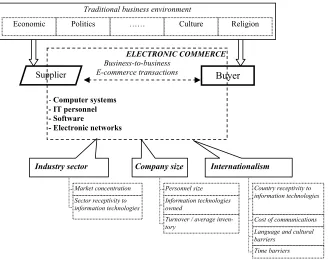
The summarizing analysis of essential business-to-business e-commerce environment components is pre-sented in figure 3. In this figure there are showed all main environment elements, which were described in this arti-cle as the most important for business-to-business e-commerce decisions realization.
It can be noticed, that the main external components,
that affect business-to-business e-commerce adoption in company, are already described in analysis of industry sec-tor, company size and internationalism. The main internal environment element is technology, which allows using e-commerce decisions. As stated above, technological envi-ronment can be described as the complex of computer sys-tems, IT personnel, software and electronic networks.
Figure 3. The complex of business-to-business e-commerce environment components
The traditional business environment elements must also be identified and assessed while adopting e-commerce decisions in company. But, because of the close contact between e-commerce system users and lim-ited number of participators in e-commerce system, the basic business environment components, such as eco-nomic, political, cultural, etc factors, have much higher impact on e-commerce system parties (buyer or seller), but not on e-commerce system. So it can be concluded, that traditional business environment elements have partly indirect impact on e-commerce decisions adoption. For this reason those elements should not be treated as the main elements, because in most cases they can be described as only a secondary matter in e-commerce sys-tem. This statement is proved by empirical research, dis-cussed below.
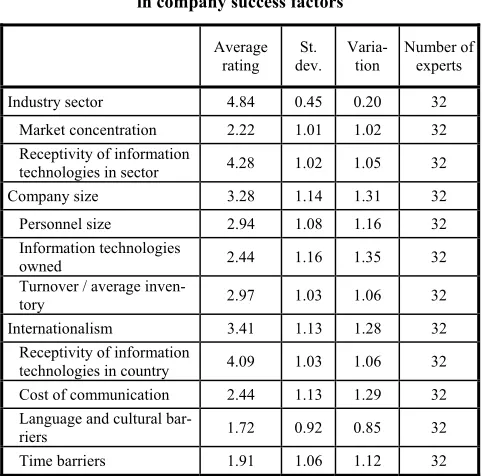
The empirical assessment of essential business-to-business e-commerce environment elements The proof of importance of presented essential busi-ness-to-business e-commerce environment elements for e-commerce evolution is given in empirical research, made by the authors of this article in the autumn of 2004. The research was made by surveying e-commerce experts in the form of advanced interview method. The opinions are measured in 5 points scale, where 5 is equal to very big impact and 1 means very small impact on e-commerce adoption in company success.
The results of this survey, presented in the table, al-low stating that the biggest impact on e-commerce adop-tion in company success is made by industry sector factor (the average rating is 4.84 point in the given points scale, which can be treated as a very big impact). This impact is evidenced mostly in the case of industry sector receptiv-ity to information technologies (average rating 4.28 points) and market concentration (2.22 points).
Company size and internationalism, which are the other two elements for e-commerce adoption in company success, are treated by experts as less important (average rating is accordingly 3.28 and 3.41 points). The most im-portant factor in this group is different countries’ recep-tivity to information technologies (4.09 points), but other factors that should accent the importance of international-ism element, are treated as not very important: the price of communication, language and cultural barriers and time barriers are rated as having quite small impact on e-commerce adoption in company success.
The coefficient of concordance (0.492, when critical minimal rating is 0.6) shows that opinions of surveyed experts are not absolutely united, so it is important to pay attention to the standard deviation and variance of each assessed factor. The evaluation of experts’ subjec-tivity, which was made by using Pearson’s correlation coefficient allows stating that presented results are rep-resentative (correlations of individual pairs of factors are less that 0.5, which means objectivity of survey re-sults).
Traditional business environment
Supplier Buyer
ELECTRONIC COMMERCE
Business-to-business E-commerce transactions
- Computer systems - IT personnel - Software
- Electronic networks
Industry sector
Market concentration Sector receptivity to information technologies
Company size
Personnel size Information technologies owned
Turnover / average inven-tory
Internationalism
Cost of communications Language and cultural barriers
Time barriers Country receptivity to information technologies
Table The importance of e-commerce adoption
in company success factors
Average rating
St. dev.
Varia-tion
Number of experts
Industry sector 4.84 0.45 0.20 32 Market concentration 2.22 1.01 1.02 32 Receptivity of information
technologies in sector 4.28 1.02 1.05 32 Company size 3.28 1.14 1.31 32
Personnel size 2.94 1.08 1.16 32 Information technologies
owned 2.44 1.16 1.35 32 Turnover / average
inven-tory 2.97 1.03 1.06 32
Internationalism 3.41 1.13 1.28 32 Receptivity of information
technologies in country 4.09 1.03 1.06 32 Cost of communication 2.44 1.13 1.29 32 Language and cultural
bar-riers 1.72 0.92 0.85 32 Time barriers 1.91 1.06 1.12 32
Presented results of empirical research confirm the theoretical presumptions about the importance of essen-tial business-to-business commerce elements for e-commerce adoption in business success. This allows con-cluding that in the case of e-commerce adoption in the company, it is important to assess the possible external sources of influence to e-commerce decisions efficiency, that are based on three essential e-commerce environment elements: industry sector, company size and internation-alism.
Conclusions
1. E-commerce systems generally are the subject of influence of traditional elements of business envi-ronment: economic, political, cultural, technologi-cal, etc. Nevertheless the research shows that business-to-business e-commerce models are mostly influenced by technological and economic factors, the other ones remaining of rather rela-tively smaller importance. The argument for em-phasizing the higher impact by economic and technological elements of environment is that within business-to-business e-commerce systems cultural, political and religious factors can be eliminated, because in standard business-to-business system there are a defined and usually limited number of parties involved. The fever par-ties involved, the higher chance to make consensus regarding minimizing the influence of such envi-ronment components that could be treated as an obstacle to fulfil the common interests, held by each party of business-to-business system.
2. The analysis of business-to-business e-commerce performance environment requires assessing mi-cro- and mami-cro- economic changes. This means that e-commerce environment is not limited to in-ternal company’s decisions, but it also is related to
external environment forces that cannot be con-trolled by e-commerce decisions adopters. Analy-sis of various authors’ researches allows conclud-ing that e-commerce spread in business has impact on these economic aspects: 1) competition level in the market and the individual companies’ competi-tion politics; 2) company’s personnel and entire labour market; 3) macro economic level (GDP amount); 4) economic cycle and payoffs. The most essential business-to-business e-commerce envi-ronment elements are as follow: 1) industry sector (the suitability of industry sector for business-to-business e-commerce development mostly depends on the number of participants and their relation-ships.); 2) company size (e-commerce ensures bigger benefit for bigger companies; this proposi-tion is oriented to the possibilities of personnel amount reduction, adopting e-commerce deci-sions); 3) internationalism (it is significant ele-ment of business-to-business e-commerce envi-ronment in geographical aspect, analysing differ-ent communication barriers of the members of various countries).
3. considering technological element of business-to-business e-commerce environment, it can be con-cluded that it consists of the following main com-ponents: 1) computer systems (this is the back-ground for information technologies, where the e-commerce system is formed); 2) electronic net-works (those netnet-works supplement computer sys-tems and create the possibility of e-commerce use by eliminating the distance factor); 3) software (the software is the instrument for e-commerce functionality realization). The parties of business-to-business system must address the mentioned technological issues as a second priority in order to identify the feasibility of business-to-business e-commerce project.
4. The empirical research of e-commerce environment elements impact on e-commerce adoption in com-pany success allows stating that the most important factors in this case are industry sector receptivity to information technologies (average rating 4.28 points) and market concentration (2.22 points). References
1. Alagar, V. An E-Commerce Architecture For Secure Transactions / V.Alagar, K.Y.Wan // E-Commerce: IADIS International Confer-ence, Portugal, 2004, p. 213 – 221.
2. Ash, C.G. eBusiness Transformation Matrix / C.G.Ash, J.M.Burn // Bled eCommerce Conference: eTransformation. Slovenia, Bled, 2003. 3. Australian Government Department of Communications, Information
technology and the Arts (1999). E-commerce Beyond. Canberra: Australian Government.
4. Benbunan-Fich, R. Effects of Web Traffic Announcements on Firm Value / Benbunan- R.Fich, E.M.Fich // International Journal of Elec-tronic Commerce, Vol. 8, No 04, 2004, p. 161 – 183.
5. Bogdanovych, A. E-Commerce Environments As 3D Electronic Institu-tions / A.Bogdanovych, H.Berger, S.Simoff, C. Sierra // E-Commerce: IADIS International Conference, Portugal, 2004, p. 237 – 244. 6. Cacheda, F. Performance evaluation of Web Information Retrieval
7. Cattaneo, G. Managing Socio-Economic Change in European Or-ganisations // Challenges and Achievements in Business and E-Work Contents: International Conference, Vol. 1, 2002.
8. Cavusoglu, H. The Effect of Internet Security Breach Announce-ments on Market Value: Capital Market Reactions for Breached Firms and Internet Security Developers / H.Cavusoglu, B.Mishra, S.Raghunathan // International Journal of Electronic Commerce, Vol. 9, No 01, 2004, p. 69 – 105.
9. Coppel, J. E-commerce: Impacts and Policy Challenges // Economics Department Working Papers, No 252, OECD, Economics Depart-ment, Paris, 2000.
10. Damaskopoulos, P. Toward a Network Topology of the Knowledge Economy: Organisational Passages from Knowledge to Innovation // eChallenges e-2003, Bologna, Italy, 2003.
11. Databank Consulting. Preliminary Estimates of the Multiplier Effects of Electronic Commerce on the EU Economy and Employment // FAIR Working Paper, No 47, 1998.
12. Davies, A.J. SMEs & eCommerce Forget what you think you know! / A.J.Davies, N.A.J.Heard // Challenges and Achievements in E-Business and E-Work Contents: International Conference, Vol. 1. 13. E-Business Watch. The European e-Business Report. 5005 edition //
Internet link: <http://www.ebusiness-watch.org/ re-sources/documents/eBusiness-Report-2005.pdf >, November 2005. 14. Friedman, B. The future of monetary policy: the central bank as an
army with only a signal corps? // International Finance (2:3), 1999, p. 16 – 23.
15. Gazzotti, D. WHALES: a Project Life-cycle Management Applica-tion for Extended OrganisaApplica-tions / D.Gazzotti, M.Palmirani, P.Paganelli // E-Work and E-Commerce, ISBN 1586032054, Am-sterdam: IOS Press, 2001, p. 23 – 29.
16. Goldman Sachs. The shocking economic effect of B2B // Global Economics Paper, No 37, 2000.
17. Gopal, R.D. Microproducts in a Digital Economy: Trading Small, Gaining Large / R.D.Gopal, R.Ramesh, A.B.Whinston // International Journal of Electronic Commerce, Vol. 8, No 02, 2003, p. 9 – 31. 18. Gupta, A. An Empirical Study of Consumer Switching from
Tradi-tional to Electronic Channels: A Purchase-Decision Process Perspec-tive / A.Gupta, B.Su, Z.Walter // International Journal of Electronic Commerce, Vol. 8, No 03, 2004, p. 131 – 149.
19. Ivezic, N. A Manufacturing B2B Interoperability Testbed / N.Ivezic, B.Kulvatunyou, A.Jones // eChallenges e-2003, Bologna, Italy, 2003. 20. Katzy, B.R. Reference Architectures for Virtual Organisations –
Towards a State-of-the-Art Compendium on European Developments / B.R.Katzy, V.I.Horodyskiy // Challenges and Achievements in E-Business and E-Work Contents: International Conference, Vol. 1, 2002.
21. King, R.C. Impact of Web-based e-Commerce on Channel Strategy in Retailing / R.C.King, R.Sen, M.Xia // International Journal of Electronic Commerce, Vol. 8, No 03, 2004, p. 103 – 131.
22. Krishnan, M.S. Quality Dimensions in E-Commerce Software Tools: An Empirical Analysis of North American and Japanese Markets / M.S.Krishnan, R.Subramanyam // Journal of Organizational Comput-ing and Electronic Commerce, Vol. 14, No 4, 2004, p. 223 – 241. 23. Krüger, C.C. Business Model Formation within the Online News
Market: The Core + Complement Business Model Framework / C.C.Krüger, P.M.C.Swatman, K. van der Beek // Bled eCommerce Conference: eTransformation. Slovenia, Bled, 2003.
24. Lamb, R. Intranet Boundaries as Guidelines for Systems Integration // International Journal of Electronic Commerce, Vol. 7, No 04, 2003, p. 9 – 37.
25. Laudon, K.C. E-commerce: Business. Technology. Society / K.C.Laudon, C.G.Traver. – USA: Addison Wesley, 2004.
26. MacInnes, I. Business Models for Peer to Peer Initiatives / I.MacInnes, J.Hwang // Bled eCommerce Conference: eTransforma-tion. Slovenia, Bled, 2003.
27. Martin, J. Information Engineering, Book II: Planning and Analysis. Eaglewood Cliffs, NJ: Prentice-Hall, Inc, 1990.
28. Mayer-Guell, A.M. Business-to-Business Electronic Commerce // Management Communication Quarterly 14(4), 2001, p. 2 – 14. 29. Meijers, H. Low inflation in the information economy and the role of
internet. Groningen: Internet economics workshop, 1999.
30. Messnarz, R. The Victory Project – A Virtual Enterprise for SPI / R.Messnarz, M.Biro, G.Velasco, G.O'Suilleabhain // Proceedings of the EuroSPI 2000 Conference, Copenhagen Business School, 2000. 31. Oracle. E-Business Suite // Verslo žinios, priedas, 2004 sausio 12 d., p. 1. 32. Scarpetta, S. Economic Growth in the OECD Area: Recent Trends at
the Aggregate and Sectoral Level // OECD working paper, 2000. 33. Šertvytis, R. Elektroninė komercija tampa reiškiniu // Verslo žinios,
2004 spalio 14 d., p. 1,5.
34. Smith, M. Understanding digital markets: review and assessment / M.Smith, J.Bailey, E.Brynjolfsson. USA: MIT Press, 1999.
35. Stich, V. Decision Support for improvement of logistics performance in production networks / V.Stich, M.Weidemann // Challenges and Achievements in E-Business and E-Work Contents: International Conference, Vol. 1, 2002.
36. Tan, Y. Electronic Contract Drafting Based on Risk and Trust As-sessment / Y.Tan, W.Thoen // International Journal of Electronic Commerce, Vol. 7, No 04, 2003, p. 55 – 73.
37. Tarabanis, K. Towards an Enterprise Architecture for Public Admini-stration: A Top Down Approach / K.Tarabanis, V.Peristeras // Euro-pean Journal of Information Systems, No 9, 2000, p. 12 – 23. 38. UWA Consortium. Ubiquitous Web Applications // Challenges and
Achievements in E-Business and E-Work Contents: International Conference, Vol. 1, 2002.
39. Van Roessler, E. B2B e-Commerce: Open Standards for Interoper-able ecatalogues / Van E.Roessler, P.Kesteloot, P.Howgate // The Proceedings of the e2000 Conference, 2000.
Tadas Šarapovas, Aurelijus Cvilikas
Verslas-verslui elektroninės komercijos aplinkos elementų identifi-kavimo problemos
Santrauka
Verslas-verslui elektroninė komercija vis labiau įsigali į vairiuo-se verslo vairiuo-sektoriuovairiuo-se. Tiriant verslas-verslui elektroninės komercijos diegimo verslo galimybes ir formas, būtina išanalizuoti elektroninės komercijos aplinkos elementus ir jųįtaką verslas-verslui elektroninės komercijos modelio funkcionavimui.
Tyrimo tikslas – nustatyti ir įvertinti esminius verslas-verslui elektroninės komercijos aplinkos elementus.
Viena iš esminių prielaidų elektroninei komercijai diegti – tinka-ma technologinėįranga, kurios bazėje elektroninė komercija yra reali-zuojama. Technologijų struktūros požiūriu išskiriami šie pagrindiniai elektroninės komercijos elementai įmonės atžvilgiu: 1) kompiuterinės sistemos (tai informacinių technologijų realizavimo terpė, kurioje for-muojama elektroninės komercijos sistema); 2) elektroniniai tinklai (šie tinklai papildo kompiuterines sistemas ir sukuria elektroninės komerci-jos naudojimo galimybę, eliminuojant erdvės veiksnį); 3) programinė įranga (tai priemonė elektroninei komercijai realizuoti).
Be to, elektroninės komercijos diegimas ir palaikymas tiesiogiai susijęs su informacinių technologijų specialistų poreikiu. Informaci-nių technologijų diegimas reikalauja specialių žinių, todėl informaci-nių technologijų specialistai yra paklausūs visuose ūkio sektoriuose. Spartus informacinių technologijų tobulėjimas ir jų pritaikymo gali-mybiųįvairovė sąlygoja kaštus, susijusius su informacinių technolo-gijų darbo apmokėjimu. Elektroninės komercijos sistemų diegimas reikalauja daug kvalifikuoto darbo, todėl darbo užmokesčio sąnaudos yra vienas svarbiausių elektroninės komercijos diegimo kaštų kom-ponentų. Kaip papildomus elektroninės komercijos diegimo darbus galima akcentuoti elektroninės komercijos sujungimą su esama prekių
apskaitos sistema; elektroninės komercijos marketingą; atsiskaitymų
per internetą integravimąį elektroninę komerciją.
-jimo tarp tarnybinės stoties ir pirkėjo/pardavėjo galimybę. Kitu atveju pirkėjas su pardavėju kontaktuoja tiesiogiai. Čia svarbu užtikrinti pirkėjo ir pardavėjo turimų technologijų suderinamumą, kadangi informacinių technologių kompleksą, naudojamą tarpusavio elektro-ninės komercijos transakcijoms vykdyti, galima traktuoti kaip vienti-są kompiuterinę sistemą, į kurią integruotas elektroninis tinklas, jun-giantis partnerių turimas technologijas. Siekiant tokios integracijos, svarbus programinės įrangos tarpusavio suderinamumas bei kompiu-terinės sistemos vientisumas.
Tiriant verslas-verslui elektroninės komercijos funkcionavimo aplinką, svarbu įvertinti mikro- bei makro- ekonominius pokyčius, kuriuos lemia didėjantys elektroninės komercijos plitimo tempai.
Kadangi dažniausiai kaip pirminis elektroninės komercijos po-veikis išskiriamas prekių ar paslaugų kainų sumažėjimas, tai akivaiz-du, jog įvairių elektroninės komercijos modelių diegimas turi didelę įtaką konkurencijai rinkoje bei atskirų įmonių konkurencijos politi-kai. Ši įtaka ryškiausiai pastebima analizuojant „skaitmeninių“ arba naudojant žinias sukurtų produktų rinkoje. Šio tipo prekių gamyba išsiskiria kaštų struktūra – idėjos ir pirmosios prekės kopijos sukū ri-mas sąlygoja dideles išlaidas, tačiau ribiniai prekės kopijų kūrimo kaštai yra artimi nuliui ir paprastai apima tik pakuotės ir paskirstymo išlaidas. Ši kaštų struktūra garantuoja akivaizdžią masto ekonomiją, todėl gamintojas turi skirti didelį dėmesį kainodaros politikai, kuri jam užtikrintų maksimalią naudą. Dažnai tokio tipo įmonių naudoja-ma kainodaros politika – pagrindinės prekės ar paslaugos išskyrimas, kas užtikrina jos patrauklumąįvairiems rinkos segmentams. Elektro-ninė komercija, kurios pagrindinis naudojimo tikslas yra kaštų eko-nomija, skaitmeninio formato prekių atveju netiesiogiai rinkoje didi-na kainų konkurencijos tikimybę, o tai mažina iš elektroninės komer-cijos diegimo laukiamą naudą.
Elektroninė komercija, darydama poveikį didžiajai daliai įmonės veiklų, turi įtakos ir įmonės personalui, taip pat ir visai darbo rinkai. Elektroninės komercijos plėtra veikia darbo rinkas ir užimtumą tiek tiesiogiai, tiek ir netiesiogiai. Elektroninės komercijos vystymasis sukuria darbo jėgos paklausą elektroninio verslo sferoje, tačiau turi didelę neigiamąįtaką darbo rinkos struktūrai kvalifikacijos požiūriu. Plėtojantis elektroninei komercijai, mažėja pardavimo ir tiekimo srityse dirbančio personalo poreikis, susijęs su daliniu šių procesų
automatizavimu, tačiau didėja poreikis informacinių technologijų
specialistų, galinčių prižiūrėti įmonės informacines sistemas. Ekonominės kooperacijos ir vystymo organizacija, skirdama di-delį dėmesį elektroninio verslo plėtros analizei, pripažįsta jo poveikį
makroekonominiu lygmeniu. Teigiama, jog informacinės ir komuni-kacinės technologijos simbolizuoja technologinį pokytį ekonomikoje, apimantį visus sektorius, ir ilgalaikį našumo augimą.
Be to, kai kas mano, jog elektroninės komercijos raida gali turėti poveikį ekonomikos cikliškumui ir atsiskaitymams tarp ūkio subjek-tų, o tai savo ruožtu gali paveikti monetarinę politiką. Kintant eko-nomikos cikliškumo bruožams, atsirastų poreikis efektyviau valdyti atsargas, o tai lemtų vidutinių atsargų sektoriuje mažėjimą. Tai pa-veiktų atsargų kaupimo ciklą. Be to, produktų rinkose padidėjus kai-nų konkurencijai, pramonės sektoriuje būtų išlaikoma daugiau darbo vietų, o infliacijos augimas trumpam sulėtėtų.
Verslas-verslui elektroninė komercija glaudžiai susijusi su į vai-riais ekonominės aplinkos elementais, tačiau, kai kurių autorių teigi-mu, elektroninės komercijos poveikio stiprumui didžiausios įtakos turi šie aplinkos veiksniai: 1) pramonės sektorius; 2) įmonės dydis; 3) tarptautinis aspektas.
Pramonės sektorius, kuriame veikia įmonė, turi didelę reikšmę
siekiant kaštų ekonomijos, taikant verslas-verslui elektroninės ko-mercijos modelį. Skirtingose pramonės šakose yra skirtingos galimy-bės siekti kaštų ekonomijos naudojant informacines technologijas, todėl įmonė turi tiksliai įvertinti šakos specifiškumą šiuo atžvilgiu. Pramonės sektoriaus tinkamumas daugiausia priklauso nuo dalyvių
skaičiaus ir jų tarpusavio santykių. Didžiausios galimybės pasiekti kaštų ekonomiją taikant verslas-verslui elektroninės komercijos mo-delį yra tobulos konkurencijos rinkoje, o mažiausios – monopolinėje ar oligopolinėje rinkoje, todėl, siekiant įvertinti elektroninės komerci-jos pritaikymo galimybes, reikia atsižvelgti į pramonės sektoriaus koncentraciją. Kadangi elektroninė komercija radikaliai mažina in-formacijos asimetriją, tai tobulos konkurencijos rinkoje elektroninės komercijos modelio diegimas sąlygoja didesnę naudą įmonei nei monopolijos atveju. Elektroninės komercijos modelio diegimo sėkmė
priklauso ir nuo pramonės sektoriaus imlumo modernioms informaci-nėms technologijoms. Jeigu sektoriaus įmonės nuolat tiesiogiai susi-duria su tokiomis technologijomis, jos labiau linkusios įdiegti šias sistemas ir savo veikloje.
Įmonės dydis taip pat yra svarbus veiksnys, lemiantis elektroni-nės komercijos modelio pritaikymo įmonės veikloje sėkmę. Laikoma, jog elektroninė komercija naudingesnė didesnėms įmonėms. Šis tei-ginys orientuojamas į personalo skaičiaus mažinimo galimybes, į die-gus elektroninės komercijos modelį. Akivaizdu, jog mažoje įmonėje, kurioje tiekimo ir išteklių valdymo srityje dirba vienas darbuotojas, verslas-verslui modelio diegimas teigiamos įtakos personalo skaičiui neturės – vienas darbuotojas šiaip ar taip turės dirbti, be to, įdiegus informacinių technologijų sistemą, įmonei gali tekti priimti naują
darbuotoją, atsakingą už šių technologijų priežiūrą. Todėl įmonė
personalo skaičiaus atžvilgiu patirtų tik nuostolį. Elektroninei komer-cijai tinkamąįmonės dydį vienareikšmiškai nusakyti sunku, kadangi šis dydis priklauso nuo įvairių tarpusavyje mažai susijusių veiksnių. Netgi panašaus dydžio konkuruojančiųįmonių, veikiančių toje pač io-je rinkoio-je ir gaminančių analogiškas prekes, galimybės įdiegti elekt-roninės komercijos modelį gali būti skirtingos, atsižvelgiant į šių įmonių tiekimo politiką ir personalo politiką.
Tarptautinis aspektas yra reikšmingas geografiniu požiūriu, t.y. vertinant skirtingų valstybių atstovų komunikavimo barjerus. Šie barjerai susidaro dėl kelių priežasčių: 1) komunikavimo kaina (nau-dojant tradicinius komunikavimo kanalus – telefonus, faksus ir kt. – komunikavimo kaštams didelęįtaką turi pokalbių kainos,
priklausan-čios nuo to, į kurią valstybę skambinama; informacinių technologijų
pagalba komunikavimo kaina tampa vienoda, nepriklausomai nuo geografinio bendradarbiaujančių šalių atstumo; be to, elektroniniai komunikavimo kanalai lemia gerokai mažesnę suminę komunikavimo kainą, nei įprastinės komunikavimo priemonės); 2) kalbiniai ir kultū -riniai barjerai (naudojant įprastinius komunikavimo kanalus, svarbus tampa kalbinis aspektas; todėl patiriama papildomų kaštų, susijusių
su didesniu darbo užmokesčiu darbuotojui, mokančiam reikalingą
užsienio kalbą; naudojant informacines technologijas, užsakymai keliauja skaitmeniniu pavidalu ir gali būti tiek įmonei, tiek tiekėjui pateikti nacionaline kalba, nepriklausimai nuo to, kokia kalba jie buvo įforminti); 3) laiko barjerai (jeigu įmonę ir jai reikalingų prekių
tiekėjus skiria dideli atstumai, tai atsiranda sunkumų tiesioginiam komunikavimui užtikrinti; elektroninės komercijos atveju užsakymai gali būti pateikti bet kuriuo paros metu, nepriklausomai nuo to, ar tiekėjas tuo metu dirba, ar ne).
Raktažodžiai: verslas-verslui elektroninė komercija, verslo aplinka, elektro-ninės komercijos aplinka.
The article has been reviewed.